FUNDAÇÃO GETULIO VARGAS
ESCOLA DE ECONOMIA DE SÃO PAULO
MALTE JULIAN NOWACK
THE ESTABLISHMENT MODE CHOICE OF GERMAN MULTINATIONAL ENTERPRISES IN BRAZIL – A COMPARATIVE APPROACH
MALTE JULIAN NOWACK
THE ESTABLISHMENT MODE CHOICE OF GERMAN MULTINATIONAL ENTERPRISES IN BRAZIL – A COMPARATIVE APPROACH
Dissertação apresentada à Escola de Economia de São Paulo da Fundação Getulio Vargas, como requisito para obtenção do título de Mestre em Economia.
Campo de conhecimento: Finanças
Orientador: Professora Mayra Ivanoff Lora
Nowack, Malte Julian
The Establishment Mode Choise of German Multinational Enterprises in Brazil – A Comparative Approach / Malte Julian Nowack. - 2014
38 f.
Orientador: Mayra Ivanoff Lora
Dissertação (MPFE) - Escola de Economia de São Paulo. 1. Establishment Mode Choice. 2. Hidden Champions. 3.
Internationalization Germany Brazil. I. Lora, Mayra Ivanoff. II. Dissertação (MPFE) - Escola de Economia de São Paulo. III. Título.
MALTE JULIAN NOWACK
THE ESTABLISHMENT MODE CHOICE OF GERMAN MULTINATIONAL ENTERPRISES IN BRAZIL – A COMPARATIVE APPROACH
Dissertação apresentada à Escola de Economia de São Paulo da Fundação Getúlio Vargas, como requisito para obtenção do título de Mestre em Economia.
Campo de conhecimento: Finanças
Data de Aprovação
___/___/______
Banca Examinadora:
Professora Mayara Ivanoff Lora FGV-EESP
Professor Daniela Vaz UNIFESP
ABSTRACT
We examine the drivers behind the establishment mode choice of German multinational enterprises (MNEs) in the sectors of Automotive, Chemicals and Mechanical Engineering in Brazil for the years 1993-2013 using a novel sample of primary data obtained directly from German MNEs. Based on prevalent theories found in the literature, we test the most common hypotheses on our sample. Firms with high R&D activities and firms with prior market knowledge in Brazil in from of previous sales offices are more likely to enter Brazil by a Greenfield investment. We also show that it is the specific private ownership of the German so-called hidden champions that drive those specific SMEs to enter Brazil by Greenfield, a sneaking suspicion that has been made before. Finally, we show that the establishment mode choice between Brazil and the USA only deviates to a low extent, with German MNEs preferring to enter Brazil by Greenfield and the USA by M&A. Thereby, we provide valuable insights for future research in this field.
LIST OF TABLES
Table I - Yearly distribution and type of market entry in Brazil (1993-2013)...17
Table II - Distribution of Industries of German MNEs entering Brazil (1993-20139..17
LIST OF CHARTS
CONTENTS
1. INTRODUCTION ... 11
2. LITERATURE REVIEW ... 13
4. SAMPLE DESCRIPTION ... 15
5. METHODOLOGY ... 18
4.1 Dependent Variable ... 18
4.2 Independent Variables ... 18
4.2.1 Transaction Cost Theory ... 18
4.2.2 M&A Theory ... 20
4.2.3 Organizational Learning Perspective ... 21
4.2.4 Institutional Organization Perspective ... 22
4.2.5 Hidden Champions and other theories ... 25
4.3 Statistical Method ... 26
6. CONCLUSION ... 32
7. REFERENCES ... 34
11
1. INTRODUCTION
Multinational enterprises (MNEs) wanting to internationalize can enter foreign countries in a wide range of different modes with each one implying different strategic rationales, which is why it is a commonly discussed topic in the scientific literature. Apart from contractual modes like, for example, licensing and direct exports, these modes generally vary between investment modes (greenfield (GF), merging with or acquiring an existing firm (M&A)) and ownership modes, where firms decide whether to enter via a wholly owned subsidiary (WOS, full ownership) or a joint venture (JV, partial ownership).1
This paper will deal with the choice of the so-called establishment mode that is the decision to enter the foreign country via a Greenfield vs. M&A, hence belonging to the study area of the investment modes.2 This topic has also been widely discussed in the literature so far, however, according to Slangen & Hennart (2007), with inconsistent findings, which is partly due to the research design employed. Most scholars either test their hypotheses on firms from various home countries, from firms entering in various host countries or both. This approach may be biased in various
forms as, for example, the MNE’s national origin can play a role or the difficulty to
finely measure the impact of government restrictions on the establishment choice3 (Gomes-Casseres, 1990). This paper will hence try to avoid most of these drawbacks of multiple home/host-countries by primarily focusing on the establishment mode choice of German MNES in Brazil.
The paper will be organized as follows: In a first step, the drivers behind the establishment mode choice of German companies in Brazil on the basis of some of the most common hypotheses found in literature will be analyzed. In a second step, the sample will be restricted to only those German firms that entered Brazil and the US in the same period in order to assess potential deviation in the drivers behind the establishment mode choice. The focus then shall be on trying to analyze potential drivers behind the deviation in the establishment mode choice.
1 For more details please see Hebous and Ruf (2010) and Brouthers and Hennart (2007).
12 A final remark is worthwhile making. In contrast to many other studies in this field, the analysis in this paper is based on primary data obtained from mainly private companies, belonging to the so-called German Mittelstand and introduced as
13
2. LITERATURE REVIEW
The studies of international entry modes state one of the most popular studies in the field of international management (Canabal & White III, 2008). Some of the earliest scholars in this field started by arguing that MNEs face the important strategic decision of whether the involvement in a foreign country should be increased or not (the so-called Uppsala Model (Johnson & Vahlne, 1977)), i.e. if accumulated market knowledge in form of exports gradually leads to a market entry (exporting vs. FDI). For many years, the entry mode was then seen as an unilateral choice made by the MNE based on the trade-off between the degree of risk-averseness and the preference of control in the foreign subsidiary (Anderson & Gatignon, 1986). These theories argue that a firm in order to succeed in a foreign market needs to combine two kinds of assets, i.e. firm-specific advantages and country-specific advantages such as, for example, the availability of inexpensive labor. However, Hennart (2009) argued that this rationale is based on the assumption that those assets are freely accessible to the MNEs, which in many cases may not be true. In fact, Sheng & Pimenta (2012) showed, when analyzing the drivers behind the market entry of US-based MNEs in Brazil, that the local market characteristics have a significant impact on the entry mode.
Most of the entry mode literature has treated US- and Japanese based MNEs with entries in multiple host countries, which were also mainly listed companies publishing public annual reports. Regarding empirical studies focusing emerging markets, many studies have put their focus on those countries belonging to the transitioning economies of Central and Eastern Europe (Witteloostuijn & Dikova, 2004; Meyer,
2001; Nakos & Brouthers, 2002). Also, these studies’ samples are mainly comprised
14 establishment mode choice as of GF vs. M&A but on the entry mode choice in from of equity vs. non-equity models (WSO vs. JV).
Until today, only a few empirical studies of German MNEs are known. In one of the more recent ones, Hebous & Ruf (2010) examine the drivers behind the entry mode of German MNEs with a data set provided by the Bundesbank, which however only includes observations for the years 2005-2007 without focusing on any particular host country. Regarding Brazil as the sole host country, only a few studies are known (Sheng & Pimenta, 2012; Ogasavara & Hoshino, 2007). In the recent past it has rather been the case that entry mode decision from MNEs based in Brazil have been analyzed than the other way around (Sousa & Lengler, 2010; Carvalho, Costa & Duysters 2009; Aulakh, Rotate & Teegen, 2000).
Although in 2012 Germany was the 4th biggest foreign direct investor in Brazil with an estimated total of USD 3bn (E&Y, 2012), little is known about the drivers behind the establishment choice mode of German MNEs in Brazil. This is quite surprising as Germany has traditionally strong ties with the Brazilian economy4 with 2013/2014 marking the German-Brazilian year. Therefore, this study aims to provide some fundamental insights into the investing behavior of German MNEs in Brazil.
15
4. SAMPLE DESCRIPTION
The first part of the analysis is based on the establishment choices of German firms in Brazil for the years 1993 to 2013.5 The reason to use this time frame is based on two historic events. On the one hand, Germany was reunified in 1990, leading to a potential bias when considering greater time frames. On the other hand, in the early 1990s, Brazil underwent some significant changes in its business policy with respect to trade liberalization (Moreira & Correa, 1998). Hence again, a larger time frame might induce some bias to the sample.
The second part will be based on German companies that entered both Brazil and the USA in the same time period, namely 1993 to 2013. Following this line, we are able to compare the establishment mode choice of German companies having entered one of the places where it is the hardest to do business (Brazil, Doing Business rank 116 (World Bank, 20136)) and one of the easiest (USA, Doing Business rank 4) and in case of deviating establishment mode choices, try to detect the drivers that might lead to the deviation.
Market entry in this study is defined as having a production facility in the country, i.e. a serious commitment like, for example, in form a built factory in the case of a Greenfield investment. As a consequence, not all industrial sectors were included, but only the following three belonging to the sector of (industrial) manufacturing: Automotive (especially the suppliers), Chemicals and Mechanical Engineering. The reason for that is twofold: First, these three sectors are some of the most active sectors of the German economy and second, in these sectors an establishment can be clearly defined as having a production facility which in case of, for example, the service industry would me more difficult.
It is important to note that this study is almost entirely based on primary data. This is so because no available data of German companies with respect to their internationalization processes publicly exist. The data was collected from various sources. Regarding the small parts of secondary data, the Brazilian National Network
5 In a former version, the sample also included the years 1990-1993. However, no German company in the sample at hand entered Brazil in those years, which might support the hypothesis that the liberalization of the Brazilian economy had not made an impact on the
establishment of German MNEs until 1993.
16 of Investment Information (RENAI) was used as it provides information about green- and brownfield investments in Brazil – however only for the years 2004-2010. The respective German firms were checked in order to assess whether the by RENAI reported Greenfield investment states the establishment mode choice (as of first establishment in Brazil) or whether the firm had entered Brazil before, i.e. via an acquisition of an existing firm. Also, some of the most prevalent M&A databases were screened for German firms having bought Brazilian and U.S. companies. Again, the respective acquisitions were tested on their correctness by stating the primary establishment mode choice in Brazil and the USA. At last, the respective German associations and their membership lists were inquired in order to find more firms having established themselves in the USA and/or Brazil between 1993 and 2013. The great extent of privately owned firms7 in the sample, which, depending on their size in terms of employees and total assets, are not obliged to publish any data except a reduced version of their balance sheet, made a direct contact necessary in order to obtain the data required for the analysis later on. Sufficient response came only from those companies that entered Brazil or both Brazil and the USA, but not from those companies that only established themselves in the USA. As a consequence, an analysis was only possible then on the establishment mode of German firms in Brazil and German companies that entered both markets in the given period.8
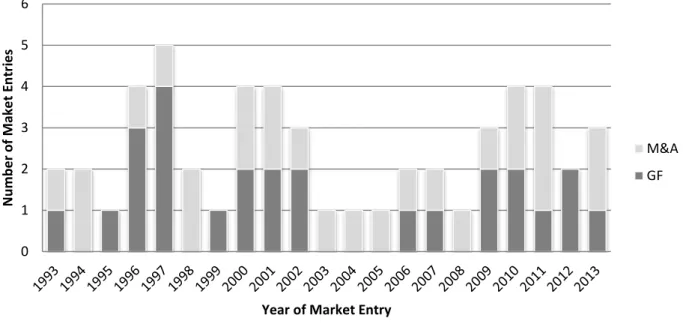
In total we were able to track the establishment choices of 55 German firms in Brazil operating in one of the three mentioned sectors Automotive, Chemicals and Mechanical Engineering l as well as 37 firms that entered both markets, Brazil and the USA. A histogram of the market entry is shown in Table 1 and an overview of the distribution with respect to the industrial sector in Table 2.
7 Called Gemeinschaft mit beschränkter Haftung (GmbH).
17 Table 1: Yearly distribution and type of market entry in Brazil (1993-2013)
Source: Own Elaboration
Table 2: Distribution of Industries of German MNEs entering Brazil (1993-2013)
Source: Own Elaboration
25%
36%
40% Automotive
Chemicals
Mechanical Engineering 0
1 2 3 4 5 6
N
u
m
b
e
r
o
f M
ake
t
E
n
tr
ie
s
Year of Market Entry
18
5. METHODOLOGY
4.1 Dependent Variable
The dependent variable used in this paper is a dichotomous variable that takes two values, i.e. 0 if M&A was the establishment mode choice taken and 1 if the entry was made via a Greenfield investment.
4.2 Independent Variables
With reference to the empirical literature on establishment mode choices, the independent variables, which will be used to test the hypotheses on the sample of German firms entering Brazil and/or the USA between 1993 and 2013, will be
presented according to their respective theory’s origin. These are: transaction cost
theory, M&A theory9, organizational learning perspective and hidden champions theory.
4.2.1 Transaction Cost Theory
Transaction cost theory states the most widely theory used in entry and establishment mode choice literature with appearance in 48 studies between 1980 and 2006 (Canabal & White III, 2008). Despite the existence of various versions, in the context of establishment mode choice research, the degree of efficiency of obtaining certain inputs is an important element when considering a certain establishment mode choice. Because of the lack of this efficiency, MNEs are often forced to internalize the costs associated with the required inputs (Slangen & Hennart, 2007). Due to acquisition premiums, which particularly are likely to arise in cross-country acquisitions and which come from the fact that the potential buyer may
19 not be able to fully assess the fair value (Arrow, 1962), some inputs may be tacit to a great extent.
This chain of thought has been transferred to distinguishing the market entry choice between Joint Ventures (JV) and and wholly-owned subsidiaries (WOS) as well as establishment mode choices, which is the scope of this paper. In this context, the theory predicts that the establishment mode is chosen, which has the lower costs associated with obtaining the required inputs.
A common and often very tacit input is firm-embedded technological knowledge, which in many cases is the root of a sustained success and an input that is very
costly to obtain on the markets (Poppo & Zenger, 1997). MNEs that don’t possess
theses skills, may be impelled to acquire these externally via (international) acquisitions since internal development mechanisms may be much more extensive with respect to time and cost (Wernerfelt, 1984). MNEs that have developed sufficient technological knowledge however, will find it more efficient to transfer their knowledge via Greenfield investments allowing them to implement their own production facilities (Andersson & Svensson, 1994). Hence having invested heavily in R&D should lead to an entry via GF which is why we expect the regression’s
coeffienct to be positive.
H1: Ceteris paribus, the higher the investments into R&D, the more likely MNEs enter by Greenfield
Since most of the MNEs in the obtained sample are not publicly listed, they are not obliged to publish any data revealing their expenses for R&D. As a proxy, the total number of registered patents divided by the sales of the year of the market entry was used. Although not a common approach, it entails some advantages, as total patents is a output-based measure whereas R&D expense states an input variable10.
Another tacit assets is the knowledge of how to successfully operate sustainably in the country, which especially in the case of Brazil is important due to the difficulty to make business in the country. Consequently, MNEs with low experience in making business in the host country may be inclined to obtain this necessary skill set via
20 M&A. This poses the most efficient way, since this Kind knowledge is primarily obtained from experience (Johnson & Valne, 1997) and hence costly in time.
H2a: Ceteris Paribus, the more experience the MNE has in making business in the host country, the more likely it will enter by Greenfield.
Since this study is about the establishment choice mode, this hypothesis will be tested via a dummy variable that shows 1 for the cases the respective MNE had some kind of a local presence (i.e. a sales office) in the country before. Similarly, we will also introduce the hypotheses that MNEs already having entered in another Latin American country will contribute to the tacit knowledge of knowing how to do business. Being active in other countries in the same geographic and cultural region will allow for, at least temporarily, transferring management and hence the tacit management of doing business. Mutinelli and Piscitello (1998) also argued that if a firm has some experience in a neighboring country, it is reasonable to assume that it will have accumulated some experience with respect to the political, social and business environment of the latter host country. Hence the impact of such an experience on the establishment mode choice will also be tested with the expectation of obtaining a positive coeficiente in the regression.
H2b: Ceteris paribus, the more experience the MNE has in making business in the same geographic/cultural region, the more likely it will enter by Greenfield.
4.2.2 M&A Theory
21 for example, previously opened a sales office, can hence accumulate a better market knowledge than MNEs that have no experience with the host country whatsoever (Hennart and Park, 2003). Consequently the management of MNEs with significant experience is in a better position to correctly evaluate potential takeovers and include all the country specific peculiarities that may alter the equity value11. This might then lead to the detection of potential bargains.
H3: Ceteris paribus, the more experience the MNE has in making business in the host country, the more likely it will enter by M&A.
H3 will be tested by a dummy variable that takes on 1 in case a sales representative of the MNE has been operating before the establishment and 0 if not. Please note, that this contradicts H2, which predict exactly the opposite. However, this is a contradiction that is commonly found in the literature and that has led to many inconsistencies in previous empirical studies on that topic (Slangen & Hennart, 2007). Likewise, given H3 was true, we expect a negative coeffienct in the regression.
4.2.3 Organizational Learning Perspective
The organizational learning perspective is based on the learning curve concept and states that with the number of countries the MNEs has already entered, the more it has learned about entering and establishing itself in foreign markets (Barkema & Vermeulen 1998). Consequently, acquisitions, which are often the easier market entry mode, are not required anymore, as they do not add further value in form of additional capabilities. This is why MNEs with a lot of international experience are predicted to prefer Greenfield as establishment mode choice12 and hence should show a positive coefficient.
H4: Ceteris paribus, the more countries the MNE has entered, the more it will prefer to enter by Greenfield in the future.
11 i.e. they might be able to run a more detailed and accurate scenario analysis
22 An extension to this hypothesis was made by Cho & Padmanabhan (1999) who suggest that the more experience the MNE has with a distinctive establishment mode choice, the more knowledge of how to undertake this market entry has been accumulated and consequently the higher the probability the MNE will stick to its internationalization strategy and not alter its establishment mode choice.
H5: Ceteris paribus, the more experience the MNE has with an establishment mode choice, the more likely it is to use the same mode for future market entries.
If both theories are true (H4 and H5), consequently a certain threshold must exist from which onwards the MNE prefers to enter by Greenfield although it has accumulated more entry mode experience with M&A entry forms. In order to try to further determine this threshold, the following variable of the establishment mode choice intensity is introduced. This is formed by the ratio of number of previous Greenfield entries over the total numbers of countries the MNE has entered. This way, apart from trying to show whether such a threshold exists, the level of the threshold may be approximated13. Unfortunately, due to the dependence on the
MNE’s provision of information, not enough response concerning this information
was reveived. Again, this is due to the fact that not listed German firms are not required to publish these kind of pieces of information since and obtaining this data
completetly depends on the MNE’s benevolence to cooperate. Still, this ratio should
be used in future research as it helps to clarify the doubt stated above.
4.2.4 Institutional Organization Perspective
Based on the existing industrial organization in the host country, several authors in the field of internationalization strategies have added to the research by analyzing the conditions of the host country and the impact of the establishment mode chosen
on the host country’s industrial organization (Meyer & Estrin, 1997; Hill, Hwang &
Kim, 1990). Particular emphasis has been put on the concentration of the respective industry before the establishment of the MNEs. By entering the foreign market by a
23 Greenfield investment, a new producer is established and hence total supply is increased. However, when entering via M&A, the supply will only be increased slightly at most in the short to medium run, which is why managers are required to think of the impact of their internationalization strategy on the concentration of the industry (Yamawaki, 1994). Therefore, MNEs planning to enter highly concentrated industry sectors should enter by M&A. Additionally, in order to be able to compete with the existing firms, the MNE, in case of entering a highly concentrated industry by Greenfield, would have to demonstrate a great commitment, i.e. enter at a large scale.
H6: Ceteris paribus, the more concentrated the host country’s industrial sector, the more likely the MNE will enter by M&A.
H6 will be tested with the annual Herfindahl-Hirschman Index (HHI) provided by the Brazilian Institute of Geography and Statistics (Instituto Brasileiro de Geografia e Estatística, IBGE) for each of the three industries. The higher the HHI, the more likely an entry by M&A. Therefore we expect a negative coeffiicent in the subsequent regression.
Other host country specific factors that have been tested in past studies and are applicable in this paper’s context include the growth rate of the foreign industry to be
entered. The lower the growth of the industry to be entered, the more market share of
the prevailing industry’s competitors is lost in case of a Greenfield entry and the more
likely a corporate response from a competitor will be, for example, in form of price reductions (price war). Hence, MNEs are more likely to enter by Greenfield to avoid
these consequences. In highly growing industries however, the competitor’s market
share may still increase, increasing the likelihood of not responding to new industry entrants in such a fierce manner. However, one has to note that the more rapidly the industry is growing, the higher are the opportunity costs of foregone profits, since Greenfield investments need time to be fully functional and able to compete (Sheng & Pimenta, 2012). Hence, a certain range of a growth rate seems to be plausible, that makes MNEs change entering by Greenfield to M&A (in case of low growth industries) and then from M&A back to Greenfield, when the industry’s rate is so high that a Greenfield entry does not provoke any corporate reaction of the industry’s
24 following this rationale, a grading of the dominating effect has to be made, which is why in this paper according to the literarture’s prevalente procedure, the following hypothesis will be tested:
H7a: Ceteris paribus, the higher the growth rate of the industry to be entered, the more likely the MNE is to enter by M&A.
The opportunity costs will be measured by the delta in the growth in GDP between Brazil and Germany for the year of the entry. Although Hennart and Slangen (2007) criticize this approach and recommend using the specific industry’s growth rate
instead, in the context of the three industries analyzed in this paper (Automotive, Chemicals and Mechanical Engineering), growth in GDP still seems to be a good
measure as all three sectors state a vital part of a country’s industrial production and
hence are tightly linked to the performance and state of the overall economy (Hobijn & Steindel, 2009). We expect the regression’s coeficiente to be negative.
A flaw of H7a is that only the delta in the growth rates between Germany and Brazil for the year of the market entry. However, the change in growth rate in percent can change a lot from one year to another and even a speedy market entry via M&A needs a certain amount of time. Also, just because the delta is high, it does not necessarily mean that the potential host country is growing a lot since both growth rates could be negative as well. Therefore, we followed the approach introduced by Caves & Mehra (1986), which was later refined by Hennart & Park (1993). They calculate the so-called growth deviation, which is defined as the deviation from the
average growth of the particular industry. This is calculated as “the growth’s deviation
from its sample mean divided by its standard deviation, with growth equal to the 3-year average annual growth rate of the industry 2 3-years before the entry of the
observed MNE” (Hennart, 1997). This value is high when the Brazilialian industry’s
growth rate is either very small or very high. A high deviation value should evoque Market entry by M&A. Hence we expect the coefficent, given it is significant, to be negative.
25
4.2.5 Hidden Champions and other theories
The German small- and medium enterprises (SME) are operating highly effectively in their respective (niche) markets and are the main factors responsible for the export surplus Germany has been able to register in the recent decade (Venohr & Meyer, 2007). The so-called “Hidden Champions” (Simon, 1990) among these SMEs are
characterized as being in a market- and/or technology leading position (top 3) in their respective field, normally having revenues under EUR 1bn and are not known to the greater public14.
Internationalization theory of German hidden champions and establishment mode choice of SMEs in general has not been the main focus of the hypotheses made in the literature (Canabal & White III, 2008). In a comparable paper, Musso and Francioni (2009) introduced an entry mode selection model and developed some hypotheses on the level of control in entry modes (i.e. Joint Ventures vs. WOS), which were then tested on direct interviews with Italian SME owners. Similar to the transaction cost theory, hidden champions, which are characterized as having a leading market position, are thus likely assumed to enter via Greenfield as they historically follow organic growth strategies and dislike cooperation in forms of JVs (Rygl & Holtbrügge 2009).
H8: Ceteris Paribus, German hidden champions are more likely to enter by Greenfield.
Although the rationale of the hypothesis is given, no specific driver behind that decision was found in the literature. Therefore, the impact on the establishment mode choice of the German hidden champions’ various characteristics will be tested. Apart
from the revenues in the year of the market entry and being in a market-/technology leading position, these companies are mainly held privately (often by the founding family) and are not listed on the stock market. This might have some implication on the ease of financing cross-border ventures and exploring market opportunities, which is why we believe that the type of ownership is an important variable that should be tested. Ownership will be expressed in form of a dummy variable, i.e. it will
26 take 0 if it is a privately owned company (for example a GmbH15) and 1 if it was listed before it entered Brazil. The respective coefficient we expect to be positive.
The leading market/technology position will be tested with a database of Prof. Vernohr16 where all German hidden champions are listed. With the help of corporate contact partners as well as corporate websites, it will be then assessed whether the market-/technology-leading position was existent prior to the market entry. A variable testing the R&D intensity has been provided before. Finally, the year of the market entry as well as the industry where the MNE is operating is in will be tested to rule out any biases that might arise from, for example, belonging to a certain industry. A detailed overview of all independent variables with their source and way of calculation is given in Appendix 1.
4.3 Statistical Method
In the field on internationalization theory, the most frequently employed econometric method used to test the hypotheses derived from the various theories described above, is the so-called binary logistic regression (Canabal & White III, 2008). Going too much into detail of the logistic regression model would be beyond the scope of this study. However, this type of regression is in line with the empirical literature (Alvarez, 2003), which is why it will be used also here. Again, the dependente variable can take 1 in case of an entry by Greenfield or 0 in case of a M&A entry.
5. RESULTS
The results of the employed binary logistic regression for M&A versus Greenfield are presented in Table 3. Before employing the regression analysis, it was assessed whether the belonging to a one of the three industries mechanical engineering,
15 GmbHs is similiar to a limited company (ltd.) under the legislation in the United Kingdom
16 Prof. Bernd Vernohr is one of the leading scholars in the field of German hidden champions. For more, see:
27 automotive or chemical industry had any impact on the establishment mode choice17. Considering the p-values, that was not the case as the p-values are 0.426, 0.186 and 0.516 for MNEs belonging to the industries of mechanical engineering, automotive and chemical respectively. Hence these variables were left out of the regression18 Thereafter, the other independent independent variables were checked on multicollinearity by using a correlation matrix as well as with the variance inflation factor (VIF). Please refer to Appendix 1 and Appendix 2 for a detailed compilation of the values. No high correlation between the independent variables was found and a low mean vif of 1.28 can be observed.
In the regressions at hand, a positive coefficient indicates that the probability that an establishment by Greenfield is increased, whereas a negative coefficient increases the probability of an entry by M&A. The respective p-values are given in parenthesis below the coefficients and the threshold for statistical significance in terms of the p-value is defined as 0.1.
As mentioned before, the most insignificant variables were gradually dropped after each step (i.e. in equation 1-3) until only significant variables remain. Equation 3 thus states the best statistical outcome since all variables are significant at the defined p-value level of 0.1. The overall fit of the model is not the focus of the analysis since we are primarily interested in the drivers behind the establishment mode choice of Germany MNEs in Brazil for the years 1993-2013, i.e. the statistical significance of the independent variables which then support or reject the hypotheses made in part 4. However, the sample in terms of the dependent variable is well balanced since out of the 55 observations, there are 26 entries via Greenfield and 29 entries by M&A, stating an almost perfect distribution.
17This was tested by taking a dummy variable to test for the respective industry’s impact like, for example a 1 if the MNE belongs tot he automotive industry and a 0 if not.
28 Chart 1: Result of the binary logistic regressions with 55 observations
The signs of the significant variables are in line with the hypotheses stated before. The model confirms H1 saying that the higher the investment in R&D activities, the more likely the MNE will enter by Greenfield. It also supports H2, which says that the more experience the respective MNE has in the host country (in form of a sales representative), the higher the likelihood the MNE will enter by Greenfield. MNES having established a sales representative in Brazil before a more than 4 times more likely to have entered Brazil via a Greenfield investment. It is also the variable with the highest statistical significance with a p-value of 0.024.
Similarly, the expenses for R&D show a statistical significance with a p-value of 0.093. Also its coefficient is the way expected it to be, i.e. with a positive sign showing that R&D intensive MNEs are more likely to have entered Brazil by
(Greenfield = 1)
Equation 1 2 3
Variable Name
Ownershiptype -3.439 -3.0106 -1.7499
(0.015) (0.020) (0.06)
Entry Year 0.04769
(0.475)
Revenues in Mn 0.000075 0.000083
(0.211) (0.153)
Top3 Position 0.2653
(0.747)
R&D Expenses 0.352 0.340572 -0.1904
(0.022) (0.027) (0.093)
Experience in LatAm -0.903
(0.419)
Experience in Market Entry -1.6281 -1.2424
(0.075) (0.117)
Number of Countries MNE is active 0.1532
(0.417)
Prior Sales Representative 1.8188 1.764846 1.5414
(0.034) (0.018) (0.024)
Delta Growth Rate -21.9273 -19.2392
(0.192) (0.221)
Market Concentration 0.539
(0.982)
29 Greenfield. For the average German MNE in the sample, improving the R&D ratio by 1% leads to an increase of the probability to have entered Brazil via Greenfield by 3.6%.
The second most significant variable (p = 0.06), which has the most powerful coefficient (-3.439), is the kind of ownership, i.e. the corporate form of the MNE. Consequently it provides some direction for future research about German SMEs. It shows that listed firms are far more probable to enter Brazil by M&A than by Greenfield. Analyzing the odds ratio for the average German MNEs established in Brazil shows that (all else equal) these MNEs show 70% more probable to have entered Brazil by M&A than by Greenfield.
30 developing a better sample to test whether the establishment mode choice differs in countries with different ease of making business.
Chart 219: Overview of deviation in establishment mod choice of the same companies
in Brazil and the USA
Company Time Gap between entry Establishment Mode Choice
ID BR & US BR USA
1 -6 GF M&A
2 1 GF M&A
3 -9 GF M&A
4 2 GF M&A
5 6 GF M&A
6 -4 M&A GF
7 7 GF M&A
8 -20 GF M&A
9 0 M&A GF
10 18 M&A GF
11 -8 GF M&A
Source: Own Elaboration
The results obtained in the analysis made are further enriched by a survey made by fdi intelligence, which is a division of The Financial Times Ltd. According to this
31 survey that comprises of data obtained from German companies that entered Brazil and of also entered the USA between 2003 and 2013, the main motive for entering either of these markets was the proximity to markets or customers or the domestic growth potential. The detailed survey can be seen in Appendix 4 and Appendix 5. These results show that also in the motives, there are not great differences in the motives between MNEs Brazil and MNEs entering the USA, which is why future research should also try to include the assessment of the motives for the market entry in the respective country.
32
6. CONCLUSION
This study provides some of the drivers behind the establishment mode choice of German MNEs operating in the sectors of Automotive, Chemicals and Mechanical Engineering. Moreover, it offers some tentative insight with respect to the deviating behavior in the establishment mode choice between Brazil and the USA for the years 1993-2013. With the help of the existing literature, the prevalent theories in the field of establishment mode choice were first presented and then tested on our sample. The sample is based on primary data, partly collected directly together with representatives of the German MNEs, stating an approach that has never been done before in the literature of establishment mode choice for German MNEs.
Apart from the common variables found in literature, we proposed two new variables. First, the ratio the MNE’s total patents over the revenues states an advantage to the
commonly used expenses for R&D activities, as it measures the actual output of the R&D activities and not only the effort put in. Second, the intensity of market entry, defined as the ratio of market entries of a certain type over the total number of countries previously entered, helps to approximate a certain threshold from which on, according to the existing literature, a Greenfield entry is preferred over a M&A entry, although the MNE had mainly entered by M&A in the past. Despite not being applicable to the sample at hand due to the lack of retrieved data from the MNEs, this variable might contribute to solving this puzzle when considering other and greater samples.
Additionally, the drivers behind the hypothesis that German hidden champions pursue organic growth strategies and hence enter foreign markets by Greenfield were tried to identify. Apart from strong activities in R&D, we identified the type of ownership as a significant variable for the establishment mode choice of German MNEs of the three mentioned sectors. In the case of Brazil, we have shown that privately owned firms are 5 times more likely to enter Brazil by Greenfield than by M&A. This creates significant potential for future research in that field20, as the empiric research on establishment mode choice of German hidden champions is still
33 a nascent area and the ownership type might have significant impact on, for example, the way MNEs finance their establishment mode selection.21 Altogether, given the importance of German investments in Brazil shown by the German-Brazilian year 2013/14, this study provides an initial understanding of the driver behind these investments and provides a great starting point for future research.
34
7. REFERENCES
Agarwal, S., & Ramaswami, S. N. (1992). Choice of foreign market entry mode: Impact of ownership, location and internalization factors. Journal of International business studies, 1-27.
Akerlof, G. A. (1970). The market for ‘lemons’: quality uncertainty and the market
mechanism. Aug, 84(3), 488-500.
Álvarez, M. (2003). Wholly-owned subsidiaries versus joint ventures: The determinant factors in the Catalan multinational manufacturing case. Institut d'Economia de Barcelona.
Andersson, T. and Svensso, R. (1994). Entry modes of foreign direct investment determined by the composition of firm-specific skills. Scandinavian Journal of Economics, vol 96, pp. 551-50.
Anderson, E., & Gatignon, H. (1986). Modes of foreign entry: A transaction cost analysis and propositions. Journal of international business studies, 17(3), 1-26. Aulakh, P. S., Rotate, M., & Teegen, H. (2000). Export strategies and performance of firms from emerging economies: Evidence from Brazil, Chile, and Mexico. Academy of management Journal, 43(3), 342-361.
Canabal, A., & White III, G. O. (2008). Entry mode research: Past and future. International Business Review, 17(3), 267-284.
Carvalho, F., Costa, I., & Duysters, G. M. (2010). Global Players from Brazil: drivers and challenges in the internationalization process of Brazilian firms. Maastricht: UNU-MERIT, Maastricht Economic and Social Research and Training Centre on Innovation and Technology.
Caves, R. E., & Mehra, S. K. (1986). Entry of foreign multinationals into US manufacturing industries. Competition in global industries, 449, 481.
35 Erel, I., Liao, R. C., & Weisbach, M. S. (2012). Determinants of Cross-Border Mergers and Acquisitions. The Journal of Finance, 67(3), 1045-1082.
Ernst & Young. (2012). Capturing the Moment –Ernst & Young’s 2012 attractiveness
survey Brazil. Retrieved from
http://www.ey.com/Publication/vwLUAssets/Capturing_the_momentum_Brazil/$File/C apturing_the_momentum_Brazil.pdf.
FDI Intelligence. (2014). Motives and Determinants of German FDI into Brazil – 2003 to 2013. Data retrieved February 5, 2014, from fdi intelligence database.
Johanson, J. & Vahlne, J, (1977). The internationalization process of the frim: A model of knowledge development and increasing market commitments. Journal of International Business Studies, 8(1): 23-32.
Haussmann, H., Rygl, D., & Holtbrügge, D. (2010). Internationalisierung mittelständischer Weltmarktführer: Eine empirische Studie der Erfolgsfaktoren, Internationalisierungsmuster und Herausforderungen. In Internationale Unternehmensführung (pp. 113-133). Gabler.
Haussmann, H., Holtbrügge, D., Rygl, D., & Schillo, K. (2006). Erfolgsfaktoren mittelständischer Weltmarktführer. GEMINI Executive Search.
Hebous, S., & Ruf, M. (2010). What determines the FDI mode of entry?!.
Hennart, J. F. (2009). Down with MNE-centric theories! Market entry and expansion as the bundling of MNE and local assets. Journal of International Business Studies, 40(9), 1432-1454.
Hennart, J. F., & Park, Y. R. (1993). Greenfield vs. acquisition: The strategy of Japanese investors in the United States. Management science, 39(9), 1054-1070.
Hill, C. W., Hwang, P., & Kim, W. C. (1990). An eclectic theory of the choice of international entry mode. Strategic Management Journal, 11(2), 117-128.
36 Lemeshow, S., & Hosmer, D. (2000). Applied Logistic Regression (Wiley Series in Probability and Statistics (pp. 2-4). Wiley-Interscience; 2 Sub edition.
Madhok, A. (1997). Cost, value and foreign market entry mode: The transaction and the firm. Strategic management journal, 18(1), 39-61.
Meyer, K. E. (2001). Institutions, transaction costs, and entry mode choice in Eastern Europe. Journal of international business studies, 32(2), 357-367.
Masulis, R. W., Wang, C., & Xie, F. (2007). Corporate governance and acquirer returns. The Journal of Finance, 62(4), 1851-1889.
Moreira, M. M., & Correa, P. G. (1998). A first look at the impacts of trade liberalization on Brazilian manufacturing industry. World Development, 26(10), 1859-1874.
Musso, F., & Francioni, B. (2009). Foreign markets entry mode decision for SMEs. Key factors and role of industrial districts.
Mutinelli, M., & Piscitello, L. (1998). The entry mode choice of MNEs: an evolutionary approach. Research Policy, 27(5), 491-506.
Nakos, G., & Brouthers, K. D. (2002). Entry mode choice of SMEs in Central and Eastern Europe. Entrepreneurship Theory and Practice, 27(1), 47-63.
Ogasavara, M. H., & Hoshino, Y. (2007). The impact of ownership, internalization,
and entry mode on Japanese subsidiaries’ performance in Brazil. Japan and the
World Economy, 19(1), 1-25.-
Osborne, K. (1996). The channel integration decision for small-to medium-sized manufacturing exporters. International Small Business Journal, 14(3), 40-56.
Poppo, L., & Zenger, T. (1998). Testing alternative theories of the firm: transaction cost, knowledge-based, and measurement explanations for make-or.buy decisions in information services. Strategic management journal, 19(9), 853-877.
37 Sheng, H. H. & Pimenta, G. D. (2012). The Drivers For Entry and Expansion Mode of U.S.-Based MNEs in Brazil (Master thesis, Fundacao Gétulio Vargas School of Economics, Sao Paulo, Brazil), retrieved from http://bibliotecadigital.fgv.br/.
Simon, H. (1990). " Hidden champions": spearheads of Germany's export success. Förderges. für Management und Marketing c/o Lehrstuhl für BWL und Marketing, Johannes-Gutenberg-Univ.
Simon, H. (1996). Hidden Champions des 21. Jahrhunderts: Die Erfolgsstrategien unbekannter Weltmarktführer. Campus Verlag.
Sousa, C. M., & Lengler, J. (2009). Psychic distance, marketing strategy and performance in export ventures of Brazilian firms. Journal of Marketing Management, 25(5-6), 591-610.
Tihanyi, L., Griffith, D. A., & Russell, C. J. (2005). The effect of cultural distance on entry mode choice, international diversification, and MNE performance: a meta-analysis. Journal of International Business Studies, 36(3), 270-283.
Venohr, B., & Meyer, K. E. (2007). The German miracle keeps running: How Germany's hidden champions stay ahead in the global economy (No. 30). Working Papers of the Institute of Management Berlin at the Berlin School of Economics (FHW Berlin).
Witteloostuijn, A. V., & Dikova, D. (2005). Acquisition versus greenfield foreign entry: diversification mode choice in Central and Eastern Europe (No. 04G26). University of Groningen, Research Institute SOM (Systems, Organisations and Management).
Wernerfelt, B. (1984). A resource‐based view of the firm. Strategic management journal, 5(2), 171-180.
World Bank. 2013. Doing Business 2013: Smarter Regulations for Small and Medium-Size Enterprises. Washington, DC: World Bank Group.
39 8. A P P E ND IX Appendi x 1 : O ve rvi ew of a ll i nd epe n den t var iab les Sourc e: O w n El abora tion
I ndependent Variable Description Type of Variable Source of I nformation Theory Origna
Type of Ownership Is the company listed on a stock exchange or is it held privately? Binary Corporate information, Amadeus Database HC
Chemical Industry Does the MNE belong to the chemical industry? Binary Corporate information, Amadeus Database
-Automotive Industry Does the MNE belong to the automotive industry? Binary Corporate information, Amadeus Database
-Mechanical Engineering Does the MNE belong to the industry of mechanical engineering? Binary Corporate information, Amadeus Database
-Entry Year Year of the market entry Categorical Corporate information, ThomsonOne, MergerMarket,
RENAI
-Revenues Revenues of the MNE in the year of the entry in million of euros Continuous Amadeus Database
-Top3 Was the MNE in a market leading or technological leading position before Binary Prof. Vernohr HC
Experience in LatAm Did the MNE have any production facility in an Latin American country
before entering Brazil? Binary Corporate information TC
Number of countries entered In how many countries had the MNE entered before entering Brazil? Binary Corporate information OLP
Sales Representative in Brazil Was the MEN present in Brazil before via a sales representative Binary Corporate information M&A
Delta Growth Rate
Absolute value of the deviation of the 3-years annual growth rate of the respective industry 2 years prior the entry from ist sample mean divided by its standard deviation
Continuous World Bank IOP
Growth Deviation
Deviation of the sample mean from the 5 years average yearly reported growth of the 5 years preceding the market entry divided by its standard deviation
Continuous World Bank IOP
R&D Expenses The ratio of the total registered patents until the year of the entry divided by
the revenues in millions of euro of the year of the entry Continuous European Patent Register TC
Market Concentration Herfindahl-Hirschman Index of the respective industry in the year of the
market entry Continuous Brazilian Institute of Geography and Statistics IOP
40 Appendix 2: Final correlation matrix of independent variables
Source: Stata Output
Appendix 3: Variance Inflation Factor Analysis
41 Appendix 4: Motives of German MNEs to enter Brazil (2003-2013)
Motive Projects % of FDI
Projects
Companies % of
Companies Domestic Market Growth
Potential
26 60.5 22 64.7
Proximity to markets or customers
15 34.9 14 41.2
Regulations or business climate
5 11.6 5 14.7
Skilled workforce availability 3 7.0 3 8.8
Industry Cluster / Critical Mass
3 7.0 3 8.8
Infrastructure and logistics 3 7.0 3 8.8
Presence of Suppliers or JV Partners
3 7.0 3 8.8
Lower Costs 2 4.7 2 5.9
Natural Resources 2 4.7 2 5.9
Language Skills 1 2.3 1 2.9
Other Motive 3 7.0 3 8.8
Source: fDi Intelligence, Financial Times Ltd. (2014)
Appendix 5: Motive of German MNEs to enter the USA (2003-2013)
Motive Projects % of FDI
Projects
Companies % of
Companies Proximity to markets or
customers
119 38.3 106 40.6
Domestic Market Growth Potential
76 24.4 66 25.3
Skilled workforce availability
69 22.2 63 24.1
Regulations or business climate
50 16.1 44 16.9
Infrastructure and logistics 48 15.4 47 18.0
Industry Cluster / Critical Mass
31 10.0 30 11.5
IPA or Gov’t support 28 9.0 27 10.3
Attractiveness / Quality of Life
19 6.1 18 6.9
Finance Incentives or Taxes or Funding
17 5.5 17 6.5
Lower Costs 16 5.1 16 6.1
Other Motive 35 11.3 33 12.6