AACL BIOFLUX
Aquaculture, Aquarium, Conservation & Legislation
International Journal of the Bioflux Society
Short-term storage of Prussian carp ova in
artificial media
M. Mehdi Taati, Ali Shabani, and M. Reza Imanpoor
Department of Fishery, Gorgan University of Agricultural Sciences and Natural Resources, Gorgan, Iran. Corresponding author: M. Taati, [email protected]
Abstract. In order to study the effects of storage media and time of storage on the viability of unfertilized eggs of Prussian carp, Carassius gibelio (Bloch, 1782), the ova of this fish, outside the ovary (ex situ storage), were stored in Dettlaff extender (111.3 NaCl + 3.3 KCl + 2.1 CaCl2 + 23.8 NaHCO3) and PCACF (Prussian carp Artificial Coelomic Fluid) medium at 4°C and 21°C for 20, 30, 60 and 120 min. For mimicking of ovarian fluid and designing the PCACF medium, obtained ova from 15 female, were filtered and coelomic fluid was separated for chemical composition analysis of ovarian fluid and the PC ACF medium was formulated. This study was done with 16 treatments and 1 control group in 3 replicate. The results shown that maintain duration and storage medium had significant effect on eyed embryos rate, hatching success (P<0.05), but their effect on malformation of larvae was not significant (P>0.05). Also, temperature had significant effects on percentage of eyed embryos and hatching rate (P<0.05) but no significant effects on number of malformed larvae (P>0.05). Eyed embryo and hatching rates decreased with increasing time. Interactions between time of storage and storage medium and temperature and the resulting effects on eye embryos and hatching rates were significant (P<0.05). Highest eyed embryo and hatching rate between treatments was observed in PCACF, 20 min storage and 4 °C (PCACF + 20 min + 4 °C) and lowest eyed embryo and hatching rates was observed in Dettlaff + 120 min + 21 °C.
Key Words: short-term storage ova, artificial media, Prussian carp.
هدﯾﻛﭼ :
نﺎﻣز و طﯾﺣﻣ تارﯾﺛﺎﺗ ﮫﻌﻟﺎطﻣ روظﻧﻣ ﮫﺑ زا جرﺎﺧ طﯾارﺷ رد ﻲھﺎﻣ نﯾا يﺎھ كﻣﺧﺗ ،زﻣرﻗ ﻲھﺎﻣ هدﺷﻧ رورﺎﺑ يﺎھ مﺧﺗ ﻲﻧﺎﻣ هدﻧز تﯾﻠﺑﺎﻗ يور رﺑ يرادﮭﮕﻧ
و فﻼﺗد يﺎھردﻧﺗﺳﻛا رد و نادﻣﺧﺗ PCACF
) زﻣرﻗ ﻲھﺎﻣ ﻲﻋوﻧﺻﻣ كﯾﻣوﻠﺳ ﻊﯾﺎﻣ (
يﺎھ ترارﺣ ﮫﺟرد رد 4
و 21 يﺎھ نﺎﻣز تدﻣ رد و دارﮔ ﻲﺗﻧﺎﺳ ﮫﺟرد 20 ، 30 ، 60 و 120 يرادﮭﮕﻧ ﮫﻘﯾﻗد دﻧدﺷ . زا هدﻣآ تﺳد ﮫﺑ يﺎھ كﻣﺧﺗ،ﻲﻋوﻧﺻﻣ كﯾﻣوﻠﺳ ﻊﯾﺎﻣ تﺧﺎﺳ يارﺑ 15
زﯾﻟﺎﻧآ تﮭﺟ رد ﺎھ نآ كﯾﻣوﻠﺳ ﻊﯾﺎﻣ و هدﺷ رﺗﻠﯾﻓ هدﺎﻣ دﻟوﻣ
دﻧدﺷ زﯾﻟﺎﻧآ ﻲﻋوﻧﺻﻣ طﯾﻣ تﺧﺎﺳ و ﻲﯾﺎﯾﻣﯾﺷ تﺎﺑﯾﻛرﺗ .
ﺎﺑ ﮫﻟﺎطﻣ نﯾا 16
و لرﺗﻧﻛ هورﮔ كﯾ ،رﺎﻣﯾﺗ 3
تﻓرﯾذﭘ تروﺻ رﺎﻣﯾﺗ رھ يازا ﮫﺑ رارﻛﺗ .
ﻛ داد نﺎﺷﻧ ﺞﯾﺎﺗﻧ ﮫﺗﺷاد حﺎﻘﻟ و ﻲﮔدز مﺷﭼ نازﯾﻣ يور رﺑ يراد ﻲﻧﻌﻣ رﯾﺛﺎﺗ يرادﮭﮕﻧ طﯾﺣﻣ و هرود لوط ﮫ
) P<0.05 ( راد ﻲﻧﻌﻣ يورﻻ ﻲﻠﻛﺷ دﺑ يور رﺑ نآ رﯾﺛﺎﺗ ﺎﻣا
دوﺑﻧ ) P>0.05 .( تﺷاد ﻲﯾﺎﺷﮔ ﮫﻣﺧﺗ و ﻲﮔدز مﺷﭼ دﺻرد يور رﺑ يراد ﻲﻧﻌﻣ تارﯾﺛﺎﺗ ترارﺣ ﮫﺟرد ،نﯾﻧﭼﻣھ )
P<0.05 ( ور رﺑ يراد ﻲﻧﻌﻣ رﯾﺛﺎﺗ ﺎﻣا ﻲﻠﻛ ﺷ د ﺑ ي
تﺷادﻧ يورﻻ )
P>0.05 .( درﻛ ادﯾﭘ شھﺎﻛ نﺎﻣز شﯾازﻓا ﺎﺑ ﻲﯾﺎﺷﮔ ﮫﻣﺧﺗ و ﻲﮔدز مﺷﭼ نازﯾﻣ .
نآ تارﯾﺛﺎﺗ و ترارﺣ ﮫﺟرد ،يرادﮭﮕﻧ طﯾﺣﻣ ،نﺎﻣز نﺎﯾﻣ لﺑﺎﻘﺗﻣ تارﯾﺛﺎﺗ
دوﺑ راد ﻲﻧﻌﻣ ﻲﯾﺎﺷﮔ ﮫﻣﺧﺗ و ﻲﮔدز مﺷﭼ خرﻧ يور رﺑ )
P<0.05 .( نﺎﯾﻣ رد ﻲﯾﺎﺷﮔ ﮫﻣﺧﺗ و ﻲﮔدز مﺷﭼ نازﯾﻣ نﯾرﺗ ﻻﺎﺑ رﺎﻣﯾﺗ رد ﻲﺷﯾﺎﻣزآ يﺎھ هورﮔ
PCACF ، 20
ترارﺣ ﮫﺟرد و يرادﮭﮕﻧ نﺎﻣز ﮫﻘﯾﻗد 4
دارﮔ ﻲﺗﻧﺎﺳ ﮫﺟرد ) PCACF + 20 ﮫﻘﯾﻗد + 4 دارﮔ ﻲﺗﻧﺎﺳ ﮫﺟرد (
نﺎﻣز تدﻣ ،فﻼﺗد ردﻧﺗﺳﻛا رد ﺎھرﺗﻣارﺎﭘ نﯾا نﯾرﺗ نﯾﯾﺎﭘ و
120 ترارﺣ ﮫﺟرد و يرادﮭﮕﻧ ﮫﻘﯾﻗد 21
دارﮔ ﻲﺗﻧﺎﺳ ﮫﺟرد ) Dettlaff + 120 ﮫﻘﯾﻗد + رد و ترارﺣ ﮫﺟ 21 دارﮔ ﻲﺗﻧﺎﺳ ﮫﺟرد (
دﺷ هدھﺎﺷﻣ .
زﻣرﻗ ﻲھﺎﻣ ،ﻲﻋوﻧﺻﻣ طﯾﺣﻣ ،كﻣﺧﺗ تدﻣ هﺎﺗوﻛ يرادﮭﮕﻧ :يدﯾﻠﻛ تﺎﻣﻠﻛ
Introduction. As over-ripening of eggs will inevitably eventually occur in fish
ovulation to produce viable embryos and their time varies between species from hours to weeks (Hobby & Pankhurst 1997). The fertilizability of mature ovulated ova gradually decrease and then disappears altogether when they are retained in the body cavity of the female, kept in coelomic fluid or in water, or under in vitro conditions (Rothbard et al 1996). Fertility of the eggs is retained much longer in saline and especially in coelomic fluid (Dettlaff et al 1993). With the addition of an extender solution, storage at reduced temperatures can delay progressive declines in gamete viability. However, there is a lack of research regarding storage of eggs in extender solutions and different temperatures prior to fertilization (Donald et al 2002). According to Stoss (1983), successful short-term oocyte preservation is obtained in species whose post-spawning activation can be controlled so that it will only occur after the oocyte is released in the water, as in salmonids. In other fish groups such as Carassius and Cyprinus auto-activation occurs after ovulation, and also when oocytes are stored in Ringer solution. Thus, precluding mechanical activation of the oocyte appears to be critical for the success of short-term storage (Leung & Jamieson 1991).
Storage for short-term duration is generally a useful and advantageous practice in various hatchery operations, where ovulation is hormonally and/or environmentally controlled, and stimulated (Rothbard et al 1996). Short term-storage is frequently applied in short-distance transport of gamete, in the synchronization of gamete collection from males and females during artificial propagation, in the over-ripening process of eggs (Kjorsvik et al 1990), in studies in chromosome-set manipulations (Stoss 1983), also improving accessibility to specific seedstocks and facilitate seedstock production, preserve genetic diversity, improve selective breeding and hybridization, and expand research opportunities (Donald et al 2002).
The post-ovulation storage of ova in the ovarian cavity (in vivo) of common carp
Cyprinus carpio (Linnaeus, 1758) is usually very short, ranging from 1–6 h (Jahnichen
1981). Ova stripped after ovulation and stored in vitro progressively lose their fertility after 4–6 h at temperatures of 15–20 °C (Zlabek & Linhart 1987). Eggs of the tilapia
Sarotherodon mossambicus (Peters, 1852) stored in coelomic fluid at 20 °C for 19 h
yielded 35% fertilization, while at temperatures below 18 °C, the fertilizing ability was
decreased after 1.5 h (Harvey & Kelley 1984). After dilution either with fresh water or saline solution, the duration of fertilizing capacity of ova is very short, decreasing to zero within a few minutes (Renard et al 1987).
The aim of the present study was to evaluate the effects of holding temperature (4ºC and 21ºC) and short-term storage time (20, 30, 60 and 120 min) as well asstorage medium (Dettlaff extender and PCACF medium) in eyed embryo, hatching and malformed larvae of Prussian carp.
Material and Method. The experiment was carried out at the aquaculture Center of
agricultural science and natural resources university of Gorgan, Iran. Broodstocks (20 mature males and 27 mature females) were captured from reared hatchery at Nahar Khoran, Gorgan, during the spawning season of Prussian carp and transferred to the place of experiment and acclimated for 2 weeks in 1000 L tanks.
Egg, milt and coelomic fluid collection. To stimulate fish, we injected
intraperitoneally: 0.5 mL kg-1 b.w. Ovaprim (sGnRHa+dompridon). Milt samples were
collected during the 2010 spawning season from 20 sexually mature two-years-old male Prussian carps (mean TW: 58.6 ± 6.23 g). Semen samples were collected by massage from the anterior portion of the testis towards the genital papilla. Care was taken to avoid contamination of the semen with water, mucus, blood cells, faeces or urine. Semen of each males was collected by using 2 mL polyethylene syringes and sperm batches were stored in a refrigerator at (4 °C) temperature until use for fertilization. At
fertilization, sperm of all males was pooled in the same proportions by volume as that obtained by stripping. These mixtures were used for the fertilization assay.
Also, females were injected with 0.5 mg kg-1 Ovaprim (sGnRH+Dompridon) and 12
hours after injection treatment females were stripped. Eggs were collected in a bowl and
Designing PCACF. In order to mimic ovarian fluid for practical operation the mean composition of ovarian fluid was determined in 15 samples. Based on the results, a specific PCACF was designed that can be made available to hatchery operators. The ovarian fluid was pipetted gently out of the egg batch and into screw–cap tubes with minimal head space to minimize air equilibration. Ovarian fluids were centrifuged at 3000 rpm for 8 min. The pH of ovarian fluids was immediately determined using a laboratory pH meter (pH meter, Iran T.S. co 462) and samples were frozen at -200C until the
analysis moment. Two mineral (Ca++ and Mg++) and two biochemical parameters (total
protein and Glucose) of the ovarian fluid were measured by spectrophotometric method (WPA-S2000-UV/VIS Cambridge - UK). The concentration of Na+ and K+ were determined
with flame photometer (Jenway PFP 7, England) (standard kits from Parsazmoon, Tehran, Iran).
After chemical analysis the composition of a specific PCACF was formulated as 123 mM NaCl, 1.7 mM KCl, 0.51 m MgSo4.7H2O, 0.68 mM CaCl2, 3.6 mM glucose, 1g bovine serum albumin, 20 mM NaHCO3, 20 mM Hepes buffer (4-2-hydroxyethyl-1- piperazineethanesulfonic acid).
Storage of ovulated ova.The all of female ova were pooled. For each replicate 300 mg
(about 300) eggs were placed in Petri dish (10 cm diameter) and Dettlaff extenders (111.3 NaCl + 3.3 KCl + 2.1 CaCl2 + 23.8 NaHCO3) and PCACF were added to them. This study was done with 16 treatments and 1 control group in 3 replicate. Half of Petri dishes of each medium were placed into a refrigerator (exposure to 4ºC) and half of them with eggs submersed in to the other medium held at 21ºC. Batches of about 200 ova (200 × 3 replicates) were fertilized immediately after egg collection and was considered as control group.
Fertilization and incubation.Just before each insemination (after storage of 20, 30, 60
and 120 min), the excess of Dettlaff extender and PCACF was removed.
After storage for above time in the two test temperature, undiluted sperm (0.02 mL) was added, and water (10 mL) at ambient temperature (21°C) was used to activate the gametes, allowing fertilization and adhesion of eggs to the Petri dishes, then transferred to aquarium (containing 80 liters aeration water) and were placed in the bottom of them. The eggs were placed in a monolayer to ensure adequate oxygen supply. The percentage
of eyed embryos, hatching rate and percentage of malformed larvae were recorded.
Statistical analysis. Data analysis of variance (two-way ANOVA) was done with Duncan
test for the comparison of mean values resulting from the various treatments at a significance level of P< 0.05. Before analysis by ANOVA, data was used for normality of data distribution and homogeneity of variance. Results are presented as mean ± SD. Statistical analyses were performed with SPSS 16 for windows statistical package.
Results and Discussion
Chemical composition of the ovarian fluid. The mean chemical composition and the
overall variation of the studied parameters in the ovarian fluid of 15 samples collected from 15 matured females of Prussian carp are shown in Table 1.
Effect of short-term storage ova on eyed embryos and hatching rate. Results
showed that the percentage of eyed embryo and hatching of stored ova in Dettlaff extender and PCACF, decreased with increasing time at 4°C and 21°C. Differences were observed in eyed embryos and hatching rate between experimental treatments in both extender, but this difference was not significant between 20 and 30 min storage in PCACF media (P>0.05). Temperature had significantly effect on eyed embryo and hatching rate, so that these parameters at 4 °C were greater than 21 °C. Effects of media storage resulted in a greater decrease of survival at high storage temperature than at low storage temperature, indicating that storage media may have damaged the fertilization capacity of ova more than storage temperature.
Effect of egg storage on malformed larvae rate. The rate of malformed larvae had
Table 1 Mean chemical composition of the ovarian fluid of 15 mature females of
Prussian carp(C. gibelio)
Mean ± SD Variable
123.3 ± 4.4 Na+ (mmol/L)
1.7±0.1 k+ (mmol/L)
0.51±0.2 Mg++ (mmol/L)
0.68±0.20 Ca++ (mmol/L)
3.6±0.42 Glucose (mmol/L)
3.25±0.86 Total Protein (gr/dL)
8.2±1.2 pH
Effect of storage duration, holding medium and temperature on fertilization,
hatching and malformed larvae rate. Result showed that the effect of storage time
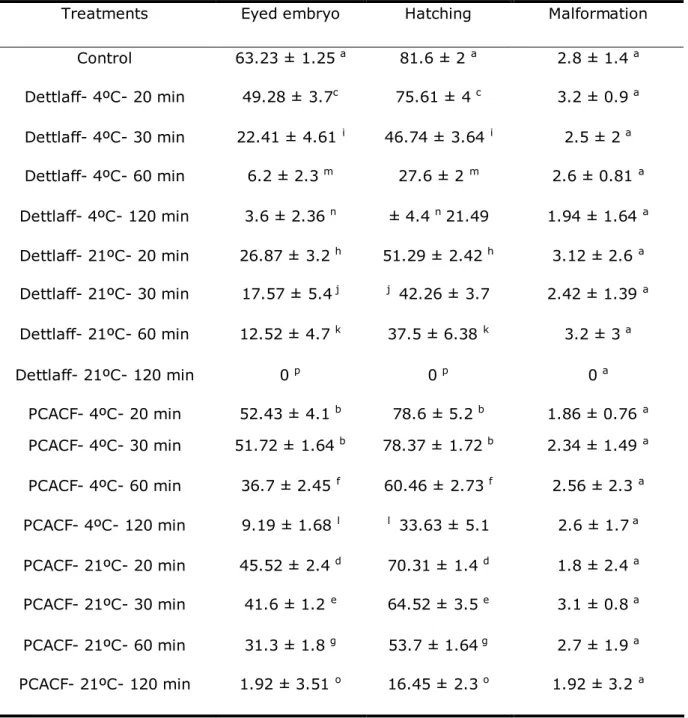
and medium on eyed embryos and hatching rate was significant (P<0.05). Storage temperature had significant effect on fertilization rate (P<0.05). Fertilization and hatching rate decreased with increasing time (20, 30, 60 and 120 min) but malformed larvae rate had not changes with time in all treatments. Highest eyed embryo and hatching rate between treatments was observed in PCACF, 20 min storage and 4 °C (PCACF + 20 min + 4 °C) and lowest eyed embryo and hatching rates was observed in Dettlaff + 120 min + 21 °C. Interaction effect of time and medium and temperature on fertilization and hatching rate was significant (P<0.05) but was not significant for malformed larvae (P>0.05) (Table 2).
Few other studies have dealt with fertilizing capacity and hatching rate of warm-water fishes ova kept in various extenders. One of parameters that have key role in short-term storage is medium in which ova were stored. In our observations (Table 2) eyed embryo and hatching rate in PCACF medium is better than Dettlaff extender. It could be hypothesized that strong buffer (Hepes) that used in building this artificial medium can ensure stable pH. Result of this study showed that the eyed embryo and hatching rate of Prussian carp ova stored in PCACF and Dettlaff extender was low and confirm the results of Rothbard et al (1999) and Linhart et al (2001) during androgenesis in common carp. Therefore, these media is not very good for Prussian carp ova storage in durations longer than 20 and 30 min. Linhart & Billard (1995) found that European catfish Silurus glanis (Linnaeus, 1758) ova were sensitive to fresh water, various saline solutions and urine. The survival of ova was very short, 40 s to 2 min in fresh water and 2–4 min in saline solution.
Hsu & Goetz (1993) preserved the fertilizing capacity of goldfish C. gibelio ova for 30 min in Ringer solution + Tris pH 7.3 and 0.5 mg mL-1 soybean trypsin inhibitor
compared with control (Ringer solution + Tris pH 7.3 and fresh water), which had a different osmotic concentration from the experimental solution.
the fertilizing capacity of common carp ova was lost 3 min after immersion in fresh water, probably due to the closing of the micropyle (Kudo et al 1994). Nevertheless, these authors found that fertilizing capacity was retained for 8 min when the ova were held in spermatozoa-activating solution (40 mM NaCl, 5 mM KCl, 20 mM Tris-HCl pH 8).
Table 2 Effects of storage medium, temperature and time on eyed embryos, hatching and
malformation rate (Mean ± SD) in Prussian carp(C. gibelio)
Treatments Eyed embryo Hatching Malformation
Control 63.23 ± 1.25 a 81.6 ± 2 a 2.8 ± 1.4 a
Dettlaff- 4ºC- 20 min 49.28 ± 3.7c 75.61 ± 4 c 3.2 ± 0.9 a
Dettlaff- 4ºC- 30 min 22.41 ± 4.61 i 46.74 ± 3.64 i 2.5 ± 2 a
Dettlaff- 4ºC- 60 min 6.2 ± 2.3 m 27.6 ± 2 m 2.6 ± 0.81 a
Dettlaff- 4ºC- 120 min 3.6 ± 2.36 n ± 4.4 n21.49 1.94 ± 1.64 a
Dettlaff- 21ºC- 20 min 26.87 ± 3.2 h 51.29 ± 2.42 h 3.12 ± 2.6 a
Dettlaff- 21ºC- 30 min 17.57 ± 5.4 j j 42.26 ± 3.7 2.42 ± 1.39 a
Dettlaff- 21ºC- 60 min 12.52 ± 4.7 k 37.5 ± 6.38 k 3.2 ± 3 a
Dettlaff- 21ºC- 120 min 0 p 0 p 0 a
PCACF- 4ºC- 20 min 52.43 ± 4.1 b 78.6 ± 5.2 b 1.86 ± 0.76 a
PCACF- 4ºC- 30 min 51.72 ± 1.64 b 78.37 ± 1.72 b 2.34 ± 1.49 a
PCACF- 4ºC- 60 min 36.7 ± 2.45 f 60.46 ± 2.73 f 2.56 ± 2.3 a
PCACF- 4ºC- 120 min 9.19 ± 1.68 l l 33.63 ± 5.1 2.6 ± 1.7 a
PCACF- 21ºC- 20 min 45.52 ± 2.4 d 70.31 ± 1.4 d 1.8 ± 2.4 a
PCACF- 21ºC- 30 min 41.6 ± 1.2 e 64.52 ± 3.5 e 3.1 ± 0.8 a
PCACF- 21ºC- 60 min 31.3 ± 1.8 g 53.7 ± 1.64 g 2.7 ± 1.9 a
PCACF- 21ºC- 120 min 1.92 ± 3.51 o 16.45 ± 2.3 o 1.92 ± 3.2 a
In our experiments eyed embryo and hatching rate at 4 ºC were higher than in 21 ºC (Table 2). We can hypothesize 2 reasons for these performances. First auto activation in 21 °C is more probable than 4 °C. Second apparently, Prussian carp ova were very sensitive to high temperature (21°C). There are many probable reasons for decrease in percentage of eyed embryo and hatching but none of them has been proved up to know. These results not agree with ex situ storage of oocytes of Prochilodus marggravii
compared with storage at 26ºC (Rizzo et al 2003). However, in some of Studies, with increasing the temperature, the hatching performance declined. In the South American catfish (Rhamdia sapo Valenciennes, 1840) oocyte viability starts decreasing after 9 h at 20°C or after 5 h at 24 °C, and viable oocytes are totally absent after 15 h at 20 °C or after 8 h at 24 °C (Espinach et al 1984).
In this work, with increasing time, eyed embryo and hatching rate were decreased. These results agree with several studies, such as Goetz & Coffman (2000) and Sohrabnezhad et al (2006).
Oocyte over ripening may be evaluated on the basis of the decline in fertilization and hatching rates (Formacion et al 1993). Since fertility and deformed larvae rate are strongly correlated, the fertilization rate alone may be sufficient to indicate the subsequent performance of embryos and larvae (Springate et al 1984). But in this work, the rate of deformed larvae in Prussian carp eggs stored in PCACF and Dettlaff extender at 4 °C and 21 °C was not in correlation with eyed embryo and hatching rate.
Short-term preservation is only feasible with eggs from species in which activation is controllable (Stoss 1983). In cyprinid fish, like Prussian carp auto activation is not controllable and occurs in different ways like increase or decrease in water temperature or pH or other reasons.
In the present study it has been shown that under hatchery conditions, ova of Prussian carp can be stored in PCACF for 30 min or in Dettlaff extender for 20 min.
Conclusions. Results shown that use of PCACF and Dettlaff (111.3 NaCl + 3.3 KCl + 2.1
CaCl2 + 23.8 NaHCO3) is not very appropriate for short-term storage of Prussian carp eggs in longer duration than 20, 30, 60 and 120 min. Also, maintain Prussian carp ova at 4 °C had percentage of eyed embryo and hatching greater than 21 °C. Storage duration had significant effect on hatching performance, but media, temperature and time had not significant influence on malformed larvae.
References
Dettlaff T. A., Ginsburg A. S., Schmalhausen O. I., 1993 Sturgeon Fishes. Developmental Biology and Aquaculture. Springer-Verlag, Berlin, 300 pp.
Donald W., Glenn ш., Terrencre T., 2002 Effect of extenders and osmotic pressure on storage of eggs of ornamental common carp Cyprinus carpio at ambient and refrigerated temperatures. J Wor Aqua Soc 33(3):254-267.
Espinach R. A., Amutio V. G., Mestre A. J. P., Orti G., Nani A., 1984 Induced breeding of the South American catfish Rhamdia sapo (C. & V.). J Aquaculture 37:141–146. Formacion M. J., Hori R., Lam T. J., 1993 Overripening of ovulated eggs in goldfish. I.
Morphological changes. Aquaculture 114:155–168.
Goetz F. W., Coffman M. A., 2000 Storage of unfertilized eggs of rainbow trout (Oncorhynchus mykiss) in artificial media. J Aquaculture 184:267–276.
Hart N. H., 1990 Fertilization in teleost fishes: mechanisms of sperm–egg interactions. Int Rev Cytol 121:1–66.
Harvey B., Kelley R. N., 1984 Short-term storage of Sarorherodon mossambicus ova. J Aquaculture 37:391-395.
Hobby A. C., Pankhurst N. W., 1997 Post-ovulatory egg viability in the snapper Pagrus auratus. J Mar Freshwater Resource 48:385-389.
Hsu S. Y., Goetz F. W., 1993 Inhibition of chorion expansion and preservation of fertility in goldfish (Carassius auratus) eggs by protease inhibitor. Canadian Journal of Fish and Aquatic Sciences 50:932–935.
Iwamatsu T., Yoshizaki N., Shibata Y., 1997 Changes in the chorion and sperm entry into the micropyle during fertilization in the teleostean fish, Oryzias latipes. J Dev Growth Differ 39:33–41.
Jahnichen H., 1981 Kurzeitkonservierung von Karpfensperma als weitere Mo¨ glichkeit der Rationalisierung der ku¨ nstlichen Vermehrung von Karpfen (Cyprinus carpio
Kjorsvik E., Mangor-Jensen A., Holmefjord I., 1990 Egg quality in fishes. J Adv Mar Biol
26:71–113.
Kudo S., Linhart O., Billard R., 1994 Ultrastructural studies of sperm penetration in the egg of the European catfish (Silurus glanis L.). J Aquatic Living Resources 7:93– 98.
Legendre M., Linhart O., Billard R., 1996 Spawning and management of gametes, fertilized eggs and embryos in Siluroidei. J Aquat Living Resour 9:59–80.
Leung L. K. P., Jamieson B. G. M., 1991 Live preservation of fish gametes. In: Jamieson BGM, (ed.) Fish evolution and systematics: evidence from spermatozoa. Cambridge: Cambridge University Press. p. 245–269.
Linhart O., Billard R., 1995 Survival of ovulated oocytes of the European catfish (Silurus glanis) after in vivo and in vitro storage or exposure to saline solutions and urine. J Aquatic Living Reso 8:317–322.
Linhart O., Gela D., Rodina M., Rodriguez G. M., 2001 Short-term storage of ova of common carp and tench in extenders. J Fish Biology 59:616–623
Renard P. H., Billard R., Christen R., 1987 Formation of the chorion in carp oocytes. An analysis of the kinetics of its elevation as a function of oocyte ageing, fertilization and the composition of the dilution medium. J Aquaculture 62:153–160.
Rizzo E., Godinho H.P., Sato Y., 2003 Short-term storage off oocytes from the neotropical teleost fish Prochilodus marggravii. Theriogenology 60:1059-1070.
Rothbard S., Rubinish I., Gelman E., 1996 Storage of common carp, Cyprinus carpio L. eggs for short durations. J Aquaculture Research 27:175-181.
Rothbard S., Rubinsthein I., David L., Shelton W.L., 1999 Ploidy manipulations aimed to produce androgenetic Japanese ornamental (KOI) carp, (Cyprinus carpio L.). Israeli Journal Aquaculture-Bamidgeh 51:26–39.
Saad A., Billard R., 1987 [The composition and use of a sperm diluent in the carp,
Cyprinus carpio]. Aquaculture 66:329–345. [in French, with English abstract] Sohrabnezhad M., Kalbassi M. R., Nazari R. M., Bahmani M., 2006 Short-term storage of
Persian sturgeon (Acipenser persicus) ova in artificial media and coelomic fluid. J Appl Ichthyol 22(1):395-399.
Springate J. R. C., Bromage N. R., Elliot J. A. K., Hudson D. L., 1984 The timing of ovulation and stripping and their effects on the rates of fertilization and survival to eyeing, hatch and swim-up in the rainbow trout (Salmo gairdneri R.). J Aquaculture 43:313–322.
Stoss J., 1983 Fish gamete preservation and spermatozoa physiology. In: W. S. Hoar, D. J. Randall, E. M. Donaldson (Eds.), Fish Physiology, vol. IXB, Academic Press, New York, pp. 305–350.
Zlabek A., Linhart O., 1987 [Short-term storage of non-inseminated and unfertilized ova of the common carp, grass carp and silver carp]. Bulletin VURH Vodnany 23:3– 11. [in Czech, with English summary]
Received: 12 October 2010. Accepted: 15 November 2010. Published online: 16 November 2010. Authors:
Mohammad Mehdi Taati, Department of Fishery, Gorgan University of Agricultural Sciences and Natural Resources, Iran, Golestan, Gorgan, Shahid Beheshti Avenue, Postal code: 49138-15739, e-mail: [email protected]
Ali Shabani, Department of Fishery, Gorgan University of Agricultural Sciences and Natural Resources, Iran, Golestan, Gorgan, Shahid Beheshti Avenue, Postal code: 49138-15739, e-mail: [email protected]
Mohammad Reza Imanpoor, Department of Fishery, Gorgan University of Agricultural Sciences and Natural Resources, Iran, Golestan, Gorgan, Shahid Beheshti Avenue, Postal code: 49138-15739, e-mail:
[email protected] How to cite this article: