Artigo Original
Luciana Leal de Sousa1 Karin Ziliotto Dias2 Liliane Desgualdo Pereira3
Descritores
Testes auditivos Audição Estimulação acústica Percepção auditiva Adulto Valores de referência Keywords
Hearing tests Hearing Acoustic stimulation Auditory perception Adult Reference values
Correspondence address:
Karin Ziliotto Dias
R. Ministro Gabriel de Rezende Passos, 500, conj. 1707, Moema, São Paulo (SP), Brasil CEP: 04521-022.
E-mail: [email protected]
Received: 2/11/2011
Accepted: 9/22/2011
Research conducted at the Department of Speech-Language Pathology and Audiology, Universidade Federal de São Paulo – UNIFESP – São Paulo (SP), Brazil.
(1) Undergraduate Program in Speech-Language Pathology and Audiology, Universidade Federal de São Paulo – UNIFESP – São Paulo (SP), Brazil.
(2) Undergraduate Program in Speech-Language Pathology and Audiology, Universidade Federal de São Paulo – UNIFESP – São Paulo (SP), Brazil; Núcleo de Estudos Fonoaudiológicos – NESF – São Paulo (SP), Brazil. (3) Department of Speech-Language Pathology and Audiology, Universidade Federal de São Paulo – UNIFESP – São Paulo (SP), Brazil.
Conflict of interests: None
youngsters with normal hearing sensitivity
Resolução temporal com estímulos clique e tom puro em
jovens com sensibilidade auditiva normal
ABSTRACT
Purpose: To assess the auditory ability of temporal resolution and to compare the random gap detection test (RGDT) versions with pure tone and clicks stimuli. Methods: Participants were 40 young individuals of both genders with ages between 18 and 25 years, and normal hearing thresholds for the sound frequencies of 250 Hz to 8 kHz. Initially, participants were submitted to the basic audiological evaluation. Then they underwent the RGDT with pure tone and clicks stimuli. Finally, we obtained the temporal acuity threshold, which corresponds to the shorter silence interval in which the patient perceives two sounds, for each type of stimulus, called final temporal acuity threshold for pure tones (mean of the thresholds obtained for 500 Hz, 1k, 2k and 4 kHz), and temporal acuity threshold for clicks. Results: The mean temporal acuity threshold for the sound frequency of 500 Hz was 7.25 ms; for the frequency of 1 kHz was 7.25 ms; for 2 kHz was 6.73 ms; for the frequency of 4 kHz was 6.03 ms. The final temporal acuity threshold was 6.72 ms. The mean temporal acuity threshold for clicks was 6.43 ms. No difference was found between the temporal acuity thresholds obtained with pure tone and clicks stimuli. Conclusion: There is no difference in the performance of individuals on the auditory ability of temporal resolution, regardless of the auditory stimulus used.
RESUMO
INTRODUCTION
Auditory processing is the term applied to refer to a series of processes involved in the analysis and interpretation of the heard sounds involving mostly structures of the central nervous system(1,2). Among these processes are localization and
latera-lization of sound source, auditory discrimination, recognition of sound patterns, temporal aspects of hearing (temporal pro-cessing) and the auditory performance with competitive and degraded acoustic signals(3).
Temporal processing, or the temporal aspects of hearing, may be defined as the perception of sounds and their modi-fication in a determined time interval(4,5). The categories of
temporal processing are: the abilities of temporal ordering or sequencing, temporal resolution or discrimination, temporal integration and temporal masking(4,6).
The focus of this research was temporal resolution, that can be defined as the ability to detect intervals of silence in the middle of sound stimuli or the shortest duration of silence that a subject may discriminate between two audible signals(4,5).
Temporal resolution is fundamental for speech comprehen-sion, as well as for reading because there are intervals of silence in different places in continuous speech(5,7,8). A specific
diffi-culty of the ability of temporal resolution reveals an injury of the physiological auditory mechanism of temporal processing, and the impairments of temporal processing may be related to phonological processing, deficits in auditory discrimination, receptive language and in reading(3,6).
The Random Gap Detection Test (RGDT) proposed by Keith is used to assess the ability of temporal resolution. The goal of the RGDT is to identify and quantify temporal proces-sing disorders in the auditory system, and it can be used with children and adults(6).
The RGDT assessed the ability of temporal resolution by the determination of the shortest interval of time a subject needs to detect two very close auditory stimuli, that is, the interval in which the stimuli are perceived as two instead of only one. Therefore, the subject will answer if he or she perceived a silence interval between two presented stimuli. This silence interval is called of temporal acuity threshold and it is measured in milliseconds (ms).
The RGDT presents a version using pure tone as the type of auditory stimuli and a version with the click as the auditory stimuli used. The version of the test with the pure tone as auditory stimuli has been widely studied in different populations(7,9-21). However, in the studied literature no studies
using the RGDT version with the click as the auditory stimuli were found.
The present study had the purpose of characterizing and comparing the ability of temporal resolution with both types of auditory stimuli, pure tone and click, in young normal listeners.
METHODS
This study was conducted after being approved by the Committee of Ethics in Research of the Federal University of São Paulo (UNIFESP), number 0512/08. All subjects that
participated in the study were informed about the goals by written material and signed a free and informed consent form.
For this study 40 young adults were selected, ranging in age from 18 to 25, 20 females and 20 males. Only subjects who presented tonal auditory thresholds for sound frequencies of 250 Hz to 8 kHz equal to or less than 20 dBNA and speech recogni-tion index equal to or superior than 88% of correct responses. It is worth mentioning that all subjects presented a minimal of 11 years of formal education.
Initially all subjects completed a basic hearing assessment, composed of: tonal audiometry and speech discrimination test.
RGDT application
Following this initial assessment those normal audiometric thresholds completed the Random Gap Detection Test (RGDT). The RGDT test is comprised of a recorded presentation of nine pairs of brief and successive sounds that are presented binaurally. The subject was instructed answer the examiner verbally or by a hand movement if he or she heard one or two sounds on each presentation.
The time interval between the two stimuli on each pair va-ried from zero to 40 milliseconds (ms), randomly. The test was conducted on an intensity level of 50 dB sensation level (NS), based on the mean hearing threshold for the sounds frequencies of 500 Hz, 1k and 2 kHz.
Hearing stimuli are of the pure tone type and of the click type for of the sound frequencies of 500 Hz, 1k, 2k and 4 kHz. In the pure tone type of stimuli the duration of each stimulus is 17 ms, and in the click type, the duration of each stimulus is of 250 microseconds. The time interval between each pair of stimulus is four and a half seconds, being this the time interval reserved for the subject’s response.
The RGDT test is composed of four subtests: the first subtest or training track for pure tone helps the examiner in verifying if the instructions were understood. It is done at the sound frequency of 500 Hz and the stimuli are presented in a crescent order of time interval, as such: zero, two, five, ten, 15, 20, 25, 30, and 40 ms.
The second subtest corresponds to the training track in the sound frequencies of 500 Hz, 1k, 2k and 4 kHz. The silence intervals for each stimulus are presented randomly and vary from zero to 40 ms.
The third subtest correspond training track for clicks. The used stimuli present silence intervals in a crescent order, such as: zero, two, five, ten, 15, 20, 25, 30, and 40 ms.
The fourth subtest correspond training track for the click type of stimuli and the silence intervals vary from zero a 40 ms in a random order.
The mean time of application and scoring of the RGDT test with pure tone stimuli was 12 minutes and with the clicks was of five minutes.
The equipment used in this research was: - Two channel audiometer, model GSI-61
- Compact disc (CD) with the version of the RGDT test (Keith, 2000)
- Panasonic® CD player (discman) - Acoustic booth
Statistics method
For the statistical analyses descriptive measures and non parametric tests and techniques were used. The selected tests were: Mann-Whitney test, Wilcoxon test, and the Spearman Correlation. The significance level was defined at 0.05 (5%), and confidence intevals adopted throughout this work were constituted with a 95% statistical confidence.
RESULTS
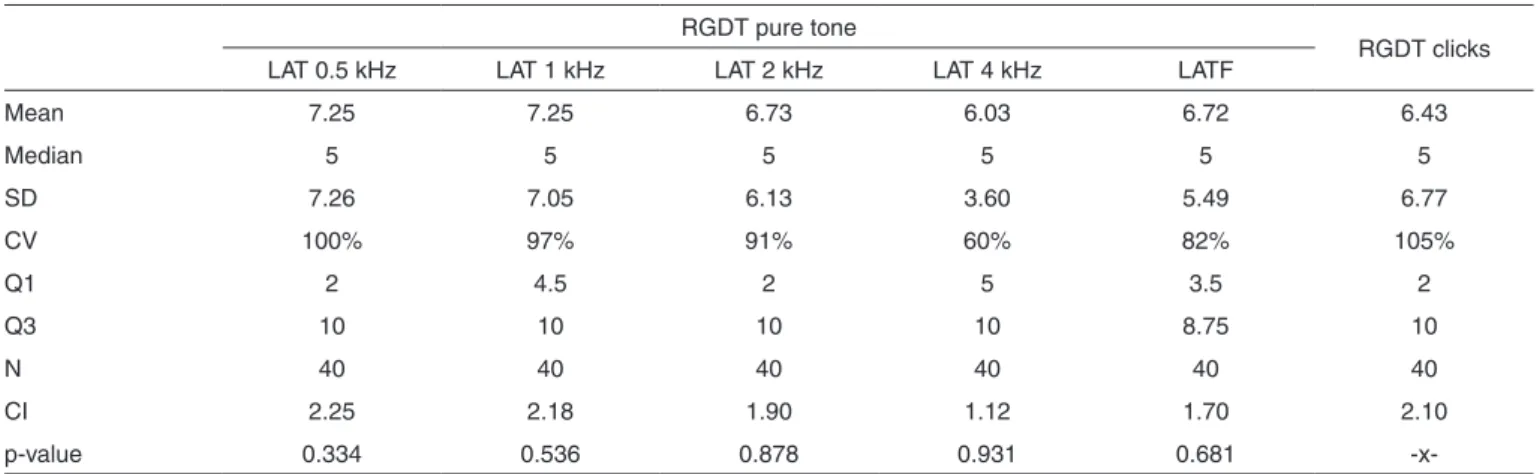
Table 1 presents the descriptive measures for the RGDT test with the pure tone and click stimuli types, and the p-values (Mann-Whitney test) calculated for the comparison of
performance for the gender variable. It was noted that there were no differences in the subjects’ performance according to gender. Table 2 presents the descriptive measures for the RGDT test with the pure tone and click stimuli types, for the entire sample, considering that there were no gender differences. It also shows the p-values (Wilcoxon test) for the comparison between the temporal acuity thresholds obtained for the RGDT test with pure tone and click stimuli. There were no differences between the temporal acuity thresholds for the obtained for the test with pure tone and with click.
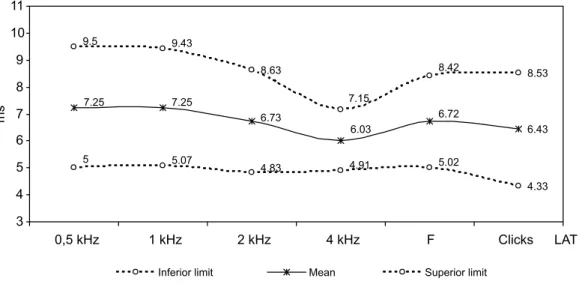
The mean values of temporal acuity thresholds obtained for the RGDT test with pure tone and click and the distribution of the confidence intervals are presented on Figure 1.
Table 3 presents the degree of association between two variables or correlation of temporal acuity thresholds. The variables considered were the temporal acuity thresholds for each pre-established pure tone sound frequency and for clicks. The correlation between the temporal acuity thresholds obtai-ned with pure tone and click stimuli and the temporal acuity thresholds obtained for each of the pure tone sound frequencies were almost in their totality significant. It is worth noting that
Table 1. Descriptive measures for the RGDT test with pure tone and click stimuli and the performance comparison on the variable gender
LAT 0.5 kHz LAT 1 kHz LAT 2 kHz LAT 4 kHz LATF LAT Clicks
Gender F M F M F M F M F M F M
Mean 7.30 7.20 7.50 7.00 6.20 7.25 5.50 6.55 6.66 6.78 6.65 6.20
Median 5 5 5 5 5 5 5 5 4.25 5 5 5
SD 8.63 5.81 8.57 5.33 5.43 6.86 2.95 4.16 5.99 5.07 8.51 4.64
CV 118% 81% 114% 76% 88% 95% 54% 64% 90% 75% 128% 75%
Q1 2 2 4.25 4.25 2 4.25 4.25 5 3.5 3.5 2 2
Q3 10 10 6.25 10 10 6.25 6.25 10 7.81 8.75 10 10
N 20 20 20 20 20 20 20 20 20 20 20 20
CI 3.78 2.55 3.76 2.34 2.38 3.01 1.29 1.82 2.63 2.22 3.73 2.03
p-value 0.682 0.828 0.699 0.459 0.799 0.597
Mann-Whitney Test (p<0.05)
Note: SD =standard deviation; CV = coefficient of variation; Q1 =first quartile; Q3 = third quartile; CI = confidence interval; LAT = temporal acuity threshold; LATF =final temporal acuity threshold; F = female; M = male; RGDT = random gap detection test
Table 2. Descriptive measures for the RGDT test with pure tone and clicks stimuli types for the total sample, related to temporal acuity
RGDT pure tone
RGDT clicks LAT 0.5 kHz LAT 1 kHz LAT 2 kHz LAT 4 kHz LATF
Mean 7.25 7.25 6.73 6.03 6.72 6.43
Median 5 5 5 5 5 5
SD 7.26 7.05 6.13 3.60 5.49 6.77
CV 100% 97% 91% 60% 82% 105%
Q1 2 4.5 2 5 3.5 2
Q3 10 10 10 10 8.75 10
N 40 40 40 40 40 40
CI 2.25 2.18 1.90 1.12 1.70 2.10
p-value 0.334 0.536 0.878 0.931 0.681
-x-Wilcoxon test (p<0.05)
all the significant correlations are positive, what indicates that the higher the temporal acuity thresholds for the RGDT with the click type of stimulus, the higher the temporal acuity thresholds obtained for the RGDT with the pure tone type of stimulus.
According to the classification scale of the Spearman cor-relation it can be noted that the highest corcor-relation is between LATF and LAT at 500 Hz, with a 90% correlation, what can be classified as excellent. Other correlations that can be classified as excellent are: LAT at 4 kHz and LATF; between LAT at 2 kHz and LATF; and between LAT at 1 kHz and LATF. The correlation between the LAT at 500 Hz, 2 kHz and LATF with the LAT for clicks were classified as regular; and the correlation of the LAT at 1000 Hz and 4000 Hz with the LAT for clicks were classified as bad.
DISCUSSION
According to the previously mentioned, there were no di-fferences in the comparison of performance on the RGDT test
on the gender variable (Table 1). This result agrees with other studies presented in the literature that failed to find differen-ces when the performance of male and female subjects were compared on tests of temporal resolution(7,9,10). However, these
findings disagree with another research(11) in which the mean
temporal acuity thresholds of male subjects (7.91 ms) were higher when compared to the mean temporal acuity thresholds of female subjects (11.69 ms), using only the RGDT test version of pure tone stimuli.
For the comparison of temporal acuity thresholds of pure tone frequencies, we noted that the difference between tem-poral acuity thresholds of each sound frequency and the final temporal acuity threshold. This data corroborates the findings obtained in other studies that used the RGDT test with pure tone stimuli(10,12-14) and they also failed to observe this difference.
When comparing the temporal acuity thresholds obtai-ned for the RGDT test with pure tone and click stimuli, we observed that there were no differences between either of them. However, no other studies using the RGDT test with the Table 3. Correlation between the noted temporal acuity thresholds on the RGDT test
LAT Clicks LAT 0.5 kHz LAT 1 kHz LAT 2 kHz LAT 4 kHz LAT 4 kHz
LAT 0.5 kHz Corr 49.5%
p-value 0.001*
LAT 1 kHz Corr 35.9% 78.3%
p-value 0.023* <0.001*
LAT 2 kHz Corr 44.0% 69.0% 65.8%
p-value 0.005* <0.001* <0.001*
LAT 4 kHz Corr 27.1% 71.3% 61.9% 70.4%
p-value 0.091 <0.001* <0.001* <0.001*
LATF Corr 53.1% 90.0% 87.0% 85.5% 80.6%
p-value 0.001* <0.001* <0.001* <0.001* <0.001* *Significant values (p<0.05) – Spearman Correlation
Note: LAT = temporal acuity threshold; LATF = final temporal acuity threshold; Corr = Spearman correlation; RGDT = random gap detection test
Note: F = final; LAT = temporal acuity threshold; RGDT = random gap detection test
click stimuli were found in the reviewed literature. The data revealed that subjects presented a very similar performance for both types stimuli used in the RGDT test: the click and the pure tone.
When comparing the RGDT test results obtained for the pure tone and click stimuli in this study to those in the reviewed literature, it was observed that the mean final temporal acuity threshold and the clicks in this study highly resemble those described by many other authors(5,10-14) when a normal
hea-ring population was studied. The mean final temporal acuity thresholds obtained at other studies in the literature with a population of similar age range to the one in the present study is between 4.77 ms and 12.2 ms(11,13-17).
The RGDT test with pure tone stimuli has been widely stu-died in different age ranges(10,11,15,16,19) and diverse populations
such as: subjects with auditory processing disorder(12), children
with phonological problems(19), children born pre-term and
at-term(9), the elderly with mild sensorineural hearing loss(16),
children with conductive hearing loss(20). Comparing the results
of the present study to those obtained in the previously mentio-ned studies, it was observed that the temporal acuity threshold in each sound frequency and the final temporal acuity threshold in the present study are lower. However, there are no studies describing the temporal acuity for the click.
It is already known that the auditory stimuli of the pure tone type stimulate separately different portion of the cochlea. Therefore, when using sound stimuli at the sound frequency of 500 Hz, the o apex of the cochlea is stimulated. Sound stimuli of 1 kHz and 2 kHz stimulate the medial portion of the cochlea and stimuli at the sound frequency 4 kHz stimulate the cochlear base(22). By its turn, the click is an auditory stimulus that runs
across and activates the entire basilar membrane and is highly effective for this. Due to the fact that it is a broad band stimulus it stimulates de hairy cells from the basal spira until the apical spira of the cochlea(23).
There are two kinds of systems of time organization in the brain that are independent of periphery mode(24), that is,
perceive the separation between two sound stimuli that are independent of the type of used stimulus because this is a task that depends on how the auditory central nervous system deals with the received stimuli. It is also important to mention that other cortical areas besides the primary auditory cortex may participate of the auditory processing of fast stimuli(18), such
as the left pre frontal region and the right cerebellar area(7).
Even though the auditory stimuli used in the present study were distinct (click and pure tone), the subjects’ performance on the RGDT test with click and pure tone stimuli was simi-lar. A hypothesis to explain this result is that even though in a peripheric point of view the stimuli arrive the cochlea in a different manner, that is indifferent to the central auditory nervous system, because the task of temporal resolution is a central auditory function(4).
The mean total time for the application of the RGDT test was 12 minutes for the version that uses pure tones as sound stimuli and of five minutes for the version that uses the click as sound stimuli. Considering the ease and speed in the implemen-tation of the RGDT in the version of the click type and the fact
that we found LAT similar to those obtained in the version of the pure tone type of stimuli, it is suggested that this test may, therefore, be used as a screening tool of temporal processing. It is worth to emphasize the importance of further the study of the RGDT test with click stimulus in other populations, regarding the validation of this test and to obtain measures of sensibility and specificity.
CONCLUSION
The temporal resolution ability measured by the RGDT test with click and pure tone types of stimuli was neither influenced by the type of stimuli nor by the gender variable. A positive correlation between the temporal acuity thresholds was obtai-ned for both types of stimulus.
ACKNOWLEDGMENTS
We thank the colleagues Renata Shiroma and Elizabeth Shinn for their collaboration in the collecting of samples for this study.
REFERENCES
1. Pereira LD, Navas AL, Santos MT. Processamento auditivo: uma abordagem de associação entre audição e linguagem. In: Santos MT, Navas AL. Distúrbios de leitura e escrita: teoria e prática. São Paulo: Manole; 2002. p. 75-96.
2. Schochat E. Avaliaçäo do processamento auditivo: revisäo da literatura. Rev Bras Med Otorrinolaringol. 1998;5(1):24-31.
3. American Speech-Language-Hearing Association (ASHA). Central auditory processing: current status of research and implications for clinical pratice. Am J Audiol. 1996;5(2):41-52.
4. Shinn JB. Temporal processing: the basics. Hear J. 2003;56(7):52. 5. Samelli AG, Schochat E. Processamento auditivo, resolução temporal
e teste de detecção de gap: revisão da literatura. Rev CEFAC. 2008;10(3):369-77.
6. Keith RW. Random gap detection test. Missouri: Auditec of Saint Louis; 2000.
7. Samelli AG, Schochat E. The gaps-in-noise test: gap detection thresholds in normal-hearing young adults. Int J Audiol. 2008;47(5):238-45. 8. Temple E, Poldrack RA, Protopapas A, Nagarajan S, Salz T, Tallal
P, et al. Disruption of the neural response to rapid acoustic stimuli in dyslexia: evidence from functional MRI. Proc Natl Acad Sci USA. 2000;97(25):13907-12.
9. Fortes AB, Pereira LD, de Azevedo MF. Resolução temporal: análise em pré-escolares nascidos a termo e pré-termo. Pró-Fono. 2007;19(1):87-96. 10. Balen SA, Liebel G, Boeno MR, Mottecy CM. Resolução temporal de
crianças escolares. Rev CEFAC. 2009;11(Supl 1):52-61.
11. Zaidan E, Garcia AP, Tedesco ML, Baran JA. Desempenho de adultos jovens normais em dois testes de resolução temporal. Pró-Fono. 2008;20(1):19-24.
12. Ziliotto K, Pereira LD. Random gap detection test in subjects with and without APD. In: 17th American Academy of Audiology - Annual Convention and Exposition; 2005; Washington (DC).p.30.
13. Ishii C, Arashiro PM, Pereira LD. Ordenação e resolução temporal em cantores profissionais e amadores afinados e desafinados. Pró-Fono. 2006;18(3):285-92.
14. Bruner AP, Sato EI, Pereira LD. Central auditory processing in patients with systemic lupus erythematosus. Acta Reumatol Port. 2009;34(4):600-7.
16. de Queiroz DS, Branco-Barreiro FC, Momensohn-Santos TM. Desempenho no Teste de Detecção de Intervalo Aleatório – Random Gap Detection Test (RGDT): estudo comparativo entre mulheres jovens e idosas. Rev Soc Bras Fonoaudiol. 2009;14(3):503-7.
17. Mataruco MA. Resolução temporal: análise comparativa entre indivíduos cegos e/ou visão subnormal com indivíduos videntes [monografia]. São Paulo: Universidade Federal de São Paulo; 2007.
18. Samelli AG, Schochat E. Estudo da vantagem da orelha direita em teste de detecção de gap. Rev Bras Otorrinolaringol. 2008;74(2):235-40. 19. Muniz LF, Roazzi A, Schochat E, Teixeira CF, de Lucena JA. Avaliação
da habilidade de resolução temporal, com uso do tom puro, em crianças com e sem desvio fonológico. Rev CEFAC. 2007;9(4):550-62. 20. Balen SA, Bretzke L, Mottecy CM, Liebel GB, Boeno MR, Gondim
LM. Resolução temporal de crianças: comparação entre audição normal, perda auditiva condutiva e distúrbio do processamento auditivo. Rev Bras Otorrinolaringol. 2009;75(1):123-9.
21. Balen SA, Boeno MR, Liebel G. A influência do nível socioeconômico na resolução temporal em escolares. Rev Soc Bras Fonoaudiol. 2010;15(1):7-13.
22. Guyton AC. Tratado de fisiologia médica. Rio de Janeiro: Guanabara Koogan; 1992. O sentido da audição; p. 502-11.
23. Munhoz ML, Caovilla HH, Silva ML, Ganança MM. Audiologia clínica. São Paulo: Atheneu; 2000. Potenciais evocados auditivos – aspectos históricos e técnicos; p.165-7.