Test-retest variability in the pure tone audiometry:
comparison between two transducers
Variabilidade teste-reteste na audiometria tonal: comparação
entre dois transdutores
Lilian Aguiar de Mello1, Roberta Almeida Machado da Silva1, Daniela Gil2
ABSTRACT
Purpose: To characterize the test-retest variability with supra-aural and insert earphones and compare the pure tone thresholds between the transducers. Methods: Seventy-four individuals of both genders with normal hearing and tympanometric curve of type A were selected. All subjects underwent anamnesis, meatoscopy, air conduction pure tone audiometry, either with the supra-aural earphone, or with insert earphone and speech audiometry. After this initial evaluation Acoustic Impedance Testswere performed. Finally, pure tone audiometry procedures were repeated with both transducers. Results: Supra-aural earphone produced higher test-retest variability when compared to the insert earphones. Comparing a transducer with each other, the responses were sometimes similar and sometimes favoring one or the other transducer considering the first and second evaluations. Conclusion: There is a greater test-retest variability with supra-aural earphones comparing with insert earphones. However, better thresholds were obtained in the retest condition for both transducers.
Keywords: Pure-tone audiometry; Audiometry; Audiology; Hearing; Auditory threshold
RESUMO
Objetivo: Caracterizar a variabilidade teste-reteste com fones supra--aurais e fones de inserção e comparar os limiares auditivos tonais entre os transdutores. Métodos: Foram selecionados 74 indivíduos de ambos os gêneros, com limiares auditivos normais e curvas timpanométricas do tipo A. Todos os indivíduos foram submetidos à anamnese, meatoscopia, audiometria tonal por via aérea, ora com o fone supra-aural, ora com o fone de inserção, e logoaudiometria. Após esta primeira avaliação, foi realizada a medida de imitância acústica. Por fim, os procedimentos de audiometria tonal foram repetidos. Resultados: O fone supra-aural produziu maior variabilidade teste-reteste, quando comparado com o fone de inserção. Já na comparação dos transdutores, verificou-se, tanto na primeira, quanto na segunda testagem, que as respostas mostraram-se ora semelhantes, ora favorecendo um ou outro transdutor. Conclusão:
Há maior variabilidade teste-reteste com o fone supra-aural do que com o fone de inserção. No entanto, foram verificados melhores limiares na condição reteste, para ambos os transdutores.
Descritores: Audiometria de tons puros; Audiometria; Audiologia; Audição; Limiar auditivo
Study conducted at the Course of Speech-Language Pathology and Audiology, Universidade Federal de São Paulo – UNIFESP – São Paulo (SP), Brazil. (1) Course of Graduation in Speech-Language Pathology and Audiology, Universidade Federal de São Paulo – UNIFESP – São Paulo (SP), Brazil. (2) Department of Speech-Language Pathology and Audiology, Universidade Federal de São Paulo – UNIFESP – São Paulo (SP), Brazil.
Conflict of interests: No
Authors’ contribution: LAM main researcher, elaboration of the schedule, literature survey, data collection and analysis, writing of the article, article submission
and procedures; RAMS assistant researcher, elaboration of the schedule, literature survey, data collection and analysis; DG advisor, elaboration and design of the
study, data analysis, correction of the study, approval of the final version.
Correspondence address: Lilian Aguiar de Mello. R. Botucatu, 802, Vila Clementino, São Paulo (SP), Brazil, CEP: 04023-062. E-mail: [email protected]
INTRODUCTION
In clinical audiology, the most used types of earphones are the supra-aural, which are those where the cushion exerts pressure on the ear and are considered the standard earphones to pure tone audiometry of air conduction; and insert earpho-nes that are inserted into the external ear canal using foam plugs, which provide better acoustic isolation, increase the interaural attenuation and cause less risk of collapse of the external ear canal(1,2).
One of the disadvantages of supra-aural earphones is the possibility of exhaust energy at low frequencies, because of not being very well connected; Furthermore, cause more discomfort due to the headband tension on the skull(3).
When compared to supra-aural, insert earphones to produce no pressure on the ear outer and the skull are more comfortable, generate greater reliability to the examination, have higher interaural attenuation and may reduce or elimi-nate the need for masking contralateral(4,5), generate greater attenuation in environmental noise, allowing the realization of audiometric tests in non-isolated environments acousti-cally(6), reduce the occlusion effect of the external ear canal in testing of bone conduction and reduce the risk of collapse of the external ear canal(7-9).
There are studies in the literature showing that there is a significant difference in the results obtained in the test and retest with the supra-aural and insert earphones, showing better results in the retest(10-13). However, there are no studies that compared the variability between the transducers.
Based on these, the aim of this study was to characterize the test-retest variability of supra-aural and insertion ear-phones and compare the pure tone thresholds between the transducers.
METHODS
Cross-sectional study, conducted at the Clinic of Clinical Audiology, with approval by the Ethics Committee of the
Universidade Federal de São Paulo (UNIFESP) under number
38594. All participants were informed about the procedure and signed a consent form and Informed Consent and Agreement for children under 18 years.
For this research we selected 74 individuals of both gen-ders, from the following inclusion criteria: age between 13 and 59 years; auditory thresholds between 250 Hz and 8000 Hz less than or equal to 25 dB HL with tympanometry curve type A(14); not present syndromes, neurological impairments and/or cognitive; and present negative otologic past to ear infections and/or ear surgery.
All participants underwent the following procedures:
audiological anamnesis*, otoscopy, pure tone audiometry (PTA), speech audiometry (speech reception threshold - SRT and percentage index of speech recognition - PISR) and acoustic impedance(14).
The PTA and speech audiometry were performed in a soundproof booth, with audiometer AD229b using the descending-ascending method. The PTA was started in the ear chosen at random by the researcher, ie, sometimes initi-ated by the right ear and sometimes the left ear in an audible frequency and intensity to the subject under test. The subject was assessed with insert and supra-aural earphones, random-ized to beginning the test. This procedure was performed twice with each transducer, in the same session, with an interval of about 15 minutes between assessments and performed by the same examiner. In between evaluation and other measures were carried out acoustic impedance, so that the earphones were repositioned and the test-retest variability could be characterized.
For the use of ER-3A earphones, correction factors were used in the obtained thresholds suggested by the manufacturer (Etymotic Research®, 1985), namely: 250 Hz = 5 dB; 500 Hz = 0 dB; 1000 Hz = 5 dB; 2000 Hz = 5 dB; 3000 Hz = 5 dB; 4000 Hz = 0 dB; 6000 Hz = -10 dB; 8000 Hz = -10 dB, since the study was performed in equipment calibrated for supra-aural earphones.
According to the manufacturer’s recommendations, the foam plug insertion should be deep (2 to 3 mm), ensuring a position of approximately 16 mm deep in the external ear canal far from the plane of the shell(15). In this study, the deep insertion was guaranteed in all cases.
The speech audiometry was carried out only with the supra-aural headset. In the SRT, the subjects repeated words presented to the speaker. It was considered the threshold intensity in which the individual repeated 50% of the words correctly. As for the PISR, the amount used was 40 dB SL on the mean of pure tone thresholds of frequencies of 500 Hz, 1 kHz and 2. The subject was asked to repeat a list of 25 monosyllabic words, phonetically balanced. Each hit / error accounted for 4% to 100% correct. The result was considered normal if the percentage was between 88-100% correct(1).
The results were recorded on worksheets. It drew up a table for testing and one for the retest. For statistical analysis, paired t-test was used in order to check the systematic error. P-value≤0.05 were considered significant.
RESULTS
The descriptive measures of the thresholds obtained in the test-retest with both transducers and both ears are in Tables 1-4.
For the insertion earphones in the right ear, there were
differences in the frequency of 3000 Hz, with lower responses in the retest (Table 1). The frequencies of 500 Hz and 2000 Hz were also nearest a significant difference. In the left ear, there was no difference at all frequencies.
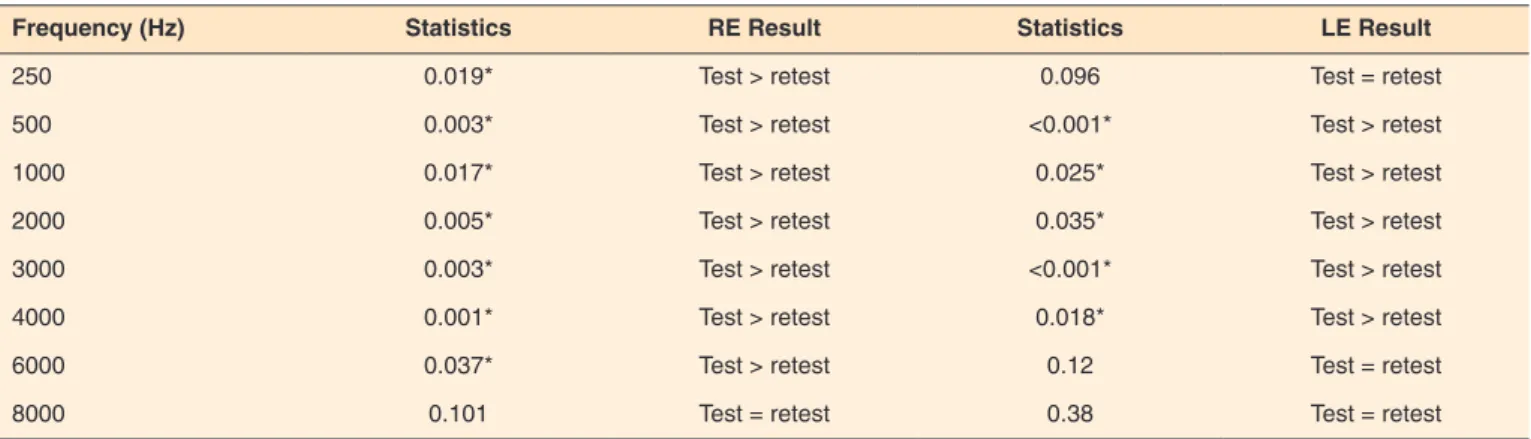
The supra-aural earphones on the right ear, there was a sig-nificant difference in minor responses in the retest for almost all frequencies except for 8000 Hz (Table 2). In the left ear, there were differences regarding minor responses in the retest, 500 Hz, 1000 Hz, 2000 Hz, 3000 Hz and 4000 Hz.
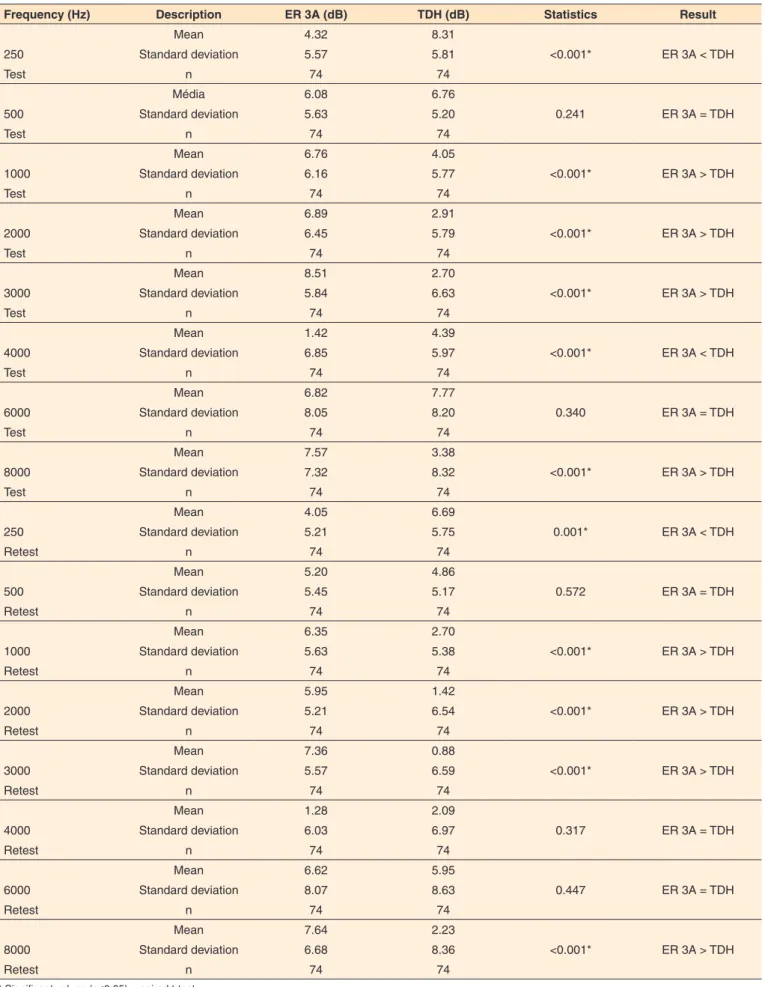
The comparative results between the transducers on the right ear shows that there were differences towards higher responses for TDH at 250 Hz in the test and retest and 4000 Hz in the test (Table 3). There was a greater difference compared to ER 3A responses in 1000, 2000, 3000 and 8000 Hz in both tests.
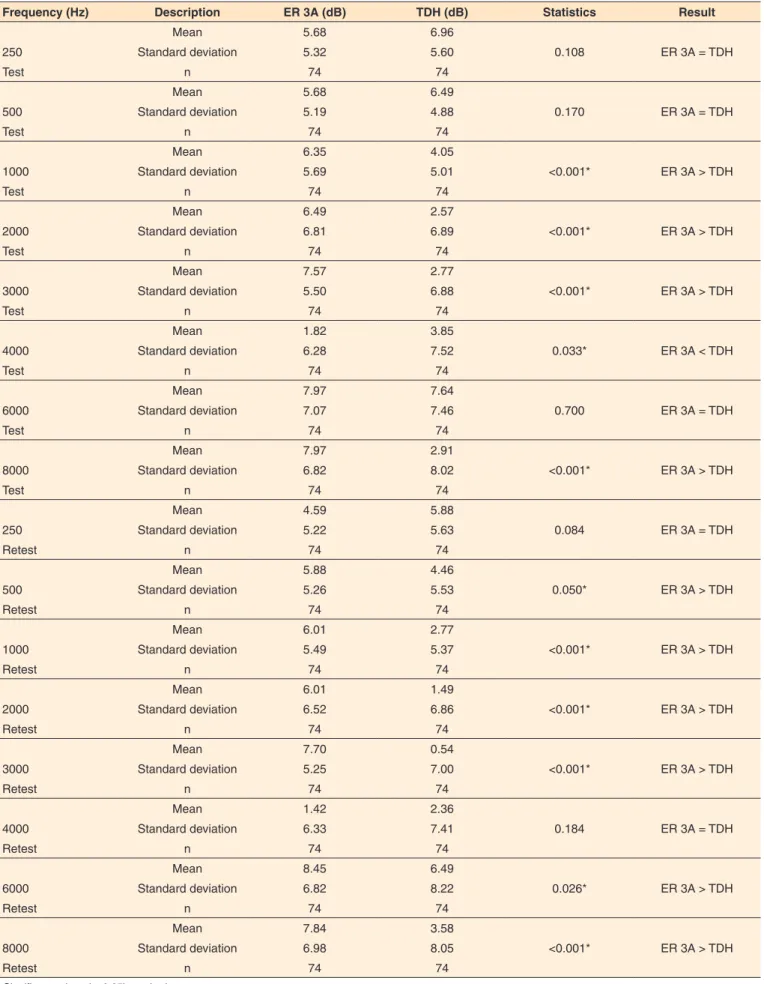
Comparing the transducers on the left ear, there were diffe-rences in higher responses to TDH in 4000 Hz in the test, and higher responses to ER 3A in 1000, 2000, 3000 and 8000 Hz in both tests, and 500 Hz and 6000 Hz in retesting (Table 4).
DISCUSSION
The supra-aural earphones showed a difference between
the mean in test and retest for most frequencies in both ears (Table 2), different from that observed with the insertion ear-phones (Table 1). Although these differences are significant, they were inferior to 5 dB at all frequencies, and clinically irrelevant, since the search range for the threshold is usually 5 dB.
Compared the results of the test and retest of frequen-cies, significant differences were found and there was better thresholds, which could be explained by learning effect, des-cribed by other authors, from which individuals take greater understanding of how the procedure is performed, becoming more attentive, less anxious and more sensitive, responding to retest more accurately(16).
Another result of this study it was found that the impro-vement profile is equal between the right and left ears at all frequencies except at 3000 Hz, it was found that the learning factor was more durable in the left ear than the right ear(16). In the present study, we found a difference in the opposite ear, but at the same frequency with the insertion earphones (Table 1).
The study showed similar results, which described the multinomial model. The authors stated that the probability of changing the threshold is 0 dB is higher than be 5 dB to +5 dB,
Table 1. Descriptive measures of hearing thresholds with insertion earphones ER 3A in the test-retest conditions
Frequency (Hz) Statistics RE Result Statistics LE Result
250 0.583 Test = retest 0.059 Test = retest
500 0.091 Test = retest 0.689 Test = retest
1000 0.477 Test = retest 0.532 Test = retest
2000 0.066 Test = retest 0.451 Test = retest
3000 0.043* Test = retest 0.798 Test = retest
4000 0.833 Test = retest 0.526 Test = retest
6000 0.778 Test = retest 0.485 Test = retest
8000 0.897 Test = retest 0.853 Test = retest
* Significant values (p≤0.05) – paired t-test
Note: RE = right ear; LE = left ear
Table 2. Descriptive measures of hearing thresholds with supra aural TDH 39 conditions in test-retest
Frequency (Hz) Statistics RE Result Statistics LE Result
250 0.019* Test > retest 0.096 Test = retest
500 0.003* Test > retest <0.001* Test > retest
1000 0.017* Test > retest 0.025* Test > retest
2000 0.005* Test > retest 0.035* Test > retest
3000 0.003* Test > retest <0.001* Test > retest
4000 0.001* Test > retest 0.018* Test > retest
6000 0.037* Test > retest 0.12 Test = retest
8000 0.101 Test = retest 0.38 Test = retest
* Significant values (p≤0.05) – paired t-test
Table 3. Descriptive measures of hearing thresholds comparing both transducers, the test-retest conditions in the right ear
Frequency (Hz) Description ER 3A (dB) TDH (dB) Statistics Result
Mean 4.32 8.31
250 Standard deviation 5.57 5.81 <0.001* ER 3A < TDH
Test n 74 74
Média 6.08 6.76
500 Standard deviation 5.63 5.20 0.241 ER 3A = TDH
Test n 74 74
Mean 6.76 4.05
1000 Standard deviation 6.16 5.77 <0.001* ER 3A > TDH
Test n 74 74
Mean 6.89 2.91
2000 Standard deviation 6.45 5.79 <0.001* ER 3A > TDH
Test n 74 74
Mean 8.51 2.70
3000 Standard deviation 5.84 6.63 <0.001* ER 3A > TDH
Test n 74 74
Mean 1.42 4.39
4000 Standard deviation 6.85 5.97 <0.001* ER 3A < TDH
Test n 74 74
Mean 6.82 7.77
6000 Standard deviation 8.05 8.20 0.340 ER 3A = TDH
Test n 74 74
Mean 7.57 3.38
8000 Standard deviation 7.32 8.32 <0.001* ER 3A > TDH
Test n 74 74
Mean 4.05 6.69
250 Standard deviation 5.21 5.75 0.001* ER 3A < TDH
Retest n 74 74
Mean 5.20 4.86
500 Standard deviation 5.45 5.17 0.572 ER 3A = TDH
Retest n 74 74
Mean 6.35 2.70
1000 Standard deviation 5.63 5.38 <0.001* ER 3A > TDH
Retest n 74 74
Mean 5.95 1.42
2000 Standard deviation 5.21 6.54 <0.001* ER 3A > TDH
Retest n 74 74
Mean 7.36 0.88
3000 Standard deviation 5.57 6.59 <0.001* ER 3A > TDH
Retest n 74 74
Mean 1.28 2.09
4000 Standard deviation 6.03 6.97 0.317 ER 3A = TDH
Retest n 74 74
Mean 6.62 5.95
6000 Standard deviation 8.07 8.63 0.447 ER 3A = TDH
Retest n 74 74
Mean 7.64 2.23
8000 Standard deviation 6.68 8.36 <0.001* ER 3A > TDH
Retest n 74 74
* Significant values (p≤0.05) – paired t-test
Table 4. Descriptive measures of hearing thresholds comparing both transducers, the test-retest conditions in the left ear
Frequency (Hz) Description ER 3A (dB) TDH (dB) Statistics Result
Mean 5.68 6.96
250 Standard deviation 5.32 5.60 0.108 ER 3A = TDH
Test n 74 74
Mean 5.68 6.49
500 Standard deviation 5.19 4.88 0.170 ER 3A = TDH
Test n 74 74
Mean 6.35 4.05
1000 Standard deviation 5.69 5.01 <0.001* ER 3A > TDH
Test n 74 74
Mean 6.49 2.57
2000 Standard deviation 6.81 6.89 <0.001* ER 3A > TDH
Test n 74 74
Mean 7.57 2.77
3000 Standard deviation 5.50 6.88 <0.001* ER 3A > TDH
Test n 74 74
Mean 1.82 3.85
4000 Standard deviation 6.28 7.52 0.033* ER 3A < TDH
Test n 74 74
Mean 7.97 7.64
6000 Standard deviation 7.07 7.46 0.700 ER 3A = TDH
Test n 74 74
Mean 7.97 2.91
8000 Standard deviation 6.82 8.02 <0.001* ER 3A > TDH
Test n 74 74
Mean 4.59 5.88
250 Standard deviation 5.22 5.63 0.084 ER 3A = TDH
Retest n 74 74
Mean 5.88 4.46
500 Standard deviation 5.26 5.53 0.050* ER 3A > TDH
Retest n 74 74
Mean 6.01 2.77
1000 Standard deviation 5.49 5.37 <0.001* ER 3A > TDH
Retest n 74 74
Mean 6.01 1.49
2000 Standard deviation 6.52 6.86 <0.001* ER 3A > TDH
Retest n 74 74
Mean 7.70 0.54
3000 Standard deviation 5.25 7.00 <0.001* ER 3A > TDH
Retest n 74 74
Mean 1.42 2.36
4000 Standard deviation 6.33 7.41 0.184 ER 3A = TDH
Retest n 74 74
Mean 8.45 6.49
6000 Standard deviation 6.82 8.22 0.026* ER 3A > TDH
Retest n 74 74
Mean 7.84 3.58
8000 Standard deviation 6.98 8.05 <0.001* ER 3A > TDH
Retest n 74 74
* Significant values (p≤0.05) – paired t-test
and will be even lower than -10 dB to +10 dB. These authors also showed that when compared to other models, most of the time there is an improvement of 20 dB thresholds at 6 kHz(10). Some authors have reported that variability is higher for supra-aural earphones at 6 and 8 kHz than at other frequen-cies, creating a false-positive result. To solve this problem, recommend the use of insert earphones, which produce a uniform variability in the frequencies of 0.5 to 8 kHz(11). In this study, it was observed that the variability in the test-retest in all studied frequencies with insertion and supra-aural ear-phones were uniform, ie, a change in tone thresholds from 0 to in maximum 3 dB, according to the study cited.
The findings of this study were significant but clinically irrelevant, since at all frequencies and for both ears, no results varied by more than 5 dB that is the minimum intensity level to the threshold search in Brazilian clinical practice. These findings are in agreement with the findings of studies by different authors, in which the test thresholds and retest with the same transducers studied in this research were analyzed, but without comparing the results between the transducers. The authors observed differences between the test and retest responses, but the results were not significant and are not considered important in clinical practice(12,13).
Despite the supra-aural earphones be considered standard in the realization of pure tone audiometry, it observed that it produced higher test-retest variability when compared to the insertion earphones (Tables 1 and 2). In comparison of a transducer with the other it has been found that, both in the first and in the second test, responses were shown to be sometimes similar, sometimes favoring one or the other transducer, showing in general higher responses for insertion earphones (Tables 3 and 4), not agreeing with recent studies that have shown that the insertion receiver provides best hearing thresholds, both at low frequencies as in the high when compared to obtaining thresholds with supra-aural earphones(17,18).
In general, it was observed that despite the insertion earphones have produced higher responses, it produced less variability between tests and showed better performance at low frequencies. But the supra-aural earphones performed better at high frequencies, results expected by the response curve for each frequency transducer(7).
CONCLUSION
There was a greater test-retest variability with supra-aural earphones than with insertion earphones, and better thresholds in the retest condition for the insertion earphones. However, the best threshold condition for the retest both transducers were checked. There was no significant clinical impact, confirming the stability of the transducers in the comparisons between tests, giving credibility to the audiological diagnosis.
REFERENCES
1. Santos TMM, Russo ICP. A prática da audiologia clínica. 5a ed. São Paulo: Cortez; 2005.
2. Zwislocki JD, Kruger B, Miller JD, Niemoeller AF, Shaw EA, Studebacker G. Earphones in audiometry. J Acoust Soc Am. 1988;83(4):1688-9.
3. Killion MC, Villchur E. Comments on “Earphones in Audiometry”. J Acoust Soc Am. 1989;85(4):1755-78.
4. Lilly DJ, Purdy J K. On the routine use of tubephone insert earphones. Am J Audiol. 1993;2:17-20. doi:10.1044/1059-0889.0201.17
5. Ramos JMP, Dabbur RR, Gil D. Atenuação interaural: estudo comparativo com dois tipos de transdutores. Rev Soc Bras Fonoaudiol. 2009;14(4):498-502. doi:10.1590/S1516-80342009000400012
6. Clemis JD, Ballad WJ, Killion MC. Clinical use of an insert earphone. Ann Otol Rhinol Laryngol. 1986;95(5):520-4. doi:10.1177/000348948609500515
7. Gil D, Borges ACLC. Fones de inserção: um estudo em indivíduos audiologicamente normais. Rev Bras Otorrinolaringol. 2001;67(4):480-7.
8. Marangoni AT, Gil D. Influência do tipo de transdutor na deficiência auditiva de grau profundo. Pro Fono. 2009;21(3):195-200. doi:10.1590/S0104-56872009000300003
9. Yantis PA. Avaliação dos limiares auditivos por via aérea. In: Katz J. Tratado de Audiologia Clínica. 4a ed. São Paulo: Manole; 1999. 97-108.
10. Schlauch RS, Carney E. A Multinomial model for identifying significant pure-tone threshold shifts. J Speech Lang Hear Res. 2007;50(6):1391-403. doi:10.1044/1092-4388(2007/097)
11. Schmuziger N, Probst R.; Smurzynski J. Test-retest reliability of pure-tone thresholds from 0.5 to 16 kHz using Sennheiser HAD 200 and Etymotic Research ER-2 earphones. Ear Hear. 2004;25(2):127-32. doi:10.1097/01.AUD.0000120361.87401.C8
12. Stuart A, Stenstromb R, Tompkins C, Vandenhoff S. Test-retest variability in audiometric threshold with supraaural e insert earphone among children and adults. Audiology. 1991;30(2):82-90. doi:10.3109/00206099109072873
13. Swanepoel DW, Mngemane S, Molemong S, Mkwanazi H, Tutshini S. Hearing assessment: reliability, accuracy, and efficiency of automated audiometry. Telemed J E Health. 2010;16(5):557-63. doi:10.1089/tmj.2009.0143
14. Munhoz MSL, Caovilla HH, Silva MLG, Ganança MM. Audiologia clínica. São Paulo: Atheneu; 2000.
15. Wilber LA, Kruger B, Killion MC. Reference thresholds for the ER-3A insert earphone. J Acous Soc Am. 1988;83(2):669-76. doi:10.1121/1.396162
17. Oda DTM, Marangoni AT, Gil D. Fones de inserção e fones supra-aurais: avaliação audiológica em idosos. Rev CEFAC. 2014;16(1):31-8. doi:10.1590/1982-021620148012