© 2011 Museu de Ciències Naturals ISSN: 1578–665X
Rivera–Ingraham, G. A., Espinosa, F. & García–Gómez, J. C., 2011. Conservation status and updated census of Patella ferruginea (Gastropoda, Patellidae) in Ceuta: distribution patterns and new evidence of the effects of environmental parameters on population structure. Animal Biodiversity and Conservation, 34.1: 83–99. Abstract
Conservation status and updated census of Patella ferruginea (Gastropoda, Patellidae) in Ceuta: distribution patterns and new evidence of the effects of environmental parameters on population structure.— The Strait of Gibraltar has important populations of the highly endangered patellid limpet Patella ferruginea. Between 2006 and 2010, an exhaustive census was carried out in Ceuta. The total coastline was divided into 17 sectors. The coast of each sector was examined by using 10 m transects. For the case of those sectors composed of breakwaters, jetties or islets, no transects were used, and instead, the total number of individuals was recorded. Each individual was measured to the nearest millimetre using a calliper. Moreover, the complete rocky shore length where the species could potentially be present was calculated, and an estimation of the total number of individuals that each sector could host was made. Results indicate that Ceuta could be home to around 44,000 individuals. The species found in Point Benzú, its westernmost limit of distribution on the North African coasts. The largest populations were recorded on the South Bay, with higher Mediterranean inluence. Our results indicate that substrate roughness (topographic heterogeneity) and the area’s accessibility highly inluence the abundance and population structure. Those populations located on high topographic heterogeneity substra-tes show higher recruitment rasubstra-tes and lower percentages of larger individuals, while medium to low rugosity surfaces presented the opposite pattern. Additionally, easily accessible areas (and frequented by humans) presented smaller average shell sizes. Implications of the results for conservation purposes are discussed. Key words: Limpet, Patella ferruginea, Endangered species, Conservation, Substrate roughness, Strait of Gibraltar, Ceuta.
Resumen
Estado de conservación y censo actualizado de Patella ferruginea (Gastropoda, Patellidae) en Ceuta: patrones de dsitribución y nueva evidencia de los efectos de los parámetros ambientales en la estructura de la población.— El Estrecho de Gibraltar presenta importantes poblaciones de la lapa Patella ferruginea altamente amenazada. Entre 2006 y 2010, se llevó a cabo un censo exhaustivo en Ceuta. La totalidad de la costa fue dividida en un total de 17 sectores. Se examinó el litoral de cada uno de estos sectores empleando transectos de 10 m. Para el caso de aquellos sectores compuestos por escolleras, espigones o islotes, no se emplearon estos transectos, y se registró el número total de individuos. Cada individuo fue medido por medio de un pie de rey con precisión de un milímetro. Además, se estimó la longitud total de costa rocosa que podría potencialmente presentar individuos y se realizó una estimación del número total de individuos que podría albergar cada sector. Los resultados indican que Ceuta podría presentar en torno a 44.000 individuos. La especie demostró tener en Punta Benzú su límite occidental de distribución en el Norte de África. Las poblaciones más importantes fueron registradas en la Bahía Sur, con importante inluencia mediterránea. Nuestros resultados indican que la rugosidad del sustrato (heterogeneidad topográica) y la accesibilidad de la zona inluencian en gran medida la abundancia y la estructura de las poblaciones. Aquellas que se localizan sobre sustratos de alta heterogeneidad topográica muestran mayores tasas de reclutamiento y menores porcentajes de individuos de gran tamaño, mientras que los sustratos de media a baja rugosidad muestran el patrón contrario. Además, aquellas áreas
Conservation status and updated
census of
Patella ferruginea
(Gastropoda, Patellidae) in Ceuta:
distribution patterns and new evidence
of the effects of environmental
parameters on population structure
fácilmente accesibles (y frecuentadas por el ser humano) presentan poblaciones con tallas medias menores. Se discuten las posibles implicaciones de los resultados de cara a la conservación de la especie.
Palabras clave: Lapa, Patella ferruginea, Especies amenazadas, Conservación, Rugosidad del sustrato, Estrecho de Gibraltar, Ceuta.
Georgina Alexandra Rivera–Ingraham, Free Espinosa & Jose Carlos García–Gómez, Lab. de Biología Marina, Depto. de Fisiología y Zoología, Univ. de Sevilla, Av. Reina Mercedes 6, 41012 Sevilla, España (Spain).
Introduction
The patellid limpet Patella ferruginea is an intertidal species endemic to the Mediterranean. It was widely distributed throughout the Western Mediterranean basin during the Pleistocene (Caton–Thompson, 1946; Laborel–Deguen & Laborel, 1991a) and its presence on European and North African coasts was recorded until the end of the 19th century. But it was in the beginning of the 20th century when the species started to suffer clear regression (Laborel–Deguen & Laborel, 1991a; Templado, 2001). Nowadays, the species has almost completely disappeared from European waters (Templado & Moreno, 1997). Its presence has been recorded in Southern Spain (Espinosa, 2006; Moreno & Arroyo, 2008) (where 700 individuals have been located, most of them present in Algeciras Bay). It can also be found on the coasts of Alborán Island (Paracuellos et al., 2003; Templado et al., 2006), North and Western Corsica (Laborel–Deguen & Laborel, 1991a; Curini–Galletti, pers. com.; Rivera–Ingraham et al., pers. obs.), Sardinia (Porcheddu & Milella, 1991; Doneddu & Manunza, 1992; Cristo et al., 2007; Cristo & Caronni, 2008; Rivera–Ingraham et al., pers. obs.), Pantellaria and Egadi Islands (Laborel–Deguen & Laborel, 1991a) and Tuscany (Italian peninsula) (Curini–Galletti, 1979; Biagi & Poli, 1986). In any case, the most important populations are currently located on the North African Coasts: Ceuta (Guerra–García et al., 2004; Espinosa, 2006; Espinosa et al., 2009), Melilla (González García et al., 2006), Chafarinas Islands (Guallart et al., 2006), Morocco (Bazairi et al., 2004), the Algerian isles of Rachgoun (Frenkiel, 1975) and Habibas (Boumaza & Semroud, 2001; Espinosa, 2009) and reaching Cape Bon (Espinosa, 2006) and Zembra Island (Boudouresque & Laborel–Deguen, 1986) (Tunisia).
This regression has been mainly caused by human exploitation (Aversano, 1986; Guerra–García et al., 2004; Moreno, 2004) which takes place in the highly accessible intertidal habitat (Raffaelli & Hawkins, 1996; Haedrich & Barnes, 1997; Rochet & Trenkel, 2003) where the species lives. It is commonly collected to be used as food, as ishing bait because of its muscular foot (Pombo & Escofet, 1996) or even for ornamental purposes, as happens with other big intertidal limpets such as Lottia gigantea (Lindberg et al., 1998; Kido & Murray, 2003). The species is presently considered as the most endangered marine invertebrate species on the Western Mediterranean rocky coasts (Labo-rel–Deguen & Laborel, 1991a; Ramos, 1998), and is protected at a European level (Annex II of Berne Convention; Annex IV of the Habitats Directive; Annex II of Barcelona Convention) as well as by Spanish laws (National Catalogue of Threatened Species; Andalusian Catalogue of Endangered Species).
Little is known regarding the biology of the species (Guerra–García et al., 2004) although many studies have been recently conducted in order to provide more information (e.g. Espinosa, 2006; Rivera–Ingraham, 2010). In this sense, the Spanish National Strategy for the Conservation of P. ferruginea has also been recently approved (MMAMRM, 2008) with the objective of
pro-moting activities that could contribute to the knowledge of the species and obtain the necessary information to propose adequate conservation measures. One of these objectives is to obtain updated quantitative data regarding the distribution and the conservational status of the species, by developing detailed censuses. Some other authors like Paracuellos et al. (2003) have also pointed out the interest of quantifying the remaining P. ferruginea populations. The aim of the present study was to achieve a complete description of the meta-population of P. ferruginea in Ceuta, and to estimate the total number of individuals present in the area. Special attention is paid to the inluence of substrate roughness and the area’s accessibility on the species distribution and population structures.
Material and methods
Study site
The study was conducted in Ceuta, located on the African coast of the Strait of Gibraltar (ig. 1A), which is known to have important P. ferruginea populations (see Guerra–García et al., 2004; Espinosa, 2006; Espinosa et al., 2009). The coasts of this city are composed of natural rocky shores, beaches and small rocky islets. We also ind many artiicial jetties (especially on the South Bay). The city’s commercial port has the peculiarity of being connected with the North Bay (through the port’s main entrance) and with the South Bay through a moat.
Sampling methods
jetties, breakwaters and those islets that are not completely submerged during high tide, the total pe-rimeter was measured, again using a metric tape, and a complete census was carried out when possible. The complete coastline was inspected from 2006 to 2010. Additionally, and for each of the prospected locations, some physical parameters were recorded: i) type of substrate (natural/artiicial), considering as an artiicial substrate any man–made structure, regardless of the origin of the substrate itself (e.g. Fauvelot et al., 2009; Bulleri & Chapman, 2010); ii) accessibility by humans, dividing areas into three categories: (a) high, easily accessible areas where it is common to ind people collecting intertidal organ-isms; (b) medium, areas relatively easy to access and where it is not frequent ind people at intertidal levels;
and (c) low, areas which are dificult or cannot be ac-cessed by land, and where no collection presumably occurs; and iii) substrate roughnessor topographical heterogeneity index (THI), calculated as in Blanchard & Bourget (1999): THI = Tr/Ts, where Tr is the actual distance between two points (measured following the substrate’s irregularities) and Ts the linear distance between the two same points. Substrates were again classiied into three categories: (a) high roughness (THI >1.30); (b) medium roughness (THI = 1.30–1.15); and (c) low roughness (THI < 1.15). It is also important to note that in the present study, the total number of individuals present in Ceuta is considered to constitute a metapopulation, which would be composed of dif-ferent sub–populations that are genetically connected (see review by Badii & Abreu, 2006).
Fig. 1. A. Location of Ceuta; B. Sectors the study site was divided into to estimate the total number of individuals of P. ferruginea.
Fig. 1. A. Localización de Ceuta; B. Sectores en los que fue dividida la zona de estudio para la estima-ción del número total de individuos de P. ferruginea.
14º 9º 4º 1º 45º 6º
40º
35º Atlantic
Ocean Mediterranean Sea 40º
35º
Morocco
North Bay
South Bay 5.23º 5.22º 5.21º 5.20º 5.19º 5.18º 5.17º
5.20º 5.19º 5.18º 5.17º 35.54º
35.53º
35.55º
35.53º
35.52º A
B
500 km
2.5 km
Ceuta
B A
C D E F G
H I J K L M N O P Q
Statistical analyses
Univariate analyses were carried out using the statistical package SPSS 15.0. One and two–way ANOVA tests were carried out between several physical parameters (nature of substrate (natural/ artiicial), sector location (North Bay, South Bay or Port) and substrate roughness) and the most com-mon population parameters (density of individuals per size class, adult average shell size, maximum shell size, adult density and total density). Finally, and taking into account that the reduction of data to summary statistics (such as means, medians, etc.) for comparisons can signiicantly reduce the amount of available information (Sagarin et al., 2007), mul-tivariate analyses were also conducted to compare size distributions among populations, as has been satisfactorily used by other authors (e.g. Sagarin et al., 2007; Espinosa, 2009). In order to do this, the total number of individuals for each size class (1 cm intervals) and sector was used. But considering that
the total length of shoreline inspected varied conside-rably between locations, these frequency values were standardized by transforming them to percentages (over the total number of recorded individuals in the sector). Additionally, these data were later transformed to log (x+1) to homogenize variances. An MDS (Mul-ti–dimensional scaling) analysis was carried out using PRIMER–E v.6.0 and based on the UPGMA (Unweigh Pair–Group Method using arithmetic means) method and the Bray–Curtis similarity index (Bray & Curtis, 1957). Moreover, the Kruskal stress coeficient was used to determine ordination (Kruskal & Wish, 1978).
Results
P. ferruginea distribution and abundance
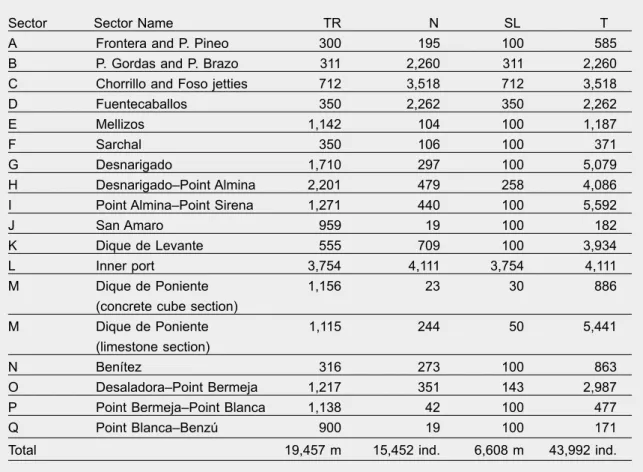
Throughout the study, a total of 6,608 m of Ceuta’s rocky shores was surveyed (33.96% of the total rocky shore that could potentially house P. ferruginea Table 1. Data corresponding to each of the considered sectors: TR.Total rocky shore length (m); N. Number of individuals recorded; SL. Shore length inspected; T. Total number of individuals
Tabla 1. Datos correspondientes a cada uno de los sectores considerados: TR. Longitud total de la orilla rocosa (m); N. Número de individuos registrados; SL. Longitud de costa inspeccionada; T. Número total de individuos.
Sector Sector Name TR N SL T
A Frontera and P. Pineo 300 195 100 585
B P. Gordas and P. Brazo 311 2,260 311 2,260
C Chorrillo and Foso jetties 712 3,518 712 3,518
D Fuentecaballos 350 2,262 350 2,262
E Mellizos 1,142 104 100 1,187
F Sarchal 350 106 100 371
G Desnarigado 1,710 297 100 5,079
H Desnarigado–Point Almina 2,201 479 258 4,086
I Point Almina–Point Sirena 1,271 440 100 5,592
J San Amaro 959 19 100 182
K Dique de Levante 555 709 100 3,934
L Inner port 3,754 4,111 3,754 4,111
M Dique de Poniente 1,156 23 30 886
(concrete cube section)
M Dique de Poniente 1,115 244 50 5,441
(limestone section)
N Benítez 316 273 100 863
O Desaladora–Point Bermeja 1,217 351 143 2,987
P Point Bermeja–Point Blanca 1,138 42 100 477
Q Point Blanca–Benzú 900 19 100 171
individuals), inding 15,452 individuals. Therefore, we estimated that Ceuta’s metapopulation is composed of 43,992 individuals (table 1).
Figure 2 shows how the South Bay of Ceuta is home to more important P. ferruginea subpopulations. Although it is frequent to ind P. ferruginea subpo-pulations in the North Bay, they became scarcer as we moved towards the Atlantic. In fact, the density of adult individuals (> 25 mm) in the South Bay (4.90 ± 7.46 ind./m) was signiicantly higher than the average values recorded for subapopulations located in the North Bay (1.44 ± 1.64 ind./m) and inside the commercial port (1.45 ± 2.02 ind./m) (x2 = 7.51;
p = 0.023). It is also interesting to note the spatial distribution of individuals in certain areas such as the artiicial breakwaters located in the southern area of the commercial port as well as on the jetties located in the South Bay (ig. 3). It was evident that the maximum densities of individuals were found within the inaccessible areas of Parque del Mediterráneo and the Guardia Civil’s base. Jetties also showed
important densities, especially in the inner sides of these structures (those oriented towards the moat exit) and preferentially in their endings.
Effect of physical parameters on population structure Information regarding the subpopulations’ size structures is represented in igure 4 and table 2. When taking into account these values and the physical parameters recor-ded in each sector, the following results were obtained: Effect of the nature of substrate and sector location The nature of substrate (natural vs. artiicial) did not seem to inluence any of the above mentioned popu-lation parameters. However, a one–way ANOVA test showed that the areas inside the port presented the highest maximum shell size values (8.89 ± 1.16 cm), higher than the values recorded in the North Bay (7.18 ± 1.19 cm) and the South Bay (8.12 ± 1.06 cm) (F = 4.87; p = 0.016). In fact, it was inside the port Fig. 2. General distribution of P. ferruginea in Ceuta, general view. Circle diameter corresponds to the density of individuals. Coastline sections plotted with thicker lines indicate the location of non–suitable areas (e.g. beaches) for the species. Light grey circles indicate the density recorded for each transect established (except for sectors H and I where only ive transects are represented due to lack of space), while darker circles represent the density of individuals in an area where a complete census of the coastline was carried out. The discontinuous line indicates the inaccesssible areas of the port.
Fig. 2. Distribución general de P. ferruginea en Ceuta, vista general. El diámetro de los círculos se corresponde con la densidad de individuos registrados. Aquellas secciones de costa marcadas con trama más gruesa indican la localización de zonas (p. ej. playas) no adecuadas para la especie. Los círculos claros representan la densidad registrada en cada uno de los transectos realizados (excepto para los sectores H e I para los que sólo se han representado cinco por falta de espacio), mientras que los oscuros representan la densidad media total en la zona tras la realización de un censo completo. La línea discontinua indica las zonas inaccesibles del puerto.
Morocco
North Bay
South Bay Ceuta
2.5 km
Fig. 3. Density of P. ferruginea individuals on the breakwaters of the southern area of the commercial port and on the jetties of the South Bay. The area represented has been completely censused. Circles represent density values grouped in 30 m stretches to visualize the spatial distribution of individuals. The inaccessible areas of the port (Parque del Mediterráneo and the Guardia Civil’s base) are surrounded by a discontinuous line. The small arrow indicates the location of a wastewater outfall. Note the important inluence of substrate inaccessibility and the presence of the outfall on the density of individuals. The two large arrows indicate the direction of water currents with east winds (light grey arrow) and west winds (right dark grey arrow). Fig. 3. Densidad de individuos de P. ferruginea en las escolleras del sur del puerto comercial así como en los principales espigones de la Bahía Sur. Toda el área mostrada ha sido completamente censada. Los círculos representan valores de densidad agrupados en tramos de 30 m para la visualización de la distri-bución de individuos. Las zonas inaccesibles del puerto (Parque del Mediterráneo y la base del servicio marítimo de la Guardia Civil) estan enmarcadas con una línea discontinua. La lecha indica la localización de un emisario aguas. Nótese la importante inluencia de la inaccesibilidad de la zona y la presencia del emisario sobre la densidad de individuos. Las dos lechas grandes indican la dirección de las corrientes de agua con vientos de levante (lecha clara) y vientos de poniente (lecha oscura).
(within the Guardia Civil’s military base) where the largest individual (10.7 cm) was located. No signiicant differences were recorded between the North and South Bays regarding this parameter.
Effect of substrate roughness and accessibility on population structure
After conducting a multivariate analysis of classiication (based on population size structures) igure 5 was ob-tained. Figure 5A shows how for an 80% similarity, a total of four groups of subpopulations can be differenced: irst, sectors P, F, G, K, N, C and D were found, all of them characterized for presenting a clear predominan-ce of small (< 25 mm) and medium (25–50 mm) size individuals, and where the largest individuals (> 50 mm) represented less than 20% of the subpopulation. These subpopulations were subject to medium to high impact by collection, and were also located on medium to high
THI substrates (ig. 5B). The second group was compo-sed of sectors L, H, I, A, B, E, M y Q. Subpopulations in these areas were mainly composed of medium and large size individuals, while small individuals (< 25 mm) only represented up to 25% of the subpopulation. Re-turning to igure 5B, it can be observed how individuals in these areas presented low impact by collection, and most of them were located on medium THI substrates. The cluster analysis detected sector J as signiicantly different from the rest of the areas considered, which was subject to medium collection impact. But the main characteristic of this area was the atypical substrates found in the area, composed of natural rocks of very low roughness. This was the only area where the largest individuals clearly dominated over the rest (47% of the total subpopulation). Finally, sector O was also clearly segregated from the rest of sectors, and it was the only area where juveniles (< 25 mm) clearly dominated the subpopulation (71%).
0 ind. < 2 ind./m 2–4 ind./m 4–6 ind./m > 6 ind./m Chorrillo
main jetty Chorrillo western jetty
Chorrillo eastern jetty
Table 2. Summary statistics for Patella ferruginea sizes (cm) for each subpopulation considered in the study: Sc. Sector; Sp. Subpopulation; TS. Type of substrate (N. Natural; Ar. Artiicial riprap; Asw. Artiicial sea wall); D. Density (ind./m); R. Recruit density (ind./m, < 25 mm); As. Average shell size (cm); Ms. maximum shell size (cm); K. Kurtosis († kurtosis is considered signiicative when its absolute value is greater than 2*SE kurtosis); Kt. Kurtosis type (Pk. Platikurtic; Lk. Leptokurtic ); Sk. Skewness (Skew is considered signiicative when its absolute value is greater than 2*SE Skew); Am. Asymmetry (P. Positive; N. Negative).
Tabla 2. Resumen de las estadísticas de los tamaños de Patella ferruginea (en cm) para cada subpoblación considerada en el estudio. Sc. Sector; Sp. Subpoblación; TS. Tipo de sustrato (N. Natural; Ar. Escollera artiicial; Asw. Muro marino artiicial); D. Densidad (ind./m); R. Densidad de reclutamiento (ind./m, < 25 mm); As. Tamaño medio de la valva (cm); Ms. Tamaño máximo de la valva (cm); K. Curtosis († la curtosis se considera signiicativa cuando su valor absoluto es mayor que el doble de su EE); Kt. Tipo de curtosis (Pk. Platicúrtica; Lk. Leptocúrtica); Sk. Coeiciente de asimetría (la desviación se considera signiicativa cuando su valor absoluto es mayor que el doble de su EE); Am. Asimetría (P. Positiva; N. Negativa).
Sc Sp TS D R As Ms K Kt Sk Am A Frontier shoreline N 2.68 0.28 4.58 8.20 –0.796 – 0.132 –
A 'Pineo' islet N 6.77 0.18 4.25 7.50 –0.643 – –0.281 –
B 'Piedras Gordas' islets N 6.71 1.44 4.12 9.20 –0.866† Pk 0.092 –
B 'Brazo' islet N 35.14 5.71 4.68 8.80 –1.157† Pk –0.246 –
C Chorrillo main jetty Ar 6.86 0.73 4.28 8.60 –0.198 – –0.082 – C Chorrillo western jetty Ar 6.36 4.03 2.44 6.10 0.554† Lk 0.899* P
C Chorrillo eastern jetty Ar 1.87 0.91 2.99 7.50 –0.247 – 0.695* P
C Foso jetty Ar 4.31 1.08 3.65 8.70 –0.290 – 0.407* P
D Fuentecaballos jetty Ar 6.46 2.18 3.47 9.30 –0.406† Pk 0.521* P
E Mellizos N 1.04 0.01 4.42 8.40 1.684† Lk 1.091* P
F Sarchal N 1.06 0.20 3.47 6.40 –0.326 – 0.581 –
G Desnarigado N 2.97 0.75 3.34 7.50 –0.027 – 0.252 –
H Desnarigado–Point Almina N 1.86 0.07 4.36 9.70 –0.842† Pk 0.254* P
I Point Almina–Point Sirena N 4.40 0.84 5.09 9.40 –0.715† Pk 0.212 –
J San Amaro N 0.19 0.04 4.40 6.90 –1.032 – –0.500 –
K Dique de Levante Ar 7.09 2.81 3.10 7.80 –0.534† Pk 0.372* P
L Parque del Mediterráneo Ar 6.81 1.71 3.67 10.00 0.881† Lk 1.125* P
L Dique del Comercio Ar 2.61 0.83 3.20 7.60 0.614† Lk 0.664* P
L S. M. Guardia Civil Ar 2.92 0.35 6.30 10.7 –0.571 – –0.648* N L Muelle de España Asw 0.10 0.02 3.84 8.00 –0.268 – 0.573* P L Muelle de Poniente Asw 0.13 0.01 4.84 9.50 –0.399 – 0.309 – L Muelle de Babor Asw 0.08 0.01 4.85 7.70 –0.546 – –0.113 –
L Interior Foso Asw 0.04 0.01 4.58 8.90 –0.695 – 0.422 –
M D. Poniente Ar 0.77 0.10 4.81 9.70 –0.846 – –0.186 –
(concrete cube section)
M D. Poniente Ar 4.88 1.18 3.58 6.60 –0.636† Pk 0.198* P
(limestone section)
N Benítez Ar 2.73 1.02 3.00 6.60 –0.903† Pk 0.167 –
O Desaladora–Point Bermeja N 0.95 0.26 3.31 6.90 –0.641 – 0.306 – (natural substrate section)
O Desaladora–Point Bermeja Ar 4.36 3.62 1.68 5.60 2.169† Lk 1.673* P
(breakwater section)
Two–way ANOVA tests were conducted to deine the effects of the substrate’s accessibility and topo-graphical heterogeneity on population structure and density. Results indicate that adult average shell size was inluenced by accessibility (table 3). However, overall adult density was not apparently inluenced by
either of these two factors. However, igure 6 shows how substrate roughness alone may be inluencing subpopulation density and structure. In this igure, the differences in density of small individuals (< 25 mm) among substrates are noticeable, the maximum be-ing observed in high THI surfaces (ig. 6). Substrate Fig. 4. Size frequencies for each of the sectors considered. Letters correspond to the code used in table 1 and igure 1: 1(0–1), 2 (1–2), 3 (2–3), 4 (3–4), 5 (4–5), 6 (5–6), 7 (6–7), 8 (7–8), 9 (8–9), 10 (9–10), 11 (10–11). Fig. 4. Frecuencias de tamaños para cada uno de los sectores considerados. Las letras corresponden al código usado en la tabla 1 y la igura 1. (Para las abreviaturas de los tamaños de clase, ver arriba.)
A B C D
E F G H
I J K L
M N O P
Q
1 2 3 4 5 6 7 8 9 10 11 Size class (cm)
Fr
equenc
y
Fr
equenc
y
Fr
equenc
y
Fr
equenc
y
1,200 1,000 800 600 400 200 0
1,200 1,000 800 600 400 200 0
1,200 1,000 800 600 400 200 0
1,200 1,000 800 600 400 200 0
1,200 1,000 800 600 400 200 0
1 2 3 4 5 6 7 8 9 10 11 1 2 3 4 5 6 7 8 9 10 11 1 2 3 4 5 6 7 8 9 10 11 Size class (cm) Size class (cm) Size class (cm)
Fr
equenc
roughness may also inluence adult average size. In high THI substrates, adult individuals showed an average size of 4.30 ± 0.87 cm, while average values of 4.65 ± 0.51 cm and 4.81 ± 0.53 cm were recorded for subpopulations on medium and low THI surfaces, respectively.
To corroborate the abovementioned results, the speciic case of 'Dique de Poniente' was taken into consideration. This sector presents the same physi-cal parameters throughout the area, except for the fact that half of the breakwater is composed of high roughness rocks while the second half was construc-ted using smooth 3 x 3 m concrete cubes. The density of individuals recorded for the transects in each of these two subareas was compared using a one–way ANOVA, which showed that the area with the highest THI presented signiicantly higher densities of P. ferruginea individuals (4.88 ± 1.82 ind./m) than the cube area (0.77 ± 0.76 ind./m) (F = 13.24; p = 0.01). Moreover, adult average size in the concrete cube area (5.08 ± 0.40 cm) was signiicantly higher than that recorded for adults located on the other section of the mole (4.09 ± 0.20 cm) (F = 22.16; p = 0.005).
Discussion
After inspecting 33.96% of the coast of Ceuta that could potentially present P. ferruginea individuals, we estimated that the city is home to around 44,000 individuals. The methodology used in the study has been used successfully by other authors to estimate the total number of individuals in metapopulations, such as that in Habibas Islands (Espinosa, 2009) or Zembra Island (Boudouresque & Laborel–Deguen, 1986). Our estimation is considerably higher than those obtained by other authors who determined
that Ceuta holds between 12,000 (Guallart et al., 2006) and 3,704 individuals (Ocaña et al., 2010). Although in the latter cases the sampling effort was considerably lower, during the present study we were able to physically count more than 15,000 indi-viduals, supporting the fact that the aforementioned estimations clearly underestimated the total number of specimens in Ceuta. We can additionally highlight that our estimations can be considered conservative. It is known that the smaller the step (or scale) used in calculating a perimeter, the higher the values and better the estimations obtained (Mandelbrot, 1967). Taking into account that the perimeter of the coastline potentially used by the species has been calculated using 1:9,000 maps, we can suggest that we clearly underestimated this value, and in consequence, the total number of individuals. An additional focus of variability is found in the quantiication of the smallest fraction of the population (< 25 mm), which is often dificult to detect (e.g. Guallart et al., 2006; Espinosa, 2009). Although censuses were always carried out by the same experienced team (reducing the probability of missing these individuals), a considerable fraction of this variability is induced by the inter–annual diffe-rences in recruitment rates that have been recorded in the area (Rivera–Ingraham, 2010) and by the time of the year in which the censuses were carried out (in relation to the species’ reproduction period).
The most important P. ferruginea subpopulations (regarding density) were, in general terms, located in the South Bay of Ceuta, which is mainly inluenced by Mediterranean waters. On one hand, this result may seem surprising, specially taking into account that one of the main problems that P. ferruginea encounters is human collection (Laborel–Deguen & Laborel, 1991a, 1991b; Templado & Moreno, 1997; Ramos, 1998), and that the South Bay’s coastline is generally very acces-Table 3. Two–way ANOVA results for the inluence of the substrate’s accessibility and THI (topographical heterogeneity index) on adult average shell size (SS): n.s. Non signiicance; * P < 0.05.
Tabla 3. Resultados del ANOVA de dos factores para la inluencia de la accesibilidad y THI (índice de heterogeneidad topográica) sobre la talla media de los adultos (SS): n.s. No signiicativo; * P < 0,05.
Source of variation Mean ± SD (cm) SS F P
Accessibility 4.043 5.439 0.012*
High 4.04 ± 0.29
Medium 4.29 ± 0.61
Low 4.93 ± 0.71
Substrate THI 0.114 0.153 n.s.
High 4.30 ± 0.87
Medium 4.65 ± 0.51
Low 4.81 ± 0.53
sible and consequently highly frequented by ishermen. However, these subpopulations became scarcer as we moved towards the Northwestern coasts (with higher Atlantic inluence). This seems a predictable pattern, taking into account that we are dealing with a Medi-terranean endemic species. This type of distribution pattern has previously been pointed out by several
authors (Templado, 2001; Guerra–García et al., 2004; Espinosa, 2006). Guallart et al. (2006) considered that the western limit of distribution of this limpet on the North African coasts could be in Point Blanca, although we recorded considerably important subpopulations reaching Point Benzú (sector Q) (0.19 ind./m) (table 2). Indeed, no individuals have been found in the near Fig. 5. Multivariate analyses: A. Cluster analysis. Continuous lines indicate signiicantly different groups (SIMPROF analysis). B. Spatial representation of centroids (MDS) for each sector. Circle diameter is positively correlated with the area's substrate roughness (THI) (Blanchard & Bourget, 1999): High, > 1.30; Medium, 1.15–1.30; Low, < 1.15. Colours are associated with the different grades of impact by collection suffered by individuals in the area (High. Easily accessible areas, where it is common to ind people recollecting intertidal macroinvertebrates; Medium. Areas of relatively easy access, although they do not present high impact by collection; Low. Areas with dificult or no access by land to the intertidal fringe, and where no people have been seen).
Fig. 5. Análisis multivariante: A. Análisis de grupos. Las líneas continuas indican diferencias signiicativas entre grupos (análisis SIMPROF). B. Representación especial de centroides (MDS) para cada sector. El diámetro de los círculos está positivamente correlacionado con el coeiciente de rugosidad del área (THI) (Blanchard & Bourget, 1999): High, rugosidad alta > 1,30; Medium, rugosidad media, 1,15–1,30; Low, rugosidad baja, < 1,15. Los colores están asociados con los diferentes grados de impacto por recolección sufrido por los individuos de cada área (High. Áreas fácilmente accesibles, donde es habitual encontrar personas recogiendo macroinvertebrados intermareales; Medium. Áreas de relativamente fácil acceso, aunque no presentan altas tasas de impacto por recolección; Low. Áreas de difícil acceso o inaccesibles por tierra, donde no se han detectado personas durante todo el estudio).
A
B
70 75 80 85 90 95 100
Br
ay–Cur
tis
Similarity
P F G K N C D L H I A B E M Q J O Sectors
Transform Log (x+1)
Resemblance: S17 Bray–Curtis similarity
2D stress 0.11 Substrate rugosity High
Medium Low
Collection impact High
Medium Low H I B L
A M E
Q F
C D G N
K
O
P
Point Leona or Point Cires, although the former is separated from our sector Q by a long beach, meaning that Benzú could actually constitute the western limit of distribution of this species in northern Africa. On the other hand, the above mentioned authors also indicated that the highest densities were recorded inside the port. However, our results indicate that the densities recorded in the South Bay were signiicantly higher than those recorded inside the port. In any case, it should be taken into account that the aforementioned authors only inspected the breakwaters inside the port of Ceuta (Parque del Mediterráneo), while the present study considered its complete extension. Vertical and smooth substrates (e.g. sea walls) are clearly dominant in the port, and this seriously affected the average density values recorded in the area as the species is not frequent on this type of substrate (pers. obs.).
It is known that P. ferruginea is commonly present on artiicial rocks (Guerra–García et al., 2004). This is corroborated by the observations and results ob-tained from the present study. However, one of the main differences we observed between natural rocky shores and artiicial structures was related to substrate roughness and the presence of microstructures, which is supported by other authors (see review by Bulleri & Chapman, 2010). Our observations and results indi-cate that substrate THI may be playing an important role in recruitment processes and in consequence, also on the distribution of P. ferruginea. The substrates presenting the highest irregularities showed coefi-cients higher than 1.30 (using the equation provided by Blanchard & Bourget, 1999) and around 1.017 (Rivera–Ingraham, 2010) using fractal dimensions (Mandelbrot, 1967) [following an adapted method from Beck (2000) and using proile gauges to obtain rock proiles as in Frost et al. (2005)]. Statistical analyses showed that these surfaces presented the highest recruitment rates. It is known that the presence of irregularities in substrates is associated with high recruitment rates (as these structures can enhance settlement and provide shelter for juvenile limpets) (e.g. Creese, 1982) and may determine the distribution patterns of intertidal species such as barnacles (Crisp & Barnes, 1954) and gastropods (including limpets) (Beck, 2000; Underwood, 2004). However, it should be taken into consideration that high THI substrates also showed low density of large individuals. This would considerably reduce competition events on these surfaces and could also explain why such important recruitment rates have been recorded. An experimental study approaching the effect of substrate roughness and the density of adult conspeciics on P. ferruginea recruitment rates is highly recommended in order to support our observations and results.
Based on this and the abovementioned studies (which support the hypothesis that high numbers of recruits are associated with substrate topographic heterogeneity), an ethological component could also be considered: larvae of many invertebrate species can actively select substrates during the settlement process (see reviews by Woodin, 1986; Butman, 1987; and results obtained by Wilson, 1990). Additionally, si-milar evidence of the inluence of larvae behaviour on
settlement has also been pointed out for other limpet species like Cellana grata (Williams & Morritt, 1995), Patelloida pygmaea (Nakai et al., 2006) P. caerulea or Cymbula nigra (Rivera–Ingraham et al., 2011b). For P. ferruginea, previous studies indicate that sett-lement may additionally be mediated by chemical cues that are presumably produced by adult conspeciics (Rivera–Ingraham et al., 2011b), which could attract larvae and produce the natural aggregation pattern that has been observed in the species (Espinosa et al., 2006a; Rivera–Ingraham, 2010).
Surprisingly, the substrate’s topography also inluences the average adult shell size, and those subpopulations located on high THI surfaces had considerably lower average shell sizes than medium and low roughness substrates. P. ferruginea is a hom-ing limpet (Espinosa et al., 2008a), and it has already been observed that when individuals cannot continue growing in their home scar because of the presence of unavoidable irregularities, they can move to smoother areas (Espinosa et al., 2008a). However, the impossi-bility of individuals to move to smoother surfaces may prevent the normal growth of the individuals, which has already been observed in other areas such as Tarifa Island (obs. pers.), explaining our results. On the other hand, smoother substrates (some natural substrates like in 'San Amaro') presented old and low density subpopulations, with the lowest recruitment rates recorded, and where individuals of more than 50 mm of shell length represented high percentages of the subpopulations. The low density values could be the result of low recruitment rates, although in-dividuals could reach large sizes as the substrate’s surface lacks relevant irregularities. These patterns have already been observed in other invertebrates (Taniguchi & Tokeshi, 2004) and giant limpet species such as L. gigantea (Kido & Murray, 2003). Moreover, these conclusions are additionally supported by the case of 'Dique de Poniente': while the area com-posed of 3 x 3 m concrete cubes (smooth surfaces) is clearly dominated by other patellid limpets such as Cymbula nigra (Rivera–Ingraham et al., 2011a), and presents very low densities of P. ferruginea individuals (0.77 ind./m), the limestone area shows an average density of 4.88 ind./m.
is true for giant limpets such as Lottia gigantea (Kido & Murray, 2003), and has already been proven for P. ferruginea (Espinosa et al., 2009; Rivera–Ingraham, 2010). Our observations support these results. On the other hand, the largest individuals were again located inside the port, in the Guardia Civil base and 'Parque del Mediterráneo'. The areas’ protection status and the fact that people are usually reluctant to collect and consume organisms from port areas (presumably living in more polluted waters) (Doneddu & Manunza, 1992) would determine a low collection rate and favour the survivorship of large individuals (Espinosa et al., 2009).
The subpopulation in Piedra del Brazo can be considered as very mature, in the sense that 49.6% of the individuals recorded exceeded 50 millimetres in maximum shell length, while recruits only constituted 16% of the total subpopulation. The area was sur-veyed in July 2009, when most of the recruits resulting from the previous reproduction process should be evident (see Rivera–Ingraham, 2010). Additionally, it was quite frequent to ind recruits established on the
adult shells (foresy), clearly at a considerably higher frequency than the rest of the areas surveyed. It is interesting to comment that after a later inspection in 2010, no growth in the number of small individuals was detected. This suggests that the area has reached its carrying capacity, and that the juvenile fraction of the subpopulation recorded the previous year did not survive, probably because of the lack of available space and the competition for food, which are the limiting factors in intertidal habitats (Branch, 1975a). The distribution pattern observed in igure 3 also deserves further examination. Individuals were mainly distributed on the sides of the jetties facing the moat's exit. This could be explained by considering the direc-tion of water currents (represented by the large arrows in igure 3) and assuming that the populations inside the port are the main larvae suppliers. Hydrodynamic currents can determine the local distribution and genetic patterns of intertidal organisms (Baus et al., 2005; Casu et al., 2006). As commented above, 20% of the subpopulation located inside the port exceeds 50 mm Fig. 6. Average density values recorded for populations located on substrates of high (THI > 1.30), medium (THI = 1.30–1.15) and low (THI < 1.15) roughness (measured using equation provided by Blanchard & Bourget, 1999). Results have been divided into three size classes (< 25 mm, 25–50 mm, > 50 mm). Those values associated with the same letter (a, b, c) and colour belong to the same roughness subset based on a one–way ANOVA and a a posteriori multiple comparison test Student–Neuman–Keuls. Fig. 6. Valores de densidad medios registrados para las poblaciones localizadas sobre sustratos de rugosidad alta (THI > 1,30), media (THI = 1,30–1,15) y baja (THI < 1,15) (medida usando la ecuación descrita por Blanchard & Bourget, 1999). Los resultados han sido divididos en tres clases de tamaños (individuos < 25 mm, 25–50 mm y > 50 mm). Aquellos valores asociados con la misma letra (a, b, c) y el mismo color pertenecen al mismo subgrupo de rugosidad en base a los resultados de un ANOVA de un factor y un test a posteriori de comparación múltiple Student–Newman–Keuls.
4,00
3,00
2,00
1,00
0,00
A
ver
a
ge
density
(ind./m)
High Medium Low Substrate roughness
Size class < 25 mm 25–50 mm > 50 mm
a
a
a
a a
b
in shell length, partly thanks to the presence of two inaccessible areas (Parque del Mediterráneo and the Guardia Civil base). As the species delays the timing at which sex change occurs when the density of individu-als larger than 50 mm is high (Rivera–Ingraham et al., in press), the port holds some of the largest males and females. It is also known that for P. ferruginea fecundity increases with shell size (Espinosa et al., 2006b). In consequence, these 'protected' subpopulations located inside the port may be producing an important number of larvae, which would be exported by tidal currents through the North and South exits of the port. This may be yet another example of the importance of protecting key populations (like the abovementioned) and creating marine reserves for the repopulation of nearby areas, as has been described extensively for many species (e.g. Hastings & Botsford, 1999; McClanahan & Mangi, 2000). Furthermore, a large concentration of individuals was detected in all the jetty endings, which could be explained if we consider that the marine currents responsible for larvae distribution, at a microscale level, run parallel to the shore. In this case, the jetty endings could act as larvae traps, and such a heterogeneous coastline may also determine a heterogeneous distribution of individuals.
Finally, it is interesting to comment on the two recently created artiicial structures: Fuentecaballos (sector D) and the concrete cube area of Dique de Poniente (Sector M). For the former, a density of 6.46 ind./m was recorded, and the maximum shell length was established at 9.3 cm. Taking into account that this jetty was inished in April 2005 (J. L. Ruiz, pers. com.), and that the census was carried out in March 2010, we could estimate that individuals may present an average growth rate of 1.86 cm/year. On the other hand, the cube area in Sector M, which presents one of the most important C. nigra subpopu-lations in Ceuta (Rivera–Ingraham, 2010), presented P. ferruginea individuals with a maximum shell length of 9.7 cm (February 2010). Its construction ended in the early months of 2004 (J. Medina, pers. com.), so we can estimate a growth rate of 1.62 cm/year. It has been found that growth rates in the species highly depend on the age of the individuals, in the sense that smaller/younger individuals show higher growth rates that larger/ older individuals (Espinosa et al., 2008b; Rivera–Ingraham, 2010). Previous studies indicate that individuals located in the North Bay of Ceuta present growth rates of 1.15 and 0.73 cm/year, for initial shell lengths of 2 and 8 cm, respectively (Rivera– Ingraham, 2010), while for individuals in the South Bay, values reach 1.64 and 0.38 cm/year. Our calculations establish that individuals located both in Sector D and the concrete–cube section of Sector M should have developed growth rates signiicantly higher than the aforementioned values. These diffe-rences could be due to the fact that the recorded individuals were probably the irst to colonize these newly constructed structures (with abundant microal-gae bioilm and almost no fauna). If this was the case, newly settled individuals would have abundant trophic resources at their disposal and these could result in higher growth rates than those for individuals that
settle in areas with well developed subpopulations (where individuals would have to compete for space and food) (Branch, 1975b). Furthermore, a shore may contain individuals in very different conditions of wave exposure or emersion. It may be inappropriate to average the population dynamics of such assembla-ges at the shore scale when demographic rates are likely to vary greatly within shores (Johnson, 2006). Implications for conservation
In the present study, two main parameters seem to highly determine distribution and population structure in P. ferruginea: substrate roughness and the area’s accessibility by humans. The creation of coastal infrastructures has grown in the last decades as a response to the increasing density of humans living by the sea (see Hinrichsen, 1999) to meet port needs and security requirements. The construction of these types of structures can have an important impact on communities settled in nearby areas. Additionally, in-vader organisms can easily colonize recently created structures, and affect natural/endemic species (see review by Bulleri & Chapman, 2010). Notwithstan-ding, the results of this study indicate that medium to high roughness substrates (as some materials that are frequently used in the creation of breakwaters and jetties) can favour settlement in P. ferruginea. The population structure recorded on newly created structures (such as Fuentecaballos) suggests that artiicial moles and jetties created with this type of substrate can constitute a good habitat that may be collecting larvae from nearby areas. It is important to note that these results and evidence cannot be considered as an excuse to promote the creation of civil engineering constructions (which frequently produce fatal effects on species and communities). However, if these type of structures need to be developed we suggest using dolomitic rocks with medium roughness surfaces (1.15–1.30 roughness coeficients) instead of the concrete cubes, which are starting to be more frequently used. This would allow good recruitment rates and the obtainment of large individuals. Additionally, it has been found that these port areas are avoided by ishermen (Doneddu & Manunza, 1992), as organisms in ports are usually associated with polluted waters. Moreover, these breakwaters are usually dificult to access and would be easy to patrol and guard, which could boost the conservation of the species with the collaboration of port authorities with very little cost (García–Gómez et al., 2011). It has been shown that the inaccessibility and guarding of certain breakwaters is a good way to enhance the obtainment of larger individuals (e.g. Parque del Mediterráneo, Guardia Civil base, etc.), which additionally contribute in large measure to the reproduction event (Espinosa et al., 2006b).
Acknowledgements
Lora for their help in the sampling process. Thanks also go to the Consejería de Medio Ambiente de Ceu-ta (OBIMASA) sCeu-taff for their support and to Dr. José Templado for his comments on the original manuscript. The present study was inanced by a F. P. U. grant from the Spanish Ministry of Science and Innovation awarded to G. A. Rivera–Ingraham (AP–2006–04220).
References
Aversano, F. R., 1986. Esperimento di insediamento artiiciale di Patella ferruginea Gmelin, 1791 nelle acque del Golfo di Arzachena (Sardegna setten-trionale). Bollettino Malacologico, 22: 169–170. Badii, M. H. & Abreu, J. L., 2006. Metapoblación,
conservación de recursos y sustentabilidad. Daena: International Journal of Good Science, 1: 37–51. Baus, E., Darrock, D. J. & Bruford, M. W., 2005.
Gene–low patterns in Atlantic and Mediterranean populations of the Lusitanian sea star Asterina gib-bosa. Molecular Ecology, 14: 3373–3382. Bazairi, H., Salvati, E., Benhissoune, S., Tunesi, L.,
Rais, C., Agnesi, S., Benhamza, A., Franzosini, C., Limam, A., Mo, G., Molinari, A., Nachite, D. & Sadki, I., 2004. Considerations on a population of the endangered marine mollusc Patella ferruginea Gmelin, 1791 (Gastropoda, Patellidae) in the Cala Iris islet (National Park of Al Hoceima–Morocco, Alboran Sea). Bollettino Malacologico, 40: 95–100. Beck, M. W., 2000. Separating the elements of habitat
structure: independent effects of habitat complex-ity and structural components on rocky intertidal gastropods. Journal of the Experimental Marine Biology and Ecology, 249: 29–49.
Biagi, V. & Poli, D., 1986. Considerazioni su una po-polazione di Patella ferruginea Gmelin, 1971 per le acque del promontorio di Piombino. Bollettino Malacologico, 22: 171–174.
Blanchard, D. & Bourget, E., 1999. Scales in coastal heterogeneity: inluence on intertidal community structure. Marine Ecology Progress Series, 179: 163–173.
Boudouresque, C. F. & Laborel–Deguen, F., 1986. Patella ferruginea. In: Le benthos marin de l’ile de Zembra (Parc National, Tunisie): 105–110 (C. F. Boudouresque, J. G. Harmelin & A. Jeudy de Gris-sac, Eds.). GIS Posidonie Publishers, Marseille. Boumaza, S. & Semroud, S., 2001. Inventaire de la
population de Patella ferruginea Gmelin, 1791 des Iles Habibas (ouest Algerien). Rapport du Congres de la Commission Internationale pour l’Exploration Scientiique de la Mer Mediterranée, 36: 361. Branch, G. M., 1975a. Notes on the ecology of Patella
concolor and Cellana capensis, and the effects of human consumption on limpet populations. Zoolo-gie Africaine, 10: 75–85.
– 1975b. Intraspeciic competition in Patella cochlear Born. Journal of Animal Ecology, 44: 263–282. Bray, J. R. & Curtis, J. T., 1957. An ordination of the
upload forest communities of southern Wisconsin. Ecological Monographs, 27: 325–349.
Bulleri, F. & Chapman, M. G., 2010. The introduction
of coastal infrastructure as a driver of change in marine environments. Journal of Applied Ecology, 47: 26–35.
Butman, C. A., 1987. Larval settlement of soft–sedi-ment invertebrates: the spatial scales of pattern ex-plained by active habitat selection and the emerging role of hydrodynamical processes. Oceanography and Marine Biology Annual Review, 25: 113–165. Casu, M., Casu, D., Lai, T., Cossu, P. & Curini–Galletti,
M., 2006. Inter–simple sequence repeat markers reveal strong genetic differentiation among popula-tions of the endangered mollusc Patella ferruginea (Gastropoda: Patellidae) from two Sardinian marine protected areas. Marine Biology, 149: 1163–1174. Caton–Thompson, G., 1946. The aterian industry:
its place and signiicance in the paleolithic world. Journal of the Royal Anthropological Institute of Great Britain and Ireland, 76: 87–130.
Creese, R. G., 1982. Distribution and abundance of the acmaeid limpet, Patelloida latistrigata, and its interaction with barnacles. Oecologia, 52: 85–96. Crisp, D. J. & Barnes, H., 1954. The orientation and
distribution of barnacles at settlement with particu-lar reference to surface contour. Journal of Animal Ecology, 23: 142–162.
Cristo, B. & Caronni, S., 2008. Osservazioni sullo stato di conservazione di Patella ferruginea Gmelin 1791, nelle vicinanze di capo ceraso (Golfo di Olbia, Sardegna nord–orientale). Biologia Marina. Mediterranea, 15: 302–303.
Cristo, B., Caronni, S. & Floris, A., 2007. Osserva-zioni su Patella ferruginea Gmelin 1791 (Mollusca, Gastropoda) nel Golfo di Olbia. Biologia Marina. Mediterranea, 14: 344–345.
Curini–Galletti, M., 1979. Ritrovamento di una Patella ferruginea. Notiziario CISMA, Roma, 1: 53–54. Doneddu, M. & Manunza, B., 1992. Valutazione
dell’impatto antropico relativo alla balneazione estiva su una populazione di Patella ferruginea Gmelin, 1791 del litorale di Aglientu. Bollettino Malacologico, 28: 161–168.
Espinosa, F., 2006. Caracterización biológica del molusco protegido Patella ferruginea Gmelin, 1791 (Gastropoda: Patellidae): bases para su gestión y conservación. Ph. D. Thesis, Univ. of Seville. – 2009. Populational status of the endangered
mo-llusc Patella ferruginea Gmelin, 1791 (Gastropoda: Patellidae) on Algerian islands (SW Mediterranean). Animal Biodiversity and Conservation, 32: 19–28. Espinosa, F., González, A. R., Maestre, M. J., Fa,
D., Guerra–García, J. M. & García–Gómez, J. C., 2008b. Responses of the endangered limpet Patella ferruginea to reintroduction under different environmental conditions: survival, growth rates and life history. Italian Journal of Zoology, 75: 371–384. Espinosa, F., Guerra–García, J. M., Fa, D. & García– Gómez, J. C., 2006a. Effects on competition on an endangered limpet Patella ferruginea (Gastropoda: Patellidae): Implications for conservation. Journal of Experimental Marine Biology and Ecology, 330: 482–492.
Patella ferruginea. Invertebrate Reproduction and Development, 49: 85–92.
Espinosa, F., Rivera–Ingraham, G. A., Fa, D. A. & García–Gómez, J. C., 2009. Effect of human pressure on population size structures of the endangered ferruginean limpet: towards future management measures. Journal of Coastal Re-search, 25: 857–863.
Espinosa, F., Rivera–Ingraham, G. A. & García– Gómez, J. C., 2008a. Seasonal activity and for-aging behaviour of the endangered limpet Patella ferruginea. Ethology, Ecology and Evolution, 20: 173–181.
Fauvelot, C., Bertozzi, F., Constantini, F., Airoldi, L. & Abbiati, M., 2009. Lower genetic diversity in the limpet Patella caerulea on urban structures com-pared to natural rocky habitats. Marine Biology, 156: 2312–2323.
Frenkiel, L., 1975. Contribution a l’étude des cycles de reproduction des patellidae en Algérie. Pubbli-cacione de la Stazzione Zoologica di Napoli, 39: 153–189.
Frost, N. J., Burrows, M. T., Johnson, M. P., Hanley, M. E. & Hawkins, S. J., 2005. Measuring surface complexity in ecological studies. Limnology and Oceanography: Methods, 3: 203–210.
García–Gómez, J. C., López–Fé, C. M., Espinosa, F., Guerra–García, J. M. & Rivera–Ingraham, G. A., 2011. Marine artiicial micro–reserves: a possibility for the conservation of endangered species living on artiicial substrata. Marine Ecology, 32: 6–14. González García, J. A., Bueno del Campo, I., García
Peña, H. & Bazairi, H., 2006. Las poblaciones de Patella ferruginea Gmelin, 1791 (Mollusca, Gas-tropoda, Patellidae) en los acantilados de Melilla y Tres Forcas. In: XIV Simposio Ibérico de Estudios de Biología Marina: 152–153 (M. Ballesteros, C. Palacín & X. Turon, Eds.). Barcelona.
Guallart, J., Templado, J., Calvo, M., Cabezas, P., Acevedo, I., Machordom, A. & Luque, A. A., 2006. Inventario y seguimiento de Patella ferruginea en España, así como la elaboración de una propuesta de estrategia de conservación de la especie. In-forme inal. Ministerio de Medio Ambiente, Madrid, Spain.
Guerra–García, J. M., Corzo, J., Espinosa, F. & Gar-cía–Gómez, J. C., 2004. Assessing habitat use of the endangered marine mollusc Patella ferruginea (Gastropoda: Patellidae) in northern Africa: pre-liminary results and implications for conservation. Biological Conservation, 116: 319–326.
Haedrich, R. L. & Barnes, S. M., 1997. Changes over time of the size structure in an exploited shellish community. Fisheries Research, 31: 229–239. Hastings, A. & Botsford, L. W., 1999. Equivalence in
yield from marine reserves and traditional isheries management. Science, 284: 1537–1541.
Hinrichsen, D., 1999. The coastal population explo-sion. In: Trends and future challanges for U.S. national ocean and coastal policy:27–29 (B. Cicin– Sain, R. W. Knecht & N. Foster, Eds.). National Ocean Service, NOAA, U.S.A.
Johnson, M. P., 2006. Rocky intertidal invertebrates:
the potential for metapopulations within and among shores. In: Marine Metapopulations: the potential for metapopulations within and among shores: 247–270 (J. P. Kritzer & P. F. Sale, Eds.). Academic Press Inc., London.
Kido, J. S. & Murray, S. N., 2003. Variation in the limpet Lottia gigantea population structures, growth rates, and gonadal production on southern califor-nia rocky shores. Marine Ecology Progress Series, 257: 111–124.
Kruskal, J. B. & Wish, M., 1978. Multidimensional scaling. Sage Publications, Beverly Hills, California. Laborel–Deguen, F. & Laborel, J., 1991a. Statut de
Patella ferruginea Gmelin en Méditerranée. In: Les Espèces marines à protéger en Méditerranée: 91–103 (C. F. Boudouresque, M. Avon & V. Gravez, Eds.). GIS Posidonie Publishers, Marseille. – 1991b. Nouvelles observations sur le population
de Patella ferruginea Gmelin de Corse. In: Les Espèces marines à protéger en Méditerranée: 119–128 (C. F. Boudouresque, M. Avon & V. Gravez, Eds.). GIS Posidonie Publishers, Marseille. Lindberg, D. R., Estes, J. A. & Warheit, K. I., 1998.
Human inluences on trophic cascades along rocky shores. Ecological Applications, 8: 880–890. Mandelbrot, B. B., 1967. How long is the coast of
Britain? Statistical self–similarity and fractional dimension. Science, 155: 636–638.
McClanahan, T. R. & Mangi, S., 2000. Spillover of exploitable ishes from a marine park and its effect on the adjacent ishery. Ecological Applications, 10: 1792–1805.
MMAMRM, 2008. Estrategia de conservación de la lapa ferrugínea (Patella ferruginea). Conferencia sectorial de Medio Ambiente, Ministerio de Medio Ambiente, Medio Rural y Marino, Madrid.
Moreno, D., 2004. Prosobranquios y Heterobran-quios. Fauna Andaluza. In: Proyecto Andalucía. Naturaleza XIV, Zoología II, los animales esqui-zocelomados: Moluscos, Anélidos, Sipuncúlidos y Equiúridos: 79–114 (J. A. Tinaut & F. Pascual, Eds.). Publicaciones Comunitarias, Grupo Hér-cules, Sevilla.
Moreno, D. & Arroyo, M. C., 2008. Patella ferruginea Gmelin, 1791. In: Libro rojo de los invertebrados de Andalucía: 280–289 (J. M. Barea–Azcon, E. Ballesteros & D. Moreno, Eds.). Consejería de Medio Ambiente, Junta de Andalucía, Sevilla. Ocaña, O., Ramos, A. & Templado, J., 2010. Los
paisajes sumergidos de la región de Ceuta y su biodiversidad. Fundación Museo del Mar de Ceuta, Ceuta, Spain.
Nakai, S., Miura, O., Maki, M. & Chiba, S., 2006. Morphological and habitat divergence in the inter-tidal limpet Patelloida pygmaea. Marine Biology, 149: 515–523.
on the limpet Lottia gigantea: a ield study in Baja California (USA). Paciic Science, 50: 393–403. Porcheddu, A. & Milella, I., 1991. Aperçu sur l’ecologie
et sur la distribution de Patella ferruginea (L.) Gmelin, 1791 en mers italiennes. In: Les Espèces marines à protéger en Méditerranée: 119–128 (C. F. Boudouresque, M. Avon & V. Gravez, Eds.). GIS Posidonie Publishers, Marseille.
Raffaelli, D. & Hawkins, S., 1996. Intertidal Ecology. Chapman and Hall, London.
Ramos, M. A., 1998. Implementing the habitats di-rective for mollusc species in Spain. Journal of Conchology, Special Publication, 2: 125–132. Rivera–Ingraham, G. A., 2010. Biología de la
conser-vación de especies de patélidos en el umbral Atlán-tico–Mediterráneo. Ph. D. Thesis, Univ. of Seville. Rivera–Ingraham, G. A., Espinosa, F. &
García–Gó-mez, J. C., 2011a. Ecological considerations and niche differentiation between juvenile and adult black limpets (Cymbula nigra). Journal of the Ma-rine Biological Association of the U.K., 91: 191–198. – 2011b. Effect of γ–amino butyric acid on limpet
populations: towards the future management and conservation of endangered patellid species. Jour-nal of Chemical Ecology, 37: 1–9.
– In press. Environmentally–mediated sex change in the endangered limpet Patella ferruginea (Gastro-poda: Patellidae). Journal of Molluscan Studies. Rochet, M. J. & Trenkel, V. M., 2003. Which
commu-nity indicators can measure the impact of ishing? A review and proposals. Canadian Journal of Fis-heries and Aquatic Sciences, 60: 86–99.
Sagarin, R. D., Ambrose, R. F., Becker, B. J., Engle, J. M., Kido, J., Lee, S. F., Miner, C. F., Murray, S. N., Raimondi, P. T., Richards, D. V. & Roe, C., 2007.
Ecological impacts on the limpet Lottia gigantea populations: human pressure over a broad scale on island and mainland intertidal zones. Marine Biology, 150.
Taniguchi, H. & Tokeshi, M., 2004. Effects of habitat complexity on benthic assemblages in a variable environment. Freshwater Biology, 49: 1164–1178. Templado, J., 2001. Patella ferruginea Gmelin, 1791.
In: Los invertebrados no insectos de la Directiva Hábitats en España: 41–49 (M. A. Ramos, D. Bragado & J. Fernádez, Eds.). Organismo Autó-nomo de Parques Nacionales. Dirección General de Conservación de la Naturaleza, Ministerio de Medio Ambiente, Madrid, Spain.
Templado, J., Calvo, M., Moreno, D., Flores, A., Conde, F., Abad, R., Rubio, J., López–Fe, C. M. & Ortiz, M., 2006. Flora y fauna de la Reserva Marina de Pesca de la Isla de Alborán. Secretaría General de Pesca Martítima, MAPA, Madrid, Spain. Templado, J. & Moreno, D., 1997. La lapa ferrugínea.
Biológica, 6: 80–81.
Underwood, A. J., 2004. Landing on one’s foot: small–scale topographic features of habitat and the dispersion of juvenile intertidal gastropods. Marine Ecology Progress Series, 268: 173–182. Williams, G. A. & Morritt, D., 1995. Habitat
partition-ing and thermal tolerance in a tropical limpet, Cellana grata. Marine Ecology Progress Series, 124: 89–103.
Wilson, F. S., 1990. Temporal and spatial patterns of settlement: a ield study of molluscs in Bogue Sound, North Carolina. Journal of Experimental Marine Biology and Ecology, 139: 201–220. Woodin, M. C., 1986. Settlement of infauna: larval