____________________________
Corresponding author: Nenad Deli , Maize Research Institute “Zemun Polje”, Belgrade,S. Baji a 1, 11185 Belgrade, [email protected], fax: +(381)11 3756-707
UDC 575:633.15 DOI: 10.2298/GENSR1003455D Original scientific paper
PARAMETERS IN THE ESTIMATION OF THE MOST SUITABLE F2
POPULATION SIZE IN CONVENTIONAL MAIZE (Zea mays L.) BREEDING PROGRAMS
Nenad DELI , Jovan PAVLOV, Vojka BABI , Gordana ŠURLAN-MOMIROVI and Tomislav ŽIVANOVI
Maize Research Institute Zemun Polje, Belgrade, Republic of Serbia
Deli N., J. Pavlov, V. Babi , G. Šurlan Momirovi and T. Živanovi (2010): Parameters in the estimation of the most suitable F2
population size in conventional maize (Zea mays L.) breeding programs- Genetika, Vol 42, No. 3, 455-464.
according to all possible comparisons, including the comparison of values obtained for the phenotypic variance. Furthermore, the values of broad-sense heritability (67.8%-69%) did not significantly vary over different F2 population sizes. Genetic variability of the observed progenies, as a principal prerequisite of successful selection, was at the satisfactory level in all population sizes.
Key words: genetic variability, F2 population, heritability, maize, recombination, yield
INTRODUCTION
The F2 population consisting of two inbred lines is an initial material that is mostly exploited in the programmes of the maize (Zea mays L.) inbred lines development, WOLFet al (2000), BABI et al (2008). Use of F2 population is also very often in commercial inbred lines improvement for different traits, RADENOVI et al (2007),MLADENOVI DRINI et al (2009). Complex of different factors influence recombination occurrences in F2 population. The number of gene combination that differ from parents, depends on the number of genes in which parents (inbred lines) differ each other, gene linkage, as well as, the number of alleles that each gene locus has. Additionally, linkage reduces the frequency of gene recombination and
practically it increases parental types in F2 population. Another potential genetic consequence of hybridization concept is linkage drag (genes that occur in the same chromosome constitute a linkage block). Also, phenomenon of crossing over provides an opportunity for linked genes to be separated and not inherited together. Sometimes a number of genes are so tightly linked that they are resistant to the effects of recombination. If desired gene is strongly linked with not desired genes, a cross to transfer a desired gene will invariably be accompanied by the linked undesirable genes, MAREN (2007), ŽIVANOVI et al (2007).
MATERIAL AND METHODS
The F2 population obtained out of two inbred lines, L500 and L21-92, was used in the present study. Inbred line L500 is a dent type, of a medium late maturity (FAO 550) and with a good combining ability with the inbred of the Lancaster origin. Inbred line L21-92 is a semi-dent type, of the FAO maturity group 700 showing combining abilities similar to the inbred L500. In 2003, 1600 S0 plants of the F2 population (L500xL-21) was self-pollinated and simultaneously crossed to a tester, an inbred line R25. The dent inbred line R25 of a medium maturity (FAO 450) combines well with both, L500 and L21-92. After harvest, 500 test hybrids out of 720 successful crosses were selected and studied in the succeeding two years in the field trial set up according to the Nested design (incomplete block design, random model, COCHRAM and COX, 1957; HALLAUER and MIRANDA (1988), with replications within sets. In 2006, the 3-replication trial with 20 tests hybrids within each of 25 sets was set up in four locations. The same method was followed in 2007, when the trial was set up in three locations. The hybrid L92 x L 1325 was sown within each set as a check. The size of the one-row elementary plot with 20 plants and sowing density of 62,112 plants ha-1 amounted to 3.22 m2. Sowing and harvesting were done by hand. The grain yield was estimated in t ha-1 and computed to 14% grain moisture. Biometric data processing was done for the sizes of the F2 population of 100, 200, 300, and 500 plants. The combinations of 100, 200 and 300 test hybrids were obtained by a computer simulation. All investigated combinations were obtained over the sets; hence the total number of combinations amounted to:
Thirty samples for each population size (100, 200 and 300) were randomly selected from the basic population size of 500 test hybrids. The analysis of variance in the Nested design - random model (COCHRAM and COX, 1957; HALLAUER and MIRANDA, 1988), (Table 1) was performed for both, the F2 population size of 500 test hybrids and for each sample (of 30 samples) for the F2 population sizes of 100, 200 and 300 test hybrids. Mean squares were used to estimate genetic variance (
σ
g2),standard error of genetic variance (SE
σ
g2), phenotypic variance (σ
f2), standard errorof phenotypic variance, coefficient of genetic variation (CVg), coefficient of phenotypic variation (
CV
f), broad-sense heritability (h
2) and standard error of heritability (SEh
2) for the same population sizes.Genetic variance (
σ
g2), according the ANOVA parameters (Table 1):l
r
MS
MS
g
×
−
=
5 62
According to values of two standard errors of genetic variance (2SE
σ
g2),significanceof difference from zero of estimated genetic variances (
σ
g2) was tested,FALCONER (1960 and 1981).
SE
2
(r l)
(MS )
s(f 1) 2
(MS )
s(f 1)(l 1) 2
g
2 5 2 6 2
σ
=
⋅
−
+
+
−
−
+
where: f - number of test hybrids within a set s - number of sets
l - number of locations
Coefficient of genetic variation (CVg), %:
CV
g gx
=
⋅
σ
2100
Phenotypic variance (
σ
2f):s
s
s
s
f g
gl e
l
r
l
MS
MS
r
l
MS
MS
r
l
MS
r
l
2 2 2 26 6 7 7
5
=
+
+
×
=
-×
+
-×
+
×
Coefficient of phenotypic variation (
CV
f), %:CV
X
f f=
⋅
σ
2100
Table 1.ANOVA in the Nested design and expected mean squares (random model) (COCHRAMand COX, 1957; HALLAUER and MIRANDA, 1988)
Var. source df Mean square
Expected mean square F value
Location l-1 MS1
σ
2e + r
σ
2fl/s + f
σ
2r/s/l + rf
σ
2ls + rfs
σ
2l MS1/MS3
Set s-1 MS2
σ
2e + r
σ
2fl/s + rl
σ
2f/s +f
σ
2r/s/l + rf
σ
2ls + rfs
σ
2l
MS2+MS5/MS3+MS6
Loc.x set (l-1) (s-1) MS3
σ
2e + rσ
2fl/s + fσ
2f/s/l + rfσ
2ls MS3/MS6Rep./set./loc. ls (r-1) MS4
σ
2e + fσ
2r/s/l MS4/MS7Hyb./set s (f-1) MS5
σ
2e + rσ
2fl/s + rlσ
2fs MS5/MS6Hyb.x loc./set s (f-1) (l-1) MS6
σ
2 e + rσ
2
fl/s MS6/MS7
Error ls (r-1) (f-1) MS7
σ
2eTotal rslf-1
RESULTS
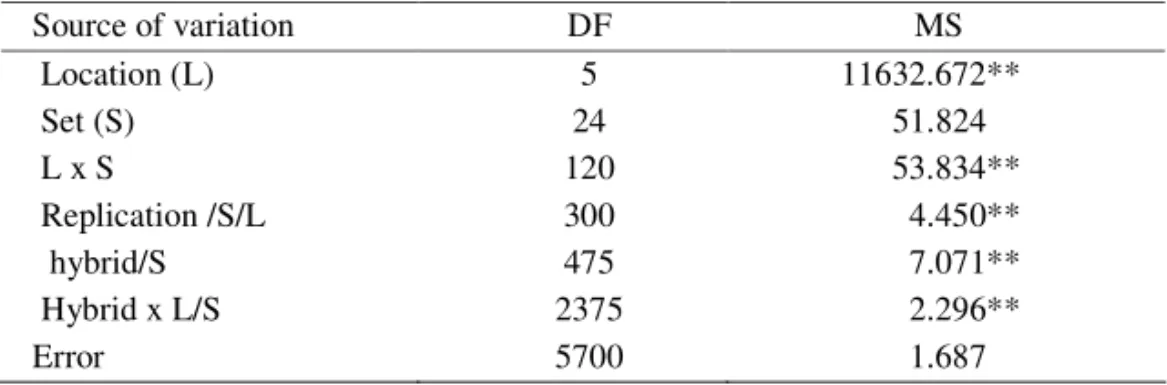
Highly significant estimates of mean squares for the test hybrids within tests with 30 samples within each test for the population sizes of 100, 200 and 300 tests hybrids were obtained by the analysis of variance in the Nested design. Mean squares for hybrids within sets for the basic sample of 500 test hybrids were also highly significant (Table 2).
Table 2. Mean squares from the analysis of variance in the Nested design for the population size of 500 test hybrids
Source of variation DF MS
Location (L) 5 11632.672**
Set (S) 24 51.824
L x S 120 53.834**
Replication /S/L 300 4.450**
hybrid/S 475 7.071**
Hybrid x L/S 2375 2.296**
Error 5700 1.687
Estimated values of genetic variance (
σ
g2) in all four studied populationsizes were significant, as they were two or a few times higher than the value of the corresponding standard error (SE
σ
g2), (FALCONER, 1960, 1981). A difference between minimum and maximum values of genetic variance over samples within a population size was greater in the populations with a lower number of test hybrids.The estimates of standard error of genetic variance (SE
σ
g2) decreased overthe increasing number of test hybrid`s, hence the lowest estimate was recorded in the population size of 500 test hybrids (Table 3). A relative parameter of genetic variation, the coefficient of genetic variation (Cvg), showed the similar trend with the increasing size of the population as in case of the estimates of genetic variance.
Table 3. Components of variance with the corresponding standard errors, coefficients of variation and heritability in the population size of 100, 200, 300 and 500 tests hybrids respect
Population size 100 plants
X t/ha
σ
g2 CVg(%)σ
f2CV
f (%)h
2 (%) SEσ
g2 SEσ
f2 SEh
2min. 9.14 0.154 4.05 0.277 5.36 53.90 0.040 0.041 0.145
max. 9.81 0.465 7.27 0.623 8.42 74.70 0.090 0.091 0.147
mean 9.53 0.285 5.56 0.416 6.73 67.80 0.060 0.061 0.145
Population size 200 plants
min. 9.38 0.191 4.50 0.307 5.72 61.20 0.032 0.033 0.103
max. 9.70 0.378 6.43 0.508 7.51 74.40 0.052 0.053 0.104
mean 9.56 0.272 5.44 0.399 6.59 68.00 0.041 0.042 0.103
Population size 300 plants
min. 9.41 0.197 4.61 0.318 5.87 61.90 0.027 0.028 0.084
max. 9.66 0.324 6.02 0.463 7.19 71.90 0.039 0.039 0.085
mean 9.54 0.275 5.48 0.403 6.64 68.00 0.034 0.034 0.084
Population size 500 plants
mean 9.56 0.284* 5.58 0.412* 6.71 69.00* 0.027 0.027 0.066
The average values of the coefficient of genetic variance ranged from 5.44% in the population of 200 test hybrids to 5.58 % in the population of 500 test hybrids. The determined values of phenotypic variance ranged from 0.399 in the population of 200 test hybrids to 0.416 in the population of 100 test hybrids and were higher than the values of genetic variance, considering that they also included environmental variations. The greater size of the population was, the lower value of standard error of phenotypic variance was. The same trend was observed for the values of standard errors of heritability (Table 3).
The calculated values of heritability were quite uniform and ranged from 67.8% in the population of 100 test hybrids to 69 % in the population of 500 test hybrids, provided that the average values of heritability in the populations of 200 and 300 test hybrids were identical and amounted to 68%.
The six possible comparisons of average values of genetic variances of the studied population sizes did not show significant differences (Table 4). Furthermore, average values of phenotypic variances of the studied population sizes were compared in the same way in all possible combinations, and not a single comparison showed significant differences (Table 5). If the values of genetic and phenotypic variances are considered the criteria for a selection of a F2 population size, the obtained results suggests that it is possible to work with 100 plants per a population without greater risk of loss of favorable genetic variation for grain yield.
Table 4. Genetic variances
σ
g2 (on the diagonal), differences among variances (above the diagonal) andσ
g2higher/σ
g2lower ratio (below the diagonal)Population size 100 200 300 500
100 0.285 0.013 0.010 0.001
200 1.048 0.272 0.003 0.012
300 1.036 1.011 0.275 0.009
500 1.004 1.044 1.033 0.284
Table 5. Phenotypic variances
σ
f2 (on the diagonal), differences among variances (above the diagonal) andσ
f2higher /σ
f2lower ratio (below the diagonal)Population size 100 200 300 500
100 0.416 0.017 0.013 0.004
200 1.043 0.399 0.004 0.013
300 1.032 1.010 0.403 0.009
DISCUSSION
The difference between minimum and maximum values of genetic variance over samples within the population size was greater in the populations with a lower number of test hybrids, while the values of standard error of genetic variance decreased with the increase of the population size. These results are absolutely in agreement with results obtained by MIŠEVI (1988) on each of three observed F2 populations. Differences between average values of genetic and phenotypic variances among observed population sizes were not significant (Table 4). Estimated values of genetic variances for such a type of progenies (HS) were higher than those obtained by DRINI (1995), and somewhat lower than those determined by ZANNONI and DUDLEY (1989) in studies of test-crosses of plants of F2 populations of inbreeds genetically related to elite opposite testers. The coefficient of genetic variation ranged over a narrow interval (5.44 % - 5.58 %), as had been expected, considering that narrow intervals of variations and insignificant differences among population sizes were determined for genetic variance. If the comparison of the material in the process of selection is done on the basis of the values of test hybrids (test-crosses), as it was a case in the present study, it is important to consider effects of different types of testers and the generations of tested progenies on genetic parameters, primarily on the values of genetic variance. RAWLINGS and THOMPSON (1962) established that the total genetic variance of test-crosses had been determined by the gene frequency of testers and the level of dominance. If there is no dominance, genetic variance of test-crosses is equal for each of gene frequencies of testers. If the gene frequency of a tester r = 0.5, genetic variance of test-crosses is equal for all levels of dominance. These authors concluded that testers with a low frequency of desirable genes had an advantage over other testers in the rank of partial to complete dominance, considering that the decrease in the level of dominance led to the increase in genetic variance of studied test-crosses, hence the differentiation of observed progenies was more obvious and more credible, which was the principal objective of testing. Similar conclusions were drawn by ALISON and CURNOW (1966), who gave the advantage to testers of poorer values per se. Moreover, HALLAUER and LOPEZ-PEREZ (1979) stated that test-crosses of the same sets of S8 inbreeds of the BSSS background expressed two-fold greater genetic variance when testers of a broad genetic base or testers of performance per se poorer than elite testers B73 (related) and Mo17 (unrelated) had been used. The present study included S0 plants tested with the elite tester R25, which was the logical choice, considering that it was pedigree selection from the F2 population of genetically close inbreeds L21-92 and L500, which cross to selected tester expressed a good combining ability. It assumes that selected recombinants would maintain high combining ability with the elite tester R25 in the subsequent selfing generations.
Further investigations concerning number of plants which are sufficient to provide satisfied portion of variability in F2 population obtained out of genetically similar inbred lines of maize (or inbred lines from the same heterotic group) should be tested over greater number of F2 mapping populations for different traits. On this way should be more certain to estimate what scope of genetic variability is usually covered by different number of F2 plants in conventional breeding programs which exploits narrow based population as breeding source materials.
Further use of molecular markers in F2 recombination study should enable more precise reviling of genetic distortion and segregation and become promising applicable tool in breeding programs, YI CHUAN XUE BAOet al (2003), ZHAOBING et al (2006).
Received March30th, 2010
Accepted December 6th, 2010
REFERENCES
ALLISON, J.C.and R.W. CURNOW(1966): The choice of tester parent for the breeding of synthetic varieties of maize (Zea mays L.). Crop Sci., 6:541-544.
BABI , V., M.BABI , M.FILIPOVI , N. DELI , V.AN ELKOVI (2008): Phenotypic characterization and relatedness of maize inbred lines Genetika, 40(3):227-236
COCHRAN, W.G. and G.M. COX (1957): Experimental designs, Copyright by John Wiley & Sons, Inc., second ed., Canada.
DELI, N., M. BABI , V. AN ELKOVI , G. STANKOVI , G. SARATLI (2005): Choice of F2 population size in maize breeding (Zea mays L). Sixty years of ZP maize hybrids breeding. International Maize Conference: Accomplishments and Perspectives, 26-28.10.2005, Belgrade, SCG. Book of abstracts (45).
DRINI , G.(1995): Genetic variability of quantitative traits in F2 synthetic population of maize (Zea mays L.). PhD thesis. Agricultural faculty, Novi Sad.
FALCONER, D.S.(1960): Quantitative genetics. The Ronald Press Co., New York, 365.
FALCONER, D.S. (1981): Introduction to quantitative genetics. Longman, London and New York. Estimating the effects of population size and type on the accuracy of genetic maps. FERREIRA, A., M. F. DA SILVA, L.DA COSTA, E SILVA and C. D.CRUZ (2006): Genetics and Molecular
Biology, 29, 1, 187-192.
HALLAUER, A.R. andE. LOPEZ-PEREZ. (1979): Comparisons among testers for evaluating lines of corn. Proceedings of the 34th annual corn & sorghum industry research conference, 34: 57-75. HALLAUER, A.R. and J. B.MIRANDA.(1988): Quantitative genetics in maize breeding (2nd ed.). Iowa State
University Press, Ames, IA.
MAREN, E. VEATCH-BLOHM (2007): Principles of Plant Genetics and Breeding. Loyola College, Biology Department, 4501 N. Charles St., Baltimore, MD 21210
MIŠEVI , D. (1988): Size of maize F2 population for the identification of superior yielding test-crosses.
Genetika, 20 (2): 207-217.
DRINI MLADENOVI , S., D. RISTI , S. SREDOJEVI , V. DRAGI EVI , D. IGNJATOVI -MICI , N. DELI (2009): Genetic variation of phytate and ionorganic phosphorus in maize population.
RADENOVI ., K. KONSTANTINOV, N. DELI , G. STANKOVI (2007): Photosynthetic and bioluminescence properties of maize inbred lines with upright leaves. Maydica 52, 347-356.
RAWLINGS, J.O.and D.L. THOMPSON (1962): Performance level as criterion for choice of maize testers. Crop Sci., 2: 217-220.
VANCETOVIC, J. (2008): An impact of environment on segregation ratio of qualitative traits in maize Genetika, Vol 40, No.2, 145-156, 2008, UDC 575:633.15, DOI:10.2298/GENSR0802145V. WOLF, D.P., L.A. PETERNELLI andA.R. HALLAUER(2000): Estimates of genetic variance in an F2 maize
population. J. Hered, 91 (5): 384-91.
YI ,CHUAN X.,H.TANG H, L.ZHENG YL.(2003): Genetic analysis of segregation distortion of molecular markers in maize F2 population. National Key Lab of Crop Genetic Improvement, Huanzhong Agricultural University, Wuhan 430070, China. Accessed over internet: http://www.ncbi.nlm.nih.gov/pubmed/14669507
ZHAO, B., D.QI-MING, Z.QI-JUN, L JIE-QIN. YE SHAO-PING, L.YONG-SHU, P.YONG and LI PING (2006): Analysis of Segregation Distortion of Molecular Markers in F2 Population of Rice.Acta
Genetica Sinica,Volume 33, Issue 5, May 2006, Pages 449-457.
ZANNONI, U. and J.W. DUDLEY.(1989):Use of F2 generations to identify inbreds with favorable alleles not
present in an elite hybrid. Crop Sci., 29: 583-589.
ŽIVANOVI , T., R.DJORDJEVI , S. DRAŽI , M. SE ANSKI, M. KOSTI (2007):Effects of recombinations on variability and heritability of traits in maize population with exotic germplasm. Biotechnology & Biotechnological Equipment, Vol 21, Issue 2, 229-234.
PARAMETRI U OCENI ODGOVARAJU E VELI INE F2 POPULACIJE U KONVENCIONALNIM PROGRAMIMA OPLEMENJIVANJA KUKURUZA
(Zea mays L.)
Nenad DELI , Jovan PAVLOV, Vojka BABI , Gordana ŠURLAN-MOMIROVI i Tomislav ŽIVANOVI
Institut za kukuruz Zemun Polje, Beograd I z v o d
U radu su ispitivane razlike izme u etiri veli ine F2 populacije od 100, 200, 300 i 500 biljaka na bazi test-ukrštanja, za prinos zrna, prema prose nim vrednostima populacija, geneti kim i fenotipskim varijansama koeficijentima geneti ke i fenotipske varijacije i vrednostima heritabilnosti u širem smislu. Vrednosti geneti ke varijanse, nisu se zna ajno razlikovale izme u razli itih veli ina populacije u svim moguæim upore enjima, što važi i za upore enja dobijenih vrednosti fenotipske varijanse. Tako e, vrednosti heritabilnosti u širem smislu (67.8% do 69%) nisu zna ajno varirale sa promenom veli ine F2 populacije. Geneti ka varijabilnost ispitivanih potomstava, kao glavni preduslov uspešne selekcije, je bila na zadovoljavaju em nivou u svim veli inama populacije.