Submitted20 September 2016 Accepted 17 November 2016 Published22 December 2016
Corresponding author Henrik Riel, [email protected]
Academic editor Justin Keogh
Additional Information and Declarations can be found on page 10
DOI10.7717/peerj.2799
Copyright 2016 Riel et al.
Distributed under
Creative Commons CC-BY 4.0
OPEN ACCESS
Comparison between Mother, ActiGraph
wGT3X-BT, and a hand tally for
measuring steps at various walking
speeds under controlled conditions
Henrik Riel1,2, Camilla Rams Rathleff2, Pernille Møller Kalstrup2,
Niels Kragh Madsen2, Elena Selmar Pedersen2, Louise Bilenberg
Pape-Haugaard2and Morten Villumsen2,3
1Research Unit for General Practice, Department of Clinical Medicine, Aalborg University, Aalborg, Denmark 2Department of Health Science and Technology, Aalborg University, Aalborg, Denmark
3Department of Physiotherapy, University College of Northern Denmark, Aalborg, Denmark
ABSTRACT
Introduction. Walking is endorsed as health enhancing and is the most common type of physical activity among older adults. Accelerometers are superior to self-reports when measuring steps, however, if they are to be used by clinicians the validity is of great importance. The aim of this study was to investigate the criterion validity of Mother and ActiGraph wGT3X-BT in measuring steps by comparing the devices to a hand tally under controlled conditions in healthy participants.
Methods. Thirty healthy participants were fitted with a belt containing the sensor of Mother (Motion Cookie) and ActiGraph. Participants walked on a treadmill for two minutes at each of the following speeds; 3.2, 4.8, and 6.4 km/h. The treadmill walking was video recorded and actual steps were subsequently determined by using a hand tally. Wilcoxon’s signed ranks test was used to determine whether Mother and ActiGraph measured an identical number of steps compared to the hand tally. Intraclass correlation coefficients were calculated to determine the relationship and Root Mean Square error was calculated to investigate the average error between the devices and the hand tally. Percent differences (PD) were calculated for between-instrument agreement (Mother vs. the hand tally and ActiGraph vs. the hand tally) and PDs below 3% were interpreted as acceptable and clinically irrelevant.
Results. Mother and ActiGraph under-counted steps significantly compared to the hand tally at all walking speeds (p<0.001). Mother had a median of total differences
of 9.5 steps (IQR=10) and ActiGraph 59 steps (IQR=77). Mother had smaller PDs at all speeds especially at 3.2 km/h (2.5% compared to 26.7%). Mother showed excellent ICC values≥0.88 (0.51–0.96) at all speeds whilst ActiGraph had poor and fair to good
ICC values ranging from 0.03 (−0.09–0.21) at a speed of 3.2 km/h to 0.64 (0.16–0.84) at a speed of 6.4 km/h.
SubjectsGeriatrics, Kinesiology, Public Health, Translational Medicine
Keywords Validity, Accelerometer, Physical activity, Adults, Pedometer
INTRODUCTION
Physical activity (PA) is endorsed as health enhancing (Steeves et al., 2015) and is known to prevent and reduce both musculoskeletal disorders and mortality (Holtermann et al., 2012; Holtermann et al., 2013;Haskell et al., 2007;Blair & Morris, 2009). Additionally, in older adults, PA is especially important in maintaining self-dependence, preventing disease and improving the quality of life (NHS Choices, 2015). In contrast, the lack of PA is related to muscular alterations such as atrophy and decreased muscle strength (Convertino, Bloomfield & Greenleaf, 1997;Appell, 1990), thus possibly contributing to loss of self-dependence, especially in older adults. During hospitalization geriatric patients have shown low levels of PA (Villumsen et al., 2015) and only 17.8% of patients regain their pre-hospitalization level of mobility function 12 months after admission (Visser et al., 2000). This emphasizes the need for PA awareness.
Walking is the most common type of leisure-time PA among adults and the prevalence of walking for PA increases with age up until 65–74 years (Rafferty et al., 2002). In order to measure PA, accelerometers are superior and recommended with respect to validity and applicability (Müller, Winter & Rosenbaum, 2010) compared to self-reports, as patients often over- or underestimate their actual level of PA (Sallis & Saelens, 2000;Farni et al., 2014;Barriera et al., 2013). Even though studies have found the validity and specificity to be high when measuring different types of PA (i.e., moderate and high pace walking), accelerometers are considered inadequate when measuring steps at low walking speeds (Crouter et al., 2013;Turner et al., 2012;Steeves et al., 2011;Webber et al., 2014;Dijkstra et al., 2008;Barriera et al., 2013). If accelerometers are to be successfully used by patients and/or healthcare personnel it may be of importance that the accelerometers are valid, versatile, user-friendly, and inexpensive.
One of the most commonly used accelerometers for monitoring PA is ActiGraph (ActiGraph, Pensacola, FL, USA) (Crouter et al., 2013;Barriera et al., 2013;Ekblom et al., 2012;Herman Hansen et al., 2014). However, ActiGraph is developed with the intention to be used by physicians and in research (Pensacola, FL, USA) whilst a new accelerometer, Mother (Sen.se, Paris, France), is developed with the intention to be used by the private consumer (Sen.se, Paris, France). The aim of this study was to investigate the criterion validity of Mother (Sen.se, Paris, France) and ActiGraph wGT3X-BT (Pensacola, FL, USA) in measuring steps by comparing the devices to a hand tally, which is considered gold standard, under controlled conditions in healthy participants.
METHODS
Table 1 Participant demographics.
Gender (N, men/women) 15/15
Age (years, mean (SD)) 27.9 (±4.2)
Height (cm, mean (SD)) 173.5 (±9.1)
Weight (kg, mean (SD)) 71.6 (±11.3)
BMI (kg/m2, mean (SD)) 23.6 (±2.2)
Ethics statement
Ethical approval of the research protocol was not needed according to The North Denmark Region Committee on Health Research Ethics. Written informed consent was signed by all participants prior to the study.
Sample size and raters
Sample size was determined to be 30 participants using large sample case (Hogg & Tanis, 1996). Two raters performed the hand tallying and conducted the treadmill test whilst two different raters performed the data treatment without being part of the data collection.
Participants
Thirty-one healthy students were recruited from Aalborg University, Denmark (male
n=15, femalen=16). Data was collected from March to April 2015.
The inclusion criteria were: (i) age of 18 years or above, (ii) no self-reported health problems evaluated by the Physical Activity Readiness Questionnaire (PAR-Q) (Shephard, 1988), (iii) ability to walk without walking aids, (iv) ability to walk continuously for 10 min on a treadmill, and (v) ability to read, understand and speak Danish and English. The fifth criterion was chosen to ensure that participants understood the instructions and the PAR-Q, which was in English, as no Danish translation was available.
The exclusion criteria were: (i) pregnancy (self-reported), (ii) BMI≥30 kg/m2, and (iii) neurological diseases (self-reported).
Thirty-one healthy participants were recruited for the study. One participant was ex-cluded due to a BMI > 30 kg/m2. Participants did not report any impairments or morbidities potentially interfering with the assessment. SeeTable 1 for participant demographics.
Mother
Mother (Sen.se, Paris, France) is a triaxial accelerometer released in March 2014 by Sen.se (Paris, France). The device consists of a hub (Mother), up to 24 sensors (Motion Cookies), and a software application (the Senseboard) (Sen.se, Paris, France). User access is gained through the Senseboard, which is a collection of different applications developed by Sen.se. The dimensions of a Motion Cookie are 5.0*2.2*0.4 cm with a weight of 6 grams (Sen.se, Paris, France). The sample rate is fixed at 25 Hz. The accelerometer has a dynamic range of
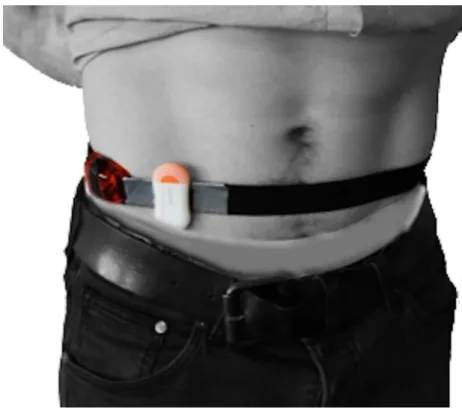
Figure 1 Accelerometer placement.ActiGraph is placed laterally to the right SIAS and the Motion Cookie is placed medially (Randomization 1).
ActiGraph wGT3X-BT
ActiGraph wGT3X-BT (ActiGraph LLC, Pensacola, FL, USA) is a triaxial accelerometer and one of the most commonly used devices for assessing PA (Crouter et al., 2013). The dimensions of the sensor are 4.6*3.3*1.5 cm with a weight of 19 grams. A sample rate of 100 Hz was chosen (range 30–100 Hz). The accelerometer has a dynamic range of±8G and a precision of 12 bit (ActiGraph LLC, Pensacola, FL, USA). Data is accessible by using the ActiLife Pro 6 software (ActiGraph LLC, Pensacola, FL, USA). After the recordings the sensor was connected to a computer through a mini-USB cable in order to upload the data. During initialization, information including subject name, gender, height, weight, race, limb and leg dominance is required, however random values were used as step counting is not affected by this information (ActiGraph LLC, Pensacola, FL, USA).
Accelerometer placement
Hand tally
A hand tally is considered the gold standard when measuring steps (Dijkstra et al., 2008;
Fortune et al., 2014;Stemland et al., 2015). In this study, the application AGR Tally counter (ver. 1.0, Angel Garcia Rubio) was used for hand tallying. Steps were measured by tapping the screen of an iPhone 4s (Apple Inc., Infinite Loop Cupertino, California, USA).
Procedures of the treadmill test
The number of steps was obtained during a treadmill test where participants walked on a treadmill for two minutes at each of the three walking speeds; 3.2, 4.8, and 6.4 km/h. The inclination was set to 0◦. The treadmill was preprogrammed to standardize the procedure
for an in- and decrease of the walking speed. The two minutes included the time the treadmill in- and decreased the walking speed. The speeds were chosen in accordance with walking speeds chosen in three previous studies that investigated the validity of measuring steps under controlled conditions at various walking speeds (Steeves et al., 2011;De Cocker et al., 2012;Clemes et al., 2010). The test was conducted in the sports science laboratory at Aalborg University, Denmark. To take the inability of Mother to synchronize more often than every 5 min into consideration, the participants were asked to stand still for five minutes and 10 s before and after each walking speed in order to identify the walking session in the application programming interface (API).
Data Treatment
Data from Mother for each test were identified by examining the walking duration in the API. Even though the participants walked for exactly two minutes, which was confirmed by video recordings of the tests, walking sessions had durations ranging from 115–130 s. The output from the API showing the number of steps of the walking session was manually examined to identify equipment malfunctions such as missing steps. Accelerometer data from ActiGraph were downloaded using ActiLife 6 Pro software.
Video recordings of the treadmill test were used for hand tallying. The definition of a step was adopted byDijkstra et al. (2008)and defined as ‘‘the first moment at which the heel of the foot for the initial step cleared the ground and the moment at which the foot of the closing step made completely contact with the floor’’. The hand tallying procedure was double validated as the two raters hand tallied independently. The two raters had 100% agreement. The two raters responsible for data treatment and the statistical analyses had not been involved in the treadmill test nor the hand tallying.
Statistical analysis
All statistical analyses were performed using IBM SPSS (ver. 22, IBM Corporation, New York, United States) with a significance level ofp<0.05.
Wilcoxon’s signed ranks test was used to create a pairwise comparison to determine whether the devices and the hand tally measured the same number of steps. Means and standard deviations (SD) were computed for age, height, weight and BMI whilst medians and interquartile ranges (IQR) were computed for steps and differences in steps measured by the devices. A two-way random effects model (2.1), single measures, absolute agreement, and intraclass correlation coefficients (ICC) with 95% confidence intervals were used to express interrater reliability between the devices and the hand tally. ICC values >0.75 were interpreted excellent, 0.40–0.75 were interpreted fair to good and <0.40 were interpreted poor (Fleiss, 1999). To investigate the average error Root Mean Square error (RMSe) was calculated between each device and the hand tally. As data were non-normally distributed the nonparametric approach to presenting Bland–Altman plots was adopted and the median, the 2.5th, and the 97.5th percentiles were visualised in the plots (Gialamas et al., 2010).
Percent differences (PD) were calculated for between-instrument agreement (Mother vs. the hand tally and ActiGraph vs. the hand tally). The PD was calculated as
Absolute difference
hand tally steps ·100. Any negative values were converted to a positive to calculate the
absolute difference. Clinical relevance of potential under- or over-counting of steps by the two accelerometers compared to hand tally was determined using a 3% criterion, which was based on previous studies (Johnson et al., 2015;Holbrook, Barreira & Kang, 2009;Colley et al., 2013;Liu et al., 2015). PD≤3% were considered clinically irrelevant.
RESULTS
Mother vs. the hand tally
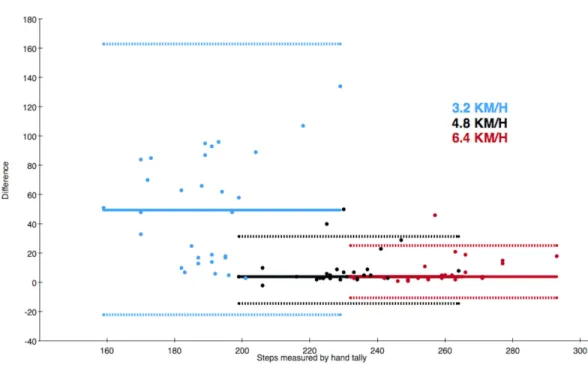
The median of differences in steps between Mother and the hand tally at the different walking speeds were 2.5 steps (IQR=5) at 3.2 km/h, 2 steps (IQR=2) at 4.8 km/h and 3.5 steps (IQR=6) at 6.4 km/h (Table 2). These are depicted in the Bland–Altman plot (Fig. 2). The median of total differences was 9.5 steps (IQR=10).
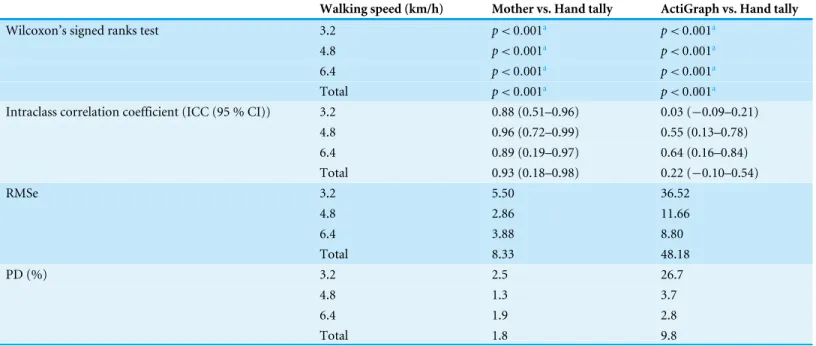
Wilcoxon’s signed ranks test showed a significant difference in the number of steps measured by the hand tally vs. Mother at all walking speeds (p<0.001) (Table 3).
The ICCs for Mother and the hand tally were all excellent ranging from 0.88 (0.51–0.96) at a speed of 3.2 km/h to 0.96 (0.72–0.99) at a speed of 4.8 km/h (Table 3). The RMSe ranged from 2.86 at 4.8 km/h to 5.50 at 3.2 km/h (Table 3). Mother had PDs≤2.5% of the steps measured by the hand tally at all speeds (Table 3).
ActiGraph vs. the hand tally
The median of differences in steps between ActiGraph and the hand tally at the different walking speeds were 49.5 steps (IQR=69) at 3.2 km/h, 4 steps (IQR=5) at 4.8 km/h and 4 steps (IQR=5) at 6.4 km/h (Table 2). These are depicted in the Bland–Altman plot (Fig. 3). The median of total differences was 59 steps (IQR=77).
Figure 2 Bland–Altman style plot of differences between the actual number of steps and steps mea-sured by Mother.The solid line depicts the median of differences and the dotted lines depict the 2.5th and 97.5th percentiles of each walking speed. The colour of the data point refers to the walking speed.
Table 2 The median of the number of steps measured by each device and the median of differences between the hand tally vs. Mother and the hand tally vs. ActiGraph.
Walking speed Median of steps Hand tally
(km/h) Median of differences in steps
Hand tally 3.2 190 (IQR=13) –
4.8 229 (IQR=11) –
6.4 260 (IQR=14) –
Total 677 (IQR=35) –
Mother 3.2 186 (IQR=22) 2.5 (IQR=5)
4.8 227 (IQR=12) 2 (IQR=2)
6.4 254 (IQR=17) 3.5 (IQR=6)
Total 663 (IQR=43) 9.5 (IQR=10)
ActiGraph 3.2 134.5 (IQR=70) 49.5 (IQR=69)
4.8 222 (IQR=10) 4 (IQR=5)
6.4 254 (IQR=15) 4 (IQR=5)
Total 615 (IQR=73) 59 (IQR=77)
Table 3 Results from Wilcoxon’s signed ranks test with significance levels of each comparison, intraclass correlation coefficient, Root Mean Square error, and percent difference.
Walking speed (km/h) Mother vs. Hand tally ActiGraph vs. Hand tally
Wilcoxon’s signed ranks test 3.2 p<0.001a p<0.001a
4.8 p<0.001a p<0.001a
6.4 p<0.001a p<0.001a
Total p<0.001a p<0.001a
Intraclass correlation coefficient (ICC (95 % CI)) 3.2 0.88 (0.51–0.96) 0.03 (−0.09–0.21)
4.8 0.96 (0.72–0.99) 0.55 (0.13–0.78)
6.4 0.89 (0.19–0.97) 0.64 (0.16–0.84)
Total 0.93 (0.18–0.98) 0.22 (−0.10–0.54)
RMSe 3.2 5.50 36.52
4.8 2.86 11.66
6.4 3.88 8.80
Total 8.33 48.18
PD (%) 3.2 2.5 26.7
4.8 1.3 3.7
6.4 1.9 2.8
Total 1.8 9.8
Notes.
aSignificant difference.
The ICCs for ActiGraph and the hand tally were poor and fair to good ranging from 0.03 (−0.09–0.21) at a speed of 3.2 km/h to 0.64 (0.16–0.84) at a speed of 6.4 km/h (Table 3). The RMSe ranged from 8.80 at 6.4 km/h to 36.52 at 3.2 km/h (Table 3).
DISCUSSION
This study aimed at investigating the criterion validity of Mother and ActiGraph in measuring steps by comparing the devices to a hand tally under controlled conditions in healthy participants. The results revealed that both Mother and ActiGraph under-counted steps significantly compared to the hand tally at all walking speeds and Mother had smaller PDs at all walking speeds compared to ActiGraph.
Both Mother and ActiGraph under-counted steps significantly at all walking speeds compared to the hand tally, which is considered gold standard of measuring steps. Hence, it is apparent that none of these accelerometers have the same level of precision as the hand tally. However, significant results are not always clinically relevant as it would be unrealistic to use a hand tally under free-living conditions. Therefore, a 3% clinically irrelevant deviation from the steps measured by the hand tally was adopted inspired by previous studies of validity (Johnson et al., 2015;Holbrook, Barreira & Kang, 2009;Colley et al., 2013;Liu et al., 2015). The PDs of≤2.5% measured by Mother were interpreted as
being clinically irrelevant as it was less than 3%, however, ActiGraph had clinically relevant deviations at both 3.2 and 4.8 km/h. Especially at 3.2 km/h with a PD of 26.7% ActiGraph may not be adequately precise to measure steps in patients with a low walking speed. These results are in accordance with previous findings of the validity of ActiGraph at measuring steps at low walking speeds, which found that ActiGraph measured only 77.5% of the actual steps at the speed of 3.2 km/h (Connolly et al., 2011). In a practical perspective, ActiGraph would under-count 4,725 steps in a week if a patient has a daily average of 3,000 steps which would make it difficult for the clinician to determine whether or not the patient was following the advised PA. Accelerometers in general are known for being inadequate when measuring steps at the low speeds that some of the patients may walk at (Barriera et al., 2013;Crouter et al., 2013;Turner et al., 2012;Steeves et al., 2011;Webber et al., 2014;
Dijkstra et al., 2008), but even though Mother is an accelerometer developed with the intention to be used by private consumers, it showed a superior accuracy compared to the accelerometer most commonly used for measuring PA in research (Crouter et al., 2013).
The excellent ICC between Mother and the hand tally would make a prediction of a margin of error at a given number of steps feasible. This means that with any given number of steps, the amount of miscounted steps can be estimated, thus making measurements with Mother more valid even at a large step counts.
Limitations
The walking sessions in the API of Mother had varying durations ranging from 115 to 130 s. The reason for this variation is unknown, however, it implies that the participants have either stopped walking prior to the end of the two minutes or they have continued moving even though the treadmill had stopped. This was, however, not indicated by the video recordings. Another explanation for the 115 s walking sessions could be that Mother stopped measuring as the participant slowed down before coming to a halt. As Mother measured durations both shorter and longer than the 120 s the walking session lasted, the inconsistencies in duration may have evened out.
Future work
This study investigated step measuring at a walking speed of 3.2 km/h as the lowest speed, but some patients may walk at an even slower pace, thus investigating the validity at lower walking speeds is highly relevant to determine the minimum speed at which Mother still provides measures of steps that have clinically irrelevant deviations from the actual number of steps. Future studies should also include testing in a semi-controlled environment and in free-living conditions and should also include participants with a larger BMI than included in this study as the waist circumference can influence precision due to tilting (Crouter, Schneider & Bassett, 2005).
CONCLUSION
Mother provides valid measures of steps at walking speeds of 3.2, 4.8, and 6.4 km/h with clinically irrelevant deviations compared to a hand tally while ActiGraph only provides valid measurements at 6.4 km/h based on the 3% criterion. These results have significant potential for valid objective measurements of low walking speeds.
ADDITIONAL INFORMATION AND DECLARATIONS
Funding
The authors received no funding for this work.
Competing Interests
The authors declare there are no competing interests.
Author Contributions
• Henrik Riel conceived and designed the experiments, performed the experiments, analyzed the data, contributed reagents/materials/analysis tools, wrote the paper, prepared figures and/or tables.
• Camilla Rams Rathleff and Pernille Møller Kalstrup conceived and designed the experiments, performed the experiments, contributed reagents/materials/analysis tools, reviewed drafts of the paper.
• Elena Selmar Pedersen conceived and designed the experiments, performed the
experiments, analyzed the data, contributed reagents/materials/analysis tools, reviewed drafts of the paper.
• Morten Villumsen wrote the paper, reviewed drafts of the paper.
Human Ethics
The following information was supplied relating to ethical approvals (i.e., approving body and any reference numbers):
The North Denmark Region Committee on Health Research Ethics. It was stated by the committee that this study was not a health science research project according to their committee law and did not need approval.
Data Availability
The following information was supplied regarding data availability: Riel, Henrik (2016): Data_final_Mother_ActiGraph.xlsx. figshare.
https://dx.doi.org/10.6084/m9.figshare.3814272.v1.
Supplemental Information
Supplemental information for this article can be found online athttp://dx.doi.org/10.7717/ peerj.2799#supplemental-information.
REFERENCES
Appell HJ. 1990.Muscular atrophy following immobilisation. A review.Sports Medicine
10(1):42–58DOI 10.2165/00007256-199010010-00005.
Barriera TV, Tudor-Locke C, Champagne CM, Broyles ST, Johnson WD, Katzmarzyk PT. 2013.Comparison of GT3X accelerometer and YAMAX pedometer steps/day in a free-living sample of overweight and obese adults.Journal of Physical Activity & Health10(2):263–270DOI 10.1123/jpah.10.2.263.
Blair SN, Morris JN. 2009.Healthy hearts—and the universal benefits of being physically active: physical activity and health.Annals of Epidemiology 19(4):253–256
DOI 10.1016/j.annepidem.2009.01.019.
Cleland I, Kikhia B, Nugent C, Boytsov A, Hallberg J, Synnes K, McClean S, Finlay D. 2013.Optimal placement of accelerometers for the detection of everyday activities.
Sensors13(7):9183–9200DOI 10.3390/s130709183.
Clemes SA, O’Connell S, Rogan LM, Griffiths PL. 2010.Evaluation of a commercially available pedometer used to promote physical activity as part of a national pro-gramme.British Journal of Sports Medicine44(16):1178–1183
DOI 10.1136/bjsm.2009.061085.
Colley RC, Barnes JD, Leblanc AG, Borghese M, Boyer C, Tremblay MS. 2013.Validity of the SC-StepMX pedometer during treadmill walking and running.Applied
Physiology, Nutrition, and Metabolism38(5):520–524DOI 10.1139/apnm-2012-0321.
Convertino VA, Bloomfield SA, Greenleaf JE. 1997.An overview of the issues: physi-ological effects of bed rest and restricted physical activity.Medicine and Science in Sports and Exercise29(2):187–190.
Crouter SE, DellaValle DM, Haas JD, Frongillo EA, Bassett DR. 2013.Validity of ActiGraph 2-regression model, Matthews cut-points, and NHANES cut-points for assessing free-living physical activity.Journal of Physical Activity & Health
10(4):504–514DOI 10.1123/jpah.10.4.504.
Crouter SE, Schneider PL, Bassett DR. 2005.Spring-levered versus piezo-electric pedometer accuracy in overweight and obese adults.Medicine and Science in Sports and Exercise 37(10):1673–1679DOI 10.1249/01.mss.0000181677.36658.a8.
De Cocker KA, De Meyer J, De Bourdeaudhuij IM, Cardon GM. 2012.Non-traditional wearing positions of pedometers: validity and reliability of the Omron HJ-203-ED pedometer under controlled and free-living conditions.Journal of Science and Medicine in Sport15(5):418–424DOI 10.1016/j.jsams.2012.02.002.
Dijkstra B, Zijlstra W, Scherder E, Kamsma Y. 2008.Detection of walking periods and number of steps in older adults and patients with Parkinson’s disease: accuracy of a pedometer and an accelerometry-based method.Age and Ageing 37(4):436–441
DOI 10.1093/ageing/afn097.
Ekblom O, Nyberg G, Bak EE, Ekelund U, Marcus C. 2012.Validity and comparability of a wrist-worn accelerometer in children.Journal of Physical Activity & Health
9(3):389–393DOI 10.1123/jpah.9.3.389.
Farni K, Shoham DA, Cao G, Luke AH, Layden J, Cooper RS, Dugas LR. 2014.Physical activity and pre-diabetes-an unacknowledged mid-life crisis: findings from NHANES 2003–2006.PeerJ2:e499 DOI 10.7717/peerj.499.
Fleiss JL. 1999.The design and analysis of clinical experiments. Vol. 73. Hoboken: John Wiley & Sons.
Fortune E, Lugade V, Morrow M, Kaufman K. 2014.Validity of using tri-axial ac-celerometers to measure human movement—Part II: step counts at a wide range of gait velocities.Medical Engineering & Physics36(6):659–669
DOI 10.1016/j.medengphy.2014.02.006.
Gialamas A, Laurence CO, Yelland LN, Tideman P, Worley P, Shephard MD, Tir-imacco R, Willson KJ, Ryan P, Gill J, Thomas DW, Beilby JJ. 2010.Assessing agreement between point of care and laboratory results for lipid testing from a clinical perspective.Clinical Biochemistry43(4–5):515–518
DOI 10.1016/j.clinbiochem.2009.11.014.
Haskell WL, Lee I-M, Pate RR, Powell KE, Blair SN, Franklin BA, Macera CA, Heath GW, Thompson PD, Bauman A. 2007.Physical activity and public health: updated recommendation for adults from the American College of Sports Medicine and the American Heart Association.Medicine and Science in Sports and Exercise
39(8):1423–1434DOI 10.1249/mss.0b013e3180616b27.
Herman Hansen B, Bortnes I, Hildebrand M, Holme I, Kolle E, Anderssen SA. 2014.
Hogg RV, Tanis EA. 1996.Probability and Statistical Inference. 5th edition. Upper Saddle River: Prentice Hall.
Holbrook EA, Barreira TV, Kang M. 2009.Validity and reliability of Omron pedometers for prescribed and self-paced walking.Medicine and Science in Sports and Exercise
41(3):670–674DOI 10.1249/MSS.0b013e3181886095.
Holtermann A, Hansen JV, Burr H, Sogaard K, Sjogaard G. 2012.The health paradox of occupational and leisure-time physical activity.British Journal of Sports Medicine
46(4):291–295DOI 10.1136/bjsm.2010.079582.
Holtermann A, Marott JL, Gyntelberg F, Søgaard K, Suadicani P, Mortensen OS, Prescott E, Schnohr P. 2013.Does the benefit on survival from leisure time physical activity depend on physical activity at work? A prospective cohort study.PLoS ONE
8(1):e54548DOI 10.1371/journal.pone.0054548.
Johnson M, Meltz K, Hart K, Schmudlach M, Clarkson L, Borman K. 2015.Validity of the Actical activity monitor for assessing steps and energy expenditure during walk-ing.Journal of Sports Sciences33(8):769–776DOI 10.1080/02640414.2014.964747.
Kottner J, Audige L, Brorson S, Donner A, Gajewski BJ, Hrobjartsson A, Roberts C, Shoukri M, Streiner DL. 2011.Guidelines for reporting reliability and agree-ment studies (GRRAS) were proposed.International Journal of Nursing Studies
48(6):661–671DOI 10.1016/j.ijnurstu.2011.01.016.
Liu S, Brooks D, Thomas S, Eysenbach G, Nolan RP. 2015.Lifesource XL-18 pedometer for measuring steps under controlled and free-living conditions.Journal of Sports Sciences33(10):1001–1006DOI 10.1080/02640414.2014.981847.
Müller C, Winter C, Rosenbaum D. 2010.Aktuelle objektive messverfahren zur erfassung körperlicher aktivität im vergleich zu subjektiven erhebungsmethoden.
Deutsche Zeitschrift Fur Sportmedizin61(1):11–18.
NHS Choices. 2015.Physical activity guidelines for older adults.Available athttp:// www.nhs.uk/ Livewell/ fitness/ Pages/ physical-activity-guidelines-for-older-adults.aspx
(accessed on 29 April 2016).
Rafferty AP, Reeves MJ, McGee HB, Pivarnik JM. 2002.Physical activity patterns among walkers and compliance with public health recommendations.Medicine & Science in Sports & Exercise34(8):1255–1261DOI 10.1097/00005768-200208000-00005.
Sallis JF, Saelens BE. 2000.Assessment of physical activity by self-report: status, limita-tions, and future directions.Research Quarterly for Exercise and Sport 71(2):1–14.
Shephard RJ. 1988.PAR-Q, canadian home fitness test and exercise screening alterna-tives.Sports Medicine5(3):185–195.
Steeves JA, Tudor-Locke C, Murphy RA, King GA, Fitzhugh EC, Harris TB. 2015.
Classification of occupational activity categories using accelerometry: NHANES 2003–2004.The International Journal of Behavioral Nutrition and Physical Activity
12(1):1–20DOI 10.1186/s12966-015-0235-z.
Steeves JA, Tyo BM, Connolly CP, Gregory DA, Stark NA, Bassett DR. 2011.Validity and reliability of the Omron HJ-303 tri-axial accelerometer-based pedometer.
Stemland I, Ingebrigtsen J, Christiansen CS, Jensen BR, Hanisch C, Skotte J, Holter-mann A. 2015.Validity of the Acti4 method for detection of physical activity types in free-living settings: comparison with video analysis.Ergonomics58(6):953–965
DOI 10.1080/00140139.2014.998724.
Turner LJ, Houchen L, Williams J, Singh SJ. 2012.Reliability of pedometers to measure step counts in patients with chronic respiratory disease.Journal of Cardiopulmonary Rehabilitation and Prevention32(5):284–291DOI 10.1097/HCR.0b013e31825c49f2.
Villumsen M, Jorgensen MG, Andreasen J, Rathleff MS, Mølgaard CM. 2015.Very low levels of physical activity in older patients during hospitalization at an acute geriatric ward: a prospective cohort study.Journal of Aging and Physical Activity
23(4):542–549DOI 10.1123/japa.2014-0115.
Visser M, Harris TB, Fox KM, Hawkes W, Hebel JR, Yahiro JY, Michael R, Zimmerman SI, Magaziner J. 2000.Change in muscle mass and muscle strength after a hip frac-ture: relationship to mobility recovery.The Journals of Gerontology. Series A, Biologi-cal Sciences and MediBiologi-cal Sciences55(8):M434–M440 DOI 10.1093/gerona/55.8.M434.
Webber SC, Magill SM, Schafer JL, Wilson KCS. 2014.GT3X+accelerometer, Ya-max pedometer and SC-StepMX pedometer step count accuracy in community-dwelling older adults.Journal of Aging and Physical Activity22(3):334–341