Submitted14 September 2015
Accepted 3 June 2016
Published28 June 2016
Corresponding author
Markus Fleischauer,
Academic editor
Abhishek Kumar
Additional Information and Declarations can be found on page 12
DOI10.7717/peerj.2172
Copyright
2016 Fleischauer and Böcker
Distributed under
Creative Commons CC-BY 4.0
OPEN ACCESS
Collecting reliable clades using the
Greedy Strict Consensus Merger
Markus Fleischauer and Sebastian Böcker
Lehrstuhl für Bioinformatik, Friedrich-Schiller Universität, Jena, Thüringen, Germany
ABSTRACT
Supertree methods combine a set of phylogenetic trees into a single supertree. Similar to supermatrix methods, these methods provide a way to reconstruct larger parts of the Tree of Life, potentially evading the computational complexity of phylogenetic inference methods such as maximum likelihood. The supertree problem can be formalized in different ways, to cope with contradictory information in the input. Many supertree methods have been developed. Some of them solve NP-hard optimization problems like the well-known Matrix Representation with Parsimony, while others have polynomial worst-case running time but work in a greedy fashion (FlipCut). Both can profit from a set of clades that are already known to be part of the supertree. The Superfine approach shows how the Greedy Strict Consensus Merger (GSCM) can be used as preprocessing to find these clades. We introduce different scoring functions for the GSCM, a randomization, as well as a combination thereof to improve the GSCM to find more clades. This helps, in turn, to improve the resolution of the GSCM supertree. We find this modifications to increase the number of true positive clades by 18% compared to the currently used Overlap scoring.
SubjectsBioinformatics, Computational Biology, Evolutionary Studies, Genetics, Taxonomy
Keywords Consensus, Supertree, Supermatrix, Divide and Conquer, FlipCut, Phylogeny
INTRODUCTION
Supertree methods are used to combine a set of phylogenetic trees with non-identical but overlapping taxon sets, into a larger supertree that contains all the taxa of every input tree. Many supertree methods have been established over the years, see for example: Bininda-Emonds(2004);Ross & Rodrigo(2004);Chen et al.(2006);Holland et al.(2007);Scornavacca et al.(2008);Ranwez, Criscuolo & Douzery(2010);Bansal et al.(2010);Snir & Rao(2010); Swenson et al. (2012); Brinkmeyer, Griebel & Böcker (2013); Berry, Bininda-Emonds & Semple (2013); Gysel, Gusfield & Stevens (2013); Whidden, Zeh & Beiko (2014); these methods complement supermatrix methods which combine the ‘‘raw’’ sequence data rather than the trees (Von Haeseler,2012).
computationally much easier to solve. The results of the subproblems are then combined using a supertree method.
Constructing a supertree is easy if no contradictory information is encoded in the input trees (Aho et al.,1981). However, resolving conflicts in a reasonable and swift way remains difficult. Matrix Representation with Parsimony (MRP) (Baum,1992;Ragan, 1992) is still the most widely used supertree method today, as the constructed supertrees are of comparatively high quality. Since MRP is NP-hard (Foulds & Graham, 1982), heuristic search strategies have to be used.Swenson et al.(2012) introduced SuperFine which combines the Greedy Strict Consensus Merger (GSCM) (Huson, Vawter & Warnow, 1999;Roshan et al.,2003) with MRP. The basic idea is to use a very conservative supertree method (in this case GSCM) as preprocessing for better-resolving supertree methods (in this case MRP). Conservative supertree methods only resolve conflict-free clades and keep the remaining parts of the tree unresolved. We call those resolved parts of a conservative supertreereliable clades. Other better-resolving supertree methods, such as the polynomial-timeFlipCut(Brinkmeyer, Griebel & Böcker,2013) algorithm, may also
benefit from this preprocessing.
The number ofreliable cladesreturned by GSCM is highly dependent on the merging order of the source trees. Although the GSCM only returns clades that are compatible with all source trees, we find that it likewise produces clades which are not supported by any of the source trees (bogus clades). Obviously, bogus clades do not necessarily have to be part of the supertree.
With the objective of improving the GSCM as a preprocessing method, we introduce new scoring functions, describe a new randomized GSCM algorithm, and show how to combine multiple GSCM results. Our new scorings increase the number of true positive clades by 5% while simultaneously reducing the number of false positive clades by 2%. Combining different scoring functions and randomization further increases the number of true positive clades by up to 18%. We find that combining a sufficient number of randomized GSCM trees is more robust than a single GSCM tree.
We describe and implement a variant of the GCSM algorithm for rooted input trees and adapt the scoring functions used within SuperFine (Swenson et al.,2012). We find that our new scoring functions and modifications improve on the ones adapted fromSwenson et al.(2012) in the rooted case. Although all scoring functions and modifications can be generalized to the unrooted case, the results may differ for unrooted trees.
All presented methods are part of our GSCM command line tool (https://bio.informatik. uni-jena.de/software/gscm/).
METHODS
PreliminariesIn this paper, we deal with graph theoretical objects called rooted (phylogenetic) trees. Let V(T) be the vertex set. Every leaf of a treeT is uniquely labeled and called ataxon. Let
L(T)⊂V(T) be the set of all taxa inT. We call every vertexv∈V(T)\L(T) an inner
Figure 1 Example SCM run including collision handling.The backbone treesT1|XandT2|Xare merged
using the strict consensus. The remaining subtrees ofT1andT2are colored in green and blue, respectively.
Both subtrees attach to the same edge inTX(red). The green and blue subtrees are inserted intoTXby
generating a polytomy (collision handling).
subtree ofT rooted atc. Two cladesC1andC2arecompatibleifC1∩C2∈ {C1,C2,∅}. Two trees are compatible if all clades are pairwise compatible. The resolutionof a rooted tree is defined as |V|(TL)(|−|T)L|−(1T)|. Hence, a completely unresolved (i.e., star) tree has resolution 0, whereas a fully resolved (i.e., binary) tree has resolution 1. For a given collection of treesT = {T1,...,Tk}, a supertreeT ofT is a phylogenetic tree with leaf
setL(T)=S
Ti∈TL(Ti). A supertreeT is called aconsensus tree if for all input trees Ti,Tj∈T,L(Ti)=L(Tj) holds. Astrict consensusofT is a tree that only contains clades
present in all treesTi∈T. Asemi-strict consensusofT contains all clades that appear in
some input tree and are compatible with each clade of eachTi∈T (Bryant,2003). For
a set of taxaX⊂L(T), we definethe X-induced subtree of T, T|X as the tree obtained by taking the (unique) minimal subgraphT(X) ofTthat connects the elements ofXand then suppressing all vertices with out-degree one: that is, for every inner vertexvwith out-degree one, replace the adjacent edges (p,v) and (v,c) by a single edge (p,c) and deletev.
Strict consensus merger (SCM)
For a given pair of trees T1 and T2 with overlapping taxon sets, the SCM (Huson, Vawter & Warnow, 1999; Roshan et al., 2003) calculates a supertree as follows. Let
X=L(T1)∩L(T2) be the set of common taxa andT1|XandT2|XtheX-induced subtrees. CalculateTX=strictConsensus(T1|X,T2|X). Insert all subtrees, removed fromT1andT2 to createT1|X andT2|X, intoTXwithout violating any of the clades inT1orT2. If removed subtrees ofT1andT2attach to the same edgee inTX, a collision occurs. In that case, all
subtrees attaching toewill be inserted at the same point by subdividingeand creating a polytomy at the new vertex (seeFig. 1).
Greedy Strict Consensus Merger (GSCM)
The GSCM algorithm generalizes the SCM idea to combine a collectionT = {T1,T2,...,Tk}
of input trees into a supertreeTwithL(T)=Sk
i=1L(Ti) by pairwise merging trees until
only the supertree is left. Letscore(Ti,Tj) be a function returning an arbitrary score of
two treesTi andTj. At each step, the pair of trees that maximizesscore(Ti,Tj) is selected
and merged, resulting in a greedy algorithm. Since the SCM does not insert clades that contradict any of the source trees, the GSCM returns a supertree that only contains clades that are compatible with all source trees.
Algorithm 1. Strict Consensus Merger
1:function scm(treeT1, treeT2)
2: X←L(T1)∩L(T2)
3: if |X| ≥3 then ⊲Otherwise, the merged tree will be unresolved.
4: calculateT1|XandT2|X
5: TX←strictConsensus(T1|X,T2|X) 6: for all removed subtrees ofT1andT2 do
7: if collisionthen ⊲Subtrees of T1and T2attach to the same edge e in TX(Fig. 1)
8: insert all colliding subtrees at the same point oneby generating a polytomy.
9: else
10: Reinsert subtree intoTXwithout violating any of the bipartitions inT1orT2.
11: end if
12: end for
13: return TX 14: end if 15:end function
Algorithm 2. Greedy Strict Consensus Merger
1:function pickOptimalTreePair(treesS⊆ {T1,T2,...,Tk}) 2: Pick two trees{Ti,Tj} ⊆S which maximizescore(Ti,Tj) 3: return Ti,Tj
4:end function
1:function gscm(trees{T1,T2,...,Tk}) 2: S ← {T1,T2,...,Tk}
3: while |S| ≥2 do
4: Ti,Tj←pickOptimalTreePair(S) 5: S ←S\ {Ti,Tj}
6: Tscm←SCM(Ti,Tj) 7: S ←S∪ {Tscm} 8: end while
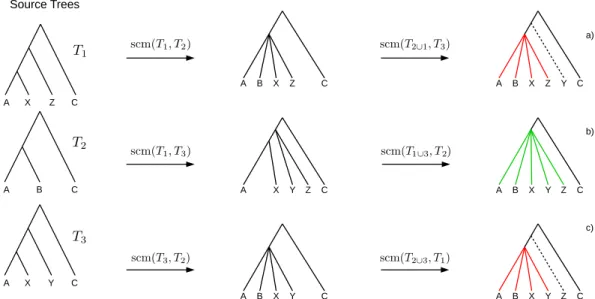
Figure 2 Example where the collision handling inserts bogus clades (red) into the supertree.Bogus clades are induced by obviated collisions, which are prevented by a previous collision on the same edge. Supertrees (A) and (C) are estimated on the same set of source trees, but contain conflicting clades ((ABXZ) conflicts with (ABXY)) induced by different merging orders. The correct supertree is (B).
Tree merging order
Although the SCM for two trees is deterministic, the output of the GSCM is influenced by the order of selecting pairs of trees to be merged, since the resulting number and positions of collisions may vary.
LetT1,...,Tnbe a set of input trees we want to merge into a supertree using the GSCM.
When merging two trees, the strict consensus merger (SCM) accepts only clades, that can be safely inferred from the two source trees. In case of a collision during reinsertion of unique taxa, the colliding subtrees are inserted as a polytomy on the edge where the collision occurred.
If collisions of different merging steps occur on the same edge, the polytomy created by the first collision may cause the following collisions to not occur. Such obviated collisions inducebogus clades(seeFig. 2) which cannot be inferred unambiguously from the source trees and hence should not be part of the supertree. A cladeC of a supertree
T=GSCM(T1,...,Tn) is abogus cladeif there is another supertreeT′=GSCM(T1,...,Tn)
(based on a different tree merging order) that contains a cladeC′conflicting withC (see Figs. 2Aand2C). Note that bogus clades cannot be recognized by comparison to the source trees since they do not conflict with any of the source treesT1,...,Tn. All clades in the
GSCM supertree that are not bogus, are calledreliable clades.
Scoring functions
We present three novel scoring functions that produce high quality GSCM supertrees with respect to F1-score and number of unique clades (unique in terms of not occurring in a supertree resulting from any of the other scorings). In addition, we use the originalResolutionscoring (Roshan et al.,2003), as well as theUnique-TaxaandOverlap
scorings (Swenson et al.,2012). Letuc(T,T′)=V(T|
L(T)\L(T′)\L(T)) be the set of unique clades ofT compared to
T′.
Unique-Clades-Lost scoring:minimizing the number of unique clades that get lost:
score(Ti,Tj)= −
|uc(Ti,Tj)| − |uc(scm(Ti,Tj),Tj)|
+ |uc(Tj,Ti)| − |uc(scm(Ti,Tj),Ti)|
.
Unique-Clade-Rate scoring:maximizing the number of preserved unique clades:
|uc(Ti,Tj)| + |uc(Tj,Ti)|
|uc(scm(Ti,Tj),Ti)| + |uc(scm(Ti,Tj),Tj)|
.
Collision scoring:minimizing the number of collisions:
score(Ti,Tj)= −(number of edges in SCM(Ti,Tj) where a collision occured).
Unique Taxa scoring (Swenson et al.,2012):minimizing the number of unique taxa:
score(Ti,Tj)= −|L(Ti)1L(Tj)|.
Overlap scoring (Swenson et al.,2012):maximizing the number of common taxa:
score(Ti,Tj)= |L(T1)∩L(T2)|.
Resolution scoring (Roshan et al.,2003):maximizing the resolution of the SCM tree:
score(Ti,Tj)=
|V(SCM(Ti,Tj))| − |L(SCM(Ti,Tj))|
|L(SCM(Ti,Tj))| −1 .
Combining multiple scorings
In general, supertrees created with the GSCM using different scoring functions contain different clades. To collect as many reliable clades as possible, we compute several GSCM supertrees using different scoring functions and combine them afterwards.
Reliable clades of all possible GSCM supertrees for a given set of source trees are pairwise compatible. In contrast, bogus clades can be incompatible among different GSCM supertrees (seeFig. 2). Thus, every conflicting clade has to be a bogus clade. By removing incompatible clades we only eliminate bogus clades but none of the reliable clades from our final supertree.
if they induce a conflict between at least two supertrees (seeFig. 2). Hence, there is no guarantee to eliminate all bogus clades.
Combined scoring:LetCombined-3be the combination of the Collision, Unique-Clade-Rate and Unique-Clades-Lost scoring functions. FurthermoreCombined-5combines the Collision, Unique-Clade-Rate, Unique-Clades-Lost, Overlap and Unique-Taxa scoring functions.
Randomized GSCM
Generating many different GSCM supertrees increases the probability of both detecting all reliable clades and eliminating all bogus clades. To generate a larger number of GSCM supertrees, randomizing the tree merging order of the GSCM algorithm may be more suitable than using a variety of different tree selection scorings. To this end, we replace picking an optimal pair of trees (see Algorithm 2) by picking a random pair of trees (see Algorithm 3).
Algorithm 3. Function for randomization step of the GSCM
1:function pickRandomTreePair(treesS⊆ {T1,T2,...,Tk}) 2: Randomly pick a pair of trees{Ti,Tj} ⊆S with probability
P(Ti,Tj)=
score(Ti,Tj)
X
Ta,Tb∈S,a6=b
score(Ta,Tb) ,i6=j
3: return Ti,Tj 4:end function
Running the randomized GSCM for different scoring functions multiple (k) times allows us to generate a large number of supertrees containing different clades. The resulting trees are combined using a semi-strict consensus as described in the previous section. For combined scorings (Combined-n) with ndifferent scoring functions we calculate
k
n supertrees for each of the scoring functions and combine allk supertrees using the
semi-strict consensus.
EXPERIMENTAL SETUP
DatasetTo evaluate the different modifications of the GSCM algorithm we simulate a rooted dataset which is based on the SMIDGen protocol (Swenson et al.,2010) calledSMIDGenOG.
The SMIDGen protocol follows data collection processes used by systematists when gathering empirical data, e.g., the creation of several densely-sampledclade-based source trees, and a sparsely-sampledscaffold source tree. All source trees are rooted using an outgroup. Unless indicated otherwise, we strictly follow the protocol of Swenson et al. (2010), see there for more details:
1. Generate model trees. We generate model trees using r8s(Sanderson, 2003) as described bySwenson et al. (2010). To each model tree, we add an outgroup. The branch to the outgroup gets the length of the longest path in the tree, plus a random value between 0 and 1. This outgroup placement guarantees that there exists an outgroup for every possible subtree of the model tree.
2. Generate sequences.Universal genes appear at the root of the model tree and do not go extinct. We simulate five universal genes along the model tree. Universal genes are used to infer scaffold trees. To simulate non-universal genes, we use a gene ‘‘birth–death’’ process (as described bySwenson et al.(2010)) to determine 200 subtrees (one for each gene) within the model tree for which a gene will be simulated. For comparison, the
SMIDGendataset evolves 100 non-universal genes. Simulating a higher number of
genes increases the probability to find a valuable outgroup. Genes (both universal and non-universal) are simulated under a GTR+Gamma+Invariable Sites process along the respective tree, usingSeq-Gen(Rambaut & Grassly,1997).
3. Generate source alignments.To generate a clade-based source alignment, we select a clade of interest from the model tree using a ‘‘birth’’ node selection process (as described by Swenson et al.(2010)). For each clade of interest, we select the three non-universal gene sequences with the highest taxa coverage to build the alignment. For each source alignment, we search in the model tree for an outgroup where all three non-universal genes are present and add it to the alignment.
To generate a scaffold source alignment, we randomly select a subset of taxa from the model tree with a fixed probability (scaffold factor) and use the universal gene sequences.
4. Estimation of source trees.We estimate Maximum Likelihood (ML) source trees using RAxMLwith GTR-GAMMA default settings and 100 bootstrap replicates. We root all source trees using the outgroup, and remove the outgroups afterwards.
Evaluation
To evaluate the accuracy of tree reconstruction methods on simulated data, a widespread method is calculating the rates of false negative (FN) clades and false positive (FP) clades between an estimated tree (supertree) and the corresponding model tree.FN clades are in the model tree but not in the supertree.FPclades are in the supertree but not in the model tree.
FN-rates andFP-rates contain information on the resolution of the supertree. Model trees are fully resolved. If it happens that the supertree is fully resolved too, we getFN-rate
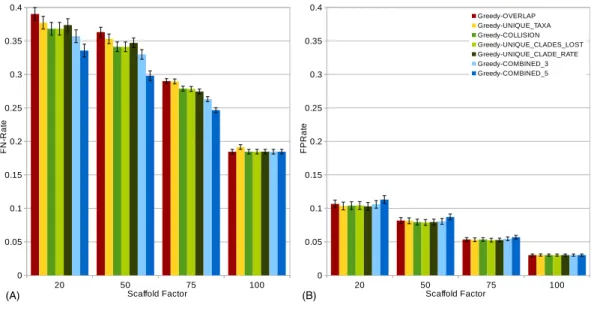
Figure 3 FN-rates (A) andFP-rates (B) of single scorings functions (Overlap, Unique-Taxa,
Colli-sion, Unique-Clades-Lost, Unique-Clade-Rate) and their combinations (Combined-3,Combined-5) for all scaffold factors (20%, 50%, 75%, 100%) of the 1,000-taxon dataset.The Combined scorings are the semi-strict consensus of the supertrees calculated by the respective scoring functions. The error bars show the standard error.
As mentioned above, we try to improve the GSCM as a preprocessing method and thus want to maximize the number ofTP, while keeping the number ofFP minimal. This is reflected in theF1-score:
F1=
2TP
2TP+FP+FN.
We measure the statistical significance of differences between the averaged F1-scores by the Wilcoxon signed-rank test withα=0.05. We calculate the pairwisep-values for all 16 scoring functions (including combined scorings and randomized scorings with 400 iterations). This leads to 1622−16 =120 significance tests. Respecting the multiple testing problem we can acceptp-values below 0120.005≈0.0004 (Bonferroni correction). The complete tables can be found inTables S1,S3andS5.
Furthermore,Tables S2,S4andS6contain the number of times that each scoring function outperforms each other scoring function. Ties are reported as well.
RESULTS AND DISCUSSION
We find the influence of scoring functions and randomization to increase with the size of the input data (as expected for greedy algorithms). Thus, in the further evaluation we only consider the larger (1,000 taxa) dataset. However, the overall effects are similar for all datasets. For the results of the 500 and 100 taxa datasets, we refer toFigs. S1–S16.
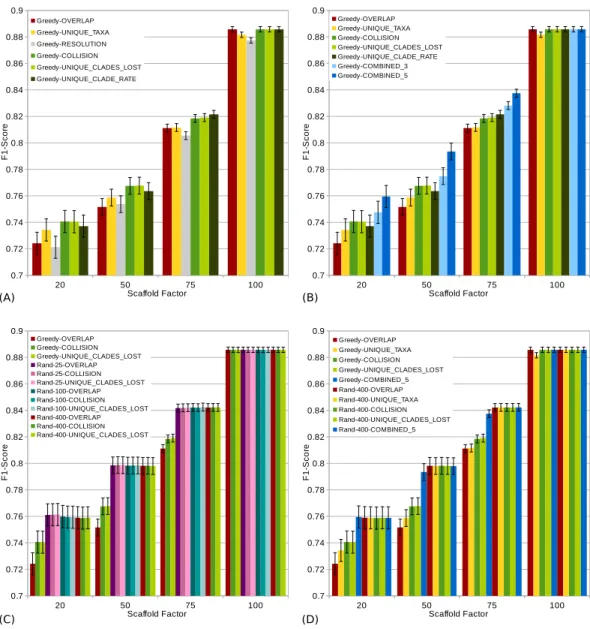
Figure 4 F1-scores (a high score is good) of different scoring functions (including combined
scor-ings) with and without randomization for all scaffold factors (20%, 50%, 75%, 100%) of the 1,000 taxa dataset. The Combined scorings are the semi-strict consensus of the supertrees calculated by the respec-tive scorings. The integer value after the keyword ‘‘Rand’’ represents the number of randomized iterations. The error bars show the standard error. (A) Comparison of single scoring functions (Overlap, Unique-Taxa, Resolution, Collision, Unique-Clades-Lost, Unique-Clades-Rate). (B) Comparison of single scoring functions (Overlap, Unique-Taxa, Collision, Unique-Clades-Lost, Unique-Clade-Rate) and their combi-nations (Combined-3,Combined-5). (C) Comparison of different scoring functions (Overlap, Collision, Unique-Clades-Lost) with (25, 100 and 400 random iterations) and without randomization. (D) Compar-ison of single (Overlap, Unique-Taxa, Collision, Unique-Clades-Lost) and combined (Combined-5) scor-ings. Both with 400 random iterations and without randomization.
scoring—which does not perform well for small scaffold tree sizes (20%, 50%)—produces optimal solutions for a scaffold factor of 100%.
Comparing the different scoring functions, we find that in general, theFN-rate varies more than theFP-rate (seeFig. 3). Our presented scoring functions (Collision, Unique-Clade-Lost, Unique-Clade-Rate) decrease theFN-rate, without increasing theFP-rate (see Fig. 3). This leads to the highestF1-scores for all scaffold factors (seeFig. 4A). They clearly outperform the Resolution, Overlap and Unique-Taxa scorings for scaffold factors 50% and 75%. The differences in theF1-scores are significant (p-values below 0.000033). For a scaffold factor of 20% the improvements of our scoring functions in comparison to Unique-Taxa are not significant. For a scaffold factor of 100% the Overlap scoring function is on par with our scoring functions (all of them will return the optimal solution). The differences between Collision, Unique-Clade-Lost and Unique-Clade-Rate are not signif-icant. Nevertheless Unique-Clade-Lost provides the most robust and input independent results. For scaffold factors of 20% and 50%, Resolution and Overlap show significantly worse (p-values≤0.000006)F1-scores than all other scoring functions (seeFig. 4A). There is no significant difference (p-values>0.09) between Resolution and Overlap scoring. For scaffold factors of 75% and 100%, the Resolution scoring function performs significantly worse than all others. For a scaffold factor of 75%, there is no significant difference between Unique-Taxa and Overlap scoring. For a scaffold factor of 100%, the Overlap scoring func-tion performs better than Unique-Taxa, which is still significantly better than Resolufunc-tion.
Even for equally-performing scoring functions, the resulting trees are often different (except for scaffold factor 100%). Thus, we combine the GSCM supertrees computed with different scorings using the semi-strict consensus. Since the Resolution scoring function performs badly, we only combine the remaining five scoring functions. The combination of different scoring functions strongly improves theFN-rate. Thus, the combined supertrees have improved F1-scores for all scaffold densities (seeFig. 4B). The combination of Collision, Unique-Clade-Lost, Unique-Clade-Rate, Overlap and Unique-Taxa (Combined-5) results in the bestF1-score. However, Combined-5 has a significantly worseFP-rate than all other scorings. In contrast, the combination of Collision, Unique-Clade-Lost, Unique-Clade-Rate scoring (Combined-3) shows no significant decline of theFP-rate.
To collect as many TP clades as possible, we use a randomized tree merging order generating multiple (k) supertrees which are combined using the semi-strict consensus. Generally we found that randomization further improves theF1-score in comparison to the single scoring functions (seeFig. 4D). Compared to the Combined-5 scoring there is only an improvement of theF1-score for scaffold factors of 50% and 75%. Again, these improvements come with a significant increase of theFP-rate.
Already for 25 random iterations, all presented scoring functions perform on almost the same level (seeFig. 4C). As the number of random iterations increases, the difference between the reported scoring functions vanishes.
CONCLUSION
perform best. Combining multiple GSCM supertrees using a semi-strict consensus method helps to better resolve the supertree.
We presented three novel scoring functions (Collision, Clades-Lost, Unique-Clade-Rate) that increase the number of true positive clades and decrease the number of false positive clades of the resulting supertree. Unique-Clades-Lost score is the overall best-performing scoring function.
Combining the supertrees calculated by these three scorings using a semi-strict consensus algorithm further increases the number of true positive clades without a significant increase of the false positives.
For almost all presented scoring functions, the highestF1-scores and best resolved trees are achieved using randomized GSCM. Randomization indeed increases the number of true positive clades but also significantly increases false positive clades. Thinking of GSCM as a preprocessing method, those false positive clades will have a strongly negative influence on the quality of the final supertree.
Depending on the application, ‘‘best performance’’ is characterized differently. The most conservative approach is our Unique-Clade-Lost scoring function which increases theTP-rate by 5% while decreasing theFP-rate by 2% compared to Overlap. To use GSCM as a preprocessing method, we recommend a combination of Collision, Unique-Clade-Lost and Unique-Clade-Rate (Combined-3) scoring. In comparison to the Overlap scoring function, this increases the number of true positive clades by 9% without a significant increase of false positive clades. The overall best ratio of true positive and false positive clades can be achieved with a combination of randomized Collision, Unique-Clade-Lost, Unique-Clade-Rate, Overlap and Unique-Taxa (Combined-5) scoring.
All presented methods are part of our platform-independent GSCM command line tool (https://bio.informatik.uni-jena.de/software/gscm/).
ADDITIONAL INFORMATION AND DECLARATIONS
Funding
Markus Fleischauer is supported by Deutsche Forschungsgemeinschaft, project BO 1910/12. The funders had no role in study design, data collection and analysis, decision to publish, or preparation of the manuscript.
Grant Disclosures
The following grant information was disclosed by the authors: Deutsche Forschungsgemeinschaft: BO 1910/12.
Competing Interests
The authors declare there are no competing interests.
Author Contributions
• Sebastian Böcker conceived and designed the experiments, reviewed drafts of the paper, developed the method.
Data Availability
The following information was supplied regarding data availability: Lehrstuhl Bioinformatik Jena:http://bio.informatik.uni-jena.de/data/.
Supplemental Information
Supplemental information for this article can be found online athttp://dx.doi.org/10.7717/ peerj.2172#supplemental-information.
REFERENCES
Aho AV, Sagiv Y, Szymanski TG, Ullman JD. 1981.Inferring a tree from lowest common ancestors with an application to the optimization of relational expressions.SIAM
Journal on Computing 10(3):405–421DOI 10.1137/0210030.
Bansal MS, Burleigh JG, Eulenstein O, Fernández-Baca D. 2010.Robinson-foulds supertrees.Algorithms for Molecular Biology5(1):1–12DOI 10.1186/1748-7188-5-18. Baum BR. 1992.Combining trees as a way of combining data sets for phylogenetic
inference, and the desirability of combining gene trees.Taxon41(1):3–10 DOI 10.2307/1222480.
Berry V, Bininda-Emonds ORP, Semple C. 2013.Amalgamating source trees with differ-ent taxonomic levels.Systematic Biology62(2):231–249DOI 10.1093/sysbio/sys090. Bininda-Emonds ORP. 2004.The evolution of supertrees.Trends in Ecology & Evolution
19(6):315–322DOI 10.1016/j.tree.2004.03.015.
Brinkmeyer M, Griebel T, Böcker S. 2013.FlipCut supertrees: towards matrix represen-tation accuracy in polynomial time.Algorithmica67(2):142–160.
Bryant D. 2003. A classification of consensus methods for phylogenetics. In: Janowitz MF, Lapoint FJ, McMorris FR, Mirkin B, Roberts FS, eds.Bioconsensus: DIMACS series in discrete mathematics and theoretical computer science, vol. 61. Providence: American Mathematical Society, 163–184.
Chen D, Eulenstein O, Fernández-Baca D, Sanderson M. 2006.Minimum-flip su-pertrees: complexity and algorithms.IEEE/ACM Transactions on Computational
Biology and Bioinformatics3(2):165–173DOI 10.1109/TCBB.2006.26.
Foulds L, Graham RL. 1982.The Steiner problem in phylogeny is NP-complete.
Advances in Applied Mathematics3(1):43–49DOI 10.1016/S0196-8858(82)80004-3.
Gysel R, Gusfield D, Stevens K. 2013.Triangulation heuristics for maximum character compatibility. In:2013 IEEE 3rd international conference on computational advances in bio and medical sciences (ICCABS). Piscataway: IEEE.
Holland B, Conner G, Huber K, Moulton V. 2007.Imputing supertrees and supernet-works from quartets.Systematic Biology56(1):57–67
DOI 10.1080/10635150601167013.
Huson DH, Vawter L, Warnow TJ. 1999.Solving large scale phylogenetic problems using DCM2. In:Proceedings of intelligent systems for molecular biology (ISMB 1999). Palo Alto: AAAI Press, 118–129.
Nelesen S, Liu K, Wang L-S, Linder CR, Warnow T. 2012.DACtal: divide-and-conquer trees (almost) without alignments.Bioinformatics28(12):i274–i282 DOI 10.1093/bioinformatics/bts218.
Ragan MA. 1992.Phylogenetic inference based on matrix representation of trees.
Molecu-lar Phylogenetics and Evolution1(1):53–58DOI 10.1016/1055-7903(92)90035-F.
Rambaut A, Grassly NC. 1997.Seq-gen: an application for the Monte Carlo simulation of DNA sequence evolution along phylogenetic trees.Computer Applications in the Biosciences13(3):235–238.
Ranwez V, Criscuolo A, Douzery EJP. 2010.SuperTriplets: a triplet-based supertree approach to phylogenomics.Bioinformatics26(12):i115–i123
DOI 10.1093/bioinformatics/btq196.
Roshan U, Moret B, Warnow T, Williams T. 2003.Greedy strict-consensus merger: a new method to combine multiple phylogenetic trees. Technical report.
Roshan U, Moret B, Warnow T, Williams T. 2004.Rec-I-DCM3: a fast algorithmic technique for reconstructing large phylogenetic trees. In:Proceedings of IEEE computational systems bioinformatics conference (CSB 2004). Piscataway: IEEE, 98–109.
Ross HA, Rodrigo AG. 2004. An assessment of matrix representation with compatibility in supertree construction. In: Bininda-Emonds ORP, ed.Phylogenetic supertrees: combining information to reveal the tree of life. Computational biology book series, vol. 4. Dordrecht: Springer, 35–63, chapter 2.
Sanderson MJ. 2003.r8s: inferring absolute rates of molecular evolution and diver-gence times in the absence of a molecular clock.Bioinformatics19(2):301–302 DOI 10.1093/bioinformatics/19.2.301.
Scornavacca C, Berry V, Lefort V, Douzery EJP, Ranwez V. 2008.PhySIC_ IST: cleaning source trees to infer more informative supertrees.BMC Bioinformatics9:413
DOI 10.1186/1471-2105-9-413.
Snir S, Rao S. 2010.Quartets MaxCut: a divide and conquer quartets algorithm.
IEEE/ACM Transactions on Computational Biology and Bioinformatics7(4):704–718
DOI 10.1109/TCBB.2008.133.
Swenson MS, Barbançon F, Warnow T, Linder CR. 2010.A simulation study comparing supertree and combined analysis methods using SMIDGen.Algorithms for Molecular
Biology5(1):1–16DOI 10.1186/1748-7188-5-8.
Swenson MS, Suri R, Linder CR, Warnow T. 2012.SuperFine: fast and accurate
supertree estimation.Systematic Biology61(2):214–227DOI 10.1093/sysbio/syr092. Von Haeseler A. 2012.Do we still need supertrees?BMC Biology10:13
DOI 10.1186/1741-7007-10-13.