Complete Denture Occlusion: An Evidence-Based Approach
Arcelino Farias-Neto, DDS, MS1& Adriana da Fonte Porto Carreiro, PhD2
1Department of Dentistry, Potiguar University, Natal, Brazil
2Department of Dentistry, UFRN – Rio Grande do Norte Federal University, Natal, Brazil
The article is associated with the American College of Prosthodontists’ journal-based continuing education program. It is accompanied by an online continuing education activity worth 1 credit. Please visit www.wileyonlinelearning.com/jopr to complete the activity and earn credit.
Keywords
Bilateral balanced occlusion; canine guidance; conventional complete denture.
Correspondence
Arcelino Farias-Neto, Rua dos Potiguares, 2421 Lagoa Nova Natal RN 59063–450, Brazil. E-mail: [email protected]
The authors deny any conflicts of interest.
Accepted May 21, 2012
doi: 10.1111/j.1532-849X.2012.00927.x
Abstract
Purpose:This study involved an extensive search for randomized controlled clini-cal trials comparing bilateral balanced and canine-guided dentures, and questioned whether a bilateral balanced occlusion is imperative for successful denture treatment.
Materials and Methods: Studies were identified by searching electronic databases (PubMed/MEDLINE, ISI Web of Science, LILACS, and BBD). The keywords “den-ture” and “occlusion” were used. The minimum inclusion requirements were (1) randomized controlled trials with patients of any age wearing both maxillary and mandibular conventional complete dentures (CDs), (2) comparison between bilateral balanced and canine-guided dentures, and (3) assessment of masticatory function and/or patients’ satisfaction.
Results:The search resulted in the identification of 5166 articles. Subsequently, 5156 articles were excluded on the basis of title and abstract. By the end of the search phase, seven randomized controlled trials were considered eligible.
Conclusions:Current scientific evidence suggests that bilateral balanced occlusion is not imperative for successful treatment with conventional CDs in average patients. More studies are necessary to identify if specific clinical conditions may benefit from a balanced occlusion.
According to the American Dental Association, evidence-based dentistry is an approach to oral healthcare requiring the judi-cious integration of systematic assessments of clinically rele-vant scientific evidence with the dentist’s clinical expertise and the patient’s treatment needs and preferences.1Assessment of
scientific evidence obtained from reliable sources may be the most challenging element for dentists to master. Clinical ex-pertise is often obtained by practitioners engaging in clinical experiences over time. Patients’ desires and preferences may be the result of many factors including perceived needs, past dental experiences, health values, and financial issues. Finally, it is essential that these three elements are present in order to obtain the greatest benefits.1
In the face of this new paradigm of clinical decision mak-ing, numerous clinical procedures have become questionable. In 2009, Carlsson2 presented examples of “old truths” in the field of prosthodontics. One of these so-called “old truths” is the bilateral balanced occlusion (BBO), held by many authors as fundamental for successful treatment with conventional com-plete dentures (CDs). For more than a hundred years, textbooks and undergraduate teaching have stated that canine guided den-tures should be avoided, since they would result in denture instability and impaired masticatory function; however, recent research has shown that conventional CDs can function suc-cessfully without a balanced occlusion.3 Also, it is interest-ing to note that 1 year after the insertion of new dentures,
balancing contacts are no longer present due to acrylic tooth wear and changes in supporting tissues, but patients do not complain about the situation.4 The conception of BBO was
not based on rigid scientific methods, but derived from clinical observation and repetition over the years. Although it does not mean it is incorrect, it seems that the needs and attitudes of indi-vidual patients may have been overestimated. If canine-guided dentures may be constructed with acceptable clinical results in a minimum amount of time and effort, clinicians should be aware of the evidence in order to make the decision that best suits their patients’ needs.
Since investigations of high quality are required for valid comparisons between different methods, the purpose of this study was to accomplish an extensive search for random-ized controlled clinical trials comparing bilateral balanced and canine-guided dentures, and question whether a BBO is im-perative for successful denture treatment. Assessment of mas-ticatory function and patient satisfaction were considered as treatment outcomes.
Materials and methods
Information sources
Studies were identified by searching electronic databases. The keywords “denture” and “occlusion” were used. No
Farias-Neto and Carreiro Complete Denture Occlusion
limits were applied for language. This search was applied to PubMed/MEDLINE, ISI Web of Science, LILACS (Latin American and Caribbean Literature on the Health Science), and BBD (Brazilian Bibliography of Dentistry). Additional ref-erences from citations within the articles were obtained, and current textbooks were also used. Papers dated between 1950 and 2012 were selected. The last search was run on 12 January 2012.
Inclusion and exclusion criteria
The minimum inclusion requirements were (1) randomized controlled trials with patients of any age wearing both max-illary and mandibular conventional CDs, (2) comparison be-tween bilateral balanced and canine-guided dentures, and (3) assessment of masticatory function and/or patients’ satisfac-tion. Clinical reports, reviews, and short communications were excluded.
Review methods
All reports identified by the search were printed and indepen-dently analyzed once by each of the two reviewers on the basis of title, keywords, and abstract (when available) to check if the study was likely to be relevant. Full reports of all relevant pa-pers and all papa-pers that could not be classified were obtained. In cases of disagreement, a third reviewer was consulted to achieve consensus. The reviewers were not blinded as to au-thors, journals, date of publication, financial support, or results. The inclusion criteria were applied, data assessed, and then in-dependently extracted by two reviewers. Consensus was sought in cases of discrepancy.
Results
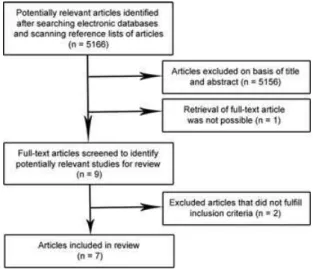
The search resulted in the identification of 5166 articles. Sub-sequently, 5156 articles were excluded on the basis of title and abstract. Of the 10 studies considered to be potentially relevant for this review, one article5 was excluded because it was not
possible to retrieve the full text. Thus, the full texts of nine studies were screened. During full-text screening, two articles were excluded. One article6was not a randomized controlled trial, and the other7did not meet the inclusion criteria for
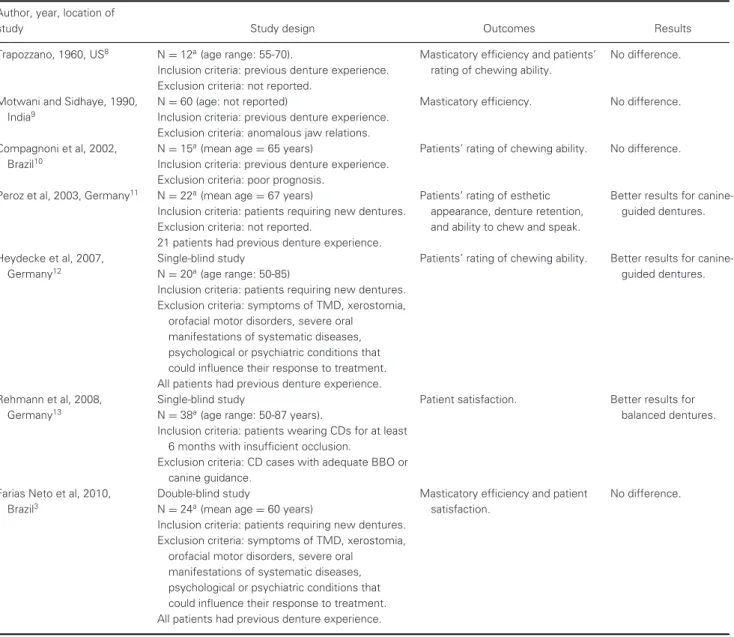
as-sessment of masticatory function and/or patients’ satisfaction. By the end of the search phase, seven randomized controlled trials were considered eligible. Their data were the basis of this review (Table 1). Figure 1 is a flow chart of studies assessed and excluded at various stages of the review.
Discussion
The issue about which occlusal concept is the most appropriate for individual needs is clinically and economically relevant. For the dentist and dental technician, the construction of a set of dentures with BBO is more complex and time consuming than construction of canine-guided dentures. Achieving BBO during the arrangement of prosthetic teeth and clinical adjustments is more complicated, making it reasonable to use technical pro-cedures that produce acceptable clinical results with minimum time and effort.
Of the seven clinical trials identified,3,8−13
six presented a crossover design.3,8,10−13 This design is common in medical
and dental human subject research. A crossover design elim-inates inter-subject response variation to the same treatment, because all treatments are applied to all participants. This in-creases the statistical efficiency of the study, given the need for a smaller number of patients. Because all patients work as their own control, the crossover design allows the reduction of the ef-fect of noncontrolled variables such as gender, previous denture experience, health status, resiliency of the mucosa, and alveo-lar ridge height and width. Those advantages aside, crossover trials do present a carry-over effect. While a washout period is necessary in pharmacological trials, carry-over effects are un-likely in oral rehabilitation. Leaving patients without dentures for a washout period was not considered possible for ethical reasons. Therefore, a washout period was not included in any of the studies. To avoid bias, three studies3,11,12
presented two groups with different treatment sequences while in one study the occlusal concept was changed daily.13
Two occlusal concepts exist in CD treatment: BBO and ca-nine guidance. Both include simultaneous contact in centric occlusion, but they differ in eccentric movements. It was sup-posed that BBO would provide greater masticatory efficiency by bringing a larger amount of grinding surfaces into contact at each movement.14However, none of the three clinical trials
investigating the influence of occlusal concepts on mastica-tory efficiency supported this assumption.3,8,9In Trapozzano’s
study8(n=12), nine patients showed greater masticatory
ef-ficiency with balanced occlusion, but the degree of difference was decisive in only two of them. In three patients the mas-ticatory efficiency was slightly greater with the nonbalanced occlusion. Differences were observed only when carrots were used as test food, but not for peanuts. In Farias Neto et al,324 edentulous patients requiring new dentures were randomized into two treatment groups with different treatment sequences. The dentures were fabricated in accordance with traditional techniques and in cooperation with undergraduate dental stu-dents. Anatomically shaped acrylic teeth with a 33◦cuspal
in-clination were used. The change from BBO to canine guidance of all dentures was performed clinically by the same dentist by the addition of light-cured composite resin in the lower ca-nines. To reestablish BBO, the composite resin was removed. Patients were subjected to both occlusal concepts for equal 3-month periods. The colormetric method, with capsules of a synthetic material enclosing fuchsine-containing granules, was used to perform a masticatory efficiency test. A method for quantifying the overall satisfaction of conventional CD wearers was used. Patients were asked to respond to questions with three-grade answers (well satisfied, satisfied, dissatisfied) regarding 12 factors: “chewing, tasting, speech, pain (upper and lower), esthetics, fit (upper and lower), retention (upper and lower), and comfort (upper and lower).”3 No difference
was observed between bilateral balanced and canine guided dentures.
The relationship between masticatory efficiency and subjec-tive chewing experience has been shown to be weak or ab-sent.15Thus, masticatory function must be evaluated in both
manners, especially in edentulous patients due to the impor-tance of psychological factors for successful treatment.2 Two
Complete Denture Occlusion Farias-Neto and Carreiro
Table 1Randomized controlled trials comparing bilateral balanced and canine guided dentures
Author, year, location of
study Study design Outcomes Results
Trapozzano, 1960, US8 N
=12a(age range: 55-70). Masticatory efficiency and patients’ No difference. Inclusion criteria: previous denture experience. rating of chewing ability.
Exclusion criteria: not reported.
Motwani and Sidhaye, 1990, N=60 (age: not reported) Masticatory efficiency. No difference. India9 Inclusion criteria: previous denture experience.
Exclusion criteria: anomalous jaw relations.
Compagnoni et al, 2002, N=15a(mean age=65 years) Patients’ rating of chewing ability. No difference. Brazil10 Inclusion criteria: previous denture experience.
Exclusion criteria: poor prognosis.
Peroz et al, 2003, Germany11 N=22a(mean age=67 years) Patients’ rating of esthetic Better results for canine-Inclusion criteria: patients requiring new dentures. appearance, denture retention, guided dentures. Exclusion criteria: not reported. and ability to chew and speak.
21 patients had previous denture experience.
Heydecke et al, 2007, Single-blind study Patients’ rating of chewing ability. Better results for
canine-Germany12 N=20a(age range: 50-85) guided dentures.
Inclusion criteria: patients requiring new dentures. Exclusion criteria: symptoms of TMD, xerostomia,
orofacial motor disorders, severe oral manifestations of systematic diseases, psychological or psychiatric conditions that could influence their response to treatment. All patients had previous denture experience.
Rehmann et al, 2008, Single-blind study Patient satisfaction. Better results for
Germany13 N
=38a(age range: 50-87 years). balanced dentures.
Inclusion criteria: patients wearing CDs for at least 6 months with insufficient occlusion.
Exclusion criteria: CD cases with adequate BBO or canine guidance.
Farias Neto et al, 2010, Double-blind study Masticatory efficiency and patient No difference.
Brazil3 N
=24a(mean age
=60 years) satisfaction.
Inclusion criteria: patients requiring new dentures. Exclusion criteria: symptoms of TMD, xerostomia,
orofacial motor disorders, severe oral manifestations of systematic diseases, psychological or psychiatric conditions that could influence their response to treatment. All patients had previous denture experience.
a
Crossover design.
studies presented no difference for patients’ rating of their chewing ability,8,10
while two studies presented better results for canine-guided dentures.11,12In a randomized crossover
clin-ical trial of 22 patients, subjective data were collected us-ing 100-mm visual analogue scales to describe patient sat-isfaction with esthetic appearance, ability to chew, ability to speak, and denture retention.11All dentures were constructed
with anatomic teeth. Each occlusal concept was worn for 3 months. Patients assessed canine-guided dentures to be sig-nificantly more satisfying in esthetic appearance, mandibular denture retention, and chewing ability.11Heydecke et al12 com-pared a simplified balanced occlusion, called lingualized oc-clusion, to first premolar/canine-guidance. Edentulous patients (n=20) received two sets of new CDs. One pair was manu-factured based on intraoral tracing of centric relation, facebow
transfer, and semi-anatomical teeth with lingualized occlusion. The second pair was made using a simplified procedure without facebow transfer; jaw relations were recorded with wax occlu-sion rims, and anatomical teeth with a first premolar/canine-guidance were selected. Patients were blinded to study group and were not informed about the differences between the two types of dentures. The dentures were delivered in random-ized order, and each was worn for 3 months. Patients’ rating of chewing ability was significantly better with nonbalanced dentures.12
Proponents of BBO believe that this occlusal concept is important for denture retention and stability.14 Because the
highest incidence of oblique forces capable of dislodging den-tures occurs during mastication, it was supposed that canine-guided dentures would impair masticatory function; however,
Farias-Neto and Carreiro Complete Denture Occlusion
Figure 1 Studies assessed and excluded at various stages of the review.
clinical trials identified in this review suggest that the occlusal concept of conventional CDs is not as crucial as often antic-ipated for long-term clinical success in terms of masticatory efficiency,3,8,9
chewing experience,8,10−12
and patient satisfac-tion.3,13 In a single-blind study with 38 edentulous patients,
patient satisfaction was assessed in the initial phase after fitting new CDs.13After 2 and 4 weeks, 63% and 47% of the patients
preferred BBO, and 5% and 11% preferred canine guidance, respectively. According to the authors, the BBO may help pa-tients adapt to their new oral situation; however, with ongoing time during adaptation, the difference between both occlusal concepts becomes more and more insignificant.13 Balancing
contacts are not found during mastication and probably are not physiologically necessary. With the food bolus between the teeth, the occlusal surfaces do not make contact with each other, but with the food. Also, during functional activities such as drinking, speaking, or singing, there is no balancing contact. It is possible that patients presenting parafunctional habits may benefit from balancing contacts, but this assumption remains to be investigated.
According to Pound,16BBO centralizes forces on the
resid-ual alveolar ridges to protect alveolar bone from resorption. No clinical trials have investigated that association. It is difficult to accomplish long-term controlled trials evaluating the influence of occlusal concepts on bone resorption due to patients’ age and many other variables. It has been explained that BBO pro-tects against bone resorption because it promotes symmetrical distribution of stress on the alveolar ridges; however, because during mastication there is no balancing contact, there is no force distribution on both sides of the arches. To avoid these problems in denture retention, stability, and bone resorption, it seems to be more reasonable for clinicians to instruct patients to not incise, to put small pieces of food in the mouth, and to masticate on both sides of the arch.
To summarize, the critical appraisal of the literature reveals no scientific evidence to support the BBO as the ideal occlusal concept for conventional CDs. Current evidence suggests that the occlusal concept has little influence on clinical outcomes or
patient satisfaction. Additional randomized controlled clinical trials should be developed taking into account the influence of mucosal resiliency, alveolar ridge anatomy, and parafunctional activities on occlusal concept choice.
Conclusions
Current scientific evidence suggests that BBO is not impera-tive for successful treatment with conventional CDs in average patients when masticatory function and patient satisfaction are considered as treatment outcomes. More studies are necessary to identify if specific clinical conditions may benefit from a balanced occlusion.
References
1. Gillette J: Answering clinical questions using the principles of evidence-based dentistry. J Evid Based Dent Pract 2009;9:1-8 2. Carlsson GE: Critical review of some dogmas in prosthodontics.
J Prosthodont Res 2009;53:3-10
3. Farias Neto A, Mestriner Junior W, Carreiro Ada F: Masticatory efficiency in denture wearers with bilateral balanced occlusion and canine guidance. Braz Dent J 2010;21:165-169
4. Utz KH: Studies of changes in occlusion after the insertion of complete dentures (Part II). J Oral Rehabil 1997;24:376-384 5. Koita AK: A Scientific Study to Investigate Improvement in Masticatory Function by Balanced Occlusion on Complete Artificial Dentures [Thesis]. Bombay, University of Bombay, 1975
6. Dubojska AM, White GE, Pasiek S: The importance of occlusal balance in the control of complete dentures. Quintessence Int 1998;29:389-394
7. Hofmann M, Knauer G: Studies on canine guidance in complete dentures. Dtsch Zahnarztl Z 1990;45:566-570
8. Trapozzano VR: Tests of balanced and nonbalanced occlusions. J Prosthet Dent 1960;10:476-487
9. Motwani BK, Sidhaye AB: The need of eccentric balance during mastication. J Prosthet Dent 1990;64:689-690
10. Compagnoni MA, Leles CR, Barbosa DB, et al: Oclus˜ao em dentaduras completas: estudo comparativo entre oclus˜ao balanceada bilateral e desoclus˜ao pelo canino. Rev do CROMG 2002;8:92-97
11. Peroz I, Leuenberg A, Haustein I, et al: Comparison between balanced occlusion and canine guidance in complete denture wearers—a clinical, randomized trial. Quintessence Int 2003;34:607-612
12. Heydecke G, Akkad AS, Wolkewitz M, et al: Patient ratings of chewing ability from a randomised crossover trial: lingualised vs. first premolar/canine-guided occlusion for complete dentures. Gerodontology 2007;24;77-86
13. Rehmann P, Balkenhol M, Ferger P, et al: Influence of the occlusal concept of complete dentures on patient satisfaction in the initial phase after fitting: bilateral balanced occlusion vs canine guidance. Int J Prosthodont 2008;21:60-61
14. Zarb GA, Bolender CL, Eckert SE, et al (eds): Prosthodontic Treatment for Edentulous Patients – Complete Dentures and Implant-Supported Prostheses. St. Louis, Mosby, 2003 15. Slagter AP, Olthoff LW, Bosman F, et al: Masticatory ability,
denture quality, and oral conditions in edentulous subjects. J Prosthet Dent 1992;68:299-307
16. Pound E. Lost-fine arts in the fallacy of the ridges. J Prosthet Dent 1954;4:6-16