RESUMO
Visto que indicadores de prognóstico são uma ferramenta impor-tante para a seleção de pacientes a serem tratados com prótese total, este estudo investigou a influência da forma e da resiliência do rebordo alveolar mandibular sobre a retenção e estabilidade de próteses totais convencionais. Noventa e três pacientes des-dentados portadores de próteses totais superior e inferior compuseram a amostra. Os dados foram coletados quanto a forma e resiliência do rebordo mandibular. As próteses foram avaliadas para a retenção e estabilidade utilizando-se uma ferramenta obje-tiva e reproduzível. As associações entre as características clínicas
do rebordo alveolar mandibular e retenção e estabilidade das próteses foram analisados por meio dos testes qui-quadrado e exato de Fisher (α = 0.05). Observou-se associação significativa entre a forma do rebordo e a estabilidade da prótese (p <0,05), enquanto que a resiliência foi associada significativamente com a retenção (p <0,001). Baseando-se nos resultados, a resiliência e forma do rebordo mandibular influenciaram, respectivamente, a retenção e estabilidade de próteses totais convencionais.
Palavras-chave:prótese total; retenção em prótese total; sat-isfação do paciente
ABSTRACT
Since prognostic indicators are likely to take on increasing importance as a diagnostic tool for selection of patients for implant provision, this study investigated the influence of the shape and resiliency of the mandibular alveolar ridge on the retention and stability of conventional complete dentures. Nine-ty-three edentulous patients wearing both maxillary and mandibular conventional complete dentures composed the sam-ple. Data were collected regarding shape and resiliencyof the mandibular residual ridge. Dentures were assessed for retention and stability using an objective and reproducible tool.The
asso-ciations between the clinical characteristics of the mandibular alveolar ridge and denture retention and stability were analyzed using chi-square and Fisher exact tests (α = 0.05). A significant association between ridge shape and denture stability (p < 0.05) was found, while ridge resiliency was significantly associated to denture retention (p < 0.001). Based on the results, mandibular ridge shape and resiliency influenced the retention and stability of conventional complete dentures.
Key words:complete denture; denture retention; patient satis-faction
THE INFLUENCE OF MANDIBULAR RIDGE ANATOMY
ON TREATMENT OUTCOME WITH CONVENTIONAL
COMPLETE DENTURES
Jaiane A.M. Ribeiro1, Camila M.B.M. de Resende1, Ana L.C. Lopes1, Arcelino Farias-Neto2, Adriana da F.P. Carreiro1
1 Department of Dentistry, Federal University of Rio Grande do Norte, Natal, Brazil.
2 Health School, Potiguar University – Laureate International Universities, Natal, Brazil.
INFLUÊNCIA DA ANATOMIA DO REBORDO MANDIBULAR NO TRATAMENTO COM PRÓTESES TOTAIS CONVENCIONAIS
INTRODUCTION
Successful treatment with conventional complete dentures depends to a great extent on the patient’s ability to use the denture. The problem is how to identify, through oral examination, which patients have suitable conditions for denture use1. Denture
stability is defined the resistance of a denture to movement on its tissue foundation, especially to lat-eral forces as opposed to vertical displacement (termed denture retention)2. Patients usually
com-plain less about comfort and retention of the maxil-lary than of the mandibular denture2,3. The maxillary
residual ridge often has a more favorable shape, and
is less resorbed and resilient than its mandibular counterpart. According to Baat et al.,4 patient’s
adaptation to complete dentures is strongly related to the prosthetic condition, which combines den-ture quality and residual ridge characteristics. Thus, the discrepancy between the dentist’s evaluation of denture quality and the patient’s subjective judg-ment may result from inappropriate assessjudg-ment of the quality of the denture-bearing surfaces4.
submandibular/sublingual salivary flow rate, oral musculature characteristics and mandibular ridge shape7. Mandibular ridge shape has also been related
to masticatory efficiency8and ability9. It is seems
obvious that better ridge shape will result in a more stable and retentive denture, and consequently better patient acceptance. However, some studies have found that residual ridge form has no influence on patient satisfaction10,11. According to a recent review
of the literature, studieson this area are equivocal and lack standardized methodologies for direct compari-son2. Since prognostic indicators are likely to take on
increasing importance as a diagnostic tool for selec-tion of patients for implant provision, the need for further research in this area has never been higher2.
Therefore, the purpose of this study was to investigate whether the shape and resiliency of the mandibular alveolar ridge are related to denture retention and sta-bility using a standardized and reproducible method-ology. The research hypothesis is that mandibular ridge anatomy may influence treatment outcome with conventional complete dentures.
MATERIAL AND METHODS
The study was approved by the institution’s Research Ethics Committee. All edentulous patients treated at the Prosthodontics Clinic between 2004 and 2009
study. After a preliminary examination, patients were excluded if they exhibited xerostomia, severe oral manifestations of systemic diseases or psychological or psychiatric conditions that could influence data collection. In addition, dentures were evaluated by an experienced prosthodontist and patients were excluded if at least one of the following features was inappropriate: extension of the denture base in rela-tion to the optimal available denture bearing area, peripheral seal, border extension, tissue fit, and bal-anced occlusion in retruded contact position. The sample was composed of 93 edentulous patients (18 male, 75 female), mean age 65.6 years (SD ± 9,2) wearing both mandibular and maxillary dentures for at least two months and less than 5 years. After pro-viding informed consent, patients answered a per-sonal information questionnaire (name, address, phone number, age, gender). Data were collected regarding shape (Cawood and Howell classifica-tion12) and resiliency7 of the mandibular residual
ridge (Table 1). The factors and criteria for evalua-tion of retenevalua-tion and stability of the mandibular den-ture were set up according to Sato et al.13 (Table 1).
Data were collected by a single examiner to avoid inter-examiner variability. Prior to the clinical examinations, the examiner participated in the cali-bration process, which was divided into theoretical
Table 1: Clinical assessment of the oral condition and denture quality.
Parameter Classification Description
Ridge shape Class I Dentate (Cawood and
Class II Immediately post extraction Howell
Class III Well-rounded ridge form, adequete in heigth and width classification)5-7,12
Class IV Knife-edge ridge form, adequate in height and inadequate in width
Class V Flat ridge form, inadequate in height and width
Class VI Depressed ridge form, with some basal loss evident
Ridge resiliency6-11 Resilient Firm, attached mucosa resistant to palpation
Flabby Mobility of ridge crest on palpation
Denture retention13 Displacement Does the denture dislodge with vertical pulling on central incisors after these are
with difficulty dired with gauze?
Easily displaced
Denture stability13 Normal tissue Is there movement induced by index and middle finger pressure on the molar
displacement teeth? (First, a direct pressure is applied equally on both sides; then a direct
Some instability pressure is applied first on one side and then on the other; and then a rotational
Shifted
discussions of codes and criteria for the study, as well as practical activities. Data were processed with SPSS software (V 17.0 for Windows, SPSS Inc, Chicago, IL, USA). The associations between the clinical characteristics of the mandibular alveo-lar ridge and denture retention and stability were analyzed using chi-square and Fisher exact tests. Confidence level was set at 95%.
RESULTS
The ridge resiliency was classified as flabby in 62 patients (63.3%) and resilient in 31 patients (31.6%). According to Cawood and Howell’s clas-sification12, seventy ridges were Class III (75.3%),
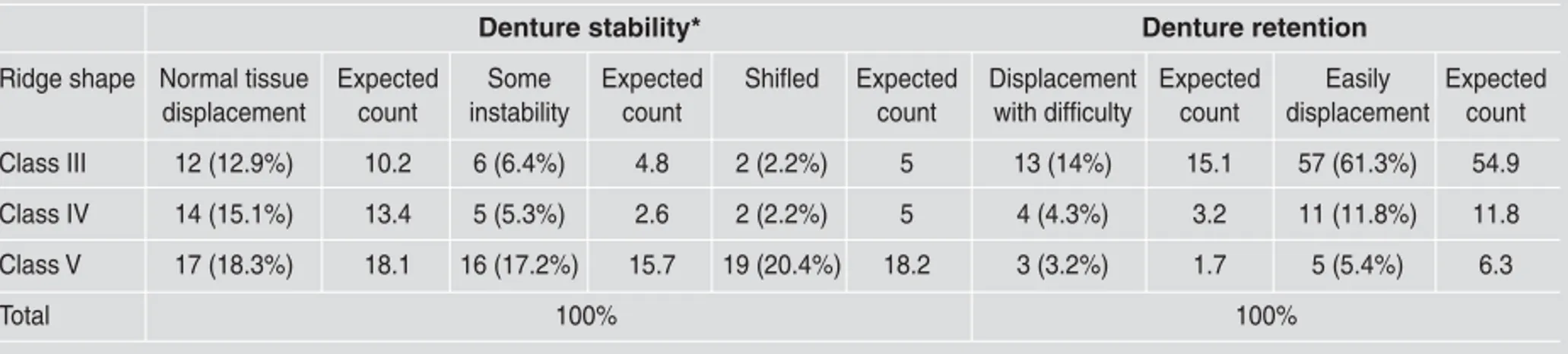
15 were Class IV (16.1%), and 8 were Class V (8.6%). Seventy-three mandibular dentures were easily displaced (78.5%), while 20 were displaced with difficulty (21.5%). Regarding denture stabil-ity, 43 were within normal tissue pattern (46.2%), 27 had some instability (29%), and 23 shifted (24.7%). Mandibular ridge shape was significant-ly associated to denture stability (p < 0.05), but did not influence denture retention (Table 2). Ridge resiliency was significantly associated to denture retention (p < 0.001), but not to denture stability (Table 3).
DISCUSSION
The results of this study support the research hypothesis that mandibular ridge anatomy may influence treatment outcome with conventional complete dentures. Mandibular ridge shape was significantly associated to denture stability (p < 0.05). Eighty-two percent of the dentures that shift-ed during the stability test were associatshift-ed to a flat ridge (Class V). In addition, ridge resiliency was associated to denture retention (p < 0.001). Direct comparison of these results to other studies was not possible because no study with the same purpose was identified. However, these results corroborate previous findings regarding the influence of ridge shape on patient satisfaction6,7 and the use of new
dentures5. Fenlon’s group observed a strong
influ-ence of ridge shapeonmandibular denture stability and security which in turn strongly influenced jaw relations5,6. This was shown to have a significant
influence on usage of and satisfaction with new dentures5,6.
It was expected that the shape and resiliency of the mandibular ridge would influence both denture retention and stability. However, ridge shape was associated only to denture stability (p < 0.05), but not to retention. In addition, ridge resiliency was
Table 2: Relationship between the shape of the mandibular ridge and denture stability and retention.
Denture stability* Denture retention
Ridge shape Normal tissue Expected Some Expected Shifled Expected Displacement Expected Easily Expected displacement count instability count count with difficulty count displacement count
Class III 12 (12.9%) 10.2 6 (6.4%) 4.8 2 (2.2%) 5 13 (14%) 15.1 57 (61.3%) 54.9
Class IV 14 (15.1%) 13.4 5 (5.3%) 2.6 2 (2.2%) 5 4 (4.3%) 3.2 11 (11.8%) 11.8
Class V 17 (18.3%) 18.1 16 (17.2%) 15.7 19 (20.4%) 18.2 3 (3.2%) 1.7 5 (5.4%) 6.3
Total 100% 100%
* Significantly associated to ridge shape (p< 0.05)
Table 3: Relationship between the resiliency of the mandibular ridge and denture retention and stability.
Denture retention* Denture stability
Ridge Displacement Expected Easily Expected Normal tissue Expected Some Expected Shifted Expected resiliency with difficulty count displaced count displacement count instability count count
Resilient 17 (85%) 15.7 14 (19.2%) 15.3 27 (29%) 28.7 21 (22.6%) 18 14 (15.1%) 15.3
Flabby 3 (15%) 5 59 (80.8%) 57 16 (17.2%) 14.3 6 (6.5%) 9 9 (9.7%) 7.7
Total 100% 100%
ty. These results may be related to the factors and criteria for evaluation of retention and stability. It is possible that the height and width of the alveo-lar ridge may be more relevant to prevent denture dislodgement under rotational forces, while a resilient ridge prevents dislodgement under verti-cal forces.
It seems logical to assume that better ridge shape would promote improved retention and stability, and consequently better patient acceptance2. However,
some studies have found contradictory results10,11.
Celebic et al.10concluded that patients rated as
hav-ing the best mandibular ridge shapes were the least satisfied with their new lower denture, and those given the best rating for maxillary ridge shape were more satisfied with their upper denture10. Another
study examined a sample of 130 patients and found no influence of physical condition of the mouth on patients’ satisfaction11. These contrasting results may
be related to differences in the methodologies used to assess retention and stability, as well as the crite-ria adopted for ridge shape classification. Our study used clear, direct criteria for objective assessment of the functional factors of a dental prosthesis13. The
method proposed by Sato et al.13has been shown to
be broad, trustworthy, reliable and reproducible13.
Assessment of the ridge shape followed the classifi-cation proposed by Cawood and Howell.12 This
ridge classificationsystem has been used in previous studies which reported similar results5-7.
According to Batt et al.,4 successful treatment with
conventional complete dentures depends on both denture quality and oral conditions. Thus, it is rea-sonable to conclude that patients’ rating of techni-cally appropriate dentures may be low due to their residual ridge characteristics. The American Col-lege of Prosthodontists has developed a classifica-tion system for complete edentulism that is based on specific diagnostic criteria, such as mandibular bone height, morphologic features of the
maxil-and maxillommaxil-andibular relationship. Edentulism is divided into 4 levels of difficulty or complexity, and the highest level designates patients who require the most difficult degree or complexity of treatment14.
Several factors other than a patient’s oral condi-tions may also influence denture retention and sta-bility. Stability can be further improved with precise linear centric occlusion15. Denture
instabil-ity may be caused by oblique forces during func-tional and parafuncfunc-tional activities as well as errors during the recording of maxillo-mandibular rela-tions1,5. Inadequate intermaxillary relationship may
have a negative impact on denture retention16. In
addition to the dentist’s technical skills and clini-cal expertise, the patient’s psychologiclini-cal profile may influence treatment outcome16. Psychological
evaluation should be carried out to determine patient’s attitudes regarding denture use2. Patients
with a negative opinion of their dentures are often less satisfied.11In addition, subjects with no
previ-ous experience of denturesare less satisfied than those who have already worn one or more pairs of dentures2.
To summarize, using a standardized and repro-ducible methodology, this study showed that mandibular ridge anatomy may influence treatment outcome with conventional complete dentures. The shape of the mandibular ridge may influence den-ture stability, while ridge resiliency may influence denture retention. Prognostic indicators are likely to take on increasing importance as a diagnostic tool for selection of patients for implant provision. Previous studies done in this area are equivocal and lack standardized methodologies for direct com-parison2. However, it must be emphasized that
suc-cessful prosthodontic therapy is likely to be multifactorial, and the clinical characteristics of alveolar ridges alone may not predict treatment outcomes4.
CORRESPONDENCE
Dr. Arcelino Farias-Neto
Health School, Potiguar University – Laureate International Universities Rua dos Potiguares, 2421, Lagoa Nova, Natal – RN, Brazil
REFERENCES
1. Wright CR. Evaluation of the factors necessary to develop stability in mandibular dentures. J Prosthet Dent 2004;92: 509-518.
2. Critchlow SB, Ellis JS. Prognostic indicators for conven-tional complete denture therapy: a review of the literature. J Dent 2010;38:2-9.
3. Wolff A, Gadre A, Begleiter A, Moskona D, Cardash H. Cor-relation between patient satisfaction with complete dentures and denture quality, oral condition, and flow rate of sub-mandibular/sublingual salivary glands. Int J Prosthodont 2003;16:45-48.
4. deBaat C, van Aken AA, Mulder J, Kalk W.“Prosthetic con-dition” and patients judgment of complete dentures. J Prosthet Dent 1997;78:472-478.
5. Fenlon MR, Sherriff M, Walter JD. An investigation of fac-tors influencing patients’ use of new complete dentures using structural equation modelling techniques.Community Dent Oral Epidemiol 2000;28:133-140.
6. Fenlon MR, Sherriff M. An investigation of factors influ-encing patients’ satisfaction with new complete dentures using structural equation modelling. J Dent 2008;36: 427-434.
7. Wolff A,Gadre A,Begleiter A, Moskona D, Cardash H. Cor-relation between patient satisfaction with complete dentures and denture quality, oral condition, and flow rate of sub-mandibular/sublingual salivary glands. Int J Prosthodont 2003;16:45-48.
8. Koshino H, Hirai T, Ishijima T, Ohtomo K. Influence of mandibular residual ridge shape on masticatory efficiency in complete denture wearers. Int J Prosthodont 2002;15: 295-298.
9. Koshino H, Hirai T, Yokoyama Y, Tanaka M, Toyoshita Y, Iwasaki K, Sudo E. Mandibular residual ridge shape and the masticatory ability in complete denture wearers. Nihon HotetsuShikaGakkaiZasshi 2008;52:488-493.
10. Celebić A, Knezović-Zlatarić D, Papić M, Carek V, Baucić I, Stipetić J. Factors related to patient satisfaction with com-plete denture therapy. J Gerontol A BiolSci Med Sci 2003; 58:M948-953.
11. Van Waas MA. The influence of clinical variables on patients’ satisfaction with complete dentures. J Prosthet Dent 1990;63:307-310.
12. Cawood JI, Howell RA. A classification of the edentulous jaws. Int J Oral MaxillofacSurg 1988;17:232–236. 13. Sato Y, Tsuga K, Akagawa Y, Tenma H. A method for
quan-tifying complete dentures quality. J Prosthet Dent 1998;80: 52-57.
14. Mazurat RD, Mazurat NM. Communicating complexity: using a diagnostic classification system for edentulous patients. J Can Dent Assoc 2003;69:511-514.
15. Gronas DG, Stout CJ. Lineal occlusion concepts for com-plete dentures. J Prosthet Dent 1974;32:122-129.