___________________________
Corresponding author:Živko ur i , Institute of Field and Vegetable Crops, Maksima Gorkog 30, 21000 Novi Sad,Phone 021 4898 328, Fax 021 6621 212,E-mail
UDC 575:633.63 DOI: 10.2298/GENSR1302361C
Original scientific paper
GENETIC DIVERSITY AND COMBINING ABILITIES FOR ROOT TRAITS OF SUGAR BEET POLLINATORS
Živko UR I , Nevena NAGL, Ksenija TAŠKI-AJDUKOVI , Dario DANOJEVI , Željka STOJAKOVI and Lazar KOVA EV
Institute of Field and Vegetable Crops, Novi Sad, Serbia
ur i Ž., N. Nagl, K. Taški-Ajdukovi , D. Danojevi , Ž. Stojakovi and L. Kova ev (2013): Genetic diversity and combining abilities for root traits of sugar beet pollinators. Genetika, Vol 45, No. 2, 361-368.
Information about genetic diversity and combining abilities of sugar beet parental components are of a great importance for hybrid creation. The aim of this research was to evaluate genetic diversity among sugar beet pollinators from different breeding programs and their combining abilities for main root traits of sugar beet, root weight, sugar content and sugar yield. As plant material were used eight pollinators originating from three different USDA-ARS breeding programs and four from Institute of field and vegetable crops Novi Sad. The analysis of variance and Duncan’s multiple range test revealed significant differences (p = 0.05) among pollinators for all investigated traits. Pollinator CR10 differs from all others in terms of quantitative traits and in terms of combining ability. Despite small root weight CR10 had significantly positive GCA for that trait and showed that genotypes with small root should not be automatically discarded. Pollinators from Institute of field and vegetable crops used in this research had negative GCA for root weight and should be used only as hosts for introduction of new germplasm in future breeding program.
Key words: genetic diversity, sugar beet, pollinator, breeding
INTRODUCTION
Sugar beet belongs to open pollinated plant species, sensitive to self-pollination – inbreeding, due to the presence of self-sterility gene (MCGRATH et al. 2007), which disables genotypes to pass more than two to three cycles of selfing. Simultaneously, with the discovery and description of the self-sterility system, was found and described self-fertility in sugar beet (OWEN, 1942). Results of this research indicate that the self-fertility is controlled by single dominant gene SfSf. Plants carrying the dominant allele of this gene produce 90-95% selfed seeds even in the presence of large amounts of unrelated pollen. The presence of self-fertility genes in the breeding material allows the efficient production of inbred lines.
Sugar beet pollinators depending on the presence of self-sterility or self-fertility genes can be divided into two groups: open pollinated populations and inbred lines. Genetic diversity among open pollinated population as well as open pollinated groups and inbred lines can be very high. Because of that knowing the genetic diversity is the basic information for the breeders and future crop improvement. Genetic diversity can be detected by pedigree analysis and morphological, physiological or cytological markers as well as biometric analysis of quantitative and qualitative traits (MELCHINGER, 1999). The development of DNA markers enabled easier, faster and more accurate evaluation of genetic diversity, where different types of markers can be used for different purposes in many crops (MILADINOVI et al. 2011; NAGL et al. 2011a; NAGL et al. 2011b).
Besides of knowing genetic diversity of breeding material and its morphological traits, in creation of sugar beet hybrids it is also important to have a reliable information/estimation about/of combining abilities. General combining ability (GCA) is the mean value of one parent in crosses with other parents. Specific combining ability (SCA) represents the value of parent X in crossing with parent Y (BOROJEVI , 1981). GCA and SCA effects are important indicators of the potential value of inbred lines in hybrid combinations. There are many methods for determination of combining abilities in inbred lines, but the most important are method of diallel crossing, topcross and polycross method (MARINKOVI et al. 2003). For examination of combining abilities in huge number of inbred lines the most suitable method is polycross, which is based on the use of one or two joint testers. This method is less extensive compared to the diallel crossing.
The aim of this study was to assess genetic diversity among sugar beet pollinators from Institute of Field and Vegetable Crops Novi Sad and USD-ARS breeding programs and their combining abilities for the following traits: root weight, sugar content and sugar yield.
MATERIALS AND METHODS
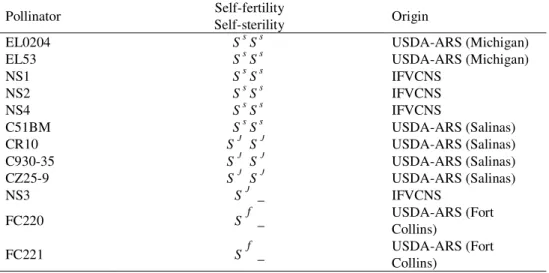
In this research were included 4 pollinators from Institute of Field and Vegetable Crops, Novi Sad and 8 pollinators from USDA-ARS breeding program. All pollinators were multigerm and have resistance to rhizomania. Depending on the presence of self-fertility genes, there were three types of pollinators: self-sterile pollinators (Ss
Ss), self-fertile (Sf S f ) and pollinators segregating for this trait (S f _) (table 1).
of the vegetation period (table 2). Compared to long term average, precipitation amount was lower for 215 mm. The roots were harvested manually at the beginning of October. Ten plants per replication were taken for root analysis. Sugar content was determined in the Laboratory for root quality testing at the Institute of Field and Vegetable Crops, Novi Sad according to standard methodology.
Table 1. Material origin and presence of self-sterility and self-fertility genes
Pollinator Self-fertility
Self-sterility Origin
EL0204 SsSs USDA-ARS (Michigan)
EL53 SsSs USDA-ARS (Michigan)
NS1 SsSs IFVCNS
NS2 SsSs IFVCNS
NS4 SsSs IFVCNS
C51BM SsSs USDA-ARS (Salinas)
CR10 S f S f USDA-ARS (Salinas)
C930-35 S f S f USDA-ARS (Salinas)
CZ25-9 S f S f USDA-ARS (Salinas)
NS3 S f _ IFVCNS
FC220 S f _ USDA-ARS (Fort
Collins)
FC221 S f _ USDA-ARS (Fort
Collins)
Table 2. Weather conditions during 2011
Precipitation (mm) Average monthly temperature (°C)
2011 1995-2010 2011 1995-2010
April 22.8 46.3 12.3 12.2
May 62.4 67.4 16.9 17.6
Jun 36.9 95.6 20.2 20.6
July 61.5 76.0 23.1 22.1
August 1.5 66.1 21.9 21.8
September 25.4 63.8 16.1 16.6
Total 210.5 415.2 -
Average - - 18.4 18.5
RESULTS AND DISCUSSION
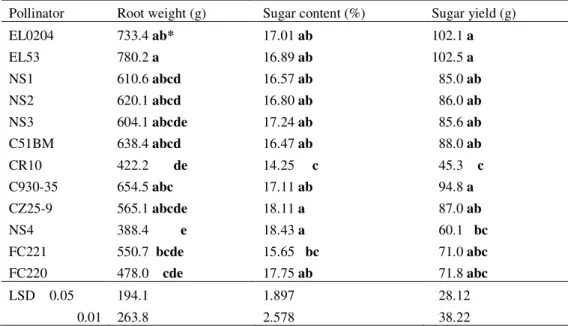
Mean values for root weight were ranged from 388.4 g (NS4) to 780.2 g (EL53). The highest sugar content 18.43% had pollinator NS4 which had lowest root weight. Pollinator CR10 had significantly lower sugar content compared to all other pollinators except FC221. Pollinator CZ25-9, registered as high sucrose variety (LEWELLEN, 2002) expressed that characteristic in our trial with sugar content of 18.11%. Results of our research were in agreement with study of PANELLAet al. (2008), where FC220 had higher sucrose concentration than FC221. Pollinators from East Lansing, Michigan USDA-ARS research station, EL0204 and EL53, had highest root weight and sugar yield (table 3).
Table 3. Mean values of sugar beet root weight, sugar content and sugar yield
Pollinator Root weight (g) Sugar content (%) Sugar yield (g)
EL0204 733.4 ab* 17.01 ab 102.1 a
EL53 780.2 a 16.89 ab 102.5 a
NS1 610.6 abcd 16.57 ab 85.0 ab
NS2 620.1 abcd 16.80 ab 86.0 ab
NS3 604.1 abcde 17.24 ab 85.6 ab
C51BM 638.4 abcd 16.47 ab 88.0 ab
CR10 422.2 de 14.25 c 45.3 c
C930-35 654.5 abc 17.11 ab 94.8 a
CZ25-9 565.1 abcde 18.11 a 87.0 ab
NS4 388.4 e 18.43 a 60.1 bc
FC221 550.7 bcde 15.65 bc 71.0 abc
FC220 478.0 cde 17.75 ab 71.8 abc
LSD 0.05 194.1 1.897 28.12
0.01 263.8 2.578 38.22
* mean separation in columns by Duncan’s multiple range test at 5% level
The analysis of variance revealed significant differences (p = 0.05) among pollinators for all investigated traits (table 4). Absence of higher differences could be due to severe drought that struck Serbia in second period of vegetation. In those conditions there was a reduction in the phenotypic variation of studied traits, masking the genetic sources of variation, as in OBER et al. (2005).
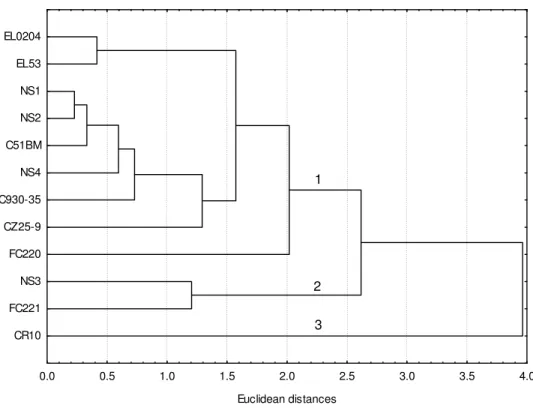
California. Third sub-group separately formed pollinator FC220. Second group formed two pollinators, NS3 and FC221. Pollinator CR10 forms separate group and with other genotypes is joined at the highest hierarchical level.
Table 4. Analysis of variance for root yield, sugar content and sugar yield
* - significant at 0.05 level of probability
0.0 0.5 1.0 1.5 2.0 2.5 3.0 3.5 4.0
Euclidean distances CR10
FC221 NS3 FC220 CZ25-9 C930-35 NS4 C51BM NS2 NS1 EL53 EL0204
1
2
3
Figure 1. UPGMA dendrogram for cluster analysis of morphological traits in observed sugar beet pollinators
Source of variation DF
Root yield Sugar content Sugar yield
SS MS F test SS MS F test SS MS F test
Replication 2 78410.2 39205.1 2.98 0.93 0.464 0.37 1114.2 557.1 2.02
Genotype 11 444560.9 40414.6 3.07* 40.68 3.698 2.95* 9391.6 853.8 3.09*
Error 22 289055.2 13138.9 27.61 1.255 6068.2 275.8
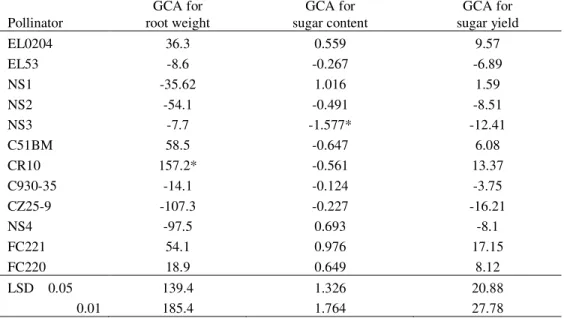
Analysis of GCA for sugar yield did not show differences between genotypes (table 5). Genotype CR10 had positive GCA (p = 0.05) for root weight, despite small root weight. Results of our research confirmed study of DANOJEVI et al. (2011) that the parents with the lowest root weight per se, produce the test hybrid with the greatest root weight. This showed that genotypes with low root weight should not be automatically discarded, at least not before information about GCA. Genotype NS3 had negative GCA (p = 0.05) for sugar content. All genotypes from Institute of Field and Vegetable Crops breeding program used in this research had negative GCA for root weight. This suggests that it should be continued with introduction of new germplasm into this breeding material.
Table 5. General combining abilities of sugar beet pollinators for analyzed traits
Pollinator
GCA for root weight
GCA for sugar content
GCA for sugar yield
EL0204 36.3 0.559 9.57
EL53 -8.6 -0.267 -6.89
NS1 -35.62 1.016 1.59
NS2 -54.1 -0.491 -8.51
NS3 -7.7 -1.577* -12.41
C51BM 58.5 -0.647 6.08
CR10 157.2* -0.561 13.37
C930-35 -14.1 -0.124 -3.75
CZ25-9 -107.3 -0.227 -16.21
NS4 -97.5 0.693 -8.1
FC221 54.1 0.976 17.15
FC220 18.9 0.649 8.12
LSD 0.05 139.4 1.326 20.88
0.01 185.4 1.764 27.78
* - significant at 0.05 level of probability
CONCLUSION
Analysis of variance showed differences (p = 0.05) between sugar beet pollinators for all quantitative traits. Severe drought influenced on level of significance between pollinators for all quantitative traits as also on GCA.
Pollinator CR10 differs from all others in terms of quantitative traits and in terms of combining ability. Despite small root weight CR10 had significantly positive GCA for that trait and showed that genotypes with small root should not be automatically discarded.
ACKNOWLEDGEMENT
This study was funded by Ministry of education, science and technological development, Republic of Serbia, under the project TR31015.
.
Received July 25th, 2012 Accepted April 06th, 2013
REFERENCES
BOROJEVI , S. (1981): Princips and methods of palnt breeding. (Principi i metodi oplemenjivanja biljaka). R. irpanov, Novi Sad.
DANOJEVI , D., Ž. UR I, N. NAGL and L. KOVA EV (2011): Correlations of Root Traits in Monogerm Sugar Beet from Open Pollination and Their Variability. Field and Vegetable Crops Research, 48: 333-340.
LEWELLEN, R. T. (2002): Registration of high sucrose, rhizomania resistant sugar beet germplasm line CZ25-9. Crop Sci
42: 320–321.
MARINKOVI , R., B. DOZET, D. VASI (2003):Sunflofer breeding ( Oplemenjivanje suncokreta). Školska knjiga, Novi Sad.
MCGRATH, J. M., M. SACCOMANI, P. STEVANATO, and E. BIANCARDI (2007): Beets (Beta vulgaris L.). In: Genome Mapping and Molecular Breeding in Plants Volume 5. (Kole, C., editor), 191-207. Berlin: Springer-Verlag.
MCGRATH, J. M. (2010): Assisted Breeding in Sugar Beets. Sugar Tech 12 (3-4): 187-193.
MELCHINGER, A. E. (1999): Genetic diversity and heterosis. In: The Genetics and Exploitation of Heterosis in Crops. (J.G.
COORS and S. PANDEY, Eds), 99-118, ASA, CSS, and SSSA, Madison, Wisconsin.
MILADINOVI , D., K. TAŠKI-AJDUKOVI , N. NAGL, B. KOVA EVI , S. BALEŠEVI -TUBI , N. DUŠANI and S. JOCI (2011): DNA polymorphism of wild sunflower accessions highly susceptible or highly tolerant to white rot on stalk. Helia 34: 91-100.
NAGL N., K. TAŠKI-AJDUKOVI , G. BARAC, A. BABURSKI, I. SECCARECCIA, D. MILI and S. KATIC (2011): Estimation of Genetic Diversity in Tetraploid Alfalfa Populations Based on RAPD Markers for Breeding Purposes. Int. J. Mol. Sci. 12: 5449-5460.
NAGL N., K. TAŠKI-AJDUKOVI , A. POPOVI , Ž. UR I , D. DANOJEVI and L. KOVA EV (2011): Estimation of genetic variation among related sugar beet genotypes by using RAPD. Genetika 43: 575-582.
OBER, E. S. and M. C. LUTERBACHER (2002): Genotypic variation for drought tolerance in Beta vulgaris. Ann Bot 89: 917-924.
OWEN, F. (1942): Inheritance of cross-and self-sterility and self-fertility in Beta vulgaris. J Agric Res 64: 679-698.
PANELLA, L., R. T. LEWELLEN and L. E. HANSON (2008): Breeding for multiple disease resistance in sugarbeet: Registration of FC220 and FC221. J. Plant Reg. 2: 146–155.
GENETSKA DIVERGENTNOST I KOMBINACIONE SPOSOBNOSTI OPRAŠIVA A ŠE ERNE REPE ZA GLAVNA SVOJSTVA KORENA
Živko UR I , Nevena NAGL, Ksenija TAŠKI-AJDUKOVI , Dario DANOJEVI , Željka STOJAKOVI and Lazar KOVA EV
Institut za ratarstvo i povrtarstvo, Novi Sad, Srbija
Izvod
Informacije o genetskoj divergentnosti i kombinacionim sposobnostima roditeljskih komponenti še erne repe su od izuzetnog zna aja za proizvodnju hibrida. Cilj ovog istraživanja je bio ocena genetske divergentnosti oprašiva a še erne repe iz razli itih oplemenjiva kih programa kao i kombinacionih sposobnosti za glavne osobine korena: masu korena, sadržaj še era i prinos še era. Osam oprašiva a vodi poreklo iz tri razli ita oplemenjiva ka programa Ameri kog ministarstva poljoprivrede (USDA-ARS), a etiri iz Instituta za ratarstvo i povrtarstvo, Novi Sad. Analiza varijanse i Dankanov višestruki test intervala su pokazali zna ajne razlike (p = 0.05) izme u oprašiva a za sva ispitivana svojstva. Oprašiva CR10 se izdvaja od svih ostalih kako u pogledu kvantitativnih vrednosti ispitivanih svojstava tako i u pogledu kombinacionih sposobnosti. Uprkos maloj masi korena CR10 je imao zna ajno pozitivnu vrednost opštih kombinacionih sposobnosti za ispitivano svojstvo i pokazao da iz oplemenjiva kog programa ne treba automatski odbacivati genotipove sa malom masom korena. Svi ispitivani oprašiva i Instituta za ratarstvo i povrtarstvo u ovom istraživanju su imali negativne vrednosti opštih kombinacionih sposobnosti za masu korena i trebalo bi ih koristiti kao doma ine za uvo enje nove germplazme.