www.atmos-chem-phys.net/15/11433/2015/ doi:10.5194/acp-15-11433-2015
© Author(s) 2015. CC Attribution 3.0 License.
The MCM v3.3.1 degradation scheme for isoprene
M. E. Jenkin1,2, J. C. Young3, and A. R. Rickard4,5
1Atmospheric Chemistry Services, Okehampton, Devon, EX20 4QB, UK
2School of Chemistry, University of Bristol, Cantock’s Close, Bristol, BS8 1TS, UK 3School of Chemistry, University of Leeds, Leeds, LS2 9JT, UK
4Wolfson Atmospheric Chemistry Laboratories, Department of Chemistry, University of York, Heslington,
York, YO10 5DD, UK
5National Centre for Atmospheric Science, University of York, Heslington, York, YO10 5DD, UK Correspondence to:M. E. Jenkin ([email protected])
Received: 1 March 2015 – Published in Atmos. Chem. Phys. Discuss.: 31 March 2015 Revised: 16 September 2015 – Accepted: 23 September 2015 – Published: 16 October 2015
Abstract.The chemistry of isoprene degradation in the Mas-ter Chemical Mechanism (MCM) has been systematically re-fined and updated to reflect recent advances in understand-ing, with these updates appearing in the latest version, MCM v3.3.1. The complete isoprene degradation mechanism in MCM v3.3.1 consists of 1926 reactions of 602 closed shell and free radical species, which treat the chemistry initiated by reaction with OH radicals, NO3radicals and ozone (O3).
A detailed overview of the updates is provided, within the context of reported kinetic and mechanistic information. The revisions mainly relate to the OH-initiated chemistry, which tends to dominate under atmospheric conditions, although these include updates to the chemistry of some products that are also generated from the O3- and NO3-initiated
oxida-tion. The revisions have impacts in a number of key areas, including HOx recycling, NOx recycling and the formation of species reported to play a role in SOA (secondary or-ganic aerosol)-formation mechanisms. The performance of the MCM v3.3.1 isoprene mechanism has been compared with those of earlier versions (MCM v3.1 and MCM v3.2) over a range of relevant conditions, using a box model of the tropical forested boundary layer. The results of these calcu-lations are presented and discussed and are used to illustrate the impacts of the mechanistic updates in MCM v3.3.1.
1 Introduction
The degradation of emitted volatile organic compounds (VOCs) has a major influence on the chemistry of the tro-posphere, contributing to the formation of ozone (O3),
sec-ondary organic aerosol (SOA) and other secsec-ondary pollu-tants (e.g. Haagen-Smit and Fox, 1954; Went, 1960; Andreae and Crutzen, 1997; Jenkin and Clemitshaw, 2000; Hallquist et al., 2009). Approximately 90 % of organic material emit-ted globally is estimaemit-ted to originate from biogenic sources (Guenther et al., 1995), with a major contribution from the reactive biogenic VOC, isoprene (2-methyl-buta-1,3-diene). In Europe, isoprene is estimated to contribute more than 30 % of total biogenic VOC emissions, and 50 % of reactive bio-genic VOC emissions. Such estimates vary widely on a re-gional if not a global scale (e.g. Arneth et al., 2008; Warneke et al., 2010; Langner et al., 2014), but isoprene is believed to be the most abundantly emitted non-methane VOC in the atmosphere. The emission rate may also be altered by fu-ture changes to climate and other environmental factors (e.g. Peñuelas and Staudt, 2010; Arneth et al., 2010; Simpson et al., 2014, and references therein). Reliable representations of isoprene emissions and atmospheric oxidation are therefore essential components of chemistry-transport models (CTMs) applied to climate change and air quality assessments.
labora-tory and theoretical studies of the kinetics and products of key elementary reactions, and elucidation and evaluation of mechanisms using chamber data (see references in Sect. 2), with additional information also resulting from the evalua-tion and intercomparison of mechanisms used in models (e.g. Archibald et al., 2010a, b; Stavrakou et al., 2010; Stone et al., 2011). The results of field studies have been used to test understanding of isoprene chemistry and to identify poten-tial gaps in that understanding under atmospheric conditions. Such studies have stimulated or informed many of the recent laboratory, chamber and theoretical investigations, particu-larly in relation to missing recycling mechanisms for HOx radicals (e.g. Tan et al., 2001; Thornton et al., 2002; Mar-tinez et al., 2003; Ren et al., 2008; Lelieveld et al., 2008; Butler et al., 2008; Karl et al., 2009; Taraborrelli et al., 2012), the chemistry of oxidised organic nitrogen species (e.g. Horowitz et al., 2007; Perring et al., 2009) and the for-mation of species that contribute to SOA (e.g. Claeys et al., 2004; Chan et al., 2010; Froyd et al., 2010; Lin et al., 2013). The Master Chemical Mechanism (MCM) provides a de-tailed description of atmospheric gas-phase organic chem-istry that has been widely used by the atmospheric science community both directly and as a benchmark representa-tion against which to develop and optimise reduced chemi-cal mechanisms for use in CTMs. The MCM isoprene chem-istry has been systematically revised and updated to reflect recent advances in understanding, with the updated mecha-nism provisionally released in March 2015 as MCM v3.3, as described in the “discussion” version of this paper (Jenkin et al., 2015). This has been further refined on the basis of a series of review comments, leading to the current finalised version, MCM v3.3.1. In this paper, a detailed overview of the updates is provided, within the context of reported kinetic and mechanistic information. The performance of the MCM v3.3.1 isoprene scheme has been examined for a range of rel-evant conditions, using a box model of the tropical forested boundary layer. The results of this study are presented and used to illustrate the impacts of the mechanistic updates in MCM v3.3.1.
2 Updates to isoprene chemistry in MCM v3.3.1 The complete degradation chemistry of isoprene, as repre-sented in MCM v3.3.1, consists of 1926 reactions of 602 species and includes chemistry initiated by reaction with OH, O3and NO3. It can be viewed and downloaded using the
sub-set mechanism assembling facility, available as part of the MCM website (http://mcm.leeds.ac.uk/MCM). The isoprene chemistry included previously in v3.1 (consisting of 605 re-actions of 201 species) has been described in some detail by Pinho et al. (2005) and Archibald et al. (2010a), and the up-dates described below therefore document the major changes to the mechanism since MCM v3.1. These were partially implemented in MCM v3.2 (released in 2011), which
con-tained 1428 reactions of 447 species. All those updates have been retained or further refined, with substantial additional revisions in the latest update to MCM v3.3.1. The revisions mainly relate to the OH-initiated chemistry, which tends to dominate under atmospheric conditions, although these in-clude updates to the chemistry of some products that are also generated from the O3- and NO3-initiated oxidation. The
re-visions have impacts in a number of key areas, including HOx recycling, NOxrecycling and the formation of species reported to play a role in SOA-formation mechanisms. The following subsections provide a detailed overview of the up-dates.
2.1 Updates to the first-generation OH-initiated chemistry
2.1.1 OH addition ratios and reactions of OH-isoprene adducts with O2
The initial stages of the chemistry following addition of OH to isoprene in the presence of O2, as represented in MCM
v3.3.1, are shown in Fig. 1. In contrast to previous versions of the mechanism, the minor addition of OH to the central car-bon atoms (i.e. at positions 2 and 3) is now represented, with respective addition ratios of 57.6, 4.2, 4.2 and 34.0 % at posi-tions 1, 2, 3 and 4. As described in more detail in Sect. 2.1.4 below (and in Sect. S1.1 of the Supplement), these were de-fined using a combination of structure–activity relationships (SARs) and optimisation of the first-generation mechanism to reported product yields. However, these addition ratios are fully consistent with those that have been reported in a num-ber of theoretical studies (e.g. McGivern et al., 2000; Lei et al., 2000; Greenwald et al., 2007; Peeters et al., 2009).
The chemistry of the minor adducts formed from addition of OH to the central carbon atoms is based on the mecha-nism postulated in the theoretical study of Park et al. (2003). This involves isomerisation of the OH-isoprene adducts to formα-hydroxyalkenyl radicals, which each react with O2
to form HO2and an unsaturated C5carbonyl product.
Addi-tion of OH at posiAddi-tion 2 thus leads to the exclusive forma-tion of pent-4-en-2-one (PE4E2CO) and HO2by this
mech-anism (see Fig. 1). Based on information reported in Park et al. (2003), addition of OH at position 3 is assumed to lead to competitive formation of both the isomeric unsaturated C5
carbonyl, 3-methyl-but-3-enal (ME3BU3ECHO), and HO2
via the isomerisation mechanism, and direct addition of O2
to the initial OH-isoprene adduct to form aβ-hydroxy per-oxy radical (denoted ISOP34O2). As represented in MCM v3.3.1, this results in a total yield of unsaturated C5carbonyls
of 6.2 %, which is consistent with that reported by Zhao et al. (2004).
Figure 1.Schematic of the addition of OH to isoprene and the reactions of OH-isoprene adducts with O2, as represented in MCM v3.3.1. Species in solid boxes are first-generation oxygenated end products, with their molar yields at 298 K. Species and routes shown in blue are new in MCM v3.3.1. The chemistry in broken boxes is not included explicitly in the mechanism but is shown to clarify the routes to the corresponding products (see Park et al., 2003).
the theoretical studies of Peeters et al. (2009, 2014), as also shown in Fig. 1. In each case, OH addition leads to the for-mation ofEandZisomers of a hydroxyalkenyl radical pos-sessing an allyl resonance. Reversible addition of O2occurs
at two possible sites in each resonant hydroxyalkenyl radi-cal isomer, resulting in the formation of aβ-hydroxy peroxy
radical and E andZ isomers of a δ-hydroxy peroxy
radi-cal (i.e. ISOPBO2, CISOPAO2 and ISOPAO2 from OH ad-dition at carbon 1; and ISOPDO2, CISOPCO2 and ISOPCO2 from OH addition at carbon 4). The reversibility of O2
addi-tion allows the peroxy radical populaaddi-tion to be redistributed between the various isomers in each subset, such that the relative population of the peroxy radicals also depends on the prevailing rates of other removal processes for the per-oxy radicals. As recommended in the review comment of Peeters (2015), the kinetic parameters applied to the O2
ad-dition and peroxy radical back decomposition reactions are based on those calculated by Peeters et al. (2014), but with each increased by a factor of 5 on the basis of the experi-mental characterisation of the equilibration of peroxy radi-cals in each subset, as recently reported in preliminary form by Crounse et al. (2014). The resultant kinetic parameters are given in Table S1 in the Supplement.
2.1.2 Peroxy radical reactions
As with previous versions of the MCM (Jenkin et al., 1997; Saunders et al., 2003), the β- and δ-hydroxy peroxy radi-cals undergo bimolecular reactions with NO, NO3and HO2
and are also removed via reaction with the peroxy radical
“pool” to represent the collective effect of peroxy radical self- and cross-reactions. Small revisions to the generic rate coefficients for the NO and NO3reactions were implemented
in MCM v3.2, and these are retained in MCM v3.3.1 (see Sect. 2.3). The rate coefficients for the other reactions re-main based on the rules presented previously by Saunders et al. (2003).
Figure 2 shows the mechanisms following the (major) propagating channels of the reactions of the peroxy radi-cals with NO, involving the formation of the correspond-ing oxy radicals and their subsequent reactions to form first-generation oxygenated end products, which are dis-cussed further in Sect. 2.1.3. Figure 2 also shows compet-ing unimolecular isomerisation reactions that are newly im-plemented in MCM v3.3.1 for specific peroxy radical struc-tures. As originally postulated by Peeters et al. (2009) and da Silva et al. (2010), 1,5 H atom shift isomerisation reac-tions are now represented for theβ-hydroxy peroxy radicals, ISOPBO2 and ISOPDO2, leading to the respective formation of methyl vinyl ketone (MVK) and methacrolein (MACR), in conjunction with HCHO and OH. The applied isomerisa-tion rates are the LIM1 values calculated recently by Peeters et al. (2014), as presented in Table S1, with these also be-ing generally consistent with those reported by da Silva et al. (2010).
pro-Figure 2.Schematic of the mechanisms following the propagating channels of the reactions of the first-generationβ- andδ-hydroxy per-oxy radicals with NO, and competing unimolecular isomerisation reactions (see also Fig. 3). Species in solid boxes are the resultant first-generation oxygenated end products, with their associated molar yields at 10 ppm NO (in red) and 100 ppt NO (in black) at 298 K (see text and Fig. 4 for further details). HCHO has multiple sources, such that its total yield is 61.0 % at 10 ppm NO and 68.0 % at 100 ppt NO. Species and routes shown in blue are new in MCM v3.3.1. Broken arrows indicate multistep mechanisms, involving the reactions of additional peroxy and oxy radicals (see Sect. 2.1.3 and Figs. S1–S3). The structure labelled ISOPCO is not included explicitly in the mechanism but is shown for clarity.
duce a resonant C5 hydroxy hydroperoxyalkenyl radical.
As shown in Fig. 3, these are represented to react with O2 partially (50 %) via α-hydroxy H atom abstraction to
yield HO2 and the unsaturated hydroperoxyaldehyde
prod-ucts C5HPALD1 and C5HPALD2; with experimental evi-dence for the production of these products being reported by Crounse et al. (2011) and Berndt (2012). Based on the recent study of Peeters et al. (2014), the reactions of O2
with the hydroxy hydroperoxyalkenyl radicals are also rep-resented to proceed equally via additionγ to the OH group, leading to the production of the complex dihydroperoxy α -formyl peroxy radicals, C536O2 and C537O2 (see Fig. 3), these species being referred to as “di-HPCARPs” by Peeters et al. (2014). Under “low NOx” conditions, C536O2 and C537O2 are represented to react significantly via 1,4 H atom shift isomerisation reactions, for consistency with newly im-plemented chemistry for the methacrolein-derivedα-formyl peroxy radical, MACRO2 (see Sect. 2.2.1). This leads to significant formation of the dihydroperoxycarbonyl products
(DHPMEK and DHPMPAL) in conjunction with OH and CO. The temperature-dependent rate expressions applied to the 1,6 H atom shift isomerisation reactions are based on those reported recently for LIM1 by Peeters et al. (2014) for CISOPAO2 and CISOPCO2, but scaled to recreate the phe-nomenological bulk isomerisation rate (kbulk)to form the
un-saturated hydroperoxyaldehyde products (C5HPALD1 and C5HPALD2) for the conditions of the experiments reported by Crounse et al. (2011) (see Sect. S1.4 for further details). It is noted that further support for operation of the LIM reac-tion framework, optimised to the observareac-tions of Crounse et al. (2011), has been reported by Fuchs et al. (2013), based on measurements of OH and peroxy radicals during the chamber oxidation of isoprene.
Figure 3.Schematic of the mechanisms following the 1,6 H atom shift isomerisation reactions of CISOPAO2 and CISOPCO2, as represented in MCM v3.3.1 (see also Fig. 2). As in Fig. 2, propagating channels of the reactions of NO with the intermediate peroxy radicals (C536O2 and C537O2), and competing unimolecular isomerisation reactions, are shown. Species in solid boxes are the resultant first-generation oxygenated end products, with their associated molar yields at 1 ppb NO (in red) and 100 ppt NO (in black) at 298 K (see text and Fig. 4 for further details). Note that GLYOX and MGLYOX are also formed via alternative routes, shown in Fig. 2.
secondary peroxy radical (ISOPDO2) and the tertiary oxy radical (ISOPBO2), but the remaining (primary) per-oxy radicals are assigned terminating channel ratios that are 20 % lower. This reflects the well-established lower propen-sities of primary peroxy radicals to form nitrates (e.g. Carter and Atkinson, 1989; Lightfoot et al., 1992), which is also supported by the recent study of Teng et al. (2015) for hy-droxyperoxy radicals formed from the reactions of OH with alkenes. The absolute values applied to the branching ratios were adjusted to result in an optimised total first-generation yield of nitrate products of 10 % at the high [NO] limit (see Sect. 2.1.4). As discussed by Archibald et al. (2010a), this value was previously assigned on the basis of a chamber evaluation of reported yields and is in agreement with the current recommendation of the IUPAC Task Group on At-mospheric Chemical Kinetic Data Evaluation (http://iupac. pole-ether.fr/).
As with previous versions of the MCM, the reactions of theβ- andδ-hydroxy peroxy radicals with HO2proceed by a
single channel producing a hydroxy-hydroperoxide product and O2. It is noted that some evidence for minor channels
for the β-hydroxy peroxy radicals producing MVK (from ISOPBO2) and MACR (from ISOPDO2) has been reported (Paulot et al., 2009a; Liu et al., 2013; Navarro et al., 2013), with the implication that this results from a propagating channel also producing OH radicals. However, no direct ev-idence for OH formation from the reactions of HO2withβ
-hydroxy peroxy radicals has been reported to date (e.g. Dil-lon et al., 2008), such that implementation of propagating channels awaits further experimental confirmation.
2.1.3 Oxy radical reactions
Figure 2 illustrates the reactions of theβ- andδ-hydroxy oxy radicals, formed from propagating channels of the peroxy radical reactions, which lead to the formation of a number of first-generation oxygenated end products.
with the CH2OH radical, which reacts with O2 to produce
HCHO and HO2. The newly represented minor β-hydroxy
oxy radical, ISOP34O, also decomposes to produce HCHO and a C4α-hydroxyalkenyl radical, which reacts with O2to
form MACR and HO2(see Fig. 2).
The propagating reactions of the (E) δ-hydroxy peroxy radicals, ISOPAO2 and ISOPCO2, initially produce the (rel-atively minor) E isomers of the corresponding δ-hydroxy oxy radicals (denoted ISOPAO and ISOPCO in Fig. 2). As also previously represented in MCM v3.2, ISOPAO under-goes a rapid 1,5 H shift isomerisation reaction, leading to the ultimate formation of hydroxymethacrolein (HMACR), HCHO and HO2via a multi-step mechanism involving a
fur-ther C5peroxy radical, as postulated by Dibble (2002) and
Zhao et al. (2003) (see Fig. S3 and Sect. S1.3 for further de-tails). Evidence for unsaturated C4hydroxycarbonyl
forma-tion was subsequently reported by Zhao et al. (2004), con-sistent with formation of HMACR and/or isomeric products. It is noted that this fate for ISOPAO is not supported by the very recent study of Nguyen and Peeters (2015), who theo-retically characterised the rapid conversion of both ISOPAO and ISOPCO into the corresponding Z isomers (CISOPAO and CISOPCO), the chemistry of which is discussed below. The 1,5 H shift chemistry of ISOPAO is currently retained, so that a route to the formation of HMACR as a minor prod-uct remains in MCM v3.3.1. In accordance with the results of Nguyen and Peeters (2015), however, exclusive isomeri-sation of ISOPCO into CISOPCO is represented in MCM v3.3.1, this reaction dominating over its alternative slow re-action with O2.
As shown in Fig. 2, a number of fates are included for the newly definedZ isomers of theδ-hydroxy oxy radicals, CISOPAO and CISOPCO. These are all initiated by a 1,5 H atom shift isomerisation, to produce a resonant C5dihydroxy
alkenyl radical in each case, which is represented to react in three ways (see Figs. S1 and S2 and Sect. S1.2 for further details).
i. α-hydroxy H atom abstraction, to yield HO2 and a C5
unsaturated hydroxyaldehyde product (i.e. HC4CCHO or HC4ACHO). These reactions are required to account for the reported yields of C5unsaturated
hydroxyalde-hydes (Zhao et al., 2004; Baker et al., 2005; Paulot et al., 2009b).
ii. Addition of O2 γ to the OH group, as postulated
by Dibble (2004). This initiates sequences of reac-tions, involving C5α-formyl peroxy radicals (C526O2
and C527O2), leading to the ultimate formation of either methyl glyoxal (MGLYOX), glycolaldehyde (HOCH2CHO) and OH from CISOPAO, or glyoxal (GLYOX), hydroxyacetone (ACETOL) and OH from CISOPCO. The mechanism is based on that reported by Peeters and Nguyen (2012) (see Figs. S1 and S2). Evidence for minor formation of glyoxal, glycolalde-hyde and hydroxyacetone (or subsets of these) as
first-generation products has been reported in the chamber studies of Volkamer et al. (2006), Galloway et al. (2011) and Paulot et al. (2009b).
iii. Dehydration/cyclisation and subsequent reaction with O2, leading to the formation of 3-methylfuran (M3F)
and HO2 by the mechanism postulated by
Francisco-Márquez et al. (2003). These reactions are included to account for the reported minor formation of 3-methylfuran in a number of studies (e.g. Atkinson et al., 1989; Paulson et al., 1992; Ruppert and Becker, 2000; Brégonzio-Rozier et al., 2015). The agreement of the yields of 3-methylfuran in those “NOx present” stud-ies, in conjunction with the reported time dependence of its production (e.g. Benkelberg et al., 2000; Lee et al., 2005), appear to indicate that it is formed (at least partially) as a first-generation product in the gas phase. However, it is noted that it is also likely formed by heterogeneous reactions of the C5unsaturated
hydrox-yaldehyde products, HC4CCHO and HC4ACHO (Dib-ble, 2007), such that there are uncertainties in the con-tribution of its gas-phase formation.
2.1.4 Optimisation of first-generation OH-initiated chemistry
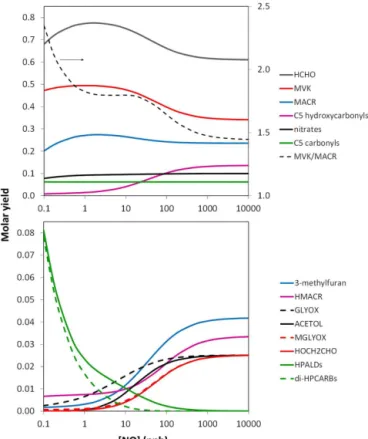
As described in greater detail in Sect. S1 of the Supplement, the first-generation OH-initiated chemistry was optimised us-ing reported product yields, with a number of constraints that have been described above in Sect. 2.1.1–2.1.3. Figure 4 shows the resultant calculated molar yields of the main prod-ucts as a function of NO mixing ratio at 298 K. These tend towards limiting values at the high end of the [NO] range shown, with little change at mixing ratios greater than about 500 ppb. This corresponds to conditions where reaction with NO is the dominant fate for all peroxy radicals in the system. At lower [NO], the back decomposition reactions of the
β- andδ-hydroxy peroxy radicals formed from OH addition at positions 1 and 4 (see Fig. 1) become increasingly com-petitive with the NO reactions, leading to a systematic vari-ation in the relative peroxy radical populvari-ation and a resul-tant impact on the product yields, as described in detail by Peeters et al. (2009, 2014). In addition to this, unimolecu-lar isomerisation reactions also compete more effectively for specific peroxy radical structures. Under many atmospheric and chamber conditions, the reactions of peroxy radicals with HO2and with the peroxy radical pool would also likely start
to compete towards the low end of the displayed [NO] range in Fig. 3, although the extent of this competition depends on the absolute radical concentration. The impact of these reac-tions therefore requires simulation of specific atmospheric or chamber conditions and is not included in the illustration in Fig. 4.
cor-Figure 4. Molar yields of main first-generation products of the OH-initiated oxidation of isoprene as a function of NO mixing ra-tio, at 298 K, as represented in MCM v3.3.1 (see discussion in Sect. 2.1.4). C5hydroxycarbonyls are HC4ACHO and HC4CCHO; C5 carbonyls are PE4E2CO and ME3BU3ECHO; HPALDs are C5HPALD1 and C5HPALD2; di-HPCARBs are DHPMEK and DHPMPAL; and nitrates are as shown in Fig. 5. The broken line in the upper panel is the MVK/MACR yield ratio, as quantified on the right-hand scale.
respond to the high [NO] limit in Fig. 4, which is the majority of reported “NOx-present” studies. A number of parameters were varied to optimise the agreement in the calculated and reported product yields. These were the relative importance of OH attack at positions 1 and 4 in isoprene (which mainly influences the relative yields of MVK and MACR) and the relative importance of the three fates of the Z-isomers of
theδ-hydroxy oxy radicals, CISOPAO and CISOPCO, as
de-scribed in Sect. 2.1.3 (which influences the formation of a number of the more minor first-generation products). This procedure resulted in generally good agreement between the reported yields and those calculated with MCM v3.3.1 at the high [NO] limit (see Sect. S1 and Table S2 for full details).
The yields calculated for the major products HCHO (61.0 %), MVK (34.1 %) and MACR (23.6 %) at the high [NO] limit are therefore consistent with the respec-tive reported yields of (60.8±4.5) %, (35.1±5.2) % and (23.6±2.8) % in “high NOx” studies (see Table S2). As shown in Fig. 4, the mechanism predicts an increase in the
yields of these products at lower [NO], with maximum re-spective values of about 77, 49 and 27 % at about 1–2 ppb NO. The relative yield of MVK and MACR generally in-creases with decreasing [NO], with the rapid increase at the low end of the scale being consistent with the preliminary re-sults of Crounse et al. (2014), as discussed by Peeters (2015). However, it is noted that both the absolute yields of MVK (approaching 50 %) and MVK/MACR ratios (≈1.8) are not fully consistent with those reported by Karl et al. (2006) and Liu et al. (2013), based on experiments carried out with NO mixing ratios of about 0.2 and 9 ppb, respectively. These studies both report MVK yields of about 41 % and MVK/MACR ratios in the range 1.4–1.5 (i.e. similar to those at the high [NO] limit).
The yields of a number of minor products formed wholly or partially from the reactions of CISOPAO and CISOPCO were also optimised to be consistent with reported studies at the high [NO] limit (see Table S2). These are the C5
hydroxy-carbonyls (HC4ACHO and HC4CCHO), 3-methylfuran, gly-oxal/hydroxyacetone and methyl glyoxal/glycolaldehyde. As shown in Fig. 4, the yields of all these products are pre-dicted to decrease as [NO] is lowered. In the cases of the C5 hydroxycarbonyls and 3-methylfuran, this is due to the
decreased production of CISOPAO and CISOPCO that re-sults from a combination of the increased operation of the isomerisation reactions for the precursor peroxy radicals (CISOPAO2 and CISOPCO2) and the general redistribution of the peroxy radical population (Peeters et al., 2014). For glyoxal/hydroxyacetone and methyl glyoxal/glycolaldehyde, however, the yields are predicted to be particularly sensi-tive to [NO], with complete inhibition of their formation from CISOPAO and CISOPCO at the low end of the [NO] range. In addition to the decreased production of CISOPAO and CISOPCO, their formation is also influenced by the chemistry of the α-formyl peroxy radicals (C526O2 and C527O2), as formed in the mechanism theoretically charac-terised by Peeters and Nguyen (2012) and applied here (see Figs. S1 and S2). As discussed further below (Sects. 2.2.1 and 2.2.3), 1,4 H atom shift isomerisation reactions are included for C526O2 and C527O2, for consistency with newly implemented chemistry for the methacrolein-derived
α-formyl peroxy radical, MACRO2, as also suggested by
Peeters and Nguyen (2012). These isomerisation reactions compete more effectively as [NO] is lowered, thereby inhibit-ing formation of glyoxal/hydroxyacetone and methyl gly-oxal/glycolaldehyde.
Figure 5. (a) Reported molar yields of speciated nitrate prod-ucts formed from the first-generation OH-initiated oxidation of isoprene (see Fig. 7 for structures). The “1,4” and “4,1” cate-gories include contributions from both E and Z isomers, where reported. The MCM v3.3.1 values correspond to 298 K at the high [NO] limit (see Fig. 3), with the total yield being 10 %. The “other” category includes C524NO3 (formed in the mechanism to HMACR formation), C526NO3 (formed in the mechanism to methyl glyoxal/glycolaldehyde formation) and C527NO3 (formed in the mechanism to glyoxal/hydroxyacetone formation). The “2,1” isomer is not formed in MCM v3.3.1.(b)[NO] dependences of the ratio of theβ-hydroxy isomers (ISOPBNO3/ISOPDNO3) and the fractional contribution of theδ-hydroxy isomers (ISOPANO3 and ISOPCNO3). The displayed [NO] range corresponds to values of ktrin the approximate range 0.022–2200 s−1.
further three species formed in the mechanisms generating hydroxymethacrolein (C524NO3), glyoxal/hydroxyacetone (C527NO3) and methyl glyoxal/glycolaldehyde (C526NO3) (see Fig. 5a). Compared with MCM v3.2, the main conse-quence of the revised branching ratios applied to the indi-vidual peroxy radical isomers in MCM v3.3.1 (described in Sect. 2.1.2) is an increased contribution of the tertiary β -hydroxynitrate (ISOPBNO3) and a decreased contribution of the secondary β-hydroxynitrate (ISOPDNO3). The re-sultant relative contributions of these β-hydroxy isomers, and the fractional contribution of the δ-hydroxy isomers
(ISOPANO3 and ISOPCNO3) at the high [NO] limit (shown in Fig. 5b) are consistent with the preliminary results of Crounse et al. (2014). However, the distribution does not ap-pear to match the results of any of the previously reported studies (Giacopelli et al., 2005; Paulot et al., 2009b; Lock-wood et al., 2010), which display some variability (Fig. 5a). The mechanism predicts a slight decrease in the total first-generation nitrate yield as [NO] is lowered, falling to about 8 % at the low end of the considered range (see Fig. 4). This results mainly from the impact of competing isomeri-sation reactions for selected peroxy radicals. The associated [NO] dependences of the β-hydroxy isomer ratio, and the δ-hydroxy isomer contribution, are consistent with the
pre-liminary results of Crounse et al. (2014) (see Fig. 5b). Figure 4 also illustrates the increasing formation of the unsaturated hydroperoxyaldehydes (C5HPALD1 and C5HPALD2) and the dihydroperoxycarbonyls (DHPMEK and DHPMPAL) as [NO] decreases, these species being formed from the chemistry initiated by the 1,6 H atom shift isomerisation reactions of CISOPAO2 and CISOPCO2 (see Fig. 3), within the LIM1 reaction framework (Peeters et al., 2014). As indicated above (Sect. 2.1.2), the formation of the unsaturated hydroperoxyaldehydes was optimised to recre-ate the phenomenological bulk isomerisation rrecre-ate (kbulk)
re-ported by Crounse et al. (2011), which was about 0.002 s−1
at 295 K, under conditions when the peroxy radical loss rate through bimolecular reactions (ktr)was≈0.021 s−1(see
Sect. S1.4 and Fig. S4 for further details). As shown in Fig. 3, the chemistry initiated by the 1,6 H atom shift isomerisation reactions also provides additional first-generation routes to methyl glyoxal and (particularly) glyoxal, which are most effective at intermediate [NO], when the reactions of NO with theα-formyl peroxy radicals C536O2 and C537O2 can compete with their 1,4 H atom shift isomerisation reactions. Evidence for operation of these routes has been reported by Crounse et al. (2012a), through detection of the hydroper-oxycarbonyl co-products, HCOCH2OOH and HYPERACET (see Fig. 3).
Although not specifically optimised, the mechanism pre-dicts a yield of hydroxymethacrolein (HMACR) of 3.3 % at the high [NO] limit, which is consistent with the yield of C4hydroxycarbonyls of (3.3±1.6) % reported by Zhao
et al. (2004). This shows a modest variation with [NO], re-sulting mainly from the redistribution of the peroxy radical population (see Fig. 4). As indicated above (Sect. 2.1.1), the yield of unsaturated C5carbonyls (6.2 %) also agrees well
with the yield of (8.4±2.4) % reported by Zhao et al. (2004).
This shows no variation with [NO] because the unsaturated C5carbonyls are formed following prompt isomerisation of
2.2 Updates to the higher-generation chemistry 2.2.1 Methacrolein (MACR)
Figure 6 shows the main features of the chemistry following the reaction of OH with MACR, with the newly implemented updates in MCM v3.3.1 highlighted. These are as follows:
i. A competitive 1,4 H atom shift isomerisation reac-tion is now included for the α-formyl peroxy radical, MACRO2, formed from the major OH addition channel, resulting in the direct formation of hydroxyacetone, CO and OH. This reaction was proposed and characterised by Crounse et al. (2012b), and the applied temperature-dependent rate coefficient is based on their reported value (see Table S3), with additional support deriving from the recent chamber study of Fuchs et al. (2014). For consistency, 1,4 H atom shift isomerisation reac-tions have also been included for a number of other
α-formyl peroxy radicals. These include HMACRO2 (formed analogously from the reaction of OH with hy-droxymethacrolein, HMACR) and the C5 peroxy
rad-icals, C57O2 and C58AO2, which have a number of sources in the isoprene mechanism, including the analo-gous reactions of OH with unsaturated C5hydroxy
car-bonyls (HC4CCHO and HC4ACHO, respectively), and the reaction of OH with the major isoprene epoxydiol (IEPOXB), as described further in Sect. 2.2.3. They also include the complexα-formyl peroxy radicals, C526O2
and C527O2 (formed in the newly implemented first-generation chemistry forming glyoxal/hydroxyacetone and methylglyoxal/glycolaldehyde, as discussed above in Sects. 2.1.3 and 2.1.4 and shown in Figs. S1 and S2) and the “di-HPCARPs”, C536O2 and C537O2 (formed following the 1,6 H atom shift isomerisation reactions of CISOPAO2 and CISOPCO2, as discussed in Sect. 2.1.2 and shown in Fig. 3).
ii. The products of the reaction of OH with methacryloyl peroxy nitrate (MPAN) have been updated on the ba-sis of the studies of Kjaergaard et al. (2012) and Lin et al. (2013). As shown in Fig. 6, the reaction now has significant channels forming hydroxymethyl-methyl-α
-lactone (HMML) and methacrylic acid epoxide (MAE), in conjunction with release of NO3 radicals. HMML
and MAE have been postulated by the above authors to play a role in SOA-formation mechanisms, through effi-cient reactive uptake on acidic aerosol particles to form condensed-phase 2-methylglyceric acid. The represen-tation of heterogeneous chemistry is outside the scope of MCM v3.3.1, but their gas-phase removal via reac-tions with OH is represented (see Sect. 2.2.7).
iii. The products of the reaction of OH with methacrylic peroxy acid (MACO3H) have been updated on the basis of the study of Kjaergaard et al. (2012). As
shown in Fig. 6, the reaction now has a major nel forming hydroxyacetone and CO, and a minor chan-nel forming HMML, in conjunction with release of OH radicals in each case. The products of the re-actions of OH with a number of structurally similar peroxy acids have also been updated to include ma-jor OH-forming channels. These include HMACO3H, formed from hydroxymethacrolein (HMACR) oxida-tion; and HC4ACO3H and HC4CCO3H, formed from the oxidation of the unsaturated C5 hydroxycarbonyls,
HC4ACHO and HC4CCHO. In these cases, however, OH formation is represented to occur exclusively in conjunction with CO and the corresponding dihydroxy-carbonyl product, such that the minor channels forming products analogous to HMML are not currently repre-sented.
2.2.2 Nitrates
Substantial revisions to the further degradation chemistry of the first-generation nitrate products were previously imple-mented in MCM v3.2, which included the chemistry ini-tiated by reactions with both OH and O3, and photolysis.
These generally followed the rules in the MCM scheme-writing protocol (Jenkin et al., 1997; Saunders et al., 2003), but without the major simplifications previously applied to oxidised organic nitrogen species. The treatment also made use of the structure–activity relationship (SAR) method of Vereecken and Peeters (2009) to estimate the impacts of the nitrate groups (–ONO2)on the reactions of the intermediate
oxy radicals and took account of information in a number of experimental studies (e.g. Paulot et al., 2009b; Lockwood et al., 2010) in defining parameters for specific reactions. The update added about 400 reactions of over 100 species to the mechanism. The majority of this chemistry has been retained unchanged in MCM v3.3.1, although selected important up-dates have been implemented, based on the results of more recent studies (e.g. Suarez-Bertoa et al., 2012; Lee et al., 2014; Müller et al., 2014).
The rate coefficients for the initiation reactions with OH and O3have been revised to take account of the recent study
of Lee et al. (2014), leading to a notable reduction in the im-portance of the O3-initiated chemistry compared with MCM
v3.2. Representative average atmospheric lifetimes for the first-generation nitrates with respect to these reactions are estimated to be about 8.5 h (for [OH]=106molecule cm−3)
and 9.4 days (for 20 ppb O3), based on the nitrate
A general overview of the OH-initiated chemistry over several generations is illustrated in Fig. 7. An important fea-ture of the degradation chemistry is the extent to which the organic products retain the nitrate group, whether NOx is released, or whether additional NOx is sequestered to form dinitrate products. Figure 7 shows that about 40 % of the second-generation products formed from the OH-initiated chemistry retain the nitrate group (in conjunction with HOx propagation), with about 50 % leading to the release of NOx in the form of NO2(in conjunction with HOxloss). A small
fraction (10 %) is estimated to generate dinitrate products, with these processes leading to loss of both NOxand HOx. These proportions are broadly consistent with the product yields reported by Lee et al. (2014) for the OH-initiated oxidation of selected first-generation nitrate isomers, and also with constraints on the lifetimes and the extent of ni-trate group recycling derived from atmospheric observa-tions in the continental USA (Perring et al., 2009). Figure 7 also demonstrates that the subsequent generations of product have generally longer lifetimes with respect to reaction with OH than the first-generation nitrates but with progressively greater proportions of NOx being released at each oxidation step. For simplicity, the illustration in Fig. 7 assumes that the level of NO is sufficiently high that the reactions of interme-diate peroxy radicals with HO2and the peroxy radical pool
are of minor importance. The participation of these reactions tends to increase the proportion of nitrate-retaining products, owing to the greater importance of terminating reaction chan-nels that preclude release of NOx, e.g. the formation of multi-functional hydroperoxynitrates from the reactions with HO2.
The representation of the O3-initiated chemistry also
re-sults in only partial release of NOx in the initial oxidation step, with about 65 % formation of second-generation prod-ucts that retain the nitrate group. Once again, this is consis-tent with the product yields reported by Lee et al. (2014) for the O3-initiated oxidation of selected first-generation nitrate
isomers. The identities of the major nitrate-containing prod-ucts overlap substantially with those generated from the OH-initiated chemistry, such that the subsequent OH-OH-initiated oxidation and NOx release follows a similar pattern to that shown in Fig. 7. By analogy with the ozonolysis of sim-ple alkenes, the O3-initiated chemistry is also currently
esti-mated to generate OH radicals with an average yield of about 50 %, although this is somewhat higher than reported by Lee et al. (2014) for selected isomers.
The mechanism also includes photolysis reactions for the first-generation nitrates, and for many of the multifunctional nitrate products formed from the OH- and O3-initiated
chem-istry. The majority of these higher-generation nitrate prod-ucts containα- orβ-carbonyl groups (e.g. all the mononi-trate species shown in Fig. 7), and the representation of their photolysis in MCM v3.3.1 has been updated on the basis of the recent study of Müller et al. (2014) and the discussion comment of Müller (2015), leading to associated clear sky lifetimes in the range of 1–10 h (for solar zenith angle =
30◦). As a result, photolysis is now the major fate in most cases, leading to quantitative release of NOx in the form of NO2, in conjunction with HOx formation. This tends to
in-hibit formation of the third- and fourth-generation mononi-trate products shown in Fig. 7 and results in substantial NOx regeneration from the second-generation species. The third-generation dinitrate species also generally contain carbonyl groupsαto at least one nitrate group and therefore photol-yse efficiently. This leads about equally to the formation of either NO2, HOxand mononitrate products, or the release of
two molecules of NO2in conjunction with organic products
not containing a nitrate group.
2.2.3 Hydroperoxides and epoxydiols
The chemistry of the first-generation hydroxy-hydroperoxides was also substantially revised in MCM v3.2 to represent dominant formation of isomeric epoxydiol products, with associated prompt regeneration of OH, as characterised by Paulot et al. (2009a). The epoxydiols are believed to play and important role in the formation of SOA from isoprene (Paulot et al., 2009a; Lin et al., 2011), and have been detected in ambient samples (e.g. Chan et al., 2010; Froyd et al., 2010). A provisional representation of the gas-phase degradation of the epoxydiols was also included in MCM v3.2. This chemistry has been updated in MCM v3.3.1, mainly based on the results of the recent study of Bates et al. (2014).
Figure 8 shows an overview of the degradation mecha-nism following reaction of OH with the five isomeric iso-prene hydroxy-hydroperoxides included in MCM v3.3.1. They are estimated to react rapidly with OH, leading to atmospheric lifetimes in the approximate range of 2–6 h, for [OH]=106molecule cm−3. Under representative “low
NOx” conditions (based on the peroxy radical distribution at the low end of the [NO] range in Fig. 4), the MCM v3.3.1 representation results in the formation of the iso-meric epoxydiols (IEPOXA, IEPOXB and IEPOXC) with a collective yield of about 85 %, which is consistent with that reported by Paulot et al. (2009a). This is dominated by IEPOXB (accounting for about 95 % of the total), this isomer being formed from the two most abundant hydroxy-hydroperoxides, ISOPBOOH and ISOPDOOH (see Fig. 8). This is also consistent with the distribution of the epoxydiol isomers reported by Bates et al. (2014).
sequential formation and removal kinetics of the hydroperox-ide and epoxydiol isomers reported by Paulot et al. (2009a). However, there is clearly some uncertainty in the lifetimes of these species.
The main features of the subsequent degradation chem-istry of IEPOXB are shown in Fig. 8. These are also largely based on the mechanism presented by Bates et al. (2014), which can potentially account for the formation of a num-ber of end products reported and quantified in that study. The mechanism thus produces a low yield (11 %) of products re-taining the epoxide group (i.e. IEB1CHO and IEB4CHO). The remainder of the chemistry forms three ring-opened isomeric peroxy radicals, C57O2 (37 %), C58AO2 (37 %) and C59O2 (15 %), which all also have a number of other sources in the MCM v3.3.1 isoprene chemistry. As indi-cated above in Sects. 2.1.4 and 2.2.1, the more abundant
α-formyl peroxy radical isomers (C57O2 and C58AO2) are also generated from the degradation of the C5hydroxy
car-bonyls (HC4ACHO and HC4CCHO). The newly imple-mented 1,4 H atom shift isomerisation reactions are likely to be the dominant fates for C57O2 and C58AO2 under most atmospheric conditions (see Sect. 2.2.1), leading to the formation of OH, CO and the dihydroxycarbonyl products, MACROH and HO12CO3C4 (see Fig. 8). The significant formation of these species is also consistent with the prod-uct study of Bates et al. (2014).
2.2.4 Unsaturated C5hydroperoxyaldehydes
(HPALDs)
Figure 9 shows the main features of the degradation chem-istry for the newly implemented unsaturated C5
hydroper-oxyaldehydes, C5HPALD1 and C5HPALD2, which is based on information provided in the appraisals of Peeters and co-workers (Peeters et al., 2009, 2014; Peeters and Müller, 2010).
The dominant fate of the hydroperoxyaldehydes is photol-ysis, which results from absorption into theα,β-enal chro-mophore, followed by dissociation of the weak O–O bond in the hydroperoxide group, to form OH and an energy-rich C5
oxy radical in each case (see Fig. 9). Efficient photolysis was originally proposed by Peeters et al. (2009), with subsequent experimental confirmation reported by Wolfe et al. (2012) for the structurally similar species, E
-4-hydroxyperoxy-hex-2-enal. The assigned photolysis rate is thus based on the UV ab-sorption cross sections of the well-studiedα,β-enal, MACR, with an assumed unity quantum yield, leading to an associ-ated clear sky lifetime of about 30 min (for solar zenith angle
=30◦). As discussed by Peeters et al. (2014), the subsequent chemistry of the C5oxy radical products is subject to some
uncertainty, but is provisionally based on information pro-vided in that study for theZconformer of C5HPALD1, sup-plemented by rules as defined in the previous MCM protocol (Saunders et al., 2003). This leads to the formation of two
new unsaturated C4hydroxycarbonyl products (HVMK and
HMAC in Fig. 9).
As shown in Fig. 9, the reactions of OH with C5HPALD1 and C5HPALD2 are also represented, with these reactions typically making a minor contribution to the removal of the hydroperoxyaldehydes. The rate coefficients and prod-uct channels for these reactions are based on the appraisal of Peeters and Müller (2010), leading to associated atmospheric lifetimes of about 5 h (for [OH]=106molecule cm−3). The
reactions of the hydroperoxyaldehyde species with O3 and
NO3are also included in MCM v3.3.1, with representations
that are consistent with the rules in the MCM protocol (Saun-ders et al., 2003).
2.2.5 Glyoxal
The chemistry of the HCOCO radical, formed most signifi-cantly from the OH-initiated oxidation of glyoxal (GLYOX), has been updated in MCM v3.3.1. This has taken partic-ular account of information reported in the studies of Or-lando and Tyndall (2001), da Silva (2010) and Lockhart et al. (2013). As a result, the mechanism now includes a tem-perature and [O2] dependence for the relative formation of
CO and CO2, a route to direct OH recycling and no longer
sequesters NOx in the form of the PAN (peroxyacetyl ni-trate) species, HC(O)C(O)O2NO2(see Sect. S2.1 for further
details).
2.2.6 3-methylfuran
The rate coefficient for the reaction of OH with 3-methylfuran is based on the studies of Atkinson et al. (1989) and Aschmann et al. (2011), leading to an associated atmospheric lifetime of about 3 h (for [OH]
= 106molecule cm−3). The subsequent mechanism
cur-rently leads to quantitative formation of HO2 and
2-methylbutenedial (C4MDIAL), which is consistent with the yield of (83±33) % reported by Gómez Gómez Alvarez et al. (2009), and informed by the theoretical study of Zhang et al. (2008). However, it is noted that Aschmann et al. (2014) have recently reported a lower yield of (38±2) % from ex-periments with much higher levels of NO (about 5 ppm), in-dicating that the mechanism is probably [NO] dependent. The chemistry initiated by the reactions with O3 and NO3
is also represented, with the rate coefficients taken from the study of Alvarado et al. (1996) and subsequent mechanisms based on rules presented previously (Saunders et al., 2003). 2.2.7 Other products
The updates to the chemistry described above lead to the for-mation of a number of other new products. These include the unsaturated C5carbonyls (PE4E2CO and ME3BU3ECHO)
(Fig. 1), the unsaturated C4hydroxycarbonyls (HVMK and
HMAC) (Fig. 9), the C4dihydroperoxycarbonyls (DHPMEK
Figure 9.Overview of the degradation mechanisms for the unsaturated C5hydroperoxyaldehydes, C5HPALD1 and C5HPALD2, as currently represented in MCM v3.3.1. The (major) chemistry initiated by photolysis is shown in black, and the (minor) OH-initiated chemistry is shown in blue. For clarity, the reactions of the peroxy radicals with NO3are not shown.
and other (usually minor) multifunctional products contain-ing combinations of functional groups. These compounds are all degraded using the rules presented previously by Jenkin et al. (1997) and Saunders et al. (2003). The degradation chem-istry of HMML is augmented to take account of chemchem-istry reported more recently for the epoxydiol, IEPOXB (Bates et al., 2014), and results in partial formation of HCOOH (see Sect. S2.2 for further details).
In the cases of HVMK and HMAC, removal via rapid pho-tolysis (initially forming OH and a stabilised hydroxyvinyl radical) is also represented, as recommended by Peeters et al. (2014) and in the discussion comment of Müller (2015). This leads to clear sky photolysis lifetimes of about 1 h for HVMK and HMAC (for solar zenith angle=30◦).
2.3 Generic updates
Small revisions were made to a number of generic rate coef-ficients for peroxy radical reactions in MCM v3.2, and these are retained in MCM v3.3.1. These include those for the reac-tions of acyl peroxy radicals (of generic formula RC(O)O2)
with NO and HO2, and the reference rate coefficient for the
reactions of other peroxy radicals with NO and NO3 (see
Sect. S2 and Table S3 for further details).
The reactions of acyl peroxy radicals with HO2were also
previously revised to include major radical propagating chan-nels as follows:
RC(O)O2+HO2→RC(O)O+OH+O2. (R1)
This has relevance to the reactions of 47 complex acyl peroxy radicals formed during isoprene degradation in MCM v3.3.1 (e.g. the methacryloyl peroxy radical, MACO3, formed from methacrolein), in addition to CH3C(O)O2
it-self. The branching ratios are based on the current IUPAC recommendations for the reaction of CH3C(O)O2with HO2
(http://iupac.pole-ether.fr/), such that 44 % of the reaction proceeds via the propagating channel (Reaction R1) in each case; this being based on the experimental determinations of Hasson et al. (2004), Jenkin et al. (2007) and Dillon and Crowley (2008). It is noted that the recent results of Groß et al. (2014), based on direct OH detection, suggest an even higher branching ratio, (62±9) %, and this may therefore in-fluence future recommendations.
MCM v3.3.1, on the basis of the recent recommendations of the IUPAC Task Group (http://iupac.pole-ether.fr/). These rate coefficients are also applied to the analogous reactions forming and removing peroxyacyl nitrates in general, with the exception of MPAN decomposition, for which the rate coefficient remains based on the IUPAC recommendation for that specific reaction.
3 Examination of the performance of MCM v3.3.1 The performance of the MCM v3.3.1 isoprene mechanism was compared with those of MCM v3.1 and MCM v3.2 us-ing simulations carried out with a boundary layer box model, coded for application with the FACSIMILE kinetics integra-tion package (MCPA Software). The aim of these studies was to examine and illustrate the effects of the updates described in Sect. 2 for a range of idealised atmospheric conditions, with particular emphasis on the impacts on HOx and NOx partitioning and recycling.
3.1 Model description
The model was designed to simulate a well-mixed tropi-cal forested boundary layer, 1000 m in depth. The bound-ary layer air parcel was continuously exchanged with the free troposphere on a timescale of 1 day, thus represent-ing a loss process for longer-lived products. The free tropo-sphere was assumed to contain the following limited series of trace species, which were mixed into the boundary layer on the same timescale: O3(20 ppb), CO (100 ppb), and HCHO
(300 ppt). The model was initialised for 7 days such that ex-change processes reached steady state, and results from the daylight portion of the eighth diurnal cycle were used in com-parisons of mechanism performance. The temperature fol-lowed a sinusoidal diurnal profile (average 298 K; amplitude 4 K), leading to a peak temperature of 302 K in the early af-ternoon. The diurnal variation of photolysis parameters was set for a latitude of 0◦at equinox in all simulations. Photol-ysis coefficients were calculated assuming clear sky condi-tions, using a parameterization previously applied with the MCM (Saunders et al., 2003). For the present illustration, the loss of product species via deposition or transfer to the condensed phase was not represented, the focus of the simu-lations being chemical processing in the gas phase. The same inorganic reaction scheme and parameters were used with each MCM version, so that the differences in performance result from the changes to the organic chemistry, as sum-marised above.
The boundary layer box received continuous emissions of isoprene and NOx, which were maintained through-out the model runs, and a fixed mixing ratio of 1.8 ppm methane was assumed. A base NOx emission rate of 4.7×10⁹molecule cm−2s−1 was applied, which is a
glob-ally averaged rate based on an annual total emission of
44.8 TgN, as applied by Derwent et al. (2003). This re-sulted in daylight-averaged NOx mixing ratios of about 30 ppt (with small variations between mechanisms). To ex-amine the NOxdependence of the chemistry, the NOx emis-sion rate was scaled by factors of 3, 10, 30, 100 and 200 which resulted in daylight-averaged NOx mixing ratios up to about 8 ppb (again with small variations between mech-anisms). The relative isoprene emission rate varied with temperature and photosynthetically active radiation (PAR) throughout the diurnal cycle, based on a standard algorithm (Guenther et al., 1995). The absolute magnitude of the emis-sions was set such that the daylight average emission rate was 7.6×10¹¹molecule cm−2s−1 (3.1 mg m−2h−1),
max-imising at 1.0×10¹²molecule cm−2s−1(4.2 mg m−2h−1)in
the early afternoon. These emissions fluxes are typical of those reported for tropical forested regions (e.g. Eerdekens et al., 2009).
Reaction with OH was the dominant fate of isoprene for the conditions of this illustration, accounting for between 89 and 93 % of isoprene removal in the MCM v3.3.1 simula-tions (depending on the NOx level). The contribution of the O3-initiated chemistry increases from about 4 % at the high
end of the NOx range to about 11 % at the low end of the NOxrange. The NO3-initiated chemistry is also simulated to
contribute up to about 4 % to isoprene removal, with the max-imum contribution towards the high end of the NOxrange. 3.2 Results
Selected results of the series of simulations using the MCM v3.3.1 isoprene chemistry are shown in Figs. 10–15, along with the corresponding results of simulations using MCM v3.1 and MCM v3.2, where applicable. These illus-trate the simulated daytime-averaged levels of a number of key species formed during isoprene degradation, or fluxes through key reactions, and their dependence on the level of NOx.
3.2.1 Ozone
As shown in Fig. 10, the simulated levels of O3are relatively
insensitive to the mechanistic updates implemented in MCM v3.2 and MCM v3.3.1. Consistent with conventional under-standing of VOC degradation (e.g. Jenkin and Clemitshaw, 2000), the simulated formation of O3 with all the
mecha-nisms progressively increases with the availability of NOx, leading to maximum mixing ratios of between 86 and 91 ppb close to the high end of the range of NOx inputs considered (see Fig. 10), corresponding to average O3 production rates
of almost 3 ppb h−1. At the low end of the NOxinput range,
the chemistry leads to very slight net O3removal, at rates
be-tween−0.02 and−0.07 ppb h−1. This is because its removal
via direct photolysis and reaction with isoprene, and its re-actions with HO2 and OH, slightly outweigh its formation
mi-Figure 10.Comparison of performances of MCM v3.1, MCM v3.2 and MCM v3.3.1, showing the NOxdependence of the daylight-averaged mixing ratios or concentrations of O3, isoprene, OH, HO2, total organic peroxy radicals (RO2)and peroxy radicals formed from the first-generation OH-initiated chemistry (ISOPO2). The broken line in the O3panel shows the background mixing ratio relative to which O3is either produced or destroyed (see text).
Figure 12.Comparison of the performances of MCM v3.1, MCM v3.2 and MCM v3.3.1, showing the NOxdependence of the daylight-averaged mixing ratios of the organic oxidised nitrogen reservoirs, nitrates (–ONO2)and PANs, and the daylight-averaged PAN/MPAN ratio. The first-generation nitrates are specifically those formed from the reactions of NO with first-generation peroxy radicals (denoted “ISOPO2” in Fig. 10). The shaded band in the PAN/MPAN panel represents the typical range of reported observed values in isoprene-dominated environments (see text).
nor sources (i.e. the minor channels of the reactions of HO2
with acyl peroxy radicals).
3.2.2 HOxradicals
Figure 10 also shows the impact of varying the NOx in-put on the simulated concentrations of HOx radicals. This shows the well-documented suppression of calculated OH concentrations as the NOx levels decrease (e.g. Jenkin et al., 1993; Lelieveld et al., 2008), which results from the progressively decreasing efficiency of OH regeneration from the NOx-catalysed free radical chemistry. This is par-ticularly pronounced in the MCM v3.1 results, with the concentration of OH varying from a maximum of about 8×10⁶molecule cm−3 close to the high end of the NOx
range to below 2×10⁵molecule cm−3at the low end of the
range. As described above in Sect. 2, the updates imple-mented in MCM v3.2 and MCM v3.3.1 are expected to have a collectively significant impact on OH radical regeneration at lower NOx levels. This is clearly apparent in the MCM v3.3.1 results presented in Fig. 10, for which the OH con-centrations are a factor of 3 greater at the low end of the NOx range than those simulated with MCM v3.1, with this also suppressing the simulated isoprene mixing ratio. To illustrate this further, Fig. 11 compares the fluxes through the newly implemented OH regeneration routes with that through the
reaction of HO2with NO (i.e. that resulting from the
NOx-catalysed free radical chemistry). This confirms that the col-lective flux through the new routes makes a notable contribu-tion at sub-ppb NOxlevels and exceeds that from the NOx-catalysed free radical chemistry at NOxlevels below 100 ppt. Particularly important contributions are simulated to result from the chemistry initiated by the 1,6 H atom shift isomeri-sation reactions of CISOPAO2 and CISOPCO2 (including the 1,4 H shift reactions of C536O2 and C537O2 and the photolysis of C5HPALD1 and C5HPALD2; see Sects. 2.1.2 and 2.2.4) and from the higher-generation 1,4 H atom shift isomerisation reactions for MACRO2, C57O2 and C58AO2 (see Sect. 2.2.1).
The newly implemented updates also lead to (more mod-est) increases in the HO2radical concentrations, with those
simulated with MCM v3.3.1 being about 30 % greater at the low end of the NOx range than those simulated with MCM v3.1 (see Fig. 10). The simulated total concentration of or-ganic peroxy radicals (RO2)is insensitive to the mechanistic
Figure 13. (a)Comparison of the fractional contributions of the initiation reactions contributing to the removal of first- and second-generation organic nitrates in the MCM v3.3.1 simulations.(b)The fractional regeneration of NOxresulting from each of the initiation reactions for first- and second-generation organic nitrates and the overall fractional NOxregeneration in each case.
3.2.3 Oxidised organic nitrogen
Figure 12 shows the simulated levels of organic nitrates (i.e. species containing –ONO2 groups) and PANs (i.e. species
containing –C(O)OONO2 groups), and subsets of these
to-tals. The results for the organic nitrates show that the up-dates implemented in MCM v3.2 and MCM v3.3.1 have a considerable impact on the simulated abundance of those formed from the first-generation OH-initiated chemistry (de-noted “first-generation –ONO2” in Fig. 12). The suppression
in the simulated levels in MCM v3.2 relative to MCM v3.1 results mainly from the inclusion of the O3-initiated removal
chemistry. As discussed in Sect. 2.2.2, revisions to the rate coefficients for the O3 reactions in MCM v3.3.1 result in a
notable reduction in the importance of the O3-initiated
chem-istry compared with MCM v3.2, leading to an increase in the abundance of the first-generation nitrates. The distribution of first-generation nitrates also has a reduced OH reactivity in MCM v3.3.1, resulting from both the changes to the nitrate-forming branching ratios for theβ-hydroxy peroxy radicals (Sect. 2.1.2) and from the reduction in the fractional contri-bution of the more reactiveδ-hydroxy species (ISOPANO3 and ISOPDNO3) under atmospheric conditions (see Fig. 5b).
Despite this, the first-generation nitrate levels at low NOx re-main substantially suppressed relative to the MCM v3.1 sim-ulation. This is partly because of the greater abundance of OH radicals, leading to enhanced removal rates, and partly because the significant operation of the newly implemented peroxy radical isomerisation reactions in MCM v3.3.1 re-duces the yield of first-generation nitrates at lower NOx lev-els.
The simulated abundance of total organic nitrates also shows differences that result from the substantial updates made to the chemistry in MCM v3.2 and MCM v3.3.1 (see Sect. 2.2.2). The more rigorous representation of the for-mation of higher-generation nitrates in MCM v3.2 leads to a notable increase in the total organic nitrate abundance. However, the levels simulated with MCM v3.3.1 are re-duced relative those with MCM v3.2. This is mainly be-cause of the implementation of rapid photolysis forα- and
Figure 14.Comparison of the performances of MCM v3.1, MCM v3.2 and MCM v3.3.1, showing the NOxdependence of the daylight-averaged mixing ratios of selected hydroperoxides and epoxides. The first-generation hydroperoxides are specifically those formed from the reactions of HO2with first-generation peroxy radicals (denoted “ISOPO2” in Fig. 10). HPALDs are C5HPALD1 and C5HPALD2; di-HPCARBs are DHPMEK and DHPMPAL; and IEPOX includes the epoxydiols, IEPOXA, IEPOXB and IEPOXC. The heavy broken line in the “first-generation –OOH” panel shows the effect of including HPALDs and di-HPCARBs in the MCM v3.3.1 total.
To illustrate the details of the nitrate chemistry further, Fig. 13 shows the relative contributions of the initiation re-actions contributing to the removal of first- and second-generation organic nitrates in the MCM v3.3.1 simulations and the associated regeneration of NOx. The oxidation of the first-generation nitrates is mainly initiated by reaction with OH, accounting for between 76 and 97 % of the removal de-pending on the level of NOx. At the high end of the NOx range, the OH-initiated oxidation results in 47 % regener-ation of NOx (along with 43 % formation of mononitrate products and 10 % formation of dinitrate products), consis-tent with the appraisal in Sect. 2.2.2 and Fig. 7. As shown in Fig. 13, the extent of NOx regeneration from the OH-initiated chemistry progressively decreases with the level of NOx, to just over 20 % at the low end of the NOxrange. This is because of the increasing operation of termination reac-tions for the intermediate nitro-oxy peroxy radicals, and the associated formation of nitrate-retaining products (e.g. hy-droperoxynitrates from the termination reactions with HO2).
However, the increasing contribution of photolysis to first-generation nitrate removal at low NOx levels (with associ-ated quantitative NOxformation) supplements NOx regener-ation, such that the total extent of NOxregeneration from the first-generation nitrates is close to 40 % for most of the NOx range, for the conditions of the present simulations.
As also shown in Fig. 13, the oxidation of the second-generation nitrates is initiated significantly by both photol-ysis and reaction with OH, with photolphotol-ysis generally mak-ing the major contribution (60–70 %). As indicated above, this is mainly because of the implementation of rapid pho-tolysis forα- and β-carbonyl nitrates, which make a large
contribution to the second-generation species. At the high end of the NOx range, these species dominate the distribu-tion, with their photolysis resulting in essentially quantita-tive NOx formation (see Sect. 2.2.2). The increasing contri-bution of other nitrate species at lower NOx(e.g. hydroper-oxynitrates) leads to a decrease of the associated NOx re-generation to just below 90 % at the low end of the range. The OH-initiated oxidation results in about 50 % NOx re-generation at the high end of the NOxrange (consistent with the appraisal in Sect. 2.2.2 and Fig. 7), although with this steadily decreasing with NOx level as the speciation of the second-generation nitrates changes. The resultant total extent of NOx regeneration from the second-generation nitrates is between about 60 and 85 % over the entire NOx range (see Fig. 13). These results therefore suggest that between about 75 and 90 % of NOx is regenerated during the oxidation of the first- and second-generation nitrates, for the conditions of the present simulations.
simu-Figure 15.Comparison of the performances of MCM v3.1, MCM v3.2 and MCM v3.3.1, showing the NOxdependence of the daylight-averaged mixing ratios of MVK, MACR, glyoxal (GLYOX) and methylglyoxal (MGLYOX); and the daylight-daylight-averaged ratios, MVK/MACR and GLYOX/MGLYOX. The shaded bands in the MVK/MACR and GLYOX/MGLYOX panels represent the typical ranges of reported observed values in isoprene-dominated environments (see text).
lation, mainly as a result of the update to the generic param-eter applied to PAN decomposition (see Sect. 2.3). PAN con-sistently accounts for about 70 % of the abundance of total PANs in all simulations and therefore makes the dominant contribution. The simulated levels of MPAN show a reduc-tion in the MCM v3.2 simulareduc-tion as a result of updates to the chemistry of MACR made at that time (e.g. including changes to the branching ratios of the initiation reaction with OH), with further slight reductions resulting from those im-plemented in MCM v3.3.1. The PAN/MPAN ratio has typi-cally been reported to lie in the approximate range of 4–10 in isoprene-dominated environments (e.g. Williams et al., 1997; Roberts et al., 2002, 2007). The ratios calculated using MCM v3.3.1 lie close to the upper bound of this range at the lower end of the considered NOxrange, although they reach values of up to about 20 towards the high end of the range. How-ever, because PAN sources persist over several generations of isoprene oxidation, the PAN/MPAN ratio is expected to be sensitive to air mass age, with lower values at shorter ex-tents of chemical processing that may not be fully captured by the idealised model used here, particularly at the high end of the NOxrange.
3.2.4 Organic hydroperoxides and epoxides
Figure 14 shows the simulated levels of organic hydroper-oxides (i.e. species containing –OOH groups) and ephydroper-oxides,
and subsets of these totals. The results for the organic hy-droperoxides show that the updates implemented in MCM v3.3.1 lead to a notable reduction in the simulated abun-dance of those formed from the traditional first-generation OH-initiated chemistry (denoted “first-generation –OOH” in Fig. 14). To allow for direct comparison with the MCM v3.1 and MCM v3.2 results, this category specifically includes only those hydroperoxides formed from the reactions of HO2
with the first-generation peroxy radicals (denoted “ISOPO2” in Fig. 10). The reduced abundance results partly from the enhanced removal of the hydroperoxides by reaction with OH, and partly because of the significant operation of the newly implemented peroxy radical isomerisation reactions in MCM v3.3.1, which compete directly with the HO2
“first-generation –OOH” panel. The significant operation of the 1,6 H atom shift isomerisation chemistry also generally in-creases the abundance of higher-generation species contain-ing hydroperoxide groups, as shown in the “total –OOH” panel of Fig. 14.
As described in Sect. 2.2.3, the epoxydiols (collec-tively denoted “IEPOX” in Fig. 14) are formed from the OH-initiated chemistry of the traditional first-generation hydroxy-hydroperoxides, with this chemistry represented in MCM v3.2 and MCM v3.3.1. The updates to the chemistry in MCM v3.3.1 result in a general lowering of their abundance, because of the inhibition of the formation of the precursor hydroxy-hydroperoxides (as indicated above). The epoxydi-ols also make the dominant contribution to the total epoxide abundance in both the MCM v3.2 and MCM v3.3.1 simula-tions, but with additional notable contributions from the for-mation of HMML and MAE from the OH-initiated chemistry of MPAN at the high end of the NOx range in the MCM v3.3.1 results (see Sect. 2.2.1). The reaction of OH with HMML partially forms HCOOH, as represented in MCM v3.3.1 (see Sects. 2.2.7 and S2.2). This source is simulated to make a notable contribution (about 30 %) to HCOOH for-mation towards the high end of the NOxrange for the condi-tions of these simulacondi-tions, although its major source remains the reaction of water vapour with the stabilised Criegee in-termediate CH2OO, formed from isoprene ozonolysis (40–
50 % relative humidity). However, representation of reactive uptake of HMML on aerosol particles (e.g. Kjaergaard et al., 2012) would reduce the importance of its gas-phase degrada-tion as a source of HCOOH.
3.2.5 Carbonyl product ratios
Figure 15 shows the simulated levels of the well-established C4 unsaturated carbonyls (MVK and MACR), formed
from the first-generation chemistry, and the α-dicarbonyls (GLYOX and MGLYOX), which are formed over several generations of isoprene oxidation. In isoprene-dominated en-vironments, observed ratios of these pairs of species have typically been reported to lie in the approximate ranges 0.8– 2 for MVK / MACR (e.g. Spaulding et al., 2003; Kuhn et al., 2007; Karl et al., 2009) and 0.2–0.7 for glyoxal/methyl glyoxal (e.g. Lee et al., 1995, 1998; Spaulding et al., 2003). Figure 15 also shows the corresponding simulated daylight-averaged ratios in comparison to these observed ranges.
The updates to the first-generation chemistry in MCM v3.2 resulted in a reduction in the first-generation yield of MVK relative to that in MCM v3.1, leading to MVK / MACR ra-tios over the complete simulated NOx range that are con-sistent with the reported range of observed values. As dis-cussed in Sect. 2.1.4, the substantial changes to the first-generation chemistry in MCM v3.3.1 have tended to increase the first-generation yield of MVK relative to that of MACR at NO levels characteristic of the atmospheric range, lead-ing to MVK / MACR ratios in the range 1.7–2.4, i.e. close
to the upper bound of the reported range of observed values (Fig. 15).
The simulated levels of GLYOX and MGLYOX show some systematic differences resulting from the updates im-plemented in MCM v3.2 and MCM v3.3.1. These have resulted in a progressive suppression of the simulated GLYOX / MGLYOX ratios. Those simulated with MCM v3.3.1 (in the range 0.14–0.33) are close to the lower bound of the observed ratios over the complete NOxrange (Fig. 15).
4 Summary and conclusions
The chemistry of isoprene degradation in the Master Chem-ical Mechanism (MCM) has been systematChem-ically refined and updated to reflect recent advances in understanding, with these updates appearing in the latest version, MCM v3.3.1. The complete isoprene degradation mechanism in MCM v3.3.1 consists of 1926 reactions of 602 closed shell and free radical species, which treat the chemistry initiated by reac-tion with OH radicals, NO3radicals and ozone (O3). A
de-tailed overview of the updates has been provided, with ref-erence to the reported kinetic and mechanistic information on which they are based. The revisions mainly relate to the OH-initiated chemistry, which generally dominates under at-mospheric conditions, although these include updates to the chemistry of some products that are also generated from the O3- and NO3-initiated oxidation. The revisions have impacts
in a number of key areas, as illustrated by comparing the per-formance of the MCM v3.3.1 isoprene mechanism with those of earlier versions (MCM v3.1 and MCM v3.2) over a range of relevant conditions in a box model of the tropical forested boundary layer.
The updates have a collectively significant impact on OH radical regeneration at lower NOx levels, with particularly important simulated contributions resulting from the chem-istry initiated by the 1,6 H atom shift isomerisation reac-tions of the (Z)δ-hydroxy peroxy radicals, CISOPAO2 and CISOPCO2, and from the higher-generation 1,4 H atom shift isomerisation reactions of theα-formyl peroxy radicals (e.g. MACRO2, C57O2 and C58AO2).
The simulated recycling of NOx from the degradation of oxidised organic nitrogen species has also been modified considerably by the updates. The degradation of organic ni-trates formed from the first-generation OH-initiated chem-istry results in about 40 % regeneration of NOx, owing to the dominance of their OH-initiated removal, which leads signif-icantly to products that retain the nitrate group. The degrada-tion of the second-generadegrada-tion nitrates leads to much greater NOx regeneration (60–85 %), owing to a major contribution from their rapid photolysis, with associated near-quantitative NOxregeneration.