CPD
5, 2391–2410, 2009Productivity feedback did not terminate the
PETM
A. Torfstein et al.
Title Page
Abstract Introduction
Conclusions References
Tables Figures
◭ ◮
◭ ◮
Back Close
Full Screen / Esc
Printer-friendly Version
Interactive Discussion
Clim. Past Discuss., 5, 2391–2410, 2009 www.clim-past-discuss.net/5/2391/2009/
© Author(s) 2009. This work is distributed under the Creative Commons Attribution 3.0 License.
Climate of the Past Discussions
Climate of the Past Discussionsis the access reviewed discussion forum ofClimate of the Past
Productivity feedback did not terminate
the Paleocene-Eocene Thermal Maximum
(PETM)
A. Torfstein1, G. Winckler1,2, and A. Tripati3,*
1
Lamont-Doherty Earth Observatory, Columbia University, 61 Rt. 9W, Palisades, NY 10964-1000, USA
2
Department of Earth and Environmental Sciences, Columbia University, NY 10027, USA
3
Department of Earth Sciences, University of Cambridge, Downing Street, Cambridge CB2 3EQ UK
*
now at: Department of Earth and Space Sciences and Institute of Geophysics and Planetary Physics, University of California, Los Angeles, 595 Charles Young Drive East, Los Angeles, CA 90095-1567, USA
Received: 11 September 2009 – Accepted: 2 October 2009 – Published: 27 October 2009 Correspondence to: A. Torfstein ([email protected])
CPD
5, 2391–2410, 2009Productivity feedback did not terminate the
PETM
A. Torfstein et al.
Title Page
Abstract Introduction
Conclusions References
Tables Figures
◭ ◮
◭ ◮
Back Close
Full Screen / Esc
Printer-friendly Version
Interactive Discussion
Abstract
The Paleocene-Eocene Thermal Maximum (PETM) occurred approximately 55 million years ago, and is one of the most dramatic abrupt global warming events in the ge-ological record. This warming was triggered by the sudden release of thousands of gigatons of carbon into the atmosphere and is widely perceived to be the best
ana-5
logue for current anthropogenic climate change. Yet, the mechanism of recovery from this event remains controversial. A massive increase in the intensity of the marine bi-ological pump (“productivity feedback”) has been suggested to cause a drawdown of atmospheric CO2 and subsequent carbon sequestration in the ocean. A re-evaluation
of the “productivity feedback hypothesis”, based on biogenic barium mass
accumula-10
tion rates (Ba-MARs) for a site in the Southern Ocean, finds that any increase in export production lagged the initial carbon release by at least∼70 000 years. This implies that
export production did not rapidly remove excess carbon from the atmosphere, and ren-ders the most likely mechanism for carbon removal to be silicate weathering, at much slower rates than previously assumed.
15
1 Introduction
Carbon and oxygen isotope records indicate that the PETM occurred in response to the release of several thousand gigatons of carbon into the atmosphere, presenting a test case in the geological record of the Earth’s climate response to rapid anthro-pogenic warming (Kennett and Stott, 1991; Thomas and Shackleton, 1996; Zachos
20
et al., 2001; Higgins and Schrag, 2006; Pagani et al., 2006). Sea surface temperatures (SSTs) are estimated to have risen by 5◦C in the tropics and by up to 9◦C at high
lat-itudes (Kennett and Stott, 1991; Zachos et al., 2003; Tripati and Elderfield, 2005) with peak polar temperatures in excess of 20◦C (Tripati and Elderfield, 2005; Sluijs et al.,
2006). Environmental changes resulted in the extinction of 30–50% of deep-sea
ben-25
CPD
5, 2391–2410, 2009Productivity feedback did not terminate the
PETM
A. Torfstein et al.
Title Page
Abstract Introduction
Conclusions References
Tables Figures
◭ ◮
◭ ◮
Back Close
Full Screen / Esc
Printer-friendly Version
Interactive Discussion
land mammals (Bowen et al., 2002).
The source and mass of carbon released at the PETM are not well understood, in part due to the limited number of existing records of deep-water carbon chemistry. Constraints on the source and mass of carbon come from the measured magnitude of theδ13C anomaly (∼2–3‰ referred to here as the carbon isotope excursion, CIE) and 5
the shoaling of the carbonate compensation depth (CCD) (Kennett and Stott, 1991; Dickens et al., 1997; Zachos et al., 2001, 2005; Pagani et al., 2006). The trigger for the carbon emission is controversial, with several suggested mechanisms, e.g., gradual global warming (Zachos et al., 2001; Sluijs et al., 2007), intrusive volcanism (Bralower et al., 1997; Svensen et al., 2004), a bolide impact (Kent et al., 2003), an abrupt
10
change in ocean circulation (Bice and Marotzke, 2002; Tripati and Elderfield, 2004, 2005; Nunes and Norris, 2006), or massive submarine landslides (Katz et al., 1999).
Equally ambiguous is the mechanism and rate by which this excess carbon was re-moved from the atmosphere and oceans. One of the most prominent hypotheses in this regard is that a sharp increase in marine biological productivity and an associated
15
increase in export production resulted in a drawdown of atmospheric CO2
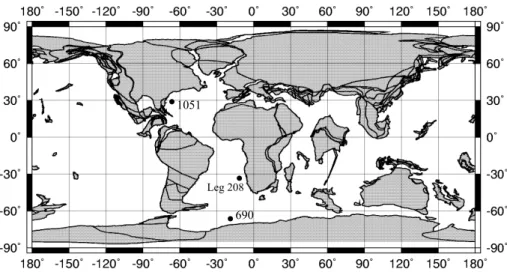
concentra-tions. This “productivity feedback hypothesis” is based on a pronounced increase in the mass accumulation rates of biogenic barium, a proxy of export production in surface waters, at ODP sites 690 and 1051 (Figs. 1 and 2) (Bains et al., 2000), with similar observations elsewhere (Schmitz et al., 1997; Faul and Paytan, 2005; Paytan and
Grif-20
fith, 2007). While high primary productivity during the PETM is supported by some reconstructions of oceanic productivity (Thomas and Shackleton, 1996; Crouch et al., 2001; Bains et al., 2003; Stoll and Bains, 2003; Stoll et al., 2007), other studies are either ambiguous or at odds with this conclusion (Bralower, 2002; Dickens et al., 2003; Bowen et al., 2004; Kelly et al., 2005; Paytan et al., 2007), yielding conflicting results
25
and differing interpretations.
CPD
5, 2391–2410, 2009Productivity feedback did not terminate the
PETM
A. Torfstein et al.
Title Page
Abstract Introduction
Conclusions References
Tables Figures
◭ ◮
◭ ◮
Back Close
Full Screen / Esc
Printer-friendly Version
Interactive Discussion
2 Methodology
Marine barite and biogenic barium correspond to the organic carbon flux from the sur-face ocean to the deep ocean (export production). Their preservation (in non-sulfate reducing environments) is high and their mass accumulation rates in the sedimentary record are thus considered robust proxies for past export production (Goldberg and
Ar-5
rhenius, 1958; Bishop, 1988; Legeleux and Reyss, 1996; Paytan et al., 1996; Monnin et al., 1999; Dickens et al., 2003; Paytan and Griffith, 2007).
Ba-MARs reflect the measured element concentrations (i.e., [Ba]) and the bulk mass accumulation rates (bulk-MARs). The latter are themselves a function of sediment dry bulk density (ρ) and the linear sedimentation rates (LSR) (Eq. 1).
10
BaMAR=bulkMAR×[Ba] =LSR×ρ×[Ba] (1)
LSR are obtained from independent age constraints such as orbital-tuning, magne-tostratigraphy or absolute dating methods, rendering the bulk- and Ba-MARs sensitive to the choice of age model (Curry and Lohmann, 1986; Lyle et al., 1988; Rea and Leinen, 1988; Francois et al., 2004; Lyle et al., 2005). Thus, any interpretation of
Ba-15
MARs in the context of the PETM event will depend on the validity of the underlying age model. The original age model used to calculate the discussed Ba-MARs was ini-tially established for ODP site 1051 by orbital-tuning (Norris and R ¨ohl, 1999) and later expanded to ODP Site 690 by correlating δ13C peaks (Bains et al., 2000). Several refined high-resolution age models have subsequently been established for this site
20
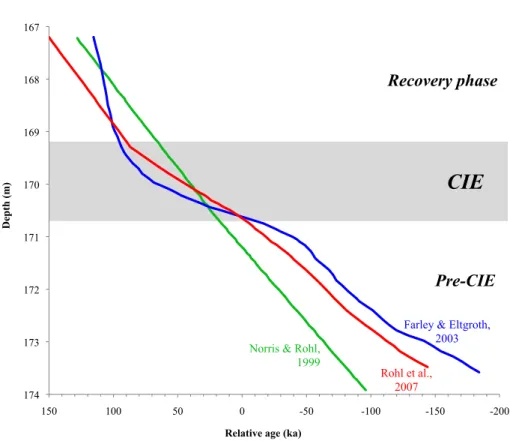
(R ¨ohl et al., 2000, 2007; Farley and Eltgroth, 2003). Here, we re-examine the export production record during the PETM, reconstructed from Ba-MARs, by using two inde-pendent updated age models by using two indeinde-pendent updated age models (Fig. 3).
2.1 3He-based approach
The first re-evaluation expands on the study of Farley and Eltgroth (2003) who
pro-25
de-CPD
5, 2391–2410, 2009Productivity feedback did not terminate the
PETM
A. Torfstein et al.
Title Page
Abstract Introduction
Conclusions References
Tables Figures
◭ ◮
◭ ◮
Back Close
Full Screen / Esc
Printer-friendly Version
Interactive Discussion
rived from small interplanetary dust particles (IDPs) (Farley et al., 1997; Farley, 2001). Because the helium isotopic composition of the interplanetary dust signal differs from terrestrial material by approximately four orders of magnitude, isotopic measurements can be used to identify the extraterrestrial source and quantify its fraction in the sed-iment. Assuming that the flux of extraterrestrial 3He to the Earth’s surface (F3He) is
5
constant over a certain time period (Marcantonio et al., 1996, 1999; Mukhopadhyay et al., 2001; Farley and Eltgroth, 2003; Winckler et al., 2004, 2005) and can be deter-mined, for example by measuring the amount of extraterrestrial3He over a well known, independently dated adjacent time interval, 3He concentration measurements can be inverted to calculate bulk-MARs (Eq. 2).
10
bulkMAR= F33He
He (2)
One of the advantages of this approach is that it provides instantaneous mass accu-mulation rates at each sample depth, whereas the resolution of orbital-tuning is limited to about∼20 ka (precession cycle). Farley and Eltgroth (2003) used this constant flux
proxy approach to reconstruct bulk-MARs for the PETM interval at ODP site 690.
15
2.2 Orbitally-tuned age models
The second and more common approach used to determine the chronological frame-work of the PETM is orbital-tuning (Norris and R ¨ohl, 1999; R ¨ohl et al., 2000), whereby repeated cycles of elemental concentrations or lithological components are assumed to represent precession cycles (∼20 ka), and thus, the time-length of particular sequences 20
within a sedimentary section can be determined. Here, we focus on the most recent orbitally-tuned age model by R ¨ohl et al. (2007) which is based on a wide compilation of data from several sites as well as an adjacent age calibration for the Paleocene-Eocene transition (Westerhold et al., 2007, 2008). This age model presents a refinement of the age-model (Norris and R ¨ohl, 1999) used by Bains et al. (2000).
CPD
5, 2391–2410, 2009Productivity feedback did not terminate the
PETM
A. Torfstein et al.
Title Page
Abstract Introduction
Conclusions References
Tables Figures
◭ ◮
◭ ◮
Back Close
Full Screen / Esc
Printer-friendly Version
Interactive Discussion
3 Reconstructions of mass accumulation rates
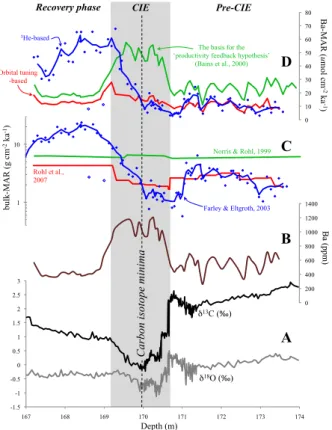
In the following discussion we re-evaluate the bulk- and Ba-MARs based on the two age models detailed above for ODP site 690. The3He-derived age model suggests a slight decrease in bulk-MARs shortly before the CIE (Fig. 2). Approximately 70 ka after the start of the CIE, bulk-MARs started a gradual increase and reached a maximum rate
5
of∼20–25 g·cm2ka−1 (an order of magnitude increase) about 20 ka later. The
bulk-MAR record based on the updated orbitally-tuned age model (R ¨ohl et al., 2007) is in reasonable agreement with the3He-derived age model for the time period before and during most of the CIE (Fig. 2).
However, the two age models display significant divergence starting at ∼169.8 m, 10
coincident with the carbon isotope minima (CIM) point. While the 3He-derived age model implies the start of a gradual but significant increase in bulk-MAR from this point onwards, the orbitally-tuned age model implies relative constant bulk-MARs until the end of the CIE, after which it increases abruptly and remains constant thereafter.
A potential cause for this difference between the age models is massive
carbon-15
ate dissolution, reflecting the temporal shoaling of the CCD during the PETM (Zachos et al., 2005). Such dissolution condenses sedimentary sections and could bias the interpreted bulk-MARs towards lower values. It is also likely to have a larger impact on the orbitally-tuned age models compared to the3He-derived ages because the former would be “missing” cycles, while the latter would still record the accumulated3He signal
20
in the primarily insoluble IDP particles. Under such conditions, the actual bulk-MARs should be higher, closer to those suggested by Farley and Eltgroth (2003). Indeed, the significant environmental changes associated with the PETM would most likely have affected non-carbonate sedimentation, also influencing MARs. This is further sup-ported by shifts in the lithology of the PETM sequence at Site 690 and elsewhere (e.g.,
25
CPD
5, 2391–2410, 2009Productivity feedback did not terminate the
PETM
A. Torfstein et al.
Title Page
Abstract Introduction
Conclusions References
Tables Figures
◭ ◮
◭ ◮
Back Close
Full Screen / Esc
Printer-friendly Version
Interactive Discussion
deposition rates implied by the orbitally-tuned age models (Fig. 3).
4 Barium MARs and discrepancies regarding biosphere feedback
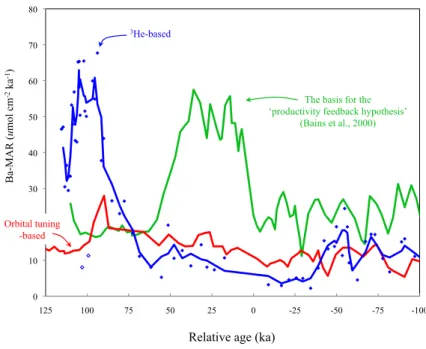
Despite the differences between them, both re-evaluations are internally consistent and indicate relatively constant Ba-MARs during the first ∼70 ka of the CIE, in sharp
contrast to the original interpretation of Bains et al. (2000) (Fig. 4). Differences in
Ba-5
MARs develop after the CIM, corresponding to the transition to the recovery phase (Fig. 2). Thereafter, Ba-MARs either display an abrupt six to seven -fold increase, as predicted by the3He-based age model (Farley and Eltgroth, 2003), or remain overall constant, as implied by the orbitally-tuned age model (R ¨ohl et al., 2007). Given the fact that the bulk-MARs is a function ofρ and LSR (Eq. 1), and that theρ remains overall
10
similar throughout the sedimentary sequence, any changes in Ba-MARs must reflect corresponding patterns in the LSR or in the barium concentrations. Thus, according to orbital tuning a small peak of Ba-MARs at ∼169.2 m (∼90 ka after start of CIE),
represents a short overlap between a sequence of increased Ba concentrations to the rise in LSR. It is not clear whether this small peak is real or if it is the result of a small
15
offset in one of the above (i.e., LSR or [Ba]). Regardless, its magnitude and time span are such that the implied shift in Ba-MARs is negligible.
Evidently, the coincidence between increased Ba concentrations and the CIE (Fig. 2a) does not reflect higher productivity or a change in the marine cycle of Ba as previously thought, but rather, the condensation of the sedimentary section due to
20
ocean acidification and carbonate dissolution.
Contrary to the “productivity feedback hypothesis” (Bains et al., 2000), there appears to have been no notable change in marine export production until at least∼70 ka after
the onset of the CIE (Fig. 4). This conclusion sheds new light on the ongoing de-bate over the response of the marine biosphere to carbon release at the PETM and
25
CPD
5, 2391–2410, 2009Productivity feedback did not terminate the
PETM
A. Torfstein et al.
Title Page
Abstract Introduction
Conclusions References
Tables Figures
◭ ◮
◭ ◮
Back Close
Full Screen / Esc
Printer-friendly Version
Interactive Discussion
oceans during the PETM (Bolle et al., 2000; Bralower, 2002; Bowen et al., 2004; Kelly et al., 2005), other studies argued for a rise in primary productivity in surface waters, supporting the biological pump as a major negative feedback to the greenhouse warm-ing (Schmitz et al., 1997; Crouch et al., 2001; Stoll and Bains, 2003; Stoll et al., 2007). Yet these lines of evidence are ambiguous. For example, increased productivity during
5
the CIE was suggested on the basis of a limited increase of Sr/Ca ratios in some (but not all) calcareous nannofossil assemblages (Stoll and Bains, 2003; Stoll et al., 2007). Additional complications arise from the magnitude of change in Ba-MARs relative to the short duration of the PETM event, which present mass balance problems. A pos-sible explanation for this discrepancy is the influx of an external source of Ba to the
10
oceans (Dickens et al., 2003) or alternatively, a mechanism of spatial differential depo-sition of barite whereby the excess Ba-MARs are counterbalanced by limited Ba-MARs in other unidentified sites (Dickens et al., 2003; Paytan et al., 2007). The latter sug-gestion is supported by constant marine Sr/Ba ratios observed throughout the PETM implying no change in barite saturation in the oceans despite the changes in Ba-MARs
15
(Paytan et al., 2007). Clearly, the revised Ba-MARs records presented here warrant re-consideration of some of the ideas detailed above.
5 A “kick-start” out of the PETM?
The revised Ba-MARs imply that any significant change in export production in the Southern Ocean lagged the abrupt rise in CO2by at least∼70 ka, or did not take place 20
at all. In the case of the3He-derived model, this increase in Ba-MARs is synchronous with the CIM, when bulkδ13C values shift from a continuous trend of depletion in13C, back towards heavier, pre-CIE values, marking the start of a period of recovery back to pre-PETM conditions (indicated in Fig. 2 by the dashed black curve). This transition is also synchronous with evidence for a bloom of species of planktic foraminifera ( Acarin-25
CPD
5, 2391–2410, 2009Productivity feedback did not terminate the
PETM
A. Torfstein et al.
Title Page
Abstract Introduction
Conclusions References
Tables Figures
◭ ◮
◭ ◮
Back Close
Full Screen / Esc
Printer-friendly Version
Interactive Discussion
responsible for CO2drawdown and carbonate precipitation in the oceans “kick-started” abruptly about∼70 ka after the initial CIE. Yet, the nature of this triggering mechanism
remains unclear.
A key observation in this regard is that the PETM is not a single event, but rather, marks the first of at least three similar events that took place during the early Eocene
5
(Lourens et al., 2005; Nicolo et al., 2007; Westerhold et al., 2008). Their recurring pat-tern may indicate that these events were all triggered by the same process, which had to be robust enough so as to be able to repeatedly trigger the discharge of vast amounts of carbon into the atmosphere. Thus, we suggest a mechanism of changes in ocean circulation as the most likely control on the recovery process. Indeed, it has been
10
suggested (Bice and Marotzke, 2002; Tripati and Elderfield, 2004, 2005; Nunes and Norris, 2006) that a switch in the deepwater formation from a southern to a northern locus caused the thermal dissociation of gas hydrates that triggered the sudden rise in atmospheric CO2 and subsequent global warming. It has been further suggested that the return to pre-PETM ocean configuration took place only after significant draw
15
down of greenhouse gases (Nunes and Norris, 2006) through biological processes and enhanced silicate weathering. However, given the evidence detailed here, it appears that the role of biological uptake was either negligible (according to the orbitally-tuned age model) or evolved only after the recovery process began at the CIM (according to the3He-derived age model). Similarly, silicate weathering appears to have become
20
significant onlyafter the CIM point (Robert and Kennett, 1994). Hence, we suggest that the recovery phase may have been triggered by a discrete event. The nature of this trigger is not known but we speculate that it may be the crossing of an oceano-graphic threshold, which most likely represents a combination of several parameters (e.g., salinity, temperature), that led to the resumption of deep-water formation in the
25
Southern Ocean approximately∼70 ka after the onset of the CIE. This shift could have
CPD
5, 2391–2410, 2009Productivity feedback did not terminate the
PETM
A. Torfstein et al.
Title Page
Abstract Introduction
Conclusions References
Tables Figures
◭ ◮
◭ ◮
Back Close
Full Screen / Esc
Printer-friendly Version
Interactive Discussion
increase in export production in the Southern Ocean (according to the 3He-derived age model), which served as an additional negative feedback to high atmospheric CO2
levels.
6 Conclusions and implications
The natural mechanisms of recovery from the PETM are of fundamental interest in the
5
context of present day global warming. Nevertheless, these mechanisms are not well constrained and are still under debate. A central observation in this context is a promi-nent increase in biogenic barium mass accumulation rates (Ba-MARs) observed within the PETM sequence at ODP site 690 in the Southern Ocean. The increase in Ba-MARs is thought to be a proxy for increased export production in surface waters and hence,
10
has been argued to indicate that a massive biogeochemical productivity feedback in the ocean was the main mechanism that supported CO2 draw down and recovery from the PETM (Bains et al., 2000). The Ba-MARs record however, is sensitive to the chronological framework established for the sedimentary sequence. In this paper we re-evaluated the Ba-MARs at ODP site 690 based on the updated age models of Farley
15
and Eltgroth (2003) and R ¨ohl et al. (2007).
Our re-evaluation of the “productivity feedback hypothesis” at ODP site 690 across the PETM reveals the sensitivity of the interpretation of the BaMAR record to the choice of the chronological framework established for the sedimentary sequence. The pro-nounced peak of the Ba-MARs during the main stage of the PETM, which served as
20
the observational evidence for the original hypothesis (Bains et al., 2000) is an artifact of the age model used. Re-evaluation of the sedimentary record using the original barium data and updated age models indicates that export production in the Southern Ocean was either constant throughout the event, or lagged the abrupt rise in CO2by at least∼70 ka, in sharp contrast to previous results. This implies that export production 25
pre-CPD
5, 2391–2410, 2009Productivity feedback did not terminate the
PETM
A. Torfstein et al.
Title Page
Abstract Introduction
Conclusions References
Tables Figures
◭ ◮
◭ ◮
Back Close
Full Screen / Esc
Printer-friendly Version
Interactive Discussion
viously assumed. It is intriguing that the carbon isotope minimum, marking the peak of the PETM, is promptly followed by a rise in kaolinite abundances (Robert and Kennett, 1994) and a bloom of species of planktic foraminifera (Acarinina subsphaerica) (Kelly et al., 2005), suggesting that the recovery phase was triggered by a discrete event that “kick-started” abruptly about∼70 ka after the initial CIE. The nature of this trigger is 5
unclear but we speculate, in accord with previous studies (Bice and Marotzke, 2002; Tripati and Elderfield, 2004, 2005; Nunes and Norris, 2006), that it involves a change in the global ocean setting and the resumption of deep-water formation in the Southern Ocean.
Accepting the PETM event as an analogue for current global warming, the primary
10
natural path of carbon sequestration in response to CO2 spiking does not appear to involve oceanic biogeochemical feedbacks, implying that efforts to enhance these pro-cesses (e.g., the “iron hypothesis” (Martin, 1992)) might not be quantitatively sufficient; additional paths should therefore be considered in the context of present day warming and the search for means to reduce atmospheric carbon content.
15
Acknowledgements. We would like to thank S. Bains and R. Norris for providing published data from Site 690. A. Tripati was supported by NERC and Magdalene College.
References
Bains, S., Corfield, R. M., and Norris, R. D.: Mechanisms of climate warming at the end of the Paleocene, Science, 285, 724–727, 1999.
20
Bains, S., Norris, R. D., Corfield, R. M., and Faul, K. L.: Termination of global warmth at the Palaeocene/Eocene boundary through productivity feedback, Nature, 407, 171–174, 2000. Bains, S., Norris, R. D., Corfield, R. M., Bowen, G. J., Gingerich, P. D., and Koch, P. L.:
Marine-terrestrial linkages at the Paleocene-Eocene boundary, Geol. S. Am. S., 369, 1–9, 2003. Bice, K. L. and Marotzke, J.: Could changing ocean circulation have destabi-25
CPD
5, 2391–2410, 2009Productivity feedback did not terminate the
PETM
A. Torfstein et al.
Title Page
Abstract Introduction
Conclusions References
Tables Figures
◭ ◮
◭ ◮
Back Close
Full Screen / Esc
Printer-friendly Version
Interactive Discussion
Bishop, J. K. B.: The barite-opal-organic carbon association in oceanic particulate matter, Na-ture, 332, 341–343, 1988.
Bolle, M. P., Pardo, A., Adatte, T., Von Salis, K., and Burns, S.: Climatic evolution on the southeastern margin of the Tethys (Negev, Israel) from the Palaeocene to the early Eocene: focus on the late Palaeocene thermal maximum, Journal of Geological Society, London, 157, 5
929–941, 2000.
Bowen, G. J., Clyde, W. C., Koch, P. L., Ting, S., Alroy, J., Tsubamoto, T., Wang, Y., and Wang, Y.: Mammalian dispersal at the Paleocene/Eocene boundary, Science, 295, 2062– 2065, 2002.
Bowen, G. J., Beerling, D. J., Koch, P. L., Zachos, J. C., and Quattlebaum, T.: A humid climate 10
state during the Palaeocene/Eocene thermal maximum, Nature, 432, 495–499, 2004. Bralower, T. J., Thomas, D. J., Zachos, J. C., Hirschmann, M. M., R ¨ohl, U., Sigurdsson, H.,
Thomas, E., and Whitney, D. L.: High-resolution records of the late Paleocene thermal maxi-mum and circum-Caribbean volcanism: is there a causal link?, Geology, 25, 963–966, 1997. Bralower, T. J.: Evidence of surface water oligotrophy during the Paleocene-Eocene thermal 15
maximum: nannofossil assemblage data from Ocean Drilling Program Site 690, Maud Rise, Weddell Sea, Paleoceanography, 17, 1023, doi:10.1029/2001PA000662, 2002.
Crouch, E. M., Heilmann-Clausen, C., Brinkhuis, H., Morgans, H. E. G., Rogers, K. M., Eg-ger, H., and Schmitz, B.: Global dinoflagellate event associated with the late Paleocene thermal maximum, Geology, 29, 315–318, 2001.
20
Curry, W. B. and Lohmann, G. P.: Late Quaternary carbonate sedimentation at the Sierra Leone Rise (eastern equatorial Atlantic Ocean), Mar. Geol., 70, 223–250, 1986.
Dickens, G. R., Castillo, M. M., and Walker, J. C. G.: A blast of gas in the latest Paleocene: simulating first-order effects of massive dissociation of oceanic methane hydrate, Geology, 25, 259–262, 1997.
25
Dickens, G. R., Fewless, T., Thomas, E., and Bralower, T. J.: Excess barite accumulation during the Paleocene-Eocene thermal maximum: massive input of dissolved barium from seafloor gas hydrate reservoirs, Geol. S. Am. S., 369, 11–23, 2003.
Farley, K. A., Love, S. G., and Patterson, D. B.: Atmospheric entry heating and helium retentivity of interplanetary dust particles, Geochim. Cosmochim. Ac., 61, 2309–2316, 1997.
30
Pub-CPD
5, 2391–2410, 2009Productivity feedback did not terminate the
PETM
A. Torfstein et al.
Title Page
Abstract Introduction
Conclusions References
Tables Figures
◭ ◮
◭ ◮
Back Close
Full Screen / Esc
Printer-friendly Version
Interactive Discussion
lishers, New York, 179–204, 2001.
Farley, K. A. and Eltgroth, S. F.: An alternative age model for the Paleocene-Eocene thermal maximum using extraterrestrial He-3, Earth Planet. Sc. Lett., 208, 135–148, 2003.
Faul, K. L. and Paytan, A.: Phosphorus and barite concentrations and geochemistry in Site 1221 Paleocene/Eocene boundary sediments, in: Proceedings of the Ocean Drilling Pro-5
gram, Scientific Results, Vol. 199, edited by: Wilson, P. A., Lyle, M., and Firth, J. V., 2005. Francois, R., Frank, M., van der Loeff, M. M. R., and Bacon, M. P.:230Th normalization: an
es-sential tool for interpreting sedimentary fluxes during the late Quaternary, Paleoceanography, 19, PA1018, doi:1010.1029/2003PA000939, 2004.
Goldberg, E. D. and Arrhenius, G. O. S.: Chemistry of Pacific pelagic sediments, Geochim. 10
Cosmochim. Ac., 13, 153–212, 1958.
Higgins, J. A. and Schrag, D. P.: Beyond methane: towards a theory for the Paleocene-Eocene thermal maximum, Earth Planet. Sc. Lett., 245, 523–537, 2006.
Katz, M. E., Pak, D. K., Dickens, G. R., and Miller, K. G.: The source and fate of massive carbon input during the latest Paleocene thermal maximum, Science, 286, 1531–1533, 1999. 15
Kelly, D. C., Zachos, J. C., Bralower, T. J., and Schellenberg, S. A.: Enhanced ter-restrial weathering/runoff and surface ocean carbonate production during the recovery stages of the Paleocene-Eocene thermal maximum, Paleoceanography, 20, PA4023, doi:10.1029/2005PA001163, 2005.
Kennett, J. P. and Stott, L. D.: Abrupt deep-sea warming, palaeoceanographic changes and 20
benthic extinctions at the end of the Paleocene, Nature, 353, 225–229, 1991.
Kent, D. V., Cramer, B. S., Lanci, L., Wang, D., Wright, J. D., and Van der Voo, R.: A case for a comet impact trigger for the Paleocene/Eocene thermal maximum and carbon isotope excursion, Earth Planet. Sc. Lett., 211, 13–26, 2003.
Legeleux, F. and Reyss, J. L.: Ra-228/Ra-226 activity ratio in oceanic settling particles: implica-25
tions regarding the use of barium as a proxy for paleoproductivity reconstruction, Deep-Sea Res. Pt. I, 43, 1857–1863, 1996.
Lourens, L. J., Sluijs, A., Kroon, D., Zachos, J. C., Thomas, E., R ¨ohl, U., Bowles, J., and Raffi, I.: Astronomical pacing of late Palaeocene to early Eocene global warming events, Nature, 435, 1083–1087, 2005.
30
CPD
5, 2391–2410, 2009Productivity feedback did not terminate the
PETM
A. Torfstein et al.
Title Page
Abstract Introduction
Conclusions References
Tables Figures
◭ ◮
◭ ◮
Back Close
Full Screen / Esc
Printer-friendly Version
Interactive Discussion
Lyle, M., Mitchell, N., Pisias, N., Mix, A., Martinez, J. I., and Paytan, A.: Do geochemical esti-mates of sediment focusing pass the sediment test in the equatorial Pacific, Paleoceanogra-phy, 20, 1–12, 2005.
Marcantonio, F., Anderson, R. F., Stute, M., Kumar, N., Schlosser, P., and Mix, A.: Extraterres-trial He-3 as a tracer of marine sediment transport and accumulation, Nature, 383, 705–707, 5
1996.
Marcantonio, F., Turekian, K. K., Higgins, S., Anderson, R. F., Stute, M., and Schlosser, P.: The accretion rate of extraterrestrial He-3 based on oceanic Th-230 flux and the relation to Os isotope variation over the past 200,000 years in an Indian Ocean core, Earth Planet. Sc. Lett., 170, 157–168, 1999.
10
Martin, J. H.: Glacial-interglacial CO2change: the iron hypothesis, Paleoceanography, 5, 1–13, 1992.
Monnin, C., Jeandel, C., Cattaldo, T., and Dehairs, F.: The marine barite saturation state of the world’s oceans, Mar. Chem., 65, 253–261, 1999.
Mukhopadhyay, S., Farley, K. A., and Montanari, A.: A short duration of the Cretaceous-Tertiary 15
boundary event: evidence from extraterrestrial helium-3, Science, 291, 1952–1955, 2001. Nicolo, M. J., Dickens, G. R., Hollis, C. J., and Zachos, J. C.: Multiple early Eocene
hyperther-mals: their sedimentary expression on the New Zealand continental margin and in the deep sea, Geology, 35, 699–702, 2007.
Norris, R. D. and R ¨ohl, U.: Carbon cycling and chronology of climate warming during the 20
Palaeocene/Eocene transition, Nature, 401, 775–778, 1999.
Nunes, F. and Norris, R. D.: Abrupt reversal in ocean overturning during the Palaeocene/Eocene warm period, Nature, 439, 60–63, 2006.
Pagani, M., Caldeira, K., Archer, D., and Zachos, J. C.: An ancient carbon mystery, Science, 314, 1556–1557, 2006.
25
Paytan, A., Kastner, M., and Chavez, F. P.: Glacial to interglacial fluctuations in productivity in the equatorial Pacific as indicated by marine barite, Science, 274, 1355–1357, 1996. Paytan, A., Averyt, K., Faul, K., Gray, E., and Thomas, E.: Barite accumulation, ocean
pro-ductivity, and Sr/Ba in barite across the Paleocene-Eocene thermal maximum, Geology, 35, 1139–1142, 2007.
30
Paytan, A. and Griffith, E. M.: Marine barite: recorder of variations in ocean export productivity, Deep Sea Res. Pt. II, 54, 687–705, 2007.
CPD
5, 2391–2410, 2009Productivity feedback did not terminate the
PETM
A. Torfstein et al.
Title Page
Abstract Introduction
Conclusions References
Tables Figures
◭ ◮
◭ ◮
Back Close
Full Screen / Esc
Printer-friendly Version
Interactive Discussion
Holocene record of eolian deposition in the northwest Pacific Ocean, Palaeogeog., Palaeo-clim., Palaeoec. , 66, 1–8, 1988.
Robert, C. and Kennett, J. P.: Antarctic subtropical humid episode at the Paleocene-Eocene boundary- clay-mineral evidence, Geology, 22, 211–214, 1994.
R ¨ohl, U., Bralower, T. J., Norris, R. D., and Wefer, G.: New chronology for the late Paleocene 5
thermal maximum and its environmental implications, Geology, 28, 927–930, 2000.
R ¨ohl, U., Westerhold, T., Bralower, T. J., and Zachos, J. C.: On the duration of the Paleocene-Eocene thermal maximum (PETM), Geochem. Geophy. Geosy., 8, Q12002, doi:10.1029/2007GC001784, 2007.
Schmitz, B., Charisi, S. D., Thompson, E. I., and Speijer, R. P.: Barium, SiO2 (excess), and 10
P2O5as proxies of biological productivity in the Middle East during the Palaeocene and the latest Palaeocene benthic extinction event, Terra Nova, 9, 95–99, 1997.
Sluijs, A., Schouten, S., Pagani, M., Woltering, M., Brinkhuis, H., Damste, J. S. S., Dick-ens, G. R., Huber, M., Reichart, G. J., Stein, R., Matthiessen, J., LourDick-ens, L. J., Pe-dentchouk, N., Backman, J., Moran, K., and Expedition, S.: Subtropical Arctic Ocean tem-15
peratures during the Palaeocene/Eocene thermal maximum, Nature, 441, 610–613, 2006. Sluijs, A., Brinkhuis, H., Schouten, S., Bohaty, S. M., John, C. M., Zachos, J. C., Reichart, G. J.,
Damste, J. S. S., Crouch, E. M., and Dickens, G. R.: Environmental precursors to rapid light carbon injection at the Palaeocene/Eocene boundary, Nature, 450, 1218–1221, 2007. Stoll, H. M. and Bains, S.: Coccolith Sr/Ca records of productivity during the Paleocene-20
Eocene thermal maximum from the Weddell Sea, Paleoceanography, 18, 1049, doi:10.1029/2002PA000875, 2003.
Stoll, H. M., Shimizu, N., Archer, D., and Ziveri, P.: Coccolithophore productivity response to greenhouse event of the Paleocene-Eocene Thermal Maximum, Earth Planet. Sc. Lett., 258, 192–206, 2007.
25
Svensen, H., Planke, S., Malthe-Sorenssen, A., Jamtveit, B., Myklebust, R., Eidem, T. R., and Rey, S. S.: Release of methane from a volcanic basin as a mechanism for initial Eocene global warming, Nature, 429, 542–545, 2004.
Thomas, E. and Shackleton, N. J.: The Paleocene-Eocene benthic foraminiferal extinction and stable isotope anomalies, Geol. Soc. Sp., 101, 401–441, 1996.
30
Tripati, A. and Elderfield, H.: Deep-sea temperature and circulation changes at the Paleocene-Eocene thermal maximum, Science, 308, 1894–1898, 2005.
CPD
5, 2391–2410, 2009Productivity feedback did not terminate the
PETM
A. Torfstein et al.
Title Page
Abstract Introduction
Conclusions References
Tables Figures
◭ ◮
◭ ◮
Back Close
Full Screen / Esc
Printer-friendly Version
Interactive Discussion
subtropical Atlantic from foraminiferal Mg/Ca indicate greenhouse origin for the thermal maximum at the Paleocene-Eocene boundary, Geochem. Geophy. Geosy., 5, Q02006, doi:10.1029/2003GC000631, 2004.
Westerhold, T., R ¨ohl, U., Laskar, J., Raffi, I., Bowles, J., Lourens, L. J., and Zachos, J. C.: On the duration of magnetochrons C24r and C25n and the timing of early Eocene global 5
warming events: implications from the Ocean Drilling Program Leg 208 Walvis Ridge depth transect, Paleoceanography, 22, PA2201, doi:10.1029/2006PA001322, 2007.
Westerhold, T., R ¨ohl, U., Raffi, I., Fornaciari, E., Monechi, S., Reale, V., Bowles, J., and Evans, H. F.: Astronomical calibration of the Paleocene time, Palaeogeog., Palaeoclim., Palaeoec., 257, 377–403, 2008.
10
Winckler, G., Anderson, R. F., Stute, M., and Schlosser, P.: Does interplanetary dust control 100 kyr glacial cycles?, Quaternary Sci. Rev., 23, 1873–1878, 2004.
Winckler, G., Anderson, R. F., and Schlosser, P.: Equatorial Pacific productivity and dust flux during the mid-Pleistocene climate transition, Paleoceanography, 20, PA4025, doi:10.1029/2005PA001177, 2005.
15
Zachos, J., Pagani, M., Sloan, L., Thomas, E., and Billups, K.: Trends, rhythms, and aberrations in global climate 65 Ma to present, Science, 292, 686–693, 2001.
Zachos, J. C., Wara, M. W., Bohaty, S., Delaney, M. L., Petrizzo, M. R., Brill, A., Bralower, T. J., and Premoli-Silva, I.: A transient rise in tropical sea surface temperature during the Paleocene-Eocene thermal maximum, Science, 302, 1551–1554, 2003.
20
CPD
5, 2391–2410, 2009Productivity feedback did not terminate the
PETM
A. Torfstein et al.
Title Page
Abstract Introduction
Conclusions References
Tables Figures
◭ ◮
◭ ◮
Back Close
Full Screen / Esc
Printer-friendly Version
Interactive Discussion
690 1051
Leg 208
CPD
5, 2391–2410, 2009Productivity feedback did not terminate the
PETM
A. Torfstein et al.
Title Page Abstract Introduction Conclusions References Tables Figures ◭ ◮ ◭ ◮ Back Close
Full Screen / Esc
Printer-friendly Version Interactive Discussion Ba -MAR ( u mol cm -2 ka -1 )
!13C (!)
!18O (!)
Pre-CIE Depth (m) B A -1.5 -1 -0.5 0 0.5 1 1.5 2 2.5 3
167 168 169 170 171 172 173 174
0 200 400 600 800 1000 1200 1400 Ba (ppm ) D 0 10 20 30 40 50 60 70 80
The basis for the ‘productivity feedback hypothesis’
(Bains et al., 2000)
C
Farley & Eltgroth, 2003 Norris & Rohl, 1999
Rohl et al., 2007
Carbon isotope minima
CIE Recovery phase 0 1 10 100 bulk-MAR ( g cm
-2 ka -1)
3He-based
Orbital tuning -based
Fig. 2.(A)Bulkδ13C andδ18O values during the PETM interval vs. depth (m) at ODP site 690 (Bains et al., 1999). The shadowed area represents the duration of the carbon isotope excursion (CIE).(B)Ba concentrations (Bains et al., 2000).(C)Sediment bulk mass accumulation rates (bulk-MARs) according to the three age models: the original orbitally-tuned age model of Norris and R ¨ohl (1999) (green), the refined orbitally-tuned age model of R ¨ohl et al. (2007)
(red) and the3He-derived age model (Farley and Eltgroth, 2003) (blue; the blue curve represent a 3-point running average excluding the two open symbols
as outliers). The Norris and R ¨ohl (1999) age model pertains to ODP site 1051 and was interpolated by Bains et al. (2000) to ODP site 690.(D)Barium mass accumulation rates (Ba-MARs) calculated according to three age models. Colors and symbols correspond to(C). Note the clear difference in the timing of Ba-MARs peaks obtained using the sedimentation rates of Farley and Eltgroth (2003) and R ¨ohl et al. (2007) compared to those of Bains et al. (1999). The shadowed area represents the duration of the carbon isotope excursion (CIE) stage. The dashed line in the center of the CIE marks the carbon isotope minima (CIM) and coincides the initial increase of bulk- and Ba-MAR, marking the start of the recovery phase.
We note that Farley and Eltgroth (2003) used the timing of adjacent magnetochrons (24R and 25R) to calculate the apparent3He flux at site 690. A recent
update of the timing of these magnetochrons (Westerhold et al., 2007) dictates a minor propagated change in the3He-derived chronology. For consistency
with published data, and because the changes in the updated chronology are small and do not affect any of the conclusions of our study, we refer to the
CPD
5, 2391–2410, 2009Productivity feedback did not terminate the
PETM
A. Torfstein et al.
Title Page
Abstract Introduction
Conclusions References
Tables Figures
◭ ◮
◭ ◮
Back Close
Full Screen / Esc
Printer-friendly Version
Interactive Discussion 167
168
169
170
171
172
173
174
-200 -150
-100 -50
0 50
100 150
Depth (m)
Relative age (ka)
CIE
Recovery phase
Pre-CIE
Rohl et al., 2007
Farley & Eltgroth, 2003 Norris & Rohl,
1999
CPD
5, 2391–2410, 2009Productivity feedback did not terminate the
PETM
A. Torfstein et al.
Title Page
Abstract Introduction
Conclusions References
Tables Figures
◭ ◮
◭ ◮
Back Close
Full Screen / Esc
Printer-friendly Version
Interactive Discussion
0 10 20 30 40 50 60 70 80
-100 -75 -50 -25 0 25 50 75 100 125
Ba
-MAR (
u
mol
cm
-2 ka -1)
Relative age (ka)
Orbital tuning -based
3He-based
The basis for the ‘productivity feedback hypothesis’
(Bains et al., 2000)