No Effect of Host Species on Phenoloxidase
Activity in a Mycophagous Beetle
Vincent Formica*, Amanda Kar-Men Chan
Department of Biology, Swarthmore College, Swarthmore, Pennsylvania, United States of America
Abstract
Ecological immunology is an interdisciplinary field that helps elucidate interactions between the environment and immune response. The host species individuals experience have pro-found effects on immune response in many species of insects. However, this conclusion comes from studies of herbivorous insects even though species of mycophagous insects also inhabit many different host species. The goal of this study was to determine if fungal host species as well as individual, sex, body size, and host patch predict one aspect of immune function, phenoloxidase activity (PO). We sampled a metapopulation of Boli-totherus cornutus, a mycophagous beetle in southwestern Virginia.B.cornutuslive on three species of fungus that differ in nutritional quality, social environment, and density. A fil-ter paper phenoloxidase assay was used to quantify phenoloxidase activity. Overall, PO activity was significantly repeatable among individuals (0.57) in adultB.cornutus. While there was significant variance among individuals in PO activity, there were surprisingly no significant differences in PO activity among subpopulations, beetles living on different host species, or between the sexes; there was also no effect of body size. Our results suggest that other factors such as age, genotype, disease prevalence, or natal environment may be generating variance among individuals in PO activity.
Introduction
The goal of ecological immunology is to understand the evolutionary processes and ecological factors that affect immune function and infection in the wild [1,2]. Diet, sex, body size, geo-graphic location, social environment, and even micro-environmental differences among popu-lations are all ecological factors shown to influence immune response in insects [3–8]. Host species can be a major source of environmental variation across several of these variables within and among insect populations. For instance, the species and quality of the host plants of herbivorous insect can affect several components of immune response [9–11]. Ecological fac-tors that are influenced by the host, such as density of the population, nutritional quality, or risk of predation have also been shown to affect immune function in insects [12–14].
Emerging work on the effects of host species on immune response is largely centered on her-bivorous insects [4,7,9,15,16]. However, many families of mycophagous insects such as
OPEN ACCESS
Citation:Formica V, Chan AK-M (2015) No Effect of Host Species on Phenoloxidase Activity in a Mycophagous Beetle. PLoS ONE 10(10): e0141167. doi:10.1371/journal.pone.0141167
Editor:Kenneth Söderhäll, Uppsala University, SWEDEN
Received:July 22, 2015
Accepted:October 4, 2015
Published:October 29, 2015
Copyright:© 2015 Formica, Chan. This is an open access article distributed under the terms of the Creative Commons Attribution License, which permits unrestricted use, distribution, and reproduction in any medium, provided the original author and source are credited.
Data Availability Statement:All relevant data are within the paper and its Supporting Information files.
Funding:This work was funded by the Mellon Mays Undergraduate Fellowship to AC and NSF-IOS-135503 to VF. The funders had no role in study design, data collection and analysis, decision to publish, or preparation of the manuscript.
Coleoptera [17], Diptera, and Lepidoptera also feed on multiple host species and the effects of their diet on immunity are largely unknown [18–20]. Polyphagous and mycophagous insect species also have the potential to experience different environments among fungal host species because many fungal species differ in life history, ephemerality, density, and secondary com-pounds [20]. We hypothesized that major effects of host species on immunity, observed in her-bivorous insects, will be similar in mycophagous insects. Specifically we predicted that the variance in individual immune response would be significantly explained by adult host fungal species. If we are to draw generalizable conclusions about the role of differing host species on insect immunity, both phytophagous and mycophagous systems should be examined.
Bolitotherus cornutusis a mycophagous tenebrionid beetle found almost exclusively on logs infected with three species of sympatric, saprophytic fungus:Ganoderma tsugae,Ganoderma applanatum, andFomes fomentarius[21,22]. Adults feed on the surface of these fungi, females lay their eggs on the surface of the brackets, and larvae develop inside the fruiting body and emerge as adults [21]. Recent work in southern Virginia demonstrates that there is no genetic structure among patches or host fungus species, indicating natal migration among patches and host fungi may occur at a fairly high rate [23]. AdultB.cornutusare thought to spend the majority of a single breeding season on one log infected with fungus (hereafter called“patch”). Therefore, residence on a patch should be a strong predictor of current adult but not larval diet [21,24].
The three host species may provide very different environments for adultB.cornutus. One species (G.tsugae) produces soft brackets annually which senesce and fall off the tree at the end of the breeding season while the other two species produce robust brackets that persist for years. In southwestern Virginia, the densities ofB.cornutuspopulations among these three fungi types vary, suggesting that they may constitute differing social environments (Formica, unpublished data). These three species of fungi also cause variation in growth rates and survi-vorship in developingB.cornutuslarvae [25], indicating that they may also differ in nutritional quality. Additionally,B.cornutusfound on different species of fungi produce quantitatively dif-ferent volatile secretions further suggesting that there are differences in nutrient composition and possibly chemical defenses of the host fungal species [26].
The goal of this study was to determine if individuals, sex, body size, patch, and host species predict one aspect of immune function, phenoloxidase activity, across a metapopulation of adultB.cornutus. As the three species of fungi differ in several aspects shown to affect immune function in other systems, we hypothesized that adultB.cornutuswould differ the most in phe-noloxidase activity among the three fungal host species.
Insects have an immune system that relies in part on the prophenoloxidase-activating sys-tem [27]. Phenoloxidase (PO) is an enzyme within a larger cascade (called the prophenoloxi-dase activating system) that contributes to several components of the complex immune system in insects, including melanotic encapsulation, clotting, and the production of cytotoxic chemi-cals, making it one of the most widely used markers in insect ecological immunity [27,28]. The melanization response of the prophenoloxidase cascade, which results in a visible difference in color of the hemolymph, provides a way to quantify immune response in the field. Variations in phenoloxidase activity have been shown to correlate with nutrition in a variety of insect and may be driving much of the variation observed in immune differences among individuals living on different host species [9,15,29–31].
Materials and Methods
(geographic coordinates: 37.375258, -80.528747). All patches of fungi were located in two square kilometers of forest. All permits and permissions to collectB.cornutuswere obtained. Patches were searched every other day during a 7 day time span (July 18–25, 2014); all animals found within this period were captured and housed individually in plastic bags with a moist-ened Kim Wipe1upon capture. Animals were not fed during capture to avoid altering their diet. Samples of hemolymph were collected within 24 hours of capture following the procedure described in [32]. Briefly, individuals present a tenebrio-type defensive gland from their anal sternite when exposed to human breath [33]. The gland was gently abraded with a micro-capil-lary tube, producing between 1–5μL of hemolymph. This method more reliably produced
hemolymph uncontaminated by other body fluids compared to hemolymph extraction via dis-section. Additionally, many of these animals are part of a larger, long-term study on the herita-bility of social behavior therefore sacrificing individuals or obtaining more hemolymph was not feasible.
To quantify phenoloxidase activity (PO) at the field station, a filter paper immunoassay was performed [34]. Immediately after hemolymph was collected, samples were pipetted in one-microliter aliquots onto Whatman No. 2 filter paper. Hemolymph was collected from each individual only once. Depending on the amount of hemolymph collected at that time, 1–3 ali-quots from the same sample were examined per individual (mean = 2.2 samples/individual). The filter paper was soaked in a solution of 10mM sodium phosphate buffer and 2mg/mL 3,4-Dihydroxy-L-phenylalanine (L-DOPA) prior to adding the hemolymph. Filter paper was kept moist for 30 minutes with the L-DOPA solution, allowed to air-dry, and then scanned on an Epson V600 flatbed scanner at 800 dpi, 48-bit color. Scanned images were converted to 8-bit gray scale and analyzed with ImageJ to determine the mean grayscale value of each hemo-lymph sample [35]. Because flatbed scanners record image values in a non-linear manner, we created a serial ink-dilution standard-curve. We then fit a standard curve using a third order polynomial on the log-transformed dilution values of the ink with the grayscale values taken from ImageJ (R2= 0.991). To calculate an interpolated melanization index, grayscale values from the hemolymph were then interpolated using the formula of the polynomial in Graphpad Prism v6 software (San Diego, CA). After hemolymph was collected, all individuals were then photographed on the same flatbed scanner at 2400 dpi for elytra measurements.B.cornutus exhibit tonic immobility from several minutes up to a half hour when exposed to human breath; individuals were photographed while immobile by placing them dorsal side down on the scanner. Elytra lengths were then measured using ImageJ.
Although, we have previously been able to extract DNA from such secretions, we were con-cerned that hemolymph sampled from this region might contain defensive compounds (e.g. quinones) that could react with light and interfere with the measurement of PO activity. There-fore, we conducted a separate experiment with 30 captive beetles. Two hemolymph samples were taken from each individual. One sample was placed in a solution of buffer only (control) and the other sample was placed concurrently in the reaction described above (buffer & L-DOPA) and the results were analyzed as above. If the darkening of the samples in the PO reaction were not correlated with darkening of the same sample in the control treatment, we can conclude that our measures of PO activity from the field population were not influenced by simple darkening of defensive secretions.
model was run with all two-way interactions—we excluded the three way interactions to avoid over-parameterizing our model. We then removed all of the interactions and re-ran the model to test for significance of the main effects only. In all of our lmm tests, significance for the fixed effects was determined using Wald F tests and the Kenward-Roger approximation for the denominator degrees of freedom. Wald F tests are more conservative for significance testing for fixed effects but not for random effects in linear mixed models [38]. The contribution of the random effects to the model was tested using a likelihood ratio test. Residuals of the lmm were not significantly different from normal (Shapiro-Wilk W test; W = 0.99; P = 0.129) and so no transformations were performed.
Results and Discussion
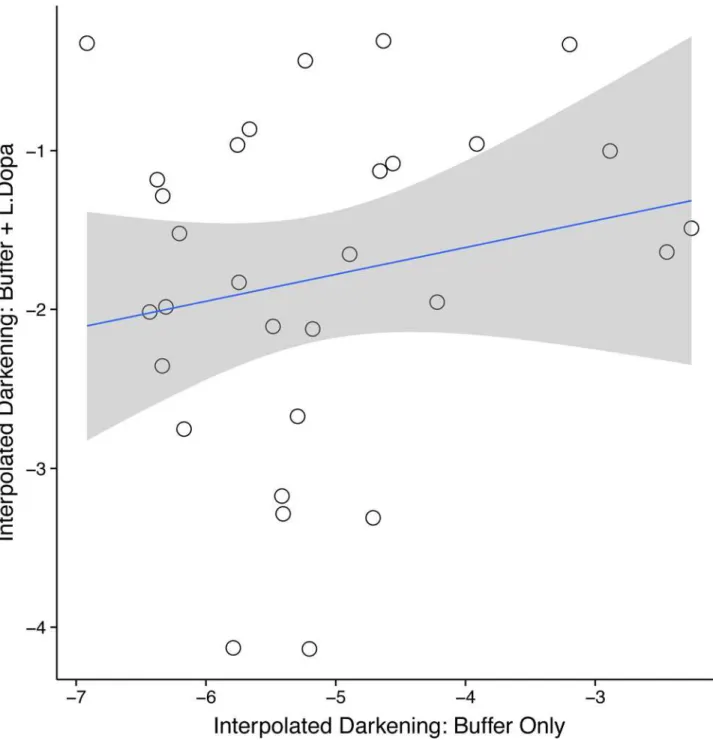
We found no correlation between darkness of hemolymph in buffer and darkness of hemo-lymph in the phenoloxidase immunoassay (F1, 28= 1.08, P = 0.31;Fig 1) suggesting that the
differences in darkness among samples was due to the reaction between PO activity and the L-DOPA and not simply due to darkening quinones in the defensive secretion.
Measurements of PO activity were significantly repeatable for individuals (repeatabil-ity = 0.57; 95% CI = 0.41, 0.70; P<0.001). These results were nearly identical to the more
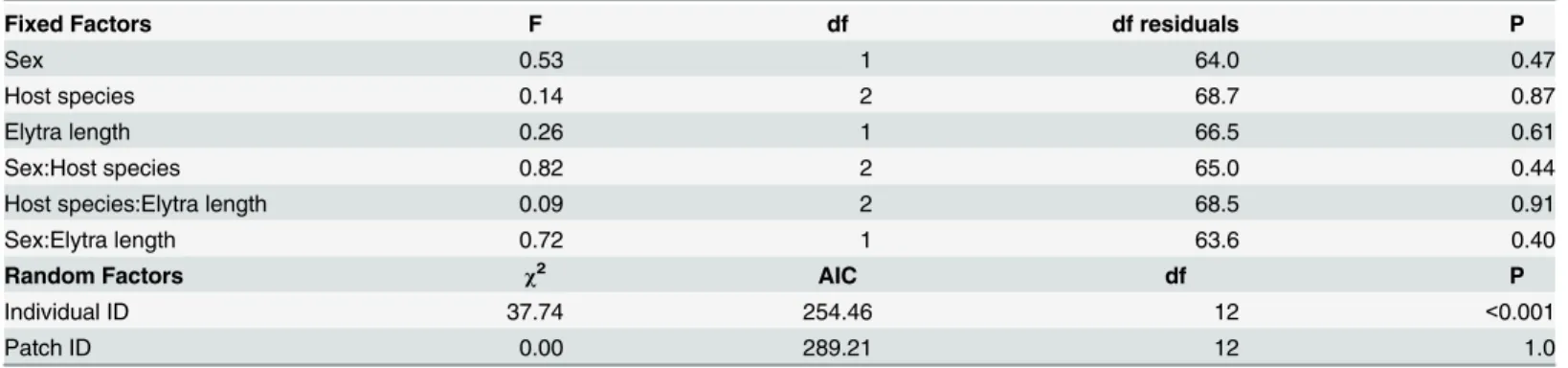
tra-ditional intra-class correlation estimate [39]. Not surprisingly, individual ID also explained a significant proportion of the variance of PO activity in the lmm (Table 1). This suggests there is variance in immune response within our population ofB cornutusthat might be influenced by ecological or intrinsic factors. However, the relatively low level of repeatability (0.57) sug-gests that our filter paper assay may have induced some within-individual variance into the assay. Surprisingly, none of the other variables—patch ID, sex, body size, host fungal species, or any of two-way interactions—significantly predicted PO activity (Table 1;Fig 2) even when the two-way interactions were removed. This result was particularly interesting since sex [40,
41], body size [42], and nutrition [30] have all been shown to cause in differences in PO activity in several insect systems.
An alternative explanation our findings is that the fungal environments do affect adult immune response and our measure (PO activity) does not reflect the differences induced by the host species. While PO activity is a standard method to measure one aspect of immune response in insects [27,46], it is not a measurement of total immune response and can be affected by numerous intrinsic and extrinsic factors. PO activity is part of a complex biochemi-cal pathway and the individual variation we observed could be caused by differences in other components of the pathway and even in concentrations of inhibitors of the pathway (e.g. Fig 1. There is no correlation between the darkness of the hemolymph placed only in buffer and the darkness of hemolymph included in the
immune assay (L-Dopa & Buffer; F1, 28= 1.08, P = 0.31).
Table 1. Statistical details from the general linear mixed model with interpolated melanization index as the dependent variable.
Fixed Factors F df df residuals P
Sex 0.53 1 64.0 0.47
Host species 0.14 2 68.7 0.87
Elytra length 0.26 1 66.5 0.61
Sex:Host species 0.82 2 65.0 0.44
Host species:Elytra length 0.09 2 68.5 0.91
Sex:Elytra length 0.72 1 63.6 0.40
Random Factors χ2 AIC df P
Individual ID 37.74 254.46 12 <0.001
Patch ID 0.00 289.21 12 1.0
Fixed factors were tested for significance using a Wald F test with Kenward-Roger df, while the random factors were tested with a likelihood ratio test. Removing the interactions had no effect on the pattern of significance for the model. Results are qualitatively similar if likelihood ratio tests were used for all significance testing.
doi:10.1371/journal.pone.0141167.t001
Fig 2. Results from the full lmm.The interpolated melanization index for each sex within the three host species (FF =Fomes fomentarius, GA =
Ganoderma applanatum, GT =Ganoderma tsugae), demonstrating no differences among any of the categories.
serpins; [27,28,46]). We examined only one component of the insect immune system, PO activity, and the effects of adult fungal environment on immune response might be expressed in other components of the immune system that we did not examine, such as encapsulation rate. While some studies have demonstrated correlated effects of PO activity with other immune measures, other studies have found experimentally induced changes in different com-ponents of the immune system or infection status while PO activity did not change [11,43,47,
48]. Therefore, we are careful not to draw conclusions about the effects of adult fungal environ-ment on the entire immune response.
Our results do suggest, however, that the differences in PO activity driven by differences in host species found in other systems may not be generalizable across host taxa (e.g., between plants and fungus). The lack of influence of fungal host species on PO activity is somewhat sur-prising as others have detected effects of host species in phytophagous insects [3,6,9,49]. Fungi and plants differ in number ways including physiology, structural composition, life his-tory, and chemistry, all of which could potentially affect the relationship between host species and immune response in insects. Phytophagous insects tend to specialize on a phylogenetically restricted group of hosts while mycophagous insects tend to be broader in their host use and may have evolved differences in physiological responses to changes in host use [20,50]. Some authors also suggest that fungal secondary compounds may not play a large role in insect host selection and so the effects of host species on insect immunity seen in phytophagous insects may not be as drastic in mycophagous insects (e.g. [51]).
It is becoming increasingly evident that host species play a large role in physiological trade-offs that result in differences in immune function. However, these conclusions are largely being drawn from insect herbivores. In adults of the mycophagous beetle,B.cornutus, we saw no such effects. While it is impossible to draw broad comparisons from a single species in a single life stage, we conclude that mycophagous insects offer an interesting and novel system to test current hypotheses concerning host specific effects on immunity.
Supporting Information
S1 Table. Sample sizes for host species, patch, and sex used in analysis. (DOCX)
S2 Table. Raw data (.csv) table used in analysis. (CSV)
Acknowledgments
We thank Corlett Wolfe Wood and Edmund Brodie III for advice throughout this study and comments on the manuscript. We also thank Sonia Altizer for sharing her protocols and encouragement. Hannah Donald-Cannon also assisted with laboratory work and editing of the manuscript. Finally, we thank Harris Hoke, Rudy Perez, Hazel Galloway, and Ian Grant for assistance in the field and laboratory. Both authors contributed to all aspects of this work.
Author Contributions
References
1. Martin LB, Hawley DM, Ardia DR. An introduction to ecological immunology. Funct Ecol. 2011; 25 (1): 1–4.
2. Schulenburg H, Kurtz J, Moret Y, Siva-Jothy MT. Ecological immunology. Philos T R Soc B. 2009; 364 (1513): 3–14.
3. Urbański A, Czarniewska E, Baraniak E, Rosiński G. Developmental changes in cellular and humoral responses of the burying beetleNicrophorus vespilloides(Coleoptera, Silphidae). J Insect Physiol. 2014; 60 (C): 98–103.
4. Bauerfeind SS, Fischer K. Integrating temperature and nutrition—Environmental impacts on an insect immune system. J Insect Physiol. 2014; 64: 14–20. doi:10.1016/j.jinsphys.2014.03.003PMID: 24636910
5. Ruiz-Gonzalez MX, Moret Y, Brown MJF. Rapid induction of immune density-dependent prophylaxis in adult social insects. Biol Letters. 2009; 5 (6): 781–3.
6. Vogelweith F, Thiery D, Moret Y, Moreau J. Immunocompetence increases with larval body size in a phytophagous moth. Physiol Entomol. 2013; 38 (3): 219–25.
7. Wilson K, Thomas MB, Blanford S, Doggett M, Simpson SJ, Moore SL. Coping with crowds: Density-dependent disease resistance in desert locusts. Proc Natl Acad Sci U S A. 2002; 99 (8): 5471–5. PMID:11960003
8. Wilson K, Knell R, Boots M, Koch-Osborne J. Group living and investment in immune defence: an inter-specific analysis. J Anim Ecol. 2003; 72 (1): 133–43.
9. Yang S, Ruuhola T, Haviola S, Rantala MJ. Effects of host-plant shift on immune and other key life-his-tory traits of an eruptive Geometrid,Epirrita autumnata(Borkhausen). Ecol Entomol. 2008; 33 (4): 510– 6.
10. Shikano I, Ericsson JD, Cory JS, Myers JH. Indirect plant-mediated effects on insect immunity and dis-ease resistance in a tritrophic system. Basic Appl Ecol. 2010; 11 (1): 15–22.
11. Klemola N, Klemola T, Rantala MJ, Ruuhola T. Natural host-plant quality affects immune defence of an insect herbivore. Entomol Exp Appl. 2007; 123 (2): 167–76.
12. Yang SY, Ruuhola T, Rantala MJ. Impact of starvation on immune defense and other life-history traits of an outbreaking geometrid,Epirrita autumnata: a possible causal trigger for the crash phase of popu-lation cycle. Ann Zool Fenn. 2007; 44 (2): 89–96.
13. Stoks R, De Block M, Slos S, Van Doorslaer W, Rolff J. Time constraints mediate predator-induced plasticity in immune function, condition, and life history. Ecology. 2006; 87 (4): 809–15. PMID: 16676523
14. Reeson AF, Wilson K, Gunn A, Hails RS, Goulson D. Baculovirus resistance in the noctuidSpodoptera exemptais phenotypically plastic and responds to population density. Proc R Soc Lond B Biol Sci. 1998; 265 (1407): 1787–91.
15. Mucklow PT, Ebert D. Physiology of immunity in the water flea Daphnia magna: Environmental and genetic aspects of phenoloxidase activity. Physiol Biochem Zool. 2003; 76 (6): 836–42. PMID: 14988798
16. Adamo SA. Estimating disease resistance in insects: phenoloxidase and lysozyme-like activity and dis-ease resistance in the cricket Gryllus texensis. J Insect Physiol. 2004; 50 (2–3): 209–16. PMID: 15019523
17. Epps MJ, Arnold AE. Diversity, abundance and community network structure in sporocarp-associated beetle communities of the central Appalachian Mountains. Mycologia. 2010; 102 (4): 785–802. PMID: 20648747
18. Jonsell M, Nordlander G, Jonsson M. Colonization patterns of insects breeding in wood-decaying fungi. J Insect Conserv. 1999; 3 (2): 145–61.
19. Wertheim B, Sevenster JG, Eijs IEM, Van Alphen JJM. Species diversity in a mycophagous insect com-munity: the case of spatial aggregation vs. resource partitioning. The Journal of Animal Ecology. 2000; 69 (2): 335–51.
20. Jonsell M, Nordlander G. Host selection patterns in insects breeding in bracket fungi. Ecol Entomol. 2004; 29 (6): 697–705.
21. Pace AE. Life history and behavior of a fungus beetle,Bolitotherus cornutus(Tenebrionidae). Occas Pap Mus Zool Univ Mich. 1967; 653: 1114–28.
23. Wood CW, Donald HM, Formica VA, Brodie ED. Surprisingly little population genetic structure in a fun-gus-associated beetle despite its exploitation of multiple hosts. Ecol Evol. 2013; 3 (6): 1484–94. doi: 10.1002/ece3.560PMID:23789061
24. Conner JK. Field measurements of natural and sexual selection in the fungus beetle,Bolitotherus cor-nutus. Evolution. 1988; 42 (4): 736–49.
25. Wood CW, Marti HE, Brodie ED. The effect of ecological context and relatedness on larval cannibalism in a fungus-associated beetle. Behav Ecol. 2014; 25 (4): 951–9.
26. Holliday AE, Walker FM, Brodie ED III, Formica VA. Differences in defensive volatiles of the forked fun-gus beetle,Bolitotherus cornutus, living on two species of fungus. J Chem Ecol. 2009; 35 (11): 1302– 8. doi:10.1007/s10886-009-9712-7PMID:19936835
27. Soderhall K, Cerenius L. Role of the prophenoloxidase-activating system in invertebrate immunity. Curr Opin Immunol. 1998; 10 (1): 23–8. PMID:9523106
28. Moreno-García M, Córdoba-Aguilar A, Condé R, Lanz-Mendoza H. Current immunity markers in insect ecological immunology: assumed trade-offs and methodological issues. Bull Entomol Res. 2013; 103 (02): 127–39.
29. Siva-Jothy MT, Thompson JJW. Short-term nutrient deprivation affects immune function. Physiol Ento-mol. 2002; 27 (3): 206–12.
30. Rantala MJ, Kortet R, Kotiaho JS, Vainikka A, Suhonen J. Condition dependence of pheromones and immune function in the grain beetle Tenebrio molitor. Funct Ecol. 2003; 17 (4): 534–40.
31. Gonzalez-Tokman DM, Munguia-Steyer R, Gonzalez-Santoyo I, Baena-Diaz FS, Cordoba-Aguilar A. Support for the Immunocompetence Handicap Hypothesis in the Wild: Hormonal Manipulation Decreases Survival in Sick Damselflies. Evolution. 2012; 66 (10): 3294–301. doi: 10.1111/j.1558-5646.2012.01678.xPMID:23025617
32. Donald HM, Wood CW, Benowitz KM, Johnson RM, Brodie ED, III, Formica VA. Nondestructive sam-pling of insect DNA from defensive secretion. Molecular Ecology Resources. 2012; 12 (5): 856–60. doi:10.1111/j.1755-0998.2012.03154.xPMID:22591239
33. Tschinkel WR. A comparative study of the chemical defensive system of tenebrionid beetles III. Mor-phology of the glands. J Morphol. 1975; 145 (3): 355–70.
34. Sorrentino RP, Small CN, Govind S. Quantitative analysis of phenoloxidase activity in insect hemo-lymph. BioTechniques. 2002; 32 (4): 815–23. PMID:11962604
35. Schneider CA, Rasband WS, Eliceiri KW. NIH Image to ImageJ: 25 years of image analysis. Nat Meth. 2012; 9 (7): 671–5.
36. Nakagawa S, Schielzeth H. Repeatability for Gaussian and non-Gaussian data: a practical guide for biologists. Biol Rev. 2010; 85 (4): 935–56. doi:10.1111/j.1469-185X.2010.00141.xPMID:20569253 37. Bates D, Maechler M, Bolker B, Walker Sl. lme4: Linear mixed-effects models using Eigen and S4.
1–1.7 ed2014.
38. Bolker BM, Brooks ME, Clark CJ, Geange SW, Poulsen JR, Stevens MHH, et al. Generalized linear mixed models: a practical guide for ecology and evolution. Trends Ecol Evol. 2009; 24 (3): 127–35. doi: 10.1016/j.tree.2008.10.008PMID:19185386
39. Wolak ME, Fairbairn DJ, Paulsen YR. Guidelines for estimating repeatability. Methods Ecol Evol. 2012; 3 (1): 129–37.
40. Kurtz J, Sauer KP. Gender differences in phenoloxidase activity of Panorpa vulgaris hemocytes. J Invertebr Pathol. 2001; 78 (1): 53–5. PMID:11500094
41. Rolff J. Effects of age and gender on immune function of dragonflies (Odonata, Lestidae) from a wild population. Canadian Journal Of Zoology-Revue Canadienne De Zoologie. 2001; 79 (12): 2176–80. 42. Vainio L, Hakkarainen H, Rantala MJ, Sorvari J. Individual variation in immune function in the ant
For-mica exsecta; effects of the nest, body size and sex. Evolutionary Ecology. 2004; 18 (1): 75–84. 43. Jacot A, Scheuber H, Kurtz J, Brinkhof MWG. Juvenile immune system activation induces a costly
upregulation of adult immunity in field cricketsGryllus campestris. Proc R Soc Lond B Biol Sci. 2005; 272 (1558): 63–9.
44. Cotter SC, Simpson SJ, Raubenheimer D, Wilson K. Macronutrient balance mediates trade-offs between immune function and life history traits. Funct Ecol. 2011; 25 (1): 186–98.
45. Emlen DJ. Artificial selection on horn length body size allometry in the horned beetleOnthophagus acu-minatus(Coleoptera: Scarabaeidae). Evolution. 1996; 50 (3): 1219–30.
46. Gonzalez-Santoyo I, Cordoba-Aguilar A. Phenoloxidase: a key component of the insect immune sys-tem. Entomol Exp Appl. 2012; 142 (1): 1–16.
48. Azambuja P, Garcia ES, Mello CB, Feder D. Immune responses in Rhodnius prolixus: influence of nutri-tion and ecdysone. J Insect Physiol. 1997; 43 (6): 513–9. PMID:12770413
49. Karimzadeh J, Wright DJ. Bottom-up cascading effects in a tritrophic system: interactions between plant quality and host-parasitoid immune responses. Ecol Entomol. 2008; 33 (1): 45–52.
50. Janz N, Nyblom K, Nylin S. Evolutionary dynamics of host-plant specialization: A case study of the tribe Nymphalini. Evolution. 2001; 55 (4): 783–96. PMID:11392396