Policy Forum
HIV Testing for Children in Resource-Limited Settings:
What Are We Waiting For?
Scott Kellerman1*, Shaffiq Essajee2
1Center for Health Services, Management Sciences for Health, Arlington, Virginia, United States of America,2Clinton Health Access Initiative, Clinton Foundation, New York, New York, United States of America
Introduction
In many African countries, HIV has reversed previously recorded declines in child mortality. Worldwide, children ac-count for 18% of HIV-related deaths and 15% of HIV infections each year [1–3], an estimated 2.3 million children are infected, and 730,000 urgently need antiretroviral therapy (ART), which only about 275,000 currently receive. The mortality of un-treated pediatric patients is very high in the first 2 years of life, and reaches 80% by age 5 [4]. While the number of children under age 15 in low- and middle-income countries receiving ART rose dramatically between 2005 and 2007 (Figure 1), it is nonetheless evident that those children currently on treatment still represent only a small proportion of those who need it. Coverage will need to be greatly expanded if the global community’s goal of providing ART to 80% of children in need by 2010 is to be met [1].
As more low-cost fixed-dose combina-tion antiretrovirals (ARVs) for children become available, the issue of access to medication is less of an impediment to treatment (Table 1). Why then are so few children in developing countries on ART? We propose that the primary reason is insufficient identification of infected chil-dren. There are many causes for this— including poor coverage of services for prevention of mother-to-child transmission (PMTCT), poor linkages to infant testing programs, provider uncertainty on how best to diagnose and treat infants, and insufficient numbers of pediatric HIV treatment sites—but the end result is that many infected children are either never identified or lost from the system before they can be enrolled into care. We believe it is essential for national HIV programs to recognize that HIV testing and counseling
systems designed for adults do not meet the needs of children. The time has come to develop and implement specific strate-gies to increase opportunities for children to access HIV testing, especially in sub-Saharan Africa.
As criteria for treatment initiation evolve and ART programs are scaled up in resource-limited settings, the need to expand HIV testing will become more urgent. Surveys in sub-Saharan Africa document 39% of adult men and women as having at some time been tested and received their results, up from 15% just 2 years before [3]. However, even when strong adult testing programs exist, access to pediatric testing remains low. The 2004 World Health Organization (WHO) HIV testing guidelines did not identify children as a specific target group for testing [5]. More recent WHO guidance on provider-initiated HIV testing provides direction on how to overcome barriers to testing children but offers little on how to operationalize pediatric testing [6].
Data from the South African CHER study highlight the survival benefit of early treatment for infants, showing an overall 75% decline in mortality in those infants who were started on ART immediately after diagnosis [7]. In response, the WHO has changed its treatment recommenda-tions, calling for treatment of all infected infants under 12 months of age, irrespec-tive of clinical stage [8]. This is a critical advance in treatment policy, which na-tional AIDS control programs should
adopt as soon as possible. But without better ways to identify infected infants, the policy alone will not change the treatment landscape in the short term. Although infant diagnosis is now available in many PMTCT programs, at current rates of PMTCT coverage, the majority of HIV-infected infants are born to mothers who were never tested and never received PMTCT prophylaxis. These infants are very unlikely to be identified and get on to treatment without targeted testing strate-gies. Scale up of testing programs for children will no doubt require investment in key areas such as training and support for providers, improvement of laboratory facilities and referral networks, and com-munity mobilization, but such investments are necessary to reduce the substantial mortality of HIV in children.
Because of the marked survival advan-tage among those identified and treated in a timely manner, the US Centers for Disease Control and Prevention has rec-ommended routine HIV testing for US adults during contact with medical facili-ties [9]. This represents a clear shift away from voluntary testing (which emphasizes personal choice) toward an emphasis on the public and individual health benefits of improved identification and control of HIV disease and prevention of HIV transmission. Of course, success in oper-ationalizing these recommendations de-pends on a well-functioning health care system—which does not exist in many of the countries most affected by the AIDS
The Policy Forum allows health policy makers around the world to discuss challenges and opportunities for improving health care in their societies.
Citation:Kellerman S, Essajee S (2010) HIV Testing for Children in Resource-Limited Settings: What Are We Waiting For? PLoS Med 7(7): e1000285. doi:10.1371/journal.pmed.1000285
PublishedJuly 20, 2010
Copyright: ß2010 Kellerman, Essajee. This is an open-access article distributed under the terms of the Creative Commons Attribution License, which permits unrestricted use, distribution, and reproduction in any medium, provided the original author and source are credited.
Funding:No specific funding was received for this piece.
Competing Interests:The authors have declared that no competing interests exist.
Abbreviations: ART, antiretroviral therapy; ARV, antiretroviral; PMTCT, prevention of mother-to-child transmission; WHO, World Health Organization
* E-mail: [email protected]
epidemic. As such, these recommenda-tions have not been widely implemented in the most affected parts of the world, where making a diagnosis is most critical, partic-ularly in children.
Building an Approach to Pediatric Testing
Current approaches to testing infants and children center on PMTCT pro-grams. New approaches should build on the considerable success realized by PMTCT while its shortcomings are
rec-ognized. Routine testing of newborns may be an appropriate approach to identify infants missed by PMTCT programs, particularly in countries with high preva-lence, while more targeted testing of infants and children at greater risk may be more cost effective for lower-prevalence countries. Regardless of the approach, there are significant challenges to testing children for HIV. In infants younger than 18 months, the persistence of maternal antibodies, the lack of appropriate labora-tory facilities for PCR testing, the cost of assays, and the need to repeat PCRs in
infants who are exposed to infected breast milk [10], make it difficult to implement infant diagnosis programs. WHO esti-mates that, in 2007, only 8% of infants known to be HIV-exposed were tested for HIV within the first 2 months of life [11]. Waiting for infants to develop symptoms or become old enough to test using standard rapid tests is not ideal but has become the norm in many places, result-ing in children tested late in the course of their infection, when ART may be less effective.
Parental attitudes towards testing are important to ensure success, but anecdotal reports suggest that many parents are apprehensive about subjecting their chil-dren to HIV tests, especially when they are unsure of their own HIV status [12]. Equally important is the issue of what informed consent means for pediatric patients and their caregivers; the complex-ities of designing testing programs for children who neither seek out nor neces-sarily understand the consequences of a test; and the ethics of testing children who, if HIV positive, would indicate the moth-er’s status as well. As pediatric testing Summary Points
N
Expansion of prevention of mother-to-child transmission in resource-limitedsettings remains a challenge.N
In many countries, most HIV-exposed infants do not benefit from PMTCTprograms, which results in a 30% or more transmission rate.N
Vertically infected infants not diagnosed in the context of PMTCT are rarelydiagnosed until symptomatic with HIV, resulting in increased morbidity andmortality.
N
Infant and pediatric testing programs are needed until PMTCT challenges areovercome or universal treatment of HIV-infected pregnant women becomes thenorm.
Figure 1. Number of children under 15 receiving antiretroviral therapy in low- and middle-income countries, 2005–2007.Source: UNICEF calculations based on data collected through the PMTCT and Paediatric HIV Care and Treatment Report Card process and reported in UNICEF Children and AIDS. 3rdstocktaking report 2008, pp. 34–42 (http://data.unaids.org/pub/Report/2008/20081201_3rd_stocktaking_summary_en.pdf)
programs are scaled up, it will be espe-cially important to consider WHO guide-lines which recommend that children be involved in the decision to be tested as much as possible, stressing that parental consent is always required and that the decision to test should be voluntary. Furthermore, in circumstances of extreme disadvantage, such as with orphans and vulnerable children, care must be taken to ensure that HIV testing does not cause harm because of the greater risk of discrimination and exploitation that these children face. This would require training and support for providers unfamiliar or uncomfortable with these situations.
Despite the inherent complexities, we believe that a focus on child testing apart from PMTCT is long overdue, beginning with national policies offering a multi-tiered approach to make pediatric HIV testing a routine element of care, and implementation support to make this a reality. We are not advocating universal screening of all newborns and infants, particularly in countries with lower prev-alence, rather preferring more cost-effec-tive, targeted approaches that consider higher diagnostic probabilities in different circumstances.
The following strategies, while not an exhaustive list, might result in improved access to testing. Given the very high mortality associated with HIV in children, even minimal attention to the develop-ment of a pediatric testing strategy might result in substantial decreases in morbidity and mortality.
Entry Points for Testing
Two groups of strategies that may be useful for case finding of children missed by PMTCT are presented here. First-tier
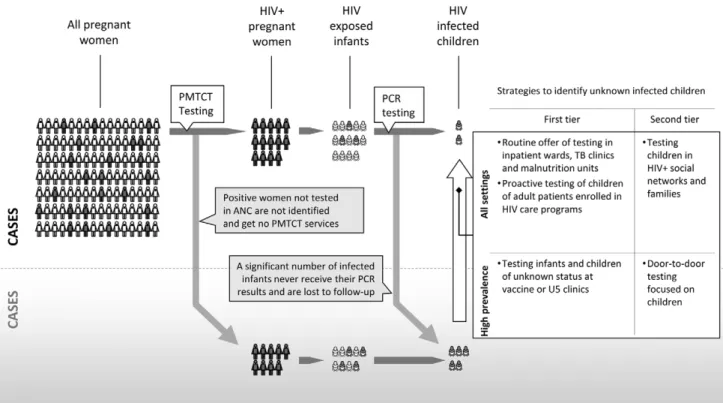
strategies use existing systems to incorpo-rate pediatric HIV testing into established entry points to care, whereas second-tier strategies require the development of new programs or systems to actively seek out and diagnose infected children and link them to care (Figure 2). First-tier ap-proaches include variations of provider or program-initiated testing such as testing newborns when they present for immuni-zations—which may prove cost-effective in countries with high HIV prevalence. In such hyperendemic settings, an initial rapid test could be used as a screen to test mothers or their newborns, with a subsequent PCR for infants who test positive or whose mothers are positive. While such screening is potentially expen-sive, higher prevalence rates, and thus higher rates of diagnosis, may justify the increased costs. One study of routine testing in immunization clinics found that testing was well accepted and identified a large number of exposed children with an overall seropositivity rate of 10% [13]. In lower-prevalence settings, connecting the offer of testing to points of care where the concentration of infected children is likely to be higher such as pediatric inpatient wards, nutrition rehabilitation units, and tuberculosis clinics may be effective. In one recent report, 80% of parents accept-ed testing in paccept-ediatric inpatient wards, yielding a seroprevalence rate of 29% [14]. In Zambia, children admitted to the malnutrition ward were found to have high HIV prevalence rates (Marc Bulterys, personal communication). Medical set-tings, while an obvious point of contact, are not the only venues through which to reach affected children. Community orga-nizations, especially those serving orphans or adults living with HIV, can also be
important partners in expanding access to pediatric testing.
Second-tier approaches might include door-to-door or in-home testing, which may be especially useful for populations that are infrequent clinic attendees or simply lack access to care. Variations of social network testing, in which friends and acquaintances of HIV-infected per-sons or those at higher risk are targeted for testing, are promising strategies in US adults [15]. Such strategies could be adapted so that families affected by HIV are counseled to refer people within their families or networks, including children, for testing. Similarly, community-level interventions, such as contact tracing in which the entire family is offered testing if one family member tests positive, may prove valuable in developing countries. Data from Uganda found household-member and door-to-door testing strate-gies relatively effective and inexpensive as compared to stand-alone and hospital-based strategies [16]. To that end, a South African program, in which HIV-positive adults accessing ART clinics view a video in their local language encouraging them to have their children tested, resulted in increased uptake of pediatric testing in the region. Another approach, in which care-givers (e.g., grandmothers) collecting gov-ernment checks are targeted with similar messages, has also shown promise [17,18].
Moving Forward
Many of the strategies proposed here have been tried and evaluated; however, implementing them in a coordinated fashion in resource-limited settings re-quires new investments. Provider-initiated testing in pediatric wards, routine testing of newborns and infants in immunization
Table 1.Costs of Pediatric ARV for Resource-Limited Settings, 2009.
Pediatric Fixed Dose
Combination FDA Approved Date WHO PQ Date
Cost per Year for a 10kg Childa
Per Pack Pricea
(Pack Size)
D4T/3TC/NVP
6/30/50 Aug 13 2007 Apr 23 2008 $60 $2.49 (60s)
12/60/100 $54 $4.54 (60s)
D4T/3TC
6/30 Jun 19 2008 – $48 $2.00 (60s)
12/60 $41 $3.42 (60s)
AZT/3TC/NVP – Oct 26 2009 $108 $4.50 (60s)
AZT/3TC July 23 2009 May 25 2009 $80 $3.33 (60s)
ABC/3TC Dec 19 2008 Oct 26 2009 $180 $7.50 (60s)
Based on ref. [21].
aCosts based on Clinton Foundation HIV/AIDS Initiative 2009 ceiling prices http://www.clintonfoundation.org/files/chaiarvpricelistaugust2009english.pdf.
clinics, and door-to-door and family test-ing have all been attempted in sub-Saharan Africa. What is needed now is a more coordinated effort at the national level to ensure that infected children known to be exposed to HIV and those missed by PMTCT are identified and linked to care. Although challenging, especially when one weighs the parents’ right to confidentiality against the child’s right to care, a standardized approach to childhood testing is feasible. Indeed, in the US many states perform mandatory test-ing of newborns, allowtest-ing the clinician to offer postnatal ARV prophylaxis to the index case, comprehensive HIV care to the mother, and early treatment to the infected child, with resultant
near-elimi-nation of pediatric HIV mortality and mother-to-child transmission [19]. Finally, while the costs of establishing routine pediatric testing are not insignificant, they pale in comparison to the societal costs of delayed diagnosis and increased child mortality. Given the challenges of scaling up ART treatment services in resource-limited settings, we believe the targeted approaches described above may be a cost-effective, first strategy to decreasing the pediatric treatment gap in many countries and as with other prevention efforts, should be based on the local epidemiology of the epidemic. It is clear that new approaches and a coordinated response to testing children are necessary to close this gap. The global public health
community should make this an urgent priority. Anything less is unacceptable.
Acknowledgments
We wish to thank Elizabeth Leonard, Manage-ment Sciences for Health for her expert assistance in readying this article for publica-tion. We also thank Neeraj Mohan from the Clinton Health Access Initiative for help with graphics.
Author Contributions
ICMJE criteria for authorship read and met: SK SE. Wrote the first draft of the paper: SK SE. Contributed to the writing of the paper: SK.
References
1. UNICEF (2009) Children and AIDS. 4th Stock-taking Report 2009. New York: UNICEF. 2. UNAIDS (2009) Report on the global HIV/
AIDS epidemic 2009. New York: UNAIDS. 3. WHO, UNAIDS, UNICEF (2009) Towards
universal access: Scaling up priority HIV/AIDS interventions in the health sector: Progress report 2009. Geneva: WHO, UNAIDS, UNICEF, Available: http://www.who.int/hiv/pub/towards_ universal_access_report_2008.pdf. Accessed 7 Oc-tober 2009.
4. Newell ML, Brahmbhatt H, Ghys PD (2004) Child mortality and HIV infection in Africa: a review. AIDS 18 Suppl 2: S27–34.
5. UNAIDS, WHO (2004) UNAIDS/WHO policy statement on HIV testing. Geneva: UNAIDS. 6. WHO, UNAIDS (2007) WHO/UNAIDS
guid-ance on provider-initiated HIV testing and counselling in health facilities. Available: http://whqlibdoc.who.int/publications/2007/ 9789241595568_eng.pdf. Accessed 10 September 2009.
7. Violari A, Cotton MF, Gibb DM, Babiker AG, et al. (2008) Early antiretroviral therapy and mor-tality among HIV-infected infants. N Engl J Med 359: 2233–44.
8. World Health Organization (2008) WHO anti-retroviral therapy for infants and children 2008.
Report of the WHO Technical Reference Group, Paediatric HIV/ART Care Guideline Group Meeting. Geneva. Available: http://www.who. int/hiv/pub/paediatric/WHO_Paediatric_ART_ guideline_rev_mreport_2008.pdf. Accessed 10 September 2009.
9. Branson BM, Handsfield HH, Lampe MA, Janssen RS, Taylor AW, et al. (2006) Revised recommendations for HIV testing of adults, adolescents, and pregnant women in health-care settings. MMWR Recomm Rep 55: 1–17. 10. DeCock KM, Bunnell R, Mermin J (2006)
Unfinished business: expanding HIV testing in developing countries. N Engl J Med 354: 440–42.
Figure 2. Despite improvements in PMTCT and infant testing coverage, many women and infants are not tested and are lost to follow up resulting in high infant and child mortality.Strategies to help increase the identification of infected children depend on the underlying seroprevalence and epidemiology.
11. WHO, UNAIDS, UNICEF (2008) Towards Universal Access: Scaling up priority HIV/AIDS interventions in the health sector: Progress report 2008. Geneva: WHO, UNAIDS, UNICEF, Available: http://www.who.int/hiv/pub/towards_ universal_access_report_2008.pdf.
12. Kenya wakes up to the reality of paediatric HIV (2007) The East African Standard (Nairobi), 5 January 2007.
13. Rollins N, Mzolo S, Moodley T, Esterhuizen T, van Rooyen H (2009) Universal HIV testing of infants at immunization clinics: an acceptable and feasible approach for early infant diagnosis in high HIV prevalence settings. AIDS 23: 1851–57. 14. Kankasa C, Carter RJ, Briggs N, Bulterys M, Chama E, et al. (2009) Routine offering of HIV testing to hospitalized pediatric patients at university teaching hospital, Lusaka, Zambia:
acceptability and feasibility. J Acquir Immune Defic Syndr 51(2): 202–8.
15. Kimbrough LW, Fisher HE, Jones KT, Johnson W, Thadiparthi S, et al. (2009) Access-ing social networks with high rates of undiag-nosed HIV infection: the social networks dem-onstration project. Am J Public Health 99: 1093–09.
16. Menzies N, Abang B, Wnayenze R, Nuwaha F, Mugisha B, Coutinho A, Bunnell R, Mermin J, Blanford J (2009) The costs and effectiveness of four HIV counseling and testing strategies in Uganda. AIDS 23: 395–401.
17. Mini NP, Scorgie F, Sheehy M, Kellerman SE (2009) Identifying and testing children at in-creased risk for HIV through caregivers: the caregiver project. Presented at 5th
International AIDS Society Conference on HIV Pathogenesis,
Treatment and Prevention. 19–22 July 2009. Cape Town, Republic of South Africa. 18. Sheehy M, Scorgie F, Mini NP, Waimar T,
Kellerman SE (2009) A family-centered approach increases HIV testing among family members of persons in care for HIV. Presented at 5th
International AIDS Society Conference on HIV Pathogenesis, Treatment and Prevention. 19–22 July 2009. Cape Town, Republic of South Africa. 19. The Centers for Disease Control and Prevention (2002) HIV testing among pregnant women— United States and Canada 1998–2001. MMWR 51: 1013–16.
20. UNICEF (2008) Children and AIDS. 3rd Stock-taking Report 2008. New York: UNICEF. 21. The Clinton Foundation (2009) Antiretroviral