aeruginosa mexAB-oprM
Efflux Operon: Involvement of
Repressors NalC and MexR and the Antirepressor ArmR
Lisa M. Starr., Michael Fruci., Keith Poole*
Department of Biomedical and Molecular Sciences, Queen’s University, Kingston, Ontario, Canada
Abstract
Pentachlorophenol (PCP) induced expression of the NalC repressor-regulated PA3720-armRoperon and the MexR repressor-controlledmexAB-oprMmultidrug efflux operon ofPseudomonas aeruginosa. PCP’s induction of PA3720-armRresulted from its direct modulation of NalC, the repressor’s binding to PA3720-armRpromoter-containing DNA as seen in electromobility shift assays (EMSAs) being obviated in the presence of this agent. The NalC binding site was localized to an inverted repeat (IR) sequence upstream of PA3720-armRand overlapping a promoter region whose transcription start site was mapped.
While modulation of MexR by the ArmR anti-repressor explains the upregulation of mexAB-oprM in nalC mutants
hyperexpressing PA3720-armR, the induction ofmexAB-oprMexpression by PCP is not wholly explainable by PCP induction of PA3720-armRand subsequent ArmR modulation of MexR, inasmuch asarmRdeletion mutants still showed PCP-inducible mexAB-oprMexpression. PCP failed, however, to inducemexAB-oprMin amexRdeletion strain, indicating that MexR was required for this, although PCP did not modulate MexR binding tomexAB-oprMpromoter-containing DNAin vitro. One possibility is that MexR responds to PCP-generated in vivoeffector molecules in controlling mexAB-oprMexpression in response to PCP. PCP is an unlikely effector and substrate for NalC and MexAB-OprM - its impact on NalC binding to the PA3720-armRpromoter DNA occurred only at highmM levels - suggesting that it mimics an intended phenolic effector/
substrate(s). In this regard, plants are an abundant source of phenolic antimicrobial compounds and, so, MexAB-OprM may function to protectP. aeruginosafrom plant antimicrobials that it encounters in nature.
Citation:Starr LM, Fruci M, Poole K (2012) Pentachlorophenol Induction of thePseudomonas aeruginosa mexAB-oprMEfflux Operon: Involvement of Repressors NalC and MexR and the Antirepressor ArmR. PLoS ONE 7(2): e32684. doi:10.1371/journal.pone.0032684
Editor:Hendrik W. van Veen, University of Cambridge, United Kingdom
ReceivedDecember 7, 2011;AcceptedJanuary 29, 2012;PublishedFebruary 29, 2012
Copyright:ß2012 Starr et al. This is an open-access article distributed under the terms of the Creative Commons Attribution License, which permits unrestricted use, distribution, and reproduction in any medium, provided the original author and source are credited.
Funding:This work was supported by Canadian Institutes of Health Research, Grant number 10274 (http://www.cihr-irsc.gc.ca) and Cystic Fibrosis Canada (http://www.cysticfibrosis.ca). The funders had no role in study design, data collection and analysis, decision to publish, or preparation of the manuscript.
Competing Interests:The authors have declared that no competing interests exist.
* E-mail: [email protected]
.These authors contributed equally to this work.
Introduction
Pseudomonas aeruginosa is an opportunistic pathogen associated with debilitating infections of immunocompromised individuals and individuals with cystic fibrosis [1] and is characterized by an innate resistance to many antimicrobials and the ability to develop/acquire resistance [2]. Significant contributors to this intrinsic and/or acquired multidrug resistance are several members of the RND family of multidrug efflux systems [2–4], particularly that encoded by the mexAB-oprM efflux operon. MexAB-OprM exhibits one of the broadest substrate profiles of the RND pumps inP. aeruginosa, accommodating a wide range of clinically-relevant antimicrobials [5] and biocides [6] as well as a variety of non-clinical agents (e.g., organic solvents [7,8], dyes [9– 11], detergents [10], metabolic inhibitors [12], acylhomoserine lactones (AHLs) associated with quorum-sensing (QS) [13,14]). An important determinant of intrinsic multidrug resistance [9] this efflux system contributes to acquired fluoroquinolone [15–17] and
b-lactam [18–23] resistance in clinical isolates ofP. aeruginosa. Expression of the mexAB-oprM operon is regulated by the product of a local repressor gene,mexR[24], occurring upstream of the efflux genes and the target of mutation in
MexAB-OprM-overexpressing multidrug-resistant nalB lab [24,25] and clinical [26–28] isolates. MexR acts to control mexAB-oprM expression from one of two promoters (PI; most distal from the efflux genes) for this efflux operon [29,30], binding as a dimer [31] to a site that also overlaps themexR promoter [29,32] and, so, effects negative autoregulation. Recent studies show that its ability to bind and so repressmexAB-oprMis governed by the redox status of the protein, MexR serving to regulatemexAB-oprMexpression in responsive to oxidative stress [33,34]. MexR repressor activity is also modulated by the product of thearmRanti-MexR repressor gene, which binds to MexR and negatively impacts its ability to bind to the mexAB-oprMPI promoter region [35,36].armRoccurs as part of the 2-gene operon PA3720-armR that is regulated by the product of the divergently-transcribed nalC repressor gene [37], with nalC
mutants showing elevated PA3720-armR expression and, so, elevatedmexAB-oprMexpression and multidrug resistance [37] as a result of ArmR modulation of MexR’s repressor activity [35].
operon-proximal promoter (PII) [30]. Mutations innalDhave been described in lab and clinical multidrug-resistant mutants [39].
Despite their contribution to antimicrobial resistance, RND family multidrug efflux systems inP. aeruginosaare increasingly appreciated as having other than drug efflux as an intended function, most of these systems being regulated independently of antimicrobials and instead induced in response to environmental stress (e.g, MexCD-OprJ, envelope stress [40]; MexEF-OprN, nitrosative stress [41]; MexXY-OprM, oxidative [42] and ribosome [43,44] stress). Recently, the mexAB-oprM efflux system and its regulatory locus
nalC/PA3720-armR have been shown to be inducible by the uncoupler of oxidative phosphorylation and environmental contam-inant, pentachlorophenol (PCP) [45], the implication being that this compound is being ‘sensed’ by NalC andmexAB-oprMrecruited as a result of ArmR-mediated MexR modulation. While MexAB-OprM appears able to accommodate this toxin (mutants lacking the pump are more sensitive to PCP) [45], it is unclear whether PCP is the actual signal/substrate or whether downstream effects of the uncoupling of oxidative phosphorylation are responsible for nalC/ PA3720-armR and mexR/mexAB-oprM upregulation. The current study was undertaken to address this and to ascertain the mechanism by which PCP ultimately inducesmexAB-oprM. We report here that NalC is a PCP-responsive repressor that mediates PCP induction of PA3720-armRand, possibly,mexAB-oprMbut that PCP is also able to induce mexAB-oprM expression independently of PA3720-armR, possibly as a result of PCP-generated oxidative stress and, so, redox regulation of MexR. During the course of this work another study demonstrating PCP control of NalC repressor activity was published [46] although the mechanism(s) by which this toxin induced mexAB-oprMwere not assessed, and the assumption that it was via ArmR are not supported by our study.
Materials and Methods
Bacterial strains and plasmids
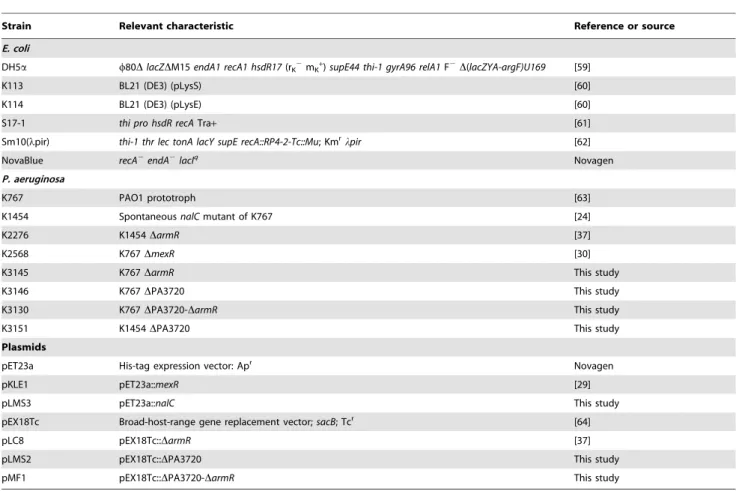
The bacterial strains and plasmids used in this study are listed in Table 1. Bacterial cells were cultured in Luria broth (L broth) and on Luria agar with antibiotics, as necessary, at 37uC. Plasmid pET23a and its derivatives were maintained in E. coli with ampicillin (100mg/ml). Plasmid pEX18Tc and its derivatives were
maintained inE. coliwith tetracycline (10mg/ml). Plasmid pLysS was maintained in E. coli with chloramphenicol (30mg/ml).
DPA3720 derivatives of P. aeruginosa strains K767 and K3145 (DarmR) were generated by constructing a PA3720 deletion in plasmid pEX18Tc and mobilizing it into these strains as before [47]. Briefly, 1 kb fragments corresponding to sequences 59and 39 to the PA3720 sequences being deleted were amplified using the polymerase chain reaction (PCR) and primers 3720 UF (59 -GCTAGAATTCGTAGGTGGTGAAGCCGAGC-39;EcoRIsite underlined) and 3720 UR (59 -GCTAGGTACCTGACGCCGC-CATGTCCCT-39; KpnI site underlined), and 3720 DF (59 -GCTAGGTACCCATGGGGGGACTCCTGCG-39; KpnI site underlined) and 3720 DR (59 -GCTAAAGCTTCCTG-GTCCTGGCGACACG-39;HindIIIsite underlined), respectively. The 50ml PCR reaction mixture contained 1mg of chromosomal
P. aeruginosa K767 DNA as template, 1mM of each primer,
0.3 mM each deoxynucleoside triphosphate (dNTP), 16Exact buffer, 16 5P buffer and 2.5 U Exact DNA polymerase (5 PRIME, Inter Medico, Markham, Ontario). Following an initial denaturation step at 95uC for 5 min, the mixture was subjected to 30 cycles of heating at 94uC for 45 sec, 63uC (annealing temperature) for 30 sec, and 72uC for 1 min, before finishing with a10-min incubation at 72uC. PCR products were gel purified, digested appropriately and cloned sequentially into pEX18Tc, to
yield theDPA3720 vector, pLMS2. Plasmid pLMS2 was mobilized into P. aeruginosaK767 from into E. coli S17-1 and P. aeruginosa
transconjugants harbouring chromosomal inserts of the deletion vector were selected on L-agar plates containing tetracycline (50mg/ml) and chloramphenicol (5mg/ml; to counterselectE. coli
S17-1). These were subsequently streaked onto L agar containing sucrose (10% [wt/vol]) as before [48], with sucrose-resistant colonies screened for the appropriate deletion using colony PCR [49] with primers 3720 UF and 3720 DR and parameters detailed above (except for an annealing temperature of 55uC). A DarmR
derivative ofP. aeruginosaK767 was constructed using pEX18Tc::
DarmR plasmid pLC8 as described previously [37] except that transconjugants carrying chromosomal inserts of the deletion vector were selected on L-agar plates containing tetracycline and chloramphenicol as above.DarmRmutants were verified by colony PCR [49] using primers 3719UF (59 -CGGTGAGCGTGG-CGCCG-39) and 3720DR (59 -TGGGCTCTTTACCTCAAGT-39). Reaction mixtures were heated to 95uC for 5 min followed by 30 cycles of 30 sec at 94uC, 30 sec at 60uC, 1 min at 72uC and a final 5-min elongation at 72uC.
DNA methods
Standard protocols were used for restriction endonuclease digestion, ligation, transformation, plasmid isolation, agarose gel electrophoresis, and preparation of chemically competent (CaCl2)E.
colicells as described by Sambrook and Russell [50]. Electrocompetent
P. aeruginosacells were prepared as described by Choi and Shwiezer [51]. Chromosomal DNA was extracted fromP. aeruginosausing the DNeasy Tissue Kit (Qiagen, Inc., Mississauga, Ontario). Plasmid DNAs were also prepared fromE. coliorP. aeruginosausing a GeneJET Plasmid Miniprep kit (Fermentas Canada Inc., Burlington, Ontario, Canada) according to a protocol provided by the manufacturer. The WizardH SV Gel and PCR Clean-Up System kit (Promega Corp., Nepean, Ontario) was used to purify PCR products and to gel-purify DNA fragments generated by restriction endonuclease digestion. Oligonucleotides were synthesized by Integrated DNA Technologies (IDT, Coralville, Iowa, USA) and nucleotide sequencing was performed by AGCT Corp. (Toronto, Ontario).
Susceptibility testing
The antimicrobial susceptibilities of the various P. aeruginosa
strains were assessed in 96-well microtiter plates using twofold serial dilutions as described [52]. In assessing the impact of PCP exposure on antimicrobial susceptibility, 0.75 mM PCP (one quarter of the MIC) was included in the growth medium used to prepare the bacterial inoculum and to generate the serial dilutions.
Quantitative RT-PCR
Overnight cultures of P. aeruginosa strains were subcultured (1:49) in fresh L-broth and incubated at 37uC with shaking for 2.5 hours, at which time cells were harvested by centrifugation. In some experiments, PCP (0.75 mM final concentration;J MIC)
was added 1 to 1.5 hr before harvesting. Total bacterial RNA was isolated from 1 ml of late-log phase culture using the RiboPureTM Bacteria kit (Ambion, Inc., Streetsville, Ontario) or the High Pure RNA Isolation Kit (Roche Diagnostics) using the manufacturers’ protocols, and resuspended in 50ml elution buffer. Samples were treated with Turbo DNA-Free (Ambion, Inc; 2 U enzyme per 10mg of RNA for 60 min at 37u). DNA-free RNA (confirmed usng
was carried out using a Bio-Rad, CFX96TM Real-Time PCR Detection System (Bio-Rad, Mississauga, Ontario). PCR amplifi-cation reactions were performed in 20ml reaction volumes each containing 10ml of SsoFast EvaGreen Supermix (Bio-Rad, Mississauga, Ontario), 0.6mM each of 2 primers per gene being amplified (mexA: mexAQ-F, 59 -CAGCAGCTCTACCAGATCG-39 and mexAQ-R, 59-CGTACTGCTGCTTGCTCA-39; PA 3720: 3720Q-F, 59-GATGCCTTTCCCTTGGTC-CA-39 and 3720Q-R, 59-TCCTTGAGCCACAACACCAG-39;rpsL: rpsLQ-F, 59-GGT-TTCCTCGTACATCGGTG-39 and rpslQ-R, 59 -TGCTTACGGTCTTTGACACC-39) and 5ml of 1:49 diluted
cDNA. Following an initial 3-min denaturation at 95uC, the mixture was subjected to 40 cycles of 10 sec at 95uC and 30 sec at 60uC. A melt curve, obtained following an initial 10-sec treatment at 95uC and involving 5-sec incubations of 0.5uC increments beginning at 65uC, was run at the end of 40 cycles to test for the presence of a unique PCR product. The expression levels ofmexA
and PA3720 were normalized to that of the reference generpsL. Biological duplicates and technical triplicates were performed for all samples. To confirm the absence of genomic DNA contam-ination, ‘no-template’ controls were performed in technical triplicates for all primer sets employed.
Expression and purification of polyhistidine (His)-tagged NalC protein
ThenalCgene was amplified by PCR using primers:
nalC-Fwd-NdeI (59
-GATCCATATGAACGATGCTTCTCCCCGTCTG-3; NdeI site underlined) and nalC-Rev-SalI (59 -GATCGTC-GACGCCCTGCGCGGGGCTCTG-39; SalI site underlined) in a 50ml PCR reaction that contained 1mgP. aeruginosastrain K767 chromosomal DNA, 0.2 mM each dNTP, 3% (vol/vol) DMSO, 16 PhusionH High Fidelity (HF) buffer and 1 U PhusionH polymerase (Finnzymes, New England Biolabs, Pickering, On-tario). The reaction mixture was heated for 30 sec at 94uC followed by 30 cycles of 30 sec at 94uC, 30 sec at 54uC and 30 sec at 72uC, before finishing with 10 min at 72uC. The nalC -containing PCR product was purified, digested with SalI and NdeI and cloned into NdeI-XhoI-restricted pET23a (Novagen, Madison, Wisconsin, USA) to yield pLMS3 encoding His-tagged NalC (i.e, NalC-His). Following nucleotide sequencing of the cloned gene to confirm the absence of PCR-generated mutations, plasmid pLMS3 was introduced intoE. coliBL21 (DE3) carrying the pLysS plasmid and NalC-His production induced with IPTG using a modified version of a previously-described protocol [29]. Briefly, an overnight culture ofE. coliBL21 (DE3) carrying pLysS and pLMS3 was diluted 1:49 in LB (50 ml) supplemented with the appropriate antibiotics and incubated at 37uC until the optical density at 600 nm reached 0.5–0.6, at which time IPTG (1 mM final concentration) was added and incubation continued a further 2 hr. Cells were harvested by centrifugation (10 min at 100006g) at 4uC and pellets were resuspended in 6 ml buffer A (0.3 M NaCl, 50 mM Na2HPO4) containing 5 mM imidazole and
sonicated (three sonic bursts of 30 sec, power 40 with a VibraCell Sonicator [Sonics & Material Inc., Danbury, Connecticut, USA]).
Table 1.Bacterial strains and plasmids.
Strain Relevant characteristic Reference or source
E. coli
DH5a w80DlacZDM15endA1 recA1 hsdR17(rK2mK+
)supE44 thi-1 gyrA96 relA1F2D(lacZYA-argF)U169 [59]
K113 BL21 (DE3) (pLysS) [60]
K114 BL21 (DE3) (pLysE) [60]
S17-1 thi pro hsdR recATra+ [61]
Sm10(lpir) thi-1 thr lec tonA lacY supE recA::RP4-2-Tc::Mu; Kmrl
pir [62]
NovaBlue recA2endA2lacIq Novagen
P. aeruginosa
K767 PAO1 prototroph [63]
K1454 SpontaneousnalCmutant of K767 [24]
K2276 K1454DarmR [37]
K2568 K767DmexR [30]
K3145 K767DarmR This study
K3146 K767DPA3720 This study
K3130 K767DPA3720-DarmR This study
K3151 K1454DPA3720 This study
Plasmids
pET23a His-tag expression vector: Apr Novagen
pKLE1 pET23a::mexR [29]
pLMS3 pET23a::nalC This study
pEX18Tc Broad-host-range gene replacement vector;sacB; Tcr [64]
pLC8 pEX18Tc::DarmR [37]
pLMS2 pEX18Tc::DPA3720 This study
pMF1 pEX18Tc::DPA3720-DarmR This study
Following centrifugation for 60 min at 160006g, the NalC-His-containing supernatant was mixed with 500ml of Ni-NTA Agarose resin (Qiagen, Inc.) equilibrated with 10 ml buffer A containing 5 mM imidazole and incubated, with shaking, for 10 min. The resin was subsequently pelleted by centrifugation (3 min at 30006g) and washed twice with 10 ml buffer A containing 5 mM imidazole and once with 2 ml buffer A containing 5 mM imidazole, the resin again being centrifuged after each wash. Bound protein was eluted stepwise with 500ml buffer A containing increasing amounts of imidazole (50, 100, 150, 250 mM); at each step the resin was incubated with shaking at room temperature and centrifuged as above. The NalC-His protein was recovered in the supernatant following elution with buffer A containing 250 mM imidazole. Protein concentration was determined using the BCA Protein Assay Kit (Pierce, Illinois, USA), and purified protein (verified using SDS-polyacrylamide gel electrophoresis [10]) was stored at220uC in 20% (vol/vol) glycerol.
Electromobility shift assay
The binding of purified NalC (see above) and MexR (prepared as above but using pET23a::mexR vector pKLE1 in place of pLMS3) to PCR-amplified target DNAs was assessed using the electro-mobility shift assay (EMSA) as described previously [30]. Briefly, 50 ng target DNA was incubated with purified NalC or MexR for 20 min at room temperature in a 15ml reaction mixture containing
16binding buffer (750 mM KCl, 0.5 mM dithiothreitol, 0.5 mM EDTA, 50 mM Tris-HCl, pH 7.4). Following the addition of EMSA gel-loading solution, mixtures were separated by electro-phoresis on a non-denaturing 8% (wt/vol) polyacrylamide gel in 0.5 TBE buffer (22 mM Tris-HCl, 22 mM boric acid, 0.5 mM EDTA, pH 8.0) and gels were stained with 16SYBR Green EMSA nucleic acid stain. DNA was then visualized using digital photography with a S6656 SYPRO photographic filter (S6656).
NalC target DNAs included the entire nalC-PA3720 intergenic region (205 bp), ca. 100 bp fragments corresponding to the PA3720-distal and -proximal halves of this region as well as shorter oligonucleotides corresponding to the putative NalC binding site. Amplification of the 205 bp fragment was achieved using primers nalC-3720 Fwd 1 (59 -TGGGGGGACTC-CTGCGGG-39) and nalC-3720 Rev 2 (59 -GAGCGGTAT-CGGGCCTCG-39) in a reaction mixture (50ml) containing 1mg chromosomal P. aeruginosa K767 DNA, 0.2 mM of each
dNTP, 30 pmol of each primer, 16ThermoPol buffer, 10% (vol/ vol) DMSO and 2 U Taq DNA polymerase (New England Biolabs). The mixture was heated at 94uC for 30 sec, followed by 30 cycles of 30 sec at 94uC, 30 sec at 63uC, and 30 sec at 72uC, before finishing with 10 min at 72uC. The 102-bp PA3720-proximal fragment was amplified using primers nalC-3720 Rev 2 and nalC-3720 9 Fwd (59-CTAACGAGAAACGCTC-39) in a mixture formulated as above and heated at 94uC for 45 sec, followed by 30 cycles of 45 sec at 94uC, 45 sec at 50uC, and 45 sec at 72uC for 45 sec, again finishing with 10 min at 72uC. The 107-bp PA3720-distal fragment was amplified using primers nalC-3720 Fwd 1 and nalC-3720 8 Rev (59 -TTAGGGTTGACG-CTGGTCA-39) in a reaction mixture containing 1mg of
chromosomal DNA, 0.3 mM each dNTP, 1mM of each primer, 16Exact buffer and 2.5 U Exact DNA polymerase (5 PRIME, Inter Medico, Markham, Ontario). The mixture was heated at 95uC for 5 min followed by 30 cycles of 30 sec at 94uC, 30 sec at 65uC, and 1 min at 72uC, before finishing with 7 min at 72uC. Oligonucleotides (41 bp) corresponding to various regions up-stream of PA3720-armR (NalC-1, 59 -TGGTCATTT-AAGAAC-TGTATCGTACAGTACTGTTTTGGCAA-39; NalC-2, TTG-
GCAAGCACT-TCCGCTCATTCCTCCGCCTTGCCTCCC-GC-39; NalC-3, TGGTCATTTATCTTGA-CAATCGTACAG-TACTGTTTTGGCAA-39), including a putative NalC-binding site, and their reverse complements were annealed and also used in EMSAs. Briefly, 75 pmol of each oligonucleotide pair was annealed in 50ml dH20 by heating for 3 min at 95uC, followed
by 10 min at 90uC, and 5 min at 10uC decrements to 30uC at which time the annealed oligonucleotides were cooled and stored at 4uC.
The MexR target DNA, corresponding to the 351-bp mexR-mexA intergenic region, was amplified using the primers K9 (59 -CTGAAGATCTGTTGCATAGCGTTG-TCCTCA-39) and K10 (59-ACGGGGTACCCGGGGTAGTTCATTGGTTTG-39) in a reaction mixture formulated as above for the 205-bp nalC-PA3720 intergenic region, except that DMSO was excluded and MgCl2was
included at 1.5 mM final concentration. The reaction was heated at 94uC for 5 min, followed by 30 cycles of 1 min at 94uC, 2 min at 56uC, and 1.5 min at 72uC, before finishing with 30 min at 72uC. To assess the specificity of any binding observed, excess salmon sperm DNA (100mM) was added to the reaction mixtures prior to
the addition of protein. In experiments where various compounds or plant extracts were being tested for an ability to interfere with protein-DNA binding, these were also added (concentrations indicated in the appropriate figure legends) prior to adding the protein. Since preparation of PCP required the use of a solvent (10 mM NaOH), control experiments involving 10 mM NaOH only were carried out to ensure that the solvent itself was not impacting the EMSA.
Mapping the PA3720-armR transcription start site
To identify the transcription start site for the PA3720-armR
operon, the 59rapid amplification of cDNA ends (RACE) protocol [53] and a 59/39RACE Kit, 2nd Generation (Roche Diagnostics) were used as described previously with modifications [29]. Total RNA was prepared from PA3720-armR-expressing P. aeruginosa nalCmutant K1454 using the Roche High Pure RNA Isolation Kit according to the manufacturer’s instructions, and contaminating DNA was removed using the Turbo DNase Kit (Ambion). cDNA was synthesized from total RNA (1mg) with a RACE kit-provided reverse transcriptase and a PA3720-specific primer, 3720 RACE Sp1 (59-GGCGGATAGACCAGGG CGAAAT-39; anneals 131 bp downstream of the PA3720 ATG start site), using a protocol provided by the manufacturer. A homopolymeric A-tail was added to the 39 end of the total cDNA using terminal transferase and dATP, and the dA-tailed cDNA subsequently PCR amplified using a kit-provided oligo (dT)-anchor primer and a second PA3720-specific primer, 3720 RACE Sp2 (59 -CGGCCAGCTCGCGGGGCATCT-39; anneals 57 bp down-stream of the PA3720 ATG start site). The resulting PCR product was purified and cloned into the pETBlue-1 AccepTorTMVector (EMD Chemicals, Gibbstown, New Jersey, USA) as per instructions provided by the manufacturer. Following transforma-tion of NovaBlue Giga Singles Competent Cells (Novagen), plasmid-carryingE. colicells were selected on L-agar kanamycin (50mg/ml) and tetracycline (15mg/ml). Plasmids carrying inserts of the amplified 59end of PA3720 mRNA were identified and the inserts sequenced and aligned with the PAO1 genome sequence to determine the PA3720-armRtranscription start site.
Results
NalC mediates PCP inducibility of PA3720-armR
PCP induction of PA3720-armRwas lost in analCmutant (K1454) – although the mutant showed the expected increase in
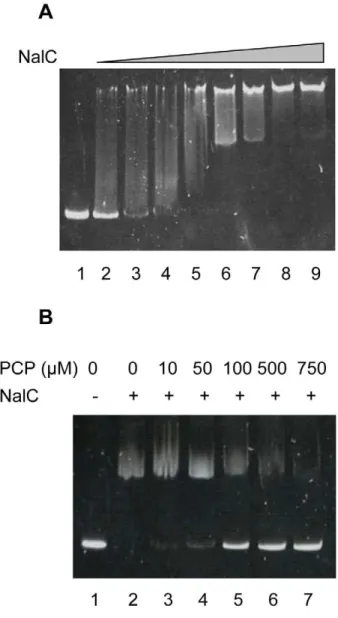
PA3720-armR expression compared with its wild type parent K767, PCP treatment did not enhance expression of this operon in K1454 (Fig. 1). This indicated that NalC was mediating the PCP induction of PA3720-armR, either via a direct response to PCP or via recognition of PCP-generated cellular products (PCP is an energy inhibitor). To assess this NalC was purified and the impact of PCP on its binding to the ca. 200 bp nalC-PA3720 intergenic region was examined using EMSA. As seen in Fig. 2, NalC bound the nalC-PA3720 intergenic region (Fig. 2A) with binding compromised by the addition of PCP (some loss of binding was detected at 10mM PCP with almost complete loss of binding seen at 750mM) (Fig. 2B). Thus, NalC responds directly to PCP in mediating its induction of PA3720-armR.
Mapping the NalC binding site
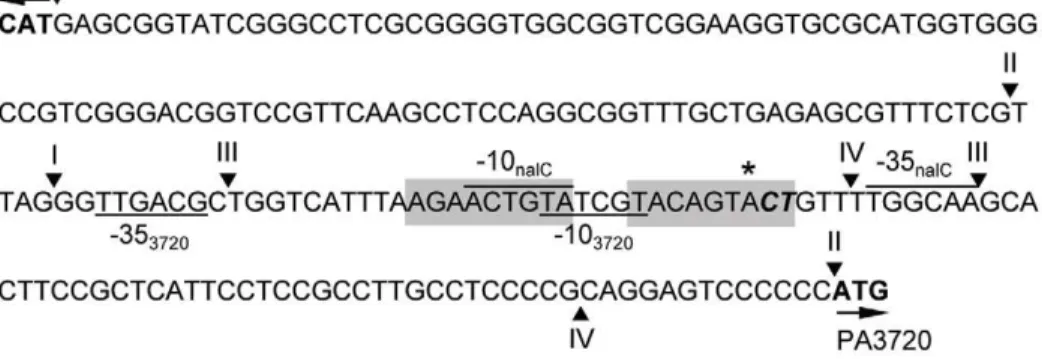
In an attempt to localize the NalC binding site NalC binding to ca. 100 bp PA3720-proximal and ca. 100 bp PA3720 distal fragments was assessed, with binding confirmed only for the PA3720-proximal fragment (Fig. 3A, cf Fig. 3B). This fragment (with endpoints II) included putative promoters for nalC and PA3720-armR as well as an inverted repeat sequence that might serve as the NalC-binding site (Fig. 4). To assess the latter, a 45 bp fragment encompassing the inverted repeat (IR; endpoints III in Fig. 4) was used in an EMSA and NalC binding was observed (Fig. 3C). An identically-sized fragment lacking the IR and encompassing a region more PA3720-proximal (endpoints IV in Fig. 4) failed to bind NalC (Fig. 3D) and little if any binding was observed to a fragment encompassing the repeat region (endpoints III) in which the repeat sequence was mutated, and then only at the highest concentration of NalC (Fig. 3E). This confirmed the repeat region as the NalC-binding site. Interestingly, a 21-bp fragment
carrying only the IR failed to bind NalC (data not shown) indicating that the proper disposition of the repeat region for NalC binding required flanking sequence. The IR-containing region to which NalC bound contains the putative promoter regions fornalCand PA3720-armR[predicted using neural network promoter prediction (http://www.fruitfly.org/seq_tools/promoter.html)] (Fig. 4) as would be expected. Using 59-RACE the PA3720-armRtranscription start site was mapped to an adjacent CT pair of bases (exact base could not be determined unequivocally owing to limitations of the RACE), which occurred downstream of the putative PA3720-armR -10 region and immediately downstream of the predicted (using neural network) start site (Fig. 4). This is consistent with NalC regulating expression of the PA3720-armRoperon.
Figure 1. PCP induction of PA3720-armR.qRT-PCR results showing impact of PCP and/or a nalC mutation on PA3720 expression (as a measure of PA3720-armRexpression). Expression of PA3720 is reported relative to therpsLinternal control for wild typeP. aeruginosaK767 and its nalC derivative, K1454 exposed or not to PCP (0.75 mM; 1.5 hr). Results shown are the mean+/2standard error of one cDNA sample for each, processed in triplicate, and are representative of 2 independent experiments.
doi:10.1371/journal.pone.0032684.g001
PCP induction ofmexAB-oprMis NalC and MexR-dependent but PA3720-ArmR-inMexR-dependent
In addition to its induction of PA320-armR, PCP was previously shown to induce the MexR-regulatedmexAB-oprMmultidrug efflux operon [45], results that have been confirmed here (modest ca. 3-fold induction; Fig. 5). Mutations in nalC and mexR yielded elevated expression of mexAB-oprM (nalC, 3-fold; mexR, 5-fold; Fig. 5), as seen previously [45], and this was no longer responsive to PCP (Fig. 5). Thus, PCP operates though these regulators in promoting mexAB-oprM expression. Given that NalC controls expression of the ArmR anti-repressor that modulates MexR repression of mexAB-oprM, the obvious interpretation of these results is that PCP as a NalC effector affords PA3720-armR
expression, with ArmR modulating MexR activity to effect mexAB-oprMexpression. To assess this, PCP induction of the efflux operon was examined inarmR mutant strain K3145. As seen in Fig. 6,
mexAB-oprMwas still induced in response to PCP treatment, albeit to a lesser extent, indicating that PCP induction of this efflux operon can occur independently of its promotion of ArmR expression. PA3720 encodes a protein of unknown function that, likearmR, is NalC regulated [37] and PCP inducible [45] (Fig. 1) and which might, therefore, play a role in PCP induction of
mexAB-oprM. Thus, PCP induction ofmexAB-oprMwas assessed in a mutant, K3146, lacking PA3720. Again, however, PCP induction ofmexAB-oprMwas retained in the mutant (Fig. 6). Similarly, PCP induction of mexAB-oprM was seen in a mutant strain, K3130, lacking both PA3720 and armR (Fig. 6), ruling out both genes independently mediating PCP induction of the efflux operon. Similarly, while loss of armR compromised the mexAB-oprM
overexpression seen in analCmutant (Fig. 5) in agreement with previous results [37], PCP induction ofmexAB-oprMwas retained in the nalCDarmR mutant K2276 (Fig. 5) again indicating that PCP induction of the efflux operon can occur independently of ArmR. Interestingly, however, and in contrast to what was observed when armR was eliminated in wild type strain K767, where there was little or no impact on basal levels ofmexAB-oprM
expression (in the absence of PCP) (Fig. 6), loss ofarmRin analC
background reduced expression ofmexAB-oprMto below the basal levels seen in K767 (Fig. 5).
PCP is not a MexR effector
The observation that PCP induction of mexAB-oprM is dependent on MexR but independent of PA3720-armRsuggested that PCP may be capable of directly modulating MexR activity to effect efflux gene expression. To assess this, the impact of PCP on MexR binding to a DNA fragment containing the mexAB-oprM
promoter region was examined using EMSA. As seen in Fig. 7 MexR binding was observed, revealing a complex pattern of DNA
Figure 3. Identifying the NalC binding site upstream of PA3720-armR. A–B) Mobility shift assay in which 50 ng of A) the 107-bp PA3720-distal DNA fragment (sequence delineated by
end-points I in Fig. 4A) or B) the 102-bp PA3720-proximal DNA fragment (sequence delineated by endpoints II in Fig. 4A) were incubated without NalC (lane 1) or with 300 (lane 2), 500 (lane 3), 800 (lane 4) or 1000 (lane 5) ng of purified NalC-His. C–E) Mobility shift assay in which 0 (lane 1), 300 (lane 2), 500 (lane 3), 800 (lane 4) and 1000 (lanes 5) and 2000 (lanes 6) ng of purified NalC-his was incubated with 40 ng of C) the annealed oligonucleotide NalC-1 and its reverse complement (corresponds to sequence delineated by endpoints III in Fig. 4A), D) the annealed oligonucleotide NalC-2 and its reverse complement (corre-sponds to sequence delineated by endpoints IV in Fig. 4A), and E) annealed oligonucleotide NalC-3 and its reverse complement, in which the AGAACTGT sequence of NalC-1 corresponding to the first half of the inverted repeat highlighted in Fig. 4(A) (shaded sequence overlapping the putative210 regions for nalCand PA3720-armR) is changed to TCTTGACA.
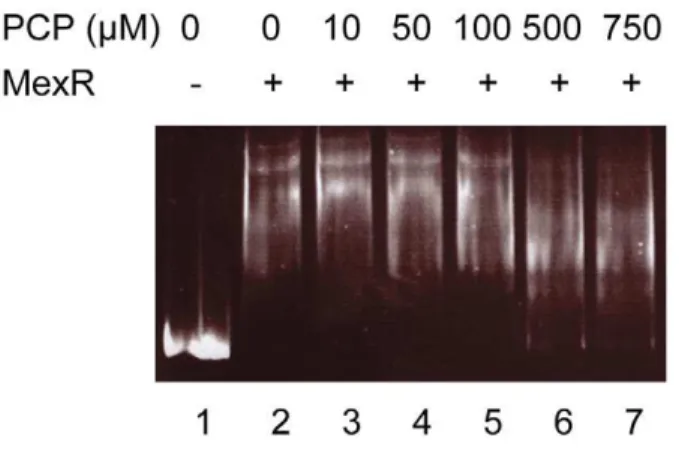
binding suggestive of variable occupancy of multiple MexR binding sites and/or cooperative binding of MexR to its target DNA. Inn any case, PCP had no impact on MexR binding at concentrations up to 100mM, and while there were qualitative differences in the pattern of shifted DNA at the highest concentrations (500 and 750mM) virtually all of themexAB-oprM
promoter-containing DNA remained bound to MexR at these concentrations of PCP. Thus, in contrast to NalC, PCP is not an effector for MexR.
Discussion
ArmR is an anti-repressor that modulates MexR repressor activity in nalC mutants that hyperexpress the PA3720-armR
operon, accounting for the elevated expression of themexAB-oprM
multidrug efflux operon in such mutants [37]. In light of the impact of PCP on NalC repression of the PA3720-armR operon and the NalC dependence of PCP induction of mexAB-oprM it seemed reasonable to suppose that PCP induction of the efflux operon followed from elevated armR expression and subsequent ArmR-dependent modulation of MexR repression ofmexAB-oprM. Indeed, this was the conclusion of a recent study, published while this work was in progress, demonstrating that PCP induction of PA3720-armR expression results from PCP directly modulating NalC’s repression of this operon [46]. Still, the requirement for ArmR in PCP-induciblemexAB-oprMexpression was not assessed in that study and results presented here clearly demonstrate that PCP induction of the efflux operon occurs in the absence of the anti-repressor. While there seemed to be some reduction in the
Figure 4. Mapping the PA3720-armRtranscriptional start site.ThenalC/PA3720-armRintergenic region highlighting the RACE-determined transcription start site for PA3720-armR(bolded and italicized), the predicted transcriptional initiation site (marked with an asterisk; assessed using neural network promoter prediction software provided by M. G. Reese athttp://www.fruitfly.org/seq_tools/promoter.html), thenalCand PA3720 start codons (arrows), and putative210/235 sites fornalC(overlined) and PA3720-armR(underlined) promoters. The end-points of PCR-generated PA3720-distal (I) and -proximal (II) fragments and oligonucleotides (III and IV) used in EMSAs with purified NalC (see Fig. 2B) are identified by arrowheads above the sequence. The shaded sequence corresponds to an inverted repeat and possible NalC-binding site.
doi:10.1371/journal.pone.0032684.g004
Figure 5. NalC and MexR dependence of PCP induction of
mexAB-oprM.Expression ofmexA(as a measure ofmexAB-oprM) was assessed inP. aeruginosa strains K767 (wild type; WT), K1454 (nalC), K2276 (nalC DarmR) and K2568 (DmexR) exposed or not to PCP (0.75 mM; 1.5 hr) using qRT-PCR. Expression was normalized to rpsL
controls and is reported relative (fold change) to untreated P. aeruginosaK767. Results shown are the mean+/2standard error of one cDNA sample for each, processed in triplicate, and are represen-tative of 2 independent experiments.
doi:10.1371/journal.pone.0032684.g005
Figure 6. ArmR-/PA3720-independence of PCP induction of
mexAB-oprM.Expression ofmexA(as a measure ofmexAB-oprM) was assessed inP. aeruginosastrains K767 (wild type; WT), K3145 (DarmR), K3146 (DPA3720) and K3130 (DPA3720-armR) exposed or not to PCP (0.75 mM; 1.5 hr) using qRT-PCR. Expression was normalized torpsL
controls and is reported relative (fold change) to untreated P. aeruginosaK767. Results shown are the mean+/2standard error of one cDNA sample for each, processed in triplicate, and are represen-tative of 2 independent experiments.
absolute levels of PCP-inducible mexAB-oprM expression in the absence of armR, all mutants lacking armR (i.e., K767DarmR,
nalCDarmR, K767DPA3720DarmR) showed fold increases in expression of the efflux genes in the presence of PCP (2- to fold increase) that were similar to wild type strain K767 (ca. 3-fold).
While it is unlikely that elevatedarmRexpression in PCP-treated
P. aeruginosawould not contribute to mexAB-oprMexpression as a result of ArmR modulation of MexR repressor activity, these results do indicate that there are other mechanisms by which PCP can promotemexAB-oprMexpression, probably in parallel with the ArmR-dependent mechanism. Such a mechanism appears not to involve PA3720, whose function still remains to be elucidated, but does require MexR, which may respond to PCP. Given the observation that PCP does not impact MexR binding to the
mexAB-oprM promoter containing DNA in vitro, one possibility is thatP. aeruginosaexposure to PCP promotesin vivoproduction of MexR effector molecule(s) that facilitatemexAB-oprMderepression. In this vein, it has been shown that MexR binding to the mexAB-oprMpromoter region and its control of efflux gene expression is impacted by oxidative stress, MexR being a redox responsive regulator whose ability to bind and repress mexAB-oprM is compromised when the protein is oxidized [33,34]. Thus,
exposure to hydroperoxide oxidizes MexR and alleviates promoter binding in vitro and induces mexAB-oprM expression in vivo[34]. One possibility, then, is that PCP exposure generates some form of oxidative stress inP. aeruginosa. Intriguingly, PCP has been shown to dramatically increase O2 flux in P. aeruginosa, generating an
oxidative stress that could impact MexR activity [54]. Puzzlingly, PCP induction of mexAB-oprM is absent innalC mutant K1454, despite the fact that efflux gene expression is less than what is seen in amexRnull strain (K2568) – while much of MexR is inactive as a repressor in K1454, being bound by ArmR, clearly some MexR repression ofmexAB-oprMis still occurring and would, presumably, be susceptible to modulation by PCP (or PCP-generated effectors). Still, there is some unexplained complexity to mexAB-oprM
expression in analCstrain given the greater impact ofarmRloss on efflux gene expression in analCbackground as compared to an otherwise wild type background where in absolute terms mexAB-oprM expression is less (2-fold; Fig. 5) in a nalC DarmR mutant (K2276) than aDarmRmutant (K3145). Whether this explains the anomaly, there is likely to be differences in the expression of at least some genes in K2276 vs. K3145, with PA3720 presumably up-regulated in the former but not the latter and any other genes impacted by loss of nalC and/or upregulation of PA3720 differentially expressed in the two strains. How these might influencemexAB-oprMexpression is uncertain.
The modulation of NalC repressor activity by PCP (and other chlorinated phenols [46]) occurs at high levels (highmM to low mM) for an effector molecule suggesting that it only mimics an intended NalC effector and ultimate inducer ofmexAB-oprM, likely a phenolic of some kind. Plants are common sources of phenolic compounds, many of which have antimicrobial activity [55–58], and these may be the intended inducers/substrates for MexAB-OprM. While attempts were made to assess the ability of plant extracts to ‘interact’ with NalC and to induce mexAB-oprM
expression technical issues (extract insolubility in aqueous solutions) compromised these efforts.
Acknowledgments
The authors thank Dr. Simon Gibbons for providing plant root extracts.
Author Contributions
Conceived and designed the experiments: LMS MF KP. Performed the experiments: LMS MF. Analyzed the data: LMS MF KP. Contributed reagents/materials/analysis tools: KP. Wrote the paper: LMS KP.
References
1. Kerr KG, Snelling AM (2009)Pseudomonas aeruginosa: a formidable and ever-present adversary. J Hosp Infect 73: 338–344.
2. Poole K (2011)Pseudomonas aeruginosa: resistance to the max. Front Microbio 2: 65-doi: 10.3389/fmicb.2011.00065.
3. Poole K (2005) Efflux-mediated antimicrobial resistance. J Antimicrob Che-mother 56: 20–51.
4. Poole K (2007) Efflux pumps as antimicrobial resistance mechanisms. Ann Med 39: 162–176.
5. Masuda N, Sakagawa E, Ohya S, Gotoh N, Tsujimoto H, et al. (2000) Sub-strate specificities of MexAB-OprM, MexCD-OprJ, and MexXY-OprM efflux pumps in Pseudomonas aeruginosa. Antimicrob Agents Chemother 44: 3322–3327.
6. Chuanchuen R, Beinlich K, Hoang TT, Becher A, Karkhoff-Schweizer RR, et al. (2001) Cross-resistance between triclosan and antibiotics inPseudomonas aeruginosa is mediated by multidrug efflux pumps: exposure of a susceptible mutant strain to triclosan selectsnfxBmutants overexpressing MexCD-OprJ. Antimicrob Agents Chemother 45: 428–432.
7. Li X-Z, Zhang L, Poole K (1998) Role of the multidrug efflux systems of
Pseudomonas aeruginosain organic solvent tolerance. J Bacteriol 180: 2987–2991. 8. Li XZ, Poole K (1999) Organic solvent-tolerant mutants ofPseudomonas aeruginosa
display multiple antibiotic resistance. Can J Microbiol 45: 18–22.
9. Srikumar R, Li X-Z, Poole K (1997) Inner membrane efflux components are responsible for the ß-lactam specificity of multidrug efflux pumps inPseudomonas aeruginosa. J Bacteriol 179: 7875–7881.
10. Srikumar R, Kon T, Gotoh N, Poole K (1998) Expression ofPseudomonas aeruginosa
multidrug efflux pumps MexA-MexB-OprM and MexC-MexD-OprJ in a multidrug-sensitiveEscherichia colistrain. Antimicrob Agents Chemother 42: 65–71. 11. Srikumar R, Poole K (1999) Demonstration of ethidium bromide efflux by multiresistant pumps of Pseudomonas aeruginosa. Clin Microbiol Infect 5: 5S58–5S59.
12. Schweizer HP (1998) Intrinsic resistance to inhibitors of fatty acid biosynthesis in
Pseudomonas aeruginosais due to efflux: application of a novel technique for generation of unmarked chromosomal mutations for the study of efflux systems. Antimicrob Agents Chemother 42: 394–398.
13. Evans K, Passador L, Srikumar R, Tsang E, Nezezon J, et al. (1998) Influence of the MexAB-OprM multidrug efflux system on quorum-sensing inPseudmonas aeruginosa. J Bacteriol 180: 5443–5447.
14. Pearson JP, Van Delden C, Iglewski BH (1999) Active efflux and diffusion are involved in transport ofPseudomonas aeruginosacell-to-cell signals. J Bacteriol 181: 1203–1210.
15. Poole K (2000) Efflux-mediated resistance to fluoroquinolones in Gram-negative bacteria. Antimicrob Agents Chemother 44: 2233–2241.
Figure 7. Lack of impact of PCP on MexR repressor binding to the mexR-mexA intergenic region. Mobility shift assay in which purified MexR-His (500 ng) was incubated with 40 ng of a 351-bp DNA fragment encompassing themexR-mexAintergenic region and increas-ing amounts of PCP as indicated. Lane 1, DNA only control.
16. Henrichfreise B, Wiegand I, Pfister W, Wiedemann B (2007) Resistance mechanisms of multiresistantPseudomonas aeruginosastrains from Germany and correlation with hypermutation. Antimicrob Agents Chemother 51: 4062–4070. 17. Dupont P, Hocquet D, Jeannot K, Chavanet P, Plesiat P (2005) Bacteriostatic and bactericidal activities of eight fluoroquinolones against MexAB-OprM-overproducing clinical strains ofPseudomonas aeruginosa. J Antimicrob Chemother 55: 518–522.
18. Cavallo JD, Hocquet D, Plesiat P, Fabre R, Roussel-Delvallez M (2007) Susceptibility of Pseudomonas aeruginosa to antimicrobials: a 2004 French multicentre hospital study. J Antimicrob Chemother 59: 1021–1024. 19. Hocquet D, Roussel-Delvallez M, Cavallo JD, Plesiat P (2007)
MexAB-OprM-and MexXY-overproducing mutants are very prevalent among clinical strains of
Pseudomonas aeruginosawith reduced susceptibility to ticarcillin. Antimicrob Agents Chemother 51: 1582–1583.
20. Boutoille D, Corvec S, Caroff N, Giraudeau C, Espaze E, et al. (2004) Detection of an IS21 insertion sequence in the mexR gene of Pseudomonas aeruginosa
increasing ß-lactam resistance. FEMS Microbiol Lett 230: 143–146. 21. Cavallo JD, Plesiat P, Couetdic G, Leblanc F, Fabre R (2002) Mechanisms of
ß-lactam resistance inPseudomonas aeruginosa: prevalence of OprM-overproducing strains in a French multicentre study (1997). J Antimicrob Chemother 50: 1039–1043.
22. Wang J, Zhou JY, Qu TT, Shen P, Wei ZQ, et al. (2010) Molecular epidemiology and mechanisms of carbapenem resistance inPseudomonas aeruginosa
isolates from Chinese hospitals. Int J Antimicrob Agents 35: 486–491. 23. Pournaras S, Maniati M, Spanakis N, Ikonomidis A, Tassios PT, et al. (2005)
Spread of efflux pump-overexpressing, non-metallo-ß-lactamase-producing, meropenem-resistant but ceftazidime-susceptible Pseudomonas aeruginosa in a region withblaVIMendemicity. J Antimicrob Chemother 56: 761–764. 24. Srikumar R, Paul CJ, Poole K (2000) Influence of mutations in the mexR
repressor gene on expression of the MexA-MexB-OprM multidrug efflux system ofPseudomonas aeruginosa. J Bacteriol 182: 1410–1414.
25. Saito K, Yoneyama H, Nakae T (1999) nalB-type mutations causing the overexpression of the MexAB-OprM efflux pump are located in themexRgene of thePseudomonas aeruginosachromosome. FEMS Microbiol Lett 179: 67–72. 26. Ziha-Zarifi I, Llanes C, Koehler T, Pechere J-C, Plesiat P (1999) In vivo
emergence of multidrug-resistant mutants ofPseudomonas aeruginosa overexpress-ing the active efflux system MexA-MexB-OprM. Antimicrob Agents Chemother 43: 287–291.
27. Jalal S, Wretlind B (1998) Mechanisms of quinolone resistance in clinical strains ofPseudomonas aeruginosa. Microbiol Drug Resist 4: 257–261.
28. Jalal S, Ciofu O, Hoiby N, Gotoh N, Wretlind B (2000) Molecular mechanisms of fluoroquinolone resistance inPseudomonas aeruginosaisolates from cystic fibrosis. Antimicrob Agents Chemother 44: 710–712.
29. Evans K, Adewoye L, Poole K (2001) MexR repressor of the mexAB-oprM
multidrug efflux operon ofPseudomonas aeruginosa: identification of MexR binding sites in themexA-mexRintergenic region. J Bacteriol 183: 807–812.
30. Morita Y, Cao L, Gould G, Avison MB, Poole K (2006)nalDencodes a second repressor of themexAB-oprMmultidrug efflux operon ofPseudomonas aeruginosa. J Bacteriol 188: 8649–8654.
31. Lim D, Poole K, Strynadka NC (2002) Crystal structure of the MexR repressor from the multidrug efflux operon inPseudomonas aeruginosa. J Biol Chem 277: 29253–29259.
32. Sanchez P, Rojo F, Martinez JL (2002) Transcriptional regulation ofmexR, the repressor ofPseudomonas aeruginosa mexAB-oprMmultidrug efflux pump. FEMS Microbiol Lett 207: 63–68.
33. Chen H, Yi C, Zhang J, Zhang W, Ge Z, et al. (2010) Structural insight into the oxidation-sensing mechanism of the antibiotic resistance of regulator MexR. EMBO Rep 11: 685–690.
34. Chen H, Hu J, Chen PR, Lan L, Li Z, et al. (2008) ThePseudomonas aeruginosa
multidrug efflux regulator MexR uses an oxidation-sensing mechanism. Proc Natl Acad Sci U S A 105: 13586–13591.
35. Daigle DM, Cao L, Fraud S, Wilke MS, Pacey A, et al. (2007) Protein modulator of multidrug efflux gene expression inPseudomonas aeruginosa. J Bacteriol 189: 5441–5451.
36. Wilke MS, Heller M, Creagh AL, Haynes CA, McIntosh LP, et al. (2008) The crystal structure of MexR from Pseudomonas aeruginosa in complex with its antirepressor ArmR. Proc Natl Acad Sci U S A 105: 14832–14837. 37. Cao L, Srikumar R, Poole K (2004) MexAB-OprM hyperexpression in NalC
type multidrug resistantPseudomonas aeruginosa: identification and characterization of thenalCgene encoding a repressor of PA3720-PA3719. Mol Microbiol 53: 1423–1436.
38. Llanes C, Hocquet D, Vogne C, Benali-Baitich D, Neuwirth C, et al. (2004) Clinical strains of Pseudomonas aeruginosa overproducing MexAB-OprM and MexXY efflux pumps simultaneously. Antimicrob Agents Chemother 48: 1797–1802.
39. Sobel ML, Hocquet D, Cao L, Plesiat P, Poole K (2005) Mutations in PA3574 (nalD) lead to increased MexAB-OprM expression and multidrug resistance in lab and clinical isolates ofPseudomonas aeruginosa. Antimicrob Agents Chemother 49: 1782–1786.
40. Fraud S, Campigotto AJ, Chen Z, Poole K (2008) The MexCD-OprJ multidrug efflux system ofPseudomonas aeruginosa: involvement in chlorhexidine resistance and induction by membrane damaging agents dependent upon the AlgU stress-response sigma factor. Antimicrob Agents Chemother 52: 4478–4482. 41. Fetar H, Gilmour C, Klinoski R, Daigle DM, Dean CR, et al. (2011)mexEF-oprN
multidrug efflux operon of Pseudomonas aeruginosa: regulation by the MexT activator in response to nitrosative stress and chloramphenicol. Antimicrob Agents Chemother 55: 508–514.
42. Fraud S, Poole K (2010) Oxidative stress induction of themexXYmultidrug efflux genes and promotion of aminoglycoside resistance development inPseudomonas aeruginosa. Antimicrob Agents Chemother 55: 1068–1074.
43. Jeannot K, Sobel ML, El Garch F, Poole K, Plesiat P (2005) Induction of the MexXY efflux pump inPseudomonas aeruginosais dependent on drug-ribosome interaction. J Bacteriol 187: 5341–5346.
44. Morita Y, Gilmour C, Metcalf D, Poole K (2009) Translational control of the antibiotic inducibility of the PA5471 gene required formexXYmultidrug efflux gene expression inPseudomonas aeruginosa. J Bacteriol 191: 4966–4975. 45. Muller JF, Stevens AM, Craig J, Love NG (2007) Transcriptome analysis reveals
that multidrug efflux genes are upregulated to protectPseudomonas aeruginosafrom pentachlorophenol stress. Appl Environ Microbiol 73: 4550–4558.
46. Ghosh S, Cremers CM, Jakob U, Love NG (2011) Chlorinated phenols control the expression of the multi-drug resistance efflux pump MexAB-OprM in
Pseudomonas aeruginosaby activating NalC. Mol Microbiol 79: 1547–1556. 47. Morita Y, Sobel ML, Poole K (2006) Antibiotic inducibility of the MexXY
multidrug efflux system ofPseudomonas aeruginosa: involvement of the antibiotic-inducible PA5471 gene product. J Bacteriol 188: 1847–1855.
48. Sobel ML, McKay GA, Poole K (2003) Contribution of the MexXY multidrug transporter to aminoglycoside resistance inPseudomonas aeruginosaclinical isolates. Antimicrob Agents Chemother 47: 3202–3207.
49. Sheu DS, Wang YT, Lee CY (2000) Rapid detection of polyhydroxyalkanoate-accumulating bacteria isolated from the environment by colony PCR. Microbiology 146: 2019–2025.
50. Sambrook J, Russell DW (2001) Molecular cloning: a laboratory manual, 3rd ed. Cold Spring Harbor, N.Y.: Cold Spring Harbor Laboratory Press.
51. Choi KH, Kumar A, Schweizer HP (2005) A 10-min method for preparation of highly electrocompetent Pseudomonas aeruginosa cells: Application for DNA fragment transfer between chromosomes and plasmid transformation. J Microbiol Methods 64: 391–397.
52. Jo JT, Brinkman FS, Hancock RE (2003) Aminoglycoside efflux inPseudomonas aeruginosa: involvement of novel outer membrane proteins. Antimicrob Agents Chemother 47: 1101–1111.
53. Frohman MA (1993) Rapid amplification of complementary DNA ends for generation of full-length complementary DNAs: thermal RACE. Methods Enzymol 218: 340–356.
54. McLamore ES, Zhang W, Porterfield DM, Banks MK (2010) Membrane-aerated biofilm proton and oxygen flux during chemical toxin exposure. Environ Sci Technol 44: 7050–7057.
55. Park YJ, Biswas R, Phillips RD, Chen J (2011) Antibacterial activities of blueberry and muscadine phenolic extracts. J Food Sci 76: M101–M105. 56. Zhao J, Lou J, Mou Y, Li P, Wu J, et al. (2011) Diterpenoid tanshinones and
phenolic acids from cultured hairy roots ofSalvia miltiorrhizaBunge and their antimicrobial activities. Molecules 16: 2259–2267.
57. Lanoue A, Burlat V, Schurr U, Rose US (2010) Induced root-secreted phenolic compounds as a belowground plant defense. Plant Signal Behav 5: 1037–1038. 58. Masoko P, Gololo SS, Mokgotho MP, Eloff JN, Howard RI, et al. (2010) Evaluation of the antioxidant, antibacterial, and antiproliferative activities of the acetone extract of the roots ofSenna italica(Fabaceae). Afr J Tradit Complement Altern Med 7: 138–148.
59. Ausubel FM, Brent R, Kingston RE, Moore DD, Seidman JG, et al. (1992) Short protocols in molecular biology, 2nd ed. New York: John Wiley & Sons, Inc.
60. Studier FW (1991) Use of bacteriophage T7 lysozyme to improve an inducible T7 expression system. J Mol Biol 219: 37–44.
61. Simon R, Priefer U, Puehler A (1983) A broad host range mobilization system for in vivo genetic engineering: transposon mutagenesis in Gram-negative bacteria. Biotechnology 1: 784–791.
62. Miller VL, Mekalanos JJ (1988) A novel suicide vector and its use in construction of insertion mutations: osmoregulation of outer membrane proteins and virulence determinants in Vibrio cholerae requires toxR. J Bacteriol 170: 2575–2583.
63. Masuda N, Ohya S (1992) Cross-resistance to meropenem, cephems, and quinolones in Pseudomonas aeruginosa. Antimicrob Agents Chemother 36: 1847–1851.
64. Hoang TT, Karkhoff-Schweizer RR, Kutchma AJ, Schweizer HP (1998) A broad-host-range Flp-FRT recombination system for site-specific excision of chromosomally-located DNA sequences: application for isolation of unmarked
![Fig. 5), as seen previously [45], and this was no longer responsive to PCP (Fig. 5). Thus, PCP operates though these regulators in promoting mexAB-oprM expression](https://thumb-eu.123doks.com/thumbv2/123dok_br/17179881.241783/6.918.97.356.86.1042/previously-longer-responsive-operates-regulators-promoting-mexab-expression.webp)