Active Social Network System for the Creation of
Self-relief Communities in Disasters
L. Ernesto DOMINGUEZ-RIOS, Tomoko IZUMI, Yoshio NAKATANI
Abstract—This research proposes the development of a plat-form considered as a tool for disaster management using a function that can create aid links between the people inside a social network system. These links are created taking advantage of users own skills or characteristics for a positive outcome in an emergency situation. The proposed platform can be used by the people who cares about protection and by the people who needs help. The collection of information like gathering the current position via GPS, and information like special skills or disabilities of the people are essential because using this information the system will make links between people, government and other organizations.
Index Terms—Social network service system, Disaster miti-gation, Disaster management, Self-relief community, Assistance system.
I. INTRODUCTION
A. Communities in disaster
T
HERE are different sources that indicate the importance of the communities as an important human force in the disaster relief efforts.According to Takazawa A. and Williams K. article, in which they define the process in how the communities respond to disasters [1], there are five statements in the process. Inthe firstone, the communities respond to disasters in stages without relying in the stronghold of the disaster. The second statement is set during the response phase, in which the people of the community start to help to each other, facing a dilemma of helping at first instance, their own family and friends, or start helping without taking into consideration of such idea. However, it is also important to notice that if they already found that all their relatives are out of danger, they will start helping the rest of the community; this statement is very interesting for this research because family is also an important part while the people is creating their own social network links and connections. The third statement includes the reality of the community members considered as survivors responding faster than any other agents from government of non-governmental support agencies relying on the building of spontaneous groups. Also Chen L., Liu Y., and Chan K. mentions about this problem, putting emphasis on the big probability that “The government emergency services can be delayed mainly by the type or size
Manuscript received July 23, 2014; revised July 29, 2014. This work was supported in part by Ritsumeikan University.
E. Dominguez-Rios is affiliated with the Graduate School of Information Science and Engineering, Ritsumeikan University, Kusatsu city, Shiga, 525-8577 Japan (phone: +81 77-561-5932; Fax: +81-77-561-5203; e-mail: [email protected] ).
T. Izumi is affiliated with Ritsumeikan University, Kusatsu city, Shiga, 525-8577 Japan (phone: +81 77-561-5932; Fax: +81-77-561-5203; e-mail: [email protected] ).
Y. Nakatani is affiliated with Ritsumeikan University, Kusatsu city, Shiga, 525-8577 Japan (phone: +81 77-561-5932; Fax: +81-77-561-5203; e-mail: [email protected] ).
of a disaster and the geographical features of the affected area” [2]. So the community should start its own phase of relief in which the main base of human force relies on the community for a great efficiency in emergency response and also in the next phase, which is the disaster recovery efforts. The fourth statement includes the rescue phase in which all the stakeholders participate and adapt to the current situation. Finally, in the fifth, we have the participation of all the groups that are coming from outside the community and start the recovery phase. Often the groups created inside the community are considered helpless. However, during this phase both groups need to work in collaboration. Having the complete look of these five statements we can observe the importance of having all these groups working together. For this purpose the addition of a system like our proposal can improve the management of their activities and take advantage of each group member.
Citizens in a community are an important piece during a disaster response. The best definition aboutcitizen response
is well declared by Helsloot I. and Ruitenberg A., as all actions taken by citizens which include: 1. preparing for disasters and major accidents, 2. during and after disasters and major accidents, 3. with the intent to help themselves, of others to limit the effects of the disaster or major accident [3]. In our research, we take this definition, and our system is developed under the need of the citizens to be able to help each others in all the phases of a disaster. It is important that the communities start contributing with some actions immediately. We make emphasis on the importance of stop thinking that citizens or communities are helpless or dependent. Main situations are when we need to have better communication and the community participation can be related to abilities and disabilities of the members in the community. That is, it is possible to create a helped-helper relation between them.
Due to the importance of the community during each phase of a disaster, such as preparedness, response and recovery, re-searchers created models of the risk perception, vulnerability during evacuation and action and those of disaster recovery for each three phases.
Community-based disaster management programs. Specially in the type Bdisaster response and recovery actions actively undertaken by communities, we need to consider how these groups emerge. According to the article emergent citizen groups and emergency management by Stallings R. and Quarantell E. [5] these groups are “New groups with absence of formalization, and lack of tradition”. Public officials often do not take into account for the community emergency management, which is the main reason of the lack of knowledge about the benefit of include these groups as part of disaster relief efforts.
In our proposal system, the groups are created based on aid links, not only between the users but also with the governmental authorities, which are proposed by this system using the information about the users.
B. Social network system platform
Social Network Service (SNS) are those services that gather information from users, including social contacts, attributes, etc. This information can be shared with all or restricted members within the network. After getting this information, this kind of services constructs an intercon-nected social network revealing to the members how they are connected in the network [6]. According to Boyd, D. and Ellison N. article about social network [7], what makes social network unique is that these services allow individual users to meet strangers, but rather that this kind of systems let the user have a visual look of their social connections.
A social network still has strong and supportive strings into the community, even if the communities are built on dispersive relationships. Ying Hu et al. [8] determined three principal layers as part of the structure of a social network:
Core:Those people who participate together and is the most intimately, primary layer: Participate in conjunction with core members on some occasions, but never as a group by themselves, secondary layer: Those who participate infrequently and are also considered as non-members.
In this research, our goal is to construct SNS for self-relief community in disasters. As long as we deal with the mitigation of disaster, the performance of our system still have a big dependency on the string between the people in various layers. So, in our system, the users that belong to the core and primary layer will be connected with each other with the aid links generated by our system. That is, by using our system, they start having a relation between them even if they have no relation in the previous SNS, such as friendship.
C. Our proposal
This study proposes a platform for disaster management based on Social Network System (SNS). Our system can help communities as a tool for preparedness, response and recovery in case of disaster. The main characteristic of our platform, is the creation of aid links between the users inside the SNS based on a helped-helper relation. The links between the community and the public agencies are also considered in our system. The development of a platform like ours empower communities to have a fast response in the relief efforts.
In the next section, we made a review of the related work. In section 3 we described the proposed method, and finally in section 4 we present the conclusion of the present paper.
II. RELATEDWORK
A. Social network and platforms for disaster
Inside the disaster mitigation systems, we can find a wide variety of researches that include Communication Service Systems, Social Network System (SNS), Geographic infor-mation system (GIS), Expert Systems (ES) and Multi-criteria Decision making Systems (MCDM).
Taiwan faced typhoon Morakot from August 8th to 10th 2009, which became a huge disaster and in which, according to Cheng-Min Huang, et al. [9] , the use of social network played an important role in the relief efforts. The most popu-lar internet social network available in Taiwan was used. The benefit of using this kind of technological resources is the reduction of the gap between professionals and residents in providing directly, sharing and tracking information. In this specific case, one of the major problems was the interaction and interconnection of some different systems. So now, the real challenge now is the integration of all these tools in one single platform. In this case of Taiwan, it can be said that the SNS was useful, but the SNS did not provide the tool for users to know where to post or ask information. That is why we need a platform that can generate the aid links automatically regardless the concern of users.
Another well described case study is related to the 2010 Yushu earthquake in China conducted by Qu Y., et al. [10]. In this case of study, the researchers have found that Sina-Weibo micro blogging service was used by the Chinese communities immediately after the earthquake. This very popular service in China is described as a Twitter-like micro blogging service. To perform the study, the information collected was related to “Yushu and earthquake” and “Qinghai and earthquake” terms or words that the people may have used at that moment. Mainly they found that the micro blogging service was used for four mayor tasks related to situation update, opinion expression, emotional support and calling for action, confirming the idea. It was shown that this kind of services are a good source for situation update and sharing information as disaster response activities by the community. In the particular case of Japan, we can find two examples from Yatsushiro city, Kumamoto prefecture and Nagaoka city, Niigata prefecture. In the case of Yatsushiro city, the system started as a way to communicate and find friends, including a bulletin board, calendar, link posting and email functions, and in 2004, added the version and added characteristics corresponding to the disaster. Mainly these functions were a fire alert service and hazard overview available in the map function in this system. Based on the previous commented Yatsushiro city project, Nagaoka city introduced a system in which the principal functions were the strengthening of the community ties, and the sharing of information to the community and direct communication with the government. In the specific case of the information sharing, it has been known that for small disasters the sharing of the information was very dependable [6].
this system provides information and communication that can be useful in case of disaster to the users: For exam-ple communication with family and friends, collection of geographical information, pictures or video, or any other data that can be helpful in the management of a crisis. The difference between this system and the one of our research is that while Greer M. and Ngo J. system only generates the links to share the preparedness plan. Our system not only will make contact with the people established by the user, but also will generate the links between people in the social network and the public agencies that can be helpful depending on the problem that each user is facing.
As a part of the usability of the social network it is important to focus on the devices or hardware that we use as the platform. The actions that can be covered by the system depends on the capacity and features offered by the device. One specific case are known as Mobile Social Networking Services (MSNS). One implementation of this kind of services is the MSNS for disaster response by Wosniak S., et al. [12]. A main feature of their system is a reporting service that lets the communities affected by any kind of disaster reports, for example, report of victims and their current location, hazards, resource requirements, and others. The importance of the reporting service is the establishment of a verification scheme and a function to vote for urgent events because of the reliability of the information obtained by the community.
Another example of Mobile Social Networking (MSN) can be seen in the findings of usability reported by Aoki E, et al. [13]. Their application was very effective in their task under the normal and emergency conditions. They found out that the communication was more efficient and effective using this smart phone application compared to those conditions without the application. From these results, we can figure out that the use of the mobile devices can be used for the improvement of communication inside a social network system and also it can be considered as a complementary tool for the users. So in our research, we think that is essential the availability for smart phones.
III. OUTLINE OF PROPOSAL
A. Characteristics of the platform
To be able to make possible the integration of our platform in order to perform its main task as a tool for the communities self relief. It is necessary to mention, the following five units that are needed.
1. Community platform. Is based on asocial network systemincluding the common characteristics that we can find in such systems, like the capacity to send image, text, etc. The creation of a Social network will let the system establish the relations and connections between the people.
2. Aid links generator function. Considered as our main proposal in the disaster management systems field. Based on each abilities and disabilities for each user, our system is able to establish the aid links for the people. At the same time the recommendation system will allow our users to set their trust circles and helped-helper circles.
3. Knowledge base establishment. The aid links are generated based on the current state and abilities/disabilities of each user. For the type and the location of a disaster, the
impacts of these elements for self relief may be changed. So, the weight parameters depend on disaster should be set to the elements. In our system, the parameters are set automatically by the analysis of success. Our system will start to record all the information related to the solution and the aid links between the people that are considered as effective. This function allows our system to learn about problems and find the best way to solve them.
4. Localization toolis needed for injured people or mas-sive problems about communication for awareness(e.g. Fire, Collapsed Building, etc.). Using geographically referenced information our system will be able to determine where and who is facing a problem.
5. Alert functionis important because when a disaster is happening, our platform will be able to set the first actions to be performed to start the relief efforts. After the alert was in the system’s server, the system will distribute the information among the users of the social network service based on two important things:
• 1. Distribution of the information on the alert to those people that is near the localization of the problem and • 2. The public agencies and people in the community
can be helpful for the relief efforts. So when the users received the information related to a disaster or any other important event, the system requires them to retrieve information about their status, or also about any problems which they are eyewitnesses. The system will try to reach the user and get as much information that can be gotten, so at the end each user will be helped based on each particular problem, but also the system can manage the priority of these problems.
B. Structure of the system
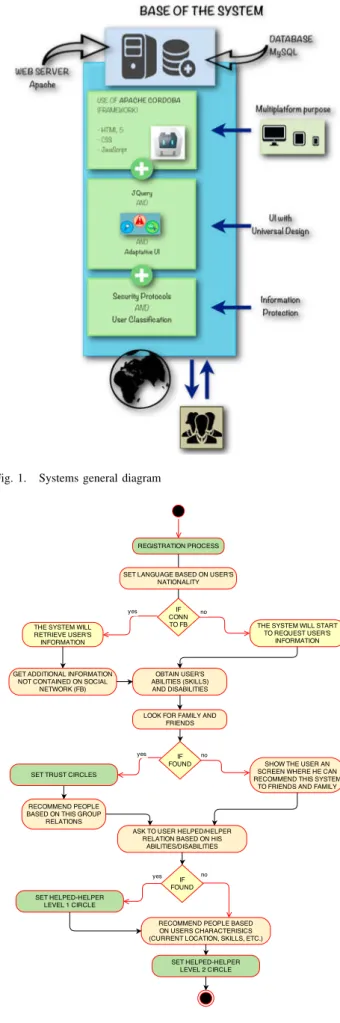
In figure 1, we can see in an understandable way the general structure of the system. This system is implemented under a web platform which includes a web server based on Apache and a Database under the MySQL scheme that can be considered as the core of this system.
We expect that at first this system should be used by people in a variety of devices. To be able to do this without facing any problem related to the differentiation on platforms, we use Apache Cordoba framework. Our first reason is because we can use HTML 5, CSS and Javascript (programming lan-guages) for the development. The second reason is because this framework allows us to migrate our system to different mobile platforms.
C. Functions of the system
1) User Registration and circle establishment: We should consider that the first step in this system is the User Reg-istration process. This process is represented in the figure 2 in which we can see the basic flowchart of this process. The main function in here is to obtain all the user’s information, this can be possible via the connection with the Facebook profile information or via the collection by a form. The collected information is stored in the system database.
Fig. 1. Systems general diagram
Fig. 2. User registration diagram
will be used to determine and make the indexation of each user in the creation of aid links between them.
Another important step during the user registration is to determinate the trust circle, helped-helper level 1 circle and helped-helper level 2 circle for each user. The establishment of these circles, let the user start making connections with the rest of the users inside our SNS. The system will require the user to set his trust circle and helped-helper level 1 circle. After that, the system will use each user information to set helper-helped level 2 circle.
a. Trust circle: Inside this circle it is possible to find all those previously registered users that have a direct relation to a user, such as familiar and friendship relations that can be found outside the social network system. The system will send a message to this group of people to make them known the user current situation in disasters.
b. Helper-helped level 1 circle: Inside this circle we will find those between a user with disability (e.g. Illness, serious medical condition, etc.) and a user with an ability corresponding to the disability. This will allow the immediate attention of these problems by a helper. The system will create these links as part of the preventive action.
c. Helper-helped level 2 circle: This circle includes all the links of the users based again on their personal abilities and disabilities. Mainly this circle is generated by the system, so there is not any personal relation between the users. However, the system considers this link useful for a specific problem or emergency. Most of the time these circles are established in real-time based on the user’s current status. This kind of circles are variable depending on each case and type of emergency.
2) User type distribution: It is important to divide each user’s abilities and disabilities in a distribution that allow us to perform a correct management of the disaster based on the needs of the helped, and the abilities or skills that can be useful from a helper. As we mentioned in the introduction, this system’s user distribution is based on the ICBDM model for disaster management [2]. In this model 5 groups where determined as medical, search and rescue, treatment, evacuation, communication. In the particular case of this system, we decided to make a minor modification to this model, joining the medical and treatment tasks, because both of them require attention in the medical sense.
To determinate the relation between the helped-helper relation and the aid links, we need to divide users into different roles. The main roles are divided into the basic four tasks shown below.
a. Medical: As helper we can consider those users with medical skill, for example doctor, medical specialist, nurse, user with first aid skill, emergency specialist or users with a special training related to disabilities (sign language). These abilities can be used to perform a task in order to assist the helped users. In some case helped will require attention related to a medical condition previously registered by the user or as a consequence of a disaster.
in a particular problem, get localizations of the helper users. The helper user is able to assist people directly if helper is near helped localization, or even inform about rescue advances in a specific area.
c. Communication:This group is very important for all the people in the community. In this group we can consider as helper those people that are witnesses of an event in place and can communicate about the event with users in the system. That is, the helper user should has an important skill, including a foreign language or with the proper media to get important information that can be useful. On the other side helped is the rest of the people, which is benefited by the information obtained and shared. For example, foreign people that can’t understand language, or even people that for any situation did not get the alert emitted by a public agency or other.
d. Public agencies: We must not forget the importance of the government agencies that are main actors in all disaster management. In this case the helper will be the public agency, such as fire fighters, public health, public utilities. The helped will be the community which is facing the disaster. Using the system’s Report generation obtained from all the community feedback, public agencies can perform their task based on these reports.
Based on the relation of ability and disability for the four groups, we define the strength of the helped-helper relation between two users. Concretely, the strength of the helped-helper relation is defined as the total number of matched relations as helped-helper in every group. Based on this, the system proposes priority of users as aid links ( the details are in Section III-C-(4)).
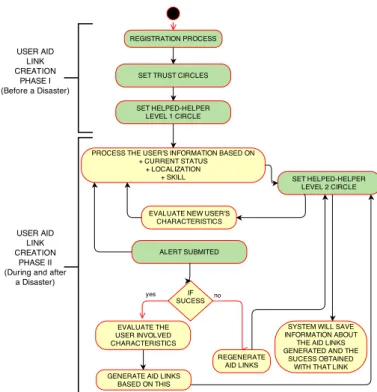
3) User aid link system’s function: The establishment of the aid links is divided into two main phases as we can see in figure 3. The first one is performed before the emergency on a preventive basis. And the second phase is performed during and after a disaster occurs. The second phase is related to the capacity of the system to create the aid links.
• First phase (before emergency): We need to remember that when the user is on the registration process, the user will input his characteristics related to abilities (skills) and disabilities (illness, serious medical condition, etc.). Then the system will ask and set the trust circle, which is the first step for the creation of the first links. Next the user will set the helped-helper level 1 circle, which is useful for helping the user in case of disaster. It is expected that the users can have the helped-helper circle based on their abilities (resp. disabilities) because most of them have relation between others with the corresponding disability (resp. ability) in the real world. The next step is the verification of the coverage of the just registered new user. This means that the system will make sure that the user disabilities are covered in a satisfactory level. Additionally to this the system will post via message board information about the new situations that should be prepared as a preventive mechanism. If there is a user that can fit or has an ability that can cover this new problem, the user will be able to set him as a helper in that kind of situation. • Second phase (during and after an emergency): In
second phase, We need to define the helped-helper level 2 circle, which is generated by the system. This type of
Fig. 3. User aid link workflow diagram
circle is used by the system as a base to establish the aid links. The aid links in this circle are created in most of the occasions in real time. There is a big dependency on three factors from the user and three factors or characteristics of the disaster to take in consideration:
– Current user’s status: This is related to the status which represents that the user is not damaged and can be a helper in a disaster. That is, the status is well or bad. When the user sets his current status to ”well”, this mean that the user is not having any problem. So this user can be considered as a potential helper.
– User’s localization: The localization of each user is very important to determine whether the user is in the possibility to help other users. Depending on the type of disasters, there may be cases that the help should be performed on site and those done in a remote way.
– User’s weight parameters: The weight parameters depends on the type, status, and location of disaster. For each disaster d, these parameters indicates which characteristics has good impact for d. That is, the parameters should be determined by the success rate.
– Disaster’s type: This factor is related to the differ-entiation of a disaster and the category or intensity reported for this disaster.
– Disaster’s status: This factor is based on the degree of recovery of a disaster. There is a direct relation between the time and the current situation that the community is facing related each new problem as a consequence of the disaster.
susceptible.
4) Rules for Aid Link System’s Function: Our system uses a series of rules to perform the aid link selection process. In those cases when we are requiring a skilled user during a disaster, the system will make the evaluation based on the previous mentioned characteristics of the users and the disaster. As a final stage of this process, we require to compute the priority of helped-helper relation for each case. Our system proposes the users in the order of highest priority. This process can be defined in the next function.
LetT be the set of the types of disaster,S be the statuses of disaster, and P the geographical position of the disaster. Each disasterdinD is represented by (t, s, p) wheretinT, s in S and pin P. Let U is the set of users. A user uin U is represented by (a, d, s(t), p(t)), where a is the user’s ability, d is the user’s disability, s(t) is the user’s status at timet, andp(t)is the user’s position at timet. For a useru inU, the priority of useru′ is defined by:
f(d, u, u′) = g1(u′)(g2(u, u′)
·w2(d) +g3(p(t), p′(t))·w3(d))
The first function g1 returns the evaluation results of
sta-tuses of two user u´. If the user’s status is set as bad the system will not consider that user a possible helper, g1(u′)returns
0. Otherwise g1(u′) returns 1, and then the system will continue performing function g2 andg3. Functiong2(u, u′)
returns the strength of helped-helper relation between the users, andg3returns the evaluation results about the distance
between the users. As mentioned above, there are cases that the helper should help remotely. In this case, the parameter w3(d) returns a positive value, that is, the remote user has higher priority. In the other case, in which the helper should help on site,w3(d)returns a negative value.The w2(d), and
w3(d) is the weight of each evaluation value. These values
are determined by the disaster.
IV. CONCLUSION
In this paper, we focused on various considerations that should be reviewed when we are developing a system for disaster management. In this occasion we are proposing the creation of aid links as an effective way to get a person with the abilities needed to counteract the current disabilities of an specific user or any other problem suffer as the consequence of a disaster. We can consider that as a future work that at the end of the development of this system we should start the analysis of the platform. In that way we will be able to determine if the system completes each of the tasks it is designed for.
REFERENCES
[1] A. Takazawa and K. Williams, “Communities in disasters: Helpless or helping?” Perspectives on Global Development and Technology, vol. 10, no. 3/4, p. 429, - 2011.
[2] L. Chen, Y. Liu, and K. Chan, “Integrated community-based disaster management program in taiwan: A case study of shang-an village,”
Natural Hazards, vol. 37, no. 1-2, p. 209, - 2006.
[3] I. Helsloot and A. Ruitenberg, “Citizen response to disasters: a survey of literature and some practical implications.”Journal of Contingencies and Crisis Management, vol. 12, no. 3, p. 98, - 2004.
[4] O. Patterson, F. Weil, and K. Patel, “The role of community in dis-aster response: Conceptual models,”Population Research and Policy Review, vol. 29, no. 2, p. 127, - 2010.
[5] R. A. Stallings and E. L. Quarantelli, “Emergent citizen groups and emergency management.”Public administration review, vol. 45, no. Special, p. 93, - 1985.
[6] S. Alexander, “Increasing social capital for disaster response through social networking services (sns) in japanese local governments,” Na-tional Center for Digital Government, - 2007.
[7] D. Boyd and N. Ellison, “Social network sites: Definition, history, and scholarship,”JOURNAL OF COMPUTER-MEDIATED COMMU-NICATION, vol. 13, no. 1, - 2007.
[8] Y. Hu, T. Ji, and L. Li, “Social networking service design: from user cluster to service cluster,” inComputer-Aided Industrial Design and Conceptual Design, 2009. CAID and CD 2009. IEEE 10th International Conference on, 2009, pp. 2008–2011, iD: 1.
[9] C.-M. Huang, E. Chan, and A. A. Hyder, “Web 2.0 and internet social networking: A new tool for disaster management? – lessons from taiwan.” BMC Medical Informatics and Decision Making, vol. 10, no. 1, p. 57, - 2010.
[10] Y. Zhou, L. Yang, B. V. de Walle, and C. Han, “Classification of microblogs for support emergency responses: Case study yushu earthquake in china.”2013 46th Hawaii International Conference on System Sciences, p. 1553, - 2013.
[11] M. B. Greer and J. W. Ngo, “Personal emergency preparedness plan (pepp) facebook app: Using cloud computing, mobile technology, and social networking services to decompress traditional channels of communication during emergencies and disasters,” in Services Computing (SCC), 2012 IEEE Ninth International Conference on, 2012, pp. 494–498, iD: 1.
[12] S. Wozniak, M. Rossberg, and G. Schaefer, “Towards trustworthy mobile social networking services for disaster response,” inPervasive Computing and Communications Workshops (PERCOM Workshops), 2013 IEEE International Conference on, 2013, pp. 528–533, iD: 1. [13] E. Aoki, T. Kikuchi, K. Korida, N. Yoshiyama, Y. Shibata, M.