Annales Geophysicae (2001) 19: 1697–1709 cEuropean Geophysical Society 2001
Annales
Geophysicae
Identification of natural plasma emissions observed close to the
plasmapause by the Cluster-Whisper relaxation sounder
P. Canu1, P. M. E. D´ecr´eau2, J. G. Trotignon2, J. L. Rauch3, H. C. Seran3, P. Fergeau3, M. L´evˆeque3, Ph. Martin3, F. X. Sen´e3, E. Le Guirriec3, H. Alleyne4, and K. Yearby4
1CETP/CNRS/UVSQ, 10–12 Avenue de l’Europe,78140 V´elizy, France
2LPCE/CNRS and Universit´e d’Orl´eans, 3A Avenue de la Recherche Scientifique, 45071 Orl´eans Cedex 2, France 3LPCE/CNRS, 3A Avenue de la Recherche Scientifique, 45071 Orl´eans Cedex 2, France
4University of Sheffield, Sheffield, S1 4DU, UK
Received: 13 April 2001 – Revised: 17 September 2001 – Accepted: 17 September 2001
Abstract. We use the data collected by the Whisper instru-ment onboard the Cluster spacecraft for a first test of its capa-bilities in the identification of the natural plasma waves ob-served in the Earth’ s magnetosphere. The main signatures observed at the plasma frequency, upper hybrid frequency, and electron Bernstein modes were often difficult to be reli-ably recognized on previous missions. We use here the char-acteristic frequencies provided by the resonances triggered by the relaxation sounder of Whisper to identify with good confidence the various signatures detected in the complex wave spectra collected close to the plasmapause. Coupled with the good sensitivity, frequency and time resolution of Whisper, the resonances detected by the sounder allow one to precisely spot these natural emissions. This first analy-sis seems to confirm the interpretation of Geos observations: the natural emissions observed in Bernstein modes above the plasma frequency, now widely observed onboard Cluster, are not modeled by a single Maxwellian electrons distribution function. Therefore, multi-temperature electron distribution functions should be considered.
Key words. Space plasma physics (active perturbation ex-periments; waves and instabilities; instrument and tech-niques)
1 Introduction
Plasma waves observed by spacecraft in planetary magneto-spheres and beyond are good tracers which allow for a diag-nosis of the local or remote particle populations from which they originate. They can thus provide key information on the physical mechanisms taking place in the plasma. How-ever, the understanding of the source mechanism requires first a precise and reliable identification of the propagating modes of the observed emissions. This can be difficult given the wide variety of characteristic frequencies of the exist-ing plasma waves. For example, the electron plasma fre-Correspondence to: P. Canu ([email protected])
quency,Fp, and the characteristic frequencies of the Bern-stein modes (the upper hybrid frequency,F uh, the harmon-ics of the electron gyrofrequency,nF c, and the so-calledF q, which is the maximum frequency for each mode between two consecutive gyroharmonics and corresponds to a zero group velocity, as well as the electromagnetic ordinary,F o, the ex-traordinary F x andF z, and the cutoff frequency of theZ mode radiation F z= −F c/2+(F c2/4+Fp2)1/2are all situated in the same frequency range and have to be taken into account when trying to identify the plasma emissions detected by a spacecraft.
The situation was further complicated when it was shown that the observed resonances were not dependent on a single Maxwellian electron distribution function (Belmont, 1981; Etcheto et al., 1983). Since all of these key resonances have a frequency separation less than one gyroharmonic, which in this case is small compared toFp, the induced uncertainty in the diagnosis of the electron density was almost negligible. However, this lack of precision can be a bigger problem for wave mode identification. Due to the difficulty of the reliable identification of some of these emissions, some interpretation of the origin of commonly observed wave signatures, such as the continuum radiation, lead to controversial interpretation (Etcheto et al.,1985).
The Whisper relaxation sounders on board each of the Cluster spacecraft have been build on the basis of the Geos and Isee sounders, with their characteristics adapted to the requirements of the Cluster objectives in terms of frequency range and time resolution (D´ecr´eau et al., 1997). The pur-pose of this paper is to test and to illustrate the capabilities of the instrument in the identification of natural plasma waves through some examples collected during the commissioning period. A more general report on the first Whisper obser-vations can be found in a companion paper (D´ecr´eau et al., 2001, this issue). Time resolution and instrument sensitivity are an order of magnitude better in routine operations than on these previous spacecraft. Better time and frequency resolu-tion are available during the operaresolu-tions of the WideBand in-strument, but are limited in time (Gurnett et al., 2001, this is-sue). The frequency resolution of the resonance observed by Whisper (160 Hz), although better than the standard one used both for passive and active measurements on Geos (300 Hz) and Isee (400 Hz), is not reaching the best one available on the Geos sounder in the active mode (12 Hz). But the iden-tification of a plasma wave can be better performed with Whisper due to its higher sensitivity (an order of magnitude) which can track these emissions at a lower level and its bet-ter time resolution. Since a diagnosis of an active spectrum requires that the characteristic frequenciesF ce andFp be stationary during the whole frequency sweep of the instru-ment, the identification of natural emissions, sometimes very unstable signatures (Gough et al., 1981b), requires that the plasma parameters be stable for more than 20 s with these past instruments, whereas now it is only about 2 s with Whis-per in standard mode. Moreover, simultaneous observations from close spacecraft can be very enlightening, as it helps to point out stationary signals.
For this very preliminary study, we have considered spec-tra observed just outside the plasmapause due to their rich-ness and complexity. TheFp/F cratio, which is observed at about 3, allows for the instrument to clearly discriminate betweenFpandF uh. The second part of the paper briefly describes the instrument. The third part presents the observa-tions with their interpretation found in the fourth part, and the last part summarizes what can be expected during the Cluster mission.
2 The instrument
The Waves of High frequency and Sounder for Probing the Electron density by Relaxation (WHISPER) experiment is a part of the Wave Experiment Consortium (WEC, Pedersen et al., 1997) flying on board each of the Cluster spacecraft. The objectives of Whisper are two fold: To measure the total elec-tron density via active stimulation of the surrounding plasma in the so-called active modes, and to provide a survey of the natural emissions in the frequency range 2–80 kHz during the passive modes. The detection of the electric signal relies on sphere antennae located on symmetric radial booms of 88 meters in length, tip to tip, which are part of the Electric Field and Wave experiment (Gustafsson et al., 1997; Gustafsson et al., 2001, this issue). The main difference between Whis-per and the past relaxation sounders flown on Geos, Isee-1 and Viking is that instead of analyzing the electric signal by sweeping the frequency range with a Stepped Frequency Analyzer (SFA), the instrument relies heavily on onboard data processing. The electric waveform is collected over the Whisper frequency range and the frequency spectrum is ob-tained through onboard Fast Fourier Transform every 13 ms. On active modes, a pulse with a duration of 1 ms or 0.5 ms excites a 1 or 2 kHz frequency bandwidth that is sent over the whole frequency range in 40 or 80 steps. The frequency resolution can be adapted by selecting the bin numbers of the FFT, which can be either 64, 128, 256, 512, correspond-ing to a frequency resolution of 1.2 kHz, 600 Hz, 320 Hz and 160 Hz; this lower and last value is always used in sounder modes. A complex data selection process is then performed on the signal by the Digital Wave-Processing experiment (DWP) in order to adapt the data flow to the allowed teleme-try rate (see Woolliscroft et al., 1997). The natural emissions detected in the passive mode are averaged. The bins corre-sponding to the frequency range stimulated by the emitter are selected, and depending on the mode of operations, addi-tional information such as the active/passive amplitude ratio or passive information collected during the active mode can be transmitted on the ground. The time resolution allowed by the onboard data processing within the allocated bit rate of about 1 kbit/s in normal mode is typically about 1.5 s for the active mode and 2 s for the passive measurements. The duty cycle choosen within WEC allows are to collect two ac-tive spectra every 28 s in normal mode (see Pedersen et al., 1997). The instrument’s overall sensitivity (averaged noise level) is about 2 10−7V/Hz−1/2. For further details on Whis-per, see D´ecr´eau et al. (1997) and D´ecr´eau et al. (2001, this issue).
P. Canu et al.: Identification of natural plasma emissions 1699
Fig. 1. Dynamic spectrogram of the electric field spectral densities observed by Whisper on 24 September 2000 from Cluster 2 Salsa. The
instrument was in active mode for most of the period displayed. The strong horizontal lines are resonances at the harmonic of the local electron gyrofrequency. Resonances atFp,F uhandF qseen at decreasing frequencies until 08:22 UT are evident between the harmonics.
combined observations of resonances stimulated by the emit-ter of Whisper and natural plasma emissions is presented in D´ecr´eau et al. (2001, this issue). We are showing here in further detail some examples in order to illustrate, on one hand, the variety and sometimes the complexity of the wave spectra, and on the other hand, the instrument’s capabilities and eventually its limits in the detection and the identifica-tion which can be achieved by Whisper of the natural plasma waves.
3 Observations
We begin first with the simplest and almost textbook-like, illustration of the observation of active resonances in fre-quency spectra. Figure 1 presents a dynamic spectrogram of Whisper data, with the colour-coded amplitude displayed as frequency versus time, collected by the Cluster 2 Salsa spacecraft on 24 September 2000, as the satellite was exit-ing the dense plasmasphere. The spacecraft geocentric dis-tance was 4.15RE, the latitude and local time in the GSE
system were 23◦and 9.8 at the beginning of the sequence. The instrument was run in active mode for most of the time, except for two natural spectra which were sampled consec-utively about once every 2 min. They are identified on the plot by the vertical black bars. Throughout the paper, the fre-quencies mentioned for characterizing the emissions will be those of the Whisper bin frequency where the peak ampli-tude is observed. The strong (red) horizontal lines at almost constant frequencies of 16.64, 33.37, 49.97 and 66.57 kHz at 08:22:30 UT, for example, are the local electron gyrofre-quency and its harmonic,nF c, withn =2,3,4. The
addi-tional resonances which enter the frequency range of Whis-per at 80 kHz at 08:17 UT are dependent on the local electron density, which is decreasing rapidly as the spacecraft recedes from the Earth. We can identify three main resonances at the beginning of the sequence, close to 08:18 UT, between 4nF c and 5nF c(out of scale).
gyro-Active
Active
Passive
Passive
Fp
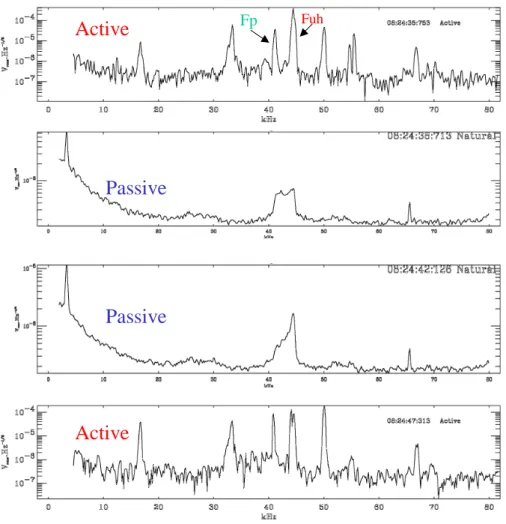
FuhFig. 2. Consecutive active and pas-sive amplitude versus frequency spec-tra. Time separation between spectra is 2–3 s. The enhanced natural plasma emission has its low and high cutoff at Fp andF uh, respectively. The emis-sion atF uhis seen as unstable on the second passive spectrum.
harmonic branch after that time when 2F c < F uh <3F c. This could be due to the fact thatF uhandF qare very close in frequency, which can happen for some givenFp/F c ra-tios (Crawford, 1964). It is then difficult to clearly sepa-rate them with the frequency resolution of Whisper (160 Hz). At this stage, we will not try to discriminate further, since a better frequency separation will be provided in the next ex-ample. A complete diagnosis of the resonances observed in Figure 1 is provided in a companion paper (Trotignon et al., 2001, this issue). Figure 2 shows four consecutive spectra, with amplitude versus frequency, obtained during this period, each separated from the previous one by about 3 s. The top one is an active spectrum and it displays the resonances identified in Fig. 1, with F uhrepresenting the strongest one, with an amplitude, A ∼ 4 ·10−4V/Hz1/2, about two orders of magnitude above the background noise. The bottom active spectrum when compared to the top spec-trum highlights some time variations of the resonance ampli-tude in the 12 s that separate the active periods. It suggests, moreover, that indeed there are two resonances close toF uh, with the upper one tentatively identified as the expectedF q discussed above. The two middle spectra are collected in passive mode. The mode used here corresponds to the best frequency resolution for passive spectra (160 Hz), and each spectrum is an onboard average of 64 spectra, even 13 ms
in duration. A large bandwidth signal is observed, with an amplitude ofA∼6·10−7V/Hz1/2between 41 and 43 kHz. The lower frequency cutoff matches exactly theFp, while the upper cutoff corresponds exactly toF uh−F q. On the second passive spectrum, the signal increases by a factor of two over a narrow bandwidth, with a frequency matching theF uh−F qseen in the active mode. Rapid increases in the amplitude ofF uhwere observed on Geos (Gough et al., 1981b). However, the limited sensitivity of the instrument that allows one to observe only emissions with an amplitude above∼ 10−6V/Hz1/2would have hidden, in this case, all passive features in theFp−F uhband, except the emission excited atF uhon the second spectrum.
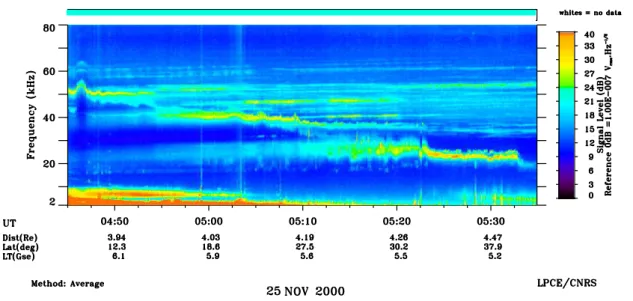
The natural emissions observed by Whisper on 25 Novem-ber 2000 are far more complex than those presented in Fig. 1. Figure 3 shows a dynamic spectrogram of the Whisper data obtained that day on Cluster 1 Rumba, while the spacecraft was again exiting the plasmasphere. The distance was in-creasing from 3.94 to 4.5RE, the latitude was increasing
P. Canu et al.: Identification of natural plasma emissions 1701
Fig. 3. Dynamic spectrogram obtained from Whisper data on 25 November 2000 from Cluster 1 Rumba. The instrument was in passive
mode only. A mixture of narrow band emissions at constant frequencies and stronger waves with decreasing frequencies are observed as the spacecraft recedes from the plasmasphere.
Fig. 4. Same period as in Fig. 3 but obtained from Cluster 4 Tango. Whisper was in active mode part of the time, as indicated by the
yellow-orange bar at the top of the spectrogram. The strong resonance is associated with the strong decreasing frequency.
locally observed emissions (Christiansen, 1978b; Gough et al., 1979; Gough et al., 1981a; Canu, 1984). The local gyrofrequencyF c is increasing slightly during this period, from aboutF c = 14.5 kHz at 04:50 UT toF c =16.4 kHz at 05:30 UT. The strong emissions seen before 05:10 UT at frequencies below 10 kHz are whistler emissions similar to those reported by the WideBand instrument on Cluster (Gur-nett et al., 2001, this issue). Two features dominate the
Fig. 5. Consecutive passive and active
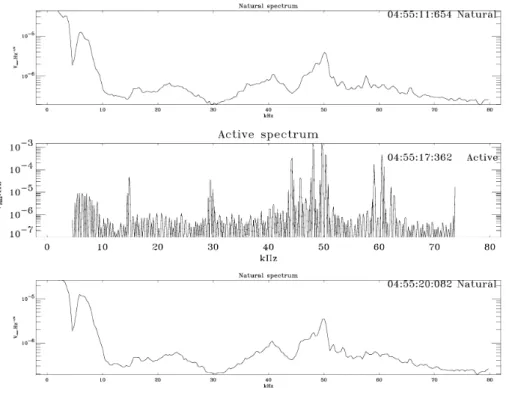
spectra collected on Tango, a few sec-onds apart, at 04:55 UT on 25 Novem-ber. The resonances at 44.27, 45.74, 48.01 and 49.8 kHz are 3F c,Fp,F uh and F q, respectively. The natural emission band lies between Fp and F q, withF qrepresenting the strongest wave.
This amplitude seems to fade away when its frequency ap-proaches a gyroharmonic (not shown on the plot), while the amplitude of the emission in the gyroharmonic branch below increases. The maximum of the amplitude seems to occur when the frequency is close to the middle of the harmonic branch. Whisper 1 Rumba was then only collecting passive measurements, so no resonance spectra were available. But the same region was sampled at the same time by Cluster 4 Tango, with Whisper in active mode part of the time on this spacecraft, as shown in Fig. 4. The separation distance be-tween both spacecraft was about 1700 km. The different se-quences, separated by some data gaps (vertical black bars), correspond to the various modes tested, since Whisper was still in its commissioning phase on Tango. The active periods are identified by a bar at the top of the plot in yellow, when the transmitter voltage is set to 100 V, and in red colour when it is set to 200 V. One can check that the natural emissions observed here closely match the ones observed by Rumba at the same time. The strongest resonance and the first with in-creasing frequency seen outside thenF cseries corresponds to the strong natural emission, which decreases in frequency during the period. Figure 5 displays consecutive passive and active spectra obtained at about 04:55 UT, which allows for a more precise view of the resonances and an identification of natural emissions. At this time, the bit rate dedicated to the active mode allows one to transmit only half of the data points. The onboard data processing then pairs two adjacent bins and downloads the characteristics of the strongest one (see D´ecr´eau et al., 1997). The natural emissions are an-alyzed on board with the 256 bins FFT which provides a 320 Hz frequency resolution. On the active spectrum (middle plot), thenF care well identified at 14.81, 29.46, 44.27 and
59.08 kHz. F uhis detected at 48.01 kHz, while Fp is the faint peak observed at 45.74, between 3F candF uh. The strong resonance at 49.8 kHz aboveF uhis aF q, which is seen in Fig. 4 with a frequency that decreases asymptotically toward 3F c at about 05:10 UT. This F q matches the fre-quency of the strongest emissions observed close to 50 kHz on the natural spectra (top and bottom plots) that are col-lected a few seconds before and after. A small bump can be observed below this strong emission, with a frequency matching the frequency of theF uhresonance. Multiple low power peaks are clearly observed in Fig. 4 and Fig. 3, above the strong amplitude F q. At this stage of the study, it is not possible to precisely identify each of these secondary peaks, which are seen with an almost constant frequency and probably propagating narrow band continuum emissions that are non-locally produced. The possibility that some of the strongerF q emissions at 04:55 UT or 05:15 UT, for ex-ample, could contribute to the generation of the continuum radiation also needs to be further investigated. The reader should note, however, that the peaks observed here have a rather low amplitude, about 1µV/m, which is far below the strong emissions, above 1 mV/m reported by spacecraft such as Geos, Isee, Ampte or Geotail. Such strong emissions are known to be concentrated close to the geomagnetic equator (Christiansen et al., 1978b; Gough et al., 1979; Gough et al., 1981a; Canu, 1984). Their frequency behaviour has been re-cently statistically studied from Ampte data (Labelle et al., 1999). They are also observed by Whisper, but will not be discussed here.
P. Canu et al.: Identification of natural plasma emissions 1703
Fig. 6. Consecutive active and passive
spectra collected on Tango at 05:11 UT on 25 November. On the active spectra, the resonance atFpis barely visible at 36.4 kHz on the middle spectrum.F uh andF qare too close in frequency to be clearly separated.
of terrestrial magnetospheric wave spectra (Christiansen et al., 1978b). They have also been observed in the Io plasma torus from the Ulysses-Urap data and shown to represent quasi-thermal noise on the Bernstein modes (Meyer-Vernet et al., 1993; Moncuquet et al., 1997). Their amplitude increases while Cluster approaches the region where the strongest emission enters the corresponding band (see Fig. 3 at 05:10 UT). Figure 6 shows consecutive active and passive spectra obtained close to 05:11 UT on Tango. Once again, the low frequency cutoff of the natural emissions matches the Fpresonance, which this time is barely visible at 36.4 kHz (panel 3 from top). F uhand the firstF q are so close that they can barely be separated at about 39.55 kHz (see top panel displaying all frequency lines). More generally, the amplitude of the resonance atFp and the one of the natu-ral emission between Fp andF uh are varying with time.
Very often during the period considered here, the resonance atFpcannot be sorted out from the background noise. A first analysis of the data suggests that this variation is related to the spin phase. The strong directivity of the resonances trig-gered by a relaxation sounder are well-known (Higel, 1978); but we will not investigate this point in this work. Return-ing to Fig. 4, we can now identifyFpas the lower cutoff of the fuzzy emissions seen just below the strongestF qrelated emissions, clearly at 04:55 UT, and close to 45 kHz.
Another example is provided in Fig. 7, which displays a Whisper spectrogram collected from Cluster 1 Rumba on 1 October 2000. Once again, the spacecraft was leaving the plasmasphere, close to the perigee: The geocentric distance was about 4RE, with the latitude varying from 7◦to+19◦,
dur-Fig. 7. Dynamic spectrogram obtained from Whisper data on 1 October 2000 from Cluster 1 Rumba. The frequency bandwidth of the
emissions detected between the harmonic of the gyrofrequency varies from broad band to narrow band during this period. They correspond to theF qstriggered in the active mode by Whisper. The plasma frequency is identified with the low frequency cutoff of the emission, which decreases in frequency from about 45 kHz at 11:00 UT down to 30 kHz at 11:45 UT.
ing the period to 16.4 kHz at 11:20 UT. The natural spectra are primarily composed of banded emissions. Each band of emission is between two consecutive harmonics and its cen-tral frequency increases slightly with the increasing gyrofquency. Their bandwidth tends to decrease with time, and re-duce to a narrow band emission before vanishing in the back-ground noise, at about 11:15 UT for the band above 4F c, at about 11:25 UT for the band above 3F cand at the end of the display, at 11:45 UT for the constant frequency band close to 40 kHz. A low amplitude fuzzy emission is also seen close to 45 kHz at about 11:05 UT, below the main band observed between 3F cand 4F c, with a modulated low frequency cut-off. This cutoff reaches the banded emissions extending be-low from 2F c to 3F c at 11:18 UT, and is seen with a de-creasing frequency down to 30 kHz at 11:35 UT. The contin-uous operation of the emitter on Whisper between 11:20 UT and 11:22 UT, clearly shows that the banded emissions with decreasing frequency bandwidths areF qs, and that the up-per cutoff of the banded emission, at 40 kHz at 11:20 UT, for example, exactly matches the strong resonance.
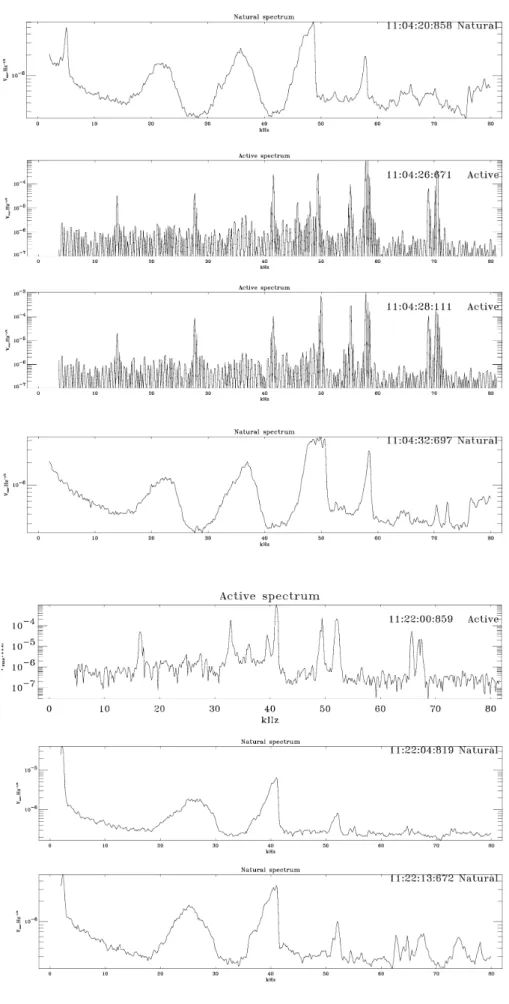
Frequency versus amplitude spectra are displayed in Figs. 8 and 9 to give a more detailed view of these natu-ral emissions at two times around 11:04 UT and 11:22 UT. On the active spectrum, collected at 11:04:26 UT, a few sec-onds before the natural spectrum at the top of Fig. 8, three resonances can be observed between 3F c(41.50 kHz) and 4F c (55.18 kHz). The two first at 45.9, 48.01 kHz have a relatively low amplitude, the third one at 49.48 kHz has an amplitude an order of magnitude above. Using the gyrofre-quency derived from the harmonics (13.8 kHz), we can note that the frequency separation between the first two
P. Canu et al.: Identification of natural plasma emissions 1705
Fig. 8. Consecutive Whisper passive
and active spectra from Rumba on 1 October. The natural emissions which lie betweenFpat 45.9 kHz are seen as a low power resonance on the second active spectrum and with a strong res-onance at F q at 49.8 kHz. The res-onances at Fp and F uh have disap-peared on the second active spectrum.
Fig. 9. Consecutive active and passive
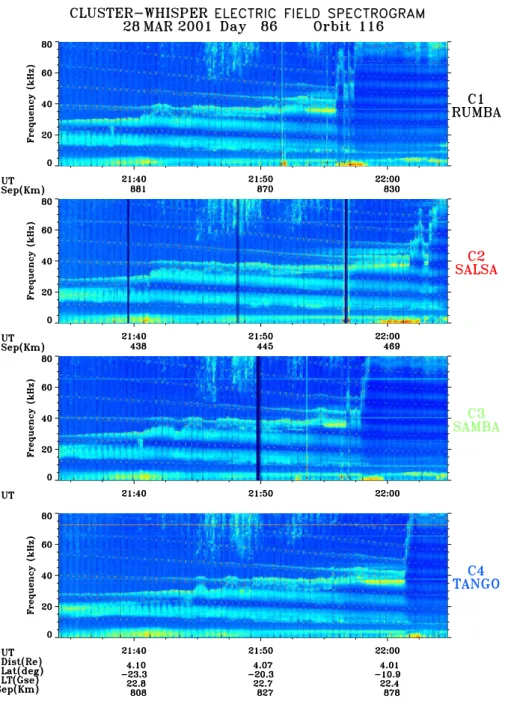
Fig. 10. Dynamic spectrograms ob-tained from the four spacecraft as they encounter the plasmapause on 28 March. Electric field signal strength ranges from about 5 · 10−6 (blue) to 5 ·10−4V/Hz−1/2 (red). Broad band spin modulated emissions are ob-served belowFp, which itself is a faint, barely visible emission seen rising on Salsa, from about 25 kHz at 21:40 UT to about 35 kHz at 21:45 UT and 40 kHz at 22:00 UT. Narrow bandF qsare seen aboveFp. The small dots are the res-onances triggered by the sounder. The horizontal red bar at 72 kHz on Tango is an interference.
and Etcheto et al. (1983).
Figure 10 shows the same signatures, but they come this time from the four spacecraft and illustrate the multi-point view provided by Cluster. On that day, 28 March 2001, the plasmapause was encountered in the nighttime sector, at about 22:30 LT. The spacecraft separation was in the range of 400–800 km. On the dynamic spectrogram, the small dots represent the resonances triggered by the sounder, which was active for 3 s, every 28 s during that period. The plasma-pause encounter occurred with a time difference of a few minutes between the four satellites. The differences in the density fluctuations which can be derived from the emission atFpis clearly visible before this line went out of the Whis-per frequency range. Differences can also be observed in the wave spectra gathered before 22:00 UT. The faint haze at
P. Canu et al.: Identification of natural plasma emissions 1707 highly spin modulated, a key information which will be used
to combine the four points of view in future studies.
4 Discussion
We have seen that in its normal mode of operation, Whisper can observe the various and complex natural wave spectra outside the plasmapause with a good time resolution, fre-quency and sensitivity, from the single emission close to the F uh to complex patterns that mix both local banded, broad band or narrow band plasma emissions on the Bern-stein modes and propagate electromagnetic banded contin-uum radiation. The simultaneous observations of these fea-tures from the Whisper instruments on board each of the Cluster spacecraft confirm that all of these signatures are de-tected by the four instruments, and this allows one to track their detailed separated evolution both in space and time, as shown in Fig. 10. These spectra and their differences re-veal density variations at the scale of the spacecraft sepa-ration, a few hundred kilometers for the data used in Fig. 10, and also suggest small differences in the electron distribu-tion funcdistribu-tions encountered at the four locadistribu-tions, which could be investigated by further common studies with the Cluster Peace instruments. These frequently observed emissions can be identified with good confidence when using the charac-teristic frequencies of the resonances triggered by the relax-ation sounder. The resonances atFp and F uhcan some-times be simultaneously observed, as reported here for the first time in the high altitude magnetosphere (see Figs. 2 and 5, for example). Their relationship with natural emis-sions is more reliably established than could be achieved on previous missions. Fp does not appear in these data as a narrow band emission, but rather as the lower cutoff of an enhanced background noise, seen as a faint haze below the main peak on the spectrograms. The strongest emission is confirmed to be eitherF uhor the firstF q, and its frequency variations can be monitored down to the instrument time res-olution, which is typically 2 s in normal mode, but can reach 0.3 s in the Cluster burst mode. Fast monitoring (∼0.1 s) has been performed on Geos (Gough et al., 1981b) during non-standard operation modes for a limited period, but in order to do this, the frequency bandwidth swept by the instrument had to be decreased to a few hundred Hz, thus the informa-tion on the spectrum outside the main peak was lost. The time and frequency resolution are, of course, better when the waveform sampled over the whole frequency range can be downloaded, as on previous spacecraft, such as Isee-1 (Kurth et al., 1981) or on the WBD instrument on Cluster (Gurnett et al., 2001, this issue). But such data are usually available only for limited periods of time. In the gyroharmonic band which containsF uh, emissions are continuously observed in the events considered in this paper. One observes amplitudes well above the background noise from the electron plasma frequency, which corresponds to a propagation in the direc-tion parallel to the local magnetic field, up to the F q fre-quency, which corresponds to a propagation perpendicular to
the magnetic field. Enhancements of the emissions at Fp, F uhorF q can be observed by Whisper, depending on the local plasma parameters which can cause instability in either of these solutions of the dispersion relation. The reader can also note that the so-called diffuse resonances,Dn, triggered belowFp by the powerful emitters of the ionospheric top-side sounders (McAfee, 1974) were predicted to be excited as well by relaxation sounders in the magnetoshere (Osherovich et al., 1993). These resonances are indeed not observed in the Geos and Isee-1 data (Canu, 2001), and are clearly not present in Whisper data (see Fig. 1 for example).
where a secondary maximum appears, depending on the den-sity and temperature ratios of these components, as shown by Belmont (1981). This qualitative interpretation will be checked in future studies by more quantitative computations of the dispersion relations of waves in a multi-component electron distribution. A final question is related to the exis-tence of additional resonances expected in a non-Maxwellian electron distribution. The modified Bernstein modes which results from this distribution function bring additional fre-quencies with zero-group velocities (Belmont, 1981); this should result in additional resonances triggered by the re-laxation sounder. These resonances, termed “hotF qs”, were indeed observed on Geos (Etcheto et al., 1983) and should appear on Whisper. However, although some resonances seem to exhibit multiple peaks, no specific search has been undertaken in this work. The precise identification of these hotF qs, which are generally of low amplitude, requires a high frequency resolution, and the Whisper capability here (160 Hz) is not reaching the best resolution available on Geos (12 Hz).
5 Conclusion
This first analysis of the plasma waves observed by Whis-per on Cluster have shown that the good sensitivity, time and frequency resolution of the instrument, combined with the plasma diagnosis capabilities provided by the resonances triggered by the relaxation sounder, are promising significant advances in the identification on a routine basis of natural plasma emissions. Whisper observational capabilities con-firm that emissions atFp,F uhandF qscan sometimes be observed at the same time, with varying relative electric field strength. Most of the time, the emission at the plasma fre-quency is not observed as a strong, narrow band, peak in the wave spectra, but rather as the lower cutoff of an en-hanced background noise, which can be tracked by Whisper. The good frequency resolution of the instrument allows are to discriminate between these various emissions with good confidence, with the help of the resonances triggered in the active mode. The good sensitivity and time resolution per-mits are to track in detail and over long period, their respec-tive frequency and time evolution depending on the varia-tions of the local plasma parameters. Similar features, as well as differences in their evolution in time and frequency, are already easily observed in the data gathered close to the plasmapause by the four spacecraft, which reveals small dif-ferences in the density variations as Cluster approachs the boundary. This first study confirms the conclusions reached from the Geos data that the observed emissions are not fully modeled by the Bernstein modes derived from a single elec-tron distribution function. Future detailed identifications of both resonances and plasma waves should then rely on a multi-temperature distribution of electrons. The capability of Whisper to precisely categorize the various characteristics of the observed emissions and their fast evolution with time allows one to now undertake the investigation of the
three-dimensional characteristics of the plasma waves which reslts from the combination of data coming from the four Cluster spacecraft.
Acknowledgements. We are very grateful to all the members of the
Cluster project who made this mission a success. We are indebted to all the colleagues who contributed in the design, build (and rebuild), tests and data processing of the Whisper instruments throughout the years, and more specially to all the WEC team. We have a specific thought for L. Woolliscroft former PI of the DWP on WEC who is not sharing with us the excitement of this first contact with the Clus-ter data. We are very grateful to the people of the WEC team and at ESOC who make the long commissioning phase of WEC instru-ments a success, more specially to P. A. Linquist, WEC chairman, and Silvano Manganelli from ESOC. We thank the French Space Agency CNES for financial and data analysis support. The CETP contribution to Whisper is supported by CNES under contract 7358. The Editor in Chief thanks S. Buchert and another referee for their help in evaluating this paper.
References
Barbosa, D. D.: Low level VLF and LF radio emissions observed at Earth and Jupiter, Rev. Geophys., 20, 316, 1982.
Belmont, G.: Characteristic frequencies of a non Maxwellian plasma. A method for localizing the exact frequencies of mag-netospheric intense natural waves nearFp, Planet. Space Sci. 29, 1251, 1981.
Belmont, G., Canu, P., Etcheto, J., de Feraudy, H., and Higel, B.: Contribution of relaxation sounding experiments to the under-standing of magnetospheric processes, ESA SP-217, 701–704, 1984.
Canu, P., Belmont, G., and Fontaine, D.: Role of the equatorial ECH waves in the generation of diffuse auroras. Contribution of the Geos IMS spacecraft, ESA SP-217, 581–584, 1984. Canu, P.: Observation of long-duration gyroharmonic resonances:
A refutation of the short duration explanation for interpreting the anomalous URAP sounder spectra observed in the Io torus, Ra-dio Sci., 36, 171–181, 2001.
Christiansen, P. J., Gough, M. P., Martelli, G., Bloch, J. J., Cornil-leau, N., Etcheto, J., Gendrin, R., Jones, D., Beghin, C., and D´ecr´eau, P. M. E.: Geos, Identification of natural magneto-spheric emissions, Nature 272, 682, 1978a.
Christiansen, P. J., Gough, M. P., Martelli, G., Bloch, J. J., Cornil-leau, N., Etcheto, J., Gendrin, R., Beghin, C., D´ecr´eau, P. M. E., and Jones, D.: Geos-1 observations of electrostatic waves and their relationship with plasma parameters, Space. Sci. Rev., 22, 283–400, 1978b.
Crawford, F. W.: Cyclotron harmonic waves in warm plasma, Radio Sci. 69D, 789, 1964.
D´ecr´eau, P. M. E., Hamelin, M., Massif, R., de Feraudy, H., Pawela, E., Perraut, S., Pottelette, R., and Bahnsen, A.: Plasma probing by active experiments on the Viking satellite, Ann. Geophysicae Ser. A, 5, 181–186, 1987.
D´ecr´eau, P. M. E., Fergeau, P.,Krasnosels´kikh, V., L´evˆeque, M., Martin, P., Randriamboarison, O., Sen´e, F. X., Trotignon, J. G., Canu, P., and M¨ogensen, P. B.: Whisper. A resonance sounder and wave analyzer: Performance and perspectives for the Cluster mission, Space Sci. Rev., 79, 157–193, 1997.
Whis-P. Canu et al.: Identification of natural plasma emissions 1709
per experimenters: Early results from the Whisper instrument on Cluster: an overview, Ann. Geophysicae, 2001, this issue. Etcheto, J. and Bloch, J. J.: Plasma density measurements from the
GEOS-1 relaxation sounder, Space Sci. Rev., 22, 597–610, 1978. Etcheto, J., Christiansen, P. J., Gough, M. P., and Trotignon, J. G.: Terrestrial continuum radiation observations with Geos-1 and Isee-1, Geophys. Res. Lett., 9, 1239–1242, 1982.
Etcheto, J., Belmont, G., Canu, P., and Trotignon, J. G.: Active sounder experiments on GEOS and ISEE, ESA SP-195, 39–46, 1983.
Etcheto J., Christiansen, P. J., and Gough, M. P.: Problems in the interpretation of natural plasma wave spectra, Ann. Geophysicae, 3, 4, 417–420, 1985.
Gough, M. P., Christiansen, P. J., Martelli, G., and Gershuny, E. J.: Interaction of electrostatic waves with warm electrons at the ge-omagnetic equator, Nature, 279, 515, 1979.
Gough, M. P., Christiansen, P. J., and Gershuny, E.: Electrostatic wave morphology near the geostationnary orbit, Adv. Space Res., 1, 337, 1981a.
Gough, M. P., Christiansen, P. J., and Thomas, R.: Electrostatic emissions studied in high rsolution, Adv. Space. Res., 1, 345, 1981b.
Gurnett, D. A.: The Earth as a radio source: The non thermal con-tinuum, J. Geophys. Res., 80, 2751–2763, 1975.
Gurnett D. A. , Huff R. L., Pickett, J. S., Persoon, A. M., Kletzing, C. A., Mutel, R. L., Christopher, I. W., Inan, U. S., Martin, W. L., and Bougeret, J.-L.: First Results from the Cluster Wide-Band Plasma Wave Investigation, Ann. Geophysicae, 2001, this issue. Gustafsson, G., Bostr¨om, R., Holback, B., Holmgren, G., Lundgren, A., Stasiewicz, K., Ahlen, L., Mozer, F. S., Pankow, D., Har-vey, P., Berg, P., Ulrich, R., Pedersen, A., Schmidt, R., Butler, A., Fransen, A. W. C., Klinge, D., Thomsen, M., Fˆalthammar, C. G., Lindqvist, P.-A., Christenson, S., Holtet, J., Lybekk, B., Sten, T. A., Tanskanen, P., Lappalainen, K., and Wygant, J.: The electric filed and wave experiment for the Cluster mission, Space Science Reviews, 79, 137–156, 1997.
Gustafsson, G., Andr´e, M., Eriksson, A. I., et al.: First results of electric field and density oberservations by Cluster EFW based on initial months of operation, Ann. Geophysicae, this issue, 2001.
Higel, B.: Small scale structure of magnetospheric electron density through on-line tracking of plasma resonance, Space Sci. Rev. 22, 611–631, 1978.
Jones, D.: Terrestrial myriametric radiation from the Earth’s
plasmapause, Planet. Space Sci., 30, 339, 1982.
Kurth, W. S.: Detailled observations of the source of terrestrial narrowband electromagnetic radiation, Geophys. Res. Lett., 9, 1341–1344, 1981.
LaBelle, J., Ruppert, D. R., and Treuman, R. A.: A statisitical study of banded magnetospheric emissions, J. Geophy. Res., 104, 293– 303, 1999.
Le Sager, P., Canu, P., and Cornilleau-Wehrlin, N.: Impact of the Ulysses velocity on the diagnosis of the electron density by the Unfied Radio and Plasma Wave sounder in the outskirts of the Io torus, J. Geophys. Res., 103, 26 667, 1998.
McAfee, J. R.: Electron plasma resonances in the topside iono-sphere, Fundam. Cosmic Phys., 1, 71–117, 1974.
Meyer-Vernet, N., Hoang, S., and Moncuquet, M.: Bernstein waves in the Io plasma torus: A novel kind of electron temperature sen-sor, J. Geophys. Res., 98, 21 163–21 176, 1993.
Moncuquet, M., Meyer-Vernet, N., Hoang, S., Forsyth, R. J., and Canu, P.: Detection of Bernstein wave forbidden bands in the Jo-vian magnetosphere: A new way to measure the electron density, J. Geophys. Res., 102, 2373–2379, 1997.
Osherovich, V. A., Benson, R. F., Fainberg, J., Stone, R. G., and MacDowall, R. J.: Sounder stimulatedDnResonances in Jupiter´s Io torus, J. Geophys. Res., 98, 18 751–18 756, 1993. Pedersen, A., Cornilleau-Wehrlin, N., de La Porte, B., Roux, A.,
Bouabdellah, A., D´ecr´eau, P. M. E., Lefeuvre, F., Sen´e, F. X., Gurnett, D., Huff, R., Gustafsson, G., Holmgren, G., Woolsis-croft, L., Alleyne, H. St. C., Thomson, J. A., and Davies, P. H. N.: The Wave Experiment Consortium (WEC), Space Sci. Rev., 97, 93–106, 1997.
Perraut, S., De Feraudy, H., Roux, A., D´ecr´eau, P. M. E., Paris, J., and Matson, L.: Density measurements in key regions of the Earth’s magnetosphere: Cusp and auroral region, J. Geophys. Res., 95, 5997–6014, 1990.