Correlation of Automobile Bumper
Performance with Geometry of the Automobile
I.U. ONYENANU, O.J. EZEONWUMELU, M. K. UGWU,
Members, IAENG
Abstract – This paper presents a correlation of Automobile bumper performance with geometry of the Automobile. The study focuses on finding out if there is any existing relationship between the two variables mentioned and to determine the strength of that relationship if there is any. An approach which allows for this- Pearson’s Correlation process- developed by Karl Pearson is applied. Varying automobile bumpers resulting from different automobile geometry models were simulated using Solid Work Software. The Correlation analysis carried out with the simulation data, produced Correlation coefficients of 0.990534919 & 0.990658205; showing a very strong positive correlation between the variables. Since the Correlation coefficient obtained is greater than the corresponding critical value of Correlation coefficient, 0.917, (under 0.1 tailed test of type1 error) for the correlation degree of freedom of 4, it follows that this research runs only 1% chance of being wrong in the relationship so determined. Hence, it will be useful in automobile design in general.
Index Terms - Automobile geometry, Bumper performance and Correlation.
I. INTRODUCTION
It is evident that many bodies in existence possess one form of geometry or the other and as such enables them in their behavioural patterns and characteristics. Geometry plays an important role in our lives that it cannot be ignored. It has helped man a lot in life. Our houses, roads, cars etc. are all geometrical work.
The significance of geometry in automotive industries (as a matter of interest) cannot be overemphasized, especially as it affects the vehicle’s aerodynamics, their crashworthiness, e.t.c. (Nicholas Wong, 2009). The angles and shapes of certain parts of a car can produce positive or negative effect(s) on the vehicle. The aerodynamics affects the stability of cars at high speed, fuel consumption rate, top speed capabilities, safety, and wind noise that filters into the cabin. Geometry is also involved in engine designs, for example, some engines are angled, like a V6 engine, while others are line segments like a straight 8. It is equally considered in vehicle transmissions too. The diameter and ratio of the gears must be correct to match the engine capabilities. The tires of the car also involve geometry. The treads forms a continuous pattern that repeats over and over. In suspensions, geometry plays an important role in the car's handling characteristics (majorly in shock absorption). Not left out are the impact absorption parts like the bumper whose geometry is of interest in the crashworthiness of a vehicle.
It is, therefore, the intent of this research work to x-ray the correlation of a vehicle bumper performance with the vehicle geometry. It is believed that in the end, it will provide automobile industries with information necessary for better/improved vehicle design.
Manuscript received March 18, 2013; revised April 14, 2013
I.U. Onyenanu is with the Nuta_Bolts Formula Student Racing Team, Department of Mechanical Engineering, Anambra State University, Uli - Nigeria (GSM: +234-8067673228; e-mail: [email protected]).
O.J. Ezeonwumelu is with the Advance Manufacturing Technology Department, Scientific Equipment development Institute, Enugu - Nigeria (GSM: +234-8030992651; e-mail: [email protected]).
M. K. Ugwu with the Production Management and Planning Department, Scientific Equipment development Institute, Enugu - Nigeria (GSM: +234-8035339123; e-mail: [email protected]).
A. Aims and Objectives of the Research
The objectives are to:
a) Determine whether a relationship exist between a vehicle bumper performance with the vehicle geometry using Pearson’s Correlation Statistical process
b) Determine whether the relationship is positive or negative if there is any .
c) Determine the strength of the relationship
B. Scope of the Work
Finding the correlation of vehicle bumper performances with the vehicle geometry will involve the application of the
Pearson’s Correlation statistical process. The different automobile geometries, giving rise to same number of various bumpers will be modelled using SolidWorks software. The data will be generated by taking advantage of the sensitivity of the major variables (bumper stiffness, k; dynamic crush, x; e.t.c) with respect to impact condition as a good basis for determining the required Pearson’s Correlation coefficient, r. A plot will be produced using the data generated. Finally, decision over the correlation will be made based on the obtained values of the Pearson’s Correlation Coefficient, r, ranging from -1.00 to +1.00 (Jim Hinggins, 2005). Large Correlation coefficients (closer to +/- 1.00) shows stronger relationship, whereas smaller Correlation coefficients (close to 0.00) shows weaker relationship. The percentage chance of being wrong in the relationship is determined with the help of the critical value of Correlation coefficient.
C. Problem Statement
During Collision, a stopping force is generated, which tends to bring the vehicle to a stop (Nelkon and Parker, third edition). The larger the stopping force of a vehicle upon collision, the more the injuries sustained by the occupants, since it will bring the vehicle to a quick stop. It is evident that some parts like the automobile bumper are incorporated to mitigate the after effect. But how effectively this is achieved could or not depend on other part(s) of the vehicle to which the bumper is attached. It is,\ therefore, the intent of this research work to ascertain the correlation between bumper performance and vehicle geometry. It is believed that at the end, it will provide automobile industries with information necessary for better/improved vehicle design which will in turn guarantee a reduced effect of the impact on the vehicle and the fragile passenger(s) as well.
D. Assumptions
1) The impact is assumed to be central (A.R. Mortazavi Moghaddam, et. Al, 2011).
2) No air resistance to the motion of the load, F
3) The bumper systems used is assumed to be made of the same material (Alumunium Alloy 6061, in this case), hence, same material properties.
4) No friction at contact point of the vehicle and the impact load.
5) Consideration is made of a fixed bumper with an applied frontal force (impact load).
6) The bumper displacement is taken as the displacement produced just at the first contact of the vehicle with the impact load for every impact velocity.
7) The bumper was never permanently deformed at this impact level.
8) The vehicle body is protected from any deformation at reasonable high velocity impact. Therefore, any system dynamics due to the body structure will not be active (Benson H. Tongue, et .al, 1997). Thus, giving rise to a collision dynamic model simplified to a bumper and a lump mass.
II. METHODOLOGY
Considering the existing Automobile designs with precisely spring loaded type bumper - made up of metallic spring absorbers; Alumunium fascia and beam; e.t.c., it is the intent of this research work to determine if there exist or not a correlation between the automobile bumper and its geometry. This was done by subjecting variuos automobile bumper geometries (resulting from the various modelled automobile geometries) to various frontal impact loads, L (N). The resulting bumper displacement, x (m) was noted. The varying bumper stiffnesses, k (N/m) (resulting from the automobile
geometry variations was determined using the Hooke’s law
relation .
Geometry Length L (m)
Radius of curvature R (m)
Impact Load F (N)
Displacement, x (m) * 10^-6
Stiffness, K, (N/m) * 10^8
A 1.135 1.125386 3000 4.07766 7.357160725 B 1.130 1.124346 3000 4.0506 7.406310176 C 1.125 1.123311 3000 4.01063 7.480121577 D 1.120 1.12228 3000 3.99145 7.51606559 E 1.115 1.121253 3000 3.97759 7.542255486 F 1.110 1.1202312 3000 3.93889 7.616358923 Table, I: Showing bumper displacements in response to changes in its length, L, radius of curvature, R, and stiffness, k,
at impact condition.
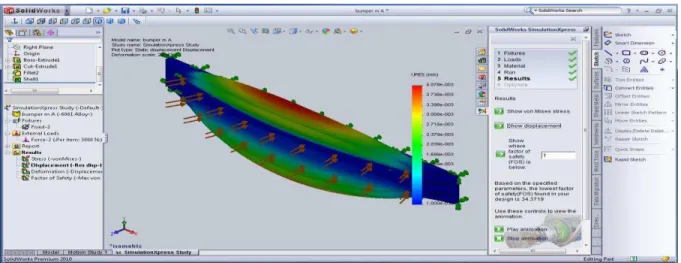
Fig. 1: The SolidWorks interface showing the displacement response of the modelled bumper impact simulation.
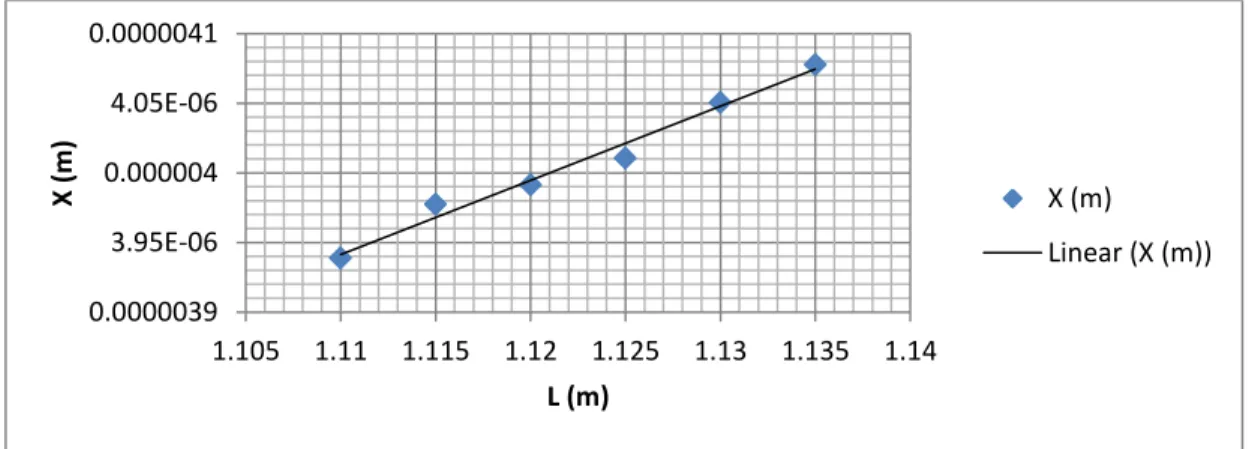
The graphs of the various bumper displacement, x (m) against the corresponding, length, L, radius of curvature, R, and stiffness, k for each of the modelled automobile geometry were plotted as shown in figures 3, 4, and 5, respectively.
0.0000039 3.95E-06 0.000004 4.05E-06 0.0000041
1.105 1.11 1.115 1.12 1.125 1.13 1.135 1.14
X
(
m
)
L (m)
X (m)
Linear (X (m))
0.0000039 3.95E-06 0.000004 4.05E-06 0.0000041
1.119 1.12 1.121 1.122 1.123 1.124 1.125 1.126
X
(
m
)
R (m)
X (m)
Linear (X (m))
3.92E-06 3.94E-06 3.96E-06 3.98E-06 0.000004 4.02E-06 4.04E-06 4.06E-06 4.08E-06 0.0000041
730000000 740000000 750000000 760000000 770000000
X
(
m
)
K (N/m)
X (m)
Linear (X (m))
Fig. 3: Bumper displacement, x, in response to changes in its length, L.
Fig. 4: Bumper displacement, x, in response to changes in its radius of curvature, R.
III. THE CORRELATION ANALYSIS
From the resulting graphs of figures 4 and 5, showing various response of the bumper (having considered its geometry to be a function of its length, L, and radius of curvature, R) , it becomes evident that there is a positive correlation between automobile bumper performance and its geometry.
Thus, applying the Pearson’s Correlation approach, using the relation of equation, 1.0, the strenght of the relationship giving by the Correlation Coefficient, r, was determined as follows:
∑
∑ ∑
√(∑ ∑ )(∑ ∑ )
…. (1.0)
Where, = Correlation Coefficient for length, L and displacement, X.
Similary, = Correlation Coefficient for radius of curvature and displacement, X.
= Correlation Coefficient for stiffness and displacement, X
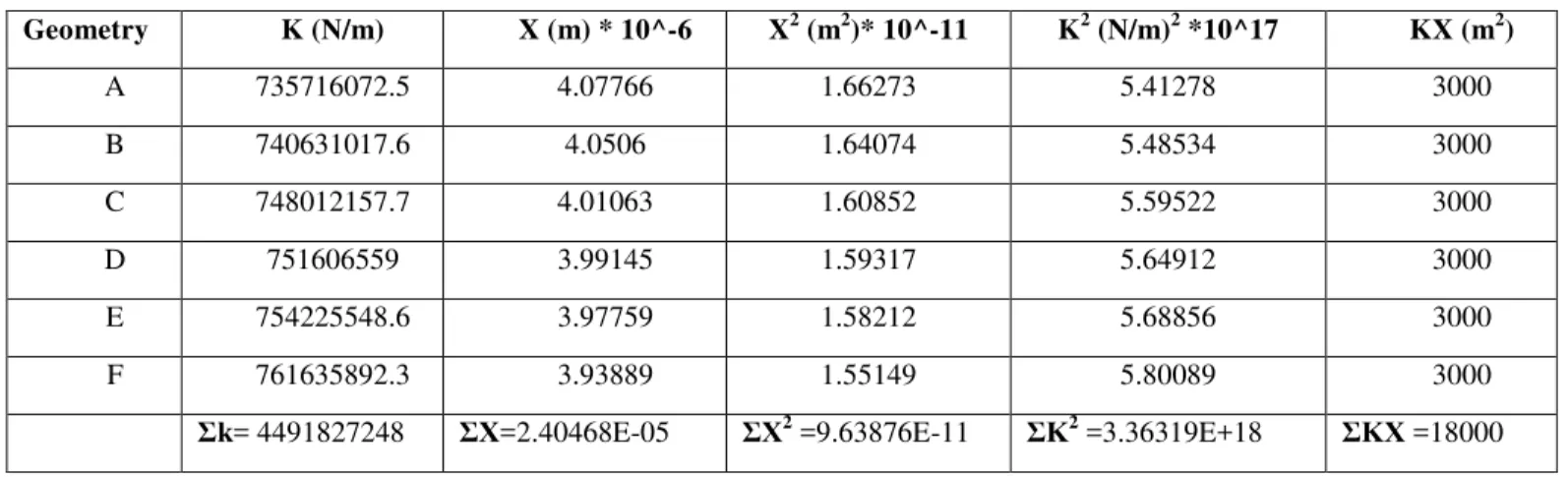
Geometry K (N/m) X (m) * 10^-6 X2 (m2)* 10^-11 K2 (N/m)2 *10^17 KX (m2)
A 735716072.5 4.07766 1.66273 5.41278 3000 B 740631017.6 4.0506 1.64074 5.48534 3000 C 748012157.7 4.01063 1.60852 5.59522 3000 D 751606559 3.99145 1.59317 5.64912 3000 E 754225548.6 3.97759 1.58212 5.68856 3000 F 761635892.3 3.93889 1.55149 5.80089 3000
Σk= 4491827248 ΣX=2.40468E-05 ΣX2 =9.63876E-11 ΣK2=3.36319E+18 ΣKX =18000
Geometry R (m) X (m) * 10^-6 X2 (m2)* 10^-11 R2 (m)2 RX (m2)
A 1.125386 4.07766 1.66273 1.266493649 3000 B 1.124346 4.0506 1.64074 1.264153928 3000 C 1.123311 4.01063 1.60852 1.261827603 3000 D 1.12228 3.99145 1.59317 1.259512398 3000 E 1.121253 3.97759 1.58212 1.25720829 3000 F 1.1202312 3.93889 1.55149 1.254917941 3000
ΣR= 6.7368072 ΣX=2.40468E-05 ΣX2 =9.63876E-11 ΣR2 =7.564113809 ΣRX =2.70003E-05
Geometry L (m) X (m) * 10^-6 X2 (m2) * 10^-11 L2 (m)2 LX (m2)* 10^-6
A 1.135 4.07766 1.66273 1.288225 4.62814E-06 B 1.130 4.0506 1.64074 1.2769 4.57718E-06 C 1.125 4.01063 1.60852 1.265625 4.51196E-06 D 1.120 3.99145 1.59317 1.2544 4.47042E-06 E 1.115 3.97759 1.58212 1.243225 4.43501E-06 F 1.110 3.93889 1.55149 1.2321 4.37217E-06
ΣL= 6.735 ΣX=2.40468E-05 ΣX2 =9.63876E-11 ΣL2 =7.560475 ΣLX =2.69949E-05 Table II: Statistical data for the correlation analysis involving the bumper stiffness, k.
Table III: Statistical data for the correlation analysis involving the bumper radius of curvature, R.
Hence, substituting the values accordingly as stated in tables above, we have; = 0.990534919 ; = 0.990658205 ; = - 0.999941415
IV. CONCLUSION
From these values obtained, it follows that there is a very strong positive relationship between the bumper response (perfomance) and its geometry (The bumper deformation/displacement, X, increases as its length, L and radius of curvature, R, increases respectively). While, there is a negative relationship between the bumper response (performance) and its stiffness (The bumper deformation/displacement increases with reduced stiffness).
Confirmation of the Correlation Coefficient values so obtained as a true representation of automobile design at large, (given by the Critical value of the Correlation Coefficient) was performed as follows:
Since there are 6 bumpers (A through F) in the data set used to calculate the correlation coefficient, it follows that there are 6 pairs of data (each bumper has two scores:one on the X variable and one on the other variables). Thus, from the relation
We have,
From the statistical table of the “Critical Values of r” or “Critical Values of the Correlation Coefficient”, it
follows that the Correlation Coefficients obtained ( = 0.990534919; = 0.990658205 ; = - 0.999941415) are greater than the critical value of the Correlation coefficient, (0.917 ) as listed in the table against the degree of freedom value of 4 under 0.1 tailed test of type1 error.
It implies that this research run only 1% chance of being wrong in the relationship so determined between automobile bumper performance and automobile geometry. Hence, it will be of good use in automobile design in general
REFERENCES
[1]
A.R. Mortazavi Moghaddam and M. T. Ahmadian. Design and Analysis of an Automobile Bumper with the Capacity of Energy Release UsingGMT Materials. World Academy of Science, Engineering and Technology, 76 2011.
[2]
Benson H. Tongue, Andrew Packard, and Douglas Harriman. A Vehicle Collision Model for Platoon Controller Development. California PATH Research Report. UCB-ITS-PRR-97-22, 1997.
[3]
Bumper (automobile) - Wikipedia, the free encyclopediaen.wikipedia.org/wiki/Bumper_
(automobile) Jim Hinggins. The Radical Statistician, 2005.
[4]
M. Nelkon and P. Parker. Advance level physics. Third Edition. Heinemann Educational Books Ltd. London.
[5]
Nicholas Wong. Geometry in Automobile Design and Technology, (www.oocities.org ) 2009.
[6]