Submitted 28 May 2015 Accepted 14 July 2015 Published25 August 2015 Corresponding author
John R. Speakman, [email protected], [email protected]
Academic editor
David Levine
Additional Information and Declarations can be found on page 23
DOI10.7717/peerj.1155 Copyright
2015 Wang et al.
Distributed under
Creative Commons CC-BY 4.0 OPEN ACCESS
The relationship of female physical
attractiveness to body fatness
Guanlin Wang1, Kurosh Djafarian2, Chima A. Egedigwe3, Asmaa El Hamdouchi4, Robert Ojiambo5, Harris Ramuth6, Sandra Johanna Wallner-Liebmann7, Sonja Lackner7,
Adama Diouf8, Justina Sauciuvenaite9, Catherine Hambly9, Lobke M. Vaanholt9, Mark D. Faries10and John R. Speakman1,9
1State Key Laboratory of Molecular Developmental Biology, Institute of Genetics and Develop-mental Biology, Chinese Academy of Sciences, Beijing, China
2Department of Clinical Nutrition, Tehran University of Medical Sciences, Tehran, Iran 3Department of Biochemistry, Michael Okpara University of Agriculture, Umuahia, Abia State,
Nigeria
4CNESTEN, Unit´e Mixte de Recherche Nutrition et Alimentation, CNESTEN-Universit´e Ibn Tofail, Rabat, Morocco
5College of Health Science, School of Medicine, Medical Physiology Department, Moi University, Eldoret, Kenya
6Biochemistry Department, Central health Laboratory services, Ministry of Health and Quality of Life, Mauritius
7Center of Molecular Medicine, Institute of Pathophysiology and Immunology, Medical Univer-sity Graz, Graz, Austria
8Laboratoire de Nutrition, D´epartement de Biologie Animale, Facult´e des Sciences et Techniques, Universit´e Cheikh Anta Diop de Dakar, Dakar, Senegal
9Institute of Biological and Environmental Sciences, University of Aberdeen, Aberdeen, UK 10Stephen F. Austin State University, Nacogdoches, TX, USA
ABSTRACT
Aspects of the female body may be attractive because they signal evolutionary fitness. Greater body fatness might reflect greater potential to survive famines, but individuals carrying larger fat stores may have poor health and lower fertility in non-famine conditions. A mathematical statistical model using epidemiological data linking fatness to fitness traits, predicted a peaked relationship between fatness and attractiveness (maximum at body mass index (BMI)=22.8 to 24.8 depending on ethnicity and assumptions). Participants from three Caucasian populations (Austria, Lithuania and the UK), three Asian populations (China, Iran and Mauritius) and four African populations (Kenya, Morocco, Nigeria and Senegal) rated attractiveness of a series of female images varying in fatness (BMI) and waist to hip ratio (WHR). There was an inverse linear relationship between physical attractiveness and body fatness or BMI in all populations. Lower body fat was more attractive, down to at least BMI=19. There was no peak in the relationship over the range we studied in any population. WHR was a significant independent but less important factor, which was more important (greaterr2) in African populations. Predictions based on the fitness model were not supported. Raters appeared to use body fat percentage (BF%) and BMI as markers of age. The covariance of BF% and BMI with age indicates that the role of body fatness alone, as a marker of attractiveness, has been overestimated.
INTRODUCTION
Mate selection is a key behavioral component of reproduction related to the survival of ones’ genes in the future gene pool (Andersson & Simmons, 2006;Trivers, 1985). Our perceptions of attractiveness of potential mates is complex and multi-dimensional, and may include many diverse aspects. These include economic parameters, like possessions, wealth and social economic status (SES) (Drury, 2000;Swami et al., 2010), psychological components such as cognitive ability, behavior, personality and social competence (Eagly et al., 1991), physiological aspects such as the major histocompatibility complex status (Thornhill et al., 2003), hormone levels (Pawlowski & Sorokowski, 2008) and age (BorgerhoffMulder, 1998). In addition, physical aspects such as leg length (Swami, Einon & Furnham, 2006b), the shape of the face (Grammer & Thornhill, 1994;Perrett et al., 1998) and shape of the body (Fallon & Rozin, 1985;Furnham, Tan & McManus, 1997;
Singh, 1993;Singh & Young, 1995;Swami et al., 2006a;Swami & Tovee, 2005;Tov´ee et al., 2006;Tovee & Cornelissen, 2001;Tovee et al., 2002;Wass et al., 1997) including the role of symmetry (Perrett et al., 1998;Singh, 1993;Singh & Young, 1995;Smith, Cornelissen & Tov´ee, 2007;Tovee & Cornelissen, 2001;Tovee et al., 2002) are also significant factors affecting attractiveness. The relative importance of these different dimensions for physical attractiveness may vary between the sexes and across cultures.
One aspect of attractiveness that has received considerable previous attention is the factors that drive perceptions of attractiveness of the female body (non-facial). Early studies focused on waist to hip ratio (WHR) (Singh, 1993;Tovee et al., 2002). A suggested preference for an optimal WHR around 0.7 has been generally interpreted within an evolutionary context because higher values of WHR are related to elevated risks of cardiovascular disease (Terry, Page & Haskell, 1992), diabetes (Chan et al., 1994) and cancer (Borugian et al., 2003). However,Lassek & Gaulin (2008)have suggested that WHR is not associated with health but more related to cognitive abilities. It has been noted, however, that WHR is not independent of body fatness, which may itself be an indicator of physical attractiveness. More recent work therefore has attempted to partition the importance of these two factors, and it has been conclusively shown across numerous studies that variation in attractiveness is much more closely related to variation in body fatness than to differences in WHR (e.g.,Henss, 2000;Ko´sci´nski, 2013;Smith, Cornelissen & Tov´ee, 2007;
Tassinary & Hansen, 1998;Tovee & Cornelissen, 1999;Tovee et al., 2002;Tovee & Cornelissen, 1999;Tovee et al., 1997;Tovee et al., 1998).
attractiveness should mirror the relationship between fatness and fitness. Our aim was to develop such a model for the role of body fatness in physical attractiveness using, where available, culture specific data and then test the model across a range of different cultures, using a common protocol. We sampled independent populations drawn from the 3 dominant racial groups on earth: three Caucasian populations (Austria, Lithuania and UK), three Asian populations (China, Iran and Mauritius) and four African populations (Kenya, Morocco, Nigeria and Senegal). Caucasian, Africans and Asians together represent 91.4% of the current total world population (http://www.geohive.com/earth/world1. aspx). We found that females with lower body fatness (BMI and BF%) were rated as more attractive in all societies. WHR was also a significant factor that was more important (greaterr2) in African populations. Deviations from the evolutionary model were probably because raters used BMI as a proxy for subject’s age.
METHODS
Evolutionary model
We considered that variation in female body fatness might have important fitness consequences for three different reasons: risk of fatal disease, impacts on fecundity, and survival under famine conditions. We searched the literature for epidemiological studies which had related the risks of mortality due to various individual fatal diseases, and all-cause mortality, to individual differences in body fatness. In addition we also sought studies that had linked together variations in body fatness and fertility. The thrifty gene hypothesis, first developed in the 1960s (Neel, 1962) with respect to diabetes, and subsequently elaborated in the context of obesity (Eknoyan, 2001;Lev-Ran, 2001), suggests that we have a genetic predisposition to obesity because in our evolutionary history we were regularly exposed to periods of famine. Individuals carrying ‘thrifty genes’, favouring the efficient deposition of fat reserves in the intervals between famines, would therefore be selected because they would have a greater chance of surviving the next famine. Body fatness is therefore an advantageous trait with respect to famine survival (but see
Speakman, 2007;Speakman, 2008). Interestingly, in this context males who are more hungry alter their ratings of female attractiveness towards fatter subjects (Swami & Tovee, 2006). The exact relationship between survival in the absence of food and body fatness has been the subject of several mathematical models (Hall, 2012;Song & Thomas, 2007;
Speakman & Westerterp, 2013). We used the outputs of such models to predict the shape of the relationship between body fatness and famine survival, and hence mortality risk (1/survival). We then combined these different impacts of body fatness on mortality, to produce two anticipated relationships between fatness and fitness: one including the effects of famine and one excluding such effects.
Female body images
previously used (Faries & Bartholomew, 2012) to study the role of fatness in the perception of physical attractiveness in US college students. The 21 female body images covered 7 levels of body fat percentage (BF %): 15%–20%, 21%–25%, 26%–30%, 31%–35%, 36%–40%,41%–45%, and 46%–50%. At each level of BF% there were 3 levels of WHR: low (0.60–0.66), mid (0.67–0.75), and high (0.76–0.88) respectively. The BMI ranged from 19 to 40 kg m−2. These images were selected from a database of over 5,000 female images and were specifically selected to break any correlation of BF% to WHR (Faries & Bartholomew, 2012). There was consequently a non-significant correlation between the two variables in these images (r2=0.029,p> .05, for full details of the images and their characteristics see (Faries & Bartholomew, 2012). We could not use a wider range of body fatness because it was not possible to find images with higher or lower BMI with also the desired range of WHR. The range we used spanned all the predicted peaks in the relationship between BMI and fitness derived from the evolutionary models.
Ages of the subjects in the images were known, but not controlled for, or revealed to the raters. By using DXA images the facial details were not a factor influencing the subjects’ judgment of attractiveness. Two of the images showing a constant level of WHR at two very different levels of body fatness are shown in (Fig. S1). For the present study, the images were printed on an A3 sheet of heavy paper and the individual images were then cut out into playing card sized rectangles. The number of the image (1 to 21) (Faries & Bartholomew, 2012) was written on the back of each card.
Participants
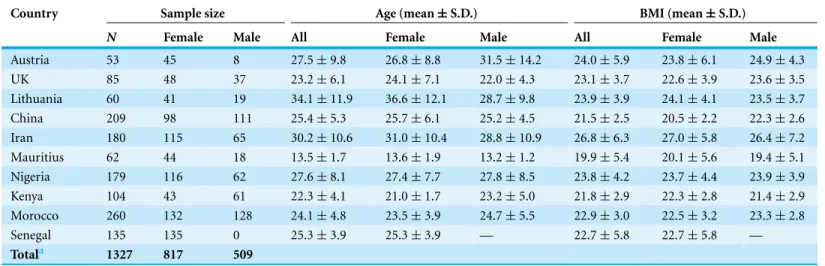
Participants (N =1,327 in total) were recruited from major cities in ten countries: Graz in Austria; Panevezys in Lithuania; Aberdeen in the UK; Beijing in China; Tehran in Iran; Port Louis in Mauritius; Eldoret in Kenya; Tiflet, Kenitra, Casablanca, Rabat and Oujda in Morocco; Umuahia, Abia state, in Nigeria; and Dakar in Senegal (Table 1). Participation was voluntary and verbal informed consent was obtained before the study. All the procedures for the overall study were ethically reviewed and approved by the Chinese Academy of Sciences,Institute of Genetics and Developmental Biology Institutional Review Board (IGDB-2013-IRB-005). In addition, local ethical approval was also obtained at the UK site from the University of Aberdeen College of Life Science and Medicine Ethical Review Board (CERB/2014/12/1123).
Procedure
Participants (raters) were asked for some basic information (age, sex, ethnicity, height, weight) before the task started. They were then given the 21 image cards which were shuffled and placed on a table in front of them in a random order. Participants were then asked to reorder the cards from the most attractive on their right to the least attractive on their left. They were not allowed to have ties. The sorting task took about 5 min to complete.
Table 1 Details of the rating participants from each country.
Country Sample size Age (mean±S.D.) BMI (mean±S.D.)
N Female Male All Female Male All Female Male
Austria 53 45 8 27.5±9.8 26.8±8.8 31.5±14.2 24.0±5.9 23.8±6.1 24.9±4.3
UK 85 48 37 23.2±6.1 24.1±7.1 22.0±4.3 23.1±3.7 22.6±3.9 23.6±3.5
Lithuania 60 41 19 34.1±11.9 36.6±12.1 28.7±9.8 23.9±3.9 24.1±4.1 23.5±3.7
China 209 98 111 25.4±5.3 25.7±6.1 25.2±4.5 21.5±2.5 20.5±2.2 22.3±2.6
Iran 180 115 65 30.2±10.6 31.0±10.4 28.8±10.9 26.8±6.3 27.0±5.8 26.4±7.2
Mauritius 62 44 18 13.5±1.7 13.6±1.9 13.2±1.2 19.9±5.4 20.1±5.6 19.4±5.1
Nigeria 179 116 62 27.6±8.1 27.4±7.7 27.8±8.5 23.8±4.2 23.7±4.4 23.9±3.9
Kenya 104 43 61 22.3±4.1 21.0±1.7 23.2±5.0 21.8±2.9 22.3±2.8 21.4±2.9
Morocco 260 132 128 24.1±4.8 23.5±3.9 24.7±5.5 22.9±3.0 22.5±3.2 23.3±2.8
Senegal 135 135 0 25.3±3.9 25.3±3.9 — 22.7±5.8 22.7±5.8 —
Totala 1327 817 509
Notes.
aOne missing gender in Nigeria population.
adolescents (Table 1). The populations varied significantly in their mean BMI (Table 1). We did not exclude anyone according to their sexual orientation. Homosexuality is illegal or highly stigmatized in several of the countries involved in the study and we therefore did not consider that self reports of sexual orientation would be reliable. We also did not control rater hunger or stress levels both of which have been previously implicated as influencing ratings of female attractiveness (Swami & Tovee, 2006;Swami & Tovee, 2012).
The methodology used here differed slightly from that inFaries & Bartholomew (2012). In that study individuals were asked to select their most and least attractive images from the set and give them ratings of 9 and 1 respectively and then use these anchors to grade all the other images on a scale from 1 to 9. In this process it was possible to get ties. To evaluate whether the resultant ratings were similar across the two methodologies we also applied this procedure to the subjects in the UK. There was a very strong correlation (r2=0.95) in the ratings of the images between the two protocols lending confidence to the fact we could directly compare our data to those collected previously in the USA, despite the slight protocol difference.
Standard score
The rank positions of the images were converted to a score in the range 1 to 9. The score followed the formulaan=1+(n−1)∗0.4 (where n was the rank order of the image from
the least attractive to the most attractive i.e., n of the least attractive image was 1 so the score wasa1=1+(1–1)∗0.4=1 and the most attractive image was 21 so the score was
a21=1+(21–1)∗0.4=9)
Age ratings
weight) before the task started. They were given the same 21 images on an A4 paper with a separate list of the actual ages of the subjects in the images (21 images with 21 ages). They were asked to match together the age and the image. The task took about 5 min to complete.
Statistical analysis
Software including R, SPSS 11.5 and Minitab 16 were used to analyze data. Pearson correlation was used to explore the overall correlation of the rankings between the sexes of the raters. In addition we compared the ratings of female and male raters for all the images individually in each country (corrected for multiple testing in each country using the Bonferroni correction) using the non-parametric Mann Whitney test as data were often not normally distributed. We performed univariate analyses using mean attractiveness across all the raters and %BF, BMI or WHR as predictors in least squares linear regression analysis for each country separately. We then performed analyses using general linear modeling with mean attractiveness across all raters as the dependent variable, and the picture BF%, BF%-squared, WHR and age and all the two way interactions as fixed factors. Analyses were conducted separately for each country. Mathematical modeling and analysis was performed in Mathcad 15.
RESULTS
Evolutionary model of the relationship between attractiveness and fatness
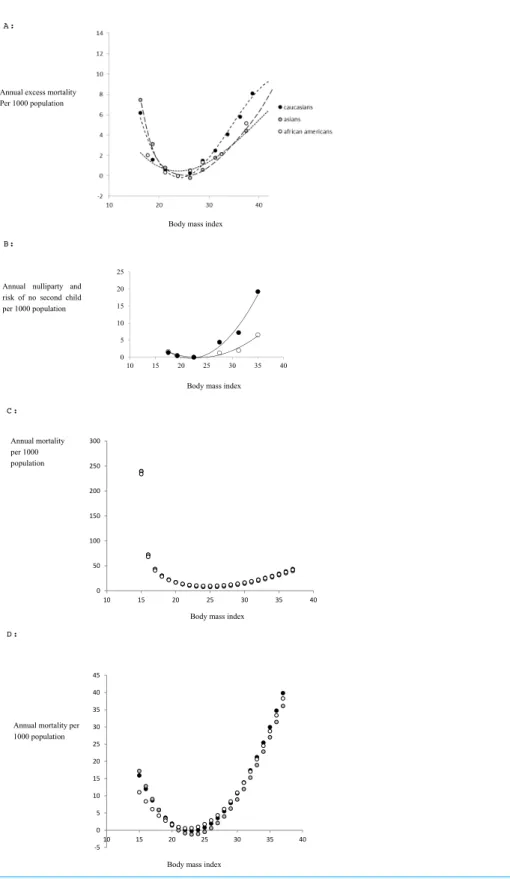
Many studies have associated the risk of developing various diseases with different levels of body fatness (Borugian et al., 2003;Chan et al., 1994;Despres, 2012;Terry, Page & Haskell, 1992). We found three reviews which compiled data for different ethnic groups to establish ethnic specific patterns of mortality in relation to fatness. These included reviews involving
>900 k Caucasians (Whitlock et al., 2009) and>1.1 million Asians (Zheng et al., 2011). We could not locate any summary of the same relationship pertaining to Africans living in Africa, but found reviews including>360 k African Americans (Cohen et al., 2014;Cohen et al., 2012;Flegal et al., 2013). In the studies involving Caucasians and African Americans the data was subdivided by gender so we could extract female specific curves, but for the Asians this was not possible from the data in the original paper. However, the patterns for males and females in the Caucasians and African Americans were almost identical so this is unlikely to be a serious source of error. The pattern of all cause mortality (total mortality irrespective of cause) from these three studies in relation to BMI is shown in
Figure 1 (...continued)
(see text for details) (B) probability of nulliparity over entire reproductive age annualized per 1,000 population (open symbols) and probability of not having a second child if one child has already been born annualized per 1,000 population (closed symbols) as a function of BMI at age 20. Data are subtracted from the class with the lowest probabilities (data fromJacobsen et al. (2013)). (C) Combined effects of infertility and all cause mortality in relation to BMI (effective mortality risk per 1,000 population) for each ethnic group. The minimum point of the curve is at BMI=23.18 for Caucasians, 23.12 for Asians and 22.45 for African Americans (see text for derivation details). (D) Combined effects of infertility and all cause mortality (as in c) as well as the impact of fatness on famine survival on the relationship between mortality and Body mass index (effective mortality per 1,000 population). The minimum points of the curves are at BMI=24.78 for Caucasians, 24.72 for Asians and 24.05 for African Americans (see text for derivation details).
annual mortality
y1c= −0.002359x3+0.24392x2−7.6714x+76.089 (1a)
y1a= −0.0034x3+0.3286x2−10.004x+97.859 (1b)
y1aa= −0.0005x3+0.0649x2−2.2071x+23.272 (1c)
wherey1c,y1a,y1aaare the excess annual mortalities per thousand population due to
all causes and x is the BMI for Caucasian, Asian and African American populations respectively. Many studies have also studied aspects of reproductive biology in relation to body fatness (or BMI). However, we could not find any summaries for Asian or African/African American populations. Among the most comprehensive studies of Caucasians was the Adventist Health study (Jacobsen et al., 2013) which included lifetime fertility records for 33,159 females along with their BMI at age 20. The relationship between the probability of having no children during a reproductive life of 20 years, and BMI class at age 20 is shown inFig. 1B. The 20 year excess probability of not having children, compared to the BMI class with the lowest rate of nulliparity, contributes to the negative effect of BMI on fertility. To obtain the annualized rate of excess ‘missing births’ we divided this lifetime rate by 20 and then fitted a polynomial to these data using ordinary least squares regression. In this case the best fit was a second order polynomial which explained 97.5% of the variation
y2=0.1065x2−4.6346x+50.145 (2)
The same study also showed that the probability of having a second child was also impacted by obesity status at age 20. The data are also shown inFig. 1Band in this case the excess missing births relative to the BMI class with the lowest rate of not having a second child were best described by a second order polynomial
y3=0.0478x2−2.2438x+26.282 (3)
which explained 95.9% of the variation.
ethnic groups were adequately represented by these Caucasian data. Hence the combined effects of fatness on all cause mortality and reduced fecundity can be expressed as
ytotal=y1+y2+y3. (4)
Substituting fromEqs. (1)to(3)into(4), collecting terms and simplifying yields three ethnic specific relationships for Caucasians, Asians and African Americans.
ytotalc= −0.00236x3+0.3982x2−14.550x+152.52 (5a)
ytotala= −0.00034x3+0.4829x2−16.8824x+171.286 (5b)
ytotalaa= −0.0005x3+0.2192x2−9.0855x+99.70. (5c)
These composite curves expressing total excess mortality and reduced fecundity are shown inFig. 1C. DifferentiatingEqs. (5a)to(5c)gives
dy
dx= −0.00708x
2+0.7964x−14.5498 (6a)
dy
dx= −0.0102x
2+0.9658x−16.8824 (6b)
dy
dx= −0.0015x
2+0.4384x−9.0855. (6c)
We can then solve these quadraticEqs. (6a)to(6c)f(x)=0 to obtain the BMI at the minimum point and this yields
0=0.00708(x−88.673)(x−23.182) (7a)
0=0.0102(x−71.554)(x−23.131) (7b)
0=0.0015(x−269.818)(x−22.448). (7c)
Each of which has only one solution in the range BMI 15 to 40 which is 23.182 for Caucasians, 23.131 for Asians and 22.448 for African Americans. Therefore the BMI at the peak of the fitness function (lowest mortality) was between 22.448 and 23.182 depending on ethnicity. This model predicts therefore that if attractiveness is directly related to fitness, combining future potential fertility with all cause mortality, the relationship between attractiveness and BMI should have a peaked function, with the maximum attractiveness at a BMI around 22.4 to 23.2. Given the shape of the function inFig. 1Cwe would expect the attractiveness function to be similarly distributed about this peak.
During famine all mortality may be considered ‘excess mortality’. We previously (Speakman & Westerterp, 2013) constructed a mathematical model of energy utilization during complete starvation to predict the survival durations of people at different starting body fatness (or BMI). This model is not dependent on the race of the individual. For females the survival function was
Since mortality risk is the inverse of survival duration we can express the excess mortality per thousand population as
y4=
1,000
(12.306x−180.1). (9)
And hence addingy4to the ethnic specific estimates ofytotalgives the total estimated
mortality risk including famine mortality for each race (Caucasian: 10.1, Asians 10.2 and African Americans 10.3) as
ytotalc= −0.002359x3+0.39822x2−14.5498x+152.516+
1,000
(12.306x−180.1) (10a)
ytotala= −0.00034x3+0.4829x2−16.8824x+171.286+
1,000
(12.306x−180.1) (10b)
ytotalaa = −0.0005x3+0.2192x2−9.0855x+99.70+
1,000
(12.306x−180.1). (10c)
The curve relating mortality to BMI represented byEqs. (10a)to(10c)are shown in
Fig. 1D. DifferentiatingEqs. (10a)to(10c)yields
dy
dx= −0.00708x
2−0.7964x−14.9498+ 12,306
(12.306x−180.1)2 (11a)
dy
dx= −0.0102x
2+0.9658x−16.8824+ 12,306
(12.306x−180.1)2 (11b)
dy
dx= −0.0015x
2+0.4384x−9.0855+ 12,306
(12.306x−180.1)2 (11c)
and solvingEq. (11)forf′(x)=0 gives a single root for each ethnic group: Caucasians (Eq. (11a))x=24.78, Asians (Eq. (11b))x=24.72 and African Americans (Eq. (11c)) x=24.05. Hence including mortality due to famine into the prediction shifts the peak upwards and strongly accentuates the negative aspects of being leaner than this optimum. If attractiveness is related to fitness the actual curve relating attractiveness to body fatness might be expected to lie somewhere between the inverses of the curves depicted inFig. 1C
and 1D, depending on the perceived risk in a given population that there will be a famine. This might for example depend on the duration since the last famine occurred in a given population.
Comparison of ratings of female physical attractiveness by males and females
were rated differently. There were no significant differences between female and male raters at the 95% confidence level (Bonferroni corrected for 188 tests) for all of the images across nine countries (Table S1). Although there was no overall effect when using the Bonferroni correction, we noted an interesting pattern in the unadjusted probability values. Among the Caucasian populations only 1/62 tests showed a significant difference in the ratings between males and females. In the Asian populations 9/63 tests were significant and in the African populations 14/63 tests showed significantly different ratings between males and females. Hence, while there was no overall effect using the adjusted values, it is possible there were ethnic differences in the extent to which males and females agreed on the attractiveness of particular images, and the use of the Bonferroni correction was too stringent to allow us to detect this effect.
Effects of BF% and WHR: univariate analyses
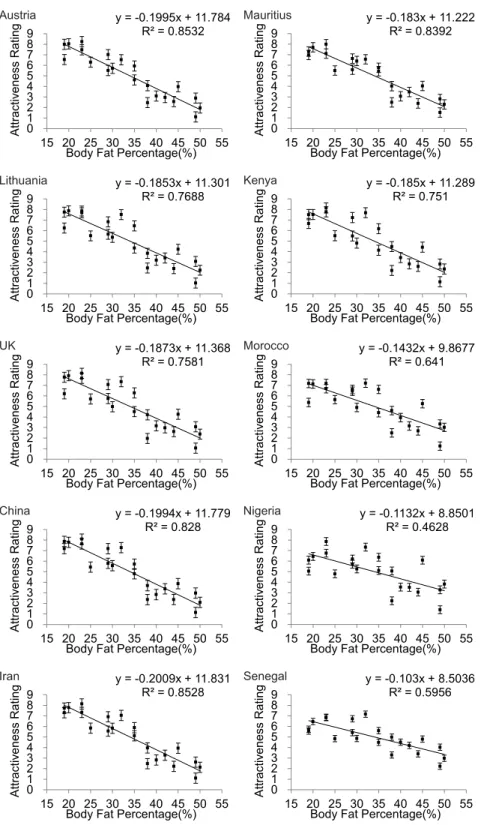
Scatter plots of female attractiveness in relation to BF% (Fig. 3) BMI (Fig. S2) and WHR (Fig. 4) were generated for each country and univariate analyses performed. We found a significant negative linear relationship between BF% and attractiveness in all the populations. Parameters of the univariate regression models are inTable 2. Across all the populations the linear fit models explained between 46.3 and 85.3% of the variance in attractiveness. The poorest fits were for Nigeria and Senegal. Including BF% squared did not result in a significant improvement in any of the relationships. The pattern for BMI was almost identical (Fig. S2). In none of the populations did a peaked relationship fit the data, contrary to what was predicteda priorifrom the evolutionary model (Fig. 1).
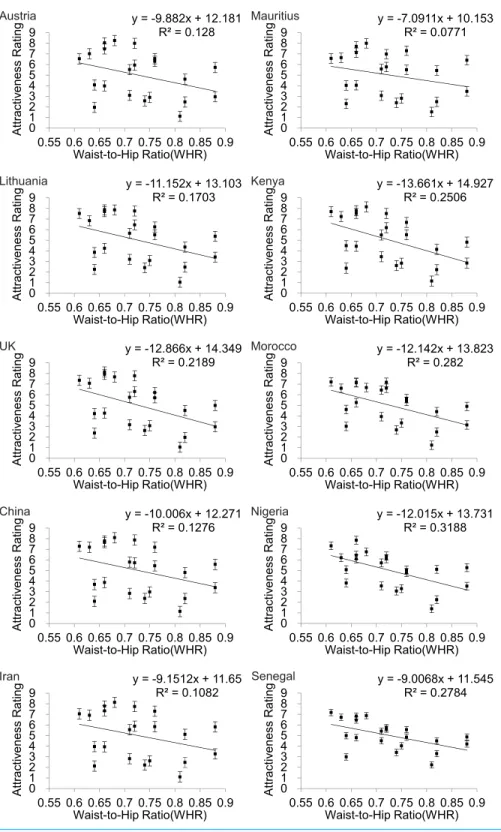
WHR also showed a linear relationship to attractiveness rating (Fig. 4) but in this instance the fits were much poorer than for BF% or BMI (Table 2) and for all three of the Asian countries WHR was not significantly associated with attractiveness (p> .05).
Multiple regression analyses
None of the two way interactions between BF%, WHR and age were significant and these terms were removed from the final models. When BF%, WHR and age were included as independent predictors they all entered as significant predictors (P< .01) in all countries except Mauritius (P=0.028: not significant atP=.05 when corrected for multiple testing). This occurred even though in the other Asian countries WHR had not been significant in the univariate analysis (above). In Mauritius only BF% was a significant predictor. BF%-squared was not a significant term in any of the models. Age of the subjects in the images was also a significant predictor (P<0.05) except in Austria (P=0.129) and UK (P=0.059) (Table 3), despite the images containing no overt indication of the subject age. Parameters of the fitted multiple regression models are presented inTable 3.
Age relationship to BF% and BMI
Table 2 Univariate analyses.Parameters of least squares fit regression equations relating BF%, BMI and WHR to average attractiveness across 21 DXA soft tissue images. In all cases the df for theFstatistic was 1,19.
Country Equation Rsquare F P-value
(A) BF%
Austria y= −0.1995x+11.784 0.853 110.41 <0.001
Lithuania y= −0.185x+11.301 0.769 63.18 <0.001
UK y= −0.187x+11.368 0.758 59.55 <0.001
China y= −0.199x+11.779 0.828 91.48 <0.001
Iran y= −0.201x+11.831 0.853 110.07 <0.001
Mauritius y= −0.183x+11.222 0.839 99.18 <0.001
Kenya y= −0.185x+11.289 0.751 57.3 <0.001
Morocco y= −0.143x+9.868 0.641 33.92 <0.001
Nigeria y= −0.113x+8.850 0.463 16.37 <0.001
Senegal y= −0.103x+8.504 0.596 27.99 <0.001
(B) BMI
Austria y= −0.3833+14.766 0.767 62.39 <0.001
Lithuania y= −0.369x+14.397 0.741 54.51 <0.001
UK y= −0.376x+14.574 0.743 54.94 <0.001
China y= −0.39x+14.941 0.772 64.36 <0.001
Iran y= −0.394x+15.03 0.797 74.66 <0.001
Mauritius y= −0.360x+14.164 0.789 71.19 <0.001
Kenya y= −0.376x+14.586 0.756 59.04 <0.001
Morocco y= −0.301x+12.67 0.69 42.29 <0.001
Nigeria y= −0.279x+12.095 0.682 40.66 <0.001
Senegal y= −0.232x+10.897 0.732 51.80 <0.001
(C) WHR
Austria y= −9.882x+12.181 0.128 2.79 >0.05
Lithuania y= −11.152x+13.103 0.170 3.90 >0.05
UK y= −12.866x+14.349 0.219 5.32 <0.05
China y= −10x+12.271 0.128 2.78 >0.05
Iran y= −9.15x+11.65 0.108 2.31 >0.05
Mauritius y= −7.09x+10.153 0.077 1.59 >0.05
Kenya y= −13.66x+14.927 0.251 6.35 <0.05
Morocco y= −12.14x+13.823 0.282 7.46 <0.05
Nigeria y= −12.02x+13.731 0.319 8.89 <0.01
Senegal y= −9.007+11.545 0.278 7 <0.05
(Fig. 5B) and between estimated age and BMI(r2=0.848)(Fig. 5C). There was also no significant relationship between estimated age and WHR (Fig. 5D).
DISCUSSION
Ratings by males v. females
Table 3 Multiple regression analyses.Effects of subject body fatness (BF%), waist to hip ratio (WHR) and age on average attractiveness using general linear models run separately for each of seven separate populations. Parameters of the full models and regression coefficients are inTable S2. df for allFstatistics are 1,17.
Population Overallr2 Age WHR BF%
F P F P F P
Austria 0.9139 2.54 0.129 11.59 0.003 111.28 <0.001
Lithuania 0.8887 6.20 0.023 16.44 0.001 67.14 <0.001
UK 0.8973 4.09 0.059 22.58 <0.001 73.89 <0.001
China 0.9101 6.34 0.022 13.19 0.002 95.05 <0.001
Iran 0.9154 5.36 0.033 10.54 0.005 108.19 <0.001
Mauritius 0.8954 6.01 0.025 5.81 0.028 84.8 <0.001
Kenya 0.9089 7.26 0.015 36.71 <0.001 92.58 <0.001
Morocco 0.8686 7.36 0.015 27.95 <0.001 40.69 <0.001
Nigeria 0.7894 8.25 0.011 22.99 <0.001 13.26 0.002
Senegal 0.8620 11.70 0.003 29.12 <0.001 31.52 <0.001
observed that males and females in a given population did not differ in their ratings of female attractiveness (Faries & Bartholomew, 2012;Furnham, Tan & McManus, 1997;
Henss, 1995;Henss, 2000;Ko´sci´nski, 2013;Schmalt, 2006;Singh, 1994;Streeter & McBurney, 2003;Swami et al., 2006a;Swami & Tovee, 2005;Tassinary & Hansen, 1998;Tov´ee et al., 2006;Tovee & Cornelissen, 2001;Tovee et al., 2002). This was despite sometimes large differences in what the different populations perceived as attractive (see in particular (Tov´ee et al., 2006)). In contrast some studies have found that females rated attractiveness differently from males with respect to WHR (Furnham, Dias & McClelland, 1998). The reasons for differences between studies are unclear. Perhaps it is evolutionarily advantageous for males and females to perceive attractiveness in their own populations in the same way, and most studies including ours indicate this is the case. However, we did note that males and females were more likely to make divergent estimates of attractiveness of given images in Asian and African populations relative to Caucasians. The reason for this ethnic difference is unclear.
Body fatness v. waist to hip ratio
Early studies regarding the relationship between female body shape and physical attractiveness placed considerable emphasis on the role played by WHR (Henss, 2000;
Mo et al., 2014;Price et al., 2013;Singh, 1993;Singh, 1994;Singh, 1995b;Tassinary & Hansen, 1998;Tovee et al., 2002). These studies suggested an optimal WHR of around 0.7 was maximally physically attractive (Dixson et al., 2007;Marlowe & Wetsman, 2001). This was consistent with the fact that Playboy centerfolds and glamour models almost all having WHRs between 0.6 and 0.7 (Katzmarzyk & Davis, 2001;Voracek & Fisher, 2002) and this changed only very slightly over the 5 decades from 1950 to 2000. Moreover, when individuals are asked to manipulate graphics to generate their ideal body shape, they routinely select a WHR of 0.7 (females) to 0.73 (males) (Crossley, Cornelissen & Tovee, 2012). Surgical enhancement of WHR increases physical ratings of attractiveness (Dixson et al., 2007). WHR was interpreted within an evolutionary context as of importance because it was suggested to be an honest signal of health and fertility (Bigaard et al., 2004;Singh, 1995a;Wass et al., 1997) or cognitive ability (Lassek and Gualin, 2008). An early suggestion that females with higher WHR might have more sons was later dismissed (Tovee, Brown & Jacobs, 2001).
was held constant, (Swami et al., 2006a;Swami & Tovee, 2005;Tov´ee et al., 2006;Tovee et al., 2002) or the relationship between BMI and WHR was made artificially negative (Tovee & Cornelissen, 1999).
Our own study confirms this general pattern that body fatness explains more of the variation in physical attractiveness than does WHR. In contrast to many previous studies however, the relative importance of body fatness and WHR in our data was culturally dependent. In the univariate analysis the variance explained by body fatness was considerably greater in the Asian and Caucasian populations (75 to 85%) than in the four African populations (46 to 75%). Moreover, in the univariate analysis there was no significant effect of WHR in the three Asian populations, but in the African populations the explained variation by WHR alone was 25 to 32%. A previous study using the same images rated by a predominantly Caucasian population (70% Caucasian) in the USA found 70% of the variance was explained by body fatness and 18% by WHR (Faries & Bartholomew, 2012) consistent with the 76% and 21.9% respectively for the Caucasian UK sample and the 77% and 17% respectively in Lithuanians measured here. The very high percentage variation explained by body fatness (BMI) and the low variation explained by WHR in the Asian populations was consistent with the variation in attractiveness explained by BMI and WHR in Malaysians (Swami & Tovee, 2005) and Thai subjects (Swami & Tov´ee, 2007), but in Japanese subjects the variance explained by WHR was higher at 30.2% (Swami et al., 2006a). Previous studies of Caucasians have also reported high levels of variation explained by BMI: 84.1% (Tov´ee et al., 2006), 83.3% (Swami et al., 2006a), 76.8% (Swami & Tov´ee, 2007),73.7% (Tovee & Cornelissen, 1999), 73.5% (Tovee et al., 1998), 70.3 to 73.3% (Swami & Tov´ee, 2007), although using 3D rotating images the impact of BMI was lower at 53% (Smith, Cornelissen & Tov´ee, 2007). This range of values for 2D images covers the data reported here. Consistent with our work, previous multiple regression analyses of rated attractiveness of the female body using digitally manufactured stimuli suggested that BMI was twice as important as WHR for the rated attractiveness in Poland (Ko´sci´nski, 2012;Ko´sci´nski, 2013;Ko´sci´nski, 2014).
Americans (Cunningham et al., 1995). This ethnic difference is apparent in the differences in ethnic ideals with respect to buttock augmentation surgery (Roberts et al., 2006) in which Asians prefer very small and African Americans very large buttocks. This difference may accentuate the importance of WHR in attractiveness ratings by African populations.
In addition, there are ethnic differences in the reported consequences of obesity for various health related parameters. For example, obese African Americans show much greater risk of developing insulin resistance and diabetes than either Caucasians or Hispanics, as they become obese, but Hispanics show a much greater risk of hepatic steatosis (Speakman & Goran, 2010). It is potentially the case that WHR provides a much better signal of health in Africans than in other populations.
Evolutionary aspects and optimal BMI
Many previous studies have set the observations that raters prefer women with given WHRs and BMIs into apost hocevolutionary context by suggesting that BMI and WHR are honest signals of both health and fertility (Bigaard et al., 2004;Singh, 1995a;Wass et al., 1997). Few studies, however, have attempted to rigorously test this suggestion by comparing the actual pattern of variation in attractiveness, as a function of fatness or WHR, to that expecteda priorion the basis of epidemiological data on the relationships between fatness, health and fertility. We attempted to fill this gap by constructing a mathematical model relating fatness to future mortality risk (incorporating both health and fertility effects) using data from several large epidemiological studies that have related BMI to all cause mortality in Caucasians (Whitlock et al., 2009), Asians (Zheng et al., 2011) and African Americans (Cohen et al., 2014;Cohen et al., 2012;Flegal et al., 2013) and BMI at age 20 to future reproductive success in over 33,000 females Caucasians (Jacobsen et al., 2013). Factoring these two effects into the model suggested the optimal female BMI should be around 22.4 to 23.2. A limitation of our study is that we could not find data on the link of mortality to BMI for Africans living in Africa, for which we substituted data on African Americans, and we could only find fecundity data based on a large sample size for Caucasians. The similarity of the mortality patterns between Caucasians, Asians and African Americans (Fig. 1A), however, lends some confidence that ethnic effects on these relationships are relatively small and the derived optima are probably appropriate for the populations we studied. An additional potential factor is that body fat stores may provide a resource base to ensure survival during periods of famine (the thrifty gene hypothesis). Using a previous mathematical model relating famine survival to fat storage (Speakman & Westerterp, 2013) we predicted that if famine mitigation was also important the optimum BMI might rise slightly to between 24.0 and 24.8 but the shape of the curve relating attractiveness to body fatness would be more steeply negative at lower levels of body fatness (Fig. 1D).
to detect a peak, if such existed, at the position we predicted. In none of the populations over this BMI range was there any indication of a peak in the relationship (as judged by the significance of adding additional polynomial terms to the regression model). Similar to our data, a linear negative relationship between BMI and physical attractiveness was observed previously over the BMI range 18 to 26 (Swami & Tov´ee, 2007), and a linear negative relationship was observed between attractiveness and body fatness over a range from 20 to 35% body fat (Smith, Cornelissen & Tov´ee, 2007). Using the same image set as used hereFaries & Bartholomew (2012)also reported a linear negative relationship between attractiveness and BMI rated by US college students of mixed ethnicity.
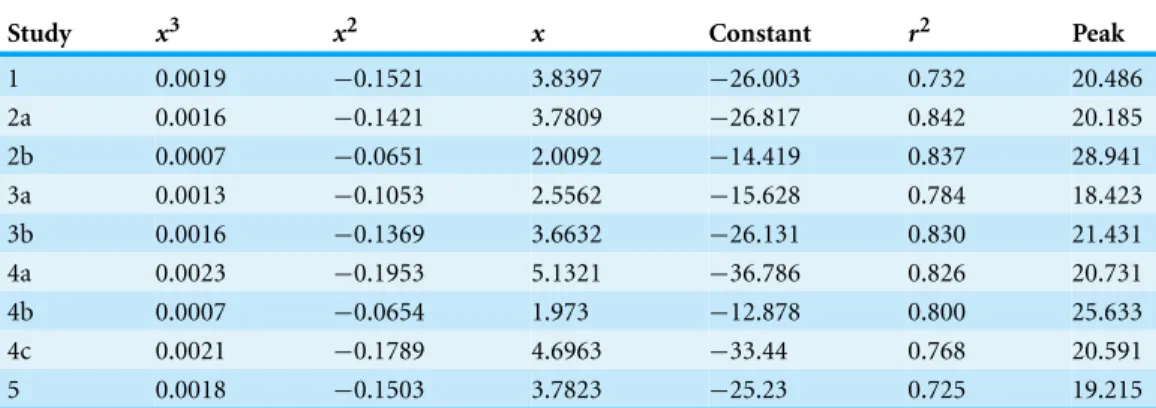
Table 4 Parameters of 3rd order polynomials fitted to data on attractiveness as a function of BMI in previous studies in the literature, along with the estimated BMI at ‘peak’ attractiveness obtained by differentiating the fitted curves and solving the resultant quadratic equations forf(x)=0 in the range 30 10.
Study x3 x2 x Constant r2 Peak
1 0.0019 −0.1521 3.8397 −26.003 0.732 20.486
2a 0.0016 −0.1421 3.7809 −26.817 0.842 20.185
2b 0.0007 −0.0651 2.0092 −14.419 0.837 28.941
3a 0.0013 −0.1053 2.5562 −15.628 0.784 18.423
3b 0.0016 −0.1369 3.6632 −26.131 0.830 21.431
4a 0.0023 −0.1953 5.1321 −36.786 0.826 20.731
4b 0.0007 −0.0654 1.973 −12.878 0.800 25.633
4c 0.0021 −0.1789 4.6963 −33.44 0.768 20.591
5 0.0018 −0.1503 3.7823 −25.23 0.725 19.215
Notes.
Studies were (1) (Tovee et al., 1999), (2) (Tov´ee et al., 2006) (a) British (b) Zulus, (3) (Swami et al., 2010), (a) Japanese (b) British, (4)Swami & Tov´ee (2007)(a) British (b) Hill tribe Thai (c) city Thai, (5) (Tovee et al., 1998)
Why do the data for these modern societies seem to deviate so widely from the evolutionary model predictions about the most attractive level of body fatness? One potential interpretation is that the populations studied here are all exposed to the same western media which promotes a thin female body ideal (Groesz, Levine & Murnen, 2002;
Posavac, Posavac & Posavac, 1998). It is difficult however to separate cause and effect. Does media exposure drive people’s perceptions of attractiveness? Or is the ‘thin ideal’ in the media simply reflecting what people already see as attractive? The fact the populations differed significantly in their perceptions of the importance of WHR suggests that in fact their opinions are not all homogenized by exposure to the same western media images of what is attractive. The data were not consistent with the suggestion that people are attracted to averageness in their own population (Ko´sci´nski, 2012) since the universal preference for low BMI contrasted the much higher and more variable levels of average BMI among the rating populations (Table 1).
However, fertility is strongly dependent on age, in part because of the declining ovarian reserve as a function of age (Wallace & Kelsey, 2010). However, fertility reaches a peak in the late teens and early 20s because prior to age 20 there is an increased risk of annovulatory cycles. The relationship between infertility and age based on literature data for Caucasians (Henry, 1961;Leridon, 1978;Leridon, 2008;Menken & Larsen, 1986;Pittenger, 1973;Trussell & Wilson, 1985;Vincent, 1950) is shown inFig. S3and a 4th order polynomial explained 98.3% of the variation in infertility. The best fit equation was
y5=0.0052A4−0.6164A3+27.105A2−514.95A+3558.1 (12)
wherey5is the age related infertility per thousand population, and A is the age. Given the
relationship between BMI and estimated age of the subjects (Fig. 5) we can use the derived fitted relationship
A=0.027x2+3.1717x−30.599 (13)
wherexis the BMI, to derive the expected relationship between BMI and mortality risk if BMI is used only as a proxy for age. SubstitutingEq. (13)intoEq. (12)gives
y5=0.0052(0.027x2+3.1717x−30.599)4−0.6164(0.027x2+3.1717x−30.599)3
+27.105(0.027x2+3.1717x−30.599)2−996.68x+12495.57 (14)
DifferentiatingEq. (14)gives
dy
dx=0.0208(0.027x
2+3.1717x−30.599)3−1.8492(0.027x2+3.1717x−30.599)2
+1.4637x2+171.94x−2655.45
Expanding the brackets and collecting terms gives the 6th order polynomial
dy
dx=0.000000409x
6+0.0001445x5+0.01421x4+0.019753x3−31.793x2
+716.18x−3790.53. (15)
There were 2 exceptions to this pattern of a peak in the range 18 to 19 (Table 4). The hill tribes people of northern Thailand had a maximum attractiveness at BMI=25.6 (Swami & Tov´ee, 2007), and the Zulus of South Africa had a maximum attractiveness at BMI=28.9. In these latter cases the maximum clearly sits much closer to the predictions of the evolutionary model derived here. Although insufficient images and data were available to fit an exact curve it seems likely that similar data with higher BMIs at maximal levels of attractiveness would also be observed among the Hadza of Tanzania (Marlowe & Wetsman, 2001).One hypothesis is that these divergent patterns emerge because these communities do not use BMI as a proxy for age, and the resultant pattern then matches more closely the evolutionary predictions from the model excluding such a link. This may be because in these communities that are all resource poor, body fatness does not increase with age in the same way it does in modern societies (Lawrence et al., 1987;Prentice et al., 1981), and hence low BMI is not an honest signal of youthfulness.
CONCLUSIONS
Our data confirm previous studies showing body fatness (and BMI) explained more of the variation in ratings of physical attractiveness than waist to hip ratio (WHR). Novel here was the demonstration that WHR played a more important role (greater r2) in African than in Asian populations. The relationships between attractiveness and body fatness (BMI) did not match the predictions from a theoretical model based on large epidemiological studies of the impacts of body fatness on health and fertility, combined with the relationship between fatness and famine survival. An explanation for this discrepancy is that raters used the body fatness of the subject images as a proxy for subject age, and age is more strongly linked to fertility than is BMI (independent of age). A model based on this assumption matched our, and previous, data relating fatness to attractiveness. Overall our data and modeling suggest that the role of BMI in ratings of attractiveness may have been overstated because of the covariance of BMI with age. Future studies aiming to quantify the contribution of body fatness (BMI or BF%) and WHR to ratings of physical attractiveness need to remove any covariance between fatness (BMI or BF%), WHR and age.
ACKNOWLEDGEMENTS
We are grateful to all the participants from all the countries and all the members of Molecular Energetics Group for their help on the investigation and discussion of the results.
ADDITIONAL INFORMATION AND DECLARATIONS
Funding
Grant Disclosures
The following grant information was disclosed by the authors: NSFC: 91431102.
National Science Foundation of China.
Competing Interests
The authors declare there are no competing interests.
Author Contributions
• Guanlin Wang performed the experiments, analyzed the data, wrote the paper, prepared figures and/or tables, reviewed drafts of the paper.
• Kurosh Djafarian, Chima A. Egedigwe, Asmaa El Hamdouchi, Robert Ojiambo, Harris Ramuth, Sandra Johanna Wallner-Liebmann, Sonja Lackner, Adama Diouf, Justina Sauciuvenaite, Catherine Hambly and Lobke M. Vaanholt performed the experiments. • Mark D. Faries contributed reagents/materials/analysis tools, contributed to the study
design and commented on the draft of this paper.
• John R. Speakman conceived and designed the experiments, wrote the paper, prepared figures and/or tables, and built the evolutionary model.
Human Ethics
The following information was supplied relating to ethical approvals (i.e., approving body and any reference numbers):
All the procedures for the overall study were ethically reviewed and approved by the Chinese Academy of Sciences, Institute of Genetics and Developmental Biology Institutional Review Board (IGDB-2013-IRB-005). In addition, local ethical approval was also obtained at the UK site from the University of Aberdeen College of Life Science and Medicine Ethical Review Board (CERB/2014/12/1123).
Supplemental Information
Supplemental information for this article can be found online athttp://dx.doi.org/ 10.7717/peerj.1155#supplemental-information.
REFERENCES
Andersson M, Simmons LW. 2006.Sexual selection and mate choice.Trends in Ecology and Evolution21:296–302DOI 10.1016/j.tree.2006.03.015.
Bigaard J, Frederiksen K, Tjonneland A, Thomsen BL, Overvad K, Heitmann BL, Sorensen TI. 2004.Body fat and fat-free mass and all-cause mortality.Obesity Research12:1042–1049 DOI 10.1038/oby.2004.131.
BorgerhoffMulder M. 1998.Reproductive success in three Kipsigis cohorts.Reproductive Success
419–435.
Borugian MJ, Sheps SB, Kim-Sing C, Olivotto IA, Van Patten C, Dunn BP, Coldman AJ, Potter JD, Gallagher RP, Hislop TG. 2003.Waist-to-hip ratio and breast cancer mortality.
Chan JM, Rimm EB, Colditz GA, Stampfer MJ, Willett WC. 1994.Obesity, fat distribution, and weight gain as risk factors for clinical diabetes in men.Diabetes Care17:961–969 DOI 10.2337/diacare.17.9.961.
Cohen SS, Park Y, Signorello LB, Patel AV, Boggs DA, Kolonel LN, Kitahara CM, Knutsen SF, Gillanders E, Monroe KR. 2014.A pooled analysis of body mass index and mortality among African Americans.PLoS ONE9:e111980DOI 10.1371/journal.pone.0111980.
Cohen SS, Signorello LB, Cope EL, McLaughlin JK, Hargreaves MK, Zheng W, Blot WJ. 2012.
Obesity and all-cause mortality among black adults and white adults.American Journal of Epidemiology176:431–442DOI 10.1093/aje/kws032.
Crossley KL, Cornelissen PL, Tovee MJ. 2012.What is an attractive body? Using an interactive 3D program to create the ideal body for you and your partner.PLoS ONE7:e50601 DOI 10.1371/journal.pone.0050601.
Cunningham MR, Roberts AR, Barbee AP, Druen PB, Wu CH. 1995.“Their ideas of beauty are, on the whole, the same as ours”: consistency and variability in the cross-cultural perception of female physical attractiveness.Journal of Personality and Social Psychology68:261–279 DOI 10.1037/0022-3514.68.2.261.
Despres JP. 2012.Body fat distribution and risk of cardiovascular disease: an update.Circulation 126:1301–1313DOI 10.1161/CIRCULATIONAHA.111.067264.
Dixson BJ, Dixson AF, Li B, Anderson MJ. 2007.Studies of human physique and sexual attractiveness: sexual preferences of men and women in China.American Journal of Human Biology19:88–95DOI 10.1002/ajhb.20584.
Drury NE. 2000.Beauty is only skin deep.Journal of the Royal Society of Medicine93:89–92.
Eagly AH, Ashmore RD, Makhijani MG, Longo LC. 1991.What is beautiful is good, but...: a meta-analytic review of research on the physical attractiveness stereotype.Psycological Bulletin 110(1):109–128DOI 10.1037/0033-2909.110.1.109.
Eknoyan G. 2001.The importance of early treatment of the anaemia of chronic kidney disease.
Nephrology, Dialysis, Transplantation16(Suppl 5):45–49DOI 10.1093/ndt/16.suppl 5.45.
Fallon AE, Rozin P. 1985.Sex differences in perceptions of desirable body shape.Journal of Abnormal Psychology94:102–105DOI 10.1037/0021-843X.94.1.102.
Faries MD, Bartholomew JB. 2012.The role of body fat in female attractiveness.Evolution and Human Behavior33:672–681DOI 10.1016/j.evolhumbehav.2012.05.002.
Flegal KM, Kit BK, Orpana H, Graubard BI. 2013.Association of all-cause mortality with overweight and obesity using standard body mass index categories: a systematic review and meta-analysis.Journal of the American Medical Association309:71–82
DOI 10.1001/jama.2012.113905.
Freedman RE, Carter MM, Sbrocco T, Gray JJ. 2004.Ethnic differences in preferences for female weight and waist-to-hip ratio: a comparison of African-American and White American college and community samples.Eating Behaviors5:191–198DOI 10.1016/j.eatbeh.2004.01.002.
Freedman DS, Kahn HS, Mei Z, Grummer-Strawn LM, Dietz WH, Srinivasan SR, Berenson GS. 2007.Relation of body mass index and waist-to-height ratio to cardiovascular disease risk factors in children and adolescents: the Bogalusa Heart Study.American Journal of Clinical Nutrition86:33–40.
Furnham A, Dias M, McClelland A. 1998.The role of body weight, waist-to-hip ratio, and breast size in judgments of female attractiveness.Sex Roles39:311–326
Furnham A, Moutafi J, Baguma P. 2002.A cross-cultural study on the role of weight and waist-to-hip ratio on female attractiveness.Personality and Individual Differences32:729–745 DOI 10.1016/S0191-8869(01)00073-3.
Furnham A, Tan T, McManus C. 1997.Waist-to-hip ratio and preferences for body shape: a replication and extension.Personality and Individual Differences22:539–549
DOI 10.1016/S0191-8869(96)00241-3.
Grammer K, Thornhill R. 1994.Human (Homo sapiens) facial attractiveness and sexual selection: the role of symmetry and averageness. Journal of Comparative Psychology108:233–242 DOI 10.1037/0735-7036.108.3.233.
Groesz LM, Levine MP, Murnen SK. 2002.The effect of experimental presentation of thin media images on body satisfaction: a meta—analytic review.International Journal of Eating Disorders 31:1–16DOI 10.1002/eat.10005.
Hall KD. 2012.Quantitative physiology of human starvation: adaptations of energy expenditure, macronutrient metabolism and body composition. In:Comparative physiology of fasting, starvation, and food limitation. Springer, 379–393.
Henry L. 1961.Some data on natural fertility.Biodemography and Social Biology8:81–91.
Henss R. 1995.Waist-to-hip ratio and attractiveness. Replication and extension.Personality and Individual Differences19:479–488DOI 10.1016/0191-8869(95)00093-L.
Henss R. 2000.Waist-to-hip ratio and female attractiveness. Evidence from photographic stimuli and methodological considerations.Personality and Individual Differences28:501–513 DOI 10.1016/S0191-8869(99)00115-4.
Jacobsen BK, Knutsen SF, Oda K, Fraser GE. 2013.Body mass index at age 20 and subsequent childbearing: the adventist health study-2. Journal of Women’s Health 22:460–466
DOI 10.1089/jwh.2012.3727.
Katzmarzyk PT, Davis C. 2001.Thinness and body shape of Playboy centerfolds from 1978 to 1998.International Journal of Obesity25:590–592DOI 10.1038/sj.ijo.0801571.
Ko´sci ´nski K. 2012.Mere visual experience impacts preference for body shape: evidence from male competitive swimmers. Evolution and Human Behavior 33:137–146 DOI 10.1016/j.evolhumbehav.2011.08.003.
Ko´sci ´nski K. 2013.Attractiveness of women’s body: body mass index, waist–hip ratio, and their relative importance.Behavioral Ecology24:914–925DOI 10.1093/beheco/art016.
Ko´sci ´nski K. 2014. Assessment of waist-to-hip ratio attractiveness in women: an anthropometric analysis of digital silhouettes.Archives of Sexual Behavior43:989–997 DOI 10.1007/s10508-013-0166-1.
Lassek WD, Gaulin SJ. 2008.Waist-hip ratio and cognitive ability: is gluteofemoral fat a privileged store of neurodevelopmental resources?Evolution and Human Behavior29:26–34 DOI 10.1016/j.evolhumbehav.2007.07.005.
Lawrence M, Lawrence F, Coward WA, Cole TJ, Whitehead RG. 1987.Energy requirements of pregnancy in The Gambia.Lancet2:1072–1076DOI 10.1016/S0140-6736(87)91492-9.
Leridon H. 1978.Fertility and demographic structures: a hypothesis on fertility change since 1940.
Population33:441–447DOI 10.2307/1531829.
Leridon H. 2008.A new estimate of permanent sterility by age: sterility defined as the inability to conceive.Population Studies62:15–24DOI 10.1080/00324720701804207.
Marlowe F, Apicella C, Reed D. 2005.Men’s preferences for women’s profile waist-to-hip ratio in two societies.Evolution and Human Behavior26:458–468
DOI 10.1016/j.evolhumbehav.2005.07.005.
Marlowe F, Wetsman A. 2001.Preferred waist-to-hip ratio and ecology.Personality and Individual Differences30:481–489DOI 10.1016/S0191-8869(00)00039-8.
Menken J, Larsen U. 1986.Fertility rates and aging. In:Aging, reproduction, and the climacteric. Springer, 147–166.
Mo JJ, Cheung KW, Gledhill LJ, Pollet TV, Boothroyd LG, Tov´ee MJ. 2014.Perceptions of Female Body Size and Shape in China, Hong Kong, and the United Kingdom.Cross-Cultural Research 48:78–103DOI 10.1177/1069397113510272.
Neel JV. 1962. Diabetes mellitus: a “thrifty” genotype rendered detrimental by “progress”?American Journal of Human Genetics14:353–362.
Pawlowski B, Sorokowski P. 2008.Men’s attraction to women’s bodies changes seasonally.
Perception37:1079–1085DOI 10.1068/p5715.
Perrett DI, Lee KJ, Penton-Voak I, Rowland D, Yoshikawa S, Burt DM, Henzi SP, Castles DL, Akamatsu S. 1998.Effects of sexual dimorphism on facial attractiveness.Nature394:884–887 DOI 10.1038/29772.
Pittenger DB. 1973. An exponential model of female sterility.Demography 10:113–121 DOI 10.2307/2060754.
Posavac HD, Posavac SS, Posavac EJ. 1998.Exposure to media images of female attractiveness and concern with body weight among young women1. Sex Roles 38:187–201
DOI 10.1023/A:1018729015490.
Prentice AM, Whitehead RG, Roberts SB, Paul AA. 1981.Long-term energy balance in child-bearing Gambian women.American Journal of Clinical Nutrition34:2790–2799.
Price ME, Pound N, Dunn J, Hopkins S, Kang J. 2013.Body shape preferences: associations with rater body shape and sociosexuality.PLoS ONE8:e52532DOI 10.1371/journal.pone.0052532.
Roberts III TL, Weinfeld AB, Bruner TW, Nguyen K. 2006.“Universal” and ethnic ideals of beautiful buttocks are best obtained by autologous micro fat grafting and liposuction.Clinics in Plastic Surgery33:371DOI 10.1016/j.cps.2006.05.001.
Schmalt HD. 2006.Waist-to-hip ratio and female physical attractiveness: the moderating role of power motivation and the mating context.Personality and Individual Differences41:455–465 DOI 10.1016/j.paid.2006.02.008.
Singh D. 1993.Body shape and women’s attractiveness: the critical role of waist-to-hip ratio.
Human Nature4:297–321DOI 10.1007/BF02692203.
Singh D. 1994.Waist-to-hip ratio and judgment of attractiveness and healthiness of female figures by male and female physicians.International Journal of Obesity and Related Metabolic Disorders 18:731–737.
Singh D. 1995a.Female health, attractiveness, and desirability for relationships: role of breast asymmetry and waist-to-hip ratio.Ethology and Sociobiology16(6):465–481
DOI 10.1016/0162-3095(95)00073-9.
Singh D. 1995b.Female judgment of male attractiveness and desirability for relationships: role of waist-to-hip ratio and financial status.Journal of Personality and Social Psychology69:1089–1101 DOI 10.1037/0022-3514.69.6.1089.
Smith KL, Cornelissen PL, Tov´ee MJ. 2007.Color 3D bodies and judgements of human female attractiveness.Evolution and Human Behavior28:48–54
DOI 10.1016/j.evolhumbehav.2006.05.007.
Song B, Thomas DM. 2007.Dynamics of starvation in humans.Journal of Mathematical Biology 54:27–43DOI 10.1007/s00285-006-0037-7.
Speakman JR. 2007.A novel non-adaptive scenario explaining the genetic pre-disposition to obe-sity: the ‘predation release’ hypothesis.Cell Metabolism6:5–11DOI 10.1016/j.cmet.2007.06.004.
Speakman JR. 2008.Thrifty genes for obesity and diabetes, an attractive but flawed idea and an alternative scenario: the ‘drifty gene’ hypothesis.International Journal of Obesity32:1611–1617 DOI 10.1038/ijo.2008.161.
Speakman JR, Goran MI. 2010.Tissue-specificity and ethnic diversity in obesity-related risk of cancer may be explained by variability in insulin response and insulin signaling pathways.
Obesity18:1071–1078DOI 10.1038/oby.2010.16.
Speakman JR, Westerterp KR. 2010.Associations between energy demands, physical activity, and body composition in adult humans between 18 and 96 y of age.American Journal of Clinical Nutrition92:826–834DOI 10.3945/ajcn.2009.28540.
Speakman JR, Westerterp KR. 2013.A mathematical model of weight loss under total starvation: evidence against the thrifty-gene hypothesis.Disease Models and Mechanisms6:236–251 DOI 10.1242/dmm.010009.
Streeter SA, McBurney DH. 2003.Waist-hip ration and attractiveness: new evidence and a critique of “a critical test”.Evolution and Human Behavior24:88–98
DOI 10.1016/S1090-5138(02)00121-6.
Swami V, Caprario C, Tov´ee MJ, Furnham A. 2006a.Female physical attractiveness in Britain and Japan: a cross-cultural study.European Journal of Personality20:69–81DOI 10.1002/per.568.
Swami V, Einon D, Furnham A. 2006b.The leg-to-body ratio as a human aesthetic criterion.Body Image3:317–323DOI 10.1016/j.bodyim.2006.08.003.
Swami V, Frederick DA, Aavik T, Alcalay L, Allik J, Anderson D, Andrianto S, Arora A, Brannstrom A, Cunningham J, Danel D, Doroszewicz K, Forbes GB, Furnham A,
Greven CU, Halberstadt J, Hao S, Haubner T, Hwang CS, Inman M, Jaafar JL, Johansson J, Jung J, Keser A, Kretzschmar U, Lachenicht L, Li NP, Locke K, Lonnqvist JE, Lopez C, Loutzenhiser L, Maisel NC, McCabe MP, McCreary DR, McKibbin WF, Mussap A, Neto F, Nowell C, Alampay LP, Pillai SK, Pokrajac-Bulian A, Proyer RT, Quintelier K, Ricciardelli LA, Rozmus-Wrzesinska M, Ruch W, Russo T, Schutz A, Shackelford TK, Shashidharan S, Simonetti F, Sinniah D, Swami M, Vandermassen G, Van Duynslaeger M, Verkasalo M, Voracek M, Yee CK, Zhang EX, Zhang X, Zivcic-Becirevic I. 2010.The attractive female body weight and female body dissatisfaction in 26 countries across 10 world regions: results of the international body project I.Personality and Social Psychology Bulletin36:309–325 DOI 10.1177/0146167209359702.
Swami V, Tovee MJ. 2005.Female physical attractiveness in Britain and Malaysia: a cross-cultural study.Body Image2:115–128DOI 10.1016/j.bodyim.2005.02.002.
Swami V, Tovee MJ. 2006. Does hunger influence judgments of female physical
attractiveness?British Journal of Psychology97:353–363DOI 10.1348/000712605X80713.
Swami V, Tov´ee MJ. 2007.Differences in attractiveness preferences between observers in low-and high-resource environments in Thailand.Journal of Evolutionary Psychology5:149–160 DOI 10.1556/JEP.2007.1005.
Tassinary LG, Hansen KA. 1998.A critical test of the waist-to-hip-ratio hypothesis of female physical attractiveness.Psychological Science9:150–155DOI 10.1111/1467-9280.00029.
Terry RB, Page WF, Haskell WL. 1992.Waist/hip ratio, body mass index and premature cardiovascular disease mortality in US Army veterans during a twenty-three year follow-up study.International Journal of Obesity and Related Metabolic Disorders16:417–423.
Thornhill R, Gangestad SW, Miller R, Scheyd G, McCollough JK, Franklin M. 2003.Major histocompatibility complex genes, symmetry, and body scent attractiveness in men and women.
Behavioral Ecology14:668–678DOI 10.1093/beheco/arg043.
Tovee MJ, Brown JE, Jacobs D. 2001. Maternal waist-to-hip ratio does not predict child gender. Proceedings of the Royal Society B: Biological Sciences268:1007–1010 DOI 10.1098/rspb.2001.1618.
Tovee MJ, Cornelissen PL. 1999. The mystery of female beauty.Nature 399:215–216 DOI 10.1038/20345.
Tovee MJ, Cornelissen PL. 2001. Female and male perceptions of female physical attractiveness in front-view and profile.British Journal of Psychology92(Part 2):391–402 DOI 10.1348/000712601162257.
Tovee MJ, Hancock PJ, Mahmoodi S, Singleton BR, Cornelissen PL. 2002.Human female attractiveness: waveform analysis of body shape.Proceedings of the Royal Society B: Biological Sciences269:2205–2213DOI 10.1098/rspb.2002.2133.
Tovee MJ, Maisey DS, Emery JL, Cornelissen PL. 1999.Visual cues to female physical attractiveness. Proceedings of the Royal Society B: Biological Sciences 266:211–218 DOI 10.1098/rspb.1999.0624.
Tovee MJ, Mason SM, Emery JL, McCluskey SE, Cohen-Tovee EM. 1997.Supermodels: stick insects or hourglasses?Lancet350:1474–1475DOI 10.1016/S0140-6736(05)64238-9.
Tovee MJ, Reinhardt S, Emery JL, Cornelissen PL. 1998.Optimum body-mass index and maximum sexual attractiveness.Lancet352:548DOI 10.1016/S0140-6736(05)79257-6.
Tov´ee MJ, Swami V, Furnham A, Mangalparsad R. 2006.Changing perceptions of attractiveness as observers are exposed to a different culture.Evolution and Human Behavior26:458–468.
Trivers R. 1985.Social evolution. Menlo Park, CA: Benjamin/Cummings.
Trussell J, Wilson C. 1985.Sterility in a population with natural fertility.Population Studies 39:269–286DOI 10.1080/0032472031000141486.
Vincent P. 1950.La st´erilit´e physiologique des populations. In:Population. french edition, 45–64.
Voracek M, Fisher ML. 2002.Shapely centrefolds? Temporal change in body measures: trend analysis.BMJ325:1447–1448DOI 10.1136/bmj.325.7378.1447.
Wallace WH, Kelsey TW. 2010.Human ovarian reserve from conception to the menopause.PLoS ONE5:e8772DOI 10.1371/journal.pone.0008772.
Wass P, Waldenstrom U, Rossner S, Hellberg D. 1997.An android body fat distribution in females impairs the pregnancy rate ofin-vitrofertilization-embryo transfer.Human Reproduction12:2057–2060DOI 10.1093/humrep/12.9.2057.
Whitlock G, Lewington S, Sherliker P, Clarke R, Emberson J, Halsey J, Qizilbash N, Collins R, Peto R. 2009.Body-mass index and cause-specific mortality in 900,000 adults: collaborative analyses of 57 prospective studies.Lancet373:1083–1096DOI 10.1016/S0140-6736(09)60318-4.