Submitted22 January 2016 Accepted 11 April 2016 Published11 May 2016
Corresponding author Brett R. Blaauw,
Academic editor Ilaria Negri
Additional Information and Declarations can be found on page 13
DOI10.7717/peerj.1997
Copyright 2016 Blaauw et al.
Distributed under
Creative Commons CC-BY 4.0
OPEN ACCESS
Utilizing immunomarking techniques
to track
Halyomorpha halys
(Hemiptera:
Pentatomidae) movement and
distribution within a peach orchard
Brett R. Blaauw1, Vincent P. Jones2and Anne L. Nielsen1
1Department of Entomology, Rutgers, The State University of New Jersey, Bridgeton, NJ, United States 2Department of Entomology, Washington State University, Wenatchee, WA, United States
ABSTRACT
In this study we focus on the invasive brown marmorated stink bug,Halyomorpha halys(Stål) (Hemiptera: Pentatomidae), which has a strong dispersal capacity and has had a significant impact on several cropping systems, including peach (Prunus persica (L.)). Management ofH. halyshas relied on intensive insecticide use, and thus a better understanding of its dispersal behavior may assist in developing improved management strategies. In order to investigateH. halysmovement and distribution patterns within a peach orchard we applied ecologically safe, food protein markers to the trees along the orchard border (chicken egg albumin in the form of liquid egg whites) and to the trees within the orchard interior (bovine casein in the form of cow’s milk). We used enzyme-linked immunosorbent assays (ELISA) to assess whether collected H. halys were ‘‘marked’’ with either of the two protein markers, revealing where in the orchard the bugs had visited. From the density data we determined thatH. halysis a perimeter-driven pest in peaches, with a significantly higher density of bugs collected along the orchard border. Interestingly, this trend is primarily driven by the distribution of male bugs. The protein marking data revealed that a small proportion of maleH. halysmove equally between the orchard border and interior, while a small proportion of females move predominately to the border after visiting the interior. The verification of a strong edge-effect, although potentially sex-specific, implies thatH. halysdisplays a dispersal behavior that may also be exploited for management, which may help growers more efficiently and more effectively manageH. halys.
SubjectsAgricultural Science, Animal Behavior, Ecology, Ecosystem Science, Entomology
Keywords Brown marmorated stink bug, Dispersal, Behavior, Capture, Protein marking
INTRODUCTION
Dispersal, as defined by an individual’s movement in space to promote gene flow (Benton & Bowler, 2012), is a behavior that is prevalent amongst organisms that impacts the spatial and temporal dynamics of populations. There are a number of reasons an organism may disperse from or to a location, including mate selection, kin competition, reduction in inbreeding, resource competition, or environmental stochasticity (Bowler & Benton, 2005;
within a defined location frequently utilize a variety of marking techniques (i.e., mark-release-recapture, mark-capture, self-marking) (Hagler & Jackson, 2001).
Mark-release-recapture techniques artificially enhance the population by releasing marked individuals and may skew assumptions on natural dispersal behavior. Marking insectsin situis an approach that minimally impacts natural movement and dispersal over space and time. As a method to investigate insect dispersal and movement patterns, previous studies have relied on immunomarking (Hagler et al., 1992) where insects are ‘‘marked’’ with a unique protein either by direct contact during application or subsequently through contact of previously marked surfaces (Jones et al., 2006;Hagler et al., 2014). Insects that are ‘‘marked’’ by the protein markers can be captured and then analyzed for the specific protein by an enzyme-linked immunosorbent assay (ELISA).Jones et al. (2006)developed an ELISA procedure using low cost and easily obtainable food proteins, such as chicken egg albumin (egg whites) and bovine casein (cow’s milk). This method allows for marking naturally occurring insects in the field using highly sensitive, inexpensive, and ecologically safe markers. It has since been used to study the natural dispersal and movement patterns of a variety of insects, including natural enemies (Horton, Jones & Unruh, 2009;Swezey et al., 2014) and herbivores (Sivakoff, Rosenheim & Hagler, 2012;Reisig, Roe & Dhammi, 2013;Swezey et al., 2013).
Marking studies in agricultural settings allows the identification of source–sink dynamics, edge effects, and/or distribution patterns. By utilizing the knowledge of how an organism moves through and within an environment, we can enhance conservation through manipulating the dispersal of an organism using habitat corridors (Mönkkönen, 1999). In addition, dispersal can be limited or hindered, such as through the use of trap/barrier crops (Shelton & Badenes-Perez, 2006;Swezey et al., 2013;Swezey et al., 2014) or by employing attractants that can be used to concentrate beneficial insects in such a manner as increase biological control in a portion of the habitat (Kaplan, 2012). The identification of a strong edge-effect from an organism dispersing from one area to another indicates a perimeter-driven species, a behavior which may also be exploited for management. For example, in an agricultural landscape, perimeter trapping can be an effective tool to manage apple maggots, Rhagoletis pomonella(Walsh) (Diptera: Tephritidae), as adults disperse into apple orchards from the surrounding natural habitat (Bostanian et al., 1999). Similarly, border-focused applications of insecticides in tree fruit have been used to successfully manage dispersing plum curculio, Conotrachelus nenuphar (Herbst) (Coleoptera: Curculionidae) (Vincent et al., 1997) and brown marmorated stink bug,Halyomorpha halys(Stål) (Hemiptera: Pentatomidae) (Blaauw, Polk & Nielsen, 2015). Feeding injury byH. halysis concentrated on crop borders (Joseph et al., in press;Venugopal et al., 2014), suggesting a strong edge-effect that might be the result of immigrating individuals stopping at the crop border before dispersing inward.
development and survival ofH. halys, as its host preference appears to change throughout the season (Nielsen & Hamilton, 2009a). Some crops, such as soybean, are not colonized byH. halysuntil later in season, with peak population abundance occurring when pods begin to fill (Nielsen, Hamilton & Shearer, 2011). Similarly, apples often experiences high populations and heavy damage fromH. halyslate in the season, but otherwise is a poor host for development (Funayama, 2004;Nielsen & Hamilton, 2009b;Joseph et al., 2015). Conversely, the peach is a unique host in that it can support development ofH. halys populations (nymphs through adults) from mid-late May through harvest (Nielsen & Hamilton, 2009b). The long susceptible period of the peach is thought to be responsible for the 80% crop loss experienced by peach growers throughout the mid-Atlantic production area in 2010 (Leskey & Hamilton, 2010). High population densities of the extremely mobileH. halys have forced growers, who traditionally did not manage stink bugs, to repeat treatments because most available insecticides are not effective after 3–7 days (Leskey et al., 2012b). The short residual control has resulted in peach growers applying insecticides (pyrethroids and neonicotinoids) on a 7–10 day cycle which undermines IPM programs developed over the last 40 years (Polk, Schmitt & Atanassov, 2010). Moreover, the frequent pesticide applications increase the cost of control up to four times compared to previous rates (Leskey et al., 2012c) and reduce natural enemies that suppress secondary pests, making the new management practices neither economically nor environmentally sustainable. Although population density has fluctuated since the high observed in 2010, it is clear thatH. halyshas established itself as a key pest of peach production.
A better understanding of an insect pest’s dispersal behavior using mark-recapture techniques may assist in developing improved management strategies. The objectives of this study were to use immunomarking to investigate whetherH. halysis a perimeter driven pest with high densities of stink bugs observed along the border, and secondly whether it moves readily between the border and interior in peach orchards.
MATERIALS & METHODS
Study site
A field study was conducted in 2013 in a rectangular research block of mixed peach-nectarine orchard of 420 trees at 6.1×6.1 m spacing (1.56 ha) at the Rutgers Agriculture Research and Extension Center in Bridgeton, NJ. A forested edge on the North, soybeans on the East, an apple orchard on the South, and a mixed varietal peach orchard on the West bordered the research orchard.
Insect marking procedure
In order to mark naturally occurring stink bugs, two unique protein marking solutions were applied to the orchard at four different times throughout the season: 20 May, 30 May, 12 July, and 30 July. The two unique protein marking solutions were a 5% liquid egg white solution (AllWhitesR, Michael Foods, Inc., Minnetonka, MN) and a 20% milk
USA), and 1,300 ppm of Silwet L-77 (Momentive Performance Materials Inc., Columbus, OH), were added to the marking solutions to reduce water hardness and enhance the distribution and residual time of the solutions (Jones et al., 2006).
The protein solutions were applied to the orchard with a tractor-driven Pak-Blast airblast sprayer (Rears Mfg Co., Eugene, OR) at a rate of 935 L/ha. The egg white solution was applied to only the edge trees (‘‘border’’) along the orchard perimeter (76 trees), whereas the milk solution was applied to the orchard ‘‘interior’’ (216 trees), leaving a two tree row buffer zone between the ‘‘border’’ and ‘‘interior’’ application areas (Fig. S1).
Insect sampling procedure
Identification of the distribution and location ofH. halyswithin the orchard was conducted by sampling for stink bug adults at 16 sites (eight along the border and eight in the interior) within the orchard (Fig. S1). The eight sites were distributed with two sampling sites along each side of the orchard, which corresponded to interior sampling sites that were 48 m deep into the orchard interior. At each of these sites, three trees were sampled using beat sampling to dislodge bugs onto a flat, 20.3 by 30.5 cm sticky sheet of cardstock coated with a thin layer of Tangle-Trap (Tanglefoot, Contech Enterprises, British Columbia, Canada). CollectedH. halysadults were immediately removed from the sticky sheet with a clean toothpick (to reduce potential protein contamination), sex was recorded and then the individual was placed in a 1.5 ml microcentrifuge tube and frozen for later analyses by the ELISAs described below. Stink bugs were sampled 1, 3, 5, and 7 days after the proteins were applied to the orchard. Additionally, stink bugs were collected from other orchards prior to protein application in order to be used as negative controls.
Leaf sampling procedure
In order to assess the uniformity of protein application to the trees, we collected leaves from the 16 insect sampling sites sample within the orchard. After the protein solution was dry and again 4–6 days later, three leaves from each of three trees were randomly collected and combined in individual plastic bags for each sampling sites. In the laboratory, a 7-mm-diameter leaf disc was removed with a cork borer (cleaned with 70% ethanol after each use) from one of the randomly chosen leaves from each of the 16 sampling sites. Leaf discs were placed in individual 1.5 ml microcentrifuge tubes and frozen for later analyses by the ELISAs described below. Negative controls for leaves were collected following the same protocols prior to protein application to the orchard.
Protein assessment procedure
One ml of the extraction buffer solution, tris-buffered saline (TBS, pH 8.0; T6664; Sigma-Aldrich) plus 0.3 g/liter EDTA, was added to each sample tube, and stink bugs and leaf discs, including negative control samples, were soaked for 3 min and then discarded. An 80µl aliquot of each sample was transferred via pipette into individual wells of a 96-well
microplate (Nunc-ImmunoTM MaxiSorpTM; Thermo Fisher Scientific). Each 96 well
microplate (8×12 wells) was laid out as follows: first column (eight wells) was extraction buffer only, second column was negative control samples, columns three through ten were the samples to be tested, column eleven was deionized water, and column twelve was the positive control samples (5% egg white or 20% milk solution). Samples were incubated at 37 ◦C for 2 h on an orbital plate shaker (Standard Orbital Shaker, Model 3500, VWR International) and the contents of each well were then discarded.
For both the egg white and milk assays, the microplates were washed five times with 300µl/well phosphate buffered saline (PBS; P4417; Sigma-Aldrich) plus 0.09%
Triton-X100 (Triton-X100; Sigma-Aldrich) (PBST). Then 300µl/well of blocker solution was added to
the microplates, which was composed of PBS plus 1,300 ppm Silwet L-77 (Momentive Performance Materials Inc., Columbus, OH) plus 20% bovine serum (B-9433; Sigma-Aldrich) for the egg white assays or 10% ethanolamine (E9508; Sigma-Sigma-Aldrich) for the milk assays. After blocking for 1 h, the microplates were washed twice with 300µl/well
of the PBST solution, and 80µl/well of the diluted primary antibodies were added. The
primary antibodies were diluted at a ratio of 1:6,000 for the egg white assay and 1:1,000 for the milk assay in a solution of PBS plus 1,300 ppm Silwet L-77 and 20% bovine serum. The secondary antibodies were diluted in the same solution at a ratio of 1:28,000 for the egg white assay and 1:20,000 for the milk assay (all antibody dilutions were determined using a checkerboard titration assay (Crowther, 2001)). The primary antibodies for both egg white and milk assays were incubated for 30 min and were then discarded. The microplates were washed five times with 300 µl/well PBST, then 80µl/well of secondary antibodies were
added, and then were allowed to incubate for 2 h. After incubation, the secondary antibody was discarded, and the microplates were washed three times with 300 µl/well PBS plus
2.3 g/liter sodium dodecyl sulfate (SDS; L-4509; Sigma-Aldrich) (PBS-SDS), followed by three more washes with 300µl/well PBST. Afterward, 80µl/well of Ultra-TMB substrate
solution (34028; Thermo Fisher Scientific) was added to each well, and the microplates were incubated in the dark at room temperature for 5 min for the egg white assay and 10 min for the milk assay. After incubation, 80µl/well of 2 N H2SO4(258105; Sigma-Aldrich) was
added to stop the reaction. The optical density (OD) for each sample was measured with a BioTek SynergyTM4 microplate reader (BioTek Instruments, Inc., Winooski, VT, USA)
at 450 nm, using 490 nm as the reference standard. All samples were scored positive for the presence of the protein marker if the ELISA OD reading was three standard deviations greater than the mean negative control result (Hagler & Jones, 2010).
Analysis
Adult densities were compared between orchard border and interior locations using a generalized linear mixed model (GLMM). The densities of bugs were pooled for each of the 16 sample sites for each of the sampling periods (20 May, 30 May, 12 July, and 30 July). The single fixed factor was sample location blocked by sampling period as the random factor, with a Poisson distribution and log link function. This was repeated to compare density of bugs collected between each location for each sex. The total number of females and males collected were pooled separately for the entire season for each of the 16 sampling sites and the means were compared using the nonparametric Kruskal–Wallis test blocking by sampling period with chi-square approximation, after data did not meet assumptions of normality. Additionally, to assess the distribution and movement of all collectedH. halys during the seven days after protein application, the total densities of collectedH. halys were pooled separately for each orchard location, averaged across sampling periods, and compared between the two locations for each of the four sampling days (1, 3, 5, and 7) using the nonparametric Kruskal–Wallis test with chi-square approximation. Furthermore, in order to review the longevity of the egg and milk proteins, we plotted the mean percentages of all bugs marked with egg only, milk only, or both proteins, averaged across sampling periods for each of the four sampling days.
The densities of positively marked stink bugs collected per sampling site were compared between crop border and interior locations using a GLMM. Bugs marked with either egg white only, milk only, or both proteins were pooled separately for each sampling site and sampling period. The single fixed factor was sample location (border or interior) blocked by sampling period as a random factor, with a Poisson distribution and log link function. The densities of positively marked stink bugs were summed for each location/sample period to calculate the percentage of marked bugs along the border and within the interior of the orchard. We compared the percentages (arcsine transformed) of positively marked specimens between crop border and interior locations using a one-way analysis of variance (ANOVA), blocked by sampling period as the random factor. This was repeated to compare percentage of marked bugs collected between each location, separately for each sex.
As all the collected bugs did not test positive for proteins through the ELISA analysis, additional statistical analyses were performed on ‘‘corrected’’ percentages. To better represent movement between border and interior, H. halysadults were assumed to be positively marked with the appropriate protein if collected within the respective orchard location regardless of ELISA results. For example, if a specimen was collected along the crop border, but tested only positive for milk protein, that stink bug was corrected to be marked as ‘‘both’’ because the border was treated with egg white protein. The corrected percentages of positively marked stink bugs between crop border and interior locations were then compared using an ANOVA as described above. This was repeated separately for males and females. Statistical analyses were performed with SPSS v.20.0 (IBM Corp., Armonk, NY).
RESULTS
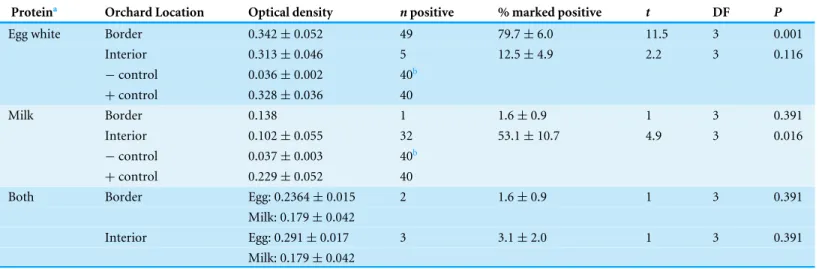
Table 1 Mean optical density (±SD) for all samples that tested positive for the protein marker and mean (±SEM) percentage of leaves marked positive with egg white, milk, or both protein marker solutions (averaged across four sampling periods) collected from the orchard border and
interior, and compared to zero with a one samplet-test.64 leaves were collected per location.
Proteina Orchard Location Optical density npositive % marked positive t DF P
Egg white Border 0.342±0.052 49 79.7±6.0 11.5 3 0.001
Interior 0.313±0.046 5 12.5±4.9 2.2 3 0.116
−control 0.036±0.002 40b +control 0.328±0.036 40
Milk Border 0.138 1 1.6±0.9 1 3 0.391
Interior 0.102±0.055 32 53.1±10.7 4.9 3 0.016
−control 0.037±0.003 40b +control 0.229±0.052 40
Both Border Egg: 0.2364±0.015 2 1.6±0.9 1 3 0.391
Milk: 0.179±0.042
Interior Egg: 0.291±0.017 3 3.1±2.0 1 3 0.391
Milk: 0.179±0.042
Notes.
aBorder was marked with only egg white and the interior with only milk. b40 samples tested, none were positive.
within the orchard interior were successfully marked with their respective protein marker (Table 1). Marking efficacy of the orchard varied between the two protein markers, and was generally lower with the milk protein, with 31–81% marked versus 62–94% marked with egg whites (Table 1), which may have been due to application coverage or the efficacy of the ELISA detection assays (Hagler et al., 2014). Some sample contamination did occur either from drift during application or other potential, unknown cross-contamination of samples, but the percentage of contaminated samples was not significantly greater than zero (Table 1).
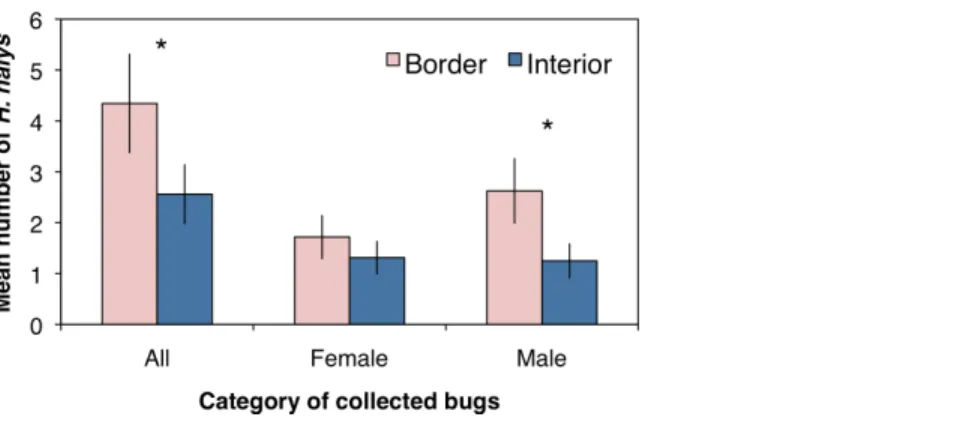
A total of 221 adultH. halyswere collected across all sampling sites in the peach orchard, with 140 collected along the crop border and 81 from the interior. Over the entire season there were significantly more stink bugs collected along the orchard border than the orchard interior (Fig. 1;F1,62=14.4,P<0.001). Of theH. halysadults collected, there
was no difference in the average abundance (±SEM) of females (1.51±0.27) compared to males (1.94 ±0.37) (χ2=0.21, df=1, P=0.644). However, the distribution of
H. halyswithin a peach orchard may be influenced by the location of male bugs. FemaleH. halyswere evenly distributed between the border and interior, with no significant difference in the density of female bugs collected between locations (Fig. 1;F1,62=1.73,P=0.193),
whereas significantly more males were collected along the orchard border compared to the interior (Fig. 1;F1,62=14.92,P<0.001).
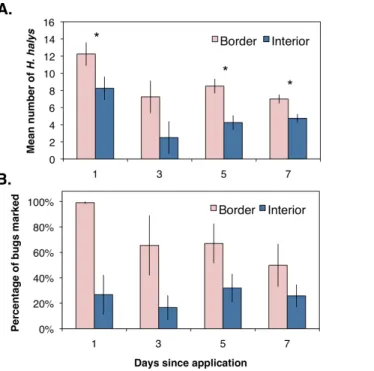
Assessing the distribution and movement of all collectedH. halysrevealed that after the first day of sampling there were significantly more bugs collected along the orchard border than within the interior (Fig. 2A;χ2=4.86, df=1,P=0.027). Even though an average
Figure 1 Mean (±SEM) density ofH. halyscollected in peach orchards comparing separately all, only
female, and only male bugs between the orchard border and interior. Asterisks indicate significant
dif-ference (GLMM;P<0.05).
colonizes peach orchards. The abundance of bugs collected by the third day dropped for both locations with no significant difference between the two (Fig. 2A;χ2=2.08, df=
1,P=0.149). By the fifth and seventh days, there were significantly higher numbers of
bugs collected along the crop border (Fig. 2A;χ2=5.33, df=1,P=0.021;χ2=4.86, df
=1,P=0.027, respectively). Additionally, even though percentages of positively marked
H. halysfluctuated over the seven day period, the egg and milk proteins were persistent enough in the orchard that we were able to consistently collect bugs marked with either egg only, milk only, or both proteins across the seven day period (Fig. 2B).
From the 221 adultH. halysthat were collected, 87 were marked with egg white only (border), 32 with milk only (interior), and 21 with both protein markers. There was a significant difference in the mean density (±SEM) of stink bugs marked with egg white only per sampling site along the border (2.5±0.7) compared with those collected within the interior (0.22 ±0.07; F1,62=38.1,P<0.001). Although overall fewer bugs were
marked with only milk, significantly more were marked with milk per sampling site that were collected from the interior (0.72±0.22) than from along the edge (0.28±0.11; F1,62=4.65,P=0.035). There were more stink bugs marked with both proteins collected
per sampling site along the border (0.5±0.16) compared with those collected within the interior (0.16±0.08), but this difference was not statistically significant (F1,62=2.36,
P=0.131).
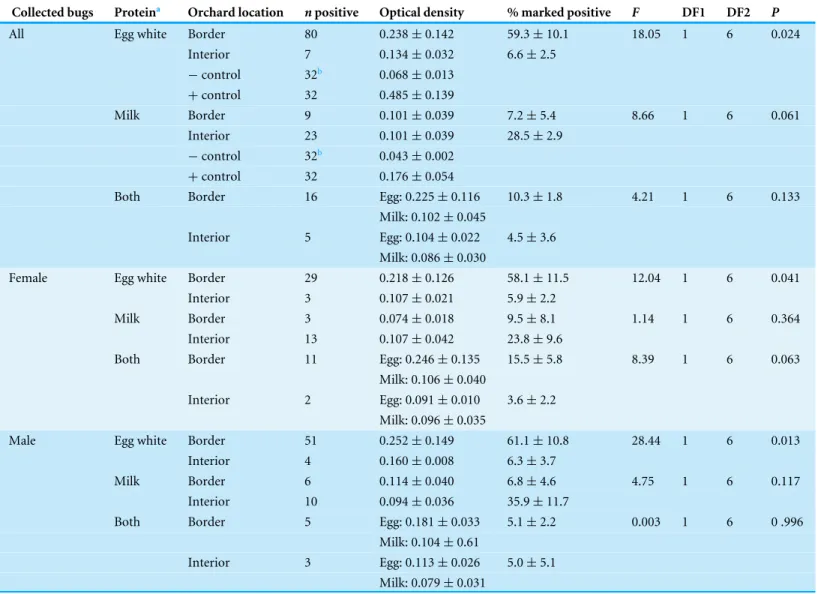
When analyzing the uncorrected percentages of marked H. halys, we found that a total of 63.3% were successfully marked. As with the density of all stink bugs collected, a significantly higher percentage ofH. halyscollected along the orchard border were marked with only egg white proteins compared to those collected within the interior (P=0.024;
Table 2). Of the bugs marked with milk, there were more collected in the interior than on the border but the results were not statistically significant (P=0.061;Table 2). There
was also no significant difference in the percentages of all bugs marked with both proteins for either orchard location (P=0.133;Table 2). Analysis of percent marked bugs by sex
Figure 2 (A) Mean (±SEM) density of allH. halyscollected in peach orchards comparing those collected from the orchard border and interior over seven days of sampling. Asterisks indicate significant difference (Kruskal–Wallis;P<0.05). (B) Mean (±SEM) percentage of bugs marked positive for both proteins,
in-dicating the longevity of the protein markers in the field.
significantly higher percentages of bugs marked with egg whites only collected along the orchard border (FemaleP=0.041; MaleP=0.013;Table 2).
The percentages of marked bugs were corrected for marking efficiency by assuming bugs were positively marked with a protein if collected within the respective orchard location. Using the corrected values, female and male H. halyswere significantly more abundant along the orchard border (Female:F1,6=183.9,P=0.001; Male:F1,6=51.1,P=0.006;
Fig. 3) than the interior. Similarly, females and males marked with milk were significantly higher in the orchard interior (Female:F1,6=82.9,P=0.003; Male:F1,6=36.5,P=0.009;
Fig. 3). Females marked with both proteins, indicating dispersal within the orchard, was significantly higher along the border (Fig. 3;F1,6=25.2,P=0.015;Fig. 3A), whereas males
marked with both proteins were collected equally between the border and the interior (Fig. 3;F1,6=0.002,P=0.964;Fig. 3B). These data imply that a small proportion of male
H. halys move evenly back-and-forth between the orchard border and interior, while a small yet significant proportion of females move to the border once they have reached the interior.
DISCUSSION
Table 2 Mean optical density (±SD) for all samples that tested positive for the protein marker and mean (±SEM) percentage ofH. halysadults per sampling site marked positive with egg white, milk, or both protein marker solutions compared from between orchard border and interior
with an ANOVA for all, female only, and male only.Total number of bugs collected was 221.
Collected bugs Proteina Orchard location npositive Optical density % marked positive F DF1 DF2 P
All Egg white Border 80 0.238±0.142 59.3±10.1 18.05 1 6 0.024 Interior 7 0.134±0.032 6.6±2.5
−control 32b 0.068±0.013 +control 32 0.485±0.139
Milk Border 9 0.101±0.039 7.2±5.4 8.66 1 6 0.061 Interior 23 0.101±0.039 28.5±2.9
−control 32b 0.043±0.002 +control 32 0.176±0.054
Both Border 16 Egg: 0.225±0.116 10.3±1.8 4.21 1 6 0.133 Milk: 0.102±0.045
Interior 5 Egg: 0.104±0.022 4.5±3.6 Milk: 0.086±0.030
Female Egg white Border 29 0.218±0.126 58.1±11.5 12.04 1 6 0.041 Interior 3 0.107±0.021 5.9±2.2
Milk Border 3 0.074±0.018 9.5±8.1 1.14 1 6 0.364 Interior 13 0.107±0.042 23.8±9.6
Both Border 11 Egg: 0.246±0.135 15.5±5.8 8.39 1 6 0.063 Milk: 0.106±0.040
Interior 2 Egg: 0.091±0.010 3.6±2.2 Milk: 0.096±0.035
Male Egg white Border 51 0.252±0.149 61.1±10.8 28.44 1 6 0.013 Interior 4 0.160±0.008 6.3±3.7
Milk Border 6 0.114±0.040 6.8±4.6 4.75 1 6 0.117 Interior 10 0.094±0.036 35.9±11.7
Both Border 5 Egg: 0.181±0.033 5.1±2.2 0.003 1 6 0 .996 Milk: 0.104±0.61
Interior 3 Egg: 0.113±0.026 5.0±5.1 Milk: 0.079±0.031
Notes.
aBorder was marked with only egg white and the interior with only milk. b32 samples tested, none were positive.
Figure 3 Mean (±SEM) percentage ofH. halysadults per sampling site marked positive with egg white, milk, or both protein marker solutions compared from between orchard border and interior
with an ANOVA for (A) female and (B) male bugs. Asterisks indicate significant difference (Kruskal–
Wallis;P<0.05).
the pheromone may have at influencing male and female retention on or dispersal between host plants.While we do not have data on the reproductive status of the collected femaleH. halysand physical sampling of peach trees only allowed us to determine the distribution of H. halyswithin the peach orchard at that specific time, the use of immunomarking, which has been used to study the dispersal and movement patterns of a variety of insects (Horton, Jones & Unruh, 2009;Sivakoff, Rosenheim & Hagler, 2012;Reisig, Roe & Dhammi, 2013;Swezey et al., 2014), allowed us to track where the stink bugs had previously been within the orchard. Unfortunately the protein marking does not clarify the process behind the differences in the distribution trend of female and maleH. halys.
Because of the gap between sampling periods, the protein application efficiency (Table 1), and the potential for removing protein from marked bugs due to the adhesive in the collection process (Jones, Melton & Baker, 2011), we are unable to determine whether stink bugs marked with only milk protein collected from within the orchard interior were already within the orchard and were marked directly during protein application, or if they immigrated directly into the interior bypassing the orchard border.
AlthoughH. halysappears to be a perimeter-driven pest, our data reveal that it readily disperses and re-invades peach orchards along the border as well as within the interior. We sampled the same three trees per sampling site over the course of a seven-day period, and even though bugs were continually removed from each sampling site location, an average of 0.5–1 bugs per site were collected each of the following seven days. Additionally, immunomarking revealed that a total of 16.7% ofH. halysadults collected were marked (corrected for marking efficiency) with both proteins, implying that there is significant movement within the orchard. Identifying the bugs marked with both proteins revealed that femaleH. halysappear to move more readily from the orchard interior to the orchard border with over double the percentage (corrected) of females marked with both proteins collected along the border. Conversely, the density of male stink bugs were nearly double along the crop border, but the percentages (corrected) of males marked with both were nearly identical in both locations. This supports previous demonstrations thatH. halyshas a strong dispersal capacity (Lee & Leskey, 2015;Wiman et al., 2015).
CONCLUSIONS
Understanding the movement and distribution patterns ofH. halysadults in an agricultural landscape will help growers more efficiently and more effectively manage H. halys through techniques that exploit insect behavior, such as border spray applications that will reduce overall insecticide use and help preserve beneficial insects in the agro-ecosystem. These results will be used to support further research on the effectiveness of the systems-level approach exploiting the perimeter-driven behavior ofH. halysand to better understand the mechanisms behind the border spray approach and how it could be further optimized. Further testing, utilizing a more appropriate sampling method, a higher concentration of milk protein solution, and investigating female reproductive status is needed.
ACKNOWLEDGEMENTS
The authors would graciously like to thank Ann Rucker, members of the Nielsen lab, and Tawnee Melton for their assistance in field collection and sample analysis.
ADDITIONAL INFORMATION AND DECLARATIONS
Funding
The authors received support from the New Jersey State Horticultural Society and the Pennsylvania Department of Agriculture’s Pennsylvania Peach & Nectarine Research Program Commodity Grant. The funders had no role in study design, data collection and analysis, decision to publish, or preparation of the manuscript.
Grant Disclosures
The following grant information was disclosed by the authors: New Jersey State Horticultural Society.
Pennsylvania Department of Agriculture’s Pennsylvania Peach & Nectarine Research Program Commodity Grant.
Competing Interests
The authors declare that there are no competing interests.
Author Contributions
• Brett R. Blaauw conceived and designed the experiments, performed the experiments, analyzed the data, contributed reagents/materials/analysis tools, wrote the paper, prepared figures and/or tables, reviewed drafts of the paper.
• Vincent P. Jones wrote the paper, reviewed drafts of the paper.
• Anne L. Nielsen conceived and designed the experiments, performed the experiments, analyzed the data, contributed reagents/materials/analysis tools, wrote the paper, reviewed drafts of the paper.
Data Availability
Supplemental Information
Supplemental information for this article can be found online athttp://dx.doi.org/10.7717/ peerj.1997#supplemental-information.
REFERENCES
Basnet S, Kuhar TP, Laub CA, Pfeiffer DG. 2015.Seasonality and distribution pattern of brown marmorated stink bug (Hemiptera: Pentatomidae) in Virginia vineyards. Journal of Economic Entomology108:1902–1909DOI 10.1093/jee/tov124.
Benton TG, Bowler DE. 2012. Dispersal in invertebrates: influences on individual decisions. In: Clobert J, Baguette M, Benton TG, Bullock JM, eds.Dispersal ecology and evolution. Oxford: Oxford University Press.
Bergmann E, Bernhard KM, Bernon G, Bickerton M, Gill S, Gonzales C, Hamilton GC, Hedstrom C, Kamminga K, Koplinka-Loehr C, Krawczyk G, Kuhar TP, Kunkel B, Lee J, Leskey TC, Martinson H, Nielsen AL, Raupp MJ, Shearer P, Shrewsbury P, Walgenbach J, Whalen J, Wiman N. 2015.Host plants of the brown marmorated stink bug in the US.Available athttp:// www.stopbmsb.org/ where-is-bmsb/ host-plants/ #host_plants_table(accessed 11 September 2015).
Blaauw BR, Polk D, Nielsen AL. 2015.IPM-CPR for peaches: incorporating
behaviorally-based methods to manageHalyomorpha halysand key pests in peach. Pest Management Science71:1513–1522DOI 10.1002/ps.3955.
Bostanian NJ, Vincent C, Chouinard G, Racette G. 1999.Managing apple maggot, Rhagoletis pomonella(Diptera: Tephritidae), by perimeter trapping.Phytoprotection
80:21–33DOI 10.7202/706178ar.
Bowler DE, Benton TG. 2005.Causes and consequences of animal dispersal strategies: relating individual behaviour to spatial dynamics.Biological Reviews80:205–225 DOI 10.1017/S1464793104006645.
Chouinard G, Hill SB, Vincent C, Barthakur NN. 1992.Border-row sprays for control of the plum curculio in apple orchards: behavioral study.Journal of Economic Entomology85:1307–1317DOI 10.1093/jee/85.4.1307.
Crowther JR. 2001.The ELISA guidebook. Totowa: Humana Press.
Funayama K. 2004.Importance of apple fruits as food for the brown-marmorated stink bug,Halyomorpha halys(Stal) (Heteroptera: Pentatomidae).Applied Entomology and Zoology39:617–623DOI 10.1303/aez.2004.617.
Gripenberg S, Mayhew PJ, Parnell M, Roslin T. 2010.A meta-analysis of preference– performance relationships in phytophagous insects.Ecology Letters13:383–393 DOI 10.1111/j.1461-0248.2009.01433.x.
Gros A, Hovestadt T, Poethke HJ. 2008.Evolution of sex-biased dispersal: the role of sex-specific dispersal costs, demographic stochasticity, and inbreeding.Ecological Modelling 219:226–233DOI 10.1016/j.ecolmodel.2008.08.014.
Hagler JR, Jackson CG. 2001.Methods for marking insects: current techniques and future prospects.Annual Review of Entomology46:511–543
DOI 10.1146/annurev.ento.46.1.511.
Hagler JR, Jones VP. 2010.A protein-based approach to mark arthropods for mark-capture type research.Entomologia Experimentalis et Applicata135:177–192 DOI 10.1111/j.1570-7458.2010.00980.x.
Hagler JR, Naranjo SE, Machtley SA, Blackmer F. 2014.Development of a standardized protein immunomarking protocol for insect mark-capture research.Journal of Applied Entomology138:772–782DOI 10.1111/jen.12135.
Horton DR, Jones VP, Unruh TR. 2009.Use of a new immunomarking method to assess movement by generalist predators between a cover crop and tree canopy in a pear orchard.American Entomologist55:49–56DOI 10.1093/ae/55.1.49.
Jones VP, Hagler JR, Brunner JF, Baker CC, Wilburn TD. 2006.An inexpensive immunomarking technique for studying movement patterns of naturally occurring insect populations.Environmental Entomology35:827–836
DOI 10.1603/0046-225X-35.4.827.
Jones VP, Melton TD, Baker CC. 2011.Optimizing immunomarking systems and development of a new marking system based on wheat.Journal of Insect Science
11:1–16DOI 10.1673/031.011.8701.
Jones VP, Westcot D, Finson NN, Nishimoto RK. 2001.Relationship between commu-nity structure and southern green stink bug (Heteroptera: Pentatomidae) damage in macadamia nuts.Environmental Entomology30:1028–1035
DOI 10.1603/0046-225X-30.6.1028.
Joseph SV, Nita M, Leskey TC, Bergh JC. 2015.Temporal effects on the incidence and severity of brown marmorated stink bug (Hemiptera: Pentatomidae) feeding injury to peaches and spples during the fruiting period in Virginia.Journal of Economic Entomology108:592–599 DOI 10.1093/jee/tou059.
Joseph SV, Stallings JW, Leskey TC, Krawczyk G, Polk D, Butler B, Bergh JC. 2014. Spatial distribution of brown marmorated stink bug (hemiptera: pentatomidae) injury at harvest in mid-Atlantic apple orchards.Journal of Economic EntomologyIn Press.
Kaplan I. 2012.Attracting carnivorous arthropods with plant volatiles: the future of biocontrol or playing with fire?Biological Control60:77–89
DOI 10.1016/j.biocontrol.2011.10.017.
Khrimian AZA, Weber DC, Ho H-Y, Aldrich JR, Vermillion KE, Siegler M, Shirali S, Guzman F, Leskey TC. 2014.Discovery of the aggregation pheromone of the brown marmorated stink bug (Halyomorpha halys) through the creation of stereoisomeric libraries of 1-Bisabolen-3-ols.Journal of Natural Products77:1708–1717.
Krupke CH, Jones VP, Brunner JF. 2006.Diel periodicity ofEuschistus conspersus (Heteroptera: Pentatomidae) aggregation, mating and feeding.Annals of the Entomological Society of America99:169–174
DOI 10.1603/0013-8746(2006)099[0169:DPOECH]2.0.CO;2.
Lee D-H, Leskey TC. 2015.Flight behavior of foraging and overwintering brown marmorated stink bug,Halyomorpha halys(Hemiptera: Pentatomidae).Bulletin of Entomological Research105:566–573DOI 10.1017/S0007485315000462.
Leskey TC, Hamilton GC. 2010.2010 Brown marmorated stink bug working group meeting report.Available athttp:// projects.ipmcenters.org/ Northeastern/ FundedProjects/ ReportFiles/ Pship2010/ Pship2010-Leskey-ProgressReport-237195-Meeting-2010_11_17.pdf.
Leskey TC, Hamilton GC, Nielsen AL, Polk DF, Rodriguez-Saona C, Bergh JC, Herbert DA, Kuhar TP, Pfeiffer D, Dively GP, Hooks CRR, Raupp MJ, Shrewsbury PM, Krawczyk G, Shearer PW, Whalen J, Koplinka-Loehr C, Myers E, Inkley D, Hoelmer KA, Lee D-H, Wright SE. 2012a.Pest status of the brown marmorated stink bug,Halyomorpha halysin the USA.Outlooks on Pest Management 23:218–226 DOI 10.1564/23oct07.
Leskey TC, Lee D-H, Short BD, Wright SE. 2012b.Impact of insecticides on the invasive Halyomorpha halys(Hemiptera: Pentatomidae): analysis of insecticide lethality. Journal of Economic Entomology105:1726–1735DOI 10.1603/EC12096. Leskey TC, Short BD, Butler BR, Wright SE. 2012c.Impact of the invasive brown
marmorated stink bug,Halyomorpha halys(Stål) in mid-Atlantic tree fruit orchards in the United States: case studies of commercial management.Psyche2012:1–14 DOI 10.1155/2012/535062.
Mazzi D, Dorn S. 2012.Movement of insect pests in agricultural landscapes.Annals of Applied Biology 160:97–113DOI 10.1111/j.1744-7348.2012.00533.x.
Mönkkönen M. 1999.Managing Nordic boreal forest landscapes for biodiversity: ecological and economic perspectives.Biodiversity and Conservation8:85–99 DOI 10.1023/A:1008813225086.
Nielsen AL, Hamilton G. 2009a.Life history of the invasive speciesHalyomorpha halys(Hemiptera: Pentatomidae) in Northeastern United States.Annals of the Entomological Society of America102:608–616DOI 10.1603/008.102.0405. Nielsen AL, Hamilton GC. 2009b.Seasonal occurrence and impact ofHalyomorpha
halys(Hemiptera: Pentatomidae) in tree fruit.Journal of Economic Entomology
102:1133–1140DOI 10.1603/029.102.0335.
Nielsen AL, Hamilton GC, Shearer PW. 2011.Seasonal phenology and monitoring of the non-nativeHalyomorpha halys(Hemiptera: Pentatomidae) in soybean. Environmental Entomology40:231–238DOI 10.1603/EN10187.
Nielsen AL, Shearer PW, Hamilton GC. 2008.Toxicity of insecticides toHalyomorpha halys(Hemiptera: Pentatomidae) using glass-vial bioassays.Journal of Economic Entomology101:1439–1442
Petit S, Moilanen A, Hanski I, Baguette M. 2001.Metapopulation dynamics of the bog fritillary butterfly: movements between habitat patches.Oikos92:491–500 DOI 10.1034/j.1600-0706.2001.920310.x.
Polk DF, Schmitt D, Atanassov A. 2010.Fruit quality and spray programs in NJ orchards. In:Proceedings of the 85th annual Cumberland-Shenandoah fruit workers conference. Winchester, VA, 63–67.
Reisig DD, Roe M, Dhammi A. 2013.Dispersal pattern and dispersion of adult and nymph stink bugs (Hemiptera: Pentatomidae) in wheat and corn.Environmental Entomology42:1184–1192DOI 10.1603/EN13166.
Shelton AM, Badenes-Perez FR. 2006.Concepts and applications of trap cropping in pest management.Annual Review of Entomology51:285–308
DOI 10.1146/annurev.ento.51.110104.150959.
Sivakoff FS, Rosenheim JA, Hagler JR. 2012.Relative dispersal ability of a key agri-cultural pest and its predators in an annual agroecosystem.Biological Control
63:296–303DOI 10.1016/j.biocontrol.2012.09.008.
Swezey SL, Nieto DJ, Hagler JR, Pickett CH, Bryer JA, Machtley SA. 2013.Dispersion, distribution, and movement ofLygusspp. (Hemiptera: Miridae) in yrap-cropped organic strawberries.Environmental Entomology42:770–778DOI 10.1603/EN12353. Swezey SL, Nieto DJ, Hagler JR, Pickett CH, Bryer JA, Machtley SA. 2014.Spatial
density and movement of theLygusspp. parasitoidPeristenus relictus(Hymenoptera: Braconidae) in organic strawberries with alfalfa trap crops.Environmental Entomol-ogy43:363–369DOI 10.1603/EN13128.
Tillman PG. 2011.Influence of corn on stink bugs (Heteroptera: Pentatomidae) in subsequent crops.Environmental Entomology40:1159–1176DOI 10.1603/EN10243. Tillman PG, Northfield TD, Mizell RF, Riddle TC. 2009.Spatiotemporal patterns and
dispersal of stink bugs (Heteroptera: Pentatomidae) in peanut-cotton farmscapes. Environmental Entomology38:1038–1052DOI 10.1603/022.038.0411.
Venugopal PD, Coffey PL, Dively GP, Lamp WO. 2014.Adjacent habitat influence on stink bug (Hemiptera: Pentatomidae) densities and the associated damage at field corn and soybean edges.PLoS ONE9:e109917DOI 10.1371/journal.pone.0109917. Venugopal PD, Martinson HM, Bergmann EJ, Shrewsbury PM, Raupp MJ. 2015.Edge
effects influence the abundance of the invasiveHalyomorpha halys(Hemiptera: Pentatomidae) in woody plant nurseries.Environmental Entomology44:474–479 DOI 10.1093/ee/nvv061.
Vincent C, Chouinard G, Bostanian NJ, Morin Y. 1997.Peripheral-zone treatments for plum curculio management: validation in commercial apple orchards.Entomologia Experimentalis et Applicata84:1–8DOI 10.1046/j.1570-7458.1997.00191.x.