ISSN 1557-4555
© 2010 Science Publications
Corresponding Author: S. Kandrelis,Department of Animal Production, Faculty of Agriculture,
Technological Educational Institute of Epirus, Postal Code 47100, Kostakioi, Arta,Greece Tel: 2681050201 Fax: 2681050527
Production and Nutritional Quality of low elevation zone Grasslands and Kermes Oak
Shrublands (Quercus coccifera L.) in the South-East Mediterranean Basin
1
C.
Roukos,
1K. Papanikolaou,
2,4S.
Kandrelis,
1A.
Mygdalia,
2Ch.
Koutsoukis and
3E.
Glavas
1
Department of Animal Production, Faculty of Agriculture,
Aristotle University of Thessaloniki, Thessaloniki, Greece
2
Department of Animal Production, Faculty of Agriculture,
Technological Educational Institute of Epirus, Arta, Greece
3
Department of Communications, Informatics and Management,
Faculty of Management and Economics, Technological Educational Institute of Epirus, Arta, Greece
4
Department of Animal Production, Faculty of Agriculture,
Technological Educational Institute of Epirus, Postal Code 47100, Kostakioi Arta, Greece
Abstract: Problem statement: The objective of this study was to evaluate the production and
nutrition quality of grasslands and kermes oak shrublands in Preveza Prefecture, northwest Greece.
Approach: The study involved the collection of herbage and browse samples along a grazing period,
from March to October for two consecutive years. In consequence, browse samples were manually separated to leaves and twigs. The three forage components (herbage, kermes oak leaves and twigs) were analyzed for crude protein, Neutral-Detergent Fiber (NDF), Acid-Detergent Fiber (ADF), lignin and In Vitro Dry Matter Digestibility (IVDMD). After the 2 years of observation, we concluded that kermes oak browse, especially the leaves, had CP content adequate to fulfill the nutrient requirements of grazing goats throughout the grazing period. Results: However, this browse is characterized by a very low IVDMD during summer, which may be the result of high lignin content and the presence of anti-nutritional factors such as phenols and tannins. The month of harvest strongly affected the production and nutritive value of forage components, firstly by giving a significant positive correlation among average monthly temperature, production, cell wall contents and secondly, a negative correlation among average monthly rainfall, IVDMD and lignin content. Conclusion: In closure, kermes oak shrublands of the lower zone constitute an important alimentary source providing adequate amounts of browse in order to maintain the nutrient requirements for grazing goats during the summer, when the herbage is not desirable for consumption from sheep and cattle.
Keywords: Herbage, kermes oak, nutritional quality, Greece
INTRODUCTION
In Greece, rangelands considered to be important feed resources for extensive Livestock Farming, extended mainly in the rural and Less Favorable Areas (LFAs) of the country. However, in these areas extensive livestock farming plays a key role to both rangeland ecosystem sustainability and in the viability of the primary sector (Chatzitheodoridis et al., 2008).
Grasslands and kermes oak shrublands are two of the main range types in Epirus which support an important grazing livestock population throughout the year.
Woody species, such as kermes oak (Quercus coccifera L.), are well adapted in Mediterranean climate particularly to summer drought (Tsiouvaras, 1987) and are considered as common components of Mediterranean vegetation growing alone or in a mixture with other sclerophyllous evergreen shrubs. Previous studies indicated that both kermes oak browse production and nutritive value are affected by environmental conditions and vary widely among species, varieties and seasons (Koukoura, 1988; Papanastasis et al., 2008; Platis and Papanastasis, 2003; Tsiouvaras, 1987). In general, kermes oak browse is rich in cell content, lignin and tannins but poor concerning energy, crude protein and digestibility (Kamalak et al., 2004; Koukoura, 1988; Papachristou and Nastis, 1994; Papanastasis et al., 2008). The low digestibility levels are associated to intense presence of secondary compounds, especially lignin and tannins.
There is some evidence that shrublands are more productive than grasslands in comparable environments, but such case is based on the shrubland structure and more specific to shrub density and height (Papanastasis et al., 2008). In addition, producers developed the impression that kermes oak browse offer to livestock a relatively higher nutrition quality feed than herbage, during the dry season when herbaceous plants complete their biological cycle and therefore, their nutritional quality is considerably low. For this reason, it is estimated that kermes oak browse can fulfill the nutritional needs during summer and winter feed gaps, if evergreen (Papanastasis et al., 2008), or can be used as feed supplements for goats during summer (Noitsakis and Papanastasis, 1992).
Lastly, the aim of this study was to evaluate the production and nutritional quality of grasslands and kermes oak shrublands within the grazing period in order to achieve a sustainable management for these specific ecosystems of Preveza Prefecture.
MATERIALS AND METHODS
Studied area: The study was carried out in the lower
altitudinal zone rangelands of Preveza Prefecture, north-western Greece, from February 2007 till October 2008.
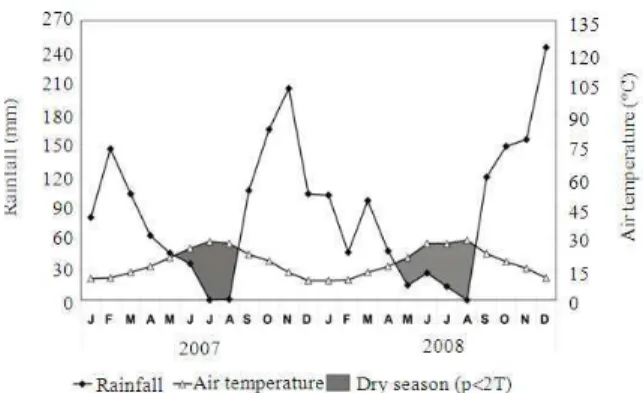
Long term records for the studied area are provided by Hellenic National Meteorological Service (HNMS, 2009). According to these, the climate, a typical Mediterranean, is characterized by rainy, cold winters and dry, warm summers. Mean monthly temperature ranges from 8.7-26.5°C for January and July respectively. Mean annual rainfall for the period of 1976-1997 was 1084.6 mm. One automatic weather
station (Onset HOBO weather station) was placed in the experimental area in order to gather data regarding the local precipitation and temperature (Fig. 1). These data showed that dry season begins at the end of April and ends at the late of August.
Sample collection: For the experiment, during
February of 2007, ten sites were selected for sampling (Fig. 2) in an altitudinal zone ranging from 125-350 m. In each site, two plots of 20 m2 each; one in grassland and one in the adjacent kermes oak shrubland, were fenced in order to avoid grazing during the experimental period. Furthermore, inside each enclosure, eight randomly selected quadrates of 0.25 m2 were selected. Both grassland and kermes oak shrubland selected, had the same morphological appearance. The sampling period was appointed to monthly intervals according to the grazing period, lasting from March till October. In grasslands, sampling was done by cutting herbaceous vegetation using hand shears at approximately 5 cm above soil level. For kermes oak shrublands, samples obtained by cutting all new twigs. All samples were immediately placed into individual paper bags and transported to the laboratory, where, they were divided in two groups, twigs and leaves. This was necessary because goats prefer to eat leaves of deciduous woody plants such as kermes oak. Dry sample weights were recorded after drying samples for 48 h in a 55°C oven and weighed to determine dry matter production on a g m−2 basis. All samples were ground in a Kinematica Mill (model Polymix PX-MFC 90 D) fitted with a 1 mm screen prior analysis.
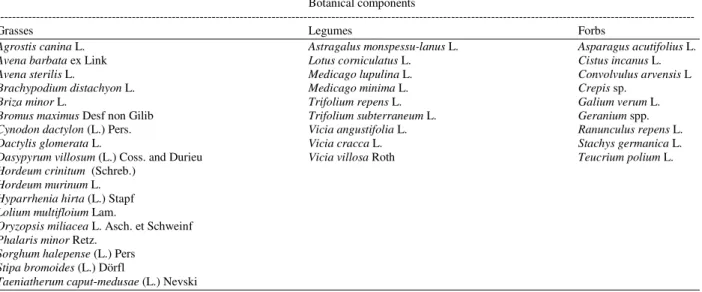
It is important to note that the dominant plant species of herbage was based on frequency of occurring above 5% in the eight quadrates equals 2 m2, in each plot at the blooming stage, near June (Table 1).
Table 1: Plant species with a frequency of occurring above 10% present in June Botanical components
---
Grasses Legumes Forbs
Agrostis canina L. Astragalus monspessu-lanus L. Asparagus acutifolius L.
Avena barbata ex Link Lotus corniculatus L. Cistus incanus L.
Avena sterilis L. Medicago lupulina L. Convolvulus arvensis L
Brachypodium distachyon L. Medicago minima L. Crepis sp.
Briza minor L. Trifolium repens L. Galium verum L.
Bromus maximus Desf non Gilib Trifolium subterraneum L. Geranium spp.
Cynodon dactylon (L.) Pers. Vicia angustifolia L. Ranunculus repens L.
Dactylis glomerata L. Vicia cracca L. Stachys germanica L.
Dasypyrum villosum (L.) Coss. and Durieu Vicia villosa Roth Teucrium polium L.
Hordeum crinitum (Schreb.)
Hordeum murinum L.
Hyparrhenia hirta (L.) Stapf
Lolium multifloium Lam.
Oryzopsis miliacea L. Asch. et Schweinf
Phalaris minor Retz.
Sorghum halepense (L.) Pers
Stipa bromoides (L.) Dörfl
Taeniatherum caput-medusae (L.) Nevski
Fig. 2: Dry matter production in each forage component over the two years. Vertical bars ± SE
Chemical analyses: Each sample was analyzed for
crude protein by the kjeldahl distillation method and further calculated by multiplying N by 6.25. Nitrogen was determined using a Vapodest distillation unit (model Vapodest 40 distillation system, Gerhardt). Neutral-Detergent Fiber (NDF), Acid-Detergent Fiber (ADF) and lignin were determined using Fibertec fiber analysis system (model Fibertec M6 fiber analysis system, FOSS, Denmark) according to the (Van, 1994) method. In vitro Dry Matter Digestibility (DMD) was determined according to the two stage technique (Tilley and Terry, 1963) using the ANKOM Daisy II-200 incubator (Ankom Technology, Fairport, NY 14450).
Statistical analyses: Statistical differences were tested
using a two-way Analysis of Variance (ANOVA) following the Generalized Linear Model (GLM)
procedure of SPSS version 16 for windows (Norusis, 2008). Least Square Differences (LSD) were used to determine significant differences among means when significant ANOVA results occurred. The Pearson’s correlation was employed to examine relationships between nutritive quality variables, climatic variables and altitude. The relationships among altitude, climatic and nutritive quality variables along with forage production, were tested using linear regression over mean values for each forage component.
RESULTS
Forage production: After the evaluation of the
Table 2: Results of two-way ANOVA showing degrees of freedom, F-statistic and the significance of the effects of forage component (herbage, kermes oak leaves and twigs), month and factors interactions on production and nutritive quality parameters
Production CP NDF
--- --- ---
Effect d.f. F P F P F P
Forage component (F) 2 178.438 0.000 564.758 0.000 183.012 0.000
Month (M) 7 170.257 0.000 492.164 0.000 775.954 0.000
F × M 14 30.321 0.000 204.211 0.000 123.324 0.000
ADF ADL IVDMD
--- --- ---
Effect d.f. F P F P F P
Forage component (F) 2 270.342 0.000 5607.492 0.000 4739.744 0.000
Month (M) 7 532.385 0.000 587.4041 0.000 1117.159 0.000
F × M 14 56.502 0.000 54.17771 0.000 95.05151 0.000
Table 3: Coefficients associated climatic variables* for significant variance in a stepwise multiple regression analysis of the production (as a dependent variable) for the period of March to June
Regression equation R2 SE
Productionherbage = -69.93+16.861 temperature 0.640 48.54
Productionkermes oak leaves = -133.05+20.582 temperature-0.515 rainfall 0.805 45.82
Productionkermes oak twigs = -35.258+9.599 temperature-0.302 rainfall 0.736 27.04
Level of significance p<0.05, *: Mean monthly temperature and rainfall of month before sampling
Table 4: Correlation coefficients of production of each forage component with climatic and nutritional quality parameters
Parameter Herbage (n = 80) Kermes oak leaves (n = 80) Kermes oak twigs (n = 80)
Rainfall -0.457** -0.441** -0.786**
Temperature 0.582** 0.381** 0.809**
IVDMD -0.647** -0.548** -0.598**
Crude protein -0.746** -0.274** -0.458**
NDF 0.664** 0.574** 0.350**
ADF 0.642** 0.708** 0.629**
Lignin 0.618** 0.663** 0.493**
Level of significance: ** p<0.01
Table 5: Correlation coefficients between nutritive quality parameters of each forage component and average monthly temperature before sample harvest
Parameter Herbage (n = 80) Kermes oak leaves (n = 80) Kermes oak twigs (n = 80)
IVDMD -0.852** -0.735** -0.529**
Crude protein -0.863** -0.396** -0.440**
NDF 0.870** 0.457** 0.473**
ADF 0.872** 0.576** 0.674**
Lignin 0.869** 0.566** 0.435**
Level of significance: ** p<0.01
Chemical composition: The crude protein content of
all forage components was significantly different among the months of sampling. This difference is expanded to forage components within the sampling months (Table 2). The CP content regarding all forage components displayed an overall rapid decrease throughout the period from March to July followed by a relatively low concentration level during August and September and finally, a smaller but significant increase located in October (Fig. 3).
As far as kermes oak concern, during summer the leaves presented significantly (p<0.05) higher crude protein content and lower cell wall contents compared to kermes oak twigs and herbage (Fig. 3). More specific, for the two years of the experiment, the
average highest and lowest CP percentage for kermes oak leaves were 14.2 and 8.4% respectively. Additionally, the CP content of kermes oak twigs was relatively low and declined after the sampling of April, with content levels falling below goats requirements.
Figure 3 shows the CP and fiber contents (NDF, ADF and lignin) of the forage components during the grazing period. It is remarkable that during the period from March to September, the CP concentration levels decreased while NDF, ADF and lignin contents increased for all forage components.
Fig. 3: Crude protein, NDF, ADF and lignin contents (%) in each forage component of the two years of study. Vertical bars ± SE
Table 6: Correlation coefficients between nutritive quality parameters of each forage component and average monthly rainfall before sample harvest
Herbage Kermes oak leaves Kermes oak twigs Parameter (n = 80) (n = 80) (n = 80)
IVDMD 0.686** 0.465** 0.378**
Crude protein 0.748** 0.057 0.128
NDF -0.649** 0.023 -0.018
ADF -0.727** -0.228** -0.381**
Lignin -0.592** -0.358** -0.282**
Level of significance: ** p<0.01
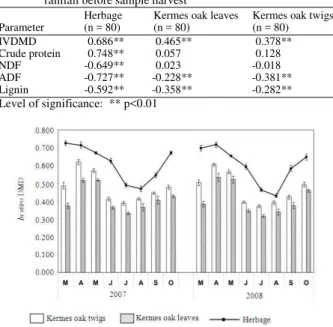
Fig. 4: In vitro DMD of forage components from Preveza Prefecture rangelands in each year. Vertical bars ± SE
The CP content and cell wall fractions of each forage component showed similar trends with the average monthly temperature (Table 5) and the average monthly rainfall (Table 6) before the harvest of the samples. However, fiber contents displayed the opposite trend compared to the CP content during the sampling period. During summer, all forage components presented the highest lignin content, which was significantly higher in kermes oak twigs than leaves and herbage. The lignin concentration is positively associated with the plant maturity (Bertrand et al., 2008; Buxton, 1996; Koukoura, 1988; Papachristou and Nastis, 1994; Tallowin and Jefferson, 1999; Tsiouvaras, 1987). The results of this study showed that for all forage components lignin content was positively related with the average monthly temperature and negatively with the average monthly rainfall. Nevertheless, it is observed that correlation coefficients values are lower in kermes oak leaves than twigs and herbage.
In Vitro Dry Matter Digestibility (IVDMD): The
Table 7: Coefficients associated climatic parameters for significant variance in a stepwise multiple regression analysis of the IVDMD (as dependent variable)
Regression equation R2 SE
IVDMDherbage = 0.792 -0.010 temperature+0.001 rainfall 0.775 0.046
IVDMDkermes oak leaves = 0.662-0.009 temperature 0.541 0.054
IVDMDkermes oak twigs = 0.538-0.006 temperature 0.280 0.063
Level of significance p<0.05
Table 8: Coefficients associated chemical composition parameters for significant variance in a stepwise multiple regression analysis of the IVDMD (as dependent variable)
Regression equation R2 SE
IVDMDherbage = 0.737-0.037 lignin+0.006 CP 0.891 0.032
IVDMDkermes oak leaves = 0.422-0.016 lignin+0.022 CP 0.700 0.044
IVDMDkermes oak twigs = 0.414-0.011 lignin+0.017 CP 0.559 0.050
Level of significance P<0.05
Also, there was a significant probability (p<0.05) for a linear relationship among IVDMD, chemical composition (Table 8) and climatic parameters (Table 7) for all botanical components. Nevertheless, the highest IVDMD values in all studied forage components were observed in spring (Fig. 4). Lastly, it is important to mention that IVDMD of herbage was always significantly higher compared to kermes oak leaves and twigs.
DISCUSSION
Forage production: The variation of herbage and
browse production observed in our experiment may indicate that the browse production is less affected by rainfall than herbage, or that kermes oak can utilize effectively the rainfall than grassland species.
Generally, the growing season of herbaceous plants starts with September rainfalls and ends at the mid of June, a fact that explains the values recorded for their production. Consequently, during summer the values of herbage production are very low due to dried herbaceous vegetative matter. On the other hand, kermes oak begins a new life cycle during the second half of March with the young twigs appearing at the beginning of April. Then, kermes oak shows a rapid growth which ends nearby May, followed by a period of stem hardening during summer and finally, a second, but smaller growth period appearing in the early of September. Therefore, we can say that the browse production of March reflects the secondary growth of the previous fall.
Furthermore the similarities of the herbage and kermes oak browse production related to the climatic variables, the chemical composition and IVDMD are strongly connected to the month of harvest and the influences occurred are documented in previous studies for grasslands (Bertrand et al., 2008; Vázquez de Aldana et al., 2000) and kermes oak shrublands
(Koukoura, 1988; Noitsakis and Papanastasis, 1992; Papanastasis et al., 2008).
Chemical composition: The CP content in forages
generally serves as a reliable measure for the nutritional quality. The CP requirements for maintenance in diets of livestock range from 77-95 g kg−1 for a 40 kg live weigh goat with medium level of muscular activity and a 50 kg live weigh sheep respectively (National Research Council, 1981; 1985). Hence, according to the findings of this study, herbage CP content is inadequate to meet the daily requirements of sheep during the period from June to September. On the other hand, kermes oak leaves contain sufficient CP fulfilling the nutrient requirements for goat’s maintenance.
It has been stated that increasing plant maturity is associated with the great need for structural plant material leading to cellulose, hemicellulose and lignin content increase (McDonald et al., 2002). This is evident while the increasing DM production formatting woody stems suggesting the importance of forage management in terms of optimising the forage quality. This fact concurs with the results obtained from the experiment and with reports given for both grassland (Bertrand et al., 2008; Karn et al., 2006; Tallowin and Jefferson, 1999; Vázquez de Aldana et al., 2000) and kermes oak shrublands (Koukoura, 1988; Papachristou and Nastis, 1994; Tsiouvaras, 1987).
the observation that correlation coefficients values are lower in kermes oak leaves than twigs and herbage may indicate that the chemical composition of kermes oak leaves is less susceptible to temperature and rainfall fluctuations than the other forage components.
In Vitro Dry Matter Digestibility (IVDMD): The
overall decrease of IVDMD for all forage components was associated to environmental factors and plant maturation. Van Soest (1994) stated that temperature, light and moisture accelerate the maturation process, with DMD to decrease with plant maturity (Bertrand et al., 2008; Karn et al., 2006; McDonald et al., 2002). These statements concur with the correlations mentioned between IVDMD and monthly temperature and monthly rainfall from present study.
The increasing average of daily temperatures combined with a relatively high spring rainfalls would have promoted the maturation process and therefore can explain the high IVDMD values in all the studied forage components (Fig. 4).
The low digestibility levels occurring at higher temperatures are due to increased lignification and the use of the cell wall content through the metabolic processes (Van, 1994). The DM lignification degree and the CP concentration in the forage affect the digestibility of forage (McDonald et al., 2002; Reynolds, 2000). This explains the high herbage IVDMD compared to kermes oak leaves and twigs.
CONCLUSION
After the evaluation of the results obtained from this study, we conclude that kermes oak browse, especially the kermes oak leaves, present adequate CP content to fulfill the nutrient requirements of grazing goats through the grazing period. However, this browse is characterized by a low IVDMD level during the summer, may be the result of anti-nutritional factors such as phenols and tannins. Nevertheless, kermes oak shrublands in the lower zone constitute an important alimentary source providing amounts of browse with a scope to maintain nutrient requirements for grazing goats during the summer, when the herbage is not consumable desirable for sheep and cattle. Conclusively, Preveza Prefecture rangelands illustrate a nutritional graduation level between grasslands and kermes oak shrublands. So, as rangelands extent from lowlands to uplands, it is crucial to determine the monthly variations of nutritional quality parameters in relation to above sea altitude in order to optimize animal nutrition and range management.
ACKNOWLEDGMENT
This study was supported financially by the “New Land: Integrated Geographical Information System for the support of the Primary Sector of Epirus” project, the Technological Educational Institute (TEI) of Epirus.
REFERENCES
Bertrand, A., G. F. Tremblay, S. Pelletier, Y. Castonguay and G. Bélanger, 2008. Yield and nutritive value of timothy as affected by temperature, photoperiod and time of harvest. Grass Forage Sci., 63: 421-432. DOI: 10.1111/j.1365-2494.2008.00649.x
Buxton, D.R., 1996. Quality-related characteristics of forages as influenced by plant environment and agronomic factors. Anim. Feed Sci. Tech., 59: 37-49. DOI:10.1016/0377-8401(95)00885-3.
Chatzitheodoridis, F., Michailidis, A. and G., Theodossiou, 2008. Comparative Analysis of Sheep-Goat Farming in a Typical Greek Island: Economy and Environment. In: Development Dialogues of Growing Economies, Jugale, V.B. (Ed.)., 1st Edn., Serials Publications, New Delhi, ISBN: 978-81-8387-151-8, pp: 173-182.
HNMS., 2009. Hellenic national meteorological service. Climatology-arta. Athens. http://www.hnms.gr/hnms/english/climatology/cli matology_html
Kamalak, A., O. Canbolat, O. Ozay and S. Aktas, 2004. nutritive value of oak (Quercus spp.) leaves. Small
Rumin. Res., 53: 161-165.
DOI:10.1016/j.smallrumres.2003.09.003.
Karn, J.F., Berdahl, J.D., and Frank, A.B., 2006. Nutritive quality of four perennial grasses as affected by species, cultivar, maturity and plant tissue. Agron. J. 98, 1400-1409. DOI: 10.2134/agronj2005.0293
Koukoura, Z., 1988. composition of kermes oak browse as affected by shade and stage of maturity. Anim. Feed Sci. Tech., 21: 1-9. DOI: 10.1016/0377-8401(88)90014-4.
McDonald, P., R.A. Edwards, J.F.D. Greenhalgh and C.A. Morgan, 2002. Animal Nutrition. 6th Edn., Pearson Education Limited, Edinburgh, Harlow, UK., ISBN: 0-582-41906-9, pp: 672.
National Research Council, 1981. Nutrient Requirements of Goats: Angora, Dairy and Meat Goats in Temperate and Tropical Countries. National Academies Press, Washington DC., ISBN: 0-309-03185-0, pp: 91.
Noitsakis, V. and V. Papanastasis, 1992. Range Ecology. Giapoudi Press, Thessaloniki, ISBN: 0007425228, pp: 256.
Norusis, M.J., 2008. SPSS 16.0 Advanced Statistical Procedures Companion. Prentice Hall, Pearson Press, ISBN: 9780136061403, pp: 418.
Papachristou, T.G. and A.S. Nastis., 1994. Changes in chemical composition and in vitro digestibility of oesophageal fistula and hand plucked forage samples due to drying method and stage of maturity. Anim. Feed Sci. Tech., 46: 87-95. DOI: 10.1016/0377-8401(94)90067-1
Papanastasis, V.P., M.D. Yiakoulaki, M. Decandia, O.D. Papanastasi. 2008. Integrating woody species into livestock feeding in the Mediterranean areas of Europe. Anim. Feed Sci. Tech., 140: 1-17. DOI: 10.1016/j.anifeedsci.2007.03.012
P÷rez, C.M.E., B.R.V.D. Aldana., B.G. Criado and A.G. Ciudad., 1998. Variations in nutritional quality and biomass production of semiarid grasslands. J. Range Manage., 51: 570-576. https://www.uair.arizona.edu/objectviewer?o=http %3A%2F%2Fjrm.library.arizona.edu%2FVolume5 1%2FNumber5%2Fazu_jrm_v51_n5_570_576_m. pdf
Platis, P.D. and V.P. Papanastasis, 2003. Relationship between shrub cover and available forage in Mediterranean shrublands. Agroforest. Syst., 57: 59-67. DOI: 10.1023/A:1022908408183 Reynolds, C.K., 2000. Forage Evaluation Using
Measurements of Energy Metabolism. In: Forage Evaluation in Ruminant Nutrition, Givens D.I. et al. (Eds.). CABI Publishing, Oxford, ISBN: 0-85199-344-3, pp: 95-112.
Tallowin, J.R.B. and R.G. Jefferson, 1999. Hay production from lowland semi-natural grasslands: A review of implications for ruminant livestock systems. Grass Forage Sci., 54: 99-115. DOI: 10.1046/j.1365-2494.1999.00171.x
Tilley, J.M.A. and R.A. Terry, 1963. A two stage technique for in vitro digestion of forage crops. Grass Forage Sci., 18: 104-111. DOI: 10.1111/j.1365-2494.1963.tb00335.x
Tsiouvaras, C.N., 1987. Ecology and management of kermes oak (Quercus coccifera L.) shrublands in Greece: A Review. J. Range Manage. 40: 542-546. https://www.uair.arizona.edu/objectviewer?o=http %3A%2F%2Fjrm.library.arizona.edu%2FVolume4 0%2FNumber6%2Fazu_jrm_v40_n6_542_546_m. pdf
Van, S.P.J., 1994. Nutritional Ecology of the Ruminant. 2nd Edn., Cornell University Press, New York, ISBN: 978-0-8014-2772-5, pp: 488.