ASSOCIATION OF
LPL
-
HIND
III POLYMORPHISM WITH CORONARY
ARTERY DISEASE IN MACEDONIAN POPULATION
Georgiev Antonio
University Clinic for Cardiology, Clinical Campus “Mother Theresa”, Medical Faculty, University “Ss. Cyril and Methodius” — Skopje, Republic of Macedonia
Primljen/Received 28. 01. 2013. god. Prihva}en/Accepted 26. 03. 2013. god.
Abstract: Objective: Coronary artery disease (CAD) is a leading cause of high mortality and morbid-ity in worldwide. TheHindIII polymorphism of theLPL gene (LPL-HindIII) is a common variant and has been associated with plasma lipid and lipoprotein variability in population studies.
Aim: Evaluation of the LPL-HindIII polymorp-hism as an independent risk factor for coronary artery disease in Macedonian population.
Material and Methods:A polymerase chain reac-tion amplificareac-tion and consecutive restricreac-tion enzyme di-gestion was used to reveal lipoprotein lipase, the intron 8 LPL-HindIII polymorphism. Study group included 114 randomized subjects with angiographically documented coronary artery stenosis (CAD group: 87 males, 27 fema-les). Control group consisted of 35 patients (21 males and 14 females) without significant stenosis in coronary arteries.
Results: Independent multiple regression analysis of LDL plasma level and their correlation with LPL-Hin-dIII polymorphism and analyzed risk factors: hyperten-sion, diabetes, family history of CAD, physical activity, antilipidemic drugs and alcohol consumption, LDL, show statistically significant correlation with BMI, and also be-tweenLPL-HindIII and LDL plasma level. In the exami-ned group, only triglycerides reached a statistically signi-ficant association with theLPL-HindIII polymorphism.
Conclusion:In our study, theLPL-HindIII poly-morphism was not identified as independent risk factor for CAD, but showed association with high triglyceri-des and LDL levels.
Key words:coronary artery disease, DNA analy-sis,LPL-HindIII polymorphism.
INTRODUCTION
Many factors are involved in the etiology of coro-nary artery disease (CAD) as a result of complex
reac-tion between genetic predisposireac-tion and environmental influences. Individual evaluation for CAD includes not only risk factors but also relevant phenotype classifica-tion for particular mutaclassifica-tions and polymorphism. In the majority of cases polymorphism and gene mutations are present in CAD (1, 2).
Lipoprotein lipase hydrolyses triglycerides from chylomicrons and very low density lipoproteins (VLDL) to the free fatty acids and glycerol. Frequency of individualLPLgene mutations significantly varied between various populations.LPLpolymorphism has minor expression, environmental factors mainly deter-mine intensity and outcome of clinically manifested at-herosclerosis and CAD (3, 4, 5, 6).
The replacement of a thymine (T) with a guanine (G) base in intron 8 of the LPL gene abolishes the LPL-HindIII restriction site. LPL-HindIII polymorp-hism in theLPLgene demonstrates strong correlation with CAD in population from various nationalities: Sa-udi Arabia (7), North Europe (8), Russia (9), Italia (10), and China (11).
The aim of the study was to assessLPL-HindIII polymorphism as an independent risk factor and pre-dictor of CAD in Macedonian population.
Hypothesis: It is not possible to LPL-HindIII poli-morhism has influence on hyperlipidemia and appear-ance of coronary artery disease?
MATERIAL AND METHODS
documen-ted significant (!70% stenosis) coronary artery
steno-sis. Demographics characteristics (age, sex, place of li-ving, and nationality), risk factors for CAD (family hi-story of CAD, the presence of hyperlipidemia, hyper-tension or diabetes mellitus, smoking), and Body-Mass Index (BMI) have been questioned by uniform questi-onnaire. Physical activity, education, use of antilipe-mic drugs, and alcohol consumption were also consid-ered. The patients with hypertensive heart disease, hea-rt defect or hypehea-rtrophic cardiomiopathy were exclu-ded from the study. The control group consisted of 35 patients with normal coronary structure and with simi-lar ethnical structure as in CAD group.
The following biochemical blood analyses were performed at the Institute of Clinical Biochemistry: tal cholesterol, LDL-cholesterol, HDL-cholesterol, to-tal lipids and triglycerides.
This study was conducted as a part of the scienti-fic and research project “Molecular-genetic Examina-tions of the Coronary Artery Disease in Macedonian Population”. The study was approved (No. 14–151/2) by the Ethical Committee of the Medical Doctor’s Chamber of Republic of Macedonia. All patients sig-ned written informed consent before the study.
DNA analysis and detection
of LPL-HindIII
polymorphism
Molecular-genetic analyses were performed at the Laboratory for Molecular Biology, Institute of Biology using the established molecular techniques for detec-tion of mutadetec-tions and polymorphism (12).
A 5 ml of venous blood sample was drawn in vac-uum sterilized test tube (Vaccutainer®) with anticoag-ulant (EDTA, disodium salt). The standard isolation of genomic DNA was performed from nucleated cells, us-ing DNA extraction with sodium chloride and chloro-form, following by ethanol precipitation. TheLPL- Hin-dIII polymorphism in intron 8 was identified by restric-tion enzyme digesrestric-tion of the PCR-amplified segment of the LPL gene (13, 14). The primers were derived from sequences between exons 8 and 9 inLPLto am-plify the sequence around aLPL-HindIII restriction si-te in intron 8 (the forward primer was 5’- TAG AGG TTG AGG CAC CTG TGC -3’ and the reverse primer was 5’- GTG GGT GAA TCA CCT GAG GTC -3’). Each PCR-amplification reaction was performed using 100-250 ng genomic DNA; 10 pmol of each primer; 200 mmol/L each of a dATP, dCTP, dGTP, and dTTP; and 0.05 U of Taq polymerase in a total reaction volu-me of 20 L. Amplification was perforvolu-med in a Gene-Amp PCR System 9400 (Perkin Elmer). In the case of amplification of exon 9, initial denaturation at 94°C for 5 minutes was followed by 30 cycles of denaturation at
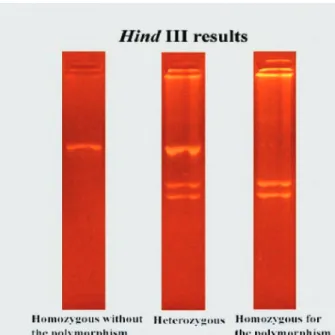
94°C for 1 minute, annealing at 57°C for 1 minute, and extension at 72°C for 1 minute, with final extension at 72°C for 10 minutes. For amplification of intron 8, ini-tial denaturation at 94°C for 5 minutes was followed by 30 cycles of denaturation at 94°C for 1 minute, anneal-ing at 57°C for 1 minute, and extension at 72°C for 1 minute, with final extension at 72°C for 10 minutes. TheLPL-HindIII polymorphism was identified by re-striction analysis usingHindIII endonuclease digestion (Figure 1). The restriction products were resolved by agarose electrophoresis and the gels were recorded by digital camera (Canon A70). Images were analyzed by GelPro software.
Statistical data processing.T-test was used to an-alyze differences in continuous variables, and the chi-square and Fisher’s exact tests were used to ana-lyze distribution of categorical variables. Odds ratio (OR) and 95% CI were used to estimate risks of HTG associated with environmental factors or serum blood chemistry. Those variables with significant OR in the univariate analysis were further examined by multiva-riate regression model to obtain adjusted OR and adju-sted 95% CI. Differences were considered statistically significant when p < 0.05 or when the 95% CI range was not included in the unity. SPSS 8.0 for MS Win-dows was used to complete the statistical analyses.
RESULTS
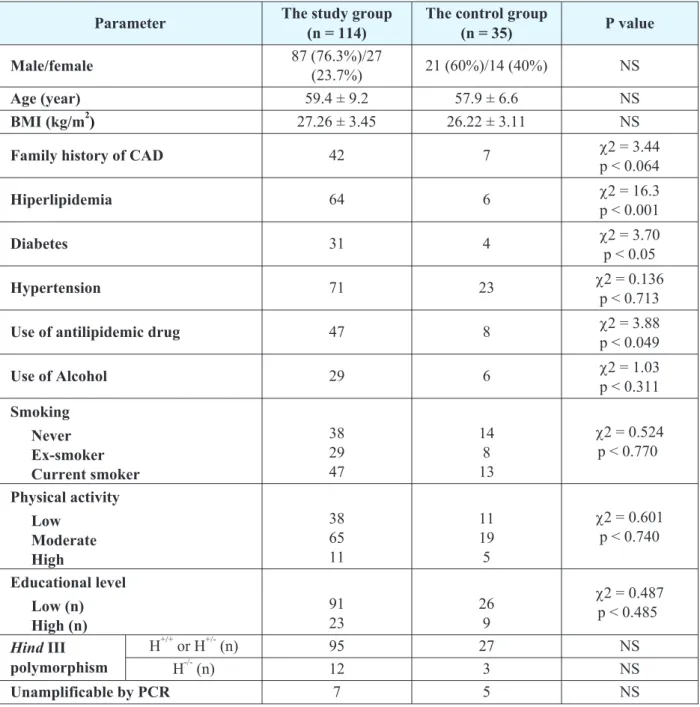
Study group included 114 patients (87 males, 27 fe-males). The control group consisted of 35 patients (21 males, 14 females) with normal coronary arteries. The results of the genetic detection ofLPL-HindIII polymor-phism, as well as of the demographics, biochemical and
other parameters between groups are summarized and compared in table 1. There was no significant difference in the sex distribution, ethnical structure and mean age between groups. Hyperlipidemia (p < 0.001), diabetes (p < 0.05) and the use of antilipidemic drugs (p < 0.05) were more common in study group. For both CAD and control groups,the genotype distributions were in ac-cordance with the Hardy-Weinberg expectation (equi-librium). Genetic equilibrium is an ideal state that pro-vides a baseline against which to measure change.
It seems that the LPL-HindIII polymorphism is not a risk factor for the presence of CAD in
Macedo-nian population ("2 = 0,0355; df = 1; p=0,851),
(Fis-her’s exact test p = 0,587) (Table 1).
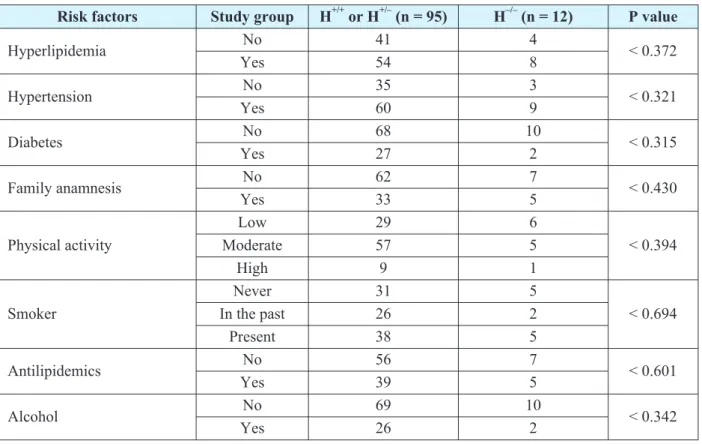
Chi-square and Fisher’s Exact test did not reveal statistical significant relationship between the LPL--HindIII polymorphism and the analyzed risk factors (hyperlipidemia, hypertension, diabetes, family his-tory of CAD, physical activity, use of antilipidemic drugs and alcohol consumption) (Table 2).
Among the plasma levels of triglycerides, total li-pids, HDL and LDL in the examined group, only triglyc-erides reached a statistically significant association with theLPL-HindIII polymorphism (p < 0.05) (Table 3).
Parameter The study group
(n = 114)
The control group
(n = 35) P value
Male/female 87 (76.3%)/27
(23.7%) 21 (60%)/14 (40%) NS
Age (year) 59.4 ± 9.2 57.9 ± 6.6 NS
BMI (kg/m2) 27.26 ± 3.45 26.22 ± 3.11 NS
Family history of CAD 42 7 "2 = 3.44
p < 0.064
Hiperlipidemia 64 6 "2 = 16.3
p < 0.001
Diabetes 31 4 "2 = 3.70
p < 0.05
Hypertension 71 23 "2 = 0.136
p < 0.713
Use of antilipidemic drug 47 8 "2 = 3.88
p < 0.049
Use of Alcohol 29 6 "2 = 1.03
p < 0.311
Smoking
Never Ex-smoker Current smoker
38 29 47
14 8 13
"2 = 0.524
p < 0.770
Physical activity
Low Moderate High
38 65 11
11 19 5
"2 = 0.601 p < 0.740
Educational level
Low (n) High (n)
91 23
26 9
"2 = 0.487
p < 0.485
HindIII polymorphism
H+/+or H+/-(n) 95 27 NS
H-/-(n) 12 3 NS
Unamplificable by PCR 7 5 NS
NS: Not Significant, PCR: Polymerase Chain Reaction
(Homozygous, H+/+, heterozygous, H+/–). The presence of theLPL-HindIII polymorphism homozygous, H-/-— the
ab-sence of theLPL-HindIII polymorphism
Table 2.Coronary risk factors and comparison to the presence and the absence (H+/+or H+/-; H-/-) of the Hind III polymorphism
Risk factors Study group H+/+or H+/–(n = 95) H–/–(n = 12) P value
Hyperlipidemia No 41 4 < 0.372
Yes 54 8
Hypertension No 35 3 < 0.321
Yes 60 9
Diabetes No 68 10 < 0.315
Yes 27 2
Family anamnesis No 62 7 < 0.430
Yes 33 5
Physical activity
Low 29 6
< 0.394
Moderate 57 5
High 9 1
Smoker
Never 31 5
< 0.694
In the past 26 2
Present 38 5
Antilipidemics No 56 7 < 0.601
Yes 39 5
Alcohol No 69 10 < 0.342
Yes 26 2
Table 3.The frequency of the lipid fractions (Triglycerides, Total lipids, HDL, LDL) and their relation to Hind III polymorphism in the examined group
Lipids/HindIII H+/+Šn=54¹ H+/–or H–/–Šn=53¹ p-level
Triglycerides 2.796 ± 1.887 2.219 ± 0.909 P < 0.0469
Total lipids 9.244 ± 3.085 8.931 ± 2.102 P < 0.5471
HDL 1.013 ± 0.299 1.090 ± 0.313 P < 0.1968
LDL 3.485 ± 0.967 3.608 ± 0.982 P < 0.5221
t = t - test; df = degrees of freedom; p = p level of the model
Table 4.Multiple regression analysis of LDL and their relation to risk factors and Hind III polymorphism in the examined group
LDL
R = 0,47 R2= 0,22 F = 2,220 p = 0,02
Beta T-test p-level
Hypertension 0.014 0.141 0.887
Diabetes 0.076 0.704 0.482
Family anamnesis 0.147 1.472 0.144
Smoker 0.147 1.402 0.164
Physical activity 0.029 0.271 0.786
Alcohol 0.051 0.465 0.642
BMI 0.210 2.018 0.046*
Hind III 0.274 2.606 0.010*
Independent multiple regression analysis of LDL plasma level and their correlation with LPL-HindIII polymorphism and analyzed risk factors: hypertension, diabetes, family history of CAD, physical activity, antili-pidemic drugs and alcohol consumption, LDL show statistically significant correlation with BMI (p < 0.05), and also betweenLPL-HindIII and LDL plasma level (p < 0.05) (Table 4).
DISCUSSION
As it’s well known, numerous studies and recent research has shown that LPL plays a key role in remo-ves triglycerides from the circulation, and generates fatty acids for storage in the adipose tissue or for oxida-tion in the skeletal muscle. In our study, the accent was placed on the examination ofLPLas a gene-candidate for coronary artery disease. Some genetic variants ha-ve been described in the sequence of LPL gene. LPL-HindIII polymorphism as one of these genetic va-riants, has important connection to CAD. So, the goal of this study was to assess the influence ofLPL-HindIII polymorphism over the appearance of the coronary ar-tery disease in Macedonian population. This original study represents the first investigation in Republic of Macedonia for this purpose.
Our study investigates LPL-HindIII polymorp-hism as independent risk factor for CAD.LPL-Hind I-II polymorphisms of theLPLgene in numerous studi-es have demonstrated strong correlation with CAD in population from various nationalities like Saudi Ara-bia (7), North Europe (8), Russia (9), Italia (10), and China (11). In our study,LPL-HindIII polymorphism was not found to be a risk factor for significant CAD in Macedonian population. Our findings support that LPL-HindIII polymorphism varies across different populations as detected by other studies (2, 8). Our study analysis shows little difference in distribution of LPL-HindIII polymorphism between study and control group. But, the presence ofLPL-HindIII poly-morphism does not expose the patient into a signifi-cant risk for appearance of CAD in Macedonian pop-ulation (table 1).
In the etiology of CAD, many risk factors are in-volved and result in complex interaction between ge-netic predisposition and environmental influences (3, 4, 7, 8, 15, 16). The environmental factors determine the intensity and result of the clinically manifested CAD. Comparison of the analyzed risk factors between groups are summarized in table 1, where there is signif-icant influence of hyperlipidemia (p < 0.001), diabetes (p < 0.05) and use of antilipidemic drugs (p < 0.049). In study we also analyzed coronary risk factors and com-pared with the presence (homozygous, H+/+or
hetero-zygous, H+/-) and the absence (homozygous, H-/-) of the LPL-HindIII polymorphism in study group, and we don’t found statistical significant influence in patients with CAD (table 2). It is supposed that the presence of polymorphisms in several genes at the same time (as those for the enzymes involved in the lipid metabo-lism, coagulation factors, inflammatory mediators and other proteins), is the cause for the multi-gene nature of arteriosclerosis and CAD (3, 6, 17).
Lipoprotein lipase plays an important role in the lipid metabolism, by hydrolyzing core triglycerides of circulating chylomicrons and VLDL. There are more authors and studies which analyze the connection of serum lipids with CAD. Also, it is known that LPL polymorphism correlated with LPL activity is associa-ted with plasma lipid and lipoprotein levels (3, 7, 12, 18). Many studies analyzed correlation ofLPL-HindIII polymorphism and level of serum lipids in patients with CAD (2, 3, 7, 12, 18, 19). In our study, on table 3, the analysis showed triglycerides level, as a significant factor linked with process of atherosclerosis and indi-rectly with appearance of CAD in Macedonian popula-tion (p < 0.0469). With independent multiple regres-sion statistical analysis of LDL plasma level and their correlation with LPL-HindIII polymorphism and re-sponse variables of the independent factors: hyperten-sion, diabetes, family history of CAD, physical activ-ity, antilipidemic drugs and alcohol consumption, we found that LDL show statistically significant correla-tion with BMI (p < 0.046), and also between LPL-Hin-dIII and LDL plasma level (table 4; p < 0.010). In our study, with our population, i.e. Macedonian popula-tion, we found thatLPL-HindIII polymorphism was as-sociated with high triglycerides and LDL levels, as a significant factor associated with process of appearan-ce of CAD.
CONCLUSION
In our studyLPL-HindIII polymorphism was not
identified as an independent risk factor for CAD in Ma-cedonian population.
Our study also confirmed that LPL-HindIII poly-morphism was associated with high triglycerides and LDL levels, what is significant factor linked with pro-cess of atherosclerosis and appearance of CAD.
Abbreviations
Coronary artery disease (CAD) Deoxyribonucleic acid (DNA) Polymerase chain reaction (PCR) Lipoprotein lipase (LPL)
riglycerides (TG)
High density lipoproteins (HDL) Low density lipoproteins (VLDL)
Very low density lipoproteins (VLDL) Body-Mass Index (BMI)
Odds ratio (OR)
Confidence interval (CI) Chi-square (Chi) t-test (t)
Degrees of freedom (df) p level of the model (p) Not Significant (NS)
Sa`etak
POVEZANOST LPL-HIND III POLIMORFIZMA SA ARTERIJSKOM BOLE[]U
U MAKEDONSKOJ POPULACIJI
Georgiev Antonio
University Clinic for Cardiology, Clinical Campus “Mother Theresa”,
Medical Faculty, University “Ss. Cyril and Methodius” — Skopje, Republic of Macedonia
Uvod:Koronarna arterijska bolest (CAD) je vo-de}i uzrok visokog mortaliteta i morbiditeta {irom sve-ta. Hind III polimorfizam LPL gena (LPL-Hind III) je ~est i povezan je sa varijantama gena za lipide i lipo-proteine u ispitivanoj populaciji.
Cilj rada:Evaluacija Hind III polimorfizma kao nezavisnog faktora rizika za koronarnu arterijsku bo-lest u makedonskoj populaciji.
Materijal i Metode:Polimerazna lan~ana reakci-ja (PCR) i enzimska digestireakci-ja DNK su kori{}ene za ot-krivanje lipoprotein lipaze, intron 8 LPL-Hind III poli-morfizma. Ispitivanu grupu je ~inilo 114 randomizira-nih pacijenata kod kojih je angiografski potvr|ena ste-noza koronarne arterije (CAD grupa: 87 mu{kog pola,
27 `enskog pola). Kontrolna grupa se sastojala od od 35 pacijenata (21 mu{kog pola, 14 `enskog pola) bez signifikantne stenoze koronarne arterije.
Rezultati:Multiplom linearnom regresijom utvr|e-na je statisti~ki zutvr|e-na~ajutvr|e-na korelacija izme|u LDL i BMI, kao i izme|u LPL-Hind III i LDL nivoa u plazmi. U ispi-tivanoj grupi je dobijena statisti~ki zna~ajna povezanost samo izme|u triglicerida i LPL-Hind III polimorfizma.
Zaklju~ak:U na{oj studiji, Hind III polimorfizam nije identifikovan kao nezavisan faktor rizika za koro-narnu arterijsku bolest, ali je dobijena povezanost sa vi-sokim nivoom triglicerida i nivoom LDLholesterola.
Klu~ne re~i: koronarna arterijska bolest, DNK analiza, LPL-Hind III polimorfizam.
REFERENCES
1. Peter Libby. Atherosclerosis: Disease Biology Affect-ing the Coronary Vasculature. The American Journal of Cardiol-ogy. 2006; 98: S3–S9.
2. Sidney C. Smith. Current and Future Directions of Car-diovascular Risk Prediction. American Journal of Cardiology. 2006; 97: 28–32.
3. Chen Qi, Razzaghi Hamid, Demirci Yesim F., Kamboh Ilyas M. Functional significance of lipoprotein lipase LPL-Hin-dIII polymorphism associated with the risk of coronary artery disease. Atherosclerosis. 2008; 200: 102–8.
4. Georgiev A., Panov S., Petrovski B., Sadikario S. Mo-lecular-genetic aspects of coronary artery disease.ŠIn Macedo-nian¹Makedonski medicinski pregled. 2004; 58: 187–192.
5. Maarten W. Peeters, Martine A. Thomis, Ruth J.F. Loos, Catherine A. Derom, Robert Fagard, Robert F. Vlietinck, Ga-ston P. Beunen. Clustering of metabolic risk factors in young adults: Genes and environment. Atherosclerosis. 2008; 200: 1: 168–176.
6. Wang L., Fan C., Topol SE., Topol EJ., Wang Q. Muta-tion of MEF2A in an inherited disorder with features of coronary artery disease. Science. 2003; 302: 1578–1581.
7. Abu-Amero KK., Wyngaard CA., Al-Boudari OM., Kambouris M., Dzimiri N. Lack of association of lipoprotein li-pase gene polymorphisms with coronary artery disease in the Sa-udi Arab population. Arch Pathol Lab Med. 2003; 127: 597–600.
8. Anderson JL., King GJ., Bair T, et al. Assotiation of li-poprotein lipase gene polymorphisms with coronary artery dise-ase. J Am Coll Cardiol. 1999; 33: 1013–20.
9. Shagisultanova EI, Mustafina OE, Tuktarova IA, Khu-snutdinova EK. LPL-HindIII polymorphism of lipoprotein lipa-se gene and risk of myocardial infarction. Mol Gen Mikrobiol Virusol. 2001; 3: 18–22.
10. Gambino R, Scaglione L, Alemanno N, Pagano G, Cassader M. Human lipoprotein lipase LPL-HindIII polymorp-hism in young patients with myocardial infarction. Metabo-lism.1999; 48: 1157–1161.
Correspondence to/Autor za korespondenciju
Assoc. Prof. Dr. Antonio Georgiev University Clinic for Cardiology
Vodnjanska 17, 1000 Skopje, R. Macedonia Tel: 00389 70 305114
antoniogeorgievªyahoo.com
12. Panov S. Basic methods in molecular biology.ŠIn Ma-cedonian¹Faculty of Natural Sciences and Mathematics, Uni-versity “Ss. Cyril and Methodius”, Skopje, Republic of Mace-donia (2003).
13. Ahn YI, Kamboh MI, Hamman RF., Cole SA., Ferrel RE. Two DNA polymorphisms in the lipoprotein lipase gene and their associations with factors related to cardiovascular disease. J Lipid Res. 1993; 34(3): 421–8.
14. Pasalic D., et al. Lipoprotein lipase gene polymorp-hism and lipid profile in patients with hypertriglyceridemia. Croat Mrd J. 2001; 42(5): 517–522.
15. Corella D., et al. Associations of LPL and APOC3 ge-ne polymorphisms on plasma lipids in a Mediterrage-nean popula-tion: interaction with tobacco smoking and the APOE locus. Jo-urnal of Lipid Research. 2002; 43: 416–429.
16. Barg E. Polymorphisms oflipoprotein lipasegene and their participation in metabolic processes. Pediatr Endocrinol Diabetes Metab. 2011;17(2): 107-12.
17. Wang SH, Cui HB, Wang DQ, Chen XM, Zhang HK, Cui CC, Chen XY, Liu XH, Zhang Z, Bai F, Jb M. Geograp-hical characteristics of single nucleotide polymorphism of can-didate genes associated with coronaryartery disease in Chinese Han population. Zhonghua Xin Xue Guan Bing Za Zhi. 2008 Jan; 36(1): 24-9.
18. Belgin Susleyici Duman., et al. Lipoprotein lipase ge-ne polymorphism and lipid profile in coronary artery disease. Arch Pathol Lab Med. 2004; 128: 869–874.