COM PAR I SON OF MULTIVARIATE CLAS SI FI CA TION
AND RE GRES SION METH ODS FOR THE IN DOOR
RA DON MEA SURE MENTS
by
Dimitrije M. MALETI], Vladi mir I. UDOVI^I]*,
Radomir M. BANJANAC, Dejan R. JOKOVI], Aleksandar L. DRAGI], Nikola B. VESELINOVI], and Jelena Z. FILIPOVI]
In sti tute of Phys ics, Uni ver sity of Bel grade, Bel grade, Ser bia
Sci en tific pa per DOI: 10.2298/NTRP1401017M
We pres ent the re sults of a test us age of multivariate meth ods, as de vel oped for data anal y sis in highen ergy phys ics and im ple mented in the toolkit for multivariate analysis soft ware pack age, in our anal y sis of the de pend ence of the vari a tion of in door ra don con cen tra tion on cli -mate vari ables. The method en ables the in ves ti ga tion of the con nec tions of the wide spec trum of cli mate vari ables with ra don con cen tra tions. We find that multivariate clas si fi ca tion and re -gres sion meth ods work well, giv ing new in for ma tion and in di ca tions, which may be help ful in fur ther re search of the vari a tion of ra don con cen tra tion in in door spaces. The method may also lead to con sid er able pre dic tion power of the vari a tions of in door ra don con cen tra tions based on the knowl edge of cli mate vari ables only.
Key words: ra don, multivariate anal y sis, cli mate pa ram e ter
IN TRO DUC TION
Ra don is a unique nat u ral el e ment since it is a gas, no ble and ra dio ac tive in all of its iso topes. As no ble gases, ra don iso topes are mo bile and can travel sig -nif i cant dis tances within the ground and through the at mo sphere. Be ing ra dio ac tive, ra don makes for about 55% of the an nual ef fec tive dose re ceived by av er age non-pro fes sional. In door ra don con cen tra tions vary sig nif i cantly due to a large num ber of fac tors, which in clude the lo cal ge ol ogy, soil per me abil ity, build ing ma te ri als and life style char ac ter is tics, cli mate pa ram e -ters and the ex change rate be tween in door and out door air. Since both the cli mate pa ram e ters and air ex change rates may sig nif i cantly vary dur ing a day, it is im por -tant to in ves ti gate their cor re la tion with short-term vari a tions of in door ra don con cen tra tions. In the past some what un usual cli mate pa ram e ters, such as wind speed and cloud cover, were oc ca sion ally con sid ered, us ing a multivariate method [13]. We start this anal y -sis with the max i mum of 18 cli mate pa ram e ters and use and com pare 12 dif fer ent multivariate meth ods.
Vari a tions of ra don con cen tra tion were stud ied in our lab o ra tory [4] in many de tails since 1999 [5-8].
Sev eral cli mate vari ables, like air tem per a ture, pres -sure, and hu mid ity were con sid ered [8, 9]. We now make fur ther ad vance and try to use all pub licly avail -able cli mate vari ables mon i tored by, in our case, nearby au to matic me te o ro log i cal sta tion (Au to matic Me te o ro log i cal Sta tion Bel grade-south, Banjica-Tro-{arina, 44°45'16"N, 20°29'21"E). We want to find the ap pro pri ate method out of the wide spec trum of multivariate anal y sis meth ods that are de vel oped for the anal y sis of data from highen ergy phys ics ex per i ments to an a lyze our mea sure ments of vari a tions of ra -don con cen tra tions in in door spaces.
FOR MU LA TION OF THE PROB LEM
The de mand for de tailed anal y ses of large amount of data in high-en ergy phys ics re sulted in wide and in tense de vel op ment and us age of multivariate meth ods. Many of multivariate meth ods and al go rithms for clas si fi ca tion and re gres sion are al ready in -te grated into the anal y sis frame work ROOT [10], more spe cif i cally, into the toolkit for multivariate anal -y sis (TMVA) [11]. We use these multivariate meth ods to cre ate, test and ap ply all avail able clas si fi ers and re -gres sion meth ods im ple mented in the TMVA in or der to find the method that would be the most ap pro pri ate
and yield max i mum in for ma tion on the de pend ence of in door ra don con cen tra tions on the mul ti tude of cli -mate vari ables.
The first step is to cal cu late and rank the cor re la -tion co ef fi cients be tween all the vari ables in volved, what will help in set ting up and test ing the frame work for run ning the var i ous multivariate meth ods con tained in the TMVA. Al though these cor re la tion rank ings will later be su per seded by methodspe cific vari -able rank ings, they are use ful at the be gin ning of the anal y sis.
The next step is to use and com pare the multivariate meth ods in or der to find out which one is best suited for clas si fi ca tion (di vi sion) of ra don con -cen tra tions into what would be con sid ered ac cept able and what would be con sid ered in creased con cen tra -tion in in door spaces. Main aim is to find out which method can, if any, on the ba sis of in put cli mate vari -ables only, give an out put that would sat is fac to rily close match the ob served vari a tions of ra don con cen -tra tions. This would en able the cre ation of the “ra don alarm” us ing only the multivariate clas si fi ca tion of the now widely avail able re cords of cli mate vari ables. To wards this aim, this work should be con sid ered a pre -lim i nary one, for the num ber of spe cific cases that should be stud ied in this way should be much larger, to com prise the mul ti tude of pos si ble rep re sen ta tive sit u -a tions th-at oc cur in re-al life.
In or der to be able to use the multivariate clas si -fi ca tion, the set of in put events (val ues for cli mate vari ables for each mea sure ment) used, have to be split into those that cor re spond to the sig nal (the ra don con -cen tra tions that are con sid ered in creased) and to the back ground (con sist ing of ra don con cen tra tions that are de clared ac cept able). This split ting of the set of in put events is for the pur poses of this pre lim i nary anal y -sis per formed at the lim it ing value of 40 Bq/m3. This
value is used for most of the anal y ses, and is se lected be cause this split ting en sures max i mum em ploy ment of multivariate com par i son meth ods, and this par tic u lar value re flects the fact that in our test case the sta tis -tics on higher ra don con cen tra tion val ues are lower. For the pur poses of set ting of a sort of a “ra don alarm”, the value of ra don con cen tra tion that should be used for split ting of in put events is the value for ra don con cen tra tion rec om mended by World health or ga ni za -tion of 100 Bq/m3. The method of multivariate re gres
-sion, how ever, does not re quire pre lim i nary split ting of in put events, and is there fore a more gen eral one.
EX PER I MEN TAL DATA
There are many meth ods avail able for mea sure -ment of ra don con cen tra tions in air. Ac cord ing to the in te grat ing mea sure ment time, these may be di vided into the long-term and short-term ones. The first are mostly per formed with pas sive in te grat ing mea sur ing
de vices based on nu clear track de tec tors, which are due to their low cost, sim plic ity, and wide avail abil ity well suited for si mul ta neous col lec tion of data from a large num ber of mea sure ment points and are thus used in large ra don map ping pro jects. The sec ond group com prises the meth ods that are per formed with more com plex and more ex pen sive pas sive or ac tive (with pumped air sam pling) de vices. For the short-term mea sure ments of ra don con cen tra tion in a sin glefam -ily dwell ing house in Bel grade, Ser bia, we use the SN1029 ra don mon i tor (man u fac tured by the Sun Nu -clear Cor po ra tion, NRSB ap proval-code 31822). The de vice con sists of two dif fused junc tion photodiodes as a ra don de tec tor, and is fur nished with sen sors for tem per a ture, bar o met ric pres sure and rel a tive hu mid -ity. The user can set the mea sure ment in ter vals from 30 minutes to 24 hours. It was set to re cord si mul ta neously the ra don con cen tra tion, tem per a ture, at mo -spheric pres sure and rel a tive hu mid ity.
The se lected house to mea sure the tem po ral vari -a tions of r-a don con cen tr-a tion is -a typ i c-al one-f-am ily de tached dwell ing house built with stan dard con struc -tion ma te ri als such as brick, con crete, and mor tar. The house is ther mally in su lated with Sty ro foam. Dur ing the pe riod of mea sure ments (sum mer), the house was nat u rally ven ti lated and air con di tion ing was used dur -ing the hot test days. The in door ra don mea sure ments were per formed in the liv ing room, where fam ily spends any thing from 16 up to 24 hours dur ing the work ing days of the week. Ra don mon i tor was mea -sur ing ra don con cen tra tion, tem per a ture, pres -sure, and hu mid ity at 2 hour in ter vals, start ing from the 3rd
of June till the 3rd of July and from the 18th of July till
the 11th of Au gust 2013.
The val ues of cli mate vari ables, which will be cor re lated with ra don mon i tor re sults, are ob tained from a mod ern au to matic me te o ro log i cal sta tion lo -cated some 400 m (GPS co or di nates) away from the house where the ra don mon i tor was placed. The wide set of cli mate vari ables were used, for the mea sure -ments of which were per formed at 5 min ute in ter vals dur ing June, July, and Au gust 2013. The fif teen cli -mate pa ram e ters used are: out door air tem per a ture, pres sure and hu mid ity, so lar irradiance, wind speed at the height of 10 m above the ground, pre cip i ta tion, evap o ra tion, and un der ground tem per a ture and hu -mid ity at the depths of 10-30 and 50 cm.
MULTIVARIATE METH ODS
The TMVA pro vides a ROOTin te grated en vi ron ment for the pro cess ing, par al lel eval u a tion and ap pli ca tion of multivariate clas si fi ca tion and multivariate re -gres sion meth ods. All multivariate meth ods in TMVA be long to the fam ily of “su per vised learn ing” al go -rithms. They make use of train ing events, for which the de sired out put is known, to de ter mine the map ping func tion that ei ther de scribes a de ci sion bound ary (clas si fi ca tion) or an ap prox i ma tion of the un der ly ing func -tional be hav ior de fin ing the tar get value (re gres sion). All MVA meth ods see the same train ing and test data. The cor re la tion co ef fi cients of the in put vari ables are cal cu lated and dis played, and a pre lim i nary rank ing is de rived (which is later su per seded by method-spe cific vari able rank ings). For standalone use of the trained clas si fi ers, TMVA also gen er ates light weight C++ re -sponse classes that do not de pend on TMVA or ROOT, nei ther on any other ex ter nal li brary. As will be dem on -strated, the two most im por tant multivariate meth ods for our pur poses are the boosted de ci sion trees (BDT) and the ar ti fi cial neu ral net works (ANN) meth ods.
Boosted decision trees
BDT has been suc cess fully used in high en ergy phys ics anal y sis for ex am ple by the MiniBooNE ex per i ment [12]. In BDT, the se lec tion is done on a ma jor ity vote on the re sult of sev eral de ci sion trees. De ci -sion tree con sists of suc ces sive de ci -sion nodes, which are used to cat e go rize the events in sam ple as ei ther sig nal or back ground. Each node uses only a sin gle dis crim i nat ing vari able to de cide if the event is sig -nal-like “goes right” or back ground-like “goes left”. This forms a tree like struc ture with “bas kets” at the end (leave nodes), and an event is clas si fied as ei ther sig nal or back ground ac cord ing to whether the bas ket where it ends up has been clas si fied as sig nal or back ground dur ing the train ing. Typ i cally, BDT is con -structed of a for est of such de ci sion trees. The (fi nal) clas si fi ca tion for an event is based on a ma jor ity vote of the clas si fi ca tions done by each tree in the for est. How ever, the ad van tage of the straight for ward in ter -pre ta tion of the de ci sion tree is lost. In many ac a demic ex am ples with more com plex cor re la tions or real life ex am ples, the BDT of ten out per form the other tech -niques. More de tailed in for ma tion about train ing can be found in [11].
Ar ti fi cial neural networks
An ar ti fi cial neu ral net work (ANN) [13] is most gen er ally speak ing any sim u lated col lec tion of in ter con nected neu rons, with each neu ron pro duc ing a cer tain re sponse at a given set of in put sig nals. By ap ply
ing an ex ter nal sig nal to some (in put) neu rons the net -work is put into a de fined state that can be mea sured from the re sponse of one or sev eral (out put) neu rons.
ANN in TMVA be long to the class of multilayer perceptrons (MLP), which are feed-for ward neu ral net works. The in put layer con tains as many neu rons as in put vari ables used in the MVA. The out put layer con -tains a sin gle neu ron for the sig nal weight. In be tween the in put and out put lay ers are a vari able num ber of k hid den lay ers with ar bi trary num bers of neu rons.
All neu ron in puts to a layer are lin ear com bi na -tions of the neu ron out put of the pre vi ous layer. The trans fer from in put to out put within a neu ron is per formed by means of an “ac ti va tion func tion”. In gen -eral, the ac ti va tion func tion of a neu ron can be zero (de ac ti vated), one (lin ear), or non-lin ear. The ANN used for our pur poses uses a sig moid ac ti va tion func tion. The trans fer func tion of the out put layer is usu -ally lin ear.
RE SULTS
We com ment on the re sults of our anal y ses di vided into cases that dif fer by the size of the set of cli -mate pa ram e ters used, by the in door space stud ied, and by the meth ods of anal y sis used.
First, we intercompare the multivariate meth ods used for clas si fi ca tion of ra don con cen tra tions by us ing the full set of cli mate vari ables as de scribed in pre -vi ous sec tions.
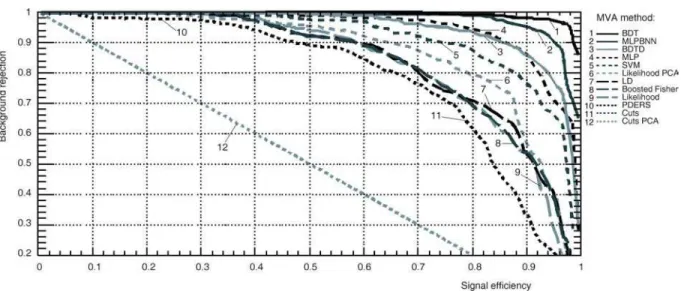
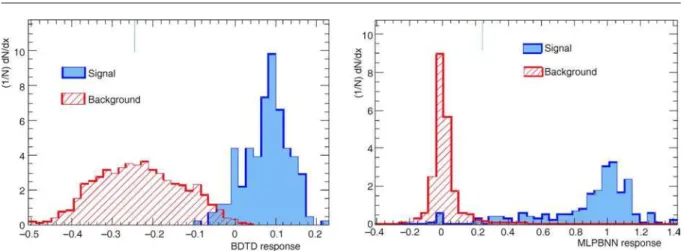
We are us ing the in put events (set of cli mate vari -ables for each mea sure ment) to train, test and eval u ate the 12 multivariate meth ods im ple mented in TMVA. The graph pre sent ing the re ceiver op er at ing char ac ter -is tic (ROC) for each multivariate method (fig. 1) may be con sid ered as the most in dic a tive in com par ing the dif fer ent meth ods used for clas si fi ca tion of ra don con -cen tra tions us ing cli mate vari ables. On this graph one can read the de pend ence of back ground re jec tion on sig nal ef fi ciency. The best method is the one that holds max i mum value of back ground re jec tion for high est sig nal ef fi ciency, i. e. the best method has ROC curve clos est to the up per right cor ner on the graph pre sented in fig. 1. It turns out that the method best suited for our pur pose is the BDT method. This means that BDT gives most ef fi cient clas si fi ca tion of in put events. This is seen in fig. 2, which shows the dis tri bu tion of BDT clas si fi ca tion method out puts for in put sig nal and back ground events. The sec ond best method is the im -ple men ta tion of ANN MLP.
In fig. 3, one can see the val ues of sig nal and back ground ef fi ciency and sig nif i cance. Sig nif i cance, cal cu lated as
N
N N
( )
( ) ( )
signal
can be used as the value for com par i son of var i ous multivariate meth ods, and also for com par i son of method efficiencies for dif fer ent sets of in put vari -ables. The sig nif i cance of the BDT method with full set of in put cli mate vari ables turns out to be 30.6. Rank ing of the BDT in put vari ables (tab. 1.) is de rived by count ing how of ten the vari ables are used to split de ci sion tree nodes, and by weight ing each split oc cur rence by the sep a ra tion it has achieved and by the num
ber of events in the node. As seen from tab. 1, tem per a -ture of the soil at the depth of 10 cm ap pears to be by far the most im por tant vari able.
Now we com pare the multivariate meth ods for clas si fi ca tion of ra don con cen tra tion by us ing the min -i mum set of cl-i mate var-i ables that would g-ive s-im -i lar re sults as when us ing the full set. While search ing for the best multivariate method for ra don clas si fi ca tion in doors in this sit u a tion, we found that the BDT method again gives the best re sult, with the sig nif i cance of 29.6 as com pared to 30.6, when all the avail -able cli mate vari ables for train ing and test ing of multivariate meth ods are used. The cli mate vari ables cho sen for train ing and test ing in this case were: out -door air tem per a ture, hu mid ity and pres sure, out -door soil tem per a ture at the depth of 10 cm, dif fer ences of Fig ure 1. ROC for all multivariate meth ods used for clas si fi ca tion of ra don con cen tra tion us ing cli mate vari ables
Fig ure 2. Dis tri bu tion of BDT clas si fi ca tion method out puts for in put sig nal and back ground events
Fig ure 3. Cut ef fi ciency and op ti mal cut value of BDT clas si fi ca tion MVA method
Ta ble 1. Rank ing of BDT in put vari ables
Vari able Vari able im por tance Tem per a ture of soil at depth of 10 cm 1.37e-01*
Out side air tem per a ture 7.40e-02 Evap o ra tion 7.16e-02 Out side air pres sure 7.16e-02 P (out side) – P (ra don mon i tor) 6.51e-02 Out side air hu mid ity 6.40e-02 H (out side) – H (ra don mon i tor) 6.12e-02 T (out side) – T (ra don mon i tor) 5.79e-02 Hu mid ity of soil at depth of 10 cm 5.74e-02 So lar irradiance 5.16e-02 Tem per a ture of soil at depth of 20 cm 4.99e-02 Tem per a ture of soil at depth of 50 cm 4.68e-02 Tem per a ture of soil at depth of 30 cm 4.46e-02 Hu mid ity of soil at depth of 20 cm 4.31e-02 Wind speed at height of 10 m 3.87e-02 Hu mid ity of soil at depth of 30 cm 3.41e-02 Hu mid ity of soil at depth of 50 cm 3.13e-02 Pre cip i ta tion 0.00e+00
*1.37e-01 read as 1.37
out door and in doors tem per a ture, and the in doors hu -mid ity and pres sure. One im por tant ca veat is in place here. It con cerns the pos si bil ity that the two sets of in -stru ments (for in door and out door mea sure ments) are not iden ti cally cal i brated, what may es pe cially be the case when two dif fer ent groups or in sti tu tions con duct the in door and out door mea sure ments. It is es ti mated that these in stru men tal ef fects do not in flu ence sig nif i cantly the re sults of this study. In the case of cal i bra -tion of MVA clas si fi ca -tion method, we need ra don mon i tor ap pa ra tus in doors and ap pa ra tus for P, H, and T mea sure ments out doors and an ap pa ra tus for mea sure ment of the out door soil tem per a ture with the sen -sor po si tioned at the soil depth of 10 cm. While aim ing at set ting a “ra don alarm” in this case, we thus have to have two ap pa ra tuses for P, H, and T mea sure ments, in door and out door, and an ap pa ra tus for mea sure ment of out door soil tem per a ture with the sen sor po si tioned at the depth of 10 cm.
Next we com pare the uses of multivariate meth -ods for clas si fi ca tion of ra don con cen tra tion in doors when us ing the sim plest pos si ble set of cli mate vari ables. The cli mate vari ables used for train ing and test ing were: out door air tem per a ture, pres sure and hu -mid ity, and dif fer ences of out door and in door tem per a ture, pres sure and hu mid ity. That means that we need to have two de vices for mea sure ment and re -cord ing of tem per a ture, pres sure and hu mid ity, both in doors and out doors at the same time. For cal i bra tion and test ing of multivariate meth ods, in case of us ing this set of cli mate vari ables we would need one ra don mon i tor in doors, and an ap pa ra tus for mea sure ment of P, H, and T out doors. For the pur pose of seting the ra -don alarm, we would need to have two ap pa ra tuses for P, H, and T mea sure ment. The best multivariate method for ra don clas si fi ca tion in doors in this case is also BDT method. The re sult ing sig nif i cance is 28.2 as com pared to 30.6 what we get when us ing the full set of avail able cli mate vari ables for train ing and test ing of multivariate meth ods. This tes ti fies that when we drop out many cli mate pa ram e ters in this case of anal y -sis the re sult ing sig nif i cance de creases no ta bly, but still leav ing MVA clas si fi ca tion work good.
We also com pared the multivariate meth ods for clas si fi ca tion of ra don con cen tra tion us ing the sim plest set of cli mate vari ables in our Ground level lab o -ra tory, which is, as said, an air-con di tioned and only sel dom ac cessed space. The cli mate data are pro vided by the 4 km away and some what older au to matic me te -o r-o l-og i cal sta ti-on. The meth -ods are still f-ound t-o w-ork sat is fac to rily – the re sult ing sig nif i cance of the BDT method now be ing 27.6 as com pared to 28.2, ob tained with the sim plest set of vari ables in the case of the ac tively in hab ited dwell ing. The cli mate vari ables, re -quire ments for train ing and test ing are the same as in the pre vi ous case.
We also tested the sim ple set of only out door mea sured cli mate vari ables con sist ing of the out door
air tem per a ture, pres sure and hu mid ity, and the out -door soil tem per a ture at the depth of 10 cm. This means that the de vices for mea sure ment and re cord ing of out door tem per a ture, pres sure and hu mid ity as well as the de vice for mea sure ment and re cord ing of the out door soil tem per a ture at depth of 10 cm are re quired. The re sult ing sig nif i cance is now 27.2 as com pared to 30.6 when us ing the full set of avail able cli -mate vari ables, and 28.19 when us ing the two ap pa ra tuses for P, H, and T mea sure ments.
Com par i son of multivariate meth ods for clas si fi ca tion of ra don con cen tra tion in doors
The dif fer ence be tween this case and the pre vi ous one with the full set of cli mate vari ables is that in put events are now split at the value of ra don con cen -tra tion of 100 Bq/m3, which is the rec om mended
lim it ing value be tween the ac cept able and in creased ra don con cen tra tion by the World Health Or ga ni za tion (WHO). Pre vi ous method had a cut on the value of 40 Bq/m3, which was found to in sure max i mum em
ploy ment of multivariate clas si fi ca tions. This par tic u lar value re flects the fact that the sta tis tics on higher ra -don con cen tra tions are get ting pro gres sively lower. In tab. 2, we pres ent the sig nif i cance and the sig nal and back ground ef fi ciency for sev eral best multivariate clas si fier meth ods. Again, the BDT (and BDT decorrelated) multivariate method shows the best per -for mance in clas si fy ing the events into the cat e go ries of in creased and ac cept able con cen tra tions.
Fig ure 4 shows the dis tri bu tion of BDT clas si fi -ca tion method out puts for in put sig nal and back ground events. These fig ures again dem on strate that clas si fi -ca tion meth ods work well i. e., that the sep a ra tion of sig nal and back ground works very good. Also, the sig -nif i cance value for BDT is higher for higher cut val ues for split ting of in put events. In ter est ingly, it ap pears that other multivariate meth ods also give better re sults un der these new con di tions.
Re gres sion meth ods
Re gres sion is the ap prox i ma tion of the un der ly -ing func tional be hav ior de fin -ing the tar get value. We tried to find the best re gres sion method that will give
Ta ble 2. Sig nif i cance, sig nal, and back ground ef fi ciency for sev eral best multivariate clas si fier meth ods in the case of im posed lim it ing value of 100 Bq/m3
Clas si fier S/sqrt(S + B) EffSig EffBkg
BDT 31.1 0.97 0.01
BDTD 30.9 0.98 0.03
MLPBNN 30.6 0.95 0.02
MLP 30.0 0.93 0.04
out put val ues (pre dicted ra don con cen tra tion) clos est to the ac tual ra don con cen tra tion that cor re sponds to spe cific in put cli mate vari ables. The best multivariate re gres sion method is found to be BDT, and the sec ond one is MLP, same as in case of multivariate clas si fi ers. Fig ure 5 pres ents the dis tri bu tion of ra don con cen tra -tions and out puts from the BDT multivariate method from re gres sion of ra don con cen tra tion us ing all cli -mate vari ables.
To best way to es ti mate the qual ity of the method is to look at the dif fer ences be tween the out put val ues from BDT multivariate re gres sion method and the val ues of mea sured ra don con cen tra tions (fig. 6). The fig -ure in di cates the sat is fac tory pre dic tive power of multivariate re gres sion meth ods as ap plied for pre dic -tion of vari a -tions of in door ra don con cen tra -tions based on the full set.
CON CLU SIONS
The first test of multivariate meth ods de vel oped for data anal y sis in highen ergy phys ics and im ple -mented in the TMVA soft ware pack age ap plied to the anal y sis of the de pend ence of in door ra don con cen tra
-tion vari a -tions on cli mate vari ables dem on strated the po ten tial use ful ness of these meth ods. It ap pears that the method can be used with suf fi cient re li abil ity for pre dic tion of the in crease of in door ra don con cen tra -tions above some pre scribed value on the ba sis of mon i tored set of cli mate vari ables only. Sur pris ingly, this set of cli mate vari ables does not have to in clude too many of those which are now a days widely avail -able. To con firm these prom is ing pre lim i nary find ings more case stud ies of sim i lar char ac ter are re quired. Fig ure 5. Dis tri bu tion of ra don con cen tra tions and out puts from BDT multivariate method for re gres sion of ra don con cen tra tion us ing all cli mate vari ables
Fig ure 6. Dif fer ence of out puts from BDT multivariate re gres sion method and ra don con cen tra tions, vs. ra don con cen tra tion
AC KNOWL EDGE MENT
The au thors wish to thank Prof. Ivan Ani~in for con stant in ter est and sup port. This work is sup ported by the Min is try of Ed u ca tion, Sci ence and Tech no log i cal De vel op ment of the Re pub lic of Ser bia un der pro -ject num bers III 43002 and OI171002.
AU THOR CON TRI BU TIONS
The idea for this pa per came as a re sult of dis cus -sions of V. I. Udovi~i}, R. M. Banjanac, D. R. Jokovi}, and D. M. Maleti}. Gath er ing cli mate data and MVA anal y sis was done by D. M. Maleti}. V. I. Udovi~i} per formed in door ra don mea sure ments. Writ ing of the pa per was done by D. M. Maleti} and V. I. Udovi~i}. A. L. Dragi} gave idea about us ing MVA meth ods in cos mic and ra don mea sure ments. N. B. Veselinovi} an a lyzed and val i dated cli mate data. J. Z. Filipovi} helped with MVA anal y sis. D. R. Jokovi} helped with data anal y sis and pa per tech ni cal prep a ra tion.
REF ER ENCES
[1] Baciu, A. C., Ra don and Thoron Prog eny Con cen tra tion Vari abil ity in Re la tion to Me te o ro log i cal Con di -tions at Bu cha rest (in Ro ma nia), Jour nal of En vi ron -men tal Ra dio ac tiv ity, 83 (2005), 2, pp. 171-189 [2] Si mon, E., et al., Estimation and Pre dic tion of the
Out door 222Rn and 220Rn Prog eny Con cen tra tions
Usin Me te o ro log i cal Vari ables, Rom. Journ. Phys., 58 (2013), Suppl., pp. S262-S272
[3] Cuculeanu, V., et al., Dy nam ics, De ter min is tic Na ture and Cor re la tions of Out door 222Rn and 220Rn Prog eny
Con cen tra tions Mea sured at Baciu, Jour nal of En vi -ron men tal Ra dio ac tiv ity, 102 (2011), 7, pp. 703-712 [4] Dragi}, A., et al., The New Setup in the Bel grade
Low-Level and Cos mic-Ray Lab o ra tory, Nucl Technol Radiat, 26 (2011), pp. 181-192
[5] Antanasijevi}, R., et al., Ra don Mea sure ments Dur -ing the Build -ing of a Low-Level Lab o ra tory, Radiat. Meas., 31 (1999), 1-6, pp. 371-374
[6] Banjanac, R., In door Ra don Mea sure ments by Nu -clear Track De tec tors: Ap pli ca tions in Sec ond ary Schools, Facta Universitas, Se ries: Phys ics, Chem is -try and Tech nol ogy, 4 (2006), 1, pp. 93-100
[7] Udovi~i}, V., et al., Ra don Prob lem in an Un der -ground Low-Level Lab o ra tory, Radiat. Meas., 44 (2009), 9-10, pp. 1009-1012
[8] Udovi~i}, V., Ra don TimeSe ries Anal y sis in the Un der ground LowLevel Lab o ra tory in Bel grade (in Ser -bian), Ra di a tion Pro tec tion Do sim e try, 145 (2-3), (2011), pp. 155-158
[9] Mihailovi}, D. T., et al., A Com plex ity Mea sure Based Method for Study ing the De pend ance of 222Rn Con cen tra tion Time Se ries on In door Air Tem per a -ture and Hu mid ity, Ap plied Ra di a tion and Iso topes, 84 (2014), pp. 27-32
[10] Brun, R., Rademakers, F., ROOT – An Ob ject Ori -ented Data Anal y sis Frame work, Nucl. Inst. Meth. in Phys. Res., A 389 (1997), 1-2, pp. 81-86
[11] Hoecker, A., et al., TMVA Us ers Guide – Toolkit for Multivariate Data Anal y sis, PoS ACAT 040 (2007), http://arxiv.org/abs/phys ics/070303
[12] Yang, H.-J., Roe, B. P., Zhu, J., Stud ies of Boosted De ci sion Trees for MiniBooNE Par ti cle Iden ti fi ca -tion, Nucl. Instrum. Meth., A555 (2005), 1-2, pp. 370-385
[13] Rojas, R., Neu ral Net works, Springer-Verlag, Berlin, 1996
Re ceived on Sep tem ber 23, 2013 Ac cepted on March 10, 2014
Dimitrije M. MALETI], Vladimir I. UDOVI^I], Radomir M. BAWANAC, Dejan R. JOKOVI], Aleksandar L. DRAGI], Nikola B. VESELINOVI],
Jelena Z. FILIPOVI]
PORE\EWE MULTIVARIJANTNIH METODA PRI KLASIFIKACIJI I REGRESIJI REZULTATA MEREWA RADONA U ZATVORENIM PROSTORIJAMA
Predstavqamo rezultate testirawa kori{}ewa multivarijantnih metoda, razvijenih za analizu podataka u fizici visokih energija i implementiranih u programskom paketu za
multivarijantnu analizu – u na{em prou~avawu zavisnosti varijacija koncentracije radona u
zatvorenim prostorijama i klimatskih varijabli. Multivarijantni metodi omogu}avaju ispitivawe povezanosti {irokog spektra klimatskih varijabli i koncentracije radona, i onda kada me|u wima nema zna~ajnih korelacija. Pokazali smo da multivarijantni metodi za klasifikaciju i regresiju rade dobro, daju}i kao rezultat nove informacije i indikacije koje bi mogle biti korisne u daqem izu~avawu varijacija koncentracije radona u zatvorenim prostorijama. Kori{}ewem ovih metoda, mo}i }e da se do|e do relativno dobre mo}i predvi|awa koncentracija radona, koriste}i samo podatke klimatskih varijabli.