SPECIFIC FEATURES OF ELITE BODYBUILDERS’ TRAINING PROCESS IN COMPETITION PERIOD
Tyhorskyy O.A.
Kharkiv State Academy of Physical Culture
Abstract. Purpose: To substantiate methodic of training process construction for elite bodybuilders in competition period with usage of different training methods. Material: elite bodybuilders – members of combined team of Ukraine (n=16) participated in the research. Results: we presented comparative characteristic of the most often used bodybuilding training methodic. Besides, optimal training methodic in competition period was worked out and substantiated. Such methodic permits to improve body proportions at the account of fat layer reduction. By the data of Harvard step-test the sportsmen improved organism’s functional potentials by 6%. Conclusions: the offered methodic noticeably reduces probability of functional unfavorable states (over-training, overloading, traumas). The methodic permits to achieve the required sport form without over-tension adaptation-compensatory mechanisms and acquire maximal muscular relief; improve proportions with minimal losses of muscles’ volume.
Key words: training, bodybuilders, proportions, competition period, training methodic.
Introduction1
Bodybuilding – is a kind of sports, in which sportsmen try to develop their constitution in the most harmonious way. Competition criteria of bodybuilding are mass of muscles, muscle separation (expressed separation of one muscles’ group from other) and muscle definition (muscular relief and internal muscular specifying); proportional condition of muscular groups [9, 10]. In competition training period sportsmen try to reduce percentage of fat and improve proportions [6]. Specificities of training construction in bodybuilding were copied from more studied and developed kinds of sports (weight- and power-lifting) [13, 14].
Analysis of domestic and foreign literature showed that many works were devoted to construction of training process in competition period [8, 15]. A.V. Samsonova [1] showed that bodybuilders require special approach to training process. Bodybuilding training differs from other power kinds of sports, in which condition of muscular fibers is only result of power training. It is known that the highest potential for growing is intrinsic to ІІ-В type fibers. It was found that interval mode of training was the most optimal: range of repetitions– 8-12; load level - 70-80% from single maximum [2, 5]. V.M. Platonov [3, 4] showed demand in micro and macro-periodizing in different kinds of sports. Introduction of different by load micro-cycles facilitates increase of muscular volume and reduce sub cutis. The recommended duration of competition period is 8-12 weeks. The problems of periodizing in bodybuilding were dealt with by V. Usychenko [6]. The author analyzed the existing variants of macro-periodizing and showed advantages and disadvantages of one-cycle, two-cycle and three-cycle planning systems in bodybuilding.
Ben and Joe Weider worked out system of elite bodybuilders’ training, which was characterized by high volume of training sessions. They widely used such methodic techniques of intensity increase as supersets, drop-sets, giant sets. The recommended mode of work (6 training during week micro-cycle) was oriented on development of anaerobic capacity [9, 10]. V.Yu. Jim showed disadvantages of this system. They included increasing risk of sportsmen’s over-fatigue. The author offered system, envisaging individualization of training process during annual macro-cycle [6, 7, and 21]. In particular, for competition period load of 40-70% from maximal is recommended with quantity of training days 6 and quantity of one exercise repetitions - 20-25.
Correlation of anaerobic, aerobic works, as well as special load (for compulsory competition program for elite bodybuilders in competition training period) has not been still studied yet.
Hypothesis: it was assumed that the worked out methodic for elite bodybuilders in competition training period can be effective, if to use one-cycle annual macro-cycle and optimally select micro-cycles. Such approach will facilitate improvement bodybuilders’ sport perfection.
Purpose: to work out and substantiate methodic of training process construction for elite bodybuilders in competition period.
Material and methods
Participants: elite bodybuilders – members of combined team of Ukraine (n=16) participated in the research. Their age was 25-33 years. Their body mass values were 85±2 – 105±2 kg. The participants were divided into two groups: control (n=8) and experimental (n=8).
Organization of the research:
The research was conducted on the base of Kharkov state academy of physical culture (weight-lifting and boxing department) in different gyms (“Pheromone”, “Tetra”, “Black Bison”, “Forma”, CJSS № 9*, «Misto”, “Metallist” in Kharkov), SC** “Dynamo” (Komsomolsk), club “Sensei” (Kiev) and SC “Neftechimik” (Kremenchug).
On the base of weight-lifting and boxing department of Kharkov state academy of physical culture and sport circles of Kharkov and Poltava regional bodybuilding federations we conducted pedagogic experiment.
*CJSS – children- junior sport school (note of translator) ** SC – sport club (note of translator)
Participants of experiment trained 6 times a week. In experimental group training the worked out by us methodic of competition period construction (see table 1) was introduced. Control group trainings were conducted by traditional scheme (see table 2), used in sport clubs. In both groups, at the beginning and at the end of training competition period we controlled anthropometric data and power indicators, which did not confidently differ at the beginning of experiment (P>0.05).
Statistical analysis was fulfilled with the help of Statistika 10.0 programs. Student’s t-criterion was used for checking of differences’ confidence between samples’ indicators and was considered to be statistically significant at p<0.05.
Results of the researches
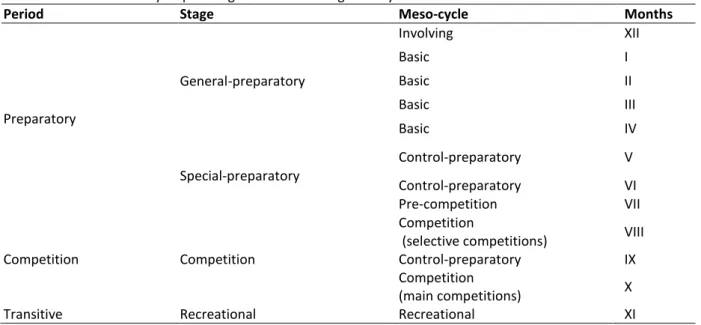
In training process of elite bodybuilders we used one-cycle planning system in annual macro-cycle (see table 1).
Table 1. Scheme of one-cycle planning in annual training of bodybuilders
Period Stage Meso-cycle Months
Preparatory
General-preparatory
Involving XII
Basic I
Basic II
Basic III
Basic IV
Special-preparatory
Control-preparatory V
Control-preparatory VI
Pre-competition VII
Competition Competition
Competition
(selective competitions) VIII Control-preparatory IX Competition
(main competitions) X
Transitive Recreational Recreational XI
Effectiveness of training was assessed by dynamic of power and endurance indicators; by dynamic of anthropometric changes and organism’s functional state.
Table 2. Scheme of CG training in competition period
Stage Meso-cycle Micro-cycle
Competition
Control-preparatory Adv., adv., adv., rec. Pre-competition Inv., adv., adv., adv. Competition Inv., adv., adv., comp. Notes: Adv. – advanced; Rec. – recreational; Inv. – involving; Comp. – competition.
Experimental group sportsmen had two competition meso-cycles (І and ІІІ). The second meso-cycle was control-preparatory. Every meso-cycle consisted of four micro-cycles. The first competition meso-cycle consisted of involving, advanced, preparatory and competition micro-cycles. The first competition meso-cycle was completed by selective competitions. Control-preparatory meso-cycle included involving, two preparatory and competition micro-cycles. It is completed by main competitions of the year (see table 3).
Table 3. Scheme of EG training in competition period
Stage Meso-cycle Micro-cycle
Competition
Competition (selective
competitions) Inv., adv., prep., comp. Control-preparatory Recr., inv.,adv., adv. Competition (main competitions) Recr., prep.,prep., comp. Notes: Inv. – involving; adv. – advanced; prep. – preparatory; recr. - recreational.
In competition stage the main task is acquiring maximal relief of muscles by sportsmen, fat layer reduction; proportions’ improvement and preservation of muscles’ mass [17, 18, 20].
In EG training process was built in the following way: during advanced micro-cycles sportsmen trained in zone of sub-maximal relative power. The work in such zone lasts up to 5 minutes [1, 19, and 22].
Sportsmen trained twice a day during six days. One day was day off. One training was conducted in simulators gym in zone of moderate and great relative power with usage Joe Weider’s principles [9, 16]: supersets. Tri- sets, Giant sets, drop sets. Training session took 50 minutes – 1 hour. The training was directed on development of ІІ-А type muscles that permitted to achieve maximal relief of muscles with minimal losses of muscles’ volume.
Other training in the same day in first meso-cycle had aerobic orientation. Trainings of aerobic orientation with little and moderate loads were used for quicker recreation after power trainings. Besides, they developed general endurance and improvement sportsman’s functional state. The means of trainings were: run on treadmill swimming in water pool, stationary bicycle. Time of training and degree of load varied depending on the tasks of micro-cycle.
In second meso-cycle quantity of aerobic trainings shortened up to three a week. Trainings of compulsory static positions and positions of free programs were added.
In third meso-cycle of competition stage EG program changed in the following way: part of aerobic trainings was replaced with working at compulsory competition positions. Static training took one hour a day and six times in week micro-cycle. Sportsmen took seven compulsory positions in front of mirror and kept every position one and half minute each. Coach looked after proper tension of all demonstrated muscles. With it face muscles should be relaxed and express positive emotions and self confidence (see table 4).
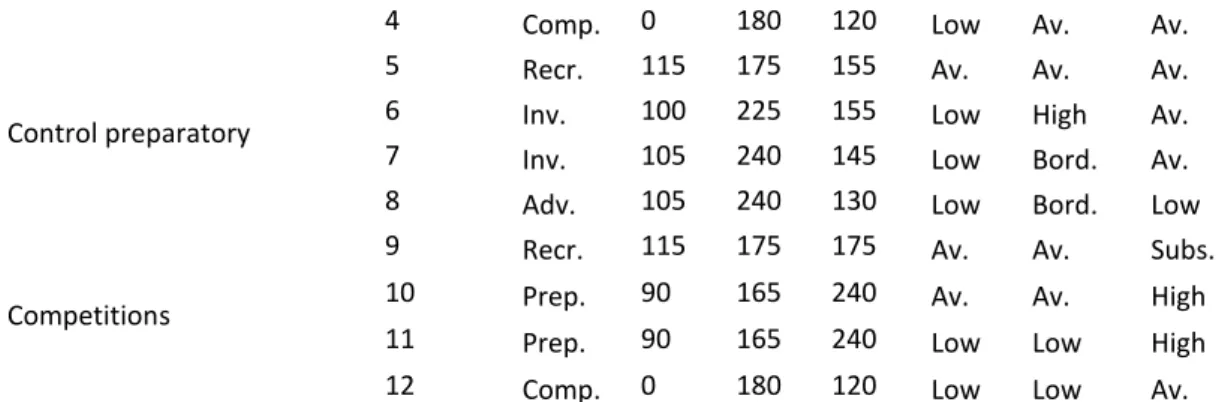
Table 4. Time of exercises and loads of different character for EG in competition period
Competition period
Meso-cycle
№ of
micro-cycle
Type of micro-cycle
Time, minutes Degree of load
Ae. Аn. Tech. Ae. Аn. Tech.
Competition period (selective competitions)
1 Inv. 130 240 165 Av. Subs. Low
2 Adv. 100 240 185 Low High Av.
4 Comp. 0 180 120 Low Av. Av.
Control preparatory
5 Recr. 115 175 155 Av. Av. Av.
6 Inv. 100 225 155 Low High Av.
7 Inv. 105 240 145 Low Bord. Av.
8 Adv. 105 240 130 Low Bord. Low
Competitions
9 Recr. 115 175 175 Av. Av. Subs.
10 Prep. 90 165 240 Av. Av. High
11 Prep. 90 165 240 Low Low High
12 Comp. 0 180 120 Low Low Av.
Notes: Low – low load for recreation; Av. – average load for supporting physical qualities; Subs. – substantial loads for physical qualities’ development; High – high loads for physical qualities development; Bord. – bordering loads for physical qualities development (by Zatsiorsky, 1995 [25]) Ae. – aerobic load; An.- anaerobic load; Tech. – technical training (in bodybuilding work at competition program).
During competition period in every micro-cycle quantity of barbell lifting and quantity of lifted kilograms varied. The data by every micro-cycle and total data of meso-cycle are presented in table 5.
Table 5. Quantity of barbell lifting and load in kg for EG in competition period
Meso-cycle Micro-cycle QBL, basic QBL,
shaping
Tonnage, basic, kg
Tonnage, shaping, kg
Competition (selective competitions)
Inv. 691 358 57251 9319
Adv. 825 423 76519 12457
Prep. 548 642 42969 18762
Comp. 441 301 37583 9309
Total 2505 1724 214322 49847
Control preparatory
Recr. 687 331 51891 5659
Inv. 735 406 61608 11086
Adv. 791 431 76311 13247
Adv. 918 502 85954 14807
Total 3131 1670 275764 44799
Competition (main competitions)
Inv. 691 358 57251 9319
Prep. 517 615 36552 16470
Prep. 511 603 29542 13434
Comp. 441 301 37583 9309
Total 2160 1877 160928 48532
Notes:QBL - quantity of barbell lifting; Tonnage – any mass measured in tons.
In third meso-cycle EG sportsmen fulfilled 2160 barbell lifts in basic exercises (by 31% less than in the second meso-cycle and by 13% less than in the first). Tonnage was 160.928 thousand kg. In basic exercises (by 41% less than in the previous and by 24% less, comparing with the first meso-cycle) and 48.532 thousand kg in shaping exercises (that was by 8% more than in second meso-cycle and by 2% less than in the first meso-cycle).
In table 6 we give changes of anthropometric data for control and experimental groups.
Table 6. Mean indicators of anthropometric data reduction in CG and EG elite bodybuilders in competition period (n1= n2=8)
Indicators
CG EG
t p
1
1
m
X
V
, %X
2
m
2V
, %Body mass, kg. 17.54 ± 0.82 13.14 8.40 ± 0.10 3.27 21.37 <0.001 Neck circumference, cm. 3.12 ± 0.03 2.76 1.33 ± 0.01 2.25 55.50 <0.001 Chest circumference, cm. 14.84 ± 0.14 2.76 4.03 ± 0.03 2.25 72.92 <0.001 Inhale, cm. 14.84 ± 0.14 2.76 4.09 ± 0.03 2.22 72.51 <0.001 Exhale, cm. 14.84 ± 0.14 2.76 3.94 ± 0.03 2.30 73.52 <0.001 Waist circumference, cm. 6.88 ± 0.10 4.17 12.06 ± 0.16 3.85 26.85 <0.001 Shoulder circumference, cm 4.53 ± 0.08 4.90 1.49 ± 0.03 4.92 36.73 <0.001 Forearm circumference, cm. 4.45 ± 0.04 2.76 1.18 ± 0.01 2.30 73.52 <0.001 Thigh circumference, cm. 8.80 ± 0.09 3.03 2.92 ± 0.04 4.13 56.88 <0.001 Shin circumference, cm. 3.52 ± 0.04 3.03 1.31 ± 0.02 4.13 52.18 <0.001 Notes: t – Student’s t-criterion or determination the confidence of difference; p – level of confidence (difference was considered to be confident at р<0.05).
By the results of our research EG sportsmen lost less amount of body mass. For assessment sportsmen’s functional state we used Harvard step-test. Both groups sportsmen ascended on of platform of 50 cm height during 5 minutes with race 30 ascend and descend per one minute. After fulfillment, during 30 seconds pulse is measured. Pulse also is measured at 2nd, 3rd and 4th minutes of recreation.
HST index = tx100/(f1+f2+f3)x2,
where f1;f2;f3 – pulse data at 2nd, 3rd and 4th minutes of rest and, t – time of test fulfillment.
Table 7. Harvard step-test results
t, time in seconds f1 f2 f3 ІГСТ
Control group 300 79.75 74 68 67.6625
Experimental group 300 67 62.5 55.5 81.47
Notes: Indicators of Harvard step-test: <55 – bad physical fitness; 55-64 – below average; 65–79average; 80–89 – good; >90 – excellent.
By the data of Harvard step-test control group sportsmen had average physical fitness and experimental group sportsmen – good. It witnesses that experimental group sportsmen recreate quicker and have better functional state. This test was conducted also for testing sportsmen’s functional state in preparatory and general preparatory periods [21]. In time of special-preparatory and competition stages both groups’ sportsmen improved their results. In control group IHST improved by 1.79%, and in experimental group – by 6%.
As far as power indicators concern both in control and experimental groups single maximum reduced (see fig.2).
Fig.2. Dynamic of changes in special physical fitness (SPF) in control and experimental groups in competition period: P – Indicators; A – Squatting with barbell; B – Barbell pressing in lying position; C – back strength; D – barbell pressing in standing position; E –ar s’ be di g i sta di g positio ; F– barbell pressing with narrow grasp, in lying position.
- control group;
- experimental group.
As per results of our research both groups’ sportsmen lost power in connection with reduction of body mass. Sportsmen, who trained by experimental methodic reduced their indicators less noticeably (see fig. 1).
Discussion
Recent years some researches devoted to content and methodic of elite bodybuilders’ training with different methods of endurance and power qualities have been fulfilled [6, 7, and 11]. Besides, there are works on training process planning in competition period and its influence on bodybuilders’ competition form. However, influence of aerobic and anaerobic power trainings on sportsmen in competition period has not been studied yet.
We note demand in micro-periodization for sportsmen in competition period as well as offered the system of one-cycle training. Such approach coincides with recommendations of V.M. Platonov [3, 4]. We considered demand in selective competitions and proved the data of muscular relief improvement in competition period, providing optimal loads [23, 24]. Besides we expanded the data of V.V. Usychenko on usage of one-cycle annual planning system [8]. In our research we proved significance of usage of Joe Weider’s methods of intensification increasing [9, 16]. For solution of cycle tasks we offered application of such methods with certain dozing for every micro-cycle. Besides, we expanded Ben and Joe Weider’s methodic by replacing some anaerobic exercises with aerobic ones [9, 10]. Such methodic facilitates better recreation of sportsmen. Exercises for aerobic endurance facilitate quicker elimination of sub cutis.
We also confirmed the data about better training regime for muscular fibers’ overgrowth: optimal regime is 3-4 attempts (8-12 repetitions in each) [1, 2].
The obtained results enrich our previous researches on improvement of elite sportsmen organism’s functional state after dozed aerobic loads [11, 12]. We supplemented the data about demand in introduction compulsory positions and free competition program in training program [17, 21]. In the offered by us methodic we mentioned the required quantity of such exercises, depending on micro-cycle. We also expanded the data of domestic [6, 21, 15] and foreign authors [9, 17, 20] about increasing the most important power and endurance indicators.
0 5 10 15 20 25 30 35 40 45 50
A B C D E F
Acknowledgements
The research has been fulfilled as per topic 3.7 of combined plan of scientific-research works in physical culture and sports sphere for 2011–2015 “Methodological and organizational-methodic principles of determination individual norm of human physical condition” (state registration number 0111U000192).
Conclusions
Perfection of elite bodybuilders’ training process permits to think that the offered for EG program gives more expressed effect. The offered methodic of training process perfection substantially reduces probability of unfavorable functional changes in sportsmen (over-tension, over-training, traumas). It permits to achieve the required sport form without over-tension of adaptation-compensatory mechanisms. Such methodic permits for sportsmen to acquire maximal relief, improve proportions with minimal losses of muscles’ volume.
Conflict of interests
The author declares that there is no conflict of interests. References:
1. Samsonova AV. Gipertrofiia skeletnikh myshc cheloveka [Overgrowth of human skeletal muscles], Sankt Petersburg; 2011. (in Russian)
2. Galysheva SM, Liubercev VN, Rapport LA. Miologiia [Myology], Ekaterinburg: Publishing House of the Ural University; 2014. (in Russian)
3. Platonov VN. Sistema podgotovki sportsmenov v olimpijskom sporte [System of sportsmen’s training in Olympic sports], Kiev: Olympic Literature; 2004. (in Russian)
4. Platonov VM, Bulatova MM. Fizichna pidgotovka sportsmena [Sportsman’s physical fitness], Kiev: Olympic Literature; 1995. (in Ukranian)
5. Oleshko VG. Pidgotovka sportsmeniv u silovikh vidakh sportu [Sportsmen’s training in power kinds of sports], Kyiv: DIA; 2011. (in Ukranian)
6. Dzhim VIu, Dorofieieva TI. Osoblivosti kharchuvannia bodibilderiv u pidgotovchomu periodi trenuvan' [Peculiarities of bodybuilders’ eating in preparatory period of training]. Slobozhans'kij naukovo-sportivnij visnik, 2013;4:15-19. (in Ukranian)
7. Dzhim VIu. Individualizaciia trenuval'nogo procesu kvalifikovanikh bodibilderiv protiagom richnogo makrociklu. Kand. Diss. [Individualization of elite bodybuilders’ training process in annual macro-cycle. Cand. Diss.], Harkiv; 2014. (in Ukranian)
8. Usychenko VV. Periodizaciia godichnogo cikla podgotovki sportsmenov specializiruiushchikhsia v bodibildinge [Periodization of annual training cycle for sportsmen, specializing in bodybuilding]. Pedagogics, psychology, medical-biological problems of physical training and sports, 2006; 7: 123–125. (in Russian)
9. Vejder B, Vejder D. Klassicheskij bodibilding [Classic bodybuilding], Moscow: EKSMO; 2003. (in Russian) 10. Uajder D. Sistema stroitel'stva tela [System of bodybuilding], Moscow: Physical Culture and Sport; 1991. (in
Russian)
11. Matveev LP. Osnovy obshchej teorii sporta i sistemy podgotovki sportsmenov [Principles of general theory of sports and system of sportsmen’s training], Kiev: Olympic Literature; 1999. (in Russian)
12. Mulik VV, Taran LM. Struktura vidnovnikh mikrocikliv v zmagal'nomu periodi u kvalifikovanikh lizhnikiv-biatlonistiv [The structure of recreational micro-cycles in competition period of elite biathlon skiers]. Slobozhans'kij naukovo-sportivnij visnik, 1999; 3:78–85. (in Ukranian)
13. Mentcer M. Supertrening [Super-training], Moscow: Mentzer Media Sports; 1998. (in Russian) 14. Bor'kin DA. Bodibilding dlia linivikh [Bodybuilding for lazy-bones], Donetsk: Stalker; 2005. 15. Pilipko VF, Ovsiienko VV. Atletizm [Athletics], Harkiv, OVS; 2007. (in Russian)
16. Shenkman BS. Vliianie trenirovki na kompoziciiu myshc, razmery i okislitel'nyj potencial myshechnykh volokon u cheloveka. Kand. Diss. [Influence of training on muscular composition, sizes and oxidation potential of human muscular fibers. Cand. Diss.], Moscow; 1990.(in Russian)
17. Shvarcenegger A. Novaia enciklopediia bodibildinga [New encyclopedia of bodybuilding], , Eksmo; 2004. (in Russian)
19. Khargivs GM. Metabolizm v processe fizicheskoj deiatel'nosti [Metabolism in physical functioning process], Kiev: Olympic Literature; 2001. (in Russian)
20. Konnors E, Grimkovski P, Kimber T, Mak-Kormik M. Bodibilding balans krasoty i zdorov'ia [Bodybuilding as the balance of beauty and health], Moscow: Fair-Press; 2000. (in Russian)
21. Tikhors'kij OA, Dzhim VIu. Udoskonalennia trenuval'nogo procesu visokokvalifikovanikh bodibilderiv u pidgotovchomu periodi, zagal'nopidgotovchomu etapi [Perfection of elite bodybuilders’ training process in preparatory period and competition stage]. Slobozhans'kij naukovo-sportivnij visnik, 2015; 4: 90-95.
22. Kleiner SM, Bazzarre TL, Ainsworth BE. Nutrional status of nationally ranked elite bodybuilders. International Journal of Sport Nutrition.1994; 4: 54–69.
23. Cornelius AE, Brewer BW, Van Raalte JL. Applications of multilevel modeling in sport injury rehabilitation research. International Journal of Sport and Exercise Psychology. 2007; 4: 387–405.
24. Visek AJ, Watson JC, Hurst JR, Maxwell JP, Harris BS. Athletic identity and aggressiveness: A cross-cultural analysis of the athletic identity maintenance model. International Journal of Sport and Exercise Psychology. 2010; 2: 99–116. 25.
25. Zatsiorskiy VM, Kraemer WJ. Science and Practice of strength training. Pennsylvania; 1995. Information about the author:
Tyhorskyy O.A.; http://orcid.org/0000-0003-1779-0849; [email protected]; Kharkiv State Academy of Physical Culture; st. Klochkіvskа, 99, Kharkov, 61058, Ukraine.
Cite this article as: Tihorsky A.A. Specific features of elite bodybuilders’ training process in competition period.
Pedagogics, psychology, medical-biological problems of
physical training and sports, 2016;6:26–33.
doi:10.15561/18189172.2016.0604
The electronic version of this article is the complete one and can be found online at: http://www.sportpedagogy.org.ua/html/arhive-e.html
This is an Open Access article distributed under the terms of the Creative Commons Attribution License, which permits unrestricted use, distribution, and reproduction in any medium, provided the
original work is properly cited
(http://creativecommons.org/licenses/by/4.0/deed.en).
Received: 07.10.2016