The Role of Amino Acid Permeases and
Tryptophan Biosynthesis in
Cryptococcus
neoformans
Survival
João Daniel Santos Fernandes1,2, Kevin Martho1, Veridiana Tofik1, Marcelo A. Vallim1,
Renata C. Pascon1*
1Departamento de Ciências Biológicas, Instituto de Ciências Ambientais, Químicas e Farmacêuticas, Universidade Federal de São Paulo, Campus Diadema, Laboratório de Interações Microbianas (Laboratory 29), Rua Arthur Ridel, 275, 09972–270, Bairro Eldorado, Diadema, SP, Brazil,2Universidade de São Paulo, Avenida Prof. Lineu Prestes, 2415 Edifício ICB–III, Cidade Universitária, CEP 05508–900, São Paulo, SP, Brazil
Abstract
Metabolic diversity is an important factor during microbial adaptation to different environ-ments. Among metabolic processes, amino acid biosynthesis has been demonstrated to be relevant for survival for many microbial pathogens, whereas the association between patho-genesis and amino acid uptake and recycling are less well-established.Cryptococcus neo-formansis an opportunistic fungal pathogen with many habitats. As a result, it faces frequent metabolic shifts and challenges during its life cycle. Here we studied theC. neofor-manstryptophan biosynthetic pathway and found that the pathway is essential. RNAi indi-cated that interruptions in the biosynthetic pathway render strains inviable. However, auxotroph complementation can be partially achieved by tryptophan uptake when a non preferred nitrogen source and lower growth temperature are applied, suggesting that amino acid permeases may be the target of nitrogen catabolism repression (NCR). We used bioin-formatics to search for amino acid permeases in theC.neoformansand found eight poten-tial global permeases (AAP1 toAAP8). The transcriptional profile of them revealed that they are subjected to regulatory mechanisms which are known to respond to nutritional status in other fungi, such as (i) quality of nitrogen (Nitrogen Catabolism Repression, NCR) and car-bon sources (Carcar-bon Catabolism Repression, CCR), (ii) amino acid availability in the extra-cellular environment (SPS-sensing) and (iii) nutritional deprivation (Global Amino Acid Control, GAAC). This study shows thatC.neoformanshas fewer amino acid permeases than other model yeasts, and that these proteins may be subjected to complex regulatory mechanisms. Our data suggest that theC.neoformanstryptophan biosynthetic pathway is an excellent pharmacological target. Furthermore, inhibitors of this pathway cause Crypto-coccusgrowth arrestin vitro.
OPEN ACCESS
Citation:Fernandes JDS, Martho K, Tofik V, Vallim MA, Pascon RC (2015) The Role of Amino Acid Permeases and Tryptophan Biosynthesis in
Cryptococcus neoformansSurvival. PLoS ONE 10 (7): e0132369. doi:10.1371/journal.pone.0132369
Editor:Yong-Sun Bahn, Yonsei University, REPUBLIC OF KOREA
Received:March 24, 2015
Accepted:June 14, 2015
Published:July 10, 2015
Copyright:© 2015 Fernandes et al. This is an open access article distributed under the terms of the
Creative Commons Attribution License, which permits unrestricted use, distribution, and reproduction in any medium, provided the original author and source are credited.
Data Availability Statement:All relevant data are within the paper and its Supporting Information files.
Funding:This work was supported by Fundação de Amparo à Pesquisa do Estado de São Paulo 2011/ 51298-4 (RCP) and Fundação de Amparo à Pesquisa do Estado de São Paulo 2007/50536-3 (MAV). The funders had no role in study design, data collection and analysis, decision to publish, or preparation of the manuscript.
Introduction
Many microbial pathogens are subjected to rapidly changing environmental conditions and require robust metabolic strategies to survive and succeed during these changes [1–3]. Yeasts from theCryptococcusgenus—mainlyC.neoformans(var.neoformansand var.grubii) andC.
gattiispecies—face this type of challenge during their life cycle [4]. Both species can be found in vegetables, fruits, trees, soil, decaying wood, and bird guano. They are adapted to the animal and human environment, encountering extreme nutritional and physical-chemical alterations when entering the host [5–7].C.gattiiis associated with eucalyptus trees and other plant niches, can cause disease in immunocompetent patients, and is responsible for recent menin-goencephalitis outbreaks in North America [8,9]. In contrast,C.neoformans(var.neoformans
and var.grubii) is the most clinically prevalent species, and is the main cause of fungal menin-gitis in immune suppressed populations, especially patients with HIV/AIDS [5,10,11]. In 2009, Park and collaborators evaluated the global burden of cryptococcal meningitis based on the population studied as part of the UN’s 2007 Programme on HIV/AIDS and found that there is an estimated 957,900 new cases per year worldwide (and 624,700 deaths), most of which are in sub-Saharan Africa [12].
Cryptococcosis is considered an invasive fungal infection (IFI) that is difficult to treat, due to the relatively few available antifungal [5,10,13]. Many virulence factors related to infection and disease have been described over the years, such as: capsule, melanin, phospholipase, ure-ase, thermotolerance, and multi-stress response [14–16]. Regulatory circuits have been described inS.cerevisiaeand other model fungi that control the assimilation of nutrients such as carbon, nitrogen, phosphate, purines, pyrimidines and amino acids [17]. Nutrient acquisi-tion mechanisms have also been recently described inC.neoformans, often in association with virulence. Nutrient sensing, transport, biosynthesis, storage and recycling have been reported as key factors for survival in the host cell [44]. The acquisition of carbon, nitrogen, phosphate, iron, pyrimidines and amino acids has been directly implicated in the expression of virulence factors as well as inin vitroandin vivosurvival [18–32].
In addition to uptake, amino acid biosynthetic pathways have been reported as key factors forC.neoformanssurvival in the host. Several of these genes are essential for growth, and oth-ers, when mutated, result in specific auxotrophies and reduced virulence, which makes them interesting pharmacological targets. Nine of the amino acid biosynthetic pathways are absent in humans, suggesting the potential for selective inhibition. Gene deletion in some of these amino acid biosynthetic pathways (lysine, isoleucine, valine, threonine, and methionine) leads to defects inC.neoformansvirulence factors, impaired multi-stress tolerance, hypersensitivity to serum, and increased susceptibility to antifungal drugs; also, all mutants tested so far display virulence attenuation in animal models [27–32]. The threonine biosynthetic pathway, in par-ticular, contains essential genes, since targeted mutations in this pathway have not been suc-cessful. This suggests that threonine uptake may not be enough to satisfy resulting
auxotrophies, perhaps due to permease inefficiency [27].
Perturbations in aromatic amino acid biosynthesis, mainly tryptophan, affect optimal growth inMycobacterium tuberculosisandM.bovis BCG. Mutants in these pathways have attenuated virulence or are avirulent, making them strong potential pharmacological targets [33–37]. Shenet al. (2009) identified a nitrogenous compound (ATB107) with inhibitory effects on IGPS (3-indol-glycerol phosphate synthase) which is encoded by theTRP3gene in
pneumophilatoCoprinus cinereusandS.cerevisiae. However, these compounds have never been tested inC.neoformans[44–48].
The block in aromatic amino acid biosynthesis inC.neoformansby sub inhibitory concen-trations of glyphosate delays melanizationin vitroandin vivo, leading to prolonged mice sur-vival during experimentalC.neoformansinfection [49]. This suggests that tryptophan, tyrosine and phenylalanine biosynthetic pathways may be valid novel drug target candidates; however, tryptophan is the only one with no alternative biosynthetic route.
The mechanisms of amino acid acquisition by membrane bound permeases and recycling have not been explored inC.neoformans. However, this subject has been extensively explored inS.cerevisiae[50–56]. In order to expand our knowledge on the nutritional attributes neces-sary to guarantee survivalin vitroandin vivoand explore new potential pharmacological tar-gets, we studied the tryptophan biosynthetic pathways inC.neoformans. In this work, we identified and described the four gene products in this pathway:TRP2(Anthranilate synthase component I–AS COI),TRP3(Anthranilate synthase component II–AS COII), a trifunc-tional protein,TRP4(Anthranilate Phosphoribosyl transferase—APRT) andTRP5(tryptophan synthase—TS). Our data highlight several important issues: first, tryptophan biosynthetic path-way is essential inC.neoformans; second, transcript levels of amino acid permeases vary in response to nutrient source availability, but do not appear sufficient to support tryptophan auxotrophies; lastly, commercial inhibitors of AS COII and TS were tested and are active against bothC.neoformansandC.gattii, demonstrating the potential application of inhibitors directed at the tryptophan biosynthetic pathway.
Materials and Methods
Strains and reagents
E.coliandC.neoformansstrains used in this work are described inS1 Table. Standard yeast extract-peptone-glucose (YEPD) plates were prepared as 1% yeast extract, 2% peptone, 2% dextrose and 2% agar; Synthetic medium was made with 6.7 g/liter Sigma Yeast Nitrogen Base with or without amino acids and ammonium sulfate, added with the appropriate carbon source (2% dextrose or galactose), nitrogen source (Ammonium sulfate or proline) and 2% agar. Tryp-tophan (kept in the dark) and uracil were added at 20 mg/L and 10μg/mL final concentrations,
respectively. Hygromycin and G418 were used as selection agents added to the medium at 200μg/mL.
Bioinformatics
Tryptophan biosynthetic (TRP) and permease genes (APC) were identified inC.neoformans
var.grubiiandC.neoformansvar.neoformansgenome by BLAST search at Broad Institute (http://www.broadinstitute.org/) and NCBI (http://blast.ncbi.nlm.nih.gov/Blast.cgi). Amino acid sequences fromS.cerevisiae TRPandAPCgenes were used as query (S2 Table). All sequence alignments and phylogenetic trees were made using Lasergene software (DNAStar).
Gene deletion
The coding region from start to stop codon was replaced by Geneticin or Hygromicin resis-tance cassettes containing theNeoRorHphRgenes under the control of actin promoter and
S4 Tabledescribes gene deletions, the selectable markers used for each one, and their respective serotypes.
RNAi
Gene silencing experiments were performed according to the previously published protocol [60]. In brief, two different regions of the coding sequence ofTRP3—trp3.1i (235 bp) and
trp3.2i (408 bp) andTRP5:trp5.1i (181 bp) andtrp5.2i (353 bp)—were PCR amplified. The primers were designed to introduceSpeI restriction sites at the 5´and 3´ends of all the ampli-cons in order to allow cloning at theSpeI restriction site of the pIBB103 vector digested with
SpeI. The linear and dephosphorylated vector was ligated to the PCR-amplified fragments and introduced intoE.coli(HB 101), generating the plasmids described inS5 Table. All plasmids were digested with I-SceI restriction enzyme and purified with QiaQuick prior to biolistic transformation. All transformants were selected on YEPD plates containing 200μg/mL
Geneti-cin (G418) and 1M sorbitol. After 72 hours at 30°C, 50 colonies obtained by transformation with each plasmid were purified by two rounds of growth in YEPD+G418. A phenotypic screen was created by replica-plating 50 transformants in YEPD+G418, YEPG+G418, SD+G418+-uracil, SG+G418+SD+G418+-uracil, SD+G418+uracil+tryptophan, and SG+G418+uracil+tryptophan. All plates were incubated at 30 and 25°C. Uracil was added to all synthetic medium compositions sinceURA5 is the sentinel gene in the pIBB103 vector. The influence of nitrogen sources was evaluated by substituting ammonium sulfate by proline [29] at 30 and 25°C.TRP3andTRP5
silencing was confirmed by qPCR.
Inhibitor sensitivity assay
All anti-metabolites directed to the tryptophan biosynthetic pathway were incorporated to solid medium on petri dishes. Anti-metabolites: 5-fluoroanthranilic acid (5-FAA), 3-hydro-xianthranilic acid (3-HAA) and 5-methylanthranilic acid (5-MAA) were purchased from Sigma and stock solutions were prepared as 100 mg/mL in 10% ethanol and used at 5μg/mL
final concentrations.C.neoformansstrains were grown on YEPD medium overnight at 30°C, washed twice in sterile ultrapure water, serial diluted (2x10⁶to 2x10²cell/mL) and 5μL of each
dilution were spotted on dry plates containing YEPD or SD medium and anti-metabolites [48].
TRP3(6-diazo-5-oxo-L-norleucine) andTRP5inhibitors [N-(3-Indolylacetyl)-DL-aspartic acid, N-(3-Indolylacetyl)-L-alanine, N-(3-Indolylacetyl)-L-valine) were purchased from Sigma, diluted in sterile water and tested by minimum inhibitory concentration assay according to the CLSI (Clinical and Laboratory Standard Institute). In brief, OPAS1 M27-A2 was applied with slight modifications: microdilution test were made in 96 well microtiter plates in a total volume of 100μL/well. The cultures were diluted and adjusted to the final concentration of 1–2 × 10²
CFU/well in the appropriate media (YEPD or YNB + Glucose + (NH4)2SO4+ tryptophan or
YNB + Glucose + Proline + Tryptophan). Viability and count tests were performed by plating 100μL of cells on YEPD. Two-fold serial dilutions of 6-diazo-5-oxo-L-norleucine (DON) and
Transcriptional analysis by real time PCR
Total RNA for transcriptional pattern analysis was obtained from cells incubated overnight in liquid YEPD under 150 rpm agitation. Cells were harvested, washed twice in sterile ultrapure water and resuspended in the appropriate medium. In the case of RNAi, induction was per-formed in YEPG and repression in YEPD for 4 hours under selection. RNA extraction was con-ducted according to the previously published protocol [60]. In brief, 3x10⁸cells grown under the desired condition were centrifuged and resuspended in 750μL Trizol (Invitrogen) and the
same volume of glass beads. The mixture was homogenized 10 times in vortex for 1 minute intercalated for 2 minutes on ice. The tubes were left to settle at room temperature to allow the glass beads to precipitate. The supernatant was transferred to a clean tube and Trizol extraction was conducted according to the manufacturer’s instructions. RNA was diluted in DEPC-treated water and stored in the freezer in separate aliquots. cDNA synthesis was performed with the RevertAid H minus First Strand cDNA synthesis kit (Thermo Scientific) with Oligo dT and random hexamer primers from 5μg of total RNA. Real time PCR amplifications were
made from diluted templates (1:10) with 800 nM target primers, 300 nMGPDH1 (Glyceralde-hyde-3-phosphate dehydrogenase) internal control primers, and 1X Power SYBR Green master mix (Life Technologies). Quantification of the transcript levels was performed using theΔΔCT method normalizing againstGPDH1, as previously described [61]. An analysis of variance was performed by Tukey´s multiple comparison test using GraphPad Prism 5.0 software, andp val-ues lower than 0.05 were considered statistically significant.
Results
Genome organization of the tryptophan biosynthetic genes in
C
.
neoformans
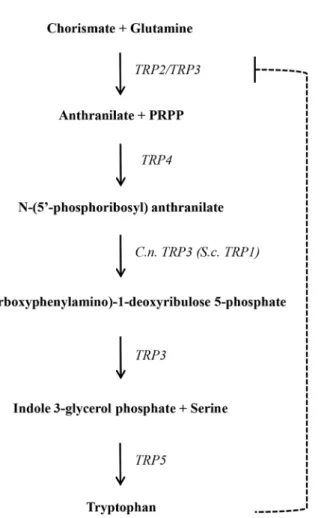
The conversion of chorismate into tryptophan depends on the catalytic steps depicted inFig 1. InS.cerevisiae, five genes (TRP1, 2, 3, 4 and 5) encode the enzymes involved in this biosyn-thetic pathway. The amino acid sequence of these proteins were used as queries to search for homologues inC.neoformansandC.gattiigenomes deposited at the Broad Institute and NCBI to gain knowledge about genome organization of this pathway inCryptococcus.Table 1shows thelocuscode, enzymatic function, gene and protein sizes and % amino acid similarity of the homologues inC.neoformans(H99, serotype A and JEC21, serotype D) andC.gattii(serotype B, strains WM276 and R265). There is a high percentage of similarity among strains of the same species (Table 1).
Thein silicoanalysis showed that inS.cerevisiae, Phosphoribosyl-anthranilate isomerase (PRAI) is encoded by a single gene (TRP1); inCryptococcus, the conserved domain correspond-ing to this enzymatic function seems to be encoded by theTRP3gene, according to the PRO-SITE (http://prosite.expasy.org) and Motif Scan databases (http://myhits.isb-sib.ch/cgi-bin/ motif_scan), in addition to its usual function. This configuration would produce a triple func-tion protein. This compact arrangement produces an enzyme that acts in the first, third and fourth steps of the pathway (Fig 1).Cryptococcustryptophan synthase encoded by theTRP5
The comparison ofTRPproteins with different Ascomycetes and Basiomycetes showed that the closest similarities can be found betweenC.neoformansandC.cinerea, followed by
U.maydis.
RegardingTRP3, the bioinformatic approach detected that other Ascomycetes and Basio-mycetes also encode trifunctional proteins (Ustilago maydis,Coprinopsis cinerea,Aspergillus fumigatus,Ajellomyces dermatitidis,Coccidioides immitisandParacoccidioides brasiliensis). Braus suggests that the separation ofTRP1 fromTRP3is a recent event in evolution and that the most ancient and widespread configuration is a trifunctional organization [62].
Thein silicoanalysis suggested thatC.neoformansandC.gattiiencode the necessary enzy-matic apparatus to synthesize tryptophan. However, biochemical data are necessary to charac-terize enzymatic properties.
TRP biosynthetic pathway is the target of anti-metabolite inhibitors
The tryptophan biosynthetic pathway may be a valuable candidate for drug targets since its end product is one of the nine essential amino acids in animal cells; moreover, it has no alterna-tive biosynthetic routes in plants, microorganisms or api-complexan parasites. Once the genes that act in this pathway were identifiedin silico, we expected that a functional pathway should be the target of anti-metabolites, which should lead to growth arrest in the wild type. Also, one can predict that interruptions in the pathway caused by mutations on theTRPgenes wouldFig 1. Tryptophan biosynthetic pathway inC.neoformansandS.cerevisiae.Genes are depicted on the right side. The dashed line indicates feedback regulation by the end product.
confer resistance to this type of growth inhibitor.Fig 2shows the effects of 5-fluoroanthranilic acid (5-FAA), 3-hydroxianthranilic acid (3-HAA) and 5-methylanthranilic acid (5-MAA) on the growth of the H99 strain in two different conditions: rich and synthetic medium. All three anti-metabolites serve as substrate for Anthranilate phosphoribosyl transferase (second step in the pathway,Fig 1). They act by generating toxic tryptophan analogues, which, once incorpo-rated into proteins, disturb growth. 5-FAA in synthetic medium supplemented with exogenous tryptophan completely inhibited growth, demonstrating that the biosynthetic pathway is func-tional. The other two inhibitors did not have any effect on growth, likely because they may not
Table 1. Summary of genome organization of theTRPgenes inC.neoformans(strains H99 and JEC21) andC.gattii(strains WM276 and R265).
Gene (catalytic activity) Strain Locus Tag Gene
(nt)
Amino Acids
% amino acid similarity*
TRP2 (ASCO I—chorismate aminase) H99 CNAG_06679.2 1869 523 97.9
JEC21 CNF 03410 1928 534
-WM276 CGB_F2090W 1882 534 98.5
R265 CNBG_1889 1882 534
-TRP3 (ASCO II—Glutamine amidotransferase/Phosphoribosyl-anthranilate isomerase/Indoleglycerol phosphate synthase)
H99 CNAG_04501.2 2396 752 97.5
JEC21 CNI 00560 2449 752
-WM276 CGB_H1160W 2366 752 97.2
R265 CNBG_2567.2 2526 651
-TRP4 (Anthranilate phosphoribosyl transferase) H99 CNAG_00811.2 1571 434 97.2
JEC21 CNA 07880 1732 434
-WM276 CGB_A9290C 1521 434 99.5
R265 CNBG_1124.2 1612 434
-TRP5 (Tryptophan synthase) H99 CNAG_00649.2 2645 715 96.8
JEC21 CNA 06290 2623 715
-WM276 CGB_A7080C 2545 715 100.0
R265 CNBG_1280.2 2540 718
-*% similarity between the two strains of the same species:C.neoformans(H99 vs. JEC21) andC.gattii(WM276 vs. R265).
doi:10.1371/journal.pone.0132369.t001
Fig 2. Effect of anti-metabolites inC.neoformans.Serial dilutions of the H99 strain were spotted in rich (YEPD) and synthetic medium (YNB supplemented with ammonium sulfate and glucose) containing 5μg/mL of anti-metabolite. 5-FAA = 5-fluoroanthranilic acid; 3-HAA = 3-hydroxianthranilic
acid; 5-MAA = 5-methylanthranilic acid and NI = no inhibitor.
be metabolized as well as 5-FAA [45,48]. This result motivated us to investigate the effects of
TRPgene deletion onC.neoformanssurvival and virulence.
Deletion of the
TRP
genes
Deletion constructs bearingNeoR(TRP2andTRP4) andHphR(TRP3andTRP5) resistance markers were assembled to individually knock out eachTRPgene (S4 Table). In all cases, the deleted region comprised the entire coding sequence, from start to stop codons. Deletion cas-settes were introduced in the H99 strain by biolistic transformation and selections were con-ducted in YEPD, added with the appropriate antibiotic (G418 or hygromycin). Phenotypic screens for tryptophan auxotrophies were conducted in synthetic medium (YNB) supple-mented with ammonia sulfate as the sole nitrogen source, with or without tryptophan. A total of 2376 transformants were analyzed and no auxotrophies were identified (S6 Table), suggest-ing TRP genes are recalcitrant to deletion. To establish the causes of this refractory behavior, we confirmed the frequency of homologous integration in a distinct locus by including an
ura4Δ::NeoRdeletion construct in our biolistic experiments [22]. We chose theura4 control because of its easy phenotypic screen (uracil auxotrophy) for homologous integration. Among 50 transformants resistant to G418, 22% were auxotrophic for uracil, showing that, at least for this locus, the frequency of homologous integration is high enough to find auxotroph mutants. Therefore, the lack of tryptophan mutants is likely unrelated to the biolistic process itself. Also, since the four TRP genes are located in different regions of the genome, it is unlikely that this refractory deletion characteristic is related to the chromosomal topology. We produced a
trp5Δ::HphRconstruct forC.neoformansserotype D and introduced it in the JEC21 strain. Among 150 transformants, no auxotroph mutant was found, suggesting that whatever the rea-son for the lack of tryptophan auxotroph, it is shared by serotype A and D.
Also, assuming the hypothesis thattrpmutants have slower growth and that this phenotype could result in difficult selection, we selected the transformants in YNB supplemented with ammonium sulfate, amino acids and 5-FAA; this condition should allow only the growth of tryptophan mutants [48], since we showed that the wild type H99 strain is sensitive to this anti-metabolite (Fig 2). The results show that among 571 transformants resistant to 5-FAA, none were tryptophan auxotrophs (S6 Table). In order to promote a more stringent selection, we used the same anti-metabolite strategy but exchanged the nitrogen source from ammonium sulfate to proline, which should alleviate nitrogen catabolite repression (NCR) and increase amino acid uptake. However, we still did not identify any auxotrophic mutants among the 150 transformants screened. 5-FAA has been used to select spontaneoustrp-mutants inS. cerevi-siae[48,63]. According to Toynet al. (2000), 10% of these mutants are resistant to the anti-metabolite but are not tryptophan auxotrophs. This phenotype may be associated with muta-tions that affect inhibitor uptake or low incorporation of 5-fluorotryptophan during protein synthesis. However, that remains to be demonstrated inS.cerevisiaeandC.neoformans.
Previous work showed thatTRP3is a single copy gene [64]. Our bioinformatic analysis sup-ported this observation, and southern blots for theTRPgenes further confirmed this (data not shown). Our data suggest thatTRPgenes may be essential inC.neoformans.
TRP3
and
TRP5
are essential genes in
C
.
neoformans
In order to test the hypothesis that the tryptophan biosynthetic pathway is essential inC. neo-formans, we used a combination of galactose inducible promoter and RNAi approaches to con-trol the expression ofTRP3andTRP5genes. This experiment was conducted inC.neoformans
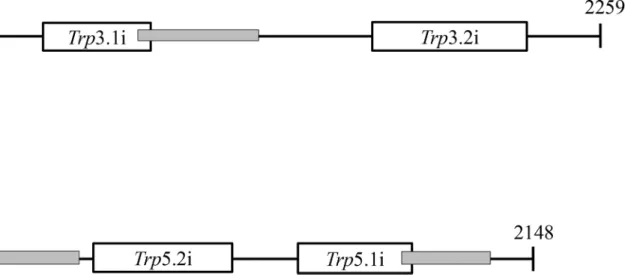
Gal7 promoters and terminators, according to the system developed by [65] and described in detail elsewhere [60]. The smaller interfering region presented inFig 3had the best results for bothTRP3andTRP5. Previous report indicated that shorter interfering regions provide the best RNA silencing effect [60]. A total of 50 transformants for each gene (trp3.1i andtrp5.1i) plus the negative control (empty pIBB103) were randomly selected in YEPD + G418. After two rounds of purification in YEPD + G418 (RNAi repressive medium), the transformants were tested in YEPG + G418 (RNAi inducible medium) plus and minus tryptophan. All 50 transfor-mants containing the empty pIBB103 grew on repressive and inducible media (YEPD and YEPG, respectively). However, out of 50 transformants analyzed for each gene, 18 (trp3.1i) and 21 (trp5.1i) transformants grew only in the RNAi repressive condition (Dextrose). No growth was observed for the 39 transformants in the inducible condition, regardless of tryptophan sup-plementation. The remaining transformants of each type grew in all four conditions, indicating partial or no interference, which is typical of RNAi phenomena [60].
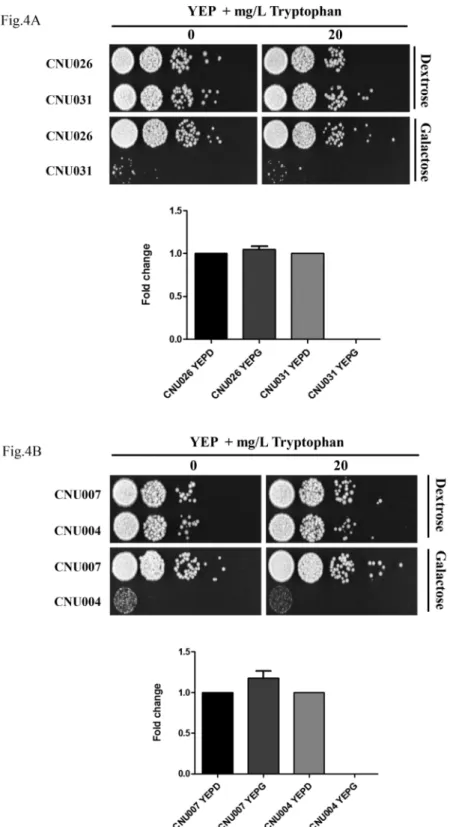
Three mutants for each gene were analyzed in more detail and submitted to qPCR for tran-script quantification. One mutant for eachtrp3.1i (CNU031) andtrp5.1i gene (CNU004) and two controls (empty pIBB103, CNU026 and CNU007) were chosen to illustrate the growth arrest in the presence of galactose, regardless of tryptophan supplementation (Fig 4A and 4B). In order to prove that the phenotype is associated with specific RNA silencing, the abundance ofTRP3andTRP5transcripts were evaluated. All four strains showed inFig 4were grown for four hours in liquid rich medium (YEP) containing dextrose or galactose. The total RNA from these cultures was extracted and the expression profiles of the controls (CNU026 and
CNU007),TRP3(CNU031) andTRP5(CNU004) in the two conditions were detected by qPCR and normalized byGPDH. The graphs inFig 4A and 4Bshow that the expression level ofTRP3andTRP5is stable between the repressive and induced conditions regarding the con-trols (CNU026 and CNU007). However,TRP3andTRP5transcripts were below detection lev-els in CNU031 (Fig 4A) and CNU004 (Fig 4B) under the RNAi induced condition (YEPG), indicating that the phenotypes correlate with transcript levels and, therefore, that RNA silenc-ing was successfully induced by galactose. These results strongly suggest thatTRP3andTRP5
are essential genes in serotype D.
Fig 3. Position of the fragments used to induce RNA interference inTRP3andTRP5.The numbers and black lines represent the coding region ofTRP3 andTRP5. The position and length of RNAi fragments in the coding region are represented as open boxes.trp3.1i andtrp5.1i fragments are smaller (280 pb and 233 pb, respectively) thantrp3.2i andtrp5.2i fragments (402 pb and 353 pb, respectively). Gray boxes indicate the position of the fragments amplified in qPCR.
Fig 4. (A)TRP3and (B)TRP5RNA interference.Ten-fold serial dilutions (104to 1 cell) were spotted in YEP
Considering the refractory gene deletion phenomena encountered for all fourTRPgenes in serotype A andTRP5in serotype D, we suggest that the tryptophan biosynthetic pathway is essential for survival in bothC.neoformansserotypes A and D.
Non preferred nitrogen source improves tryptophan uptake in
trp
3.1i and
trp
5.1i mutants
The threonine biosynthetic pathway has also been considered essential inC.neoformans[27]. This condition has been attributed to the presence of few permeases or their low affinity to the substrate inC.neoformans. Also, a tight regulation of the permeases by the preferable nitrogen source (ammonium sulfate) may be the cause of low amino acid transport; however, these hypotheses have not been experimentally addressed.
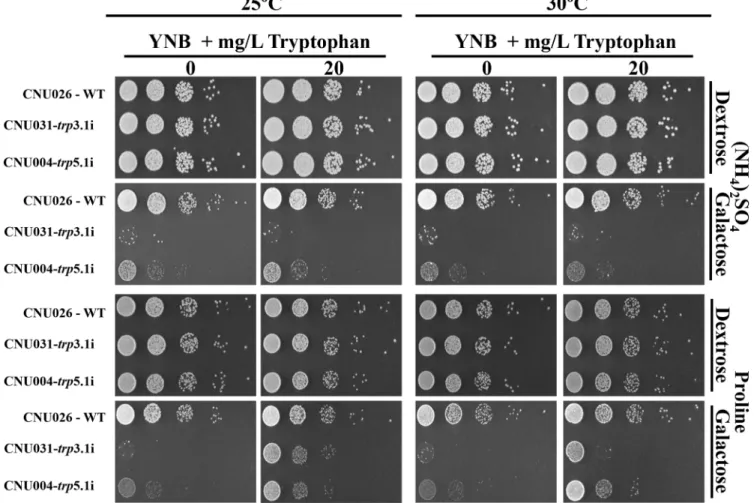
The control (CNU026) and the RNAi mutants forTRP3andTRP5, CNU0031 and CNU004, respectively, were diluted and spotted on YNB without amino acids containing ammonium sulfate or proline as the sole nitrogen source (dextrose or galactose), supplemented or not with tryptophan at 25 and 30°C.Fig 5shows that all strains grew to the same extent in dextrose regardless of nitrogen source, tryptophan supplementation or growth temperature. Regarding theTRP3RNAi mutant in galactose and tryptophan, the use of proline as the sole
Fig 5.trp3iandtrp5iphenotype in synthetic medium.Tryptophan uptake bytrp3.1i (CNU031) andtrp5.1i (CNU004) mutants was compared to the wild-type (CNU026) in synthetic medium (YNB) under preferred (NH4)2SO4and non preferred nitrogen sources (proline) at 25ºand 30ºC. Five serial dilutions (104
to 1 cell) were spotted on plates containing YNB plus (NH4)2SO4or proline, dextrose (repressing condition) or galactose (inducing condition), with and
without 20 mg/L tryptophan.
nitrogen source greatly improved growth, probably due to the more efficient intracellular transport of tryptophan. Also, the same medium supplemented with proline and tryptophan improved growth at 25°C even further. The RNAi mutant forTRP5was also able to uptake tryptophan in the presence of proline. However, it did so without a detectable effect on temperature.
In spite of the growth induced by possible NCR alleviation (proline as the sole nitrogen source), mutant growth was never restored to wild type levels, indicating that perturbations in the tryptophan biosynthetic pathway are deleterious, even in the presence of higher tryptophan uptake. A growth curve with increasing amounts of tryptophan supplementation (0 to 200 mg/ L) was performed in order to account for the concentration effect in all nitrogen conditions tested, but no gain in growth was achieved by increasing the amount of the amino acid in the medium. This suggests that poor growth is not due to insufficient tryptophan in the growth medium.
Kingsbury & McCusker (2008) found that growth can be partially restored in the threonine mutants by the use of dipeptides. We tested Trp-Met, Trp-Ala, Trp-Trp and Trp-Pro dipeptide supplementation individually and as a pool and found no growth improvement.
The fact that proline as the sole nitrogen source improves amino acid uptake indicates that NCR play a role in permease expression; however, that may not be the only reason for essential tryptophan biosynthesis, since the mutants cannot survive in rich medium either. In this case, we would have to assume that permease expression and activity are low. Several attempts to selecttrp-mutants on YNB + proline and antibiotic (G418 or Hygromycin), a condition that should alleviate NCR and promote amino acid uptake, have failed, supporting the idea that multiple factors contribute to the essentiality of this amino acid’s biosynthetic pathway.
Amino acid permease genes in
C
.
neoformans
Our data revealed tryptophan as the second essential amino acid biosynthetic pathway inC.
neoformans[27]. The only way an auxotroph can survive is by amino acid uptake from medium. Therefore, it is possible that essentiality may be caused by few permeases or low affin-ity to substrate, leading to low amino acid uptake and growth arrest. In order to address this hypothesis, we used the amino acid sequence of 24 amino acid permeases of theAPCfamily present in theS.cerevisiaegenome, including the high affinity ones (S2 Table), as queries to search forC.neoformansamino acid permease homologues. All 24 queries showed high simi-larity to 8 annotated genes, which we namedAAP1 toAAP8 (S7 Table).UGA4,MUP1 and
MUP3 (GABA, high and low affinity methionine permeases, respectively) showed sequence similarity to genes other thanAAP1 toAAP8.
AAP1 andAAP2 have 80.9% andAAP4 andAAP5 have 89.5% sequence similarity, suggest-ing they may be redundant.AAP3 is more similar toAAP1 andAAP2 (49%). PermeasesAAP6 andAAP7 have 41.1% similarity andAAP8 shares the least similarities with the other perme-ases (S1 Fig).
The transcriptional profile of all eight permeases was evaluated by Real-Time PCR in the wild type strain under different growth conditions with rich medium as the reference. Amplifi-cations forAAP3 andAAP7 were below the threshold level; therefore, they were considered inactive in the conditions applied here and they were not analyzed further.
Comparing rich (YEPD) and synthetic dextrose medium (SD), permeasesAAP2 toAAP8 display a striking increase in transcription under all types of SD mediums tested, regardless of the nitrogen source or amino acid supplementation (S2 Fig).
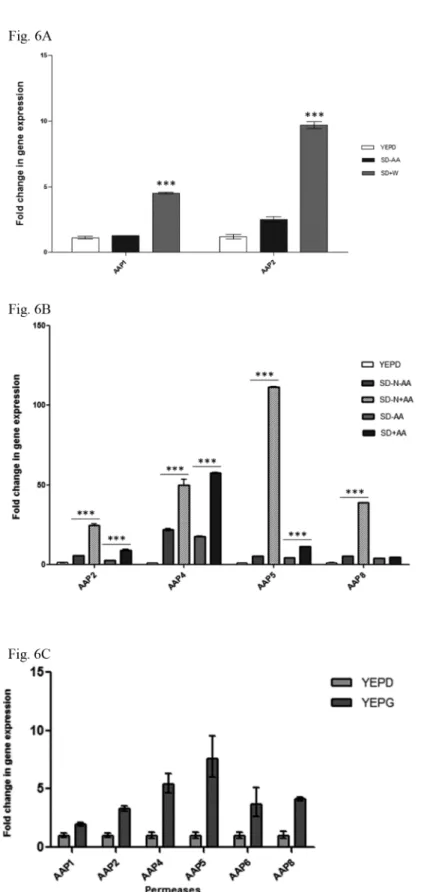
synthetic medium without addition of amino acids (SD-AA) resulted in 1.2 and 2.5 fold increases onAAP1 andAAP2 expression (respectively). Whereas, the addition of tryptophan to synthetic medium (SD+W) led to 4.5 and 9.6 fold increase inAAP1 andAAP2 expression, respectively. This increase represents a significant augmentation of 3.5 (AAP1) and 3.8 (AAP2) fold promoted by tryptophan addition to SD-AA (p<0.05).
Also, we asked if a combination of amino acids (L-tryptophan, L-methionine and L-histi-dine) with or without ammonium sulfate would promote higher expression than that observed for tryptophan.Fig 6Bshows that amino acids as the sole nitrogen source are capable of the highest induction ofAAP5, followed byAAP8, 2 and 4 (21, 7.5, 4.2 and 3.3-fold inductions, respectively;p<0.05). This result suggests that a regulatory mechanism operates in response to extracellular amino acids, leading to the transcriptional induction of these four permeases. The addition of (NH4)2SO4(preferred nitrogen source), regardless of amino acids, caused a
significant reduction in the expression ofAAP5,AAP8 andAAP2, (SD-N+AA vs. SD+N-AA and SD+N+AA), suggesting that a regulatory mechanism controlled by the preferred nitrogen source, such as nitrogen catabolism repression (NCR), may also contribute to the transcrip-tional regulation of these 3 permeases (Fig 6B). Clearly,AAP4 permease responds mainly to the presence of amino acids rather than the preferable nitrogen source, indicating that NCR may not regulate this permease.
We also inquired whether the permeases would be affected by the carbon source. The wild-type strain H99 was cultivated in rich medium (YEP) supplemented with dextrose (a preferred carbon source) or galactose (the non-preferred carbon source). Expression of all eight perme-ases under investigation was evaluated by qPCR. As expected, permeperme-asesAAP3 andAAP7 were amplified only below the threshold level, and therefore, were considered them inactive. The graph inFig 6Cclearly shows that galactose induced the expression of the remaining per-meases, indicating they are all subject to CCR (carbon catabolite repression).
Taken together, these data suggest that: (i)C.neoformansencodes fewer permeases thanS.
cerevisiae(8 general permease genes and 2 methionine high and low affinity permeases); (ii) under rich medium, the permeases have the lowest transcriptional pattern observed; (iii) tryp-tophan can only induce permeasesAAP1 and 2 at modest levels and, inC.neoformans, no spe-cific high affinity tryptophan permease likeS.cerevisiae TAT2 could be identified in the BLAST search; (iv)AAP2, 4, 5 and 8 have the highest expression when cultivated in the pres-ence of a combination of amino acids (rather than specific ones) as the sole nitrogen source and (v) permeasesAAP2, 5 and 8, but notAAP4, may be subject to nitrogen catabolism repres-sion, since their transcription decreases under the preferable nitrogen source condition (ammonium sulfate).
Transcriptional profile of the tryptophan biosynthetic genes
The permease transcriptional profiling results raised the question about how the transcription of theTRPgenes would be affected by different nutritional statuses in aC.neoformans wild-type strain. We evaluated the expression profile of the fourTRPgenes under the same condi-tions in which we studied the permeases.Fig 7shows that nitrogen starvation is the condition
SD = synthetic dextrose with ammonium sulfate; SD+AA = synthetic dextrose added with ammonium sulfate and amino acids (histidine, tryptophan and methionine); SD-AA = synthetic dextrose added with ammonium sulfate without amino acids; SD+W = synthetic dextrose added with ammonium sulfate and tryptophan; SD-N +AA = synthetic dextrose without ammonium sulfate added with amino acids; SD-N-AA = synthetic dextrose without ammonium sulfate and without amino acids; YEPD = yeast extract peptone and dextrose;
YEPG = yeast extract, peptone and galactose. Bars represent standard errors of 3 biological replicates. Differences are significant ifp<0.05 (***).
in whichTRPgenes are fully induced. In the other conditions, only minor or no transcriptional pattern shifts were detected. This is consistent with the literature, since it is known that inS.
cerevisiae, uncharged tRNA generated by nitrogen starvation triggers global amino acid control (GAAC), which leads to the induction of more than 500 genes, including several amino acid biosynthetic genes [17,66].
Proteins encoded by
TRP3
and
TRP5
genes are targets of inhibitors
One of the main interests behind finding an essential pathway in a pathogen is the possibility of developing a novel target for drug treatment that can be directed towards the proteins in the pathway. In this work, the initial idea was to evaluate the tryptophan biosynthetic pathway as a putative molecular target, which we accomplished, along with identifying the tryptophan bio-synthetic genesTRP3andTRP5as being essential in this pathway.TheTRP5inhibitor N-(3-Indolylacetyl)-DL-aspartic acid acts as an allosteric effector and perturbs the TSβ-active site. On the other hand, N-(3-Indolylacetyl)-L-alanine and N-(3-Indo-lylacetyl)-L-valine behave as competitive inhibitors of the TSα-subunit. In our experiments, we calculated the MIC for each one of these inhibitors and found that only N-(3-Indolylace-tyl)-DL-aspartic acid promoted growth arrest. However, inhibition was achieved at 50 mM, which was considered physiologically irrelevant, since, at the millimolar scale, this inhibitor would be required in large amounts to promote inhibition.
Next, we wanted to test an inhibitor expected to bind and inhibit the enzyme complex antharnilate synthase. 6-diazo-5-oxo-L-norleucine (DON) inhibits glutamine amidotransferase activity in Anthranilate synthase COII, since it is a glutamine analogue [41].Table 2shows that
Fig 7. Expression profile of the tryptophan biosynthetic genes.TRP2,TRP3,TRP4andTRP5transcripts were evaluated by qPCR in response to nutritional deprivation of the nitrogen source (SD-N-AA). Bars represent standard errors of 3 biological replicates. Differences are significant ifp<0.05 (***).
DON inhibitsCryptococcusgrowth at theμMolar scale in rich medium, and interestingly,C. neoformansserotype A is the most sensitive (62,5μM), whereasC.gattiiserotype B is most
resistant strain (500μM). Considering that DON has the potential to blocks tryptophan
bio-synthesis and since we have shown that amino acid permease expression is repressed in rich medium and induced in synthetic dextrose medium, we asked if the MIC for DON would change under these conditions.Table 2shows the switch from rich to synthetic medium dra-matically reduced the MIC for allCryptococcusspecies and serotypes tested. The use of pre-ferred (ammonium sulfate) or non-prepre-ferred nitrogen source (proline) and tryptophan caused no change in the MIC, except forC.neoformansserotype D. This result indicated that all four strains have serious growth impairment when tryptophan biosynthesis is blocked, even when the best tryptophan assimilation condition is provided. Probably, since DON is a glutamine analogue widely used by the cell as a primary nitrogen source, it might block other important aspects of metabolism leading to high sensitivity. During the course of this work we provided genetic evidence that tryptophan biosynthesis is essential. Now, we showed a similar phenotype using a pharmacological tool.
Discussion
The ability to cope with limiting and diverse nutritional conditions is important for microbial adaptation to various environments. Microbes are highly exposed to these changing conditions and require a plastic metabolism to survive and succeed in these situations. Yeasts are able to sense nutrients available in the surrounding environment and trigger a response that allows the uptake, biosynthesis or recycling of building blocks for cellular physiology. The choice is driven by the best resource usage and energy savings. Amino acids are among the essential compo-nents that can be acquired by uptake, biosynthesis or recycling, andS.cerevisiaecontains a large amount of information about the mechanisms underlying these important metabolic pro-cesses [17,54]. InC.neoformans, biosynthesis is one aspect of amino acid acquisition that has been studied and linked to pathogenesis in the last 10 years. Several pathways have been associ-ated with virulence attenuation in animal models of infection, which would serve as putative molecular targets for antifungal development [27–32,67,68].
Notable differences in the configuration of biosynthetic genes are found amongS.cerevisiae
andC.neoformans. Often, different catalytic activities that are encoded by separate genes inS.
cerevisiaeare combined as chimeras inC.neoformans[32], giving rise to proteins that act in more than one biochemical step in a pathway. This feature was also observed in this study, since we described theTRP3gene encoding a likely trifunctional protein that evolved as the fusion betweenTRP1andTRP3. Our extended bioinformatics analysis yielded the same arrangement in two other Basidiomycetes,U.maydisandC.cinerea(data not shown).
Table 2. Minimum inhibitory concentration (inμM) of 6-diazo-5-oxo-L-norleucine (DON) determined by broth microdilution method.
Species μM DON
Serotype Rich medium SD + NH4+ Trp SD + Proline + Trp
C.neoformans A (KN99) 62.5 (98%±0) 3.9 (95%±0) 3.9 (99%±0)
D (JEC21) 125.0 (96%±2) 31.3 (97%±1) 0.9 (91%±5)
C.gattii C (NIH312) 125.0 (94%±4) 0.78 (97%±5) 0.78 (99%±1)
B (R265) 500.0 (90%±0) 1.9 (91%±11) 1.9 (91%±11)
Numbers in parenthesis represent the average percentage inhibition at the MIC and standard deviation. Trp = tryptophan.
The other aspect that is different between these two model system yeasts is the impact that the biosynthetic pathway has on the survival ofC.neoformans; apparently, this opportunistic pathogen is more dependent upon biosynthesis than uptake, and this argument is based on sev-eral pieces of evidence. Kingsbury and McCusker (2008) reported that the threonine biosyn-thetic pathway is essential inC.neoformans. In this work, we report tryptophan as a second amino acid biosynthetic pathway that is required forin vitrosurvival. Our data showed that
trp3i andtrp5i mutants do not grow at RNAi inducing conditions in rich medium, where tryp-tophan is available in abundance (Fig 4). In agreement with Kingsbury and McCusker, we believe this fact could be explained by the low amino acid uptake caused by the few permeases encoded by the genome, the low affinity of these transporters to their substrate and tight regu-lation of permeases by the preferred nitrogen source. This idea was corroborated by our bioin-formatics data, which showed thatC.neoformanshas fewer permeases and lacks a tryptophan high affinity transporter similar toS.cerevisiae TAT2. The lack ofTAT2 may explain why even after alleviating the nitrogen catabolism repression on permeases, growth was never restored to wild type levels.
To gain insights about the role of amino acid uptake on the survival ofC.neoformans, we created an inventory of amino acid permeases inC.neoformans. When we used the 24 perme-ases of the APC family ofS.cerevisiaeas query to search theC.neoformansgenomes, we found eight permease genes. Among theS.cerevisiaepermeases with high and low affinity to specific amino acids (GNP1,LYP1,TAT2,PUT4), onlyMUP1,MUP3 andUGA4 (high and low methi-onine affinity and high GABA affinity) were found to have homologues outside the group with the eight readily encountered permeases. In summary, it seems thatC.neoformanshas eight global affinity and two methionine permease homologues (high affinityMUP1 and low affinity
MUP3), which is a considerably smaller number than the 24S.cerevisiaepermeases. We then searched the genome of other Asco- and Basidiomycetes to study their permease organization. Our results showed the very same organization inU.maydisandC.cinerea. On the other hand,
A.nidulans,C.albicans,N.crassaandS.pombeall have a much more diverse and larger set of permeases (S8 Table).
The improvement in growth noted in this work (Fig 5) and reported in the literature, which is presumably caused by higher amino acid uptake under a non-preferred nitrogen source, sug-gests that permease genes may be under genetic regulatory mechanisms. The expression profile of these genes by qPCR indicated they have a complex regulation at the transcriptional level which is dependent upon: (i) nitrogen and carbon sources (NCR and CCR), (ii) extracellular amino acids and (iii) nutritional deprivation (Fig 6). InS.cerevisiae, the genetics underlying these 3 nutritional conditions are well-known [17,53,54,56]. InC.neoformans, the effects of the preferable nitrogen source (ammonium) on the transcription of the genes necessary for assimilation of less preferable sources (such as uric acid and creatinine) have been described [20,69]. In this work, we show the same NCR effect on permeases (AAP2, 5 and 8), which should impact on the efficiency of amino acid uptake. A signaling pathway such asS.cerevisiae
SPS-sensing that responds to the presence of extracellular amino acids, promoting uptake, has not been described inC.neoformans. Among the main elements of this regulatory network (SSY1,PTR3,SSY5,STP1 andSTP2), onlySSY1 andSTP2 seem to have homologues inC. neo-formans(data not shown). There are no reports in the literature forC.neoformansregarding global amino acid control (GAAC) triggered by nitrogen starvation and uncharged tRNAs. However, homologues for several elements of this pathway can be found in theC.neoformans
genome (data not shown). Nevertheless, our study suggests that this control system operates in
amino acid control (GAAC) inS.cerevisiae. In spite of the evidence presented here, these last two regulatory mechanisms remain to be demonstrated inC.neoformans.
In summary, we demonstrated that the tryptophan biosynthetic pathway is essential inC.
neoformans. We suggest that essentiality is linked to the low number of permease genes encoded by the genome and their complex regulation, which is revealed by nutritional status. However, why gene deletions of some amino acid biosynthetic pathways are lethal and others are not is not completely clear. The methionine pathway is not essential but nonetheless deeply impacts virulence [29,30,68]; however, specific high and low affinity methionine permeases (MUP1 andMUP3) seem to be present inC.neoformans. Whether those permeases are specific to methionine and facilitate its uptake remains to be shown. Other pathways (isoleucine, valine and lysine) are not essential, but growth, survival and virulence are decreased in the auxotroph mutants [28,32]. The uptake of these amino acids could be more efficient due to protein con-formation and higher uptake could be just enough for mutant rescue, but still not enough to confer wild type growth, even with abundant supplementation.
Also in this work, we tested anti-metabolites and inhibitor against anthranilate phosphori-bosyl transferase, anthranilate synthase and tryptophan synthase. Regarding AS we obtained remarkable inhibition (DON), at theμmolar level, showing the potential of inhibitors directed
to this target. Other inhibitors have been reported in the literature and could be tested as they become available [34–40,43,46,49,70]. The next step in this investigation will be the search for novel inhibitors that have these proteins as targets. Also, the crystal structure of the enzymes should be elucidated, and inhibitors should be searched for in chemical libraries or alternatively, designed.
In conclusion, this work not only broadens the knowledge about amino acid acquisition in
C.neoformans, but also indicates that the tryptophan biosynthetic pathway may be a good choice as a molecular target for novel antifungal development
Supporting Information
S1 Fig. Sequence similarity amongC.neoformanspermeases.AAP1 to AAP8 amino acid sequences were aligned by ClustalW in MegaAlign module of Lasergene software (DNAStar). (DOCX)
S2 Fig. Expression profile of six permease genes inC.neoformansin response to nutritional status.AAP1, 2, 4, 5 6, and 8 transcripts were evaluated by qPCR under rich medium (YEPD) and synthetic glucose medium (SD) plus amino acids as sole nitrogen source (SD-N+AA), without ammonium sulfate and amino acids (SD-N-AA), with tryptophan as sole nitrogen source (SD-N+W) or SD plus ammonium sulfate, minus amino acids (SD+N-AA), plus amino acids (SD+N+AA) or without tryptophan (SD+N+W).
(DOCX)
S1 Table. List of strains used in this work. (DOCX)
S2 Table.S.cerevisiaepermease genes (1 to 24) and tryptophan biosynthetic genes (25 to 29) used as query for BLASTp search of theC.neoformansgenome serotype A at Broad Institute.
(DOCX)
S4 Table. Deletions and selectable markers. (DOCX)
S5 Table. Plasmids used and constructed in this work. (DOCX)
S6 Table. Number of transformants selected afterTRPgene deletion attempts. (DOCX)
S7 Table. Permease genes denomination inC.neoformans. (DOCX)
S8 Table. List of putative amino acid permeases in Asco and Basidiomycetes. (DOCX)
Acknowledgments
We thank Dr. Tamara Doering and Dr. Lukas Kozubowski for providing plasmids; Dr. Andrew Alspaugh for critical reading of the manuscript and Dr. Amanda Teixeira and Crislaine Calvete for technical assistance.
Author Contributions
Conceived and designed the experiments: RCP MAV. Performed the experiments: JDSF VT KM RCP. Analyzed the data: JDSF VT KM MAV RCP. Contributed reagents/materials/analy-sis tools: MAV RCP. Wrote the paper: RCP.
References
1. Fernandez J, Marroquin-Guzman M, Wilson RA. Mechanisms of nutrient acquisition and utilization dur-ing fungal infections of leaves. Annual review of phytopathology. 2014; 52:155–74. doi:10.1146/ annurev-phyto-102313-050135PMID:24848414.
2. Gahan CG, Hill C. Listeria monocytogenes: survival and adaptation in the gastrointestinal tract. Fron-tiers in cellular and infection microbiology. 2014; 4:9. doi:10.3389/fcimb.2014.00009PMID:24551601; PubMed Central PMCID: PMC3913888.
3. Moran GP, Coleman DC, Sullivan DJ. Comparative genomics and the evolution of pathogenicity in human pathogenic fungi. Eukaryot Cell. 2011; 10(1):34–42. doi:10.1128/EC.00242-10PMID: 21076011; PubMed Central PMCID: PMC3019795.
4. Kronstad J, Saikia S, Nielson ED, Kretschmer M, Jung W, Hu G, et al. Adaptation of Cryptococcus neo-formans to mammalian hosts: integrated regulation of metabolism and virulence. Eukaryot Cell. 2012; 11(2):109–18. doi:10.1128/EC.05273-11PMID:22140231; PubMed Central PMCID: PMC3272904. 5. Lin X, Heitman J. The biology of the Cryptococcus neoformans species complex. Annu Rev Microbiol.
2006; 60:69–105. Epub 2006/05/18. doi:10.1146/annurev.micro.60.080805.142102PMID:16704346. 6. Fan W, Kraus PR, Boily MJ, Heitman J. Cryptococcus neoformans gene expression during murine
macrophage infection. Eukaryot Cell. 2005; 4(8):1420–33. doi:10.1128/EC.4.8.1420–1433.2005
PMID:16087747; PubMed Central PMCID: PMC1214536.
7. Hu G, Cheng PY, Sham A, Perfect JR, Kronstad JW. Metabolic adaptation in Cryptococcus neoformans during early murine pulmonary infection. Mol Microbiol. 2008; 69(6):1456–75. doi: 10.1111/j.1365-2958.2008.06374.xPMID:18673460; PubMed Central PMCID: PMC2730461.
8. Datta K, Bartlett KH, Baer R, Byrnes E, Galanis E, Heitman J, et al. Spread of Cryptococcus gattii into Pacific Northwest region of the United States. Emerging infectious diseases. 2009; 15(8):1185–91. doi: 10.3201/eid1508.081384PMID:19757550; PubMed Central PMCID: PMC2815957.
9. Fraser JA, Giles SS, Wenink EC, Geunes-Boyer SG, Wright JR, Diezmann S, et al. Same-sex mating and the origin of the Vancouver Island Cryptococcus gattii outbreak. Nature. 2005; 437(7063):1360–4. doi:10.1038/nature04220PMID:16222245.
11. Brown GD, Denning DW, Gow NA, Levitz SM, Netea MG, White TC. Hidden killers: human fungal infec-tions. Science translational medicine. 2012; 4(165):165rv13. doi:10.1126/scitranslmed.3004404 PMID:23253612.
12. Park BJ, Wannemuehler KA, Marston BJ, Govender N, Pappas PG, Chiller TM. Estimation of the cur-rent global burden of cryptococcal meningitis among persons living with HIV/AIDS. Aids. 2009; 23 (4):525–30. doi:10.1097/QAD.0b013e328322ffacPMID:19182676.
13. Antinori S. New Insights into HIV/AIDS-Associated Cryptococcosis. Isrn Aids. 2013; 2013:471363. doi: 10.1155/2013/471363PMID:24052889; PubMed Central PMCID: PMC3767198.
14. Alspaugh JA. Virulence mechanisms and Cryptococcus neoformans pathogenesis. Fungal Genet Biol. 2014. doi:10.1016/j.fgb.2014.09.004PMID:25256589.
15. Brown SM, Campbell LT, Lodge JK. Cryptococcus neoformans, a fungus under stress. Curr Opin Microbiol. 2007; 10(4):320–5. doi:10.1016/j.mib.2007.05.014PMID:17707685; PubMed Central PMCID: PMC2570326.
16. Cox GM, Harrison TS, McDade HC, Taborda CP, Heinrich G, Casadevall A, et al. Superoxide dismut-ase influences the virulence of Cryptococcus neoformans by affecting growth within macrophages. Infect Immun. 2003; 71(1):173–80. Epub 2002/12/24. PMID:12496163.
17. Ljungdahl PO, Daignan-Fornier B. Regulation of amino acid, nucleotide, and phosphate metabolism in Saccharomyces cerevisiae. Genetics. 2012; 190(3):885–929. doi:10.1534/genetics.111.133306 PMID:22419079; PubMed Central PMCID: PMC3296254.
18. Lee IR, Morrow CA, Fraser JA. Nitrogen regulation of virulence in clinically prevalent fungal pathogens. FEMS microbiology letters. 2013; 345(2):77–84. doi:10.1111/1574-6968.12181PMID:23701678. 19. Lee IR, Yang L, Sebetso G, Allen R, Doan TH, Blundell R, et al. Characterization of the complete uric
acid degradation pathway in the fungal pathogen Cryptococcus neoformans. PloS one. 2013; 8(5): e64292. doi:10.1371/journal.pone.0064292PMID:23667704; PubMed Central PMCID: PMC3646786. 20. Kmetzsch L, Staats CC, Simon E, Fonseca FL, Oliveira DL, Joffe LS, et al. The GATA-type
transcrip-tional activator Gat1 regulates nitrogen uptake and metabolism in the human pathogen Cryptococcus neoformans. Fungal Genet Biol. 2011; 48(2):192–9. doi:10.1016/j.fgb.2010.07.011PMID:20673806. 21. Kretschmer M, Reiner E, Hu G, Tam N, Oliveira DL, Caza M, et al. Defects in phosphate acquisition
and storage influence virulence of Cryptococcus neoformans. Infect Immun. 2014; 82(7):2697–712. doi:10.1128/IAI.01607-14PMID:24711572; PubMed Central PMCID: PMC4097646.
22. de Gontijo FA, Pascon RC, Fernandes L, Machado J Jr., Alspaugh JA, Vallim MA. The role of the de novo pyrimidine biosynthetic pathway in Cryptococcus neoformans high temperature growth and viru-lence. Fungal Genet Biol. 2014; 70C:12–23. doi:10.1016/j.fgb.2014.06.003PMID:25011011. 23. Jung WH, Hu G, Kuo W, Kronstad JW. Role of ferroxidases in iron uptake and virulence of
Cryptococ-cus neoformans. Eukaryot Cell. 2009; 8(10):1511–20. doi:10.1128/EC.00166-09PMID:19700638; PubMed Central PMCID: PMC2756870.
24. Jung WH, Kronstad JW. The iron-responsive, GATA-type transcription factor Cir1 influences mating in Cryptococcus neoformans. Molecules and cells. 2011; 31(1):73–7. doi:10.1007/s10059-011-0011-0 PMID:21120626; PubMed Central PMCID: PMC3906865.
25. Jung WH, Kronstad JW. Iron and fungal pathogenesis: a case study with Cryptococcus neoformans. Cellular microbiology. 2008; 10(2):277–84. doi:10.1111/j.1462-5822.2007.01077.xPMID:18042257. 26. Jung WH, Sham A, Lian T, Singh A, Kosman DJ, Kronstad JW. Iron source preference and regulation
of iron uptake in Cryptococcus neoformans. PLoS pathogens. 2008; 4(2):e45. doi:10.1371/journal. ppat.0040045PMID:18282105; PubMed Central PMCID: PMC2242830.
27. Kingsbury JM, McCusker JH. Threonine biosynthetic genes are essential in Cryptococcus neoformans. Microbiology. 2008; 154(Pt 9):2767–75. Epub 2008/09/02. 154/9/2767 [pii] doi:10.1099/mic.0.2008/ 019729-0PMID:18757810.
28. Kingsbury JM, Yang Z, Ganous TM, Cox GM, McCusker JH. Cryptococcus neoformans Ilv2p confers resistance to sulfometuron methyl and is required for survival at 37 degrees C and in vivo. Microbiology. 2004; 150(Pt 5):1547–58. PMID:15133116.
29. Pascon RC, Ganous TM, Kingsbury JM, Cox GM, McCusker JH. Cryptococcus neoformans methionine synthase: expression analysis and requirement for virulence. Microbiology. 2004; 150(Pt 9):3013–23. Epub 2004/09/07. doi:10.1099/mic.0.27235-0150/9/3013[pii]. PMID:15347759.
30. Yang Z, Pascon RC, Alspaugh A, Cox GM, McCusker JH. Molecular and genetic analysis of the Crypto-coccus neoformans MET3 gene and a met3 mutant. Microbiology. 2002; 148(Pt 8):2617–25. Epub 2002/08/15. PMID:12177356.
32. Kingsbury JM, Yang Z, Ganous TM, Cox GM, McCusker JH. Novel chimeric spermidine synthase-sac-charopine dehydrogenase gene (SPE3-LYS9) in the human pathogen Cryptococcus neoformans. Eukaryot Cell. 2004; 3(3):752–63. doi:10.1128/EC.3.3.752–763.2004PMID:15189996; PubMed
Cen-tral PMCID: PMC420128.
33. Sassetti CM, Rubin EJ. Genetic requirements for mycobacterial survival during infection. Proceedings of the National Academy of Sciences of the United States of America. 2003; 100(22):12989–94. doi: 10.1073/pnas.2134250100PMID:14569030; PubMed Central PMCID: PMC240732.
34. Smith DA, Parish T, Stoker NG, Bancroft GJ. Characterization of auxotrophic mutants of Mycobacte-rium tuberculosis and their potential as vaccine candidates. Infect Immun. 2001; 69(2):1142–50. doi: 10.1128/IAI.69.2.1442–1150.2001PMID:11160012; PubMed Central PMCID: PMC97996.
35. Webby CJ, Jiao W, Hutton RD, Blackmore NJ, Baker HM, Baker EN, et al. Synergistic allostery, a sophisticated regulatory network for the control of aromatic amino acid biosynthesis in Mycobacterium tuberculosis. J Biol Chem. 2010; 285(40):30567–76. doi:10.1074/jbc.M110.111856PMID:20667835; PubMed Central PMCID: PMC2945551.
36. Shen H, Wang F, Zhang Y, Huang Q, Xu S, Hu H, et al. A novel inhibitor of indole-3-glycerol phosphate synthase with activity against multidrug-resistant Mycobacterium tuberculosis. The FEBS journal. 2009; 276(1):144–54. doi:10.1111/j.1742-4658.2008.06763.xPMID:19032598.
37. Shen H, Yang E, Wang F, Jin R, Xu S, Huang Q, et al. Altered protein expression patterns of Mycobac-terium tuberculosis induced by ATB107. Journal of microbiology. 2010; 48(3):337–46. doi:10.1007/ s12275-010-9315-6PMID:20571952.
38. Payne RJ, Bulloch EM, Abell AD, Abell C. Design and synthesis of aromatic inhibitors of anthranilate synthase. Org Biomol Chem. 2005; 3(20):3629–35. Epub 2005/10/08. doi:10.1039/b510633hPMID: 16211099.
39. Payne RJ, Bulloch EM, Kerbarh O, Abell C. Inhibition of chorismate-utilising enzymes by 2-amino-4-carboxypyridine and 4-carboxypyridone and 5-carboxypyridone analogues. Org Biomol Chem. 2010; 8 (15):3534–42. Epub 2010/06/10. doi:10.1039/c004062bPMID:20532401.
40. Payne RJ, Bulloch EM, Toscano MM, Jones MA, Kerbarh O, Abell C. Synthesis and evaluation of 2,5-dihydrochorismate analogues as inhibitors of the chorismate-utilising enzymes. Org Biomol Chem. 2009; 7(11):2421–9. Epub 2009/05/23. doi:10.1039/b901694ePMID:19462053.
41. Chittur SV, Klem TJ, Shafer CM, Davisson VJ. Mechanism for acivicin inactivation of triad glutamine amidotransferases. Biochemistry. 2001; 40(4):876–87. PMID:11170408.
42. Raboni S, Bettati S, Mozzarelli A. Tryptophan synthase: a mine for enzymologists. Cellular and molecu-lar life sciences: CMLS. 2009; 66(14):2391–403. doi:10.1007/s00018-009-0028-0PMID:19387555. 43. Ziebart KT, Dixon SM, Avila B, El-Badri MH, Guggenheim KG, Kurth MJ, et al. Targeting multiple
choris-mate-utilizing enzymes with a single inhibitor: validation of a three-stage design. J Med Chem. 2010; 53 (9):3718–29. Epub 2010/04/03. doi:10.1021/jm100158vPMID:20359225.
44. Maurer R, Crawford IP. New regulatory mutation affecting some of the tryptophan genes in Pseudomo-nas putida. J Bacteriol. 1971; 106(2):331–8. PMID:5573729; PubMed Central PMCID: PMC285101. 45. Miozzari G, Niederberger P, Hutter R. Action of tryptophan analogues in Saccharomyces cerevisiae.
Archives of microbiology. 1977; 115(3):307–16. PMID:341826.
46. Sasaki T, Mizuguchi S, Honda K. Growth inhibitory effects of anthranilic acid and its derivatives against Legionella pneumophila. Journal of bioscience and bioengineering. 2012; 113(6):726–9. doi:10.1016/j. jbiosc.2012.01.012PMID:22341575.
47. Tilby MJ. Tryptophan biosynthesis in Coprinus lagopus: a genetic analysis of mutants. Journal of gen-eral microbiology. 1976; 93(1):126–32. PMID:944234.
48. Toyn JH, Gunyuzlu PL, White WH, Thompson LA, Hollis GF. A counterselection for the tryptophan pathway in yeast: 5-fluoroanthranilic acid resistance. Yeast. 2000; 16(6):553–60. Epub 2000/05/03. doi:10.1002/(SICI)1097-0061(200004)16:6<553::AID-YEA554>3.0.CO;2–7[pii]
10.1002/(SICI)1097-0061(200004)16:6<553::AID-YEA554>3.0.CO;2–7. PMID:10790693.
49. Nosanchuk JD, Ovalle R, Casadevall A. Glyphosate inhibits melanization of Cryptococcus neoformans and prolongs survival of mice after systemic infection. J Infect Dis. 2001; 183(7):1093–9. Epub 2001/ 03/10. JID000863 [pii] doi:10.1086/319272PMID:11237835.
50. Nelissen B, De Wachter R, Goffeau A. Classification of all putative permeases and other membrane plurispanners of the major facilitator superfamily encoded by the complete genome of Saccharomyces cerevisiae. FEMS microbiology reviews. 1997; 21(2):113–34. PMID:9348664.
52. Paulsen IT, Sliwinski MK, Nelissen B, Goffeau A, Saier MH Jr. Unified inventory of established and putative transporters encoded within the complete genome of Saccharomyces cerevisiae. FEBS let-ters. 1998; 430(1–2):116–25. PMID:9678606.
53. Godard P, Urrestarazu A, Vissers S, Kontos K, Bontempi G, van Helden J, et al. Effect of 21 different nitrogen sources on global gene expression in the yeast Saccharomyces cerevisiae. Molecular and cel-lular biology. 2007; 27(8):3065–86. doi:10.1128/MCB.01084-06PMID:17308034; PubMed Central PMCID: PMC1899933.
54. Ljungdahl PO. Amino-acid-induced signalling via the SPS-sensing pathway in yeast. Biochemical Soci-ety transactions. 2009; 37(Pt 1):242–7. doi:10.1042/BST0370242PMID:19143640.
55. Regenberg B, During-Olsen L, Kielland-Brandt MC, Holmberg S. Substrate specificity and gene expression of the amino-acid permeases in Saccharomyces cerevisiae. Current genetics. 1999; 36 (6):317–28. PMID:10654085.
56. Peter GJ, During L, Ahmed A. Carbon catabolite repression regulates amino acid permeases in Sac-charomyces cerevisiae via the TOR signaling pathway. J Biol Chem. 2006; 281(9):5546–52. doi:10. 1074/jbc.M513842200PMID:16407266.
57. Davidson RC, Blankenship JR, Kraus PR, de Jesus Berrios M, Hull CM, D'Souza C, et al. A PCR-based strategy to generate integrative targeting alleles with large regions of homology. Microbiology. 2002; 148(Pt 8):2607–15. Epub 2002/08/15. PMID:12177355.
58. Kim MS, Kim SY, Yoon JK, Lee YW, Bahn YS. An efficient gene-disruption method in Cryptococcus neoformans by double-joint PCR with NAT-split markers. Biochemical and biophysical research com-munications. 2009; 390(3):983–8. doi:10.1016/j.bbrc.2009.10.089PMID:19852932.
59. Toffaletti DL, Rude TH, Johnston SA, Durack DT, Perfect JR. Gene transfer in Cryptococcus neofor-mans by use of biolistic delivery of DNA. J Bacteriol. 1993; 175(5):1405–11. Epub 1993/03/01. PMID: 8444802.
60. Skowyra ML, Doering TL. RNA interference in Cryptococcus neoformans. Methods in molecular biol-ogy. 2012; 845:165–86. doi:10.1007/978-1-61779-539-8_11PMID:22328374; PubMed Central PMCID: PMC3708647.
61. Livak KJ, Schmittgen TD. Analysis of relative gene expression data using real-time quantitative PCR and the 2(-Delta Delta C(T)) Method. Methods. 2001; 25(4):402–8. doi:10.1006/meth.2001.1262 PMID:11846609.
62. Braus GH. Aromatic amino acid biosynthesis in the yeast Saccharomyces cerevisiae: a model system for the regulation of a eukaryotic biosynthetic pathway. Microbiol Rev. 1991; 55(3):349–70. Epub 1991/ 09/01. PMID:1943992.
63. Jones EW, Berget PB, Burnette JM 3rd, Anderson C, Asafu-Adjei D, Avetisian S, et al. The spectrum of Trp- mutants isolated as 5-fluoroanthranilate-resistant clones in Saccharomyces bayanus, S. mikatae and S. paradoxus. Yeast. 2008; 25(1):41–6. doi:10.1002/yea.1552PMID:17924454.
64. Perfect JR, Rude TH, Penning LM, Johnson SA. Cloning the Cryptococcus neoformans TRP1 gene by complementation in Saccharomyces cerevisiae. Gene. 1992; 122(1):213–7. PMID:1452032.
65. Reilly MC, Levery SB, Castle SA, Klutts JS, Doering TL. A novel xylosylphosphotransferase activity dis-covered in Cryptococcus neoformans. J Biol Chem. 2009; 284(52):36118–27. doi:10.1074/jbc.M109. 056226PMID:19864415; PubMed Central PMCID: PMC2794727.
66. Hinnebusch AG. Translational regulation of GCN4 and the general amino acid control of yeast. Annu Rev Microbiol. 2005; 59:407–50. doi:10.1146/annurev.micro.59.031805.133833PMID:16153175. 67. Kingsbury JM, McCusker JH. Cytocidal amino acid starvation of Saccharomyces cerevisiae and
Can-dida albicans acetolactate synthase (ilv2{Delta}) mutants is influenced by the carbon source and rapa-mycin. Microbiology. 2010; 156(Pt 3):929–39. doi:10.1099/mic.0.034348–0PMID:20019084; PubMed
Central PMCID: PMC2841795.
68. Nazi I, Scott A, Sham A, Rossi L, Williamson PR, Kronstad JW, et al. Role of homoserine transacety-lase as a new target for antifungal agents. Antimicrobial agents and chemotherapy. 2007; 51(5):1731– 6. doi:10.1128/AAC.01400-06PMID:17353245; PubMed Central PMCID: PMC1855549.
69. Lee IR, Chow EW, Morrow CA, Djordjevic JT, Fraser JA. Nitrogen metabolite repression of metabolism and virulence in the human fungal pathogen Cryptococcus neoformans. Genetics. 2011; 188(2):309– 23. doi:10.1534/genetics.111.128538PMID:21441208; PubMed Central PMCID: PMC3122321. 70. Morya VK, Kumari S., Kim E. Imperative pathway analysis to identify the potential drug target for