Volume 4 PROGRESS IN PHYSICS October, 2006
Developing de Broglie Wave
J. X. Zheng-Johansson∗and Per-Ivar Johansson† ∗
Institute of Fundamental Physics Research, 611 93 Nyk ¨oping, Sweden
E-mail: [email protected]
†Uppsala University, Studsvik, 611 82 Nyk ¨oping, Sweden
E-mail: [email protected]
The electromagnetic component waves, comprising together with their generating oscillatory massless charge a material particle, will be Doppler shifted when the charge hence particle is in motion, with a velocity v, as a mere mechanical consequence of the source motion. We illustrate here that two such component waves generated in opposite directions and propagating at speed cbetween walls in a one-dimensional box, superpose into a traveling beat wave of wavelengthΛd=
v
cΛand phase velocity c2
/v+vwhich resembles directly L. de Broglie’s hypothetic phase wave. This phase wave in terms of transmitting the particle mass at the speedvand angular frequency Ωd= 2πv/Λd, with Λd and Ωd obeying the de Broglie relations, represents a de Broglie wave. The standing-wave function of the de Broglie (phase) wave and its variables for particle dynamics in small geometries are equivalent to the eigen-state solutions to Schr ¨odinger equation of an identical system.
1 Introduction
As it stood at the turn of the 20th century, M. Planck’s quantum theory suggested that energy (ε) is associated with a certain periodic process of frequency (ν),ε=hν; and A. Einstein’s mass-energy relation suggested the total energy of a particle (ε) is connected to its mass (m),ε=mc2. Planck and Einstein together implied that mass was associated with a periodic processmc2=hν, and accordingly a largerνwith a moving mass. Incited by such a connection but also a clash with this from Einstein’s relativity theory which suggested a moving mass is associated with a slowing-down clock and thus a smaller ν, L. de Broglie put forward in 1923 [1] a hypothesis that a matter particle (moving at velocity
v) consists of an internal periodic process describable as a packet of phase waves of frequencies dispersed about ν, having a phase velocity W=νk=c2/v, with c the speed of light, and a group velocity of the phase-wave packet equal to v. Despite the hypothetic phase wave appeared supernatural and is today not held a standard physics notion, the de Broglie wave has proven in modern physics to depict accurately the matter particles, and the de Broglie relations proven their fundamental relations.
So inevitably the puzzles with the de Broglie wave per-sist, involving the hypothetic phase waves or not, and are unanswered prior to our recent unification work [2]: What is waving with a de Broglie wave and more generally Schr ¨o-dinger’s wave function? If de Broglie’s phase wave is indeed a reality, what is then transmitted at a speed (W) being vc times the speed of light c? How is the de Broglie (phase) wave related to the particle’s charge, which if accelerated generates according to Maxwell’s theory electromagnetic (EM) waves of speed c, and how is it in turn related to the EM waves, which are commonplace emitted or absorbed by
a particle which changes its internal state? In [2] we showed that a physical model able to yield all of the essential prop-erties of a de Broglie particle, in terms of solutions in a unified framework of the three basic mechanics, is provided by a single harmonic oscillating, massless charge +e or
−e (termed a vaculeon) and the resulting electromagnetic waves. The solutions for a basic material particle generally in motion, with the charge quantity (accompanied with a spin) and energy of the charge as the sole inputs, predict ac-curately the inertial mass, total wave function, total energy equal to the mass timesc2, total momentum, kinetic energy and linear momentum of the particle, and that the particle is a de Broglie wave, it obeys Newton’s laws of motion, de Broglie relations, Schr ¨odinger equation in small geometries, Newton’s law of gravitation, and Galilean-Lorentz-Einstein transformation at high velocities. In this paper we give a self-contained illustration of the process by which the electro-magnetic component waves of such a particle in motion superpose into a de Broglie (phase) wave.
2 Particle; component waves; dynamic variables
A free massless vaculeon charge (q) endowed with a kinetic energy Eq at its creation, being not dissipatable except in a pair annihilation, will tend to move about in the vacuum, and yet at larger displacement restored, fully ifEq below a threshold, toward equilibrium by the potential field of the surrounding dielectric vacuum being here polarized under the charge’s own field [2]. As a result the charge oscillates in the vacuum, at a frequency Ωq; once in addition uni-directionally driven, it will also be traveling at a velocity
v here in a one-dimensional box of length Lalong X-axis firstly in+X-direction. Let axisX′be attached to the mov-ing charge,X′=X−vT; let v be low so that (v/c)2→0,
October, 2006 PROGRESS IN PHYSICS Volume 4
withcthe velocity of light; accordingly T′=T. The charge will according to Maxwell’s theory generate electromagnetic waves to both+Xand−X-directions, being by the standard solution a plane wave, given in dimensionless displacements (of the medium or fields in it):
ϕ†(X′, T) =C 1sin
K†X′
−Ω†T+α
0
, (a)
ϕ‡
(X′, T) = −C1sinK‡X′+Ω‡T −α0, (b) (1) where hKK†‡
i
= lim(v/c)2 →0
h
k†
k‡
i
=K±Kd,
h
k†
k‡
i
=1∓v/cK being wavevectors Doppler-shifted due to the source motion from their zero-vvalue,K; Λ= 2π/K, andΩ=cK; Ω=Ωq for the classical electromagnetic radiation. On defining kd= =p(k†−K)(K−k‡) = v
c
k, with k=γK,γ=√ 1 1−(v/c)2, we have at classic-velocity limit:
Kd = lim
(v/c)2 →0kd=
v
c
K; (2)
h
Ω†
Ω‡
i
=hKK†‡cc
i
=Ω±Kdc, and α0 is the initial phase. As-sumingEq is large and radiated inJ(≫1) wave periods if without re-fuel, the wavetrain of ϕj of a length L
ϕ=JL will wind about the boxLinJ≫1loops.
The electromagnetic wave ϕj of an angular frequency
ωj=kjc, j=
† or ‡, has according to M. Planck a wave energyεj= ¯hωj, with2π¯hthe Planck constant. The waves are here the components of a particle; the geometric mean of their wave energies,√ε†ε‡= ¯h√ω†ω‡=γ¯hΩ gives thereby
the total energy of the particle.εv=γ¯hΩ−¯hΩ=12¯hΩd
1+ +3
4( v c)
2+. . .gives further the particle’s kinetic energy and in a similar fashion its linear momentumpv (see [2]), and
Ev= lim(v/c)2
→0εv=12¯h vc 2
Ω , (3)
Pv= lim(v/c)2→0pv=
√
2m0Ev = ¯h vc
K . (4)
The above continues to indeed imply as L. de Broglie noted that a moving mass has a larger γΩ/2π (=ν), and thus a clash with the time-dilation of Einstein’smoving clock. This conflict however vanishes when the underlying physics becomes clear-cut [2, 2006c].
3 Propagating total wave of particle
A tagged wave front of say ϕ†(X′, T) generated by the vaculeon charge, ofv >0, to its right at locationX′at time
T, will after a round-trip of distance2Lin timeδT= 2L/c
return from left and propagate again to the right toX′at time
T∗=T+δT. Here it gains a total extra phaseα′=K2L+2π due to 2L (with (K†+2K‡)=K) and the twice reflections at the massive walls, and becomes
ϕ†
r(X′, T∗) =C1sinK†X′−Ω†T+α0+α′. (1a)′ ϕ†
rmeetsϕ†(X′, T∗)just generated to the right, an ident-ical wave except for an α′, and superposes with it to a
X Y ϕ† ; ϕ‡
c
T'=0 v
X Y ψ; Ψ
W
~ ~
v
T'=Γ 8
T'=2Γ 8
T'=3Γ 8
L=Λ
d
-L/2 L/2
T'=4Γ
8
(a)
L=Λ
d
-L/2 L/2
(b)
Fig. 1: (a) The time development of electromagnetic waves with wave speedcand wavelengthΛ,ϕ†generated to the right of (1a)′ andϕ‡
to the left of (1b) by a charge (⊖) traveling at velocityv in+X direction in a one-dimensional box of side L. (b)ϕ† and
ϕ‡
superpose to a beat, or de Broglie phase wave ψeof (5) tra-veling at phase velocityW≃c
2
v, of wavelengthΛd. For the plot: Λ= 0.067Λd, andα0=−
π
2; T
′=T−Γ
4; v= (
Λ Λd)c≪c.
maximum if assumingK2L=N2π,N= 0,1, . . ., returning the sameϕ†(assuming normalized). Meanwhile,ϕ†
r(X′, T∗) meets ϕ‡(X′
1, T∗) just generated to the left (Fig. 1a) and superposes with it asψe=ϕ†
r+ϕ‡. Using the trigonometric identity (TI), denoting ψe(X′, T) =ψe(X′, T∗), this is
e
ψ(X′, T) = 2C
1cos(KX′−KdcT) sin(KdX′−ΩT+α0). WithX′=X
−v T, we have on theX-axis:
e
ψ(X, T) =Φe(X, T)Ψe(X, T), (5)
e
Φ(X, T) = 2C1cos(KX−2KdcT), (6)
e
Ψ(X, T) = sinKdX−(Ω+Ωd)T+α0, (7) whereKv=Kdc, and
Ωd=Kdv=
v
c
2
Ω . (8)
e
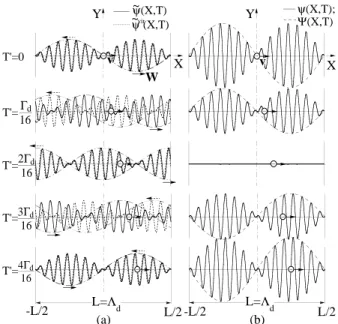
ψ expressed by (5) is a traveling beat wave, as plotted versusX in Fig. 1b for consecutive time points duringΓ/2, or Fig. 2a during Γd/2. ψe is due to all the component waves of the particle while its charge is moving in one direc-tion, and thus represents the (propagating) total wave of the particle, to be identified as ade Broglie phase wavebelow.
e
ψ has one product component Φe oscillating rapidly on the X-axis with the wavelength Λ= 2π/K, and propagat-ing at the speed of lightc at which the total wave energy is transported. The other, Ψe, envelops about Φe, modulating it into a slow varying beatψewhich has a wavevector, wave-length and angular frequency given by:
Kb=Kd, Λb= 2π Kb
=2π
Kd
=Λd, Ωb=Ω+Ωd; (9)
where Λd=
c
v
Λ . (10)
Volume 4 PROGRESS IN PHYSICS October, 2006
As follows (9), the beat ψetravels at thephase velocity
W = Ωb
Kb = Ω
Kd
+v=c
v
c+v . (11)
4 De Broglie wave
Transmitted along with its beat wave, of a wavelength Λd, withKd= 2π/Λd, is the mass of the particle at the velocity
v. The beat wave conjoined with its transportation of the particle’s mass represents thereby a periodic process of the particle, of a wavelength and wavevector equal toΛdandKd of the beat wave.Kd andvdefine for the particle dynamics an angular frequency,Kdv=Ωd, as expressed by (8). Com-bining (10) and (4), and (8) and (3) respectively yield just thede Broglie relations:
Pv = ¯hKd; (12) Ev =1
2¯hΩd. (13) Accordingly Kd, Λd, and Ωd represent the de Broglie wave-vector, wavelength and angular frequency. The beat wave ψe of a phase velocity W resembles thereby the de Broglie phase waveand it in the context of transmitting the particle mass represents thede Broglie waveof the particle.
5 Virtual source. Reflected total particle wave
At an earlier timeT1=T−∆T, at a distanceLadvancing its present location X, with ∆T=L/v, the actual charge was traveling to the left, let axis X′′( =X+v T)be fixed to it. This past-time charge, said being virtual, generated at location X′′ at time T
1 similarly one component wave ϕ†vir(X′′, T∗
1)to the right, which after traversing2Lreturned from left to X′′ at time T∗
1=T1+δT as ϕ†virr (X′′, T1∗) = =C1sin(K−v† X′′−Ω
†
−vT1∗+α0+α′), whereK−v† =K−Kd,
K‡
−v=K+Kd, and Ω j −v=K
j
−vc are the Doppler shifted wavevectors and angular frequencies; α′= (2N+ 1)π as earlier. Here atX′′ andT∗
1,ϕ†virr meets the wave the virtual charge just generated to the left, ϕ‡vir(X′′, T∗
1) =−C1×
×sin(K‡
−vX′′ +Ω
†
−vT1∗−α0), and superpose with it to
e
ψvir(X, T∗
1) = ϕ†virr +ϕ‡vir = 2C1cos(KX′′+KdcT1)×
×sin−KdX′′−2ΩT1−α0.
WithJ≫1and being nondamping,ψevirwill be looping
continuously, up to the present time T. Its present form
e
ψvir(X′′, T)is then as if just produced by the virtual charge at time T but at a location of a distance L advancing the actual charge; it accordingly has a phase advance β= =(K
†−K† −v)
2 L=KdL relative to ψe (the phase advance in time yields no never feature). Including thisβ, using TI and with some algebra,ψevir(X′′, T)writes on axisX as
e
ψvir(X, T) =Φevir(X, T)Ψevir(X, T), (14) e
Φvir(X, T) = 2C
1cos(KX+ 2KdcT, (15)
e
Ψvir(X, T) =−sinKdX+ (Ω+Ωd)T+α0+β. (16)
X
W
ψ(X,T)
~ ~vir ψ (X,T)
Y
v T'=0
X Y ψΨ(X,T);
(X,T)
v
T'=Γd
16
T'=2Γd
16
T'=3Γd
16
-L/2 L=Λd L/2
T'=4Γd
16
(a) -L/2 L/2
L=Λ
d
(b)
Fig. 2: (a) The beat wavesψetraveling at a phase velocity W to the right as in Fig. 1b andψevirat−W to the left, of a wavelength Λd, due to the right- and left- traveling actual and virtual sources respectively. (b) ψe and ψevir superpose to a standing beat or de Broglie phase waveψof wavelengthΛd, angular frequency∼Ω. Along with the ψ process, the particle’s center of mass (⊖) is transported at the velocityv, of a period 2π
Ωd =Λd/v.
e
ψvirof the virtual or reflected charge is seen to be
simi-larly a traveling beat or de Broglie phase wave to the left of a phase velocity−W and wave parametersKb,ΛbandΩb as of (9).
6 Standing total wave and de Broglie wave
Now ifKdL(=β) =nπ, i. e.
Kdn=
nπ
L , n= 1,2, . . . , (17)
and accordinglyΛdn=2nL, thenψevirandψesuperposed onto themselves from different loops are each a maximum. Also at(X, T),ψevirandψemeet and superpose, asψ=ψe+ψevir=
=ΦeΨe+ΦevirΨevir. On the scale ofΛd, orKd, the time
varia-tions inΦeandΦevirare higher-order ones; thus forK≫Kd,
we have to a good approximationΦe(X, T)≃Φevir(X, T)≃ ≃2C1cos(KX) =F(X)andψ(X, T) =F(X)
e
Ψ+Ψevir=
=C4cos(KX) sin(Ω+Ωd)Tcos(KdX+α0);C4= 4C1. As a mechanical requirement at the massive walls,
ψ(0, T) =ψ(L, T) = 0. (18) Condition (18) requiresα0=−π2;ψis thus now
ψ(X, T) =Φ(X, T)ΨX(X) ; (19)
ΨX(X) = sin (KdX), (20)
Φ(X, T) =C4cos(KX) sin(Ω+Ωd)T. (21)
October, 2006 PROGRESS IN PHYSICS Volume 4
ψof (18) is a standing beat or standing de Broglie phase wave; it includes all of the component waves due to both the actual and virtual charges and hence represents the (standing) total wave of the particle.
7 Eigen-state wave function and variables
Equation (13) showed the particle’s kinetic energy is trans-mitted at the angular frequency 12Ωd, half the value Ωd for transporting the particle mass, and is a source motion effect of order (vc)2. This is distinct from, actually exclusive of, the source motion effect, of order v, responsible for the earlier beat wave formation. We here include the order(vc)2 effect only simply as a multiplication factor to ψ, and thus haveψ′=ψ(X, T)e−i1
2¯hΩdT which describes the particle’s kinetic energy transmission. Furthermore, in typical applica-tionsK≫Kd,Ω≫Ωd; thus on the scale of (Kd,Ωd), we can to a good approximation ignore the rapid oscillation in
Φof (21), and have
Φ(X, T)≃C4≡constant (21)′ andψ(X, T)=C ΨX(X). The time-dependent wave function, in energy terms, is thus Ψ(X,T) =ψ′(X,T) =ψe−iΩd2 T= =C ΨX(X)e−iΩd2 T, or
Ψ(X, T) =Csin(KdX)e−i 1
2ΩdT, (22) whereC=RL1
0 ψ 2dX=
√
2/L
C4 is a normalization constant. With (17) forKdnin (12)–(13), for a fixedLwe have the permit-ted dynamic variables
Pvn=
n¯hπ
L , (23) Evn=
n2¯h2π2
2M L2 , (24) where n= 1,2, . . .These dynamic variables are seen to be quantized, pronouncingly for L not much greater than Λd, as the direct result of the standing wave solutions. As shown for the three lowest energy levels in Fig. 3a, the permitted
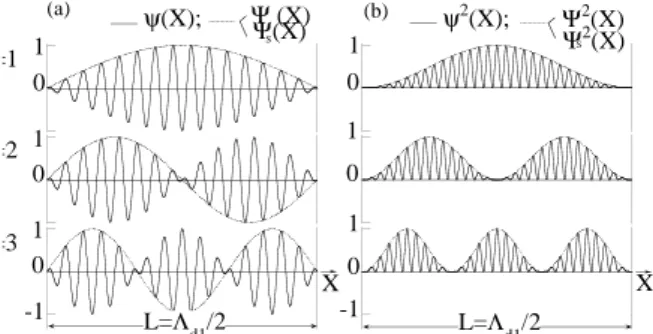
Ψ(X), ≡Ψ (X, T0)withT0 a fixed time point, describing the envelopes (dotted lines) of ψ(X) ≡ ψ(X, T0) which rapid oscillations have no physical consequence to the par-ticle dynamics, are in complete agreement with the corre-sponding solution of Schr ¨odinger equation for an identical system,ΨS(X), indicated by the same dotted lines.
The total wave of a particle, hence its total energy, mass, size, all extend in (real) space throughout the wave path. A portion of the particle, hence the probability of finding the particle, at a given position X in real space is proportional to the wave energy stored in the infinitesimal volume at
X, E(X) =B ψ(X)2, withB a conversion constant [2], ψ(X)as shown in Fig. 3b.
With (23) in∆Pv=Pv.n+1−Pv.nwe have∆Pv2L=h, which reproduces Heisenberg’s uncertainty relation. It fol-lows from the solution that the uncertainty in finding a par-ticle in real space results from the parpar-ticle is an extensive
0 1 n=1
Ψ (X)
ψ(X); Ψ
(X)
S
(a)
0 1
ψ2(X);
S
Ψ2(X)
Ψ2(X) (b)
0 1 n=2
0 1
-1 0 1
L=Λ
d1/2
X n=3
-1 0 1
L=Λ
d1/2
X
Fig. 3: (a) The total wave of particle ψ(X) of (19) with rapid oscillation, and the de Broglie waveΨ(X)as the envelop, for three lowest energy levels n= 1,2,3; Ψ coincides with Schr ¨odinger eigen-state functionsΨS. (b) The corresponding probabilities.
wave over L, and in momentum space from the standing wave solution where waves interfering destructively are can-celled and inaccessible to an external observer.
8 Concluding remarks
We have seen that the total wave superposed from the elect-romagnetic component waves generated by a traveling oscil-latory vaculeon charge, which together make up our particle, has actually the requisite properties of a de Broglie wave. It exhibits in spatial coordinate the periodicity of the de Broglie wave, by the wavelength Λd, facilitated by a beat or de Broglie phase wave traveling at a phase velocity∼c2/v, with the beat in the total wave resulting naturally from the source-motion resultant Doppler differentiation of the electromag-netic component waves. Λd conjoined with the particle’s center-of-mass motion leads to a periodicity of the de Broglie wave on time axis, the angular frequencyΩd. TheΛdandΩd obey the de Broglie relations. The particle’s standing wave solutions in confined space agree completely with solutions for Schr¨odinger equation for an identical system.
References
1. De Broglie L.,Comptes rendus, 1923, v. 177, 507–510; PhD Thesis, Univ. of Paris, 1924;Phil. Mag.1924, v. 47, 446.
2. Zheng-Johansson J. X. and Johansson P.-I., Unification of clas-sical, quantum and relativistic mechanics and of the four for-ces (Foreword by R. Lundin). Nova Science, N.Y., 2006a, 2nd printing (later 2006); Quantum Theory and Symmetries IV, ed. by V. K. Dobrev, Heron Press, Sofia, 2006b (one of two papers with R. Lundin); arxiv: phyiscs/0411134(v4); phyiscs/0411245; physics/0501037(v3); Inference of basic laws of classical, quantum and relativistic mechanics from first-principles classical-mechanics solutions (updated title), Nova Science, N.Y., 2006c.