Comment-based Keyword Programming
Yusuke Sakamoto, Haruhiko Sato, Satoshi Oyama, Masahito Kurihara
Abstract—Keyword programming is a technique to generate code fragments automatically from the several keywords pro-vided by the user and the context of the code. It reduces a burden of remembering the details of a particular language or API. In this paper, we extend the technique for using comments, instead of keywords, in the search of expressions. The use of comments is expected not only to motivate us to write comments frequently, but also to give us more semantic information which is useful for improving quality of generated codes.
Index Terms—Autocomplete, Code assistants, Code comple-tion
I. INTRODUCTION
W
ITH the advancement of software development tech-nology, a lot of programming languages such as Java, C#, VB, PHP, Ruby, etc. exist today. However, modern programmers must learn and remember the details of these many programming languages and APIs. It is a heavy burden for programmers to learn, remember, and use these language syntaxes correctly. Keyword programming [1] is a technique to reduce the burden of remembering the details of a particu-lar language or API. It uses a few keywords provided by the user to search for expressions that are possible in the context of the code.In this paper, we extend the keyword programming and present the idea of comment-based keyword programming, which provides a tool to create executable code fragment from a single line comment input by the user programmer. Thus it can further reduce the burden of programmers. Programmers generally have to write comments explaining what an executable code means for making it easier to understand. Comment-based keyword programming utilizes their works of writing comments for creating candidates of an executable code fragment.
The paper is organized as follows. In Section II, we briefly review the general idea of the keyword programming. In Section III, we present the main idea of the comment-based keyword programming. In Section IV, we conclude our work and discuss some future work.
II. KEYWORDPROGRAMMING
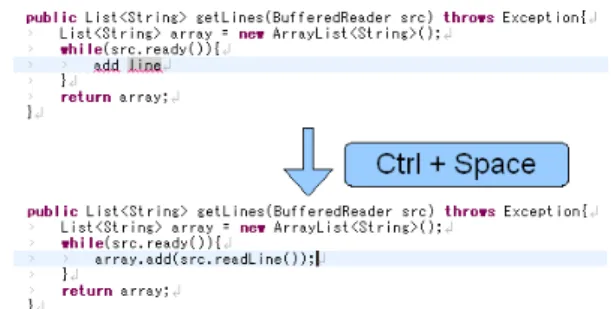
In keyword programming [1], the user provides a few keywords for the input query to search for a desired code fragment. The user interface takes the form of a code completion interface in an IDE. For instance, Fig.1 shows a user entering add line in a Java file, which the system translates in-place to array.add(src.readLine()). The gener-ated expression contains the user’s keywords add and line, but also fills in many details, including the receiver objects array and src, the full method name readLine, and the formal
Manuscript received January 12, 2011; revised February 7, 2011. The authors are with the Graduate School of Information Science and Technology, Hokkaido University, Sapporo 060-0814, Japan. E-mail: [email protected].
Java syntax for method invocation. Keyword programming is related to work on searching for examples in a large corpus of existing code. It can be distinguished by the kind of query provided by the user. In Prospector [4] and XSnippet [3], these systems require types for the input. However, in keyword programming, the input is not restricted to a type.
Fig. 1. In keyword programming, the user types some keywords, presses a completion command (such as Ctrl-Space in Eclipse), and the keywords are translated into a valid expression
A. Model
Keyword programming models the available methods, fields and local variables in the case of Java. Although it could be applied to many languages, this paper focuses on Java. Keyword programming defines the model M as the triple (T, L, F), where T is a set of types, L is a set of labels used for matching the keywords, and F is a set of functions.
1) Type set: T: Each type is represented by a unique name. For Java, keyword programming gets this from the fully qualified name for the type. Examples include int and java.lang.Object.
2) Label set: L: Keyword programming uses labels to represent method names, so that keyword programming can match them against the keywords in a query. To get the keywords from an identifier, keyword programming breaks up the identifier at punctuation and capitalization boundaries. For instance, the method name currentTimeMillis is repre-sented with the label (current, time, millis).
3) Function set: F: Functions are used to model each component in an expression that keyword programming wants to match against the users keyword query. In Java, these include methods, fields, and local variables. Keyword programming models expressions generated by a keyword query as a function tree. Each node in the tree is associated with a function from F, and obeys constraints of the types of return value and parameters.
B. Evaluation of a Function Tree
Fig. 2. This tree is a function tree representing the Java expression
array.add(src.readLine()) from Fig.1. Each node is associated with a function. The words at the top of each node represent the return type, and the words at the bottom represent the parameter types.
• +1.0for each keywordkin the query where there exists
an f ∈ Tf uncs such that k ∈ label(f). This gives 1 point for each keyword that the tree explains.
• −0.05 for each f ∈Tf uncs. This favors function trees
with fewer functions.
• For each f ∈Tf uncs, consider each w∈label(f), and
subtract 0.01if w is not in the query. This favors less verbose function trees.
• +0.001for eachf ∈Tf uncs wheref is a local variable, or f is a member variable or member method of the enclosing class. This favors functions and variables which are close to the user’s context.
Since it takes a lot of time to calculate all the combinations of the functions, keyword programming uses a dynamic programming (Fig.3) to reduce the amount of calculation. Algorithm 1 Pseudocode to fill out the dynamic program-ming table in keyword programprogram-ming
procedure DynamicProgram() for each1≤i≤hdo
for eacht∈T do
bestRoots(t, i)← ∅
for eachf ∈F whereret(f)∈sub(t)do
e←GetBestExplF orF unc(f, i−1) ife <−∞then
bestRoots(t, i)←bestRoots(t, i)∪(e, f) end if
bestRoots(t, i)←GetBestN(bestRoots(t, i), r) end for
end for end for
procedureGetBestExplF orF unc(f, hmax)
ecumulative←expl(f) for eachp∈params(f) do
ebest←(−∞,0,0,0, . . .) for each1≤i≤hmax do
for each(e′, f′)∈bestRoots(p, i)do
ifecumulative+e′ > ebest then
ebest←ecumulative+e′ end if
end for end for
ecumulative←ebest end for
return (ecumulative)
III. COMMENT-BASEDKEYWORDPROGRAMMING
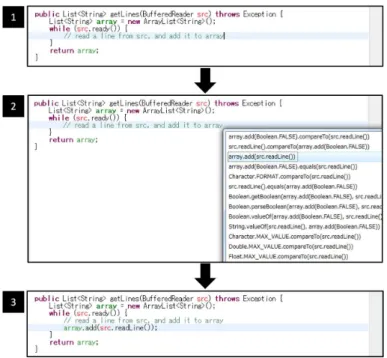
For utilizing the comments in generating code fragments in keyword programming, we propose comment-based keyword programming. The actual flow of comment-based keyword programming is as follows: first, the user input a short, one line comment and invokes the tool by command of Ctrl-Space. Second, the tool shows multiple candidates of executable code fragment on a pop-up window and the user select a suitable one. Finally, the tool outputs the code and the input comment remains on the source code (Fig.4).
Fig. 4. This picture shows a flow of the actual works of our tool. It is a plug-in of the Eclipse IDE.
A. Advantage
If you use our tool at programming, there are two ad-vantages. Since the input is a comment, you unify the two works, writing codes and writing comments. Since the input is a comment, you tend to write more comments naturally than usual. Our tool reduces the works of programming and enhances the readability.
B. Algorithm for multiple outputs
We have improved the algorithm of previous study pre-sented in the section of algorithm. The algorithm of previous study outputs only one candidate. We have improved it in order to output multiple candidates. The improved points are as follows:
• Each cell in the dynamic programming table keeps a
few hundred of candidates. In previous work, each cell contains at most 3 candidates.
• Each cell keeps a function tree, instead of the root
function of the tree.
• Outputs are a few hundred of function trees whose
height is at most 3 (same as previous study) and having desired return type.
The reason that the number of candidates is limited to a few hundred of pairs is the limit of memory size (4GB in Proceedings of the International MultiConference of Engineers and Computer Scientists 2011 Vol I,
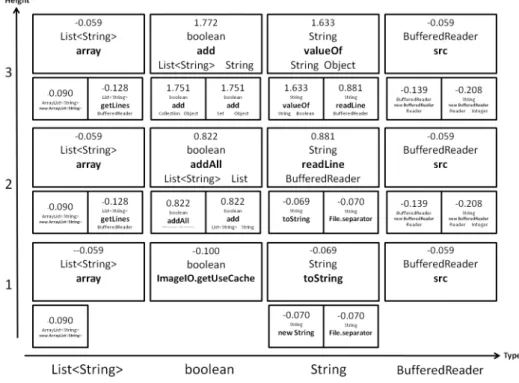
Fig. 3. This is the dynamic programming table for a run of the algorithm on the input add line in the context of Fig. 1. Each row represents a height, and each column represents a return type. Each cell contains up to three boxes. The box with the highest score in each cell is enlarged. Each box represents a function with the name in the center, the return type above the name, and the parameter types listed below the name. The return type of each function must be a subtype of the column type that the box is in. The number above the return type is the score of the function.
our environment). Although this algorithm clearly consumes larger amount of memory than previous algorithm, our tool responds within a second even if the size of function setF
is a few thousand.
Algorithm 2 Our DynamicProgram procedure procedure DynamicProgram()
for each1≤i≤hdo for eacht∈T do
bestRoots(t, i)← ∅
for eachf ∈F whereret(f)∈sub(t)do
tree←GetBestExplF orF unc(f, i−1)
e←tree.getRoot().getE() ife <−∞then
bestRoots(t, i)←bestRoots(t, i)∪tree
end if
bestRoots(t, i)←GetBestN(bestRoots(t, i), r) end for
end for end for
In addition to output multiple candidates, we have tried to consider the use of frequency of the selected candidate. Be-cause of higher probability of occurrence, a lot of candidates is useful. However, a lot of candidates is also a burden for users when selecting what they need. We think that this is a similar problem of web search engines. Like web search engines, the list of candidates presented to users should be customized for each user using the tool.
We define a sorting rule for user customized list. We calculate the score of each candidate of function tree by the sum of (1) the number of times of the use of a function tree and (2) the score for a function tree calculated the rules
Algorithm 3 Our GetBestExplForFunc procedure procedureGetBestExplF orF unc(f, hmax)
ecumulative←expl(f)
treebest←CreateF unctionT ree(f, ecumulative) for eachp∈params(f)do
ebest←(−∞,0,0,0, . . .)
treeparam←null
for each1≤i≤hmax do
for eachtree∈bestRoots(p, i)do ifecumulative+e′> ebest then
ebest←ecumulative+e′
treeparam←tree end if
end for end for
ecumulative←ebest
treebest←AddChild(treebest, treeparam) end for
return (ecumulative)
explained in the section of II-B. The candidate list is sorted in descending order of the score.
C. Implementation
We have implemented our idea as an Eclipse plug-in. Our tool works following steps:
1) A programmer inputs keywords on the editor, and invokes our tool.
Fig. 5. This figure is an image of the improved dynamic programming table in order to output multiple candidates. Each cell of the table is a function tree. Each cell contains a few hundred of function trees.
3) Our tool sorts list of output candidates with their use of frequency.
4) The programmer selects candidate and the use of selected candidate is written in the database.
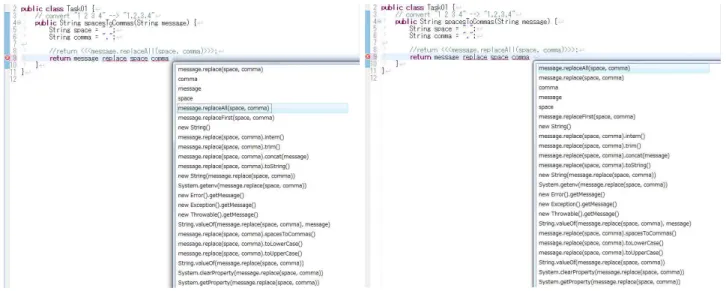
Fig.6 shows the usefulness of considering the use of fre-quency. These two pictures are the snapshots after invoking our Eclipse tool on the same context. The left snapshot is the first time of the invocation. The right is the third time. In this context, the candidate that user needs are colored in the list. The candidate exists higher in the list of the right snapshot. The introduction of the use of frequency makes commonly-used candidates easy to find.
IV. CONCLUSION ANDFUTUREWORK
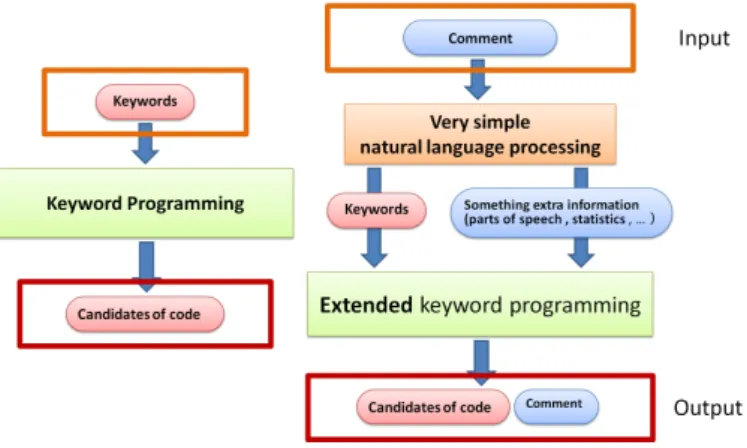
One line short comment is often used line by line es-pecially on a commercial source code that requires high readability. Comment-based keyword programming is very useful for such situations. Our future work is applying a very easy natural language processing for processing input small comment (Fig.7). We think that applying it will improve the precision of the tool. We will analyze parts of speech of the input using part-of-speech tagger and apply the naming conventions of programming. For example, the input: ”add line” is a Verb-Object pattern. The result is likely to be ”add(line)” or ”line.add(X)” or ”addLine()”. The input: ”robot moves to (x,y)” is a Subject-Verb pattern. The result is likely to be ”robot.move(x,y)” or ”move(robot,x,y)”. The object and the subject are likely to be a child node of the verb in a function tree. We will add a new scoring rule to existing four rules on the basis of this way of thinking. The other future works are as follows: We will extract important words for programming by analyzing open source project forums with TF/IDF to take priorities of words into account. Since keyword programming cannot handle synonyms like ”add”
and ”append”, we will allow our tool to handle synonyms by making a thesaurus specialized for software developments.
Fig. 7. These are the overviews of the tool. The left is keyword programming and the right is our study.
REFERENCES
[1] G. Little, R. C. Miller. Keyword programming in Java. Automated
Software Engineering , 16(1), pp. 37-71, 2009.
[2] Steven P. Reiss. Semantics-based code search Proceedings of the 31st
International Conference on Software Engineering , pp. 243-253, 2009.
[3] N. Sahavechaphan, K. Claypool. XSnippet: Mining For Sample Code.
Proceedings of the 21st annual ACM SIGPLAN conference on Object-oriented Programming Systems, Languages, and Applications (OOPSLA 2006) , pp. 413-430.
[4] D. Mandelin, L. Xu, R. Bodik, D. Kimelman. Jungloid Mining: Helping to Navigate the API Jungle. Proceedings of the 2005 ACM SIGPLAN
conference on Programming language design and implementation , pp.
48-61.
[5] Rosco Hill, Joe Rideout. Automatic Method Completion. Proceedings
of the 19th IEEE international conference on Automated software engineering , pp. 228-235, 2004.
[6] Brad A. Myers, Andrew J. Ko, Sun Young Park, Jeffrey Stylos, Thomas D. LaToza, Jack Beaton. More natural end-user software engineering.
Proceedings of the 4th international workshop on End-user software engineering , pp. 30-34, 2008.
Fig. 6. Snapshots of the simulation using our Eclipse plug-in. Although these two pictures are on the same context, the item that user needs (colored items in the list) exists in different order. The left picture is the first time of the command invocation. The right is the third time. By the introduction of the use of frequency, commonly-used items are way up on the list.
[7] Brad A. Myers, John F. Pane, Andy Ko. Natural programming languages and environments. Communications of the ACM , 47(9), pp. 47-52, 2004.