USe OF decOmpreSSive craniectOmy in tHe
treatment OF HemiSpHeric inFarctiOn
José Antonio Fiorot Jr.
1, Gisele Sampaio Silva
1, Sergio Cavalheiro
2, Ayrton Roberto Massaro
3Abstract – Decompressive craniectomy (DC) has demonstrated efficacy in reducing mortality in hemispheric infarction of the middle cerebral artery. The aim of our study was to compare the outcome of patients submitted to DC to patients treated in a conservative way. Eighteen patients were submitted to DC and 14 received conservative treatment. Neurological status was assessed by the Glasgow Coma Score and National Institutes of Health Stroke Scale score. Mortality, modified Rankin Scale and Barthel Index scores were assessed at 90 days to evaluate outcome.We did not observe reduction in overall mortality and functional outcome in patients submitted to DC. The differences between our group and previously published series are probably related to the neurological status of the patients at the time of therapeutic decision.
KEy WoRDS: craniectomy, decompressive surgery, middle cerebral artery infarction.
Uso da craniectomia descompressiva no tratamento do acidente vascular cerebral isquêmico hemisférico Resumo – Craniectomia descompressiva (CD) tem demonstrado eficácia em reduzir a mortalidade em pacientes com infarto hemisférico (IH) da artéria cerebral média. Este estudo avaliou o prognóstico dos pacientes submetidos a CD comparando a pacientes com IH tratados de maneira conservadora. Dezoito pacientes foram submetidos a CD e 14 receberam tratamento conservador. Escala de Coma de Glasgow e Escala de AVC do National Institutes of Health foram utilizadas para graduar o déficit neurológico. A mortalidade, bem como os escores obtidos na escala modificada de Rankin e índice de Barthel foram avaliados em 90 dias. Não foi observada redução de mortalidade nos pacientes submetidos a CD. Essa diferença entre os nossos resultados e os estudos publicados previamente se deve, provavelmente, à decisão cirúrgica tardia em pacientes com sinais clínicos de herniação cerebral.
PALAVRAS-CHAVE: craniectomia, descompressão cirúrgica, infarto da artéria cerebral média.
Department of Neurology and Neurosurgery, Universidade Federal de São Paulo, Brazil (UNIFESP/EPM): 1Neurologist; 2Professor of Neurosurgery; Centro de Medicina Diagnóstica Fleury: 3Neurologist.
Received 19 November 2007, received in inal form 22 February 2008. Accepted 10 March 2008.
Dr. José Antonio Fiorot Júnior – Rua Aníbal Vieira Rabaiolly 11 - 29065-240 Vitória ES - Brasil. E-mail: [email protected] Decompressive craniectomy (DC) has been used to
treat intracranial hypertension and cerebral edema asso-ciated with several causes. In 1905, Cushing was the irst to describe this procedure in the treatment of brain tu-mors1. Today, DC is the main treatment option for oth-er diseases, such as brain trauma2, subdural and epidur-al hematoma3, edema due to subarachnoid hemorrhage4, cerebral venous thrombosis with intractable intracranial hypertension5, cerebellar infarction6 and hemispheric in-farction of the middle cerebral artery (HI)7. HIs occur in strokes with occlusion of the distal internal carotid artery or the proximal middle cerebral artery. They represent 10 to 15% of overall strokes8. Clinical worsening related to cerebral edema occurs two or three days after the stroke onset, and is associated with high early mortality9. DC in-creases cerebral perfusion, preventing infarction
enlarge-ment, and attenuates the expansive effect of edema that leads to cerebral herniation10.
Recent international trials showed the importance of DC in reducing mortality and morbidity in HI11. Few Brazil-ian studies have analyzed the eficacy of DC in HIs. Nobre et al. worked on a retrospective study, with 34 patients submitted to DC. The authors concluded that men over 50 years have the worst outcome after DC12.
The aim of our study was to compare the outcome of HI patients submitted to DC to patients treated in a con-servative way.
metHOd
August 2006. HI was an acute ischemic stroke deined by CT as a large parenchymal ischemic lesion that involved at least 50% of the vascular territory of the middle cerebral artery, or the ante-rior and middle cerebral arteries territories simultaneously, asso-ciated with early brain swelling signs, such as midline shift, com-pression of the lateral ventricles and basal cisterns. Patients with prior poor clinical conditions (mRS ≥02), those with other crit-ical diseases that affect clincrit-ical prognosis, and those who died during surgery were excluded.
Epidemiological data were obtained from medical records. We have selected the clinical neurological parameters Glasgow Co-ma Score (GCS) and National Institute of Health Stroke Scale (NI-HSS) scores and outcome measures modiied Rankin Scale (mRS) and Barthel Indice (BI) scores that were systematically registered by the neurological and stroke team upon hospital admission, at the time of therapeutic decision and in a follow-up at 90 days.
This study was approved by the Ethics Committee of Hos-pital S.Paulo (UNIFESP-EPM) and a signed informed consent was obtained from all patients or their legal representatives.
Statistical analysis
Statistical analyses were performed using SPSS software ver-sion 10.0 (SPSS Inc). A descriptive analysis, including mean±SD and median, was used to describe patient data. Parametric da-ta was expressed as mean±SD and was analyzed by t-test. Non-parametric data was expressed as median and was analyzed by
Kruskal Wallis test. Dichotomic data was expressed by
percent-age and analyzed by c2test and Fisher’s exact test. Statistical
sig-niicance was assigned to p value<0.05.
reSULtS
Thirty-two HI patients were analyzed. Eighteen pa-tients were submitted to DC and 14 received conserva-tive treatment (Ct). The therapeutic decision to perform DC was evaluated by the neurosurgeon on call at the neu-rological emergency department.
Demographic data
The median age of our patients was 59.1±18 years (range 17–93 years). Patients in the operated group were
younger (52±15 years) than those with Ct (68±17 years), while patients who received Ct had a higher educational level than those submitted to surgery.
Admission to the hospital
The mean time between the onset of symptoms and admission to the emergency room was 6.3±11.3 hours (range 0.5–50), and did not differ between the two groups. Table 1 summarizes the clinical characteristics of the pa-tients upon admission. The GCS and NIHSS scores did not differ between the two groups. In addition, there was no statistical difference in arterial blood pressure and capil-lary glucose level, between the two groups at admission. Nearly 15% of all HI patients were submitted to throm-bolytic treatment.
Therapeutic decision
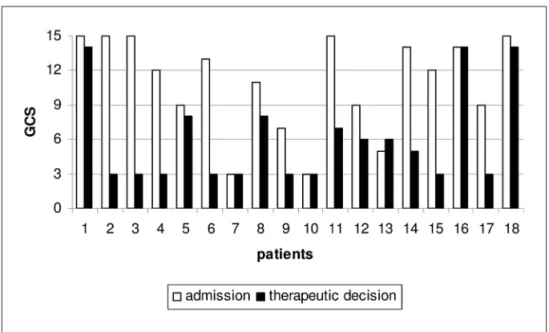
The mean time between the onset of symptoms and therapeutic decision among our HI patients was 35.4±27.1 hours and did not differ between the two groups.Fifty percent of our patients submitted to DC were treated in less than 24 hours of symptoms onset. However, at thera-peutic decision, patients submitted to DC had lower GCS scores than those with Ct. In addition, NIHSS scores were also worse in those selected to DC. There was a rapid neu-rological deterioration between admission and therapeu-tic decision in both groups, marked in those patients se-lected to DC, as demonstrated in Figures 1 and 2. All pa-tients in the DC group had a decreased level of conscious-ness and almost half of them showed unilateral ixed and dilated pupil at the time of therapeutic decision (Table 2).
Follow-up at 90 days after therapeutic decision Mortality, GCS, NIHSS, mRS and BI scores did not dif-fer between the two groups at 90 days (Table 3).
diScUSSiOn
Many international studies conirmed that age is the most important predictor affecting outcome in DC13-15.
Table 1. Clinical and neurological parameters at admission in patients with HI.
Hemispheric infarction DC N=18 Ct N=14 p
Admission
Mean (median) of time delay from onset to admission (hrs) 5.4±8.4 (2,0) 7.3±13.7 (2.0) NS Mean (median) GCS score 10± 4 (12) 12±2 (12) NS Mean (median) NIHSS score 17±7 (15) 14±6 (14) NS Mean systolic arterial pressure (mmHg) 145±32 141±39 NS Mean diastolic arterial pressure (mmHg) 89±20 85±21 NS Mean arterial pressure (mmHg) 109±22 104±26 NS Mean capillary glucose (mg/dl) 172±68 183±92 NS
Table 2. Clinical and neurological parameters at therapeutical decision in patients with HI.
Hemispheric infarction DC N=18 Ct N=14 P
Therapeutic decision
Mean (median) time delay from onset (hrs) 33±25 (25) 37±29 (29) NS Mean (median) time delay from admission (hrs) 31±20 (30) 34,7±27.8 (27) NS
Mean (median) GCS score 6±4 (4) 9±3 (10) 0.016
Mean (median) NIHSS score 25±7 (30) 19±7 (17) 0.025
Decreased level of consciousness 100% 50% 0.001
Anisocoria 38% 0 0.01
Treatment with manitol 56% 36% NS
Fig 1. GCS score in DC patients.
yu yao et al. conducted a study comparing the effects of DC in older and younger patients. The mortality was 7.7% in patients with less than 60 years, compared to 33.3% in those ≥60 years14. In a systematic review of DC with 138 patients, Grupta et al. also cited the importance of age15. Eighty percent of 75 patients over 50 years had poor func-tional outcome or death when treated with DC, while in younger patients, these endpoints occurred in only 32%. our DC patients have been selected within the theoreti-cally ideal age group (<60 years) to obtain good results with this procedure.
Patients in both groups arrived early in the Emergency Department. This is probably due to the severity of the neurological deicits that leads the patient and the family to seek out hospital care immediately16. Despite early arriv-al, the decision to perform DC in our patients was delayed. This time frame between hospital arrival and therapeutic decision-making probably played an important role in the neurological deterioration and the outcome in HI patients.
Kilincer et al. showed that a pre-surgery GCS>8 is an important determinant of a favorable outcome17. Perform-ing surgery on several patients with clinical signs of brain herniation was probably one of the most important rea-sons for the lack of clinical beneits from DC in our group. Most of the studies on DC in HI patients evaluated outcome after 90 days. In a study with 118 patients, 63 submitted to DC, Schwab et al. demonstrated the great beneit on mortality reduction in patients with HI submit-ted to DC. Results were even better when surgery was performed earlier than 24 hours, causing an extraordinary decrease in deaths and a mild improvement in functional outcome10.
Besides the timing to perform DC in HI patients, neu-roimaging seems to be another important tool to select the ideal patient. Der-yang Cho et al. used diffusion (DWI) and perfusion (PWI) sequences of magnetic resonance (MRI), and proposed the new concept of ultra-early DC (<6 hours from onset)18. The authors obtained excellent results, with mortality lower than 10% and a better func-tional outcome than prior studies. Thomalla et al. studied
the role of early MRI to predict the occurrence of HI. Thir-ty-seven patients with acute HI were submitted to DWI, PWI, and MR angiography within 6 hours of symptom on-set. Predictors of HI were as follows for sensitivity and speciicity, respectively: apparent diffusion coeficient (ADC) <80% >82 ml (87% and 91%), time to peak (TTP) >+4s
>162 ml (83% and 75%) and TTP/ADC mismatch ratio <2.4 (80% and 79%) (p<0.05)19. Although there was a signiicant difference in the clinical parameters in our patients at the time of therapeutic decision, we could not detect any dif-ferences in the outcome at 90 days follow-up visit.
our initial results were not as encouraging as the pre-viously published ones10. We could not observe a signii-cant reduction in overall mortality, when comparing pa-tients treated with DC to Ct. The lack of beneit of DC in our study group is probably a consequence of performing late surgery in patients with rapidly evolving clinical signs of brain herniation and less salvable brain tissue. This fact may suggest that if patients submitted to DC had been operated in equal neurological conditions that those in-dicated to Ct, they might have had better outcome.
Early DC, performed within 24 hours from stroke onset, is a well established option of treatment in HI, in which thrombolysis was unsuccessful. Hypothermia maybe another possible early synergic therapy in future trials with HI patients. When combined to DC, hypother-mia seems to reduce the inal brain infarction volume, improving neurological outcome20. It is obvious that in-tensive care conditions play an additional important role in the inal results of DC. Control of temperature21, arte-rial blood pressure22, glycemia23 and intracranial pressure24 must be rigorous.
Further protocols should improve decision-making for DC to optimize patient selection and minimize treat-ment delays selecting the patient with acute HI that will mostly beneit from this therapeutic procedure. Based on our data and reviewing the literature, we may suggest the following criteria: age less than 60 years; early decision for surgery within the irst 24 hours of stroke onset; pa-tients with rapidly neurological worsening evaluated by Table 3. Outcome parameters at 90 days in patients with HI.
Hemispheric infarction DC N=18 Ct N=14 p
Follow-up at 90 days
Death 55% 57% NS
Mean (median) GCS score 11±3 (13) 13±2 (13) NS Mean (median) NIHSS score 15±8 (13) 10±5 (10) NS
mRS≤04 50% 50% NS
GCS and NIHSS scores without signs of brain herniation; and inally subtle large and early acute ischemic lesions detected by the initial CT or MRI.
Acknowledgments – The authors are indebted to Dr. Sheila Mar-tins for her technical assistance with statistical analysis.
reFerenceS
1. Cushing H. The establishment of cerebral hernia as a decompressive measure of inaccessible brain tumors; with the description of intermus-cular methods of making the bone defect in temporal and occipital re-gions. Surg Gynecol Obstet 1905;1:297-314.
2. Guerra WK, Gaab MR, Dietz H, Mueller JU, Piek J, Fritsch MJ. Surgical decompression for traumatic brain swelling: indications and results. J Neurosurg 1999;90:187-196.
3. Cooper PR, Rovit RL, Ransohoff J. Hemicraniectomy in the treatment of acute subdural hematoma: a re-appraisal. Surg Neurol 1976;5:25-28. 4. Fisher CM, Ojemann RG. Bilateral decompressive craniectomy for
wors-ening coma in acute subarachnoid hemorrhage: observations in sup-port of the procedure. Surg Neurol 1994;41:65-74.
5. Steini R, Latronico N, Cornali C, Rasulo F, Bollati A. ��er�ent �eco����er�ent �eco� -pressive craniecto�y in patient with ixe� �ilate� pupils �ue to cere -bral venous and dural sinus thrombosis: report of three cases. Neuro-surgery 1999;45:626-630.
6. Chen HJ, Lee TC, Wei CP. Treatment of cerebellar infarction by decom-Treatment of cerebellar infarction by decom-pressive subocciptal craniectomy. Stroke 1992;23:957-961.
7. Ren�achary SS, Batnitzky S, Moranz RA, Arjunan K, Jeffries B. He�i -craniectomy for acute massive cerebral infarction. Neurosurgery 1981;8:321-328.
8. Hacke W, Schwab S, Horn M, Spranger M, de Georgia M, von Kummer R. Mali�nant �i��le cerebral artery territory infarction. Arch Neurol 1996;53:309-315.
9. Heinsius T, Bogousslavsky J, van Melle G. Large infarcts in the mid-Large infarcts in the mid-dle cerebral artery territory: etiology and outcome patterns. Neurolo-gy 1996;50:341-350.
10. Schwab S, Steiner T, Aschoff A, et al. �arly he�icraniecto�y in patients�arly he�icraniecto�y in patients with complete middle cerebral artery infarction. Stroke 1998;29:1888-1893. 11. Vahe�i K, Hof�eijer J, Juettler �, et al. D�CIMAL, D�STINY, an� HAM -L�T investi�ators. �arly �eco�pressive sur�ery in �ali�nant infarction of the middle cerebral artery: a pooled analysis of three randomized controlled trials. Lancet Neurology 2007;6:215-222.
12. Nobre MC, Monteiro M, Albuquerque AC, et al. Deco�pressive crani -ectomy for treatment of intracranial hypertension secondary to large ische�ic cerebral infarction: analysis of 34 cases. Arq Neuropsiquiatr 2007;65:107-113.
13. Rieke K, Schwab S, Krieger D, et al. Decompressive surgery in space-Decompressive surgery in space-occupying hemispheric infarction: results of an open prospective trial. Crit Care Med 1995;23:1576-1578.
14. Yao Y, Liu W, Yan� X, Hu W, Li G. Is �eco�pressive craniecto�y for �ali�nant �i��le cerebral artery territory infarction of any beneit for elderly patients? Surg Neurol 2005;64:165-169.
15. Gupta R, Connolly �S, Mayer S, �lkin� MS. Hemicraniectomy for
mas-sive middle cerebral artery territory infarction: a systematic review. Stroke 2004;35:539-543.
16. Cho DY, Chen TC, Lee HC. Ultra-early decompressive craniectomy for malignant middle cerebral artery infarction. Surg Neurol 2003;60:227-232. 17. Qureshi AI, Kir�ani JF, Saye� MA, et al. Buffalo Metropolitan AreaBuffalo Metropolitan Area an� �rie County Stroke Stu�y Group: ti�e to hospital arrival, use of thrombolytics, and in-hospital outcomes in ischemic stroke. Neurolo-gy 2005;64:2115-2120.
18. Kilincer C, Asil T, Utku U, et al. Factors affectin� the outco�e of �e -compressive craniectomy for large hemispheric infarctions: a prospec-tive cohort stu�y. Acta Neurochir (Wien) 2005:147:587�594.
19. Cho DY, Chen TC, Lee HC. Ultra-early decompressive craniectomy for malignant middle cerebral artery infarction. Surg Neurol. 2003;60:227-232. 20. Thomalla GJ, Kucinski T, Schoder V, et al. Prediction of malignant mid-Prediction of malignant mid-dle cerebral artery infarction by early perfusion and diffusion weight-ed magnetic resonance imaging. Stroke 2003;34:1892-1900.
21. Doerler A, Schwab S, Hoffmann TT, �n�elhorn T, Forsting M. Combi- Combi-nation of decompressive craniectomy and mild hypothermia amelio-rates infarction volume after permanent focal ischemia in rats. Stroke. 2001;32:2675-2681.
22. Won� AA, Davis JP, Schluter PJ, Hen�erson RD, O’Sullivan JD, Rea� SJ. The ti�e course an� �eter�inants of te�perature within the irst 48 h after ischaemic stroke. Cerebrovasc Dis 2007;24:104-110. 23. Urrutia VC, Wityk RJ. Blood pressure management in acute stroke. Crit
Care Clin 2006;22:695-711.
24. Gray CS, Hil�reth AJ, San�ercock PA, et al. GIST trialists collaboration. Glucose-potassium-insulin infusions in the management of post-stroke hyper�lyce�ia: the UK �lucose insulin in stroke trial (GIST�UK). Lan-cet Neurol 2007;6:397-406.