NHESSD
2, 2011–2048, 2014The XWS catalogue
J. F. Roberts et al.
Title Page
Abstract Introduction
Conclusions References
Tables Figures
◭ ◮
◭ ◮
Back Close
Full Screen / Esc
Printer-friendly Version Interactive Discussion
Discussion
P
a
per
|
D
iscussion
P
a
per
|
Discussion
P
a
per
|
Discuss
ion
P
a
per
|
Nat. Hazards Earth Syst. Sci. Discuss., 2, 2011–2048, 2014 www.nat-hazards-earth-syst-sci-discuss.net/2/2011/2014/ doi:10.5194/nhessd-2-2011-2014
© Author(s) 2014. CC Attribution 3.0 License.
Natural Hazards and Earth System Sciences
Open Access
Discussions
This discussion paper is/has been under review for the journal Natural Hazards and Earth System Sciences (NHESS). Please refer to the corresponding final paper in NHESS if available.
The XWS open access catalogue of
extreme European windstorms from
1979–2012
J. F. Roberts1, A. J. Champion2, L. C. Dawkins3, K. I. Hodges4, L. C. Shaffrey5, D. B. Stephenson3, M. A. Stringer2, H. E. Thornton1, and B. D. Youngman3
1
Met Office Hadley Centre, Exeter, UK
2
Department of Meteorology, University of Reading, Reading, UK
3
College of Engineering, Mathematics and Physical Sciences, University of Exeter, Exeter, UK
4
National Centre for Earth Observation, University of Reading, Reading, UK
5
National Centre for Atmospheric Science, University of Reading, Reading, UK
Received: 13 January 2014 – Accepted: 12 February 2014 – Published: 7 March 2014
Correspondence to: J. F. Roberts ([email protected])
Published by Copernicus Publications on behalf of the European Geosciences Union.
NHESSD
2, 2011–2048, 2014The XWS catalogue
J. F. Roberts et al.
Title Page
Abstract Introduction
Conclusions References
Tables Figures
◭ ◮
◭ ◮
Back Close
Full Screen / Esc
Printer-friendly Version Interactive Discussion
Discussion
P
a
per
|
D
iscussion
P
a
per
|
Discussion
P
a
per
|
Discuss
ion
P
a
per
|
Abstract
The XWS (eXtreme WindStorms) catalogue consists of storm tracks and model-generated maximum three-second wind-gust footprints for 50 of the most extreme winter windstorms to hit Europe over 1979–2012. The catalogue is intended to be a valuable resource for both academia and industries such as (re)insurance, for
ex-5
ample allowing users to characterise extreme European storms, and validate climate and catastrophe models. Several storm severity indices were investigated to find which could best represent a list of known high loss (severe) storms. The best performing
index wasSft, which is a combination of storm area calculated from the storm footprint
and maximum 925 hPa wind speed from the storm track. All the listed severe storms are
10
included in the catalogue, and the remaining ones were selected usingSft. A
compari-son of the model footprint to station observations revealed that storms were generally well represented, although for some storms the highest gusts were underestimated due to the model not simulating strong enough pressure gradients. A new recalibra-tion method was developed to estimate the true distriburecalibra-tion of gusts at each grid point
15
and correct for this underestimation. The recalibration model allows for storm-to-storm
variation which is essential given that different storms have different degrees of model
bias. The catalogue is available at www.europeanwindstorms.org.
1 Introduction
European windstorms are extra-tropical cyclones with very strong winds or violent
20
gusts that are capable of producing devastating socioeconomic impacts. They can lead to structural damage, power outages to millions of people, and closed transport net-works, resulting in severe disruption and even loss of lives. For example the windstorms Anatol, Lothar and Martin that struck in December 1999 inflicted approximately 13.5 Billion USD (indexed to 2012) worth of damage, and lead to over 150 fatalities (Sigma,
25
NHESSD
2, 2011–2048, 2014The XWS catalogue
J. F. Roberts et al.
Title Page
Abstract Introduction
Conclusions References
Tables Figures
◭ ◮
◭ ◮
Back Close
Full Screen / Esc
Printer-friendly Version Interactive Discussion
Discussion
P
a
per
|
D
iscussion
P
a
per
|
Discussion
P
a
per
|
Discuss
ion
P
a
per
|
By cataloguing these events, the intensity, location and frequency of historical wind-storms can be studied. This is crucial to understanding the factors that influence their development (such as the North Atlantic jet stream or the North Atlantic Oscillation), and for evaluating and improving the predictions of weather and climate models.
Publically available historical storm catalogues, such as HURDAT (Landsea et al.,
5
2004) and IBTRACS (Levinson et al., 2010), are widely used in the tropical cyclone community. These catalogues provide quantitative information about historical tropical cyclones, including observed tracks of storm position and intensity. Tropical cyclone catalogues are an essential resource for the scientific community and are used to un-derstand how climate variability modulates the development and activity of tropical
10
cyclones (e.g., Ventrice et al., 2012) and for evaluating climate models (e.g., Strachan et al., 2013; Manganello et al., 2012). These catalogues are also widely used within the insurance and reinsurance industry to assess risks associated with intense tropical cyclones.
Despite the utility of tropical cyclone catalogues, no comparable catalogue of
Euro-15
pean windstorms currently exists. One of the last major freely available catalogues was that of Lamb (1991). This catalogue has not been digitised and is now long out-of-date. More recent catalogues only contain information on storm intensity (Della-Marta et al., 2009), only pertain to a specific country (e.g., Bessemoulin, 2002), or are not publically available. The XWS catalogue, available at www.europeanwindstorms.org, aims to
ad-20
dress this gap, by producing a publically available catalogue of the 50 most extreme European winter windstorms. The catalogue consists of tracks and model-generated maps of maximum three-second wind-gusts at each model grid point over a 72 h
pe-riod for each storm (hereafter the maps are referred to as the storm footprints, and
three-second wind-gusts as gusts).
25
In order to create the catalogue, several scientific questions had to be addressed:
1. What is the best method for defining extreme European windstorms?
NHESSD
2, 2011–2048, 2014The XWS catalogue
J. F. Roberts et al.
Title Page
Abstract Introduction
Conclusions References
Tables Figures
◭ ◮
◭ ◮
Back Close
Full Screen / Esc
Printer-friendly Version Interactive Discussion
Discussion
P
a
per
|
D
iscussion
P
a
per
|
Discussion
P
a
per
|
Discuss
ion
P
a
per
|
2. How well do the model storm footprints compare with observations, and what are the reasons for any biases?
3. What is the best way to recalibrate the footprints given the observations?
This paper describes how the above questions were addressed to produce the XWS catalogue. The paper is structured as follows: Sect. 2 describes the data and methods
5
used to generate the storm tracks and footprints, and Sect. 3 describes the method used to select the 50 most extreme storms. Section 4 evaluates the storm footprints using weather station data, and Sect. 5 describes the recalibration method. Conclu-sions and future research directions are discussed in Sect. 6.
2 Data
10
This section describes the datasets and models used to produce the data for the 50 extreme European windstorms in the XWS catalogue, which consists of:
– Tracks of the 3 hourly locations of the maximum T42 850 hPa relative vorticity,
min-imum mean sea level pressures (MSLP) and maxmin-imum 925 hPa wind speed from the ERA Interim reanalysis identified by an automated cyclone tracking algorithm
15
(Hodges, 1995, 1999).
– Maximum three-second gust footprints over a 72 h-period using the ERA Interim
reanalysis dynamically downscaled using the Met Office Unified Model.
– Recalibrated maximum three-second gust footprints using Met Office Integrated
Data Archive System (MIDAS) weather station observations.
20
NHESSD
2, 2011–2048, 2014The XWS catalogue
J. F. Roberts et al.
Title Page
Abstract Introduction
Conclusions References
Tables Figures
◭ ◮
◭ ◮
Back Close
Full Screen / Esc
Printer-friendly Version Interactive Discussion
Discussion
P
a
per
|
D
iscussion
P
a
per
|
Discussion
P
a
per
|
Discuss
ion
P
a
per
|
2.1 Storm tracks
Storms are tracked in the European Centre for Medium Range Weather Forecasts (ECMWF) Interim Reanalysis (ERA Interim) data set (Dee et al., 2011), over 33 ex-tended winters (October–March 1979/80–2011/12). The identification and tracking of the cyclones is performed following the approach used in Hoskins and Hodges (2002)
5
based on the Hodges (1995, 1999) tracking algorithm. This uses 850 hPa relative vor-ticity to identify and track the cyclones.
Previous studies (Hodges et al., 2011) have used 6 hourly reanalysis data, but here 3 hourly data are used to produce more reliable tracks since some extreme European windstorms have very fast propagation speeds. The 3 hourly data are obtained for ERA
10
Interim by splicing the 3 h forecasts in between the 6 hourly analyses. Before the iden-tification and tracking progresses the data are smoothed to T42 and the large scale background removed as described in Hoskins and Hodges (2002), reducing the inher-ent noisiness of the vorticity and making tracking more reliable. The cyclones are idinher-enti- identi-fied by determining the vorticity maxima by steepest ascent maximisation in the filtered
15
data as described in Hodges (1995). These are linked together, initially using a nearest neighbour search, and then refined by minimizing a cost function for track smoothness (Hodges, 1995) subject to adaptive constraints on the displacement distance and track smoothness (Hodges, 1999). These constraints have been modified from those used for 6 hourly data to be suitable for the 3 hourly data. Storms that last longer than 2 days
20
are retained for further analysis. The algorithm identified 5730 storms over the 33 yr
period in a European domain defined as 15◦W to 25◦E in longitude, 35◦N to 70◦N in
latitude. 50 of these storms were selected for the catalogue as described in Sect. 3. The MSLP and maximum 925 hPa wind speed associated with the vorticity maxima are found in post-processing. This is done by searching for a minimum/maximum within
25
a certain radius of the vorticity maximum. A radius of 6◦ is used for the MSLP. For the
925 hPa wind speed, radii of 3◦, 6◦ and 10◦ were tested but only the results for 3◦ are
given as this was found to be the best indicator of storm severity (see Sect. 3.1). For
NHESSD
2, 2011–2048, 2014The XWS catalogue
J. F. Roberts et al.
Title Page
Abstract Introduction
Conclusions References
Tables Figures
◭ ◮
◭ ◮
Back Close
Full Screen / Esc
Printer-friendly Version Interactive Discussion
Discussion
P
a
per
|
D
iscussion
P
a
per
|
Discussion
P
a
per
|
Discuss
ion
P
a
per
|
the MSLP the location of the minimum is only given if it is a true minimum. If not, the MSLP value given is that at the vorticity centre.
2.2 Windstorm footprints
2.2.1 Dynamical downscaling
The dataset used to create the windstorm footprints is generated by dynamically
down-5
scaling ERA Interim (T255 ∼0.7◦) to a horizontal resolution of 0.22◦ (equivalent to
∼24 km at the model’s equator). The atmospheric model used to perform the
down-scaling is the Met Office Unified Model (MetUM) version 7.4 (Davies et al., 2005).
The model’s non-hydrostatic dynamical equations are solved using semi-Langrangian advection and semi-implicit time stepping. There are 70 (irregularly spaced) vertical
10
levels, with the model top being 80 km.
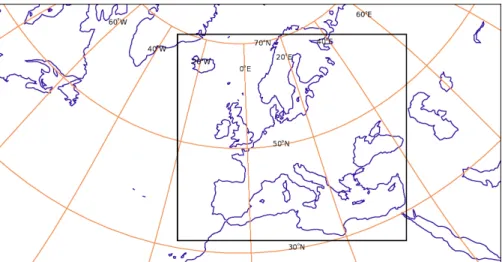
The downscaled region covers western Europe and the eastern North Atlantic
(here-after referred to as the “WEuro” region), and is shown in Fig. 1. The 0.22◦ MetUM grid
uses a rotated pole at a longitude of 177.5◦ and latitude 37.5◦ so that the grid spacing
does not vary substantially over the domain1. To drive the 0.22◦MetUM, lateral
bound-15
ary and initial conditions for the WEuro domain are generated from the ERA Interim
6 hourly analyses. The 0.22◦MetUM is initialised each day using the 18Z reconfigured
ERA Interim analyses and a 30 h forecast is performed. The first six hours are disre-garded due to spin up, allowing the model to adjust from the ECMWF IFS (the EMCWF Integrated Forecast System, ECMWF, 2006) initial conditions. This results in daily 24 h
20
forecasts for the full period. By combining the daily forecasts a new, higher resolution data set is created.
1
NHESSD
2, 2011–2048, 2014The XWS catalogue
J. F. Roberts et al.
Title Page
Abstract Introduction
Conclusions References
Tables Figures
◭ ◮
◭ ◮
Back Close
Full Screen / Esc
Printer-friendly Version Interactive Discussion
Discussion
P
a
per
|
D
iscussion
P
a
per
|
Discussion
P
a
per
|
Discuss
ion
P
a
per
|
2.2.2 Creating the windstorm footprints
For this catalogue the footprint of a windstorm is defined as the maximum three-second gust at each grid point over a 72 h period during which the storm passes through the do-main. The three-second gust has been shown to have a robust relationship with storm damage (Klawa and Ulbrich, 2003), and is commonly used in catastrophe models
cur-5
rently used by the insurance industry. The 72 h period was chosen because again it is commonly used in the insurance industry (Haylock, 2011), and although lifetimes of windstorm can be longer than 72 h it is rare that the damaging winds associated with a windstorm last longer than this.
Maximum three-second gusts at a height of 10 m, which output every 6 h and give the
10
maximum gust achieved over the preceding 6 h period, from the 0.22◦MetUM dataset
are used to create the footprints. In the MetUM the gusts,Ugust, are estimated by finding
the value at which the normalised maximum gust, (Ugust−U10 m)/σ (whereU10 mis the
10 m wind speed andσ is the standard deviation of the horizontal wind), has a 25 %
exceedance probability, i.e. P((Ugust−U10 m)/σ)> C)=0.25, giving Ugust=U10 m+Cσ
15
(Beljaars, 1987). Cis estimated from the universal turbulence spectra, and σ is
esti-mated from the friction velocity using the similarity relation of Panofsky et al. (1977). Footprints were created for each of the 5730 storms identified by the tracking algo-rithm applied to ERA Interim (1979–2012; see Sect. 2.1). The 72 h period over which the maximum gusts were taken was centred on the time which the tracking algorithm
20
identified as having the maximum 925 hPa wind speed over land2within a 3◦ radius of
the track centre. This was done to ensure that the 72 h period of the footprint captured the storm at its most damaging phase.
2
Land on the ERA Interim grid in the European domain defined by 15◦W to 25◦E and 35◦N to 70◦N, excluding Iceland.
NHESSD
2, 2011–2048, 2014The XWS catalogue
J. F. Roberts et al.
Title Page
Abstract Introduction
Conclusions References
Tables Figures
◭ ◮
◭ ◮
Back Close
Full Screen / Esc
Printer-friendly Version Interactive Discussion
Discussion
P
a
per
|
D
iscussion
P
a
per
|
Discussion
P
a
per
|
Discuss
ion
P
a
per
|
2.2.3 Footprint contamination
The European extratropical cyclones identified by the tracking algorithm are relatively frequent events. Over the 33 extended winters that have been tracked, on average 2.5 events pass through the domain in any given 72 h period. Furthermore, extra-tropical cyclones exhibit temporal clustering (Mailier et al., 2006), which could result in days
5
with even more storms. The highest number of storms passing through in a single 72 h period is 8, for the period starting at 00Z on 6 February 1985.
Footprints are therefore likely to include gusts from two or more windstorms. This can create problems when trying to attribute damage to a particular windstorm. To attempt to isolate the footprint to a particular windstorm, all the gusts within a 1000 km
10
radius3 of the track position at each 6 h timestep are assumed to be associated with
that particular windstorm and all other data is rejected. The “decontaminated” footprint is then derived by taking the maximum of these gusts within the 72 h period of the windstorm.
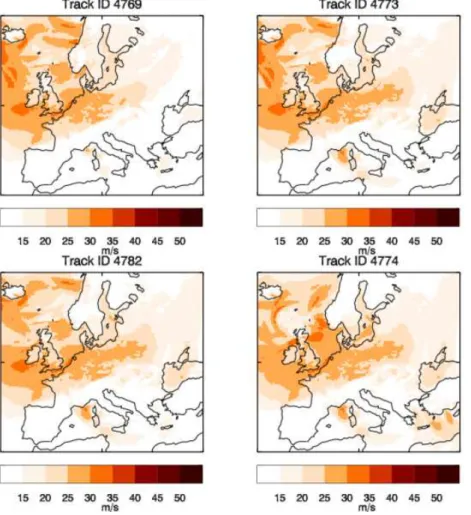
Figure 2 shows the footprints for windstorms with track IDs 4769, 4773, 4782, 4774,
15
centred on times 15Z 17 January 2007, 06Z 18 January 2007, 15Z 18 January 2007 and 18Z 19 January 2007 respectively, derived by taking maximum gusts over the whole domain (the contaminated footprints). The footprints are almost indistinguish-able, and are dominated by one large event. Figure 3 shows the footprints for the same windstorms, but created using the decontamination method described above. The new
20
footprints show that storm 4769 was in fact a very weak event over southern France and the Mediterranean Sea, storms 4773 and 4774 are northern storms which did not make much impact on land, and the dominant event is storm 4782, centred on 15Z 18 January 2007, which is the famous storm Kyrill (January 2007).
3
NHESSD
2, 2011–2048, 2014The XWS catalogue
J. F. Roberts et al.
Title Page
Abstract Introduction
Conclusions References
Tables Figures
◭ ◮
◭ ◮
Back Close
Full Screen / Esc
Printer-friendly Version Interactive Discussion
Discussion
P
a
per
|
D
iscussion
P
a
per
|
Discussion
P
a
per
|
Discuss
ion
P
a
per
|
The uncontaminated footprints are used for the calculation of the storm severity in-dices (see Sect. 3), although in the catalogue both the contaminated and uncontami-nated footprints are available.
3 How to select extreme windstorms
Fifty of the most extreme storms of the 5730 identified by the tracking algorithm
5
(Sect. 2.1) have been selected for the XWS catalogue. The challenge when select-ing these storms was definselect-ing an “extreme storm”. A storm can be defined as extreme in many ways, for example in terms of a meteorological index, or extreme values of in-sured losses i.e. a severe event (Stephenson, 2008). Note that here severity is defined in terms of total insurance loss, however other measures are possible such as
hu-10
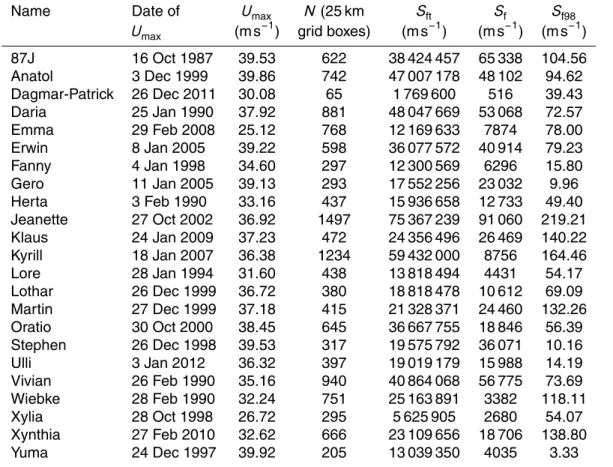
man mortality, ecosystem damage, etc. The aim here was to find an optimal objective meteorological index that selects storms that were both meteorologically extreme and severe. Expert elicitation with individuals in the insurance industry led to the identifica-tion of 23 severe storms in the period 1979–2012 (Table 1) which would be expected to be included if considering insured loss only. The most successful meteorological index
15
is considered to be the one that ranks most of these 23 severe as extreme (defined as category C storms in Sect. 3.2, Fig. 4a).
3.1 Possible meteorological indices
Meteorological indices from both the track and footprint of the storm were investigated.
These indices included the maximum intensity of the storm (Umax), defined as the
max-20
imum 925 hPa wind speed over continental European and Scandinavian land within
a 3◦radius of the cyclone track. Radii of 6◦and 10◦were considered, both resulting in
a slightly poorer performance by the index (fewer storms in category C). The size of the
storm (N) was also considered, defined as the area of the (uncontaminated) footprint
that exceeds 25 m s−1over continental European and Scandinavian land. A threshold
25
NHESSD
2, 2011–2048, 2014The XWS catalogue
J. F. Roberts et al.
Title Page
Abstract Introduction
Conclusions References
Tables Figures
◭ ◮
◭ ◮
Back Close
Full Screen / Esc
Printer-friendly Version Interactive Discussion
Discussion
P
a
per
|
D
iscussion
P
a
per
|
Discussion
P
a
per
|
Discuss
ion
P
a
per
|
of 25 m s−1 was used as it is recognised as being the wind speed at which damage
starts to occur. In Lamb (1991) it was noted that wind speeds of 38–44 knots (19.5–
22.6 m s−1) damage chimney pots and branches of trees and wind speeds of 45–52
knots (23.1–26.8 m s−1) uproot trees and cause severe damage to buildings.
IndicesUmaxandN can be combined to form a storm severity index (SSI). Numerous
5
SSIs have been developed with their uses ranging from the estimation of the return period of windstorms over Europe (Della-Marta et al., 2009) to understanding how windstorms will change under anthropogenic climate change (Leckebusch et al., 2008). An SSI was used to rank the storms in the catalogue of extreme storms over the North Sea, British Isles and Northwest Europe by Lamb (1991). The SSI used by Lamb (1991)
10
is based on the greatest observed wind speed over land (Vmax), the area affected by
damaging winds (A) and the overall duration of occurrence of damaging winds (D).
Damaging winds were defined as those in excess of 50 knots (25.7 m s−1):
SLamb=Vmax3 AD.
The cube of the wind speed is a measure of the advection of kinetic energy and is used
15
to model wind power and damage (Lamb, 1991, p. 7). A similar SSI can be derived by
combining the track indexUmax3 (intensity) and footprint indexN (area) and assuming
that the duration of all storms is 72 h in accordance with the insurance industry defini-tion of an event (Haylock, 2011):
Sft=Umax3 N.
20
Alternatively the intensity of a storm can be approximated from the footprint rather than the track, as the mean of the excess gust speed cubed at grid points over
Eu-ropean and Scandinavian land. Combining with indexN, this gives an SSI calculated
from the footprint only:
Sf=
1
N
X
land,ui>25
(ui−25)3
N=
X
land,ui>25
(ui−25)3,
NHESSD
2, 2011–2048, 2014The XWS catalogue
J. F. Roberts et al.
Title Page
Abstract Introduction
Conclusions References
Tables Figures
◭ ◮
◭ ◮
Back Close
Full Screen / Esc
Printer-friendly Version Interactive Discussion
Discussion
P
a
per
|
D
iscussion
P
a
per
|
Discussion
P
a
per
|
Discuss
ion
P
a
per
|
where ui is the maximum gust at grid point i in the footprint. A relative local 98th
percentile threshold can be used as an alternative to the fixed threshold, as in Klawa and Ulbrich (2003). This threshold implies that at any location storm damages are assumed to occur on 2 % of all days. This adaptation to wind climate can also be
expected to affect the degree to which damage increases with growing wind speed in
5
excess of the threshold value, hence the normalised rather than absolute winds are used. In Klawa and Ulbrich (2003) weather station data are used, but an equivalent SSI can be calculated from the footprint to quantify the advantage of using a relative threshold when predicting severity:
Sf98= X land,ui>u98,i
u
i u98,i
−1 3
, (1)
10
whereu98,i is the 98 % quantile of maximum gust speeds during the reference period
(October–March, 1979–2012) at grid pointi. In Klawa and Ulbrich (2003) the summand
in Eq. (1) is multiplied by population density to calculate a loss index, but here the aim is to find a purely meteorological index for storm severity.
3.2 Results
15
The indices presented in Fig. 5 are related to one another. A positive association exists
betweenUmax and N and betweenSft and Sf98.Sft has a stronger dependence on N
thanUmax and the strongest extremal dependence exists between Sft and N. The 23
most severe storms are in the top 18 %, 7 %, 5 %, 10 % and 16 % of storms when
ranked according toUmax, N,Sft,Sf (not shown) andSf98 respectively, hence severe
20
storms are best characterised by a high value ofSft(Fig. 5e–h).
The catalogue will comprise of the 23 severe storms and 27 storms which are ex-treme in the optimal meteorological index. The intercept of the number of the 23 severe
storms in the top K storms andy=x−27 identifies the number of storms in category
C such that 50 storms are selected for the catalogue (Fig. 4b). Umax, N, Sft, Sf and
25
NHESSD
2, 2011–2048, 2014The XWS catalogue
J. F. Roberts et al.
Title Page
Abstract Introduction
Conclusions References
Tables Figures
◭ ◮
◭ ◮
Back Close
Full Screen / Esc
Printer-friendly Version Interactive Discussion
Discussion
P
a
per
|
D
iscussion
P
a
per
|
Discussion
P
a
per
|
Discuss
ion
P
a
per
|
Sf98 give 15, 15, 17, 10 and 13 storms in category C respectively (Table 2). The use
of the relative threshold indexSf98 results in more storms in category C than the fixed
threshold equivalent,Sf. The index Sft, however, maximises the number of storms in
category C and therefore is the most successful index at identifying both meteorologi-cally extreme and severe storms.
5
The location of the 50 storms selected by Umax,N and Sft are broadly similar,
con-centrated around the UK and Northern Europe (Fig. 6a–c). These are Atlantic storms
which are strong and well represented in the reanalysis data. IndicesSf andSf98
se-lect very similarly located storms (Fig. 6d). They both sese-lect “meteorologically extreme and not severe” (category B) storms that are located in the Mediterranean which are
10
generally weaker and less well represented by the reanalysis data due to their small
scale (Cavicchia et al., 2013). Of the 27 category B storms selected bySft, 10 are also
selected byUmax, 9 byN and 4 by bothUmaxandN, demonstrating thatSftselects an
almost even combination of large area and intense wind speed storms.
IndicesUmax,N,Sft,Sf (not shown) andSf98select events from 29, 26, 27, 30 and
15
30 yr out of the 33 yr period 1979–2012 respectively, hence all indices represent the period spanned by the XWS catalogue well (Fig. 7). A similar trend exists within the time series for all 5 indices, with more storms selected in the period 1985–1995 and fewer in the period 2000–2010 (Fig. 7).
In summary the indexSft is the most successful index at identifying severe storms.
20
It depends on both the area and maximum wind speed intensity of the storm. The
indexSftselects storms located over the UK and Northern Europe and samples storms
over the full time period of the XWS catalogue, hence giving a good representation of the meteorologically extreme and severe Atlantic storms that occurred throughout the
period. For these reasonsSftis the meteorological index used to select the 50 storms
25
NHESSD
2, 2011–2048, 2014The XWS catalogue
J. F. Roberts et al.
Title Page
Abstract Introduction
Conclusions References
Tables Figures
◭ ◮
◭ ◮
Back Close
Full Screen / Esc
Printer-friendly Version Interactive Discussion
Discussion
P
a
per
|
D
iscussion
P
a
per
|
Discussion
P
a
per
|
Discuss
ion
P
a
per
|
4 Evaluation of MetUM windstorm footprints
Observational data were extracted from the MIDAS database. For each of the selected storms, all stations roughly within the WEuro domain which recorded maximum gusts during the 72 h period were used to evaluate the MetUM windstorm footprints. The gust data were a mixture of 1, 3 and 6 hourly maximum gusts.
5
Example observational footprints for the storms Jeanette (October 2002) and Kyrill (January 2007) are shown in Fig. 8a and d. The observational footprints are defined in the same way as the model footprints, plotting the maximum gust over the same 72 h period, but instead of a gridded map they show the maximum gust recorded at the locations of each station. A quick inspection of the footprints shows that the model
10
and observations agree on the on the regions where the high gusts occur, although
it is difficult to confirm the exact affected region given the irregular locations of the
observations.
Figure 8c and f shows scatter plots of model maximum gusts against observed max-imum gusts for all of the stations in the observational footprint for each storm. The
15
MetUM maximum gusts for each specific station location were calculated using bilinear interpolation between grid points.
The scatter plots show that the gusts are scattered about they=xline, meaning that
in general the model gusts are in agreement with the observations. This result is espe-cially impressive when considering that the model gusts have simply been interpolated
20
from a∼25 km grid to a specific location without applying any corrections. For the 50
storms in the catalogue, the mean root mean square (RMS) error in the model gusts
is 5.7 m s−1(for stations at altitudes less than 500 m, and removing gusts for which the
observations read 0 m s−1which are believed to be erroneous).
However, two problems with the model are apparent from these scatter plots:
25
– For all storms there is a more dispersed population separate from the general
population, below the y=x line. It was found that these points are mostly from
stations with altitudes greater than∼500 m (plotted in red).
NHESSD
2, 2011–2048, 2014The XWS catalogue
J. F. Roberts et al.
Title Page
Abstract Introduction
Conclusions References
Tables Figures
◭ ◮
◭ ◮
Back Close
Full Screen / Esc
Printer-friendly Version Interactive Discussion
Discussion
P
a
per
|
D
iscussion
P
a
per
|
Discussion
P
a
per
|
Discuss
ion
P
a
per
|
– For a number of storms the plots of model vs. observed gusts appears to
de-viate from the y=x line, flattening offfor observed gust speeds of greater than
∼25 m s−1, showing that the model is underpredicting extreme gusts. In Fig. 8
this can be seen for the storm Kyrill, although the problem is not so severe for the storm Jeanette.
5
The first issue has been noted previously, and is a common issue with climate and numerical weather prediction models (e.g. Donat et al., 2010; Howard and Clark, 2007).
It is caused by the use of an effective roughness parametrisation, which is needed to
estimate the effect of sub-grid scale orography on the synoptic scale flow, however it
causes unrealistically slow wind (and hence gust) speeds at 10 m.
10
In Howard and Clark (2007) a method was proposed to correct for this effect, by
estimating a reference height,href, above which the wind speeds are unaffected by the
surface, and then assuming a log-profile to interpolate wind speeds back down to 10 m,
using the local vegetative roughness,z0, rather than the effective roughness.
In this model only wind speeds on seven model levels were archived which means
15
the estimation of wind speeds athref could be subject to large errors. Nevertheless,
applying the correction to the storm Kyrill gave a clear improvement to the maximum 10 m winds for high altitude locations, although the underestimation of extreme gust
at lower altitudes remained (plot not shown). For this calculation href was estimated
from orographic data at the resolution of the MetUM, but it is possible to estimatehref
20
from finer resolution data (as was done in Howard and Clark, 2007), which may further improve the correction.
It would be desirable to apply this correction to all of the storms in the catalogue, although the extraction of the archived data on all model levels is a time consuming and costly process and cannot be done at present. Instead, altitude is used as a covariate
25
NHESSD
2, 2011–2048, 2014The XWS catalogue
J. F. Roberts et al.
Title Page
Abstract Introduction
Conclusions References
Tables Figures
◭ ◮
◭ ◮
Back Close
Full Screen / Esc
Printer-friendly Version Interactive Discussion
Discussion
P
a
per
|
D
iscussion
P
a
per
|
Discussion
P
a
per
|
Discuss
ion
P
a
per
|
4.1 Underprediction of high gusts for low altitude stations
Possible reasons for the underprediction of high gusts for low altitude stations de-scribed above include (i) the gust parameterisation scheme used, and (ii) whether the model can reproduce the strong pressure gradients. It is unlikely that the underpre-diction is dependent on the storms’ locations because the storms Jeanette and Kyrill
5
passed through similar areas and have very similar observational footprints, yet Fig. 8g shows that the underforecasting in Kyrill is much more pronounced.
Regarding point (i), Born et al. (2012) show that different parameterisation schemes
can sometimes lead to differences of up to 10–20 m s−1in the estimated gust at a
par-ticular site. If this is the cause of the underforecasting one would expect the 10 m winds
10
from which the gusts are derived not to show this problem.
To test this, Fig. 9 shows a scatter plot of the model error in the maximum gusts
against the model error in the maximum 10 m 10 min mean winds4 at stations which
recorded both these measures for the storm Kyrill. The stations which recorded gusts
greater than 25 m s−1(which is approximately when the model begins to systematically
15
underpredict the gusts for this storm) are highlighted in red. All points lie approximately
on they =xline, and the behaviour of the gusts>25 m s−1is similar to that of gusts≤
25 m s−1. The correlation coefficient,r, is 0.57 for stations which recorded gusts greater
than 25 m s−1. This strong relationship indicates that the underlying problem is with the
10 m winds rather than the gust parametrisation itself.
20
4
For the observations the maximum 10 min mean winds are the maximum of the instan-taneous 10 min mean winds which are recorded every 1, 3, or 6 h depending on the station. The model maximum wind speeds are the maximum of the instantaneous 10 m wind speeds which are output every 6 h. Since the model timestep is 10 min, the model wind speeds should be comparable to the 10 min mean observed wind speeds. The true maximum wind speeds of both the observations and model may be underestimated, but given the strong correlation between error in maximum gusts and error in maximum wind speeds this does not appear to be significant.
NHESSD
2, 2011–2048, 2014The XWS catalogue
J. F. Roberts et al.
Title Page
Abstract Introduction
Conclusions References
Tables Figures
◭ ◮
◭ ◮
Back Close
Full Screen / Esc
Printer-friendly Version Interactive Discussion
Discussion
P
a
per
|
D
iscussion
P
a
per
|
Discussion
P
a
per
|
Discuss
ion
P
a
per
|
To investigate whether the underprediction of gusts is due to the underestimation of strong pressure gradients for some storms (point ii), the observed and modelled minimum MSLP for the storm Kyrill were compared. Figure 10a shows the observed minimum MSLP (over the same 72 h period over which the maximum gusts) recorded at all stations where data was available. The minimum MSLP from the model over the
5
same period is shown in Fig. 10b.
These plots show that Kyrill deepened earlier (further west) than the model predicted, and so the depth of the minimum MSLP over Ireland, the UK and Denmark is underes-timated. A possible reason for this is that the western boundary of the WEuro domain is too far east to capture the early stages of this storm well. If the storm develops outside
10
the western boundary, when it enters the domain the 0.22◦MetUM is only being driven
at the boundaries, so it may not simulate a low as extreme as in the reanalysis data. When the MetUM is reinitialised (every 24 h) with the storm already within the domain it then has the initial conditions to develop into an extreme event. This is expected to be more of a problem for rapidly moving storms which can travel quite far into the domain
15
before reinitialisation. The observational footprint of Kyrill shown in Fig. 8 shows that many of the strongest gusts recorded for this storm were just to the south of the re-gions where the model failed to reproduce the depth of the central MSLP, i.e. in rere-gions where the model pressure gradients would be underestimated.
Figure 10c shows the maximum model geostrophic winds against maximum
ob-20
served geostrophic winds5for the locations of the stations with altitude≤500 m which
recorded gusts for this storm. The geostrophic winds corresponding to the locations
of the stations which recorded gusts>25 m s−1 are highlighted. This plot shows that
for the locations where strong gusts were recorded, a higher proportion (85 %) of the
5
For Fig. 10c, the observed geostrophic winds were estimated by reconstructing the ob-served 6 hourly mean sea level pressure field by bilinearly interpolating MSLP station record-ings. The instantaneous geostrophic winds could then be estimated from∂P/∂xand∂P/∂y
NHESSD
2, 2011–2048, 2014The XWS catalogue
J. F. Roberts et al.
Title Page
Abstract Introduction
Conclusions References
Tables Figures
◭ ◮
◭ ◮
Back Close
Full Screen / Esc
Printer-friendly Version Interactive Discussion
Discussion
P
a
per
|
D
iscussion
P
a
per
|
Discussion
P
a
per
|
Discuss
ion
P
a
per
|
geostrophic winds were underestimated compared to the locations which had gusts
≤25 m s−1 (67 %). For comparison Fig. 10d shows the maximum model geostrophic
winds against maximum observed geostrophic winds for Jeanette, where unlike for Kyrill the model reproduces the tight pressure gradients and high geostrophic winds.
We conclude that the underestimation of strong gusts (>25 m s−1) apparent in some
5
storms is due to the underprediction of the geostrophic component of gusts, resulting from the underestimation of the central pressure depth and strong pressure gradients. It would not make sense to apply a “universal” correction to all storms, since the problem varies from storm to storm. The recalibration method described below (Sect. 5) takes into account storm-to-storm variation.
10
5 Footprint recalibration
This section introduces a statistical method for “recalibrating” wind storm footprints, where recalibration describes estimating the true distribution of wind gusts, given the
0.22◦MetUM output. The proposed method is based on polynomial regression between
transformed gust speeds: the response variable represents station observations and
15
the explanatory variable the MetUM output. All station data within the footprint’s do-main are used, ranging between storms from 154 to 1224 stations, depending on data
availability. Gusts above 20 m s−1are recalibrated. Where MetUM gusts do not exceed
20 m s−1, the recalibrated footprint uses the original MetUM output. By assuming that
the observations are representative of the true gusts, the regression relationship gives
20
an estimate of the distribution of true gusts given the MetUM’s output.
A random effects model (Pinheiro and Bates, 2000) is used to allow multiple wind
storm footprints to be recalibrated simultaneously, which is achieved by associating
a separate random effect with each storm. This model is based on an underlying
polynomial relationship between observed and MetUM-simulated gusts, from which
25
storm-specific relationships deviate according to some distributional assumptions and
location-specific covariates. The random effects capture unmodelled differences
NHESSD
2, 2011–2048, 2014The XWS catalogue
J. F. Roberts et al.
Title Page
Abstract Introduction
Conclusions References
Tables Figures
◭ ◮
◭ ◮
Back Close
Full Screen / Esc
Printer-friendly Version Interactive Discussion
Discussion
P
a
per
|
D
iscussion
P
a
per
|
Discussion
P
a
per
|
Discuss
ion
P
a
per
|
tween storms, one example being whether a storm has a sting jet (Browning, 2004). Not only does this allow a specific storm’s footprint to be recalibrated, but storms
with-out observational data can too, by integrating with-out the random effects, though this latter
feature is not utilised here.
5.1 Statistical model specification
5
The notation adopted is that Yj(s) is the observed maximum gust for storm j, j=
1,. . .,J, at location s, andXj(s) is the corresponding MetUM output, noting that only
Xj(s)>20 m s−1 are modelled. Gusts are log-transformed. The random effects model
then has the formulation
logYj(s)∼N
mj(logXj(s),z(s)),σ2
,
10
wherez(s) is a vector of known covariates for locations, andσ2is a variance
param-eter. This assumes that for storm j, log observed gusts are normally distributed with
meanmj, which is a function of MetUM gust, location and elevation, and varianceσ2.
The mean,mj(logXj(s),z(s)), has the linear form
2 X
k=0
βk+bj,k+zT(s)(γk+cj,k)
{logXj(s)}k
15
where (bj,0,bj,1,bj,2)T∼MVN(0, 0, 0)T,Σb, (where MVN means multi-variate normal
distribution),(cj,0,cj,1,cj,2)T∼MVN
(0,. . ., 0)T,Σc,β0,β1,β2,γ0,γ1 andγ2 are
re-gression coefficients and Σb and Σc are covariance matrices. Maximum likelihood is
used to estimateβ0,β1,β2,γ0,γ1,γ2,σ2,Σb, andΣγ.
LetzT(s)=(elevation(s), lon(s), lat(s), lon(s)lat(s)) (where lon(s) and lat(s) represent
20
NHESSD
2, 2011–2048, 2014The XWS catalogue
J. F. Roberts et al.
Title Page
Abstract Introduction
Conclusions References
Tables Figures
◭ ◮
◭ ◮
Back Close
Full Screen / Esc
Printer-friendly Version Interactive Discussion
Discussion
P
a
per
|
D
iscussion
P
a
per
|
Discussion
P
a
per
|
Discuss
ion
P
a
per
|
so that γk=(γelev,k,γlon,k,γlat,k,γlon:lat,k)T for k=0, 1, 2. This formulation allows the
mean relationship to vary with elevation and location in a sufficiently robust way.
Var-ious combinations of the included covariates were tested, though those used in the presented model were found to perform best based on the Akaike Information Crite-rion. However, more complex relationships could be captured with covariates related
5
to pressure fields or coastal proximity. Due to insufficient data, and the desire for
parsi-mony, these were not tested here.
Parameter estimates (excluding those ofΣband Σc) are shown in Table 3 together
with standard errors. Figure 11 shows the resulting recalibrated footprints for the storms Jeanette and Kyrill. Column 1 of Fig. 11 shows that the recalibrated gusts are more
10
consistent with the observations than originally simulated by the MetUM, which are in general negatively biased (column 3), though predictions are accompanied by rela-tively large uncertainty (prediction intervals, column 1; columns 4 and 5). The example mean relationships, for a station located in London, between MetUM and observed gust plotted in Column 1 of Fig. 11 (solid lines) show that for the storm Kyrill, where the
15
MetUM gusts were significantly underestimated, the mean increases abovey =x line
for MetUM gusts of∼25 m s−1, so recalibration results in an increase in gust speed.
For Jeanette the MetUM gusts compared better to observations, so the mean lies close
to they=x line and even shows a slight decrease for high MetUM gusts. This shows
the importance of including storm-to-storm variation when recalibrating footprints.
20
The choice of threshold above which to recalibrate the MetUM’s gusts is arbitrary;
20 m s−1 was chosen here as it retained sufficient data to give a reliable statistical
model, while ensuring that gusts were “extreme”. To improve consistency between the
raw and recalibrated footprints at the 20 m s−1 threshold, non-exceedances are also
used in model estimation, but downweighted exponentially according to the deficit
be-25
tween MetUM-simulated gusts and 20 m s−1. However, little appreciable difference in
predictions was found for thresholds in the range 15–25 m s−1.
NHESSD
2, 2011–2048, 2014The XWS catalogue
J. F. Roberts et al.
Title Page
Abstract Introduction
Conclusions References
Tables Figures
◭ ◮
◭ ◮
Back Close
Full Screen / Esc
Printer-friendly Version Interactive Discussion
Discussion
P
a
per
|
D
iscussion
P
a
per
|
Discussion
P
a
per
|
Discuss
ion
P
a
per
|
6 Conclusions
We have compiled a catalogue of 50 of the most extreme winter storms to have hit Europe over the period October–March 1979–2012, available at www. europeanwindstorms.org. The catalogue gives tracks, model generated maximum three-second gust footprints and recalibrated footprints for each storm.
5
The tracking algorithm used was that of Hodges (1995, 1999), which identified 5730 storms in the catalogue period. To select the storms for the catalogue several
meteoro-logical indices were investigated. It was found that the indexSft, which depends on both
storm area and intensity, was the most successful at characterising 23 severe storms highlighted by the insurance industry. The 50 storms chosen for the catalogue are the
10
23 severe storms plus the top 27 other storms as ranked bySft. Using an index with
a relative threshold would result in more Mediterranean storms being selected, which are not the focus of this catalogue.
The severe storms ranked highly (in the top 18 %) in all meteorological indices inves-tigated. The choice of index is sensitive to the given list of severe storms, which may
15
be biased or incomplete. If loss data were available for many storms this may improve the comparison of the indices.
The model used to generate the storm footprints is the Met Office Unified Model
(MetUM) at 0.22◦resolution. The MetUM footprints compare reasonably well to
obser-vations, although for some storms the highest gusts are underestimated. For the storm
20
Kyrill (January 2007) this is because the MetUM underestimates the strong pressure
gradients of the storm, which is possibly an effect of the western domain boundary
being close to continental Europe. The MetUM footprints have large errors for gusts at altitudes greater than 500 m due to the orographic drag scheme. A correction can be applied for this, but it has not been applied in this version of the catalogue.
25
NHESSD
2, 2011–2048, 2014The XWS catalogue
J. F. Roberts et al.
Title Page
Abstract Introduction
Conclusions References
Tables Figures
◭ ◮
◭ ◮
Back Close
Full Screen / Esc
Printer-friendly Version Interactive Discussion
Discussion
P
a
per
|
D
iscussion
P
a
per
|
Discussion
P
a
per
|
Discuss
ion
P
a
per
|
all storms suffer the same biases. The method gives an estimate of the true distribution
of gusts at each MetUM grid point, therefore also quantifying the uncertainty in gusts. We intend to update the catalogue yearly to include recent events. Possible future plans include extending the catalogue back in time by performing tracking and down-scaling to the 20th century reanalysis dataset (Compo et al., 2011), and including tracks
5
and footprints derived from different tracking algorithms and atmospheric models.
Fur-ther improvements to the recalibration include recognition of spatial features of the windstorms, using Gaussian process kriging methods, and using high resolution alti-tude data as a way to statistically downscale the footprints.
Acknowledgements. We wish to thank the Willis Research Network for funding BY, and
Ange-10
lika Werner at Wilis Re for her enthusiastic support and ideas. JFR would like to thank Jessica Standen for her help and advice using the 0.22◦ MetUM data, and Joaquim Pinto for useful discussions on historical windstorm event sets. DBS wishes to thank the Centre for Business and Climate Solutions at the U. of Exter for partial support of his time on this project. JFR and HET were supported by the Met Office, who would like to acknowledge the financial support
15
from the Lighthill Risk Network for this project. LD was supported by the Natural Environment Research Council (Consortium on Risk in the Environment: Diagnostics, Integration, Bench-marking, Learning and Elicitation (CREDIBLE project); NE/J017043/1). LS was funded by the NERC TEMPEST project and AC was funded by the National Centre for Atmospheric Science.
References
20
Beljaars, A. C. M.: The influence of sampling and filtering on measured wind gusts, J. Atmos. Ocean. Tech., 4, 613–626, 1987. 2017
Bessemoulin, P.: Les têmpetes en France, Ann. Mines, 9–14, 2002. 2013
Born, K., Ludwig, P., and Pinto, J. G.: Wind gust estimation for Mid-European winter storms: to-wards a probabilistic view, Tellus A, 64, 17471, doi:10.3402/tellusa.v64i0.17471, 2012. 2025
25
Browning, K. A.: The sting at the end of the tail: damaging winds associated with extratropical cyclones, Q. J. Roy. Meteor. Soc., 130, 375–399, 2004. 2028
Cavicchia, L., von Storch, H., and Gualdi, S.: A long-term climatology of medicanes, Clim. Dynam., 1–13, doi:10.1007/s00382-011-1220-0, 2013. 2022
NHESSD
2, 2011–2048, 2014The XWS catalogue
J. F. Roberts et al.
Title Page
Abstract Introduction
Conclusions References
Tables Figures
◭ ◮
◭ ◮
Back Close
Full Screen / Esc
Printer-friendly Version Interactive Discussion
Discussion
P
a
per
|
D
iscussion
P
a
per
|
Discussion
P
a
per
|
Discuss
ion
P
a
per
|
Compo, G. P., Whitaker, J. S., Sardeshmukh, P. D., Matsui, N., Allan, R. J., Yin, X., Glea-son, B. E., Vose, R. S., Rutledge, G., Bessemoulin, P., Brönnimann, S., Brunet, M., Crouthamel, R. I., Grant, A. N., Groisman, P. Y., Jones, P. D., Kruk, M. C., Kruger, A. C., Marshall, G. J., Maugeri, M., Mok, H. Y., Nordli, O., Ross, T. F., Trigo, R. M., Wang, X. L., Woodruff, S. D., and Worley, S. J.: The Twentieth Century Reanalysis Project, Q. J. Roy.
5
Meteor. Soc., 137, 1–28, 2011. 2031
Davies, T., Cullen, M. J. P., Malcolm, A. J., Mawson, M. H., Staniforth, A., White, A. A., and Wood, N.: A new dynamical core for the Met Office’s global and regional modelling of the atmosphere, Q. J. Roy. Meteor. Soc., 131, 1759–1782, 2005. 2016
Dee, D. P., Uppala, S. M., Simmons, A. J., Berrisford, P., Poli, P., Kobayashi, S., Andrae, U.,
10
Balmaseda, M. A., Balsamo, G., Bauer, P., Bechtold, P., Beljaars, A. C. M., van de Berg, L., Bidlot, J., Bormann, N., Delsol, C., Dragani, R., Fuentes, M., Geer, A. J., Haimberger, L., Healy, S. B., Hersbach, H., Hólm, E. V., Isaksen, L., Kållberg, P., Köhler, M., Matricardi, M., McNally, A. P., Monge-Sanz, B. M., Morcrette, J. J., Park, B. K., Peubey, C., de Rosnay, P., Tavolato, C., Thépaut, J. N., and Vitart, F.: The ERA Interim reanalysis: configuration and
15
performance of the data assimilation system, Q. J. Roy. Meteor. Soc., 137, 553–597, 2011. 2015
Della-Marta, P. M., Mathis, H., Frei, C., Liniger, M. A., Kleinn, J., and Appenzeller, C.: The return period of wind storms over Europe, Int. J. Climatol., 29, 437–459, 2009. 2013, 2020
Donat, M. G., Leckebusch, G. C., Wild, S., and Ulbrich, U.: Benefits and limitations of regional
20
multi-model ensembles for storm loss estimations, Clim. Res., 44, 211–225, 2010. 2024 ECMWF: IFS documentation – Cy31r1 operational implementation, Tech. rep., ECMWF,
avail-able at: http://www.ecmwf.int/research/ifsdocs/CY31r1, 2006. 2016
Haylock, M. R.: European extra-tropical storm damage risk from a multi-model ensemble of dynamically-downscaled global climate models, Nat. Hazards Earth Syst. Sci., 11, 2847–
25
2857, doi:10.5194/nhess-11-2847-2011, 2011. 2017, 2020
Hodges, K. I.: Feature tracking on the unit sphere, Mon. Weather Rev., 123, 3458–3465, 1995. 2014, 2015, 2030
Hodges, K. I.: Adaptive constraints for feature tracking, Mon. Weather Rev., 127, 1362–1373, 1999. 2014, 2015, 2030
30
NHESSD
2, 2011–2048, 2014The XWS catalogue
J. F. Roberts et al.
Title Page
Abstract Introduction
Conclusions References
Tables Figures
◭ ◮
◭ ◮
Back Close
Full Screen / Esc
Printer-friendly Version Interactive Discussion
Discussion
P
a
per
|
D
iscussion
P
a
per
|
Discussion
P
a
per
|
Discuss
ion
P
a
per
|
Hoskins, B. J. and Hodges, K. I.: New perspectives on the northern hemisphere winter storm tracks, J. Atmos. Sci., 59, 1041–1061, 2002. 2015
Howard, T. and Clark, P.: Correction and downscaling of NWP wind speed forecasts, Meteorol. Appl., 14, 105–116, 2007. 2024
Klawa, M. and Ulbrich, U.: A model for the estimation of storm losses and the
identifi-5
cation of severe winter storms in Germany, Nat. Hazards Earth Syst. Sci., 3, 725–732, doi:10.5194/nhess-3-725-2003, 2003. 2017, 2021
Lamb, H. H.: Historic Storms of the North Sea, British Isles and Northwest Europe, Cambridge University Press, 1991. 2013, 2020
Landsea, C. W., Anderson, C., Charles, N., Clark, G., and Dunion, J.: The Atlantic hurricane
10
database reanalysis project: documentation for 1851–1910 alterations and additions to the HURDAT Database, in: Hurricanes and Typhoons: Past, Present and Future, edited by: Mur-nane, R. J. and Liu, K.-B., Columbia University Press, 2004. 2013
Leckebusch, G., Renggli, D., and Ulbrich, U.: Development and application of an objective storm severity measure for the Northeast Atlantic region, Meteorol. Z., 17, 575–587, 2008. 2020
15
Levinson, D. H., Diamond, H. J., Knapp, K. R., Kruk, M. C., and Gibney, E. J.: Toward a ho-mogenous global tropical cyclone best-track dataset, B. Am. Meteorol. Soc., 91, 377–380, 2010. 2013
Mailier, P. J., Stephenson, D. B., Ferro, C. A. T., and Hodges, K. I.: Serial clustering of extrat-ropical cyclones, Mon. Weather Rev., 134, 2224–2240, 2006. 2018
20
Manganello, J., Hodges, K. I., Kinter-III, J. L., Cash, B. A., Marx, L., Jung, T., Achuthavarier, D., Adams, J. M., Altshuler, E. L., Huang, B., Jin, E. K., Stan, C., Towers, P., and Wedi, N.: Tropical cyclone climatology in a 10-km global atmospheric GCM: toward weather-resolving climate modeling, J. Climate, 25, 3867–3893, 2012. 2013
Panofsky, H. A., Tennekes, H., Lenschow, D. H., and Wyngaard, J. C.: The characteristics of
25
turbulent velocity components in the surface layer under convective conditions, Bound.-Lay. Meteorol., 11, 355–361, 1977. 2017
Pinheiro, J. and Bates, D.: Mixed-Effects Models in S and S-PLUS, Springer, 2000. 2027 Sigma: No 2/2007: Natural catastrophes and man-made disasters in 2006: Low insured losses,
Tech. rep., Swiss Reinsurance Company, 2007. 2012
30
Sigma: No 2/2013: Natural catastrophes and man-made disasters in 2012: a year of extreme weather events in the US, Tech. rep., Swiss Reinsurance Company, 2013. 2012
NHESSD
2, 2011–2048, 2014The XWS catalogue
J. F. Roberts et al.
Title Page
Abstract Introduction
Conclusions References
Tables Figures
◭ ◮
◭ ◮
Back Close
Full Screen / Esc
Printer-friendly Version Interactive Discussion
Discussion
P
a
per
|
D
iscussion
P
a
per
|
Discussion
P
a
per
|
Discuss
ion
P
a
per
|
Stephenson, D. B.: Definition, diagnosis, and origin of extreme weather and climate events, in: Climate Extremes and Society, edited by: Murnane, R. and Diaz, D., Cambridge University Press, chap. 1, 2008. 2019
Strachan, J., Vidale, P.-L., Hodges, K., Roberts, M., and Demory, M.-E.: Investigating global tropical cyclone activity with a hierarchy of AGCMs: the role of model resolution, J. Climate, 26, 133–152, 2013. 2013
5
Ventrice, M. J., Thorncroft, C. D., and Janiga, M. A.: Atlantic tropical cyclogenesis: a three-way interaction between an African Easterly Wave, diurnally varying convection, and a
convec-575
NHESSD
2, 2011–2048, 2014The XWS catalogue
J. F. Roberts et al.
Title Page
Abstract Introduction
Conclusions References
Tables Figures
◭ ◮
◭ ◮
Back Close
Full Screen / Esc
Printer-friendly Version Interactive Discussion
Discussion
P
a
per
|
D
iscussion
P
a
per
|
Discussion
P
a
per
|
Discuss
ion
P
a
per
|
Table 1.The 23 severe storms highlighted by insurance experts in the period 1979–2012. The indicesUmax,N,Sft,SfandSf98are defined in Sect. 3.1.
Name Date of Umax N(25 km Sft Sf Sf98
Umax (m s−1) grid boxes) (m s−1) (m s−1) (m s−1)
87J 16 Oct 1987 39.53 622 38 424 457 65 338 104.56
Anatol 3 Dec 1999 39.86 742 47 007 178 48 102 94.62
Dagmar-Patrick 26 Dec 2011 30.08 65 1 769 600 516 39.43
Daria 25 Jan 1990 37.92 881 48 047 669 53 068 72.57
Emma 29 Feb 2008 25.12 768 12 169 633 7874 78.00
Erwin 8 Jan 2005 39.22 598 36 077 572 40 914 79.23
Fanny 4 Jan 1998 34.60 297 12 300 569 6296 15.80
Gero 11 Jan 2005 39.13 293 17 552 256 23 032 9.96
Herta 3 Feb 1990 33.16 437 15 936 658 12 733 49.40
Jeanette 27 Oct 2002 36.92 1497 75 367 239 91 060 219.21
Klaus 24 Jan 2009 37.23 472 24 356 496 26 469 140.22
Kyrill 18 Jan 2007 36.38 1234 59 432 000 8756 164.46
Lore 28 Jan 1994 31.60 438 13 818 494 4431 54.17
Lothar 26 Dec 1999 36.72 380 18 818 478 10 612 69.09
Martin 27 Dec 1999 37.18 415 21 328 371 24 460 132.26
Oratio 30 Oct 2000 38.45 645 36 667 755 18 846 56.39
Stephen 26 Dec 1998 39.53 317 19 575 792 36 071 10.16
Ulli 3 Jan 2012 36.32 397 19 019 179 15 988 14.19
Vivian 26 Feb 1990 35.16 940 40 864 068 56 775 73.69
Wiebke 28 Feb 1990 32.24 751 25 163 891 3382 118.11
Xylia 28 Oct 1998 26.72 295 5 625 905 2680 54.07
Xynthia 27 Feb 2010 32.62 666 23 109 656 18 706 138.80
Yuma 24 Dec 1997 39.92 205 13 039 350 4035 3.33
NHESSD
2, 2011–2048, 2014The XWS catalogue
J. F. Roberts et al.
Title Page
Abstract Introduction
Conclusions References
Tables Figures
◭ ◮
◭ ◮
Back Close
Full Screen / Esc
Printer-friendly Version Interactive Discussion
Discussion
P
a
per
|
D
iscussion
P
a
per
|
Discussion
P
a
per
|
Discuss
ion
P
a
per
|
Table 2. The number of storms in categories A, B and C for each index, where category A storms are severe and not meteorologically extreme, category B storms are meteorologi-cally extreme and not severe, category C storms are severe and meteorologimeteorologi-cally extreme, and category D storms are not severe and not meteorologically extreme.
Index nA nB nC
Umax 8 27 15
N 8 27 15
Sft 6 27 17
Sf 13 27 10
Sf98 10 27 13
NHESSD
2, 2011–2048, 2014The XWS catalogue
J. F. Roberts et al.
Title Page
Abstract Introduction
Conclusions References
Tables Figures
◭ ◮
◭ ◮
Back Close
Full Screen / Esc
Printer-friendly Version Interactive Discussion
Discussion
P
a
per
|
D
iscussion
P
a
per
|
Discussion
P
a
per
|
Discuss
ion
P
a
per
|
Table 3.Parameter estimates and standard errors for the mean function described in Sect. 5.
Parameter logσ β0 β1 β2 γelev,0 γlon,0 γlat,0 γlon:lat,0
Estimate −1.6023 −1.3411 1.8340 −0.1266 0.0056 0.1382 −0.8135 0.2734 Standard error 0.0007 0.0007 0.0007 0.0008 0.0007 0.0007 0.0007 0.0007
Parameter γelev,1 γlon,1 γlat,1 γlon:lat,1 γelev,2 γlon,2 γlat,2 γlon:lat,2
Estimate −0.0030 −0.1506 0.5199 −0.1883 0.0004 0.0292 −0.0832 0.0321 Standard error 0.0006 0.0007 0.0007 0.0007 0.0002 0.0008 0.0007 0.0007
NHESSD
2, 2011–2048, 2014The XWS catalogue
J. F. Roberts et al.
Title Page
Abstract Introduction
Conclusions References
Tables Figures
◭ ◮
◭ ◮
Back Close
Full Screen / Esc
Printer-friendly Version Interactive Discussion
Discussion
P
a
per
|
D
iscussion
P
a
per
|
Discussion
P
a
per
|
Discuss
ion
P
a
per
|
NHESSD
2, 2011–2048, 2014The XWS catalogue
J. F. Roberts et al.
Title Page
Abstract Introduction
Conclusions References
Tables Figures
◭ ◮
◭ ◮
Back Close
Full Screen / Esc
Printer-friendly Version Interactive Discussion
Discussion
P
a
per
|
D
iscussion
P
a
per
|
Discussion
P
a
per
|
Discuss
ion
P
a
per
|
Fig. 2.Footprints of storms 4769, 4773, 4782 and 4774 made by taking the maximum gusts over the whole domain (contaminated).
NHESSD
2, 2011–2048, 2014The XWS catalogue
J. F. Roberts et al.
Title Page
Abstract Introduction
Conclusions References
Tables Figures
◭ ◮
◭ ◮
Back Close
Full Screen / Esc
Printer-friendly Version Interactive Discussion
Discussion
P
a
per
|
D
iscussion
P
a
per
|
Discussion
P
a
per
|
Discuss
ion
P
a
per
|
NHESSD
2, 2011–2048, 2014The XWS catalogue
J. F. Roberts et al.
Title Page
Abstract Introduction
Conclusions References
Tables Figures
◭ ◮
◭ ◮
Back Close
Full Screen / Esc
Printer-friendly Version Interactive Discussion
Discussion
P
a
per
|
D
iscussion
P
a
per
|
Discussion
P
a
per
|
Discuss
ion
P
a
per
|
Fig. 4. (a)Conceptual diagram of meteorological extremity and severity. All 5730 storms can be classified into 1 of 4 categories: severe and not meteorologically extreme (category A), meteorologically extreme and not severe (category B), severe and meteorologically extreme (category C) and not severe and not meteorologically extreme (category D). The number of storms in category A, B and C must total 50 (nA+nB+nC=50).(b)The number of storms in category C (nC) for the topnB+nCstorms, for indexSft.