Patterns of Assemblage Structure Indicate a
Broader Conservation Potential of Focal
Amphibians for Pond Management
Elin Soomets*, Riinu Rannap, Asko Lõhmus
Institute of Ecology and Earth Sciences, University of Tartu, Tartu, Estonia
Abstract
Small freshwater ponds host diverse and vulnerable biotic assemblages but relatively few conspicuous, specially protected taxa. In Europe, the amphibiansTriturus cristatusand Pelobates fuscusare among a few species whose populations have been successfully
restored using pond restoration and management activities at the landscape scale. In this study, we explored whether the ponds constructed for those two target species have wider conservation significance, particularly for other species of conservation concern. We recorded the occurrence of amphibians and selected aquatic macro-invertebrates (dragon-flies; damsel(dragon-flies; diving beetles; water scavenger beetles) in 66 ponds specially con-structed for amphibians (up to 8 years post construction) and, for comparison, in 100 man-made ponds (created by local people for cattle or garden watering, peat excavation, etc.) and 65 natural ponds in Estonia. We analysed nestedness of the species assemblages and its dependence on the environment, and described the co-occurrence patterns between the target amphibians and other aquatic species. The assemblages in all ponds were signifi-cantly nested, but the environmental determinants of nestedness and co-occurrence of par-ticular species differed among pond types. Constructed ponds were most species-rich irrespective of the presence of the target species; however,T.cristatuswas frequent in
those ponds and rare elsewhere, and it showed nested patterns in every type of pond. We thus conclude that pond construction for the protected amphibians can serve broader habi-tat conservation aims in the short term. However, the heterogeneity and inconsistent pres-ence of species of conservation concern observed in other types of ponds implies that long-term perspectives on pond management require more explicit consideration of different habitat and biodiversity values. We also highlight nestedness analysis as a tool that can be used for the practical task of selecting focal species for habitat conservation.
Introduction
Freshwater ecosystems have rich and unique biodiversity, which is under severe threat throughout the world due to overexploitation, pollution, hydrological modification, habitat
a11111
OPEN ACCESS
Citation:Soomets E, Rannap R, Lõhmus A (2016)
Patterns of Assemblage Structure Indicate a Broader Conservation Potential of Focal Amphibians for Pond Management. PLoS ONE 11(7): e0160012. doi:10.1371/journal.pone.0160012
Editor:Carlos A Navas, University of Sao Paulo, BRAZIL
Received:February 2, 2016
Accepted:July 12, 2016
Published:July 26, 2016
Copyright:© 2016 Soomets et al. This is an open access article distributed under the terms of the Creative Commons Attribution License, which permits unrestricted use, distribution, and reproduction in any medium, provided the original author and source are credited.
Data Availability Statement:All relevant data are within the paper and its Supporting Information files.
Funding:Financial support was provided by the Estonian Research Council (grants no. 9051 and IUT 34-7.
Competing Interests:The authors have declared
degradation, and invasion by exotic species [1]. This biodiversity crisis is widely recognised and a lot of resources have been allocated to the conservation of lakes and rivers over the last 30–40 years [2]. Much less attention has been paid to conserving the biodiversity of small lentic freshwater bodies, such as ponds, natural depressions, floods and vernal pools [3,4]. Yet, these small freshwater bodies are very valuable habitats, which, by supporting many unique and rare species, play a central role in maintaining high regional biodiversity [5,6]. In many regions, small freshwater bodies are under serious anthropogenic threat due to changed land use and agricultural intensification [6–8], notably draining, pollution, eutrophication, fish stocking, and mismanagement [9,10].
It is well known that anthropogenic pressures on small freshwater bodies can be mitigated by pond management for biodiversity, and many small-scale actions have been implemented [11]. There are, however, at least three major concerns that urge conservationists to take more systematic and broader-scale approaches. First, the naturally fragmented pond habitat implies metapopulation dynamics to be common in aquatic and semi-aquatic freshwater species (e.g., [12,13]). Such populations depend on the maintenance or restoration of habitat connectivity in addition to habitat quality at the pond scale. For example, Semlitsch and Bodie [5] demon-strated how the viability of amphibian populations can be lost due to increasingly impaired dis-persal within a shrinking pond network. Secondly, while a (meta-) population approach can be implemented for conspicuous taxa (such as some amphibians), the ultimate aim should be to preserve the whole pond biodiversity, most of which is difficult to monitor comprehensively. Hence, there is a need for practical analyses of species co-occurrence patterns in ponds, to understand how well, and where, conspicuous species represent other taxa (e.g.,[14,15]). Thirdly, to address different threats and all parts of the pond biodiversity in a cost-effective way, a systematically selected set of‘focal species’(sensu [16]) may be needed.
According to Lambeck [16], a set of focal species should comprise the most threat-sensitive and/or rarest species representing four main categories: area -, resource -, process—and dis-persal-limited species. This approach first requires the identification of processes that threaten biodiversity [17] and it should be separately demonstrated that the focal species co-occur with other species of conservation concern [18,19]. So far, there exists no established protocol for selecting focal species for biodiversity conservation [20,21] and practical problems abound (e.g., insufficient data quality; limited numbers of potential focal species; researcher’s failure to comprehensively identify limiting factors; [22]). Perhaps most importantly, however, the focal species approach will remain an academic exercise unless the habitat is (successfully) managed in practice. Therefore, the existing, publicly accepted habitat conservation activities for charis-matic species constitute an important system for effectiveness research [23].
In this paper we report on the potential of protected amphibians as focal species for pond biodiversity. So far, there are only few cases where pond restorations has helped threatened amphibians [24–26], although common species have thrived [27–29]. It is known that pond management can also support some less conspicuous species, notably aquatic macro-inverte-brates [11,30–32], but, again, only a few success stories exist for threatened taxa [33,34]. Thus, the main failure of pond management has been its low value for threatened species and it is important to further explore wider benefits of the few success stories.
constructed for the two amphibians (hereafter: target species), and in man-made and natural ponds, and we identify some habitat factors shaping the nestedness patterns. The comparison among pond types was aimed to assess the relative value of constructed ponds for the target species and other threatened species (note that pond construction is rather costly), which also reflects their habitat sensitivity. We then specifically explore the co-occurrence of the target species with the other taxa to assess their potential for a focal species scheme. We use the for-mal nestedness analysis as the central tool (e.g., [38]) and, thus, our analysis also contributes to a more basic understanding of nestedness patterns among amphibians and aquatic macro-invertebrates in different types of small freshwater bodies (see also [39–42]).
Material and Methods
Study area
Our study was conducted in northern, eastern and southern Estonia, following the national dis-tribution area ofTriturus cristatusandPelobates fuscus(Fig 1). Estonia is situated in the hemi-boreal vegetation zone; the mean January and July temperatures across the study area are–6°C and 17°C, respectively. We sampled six protected areas where large-scale pond construction
Fig 1. The location of study sites (black areas) in Estonia:1–Neeruti reserve; 2–Porkuni reserve; 3–Mõdriku-Roela reserve; 4–Emajõ
e-Suursoo NPA; 5–Karula NP; 6–Haanja LPA. The grey area and the dotted area show the distribution area ofT.cristatusandP.fuscus, respectively; as revealed by country-wide systematic surveys of small water-bodies in 2007–2015.
(restoration of overgrown and silted ponds or creation of new ones) has been carried out spe-cifically forT.cristatusand/orP.fuscussince 2004 (Fig 1). For a comparison with 66 such ponds specially constructed for amphibians in 2005–2011, we also explored 65 natural ponds (e.g., in depressions, beaver floods, small karst lakes) and 100 man-made ponds created for cat-tle or garden watering, peat excavation, fish cultivation or for sauna use. These proportions roughly correspond to the actual ratio of the pond types in the study area. The pond sizes ran-ged from 0.003 ha to 6.72 ha (mean 0.5 ha).
Two of the study areas, Karula National Park (NP) (26°29’E; 57°42’N) and Haanja Land-scape Protected Area (LPA) (27°2’E; 57°43’N), are situated in the hilly, well-forested southern Estonia with small scattered settlements and agricultural lands. Numerous lakes, beaver floods, swamps and human-created ponds are found in these reserves. Emajõe-Suursoo Nature Pro-tected area (NPA) (27° 12’E; 58° 22’N) is located in eastern Estonia and encompasses one of the oldest and largest Estonian delta swamps (20,000 ha), at the mouth of the Emajõgi River. The lentic water-bodies include flooded marshes and lakes. Small ponds in the agricultural areas can be found on sandy ridges bordering the nature reserve. We also sampled three smaller reserves–Mõdriku-Roela (1621 ha), Neeruti (1271 ha) and Porkuni (1145 ha)–in northern Estonia on the Pandivere Upland (26° 18’E, 59°10’N; 2415 km2large), which is the highest bedrock upland in Estonia. The terrain is hilly moraine with clearly defined eskers that rise over 160 m a.s.l. Agricultural landscapes dominate the area; grasslands and conifer-domi-nated forests cover ca. 30%. The raised limestone topography causes intense filtration and karst processes, such that many temporary lakes are formed during the snowmelt and rainfall in the spring, but they typically dry out by late summer–early autumn.
In Estonia the Environmental Board is a manager of all protected areas. It is a public body which falls within the area of governance of the Ministry of the Environment. The Environ-mental Board is also responsible for the organisation of monitoring activities in protected areas, and our study was part of it. All the study sites and activities, as well as field methods were agreed with the Environmental Board before the outset of the fieldwork, thus, specific per-missions were not needed.
Fieldwork
We searched for all the eight amphibian species that have been recorded in the study areas: Lis-sotriton vulgaris,Triturus cristatus,Bufo bufo,Pelobates fuscus,Pelophylax lessonae,P. esculen-tus,Rana arvalis and R.temporaria. In addition toT.cristatus and P.fuscus, alsoP.lessonae andR.arvalisare included in the EU Habitats Directive (Annex IV). Among the diverse macro-invertebrate fauna of small freshwater bodies [43], we included all odonates (Odonata: Anisoptera; Zygoptera) and a selection of large water beetles (Coleoptera: Dytiscidae; Hydro-philidae). The insect sets included three species of dragonflies (Leucorrhinia albifrons,L. pec-toralisandL.caudalis) and two water beetles (Dytiscus latissimusandGraphoderus bilineatus) that are strictly protected by the EU Habitats Directive. The two latter beetle species also have a regionally vulnerable status ([44];Table 1).
Table 1. Pond type-specific frequencies of occurrence of amphibians and aquatic insects, and the NODF-based significance of fit with a nested assemblage pattern in protected species (listed in the Annexes II and IV of the EU Habitats Directive).
Frequency of occurrence (%)
andfit with the nested pattern (p)
Constructed ponds Natural ponds Man-made ponds
(N = 66; 24 taxa) (N = 65; 31 taxa) (N = 100; 31 taxa)
% p % p % p
Amphibians
Pelobates fuscus 25 0.132 17 0.055 7 0.091
Triturus cristatus 60 0.001 22 0.001 10 0.022
Bufo bufo 9 31 34
Lissotriton vulgaris 95 51 56
Rana arvalis 15 0.151 45 0.001 26 0.001
Pelophylax sp. 86 46 68
Rana temporaria 34 34 22
Dragonflies and damselflies
Coenagrion armatum 0 3 0
C.hastulatum 7 20 27
C.puella 7 18 30
C.pulchellum 6 12 11
Cordulia aenea 63 18 23
Enallagma cyathigerum 1 0 5
Epitheca bimaculata 4 6 0
Erythromma najas 0 9 14
Leucorrhinia albifrons 13 0.463 5 0.277 4 0.001
L.caudalis 4 0.455 17 0.346 0
L.dubia 3 3 2
L.pectoralis 48 0.084 34 0.091 13 0.024
L.rubicunda 33 14 9
Libellula depressa 0 0 5
L.quadrimaculata 81 17 30
Orthetrum cancellatum 0 0 5
Diving beetles and water scavenger beetles
Acilius canaliculatus 7 3 2
A.sulcatus 68 11 6
Cybister lateralimarginalis 0 9 3
Dytiscus latissimus 0 3 0.264 1 0.001
D.marginaalis 0 2 4
Graphoderus bilineatus 0 18 0.148 3 0.001
G.cinereus 12 17 8
G.zonatus 18 0 0
Hydaticus seminiger 0 5 2
H.transversalis 0 9 6
Hydrochara caraboides 0 6 2
Hydrophilus aterrimus 3 5 5
between water bodies: we dip-netted up to 45 minutes and sampling effort increased along with the pond size. The absence of species was only concluded after 45 minutes of dip-netting. In addition, eggs of newts and egg-clusters of the“green frogs”(Pelophylax lessonae/esculentus) were searched for. The latter were treated collectively, given the difficulties in distinguishing the eggs and tadpoles of the pool frog (P.lessonae) and the edible frog (P.esculentus). Odonate larvae and water beetles (both adults and larvae) were actively searched for at each site by sweeping a hand dip-net (40 x 40 cm frame) through the vegetation and detritus material. This survey method has proven to be the most time-effective [47].
We established the presence of fish, using combined data of dip-netting (described below), visual observation and information from local people (S1 Table). As the fieldwork was carried out by experienced herpetologists and entomologists, all caught specimens were detected in the field and thereafter released into their natal ponds.
Analytical procedures
Our framework refers to the focal species approach, which involves identification of a suite of species targeted to habitat management, each focal species acting as a surrogate for other spe-cies [16]. We followed three steps (criteria) for assessing our target species within this frame-work. First, since the focal species approach relies in part of nestedness pattern among
assemblage [18], we established both assemblage- and species-scale nestedness patterns in each type of pond [48]. Secondly, we considered the fact that lack of presence data and habitat suit-ability may be a problem of focal species selection (see also [18]). Thus, we studiedP.fuscus andT.cristatusabundance in each type of pond. Thirdly, we interpreted the habitat-sensitivity of the potential focal species distribution as a combination of relatively uncommon occurrence (e.g., the<25% frequency criterion [48,49]) and its difference between specially constructed
and other ponds.
Our main nestedness analyses were based on the relatively conservative NODF metric (Nestedness based on Overlap and Decreasing Fill), which ranges between 0% (maximal scat-ter) and 100% (perfectly nested). NODF is based on standardized differences between rows (sites) and columns (species) and the paired matching of occurrences in this matrix, so that the value does not depend on the matrix shape, size, or column-row transition, and one can disen-tangle nestedness patterns for particular species or types of sites [50,51]. We used the ANIN-HADO software [52] for analysing both the full presence/absence matrix (water bodies ordered by species presence, i.e., most presences in the left-top corner of the matrix) and, sepa-rately, for sub-matrices for each of the three pond types and for each protected species found (S2 Table) Statistical significance of nestedness was estimated by comparing the observed NODF value with that of 1000 permuted matrices where the presences were randomly assigned among cells (‘ER model’; [50,53]).
To specifically assessT.cristatusandP.fuscusas indicators for other species of amphibians and aquatic macro-invertebrates listed in the EU Habitats Directive (see above), we used two approaches. First, we used Generalized Linear Models (GLM; based on Poisson error distribu-tion and log link funcdistribu-tion) for analysing the number of accompanying species in reladistribu-tion to the pond type and incidence of each target species at the time of the sampling. These analyses also included an interaction term. Secondly, we elaborated the nestedness analyses at the scale of individual species-pairs. We used the software ANINHADO for ordered-by-species-presence matrices [52,54] to calculate paired overlap (POij) between the presence of each target species
with that of other amphibians and aquatic macro-invertebrates [50,55]. For columns (species), POijis the share of presences in a given columnj(here: other amphibian and aquatic
species). Statistical significance of POijwas assessed by comparing the observed POijvalue with
1000 permuted POijvalue produced by ER null model algorithms [50,52,53].
To test for differences in the presence of fish between specially created ponds and other pond types, we usedχ2-test. For determining the impact of environmental factors on the assemblage nestedness, we used Lomolino’s“departures method”[56]. The principle is to quantify unexpected presences of species (‘departures’) for alternative matrix configurations that order the sites along with the environmental gradients (S3,S4andS5Tables). We ordered water bodies according to species occurrences and (i) total area, (ii) shade and (iii) age in spe-cially created ponds, and compared those patterns with the randomized main matrix and the pond-type sub-matrixes (see above). We also studied the nestedness pattern according to the presence and absence of fish. We divided the dataset of each pond type into two groups–ponds with fish and without fish. We used the NestSim software to estimate the departures and to cal-culate the percent perfect nestedness (%PN): %PN = 100((R-D)/R); where R is the mean number of departures sorted by column; and D is observed numbers of departures sorted by column. We used the outcomes of each sorting against 1000 random permutations to deter-mine the p-value for each factor.
Results
Faunal richness of the ponds
We recorded a total of seven species of amphibians, 16 species of odonates, and 12 species of water beetles (from the pre-defined list) in the 231 water bodies (Table 1,S2 Table). Only three water bodies lacked any of those species. In 159 ponds, at least one species protected by the EU Habitats Directive was found (maximum: five species; eight in total): in 61 (92%) constructed ponds, in 48 (48%) man-made ponds, and in 50 (77%) natural ponds.Leucorrhinia pectoralis, Triturus vulgarisandPelobates fuscuswere the most frequent protected species, whileDytiscus latissimuswas the rarest. The presence of fish was a significantly less frequent in constructed ponds (7.7%) than natural ponds (43.9%;χ2= 21.42; p<0.0001) or man-made ponds (61.1%; χ2= 45.39; p<0.0001).
The mean number of recorded amphibian and macro-invertebrate species across all studied ponds was 5.3 ±3.2 (SD) but that varied significantly among pond types (GLM, likelihood-ratio test:χ22= 54.3, p<0.001). The largest difference was between species-rich constructed
ponds (7.1 ±2.2 species) and both the natural (4.9 ±3.7) and man-made ponds (4.4 ±3.0), but all the contrasts were highly significant (p<0.001). Similar pond-type influences persisted in
the analyses on the species accompanying the target species of pond construction,T.cristatus andP.fuscus(Fig 2). Thus, in the case ofP.fuscus, the number of accompanying species (excluding both target species) only depended on the pond type. In contrast,T.cristatushad an independent effect, which, additionally, depended on the pond type (Table 2). The interaction indicated that presence ofT.cristatushad no effect on the accompanying species in the con-structed ponds, while it negatively affected them in natural and man-made ponds (Fig 2).
Nestedness patterns
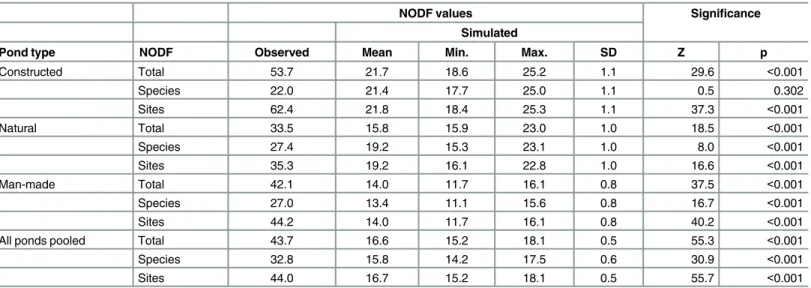
The studied assemblages were significantly nested both at the scale of pond types and overall (Table 3;S2 Table). The nestedness values were larger for sites (NODFrow) than for species
(NODFcolumn); that contrast was particularly clear (and significant) in constructed ponds.
fuscusthe null-hypothesis of random assembly could not be rejected at all, atα= 0.05 (Table 1).
The presence of fish impacted the nestedness patterns in different pond types. In con-structed ponds without fish the species assemblages were significantly more nested
(NODF = 51.86; p<0.01; N = 60) than in ponds with fish (NODF = 13.14; p = 0.93; N = 5).
Contrary, in natural and man-made ponds the species assemblages were less structured in ponds which did not consist fish (natural ponds: NODF = 26.14; p<0.01; N = 32; man-made
ponds: NODF = 28.1; p<0.01; N = 35) than in ponds with fish (natural ponds:
NODF = 34.75; p<0.01; N = 57; man-made ponds: NODF = 42.04; p<0.01; N = 55).
Both pond size, shade, and age supported the formation of the nested assemblage pattern and there were apparent differences among pond types. Thus, pond size was a significant factor for man-made ponds only, while shade (and not size) affected natural and constructed ponds (Table 4;S3andS4Tables). The age of the pond was only known for the constructed ponds (Table 4;S5 Table).
Fig 2. The number of studied species in ponds with and without focal species.Filled bars are ponds of focal species presence (T.cristatusorP.
fuscus) and empty bars are ponds of focal species absence; whiskers are 95% confidence intervals; number above the bars represent the N–value of each type of pond with and without focal species.
doi:10.1371/journal.pone.0160012.g002
Table 2. The effects of pond type (3 types) and the presence of target species (T.cristatusorP. fus-cus) to the number of other considered amphibian and insect species. The effects refer to likelihood-ratio tests for Generalized Linear Models based on Poisson error distribution and log link function.
T.cristatus P.fuscus
Factor (df) χ2 p χ2 p
Pond type (2) 63.0 <0.001 22.6 <0.001
Target species (1) 32.9 <0.001 <0.1 0.905
Pond type × Target species (2) 18.0 <0.001 0.6 0.740
Discussion
Pond construction for protected amphibians
Our analyses confirmed a relatively high occupancy of specially constructed ponds not only by the two target species,Triturus cristatusandPelobates fuscus, but also by other amphibians and
Table 3. Nestedness of the aquatic assemblages by pond type, according to the NODF statistic.NODF metric (Nestedness based on Overlap and Decreasing Fill) ranges between 0% (maximal scatter) and 100% (perfectly nested).
NODF values Significance
Simulated
Pond type NODF Observed Mean Min. Max. SD Z p
Constructed Total 53.7 21.7 18.6 25.2 1.1 29.6 <0.001
Species 22.0 21.4 17.7 25.0 1.1 0.5 0.302
Sites 62.4 21.8 18.4 25.3 1.1 37.3 <0.001
Natural Total 33.5 15.8 15.9 23.0 1.0 18.5 <0.001
Species 27.4 19.2 15.3 23.1 1.0 8.0 <0.001
Sites 35.3 19.2 16.1 22.8 1.0 16.6 <0.001
Man-made Total 42.1 14.0 11.7 16.1 0.8 37.5 <0.001
Species 27.0 13.4 11.1 15.6 0.8 16.7 <0.001
Sites 44.2 14.0 11.7 16.1 0.8 40.2 <0.001
All ponds pooled Total 43.7 16.6 15.2 18.1 0.5 55.3 <0.001
Species 32.8 15.8 14.2 17.5 0.6 30.9 <0.001
Sites 44.0 16.7 15.2 18.1 0.5 55.7 <0.001
doi:10.1371/journal.pone.0160012.t003
Table 4. Influence of shade, pond size, pond age on the assemblage nestedness by pond type.Percent perfect nestedness and its significance have been calculated according to Lomolino [56]. Sample sizes vary slightly depending on the availability of the environmental data.
Pond type
Characteristic Natural Constructed Man-made Total
Shade
No. of sites 51 62 90 203
Mean shade of sites (%) 22 10 16 15.7
Min. shade (%) 0 0 0 0
Max. shade (%) 100 100 100 100
% perfect nestedness 8.5 15.5 4.4 18.2
p-value 0.02 <0.001 0.08 <0.001
Pond size
No. of sites 62 66 98 226
Mean area of sites (ha) 1.31 0.10 0.29 0.51
Min. area of sites (ha) 0.003 0.01 0.01 0.003
Max. area of sites (ha) 6.72 3.00 5.20 6.72
% perfect nestedness 1.9 -1.5 6.3 8.4
p-value 0.31 0.68 0.02 <0.001
Pond age
No. of sites - 59 -
-Mean age of ponds (y) - 7.68 -
-Min. age of ponds (y) - 3 -
-Max. age of ponds (y) - 9 -
-% perfect nestedness - 17 -
-p-value - <0.001 -
aquatic insects including several other protected taxa. These ponds were specially constructed forT.cristatusand/orP.fuscus, taking their habitat demands into account. The constructed ponds had gentle slopes and rather large shallow littoral zone, the maximum depth of water varied from 0.4m to 2.5 m [25]. None of the constructed ponds was allowed a connection to running water (ditch, stream, river) to avoid fish introduction or sedimentation. It could be the reason why fish was rarely present in constructed ponds compare to the natural ponds. Land cover within 50 m from any constructed pond was mainly to consist of a mosaic of forest and (semi)natural grassland (forT.cristatus) and (semi)natural grasslands and small extensively used potato fields or vegetable gardens (forP.fuscus) [25], while natural ponds were often sur-rounded by forest [57]. Previous studies have demonstrated that pond construction may sup-port assemblage richness comparable to natural wetlands [30,58] but, in our study, specially constructed ponds even outperformed natural ponds. We recall, however, that a seemingly low quality of natural habitat may be, at least in some species, a sampling artifact since we only sampled the natural water-bodies that were comparable with man-made ponds in terms of size and water conditions. For example, both diving beetles of conservation concern,Dytiscus latis-simusandGraphoderus bilineatus, have their main populations in lakes [59,60].
Another key finding was that the time since pond construction affected the nestedness of the pond fauna. Considering also the distinct contrast between site- and species-scale nested-ness in this pond type (Table 1), the time effect probably reflects the rapid, but initially stochas-tic, processes of habitat development and species colonization in the taxa studied (e.g., [61–
63]). Such parallel development could explain, for example, why significant co-occurrences of odonate species and the two target amphibians were mostly observed among the constructed ponds (Table 5).
These findings suggest that pond construction forT.cristatusandP.fuscuscreated quality habitats also for several other species of conservation concern and, thus, these two amphibians could be used as focal species for pond management. The keys for such success probably include: reversing the succession, consistent creation of limiting conditions (e.g., shallow-water areas and variability), and the elimination of fish [25]. In contrast, actual presence of the target species in those ponds did not add accompanying species in our study. Other types of ponds even had reduced number of accompanying species in the presence ofT.cristatus(Fig 2; but see [64], for an opposite result). AsT.cristatusis a predatory species [65], one reason can be its lasting predation influence on those longer-developed assemblages. This hypothesis deserves experimental study because it refers to a potential conservation dilemma–an unstudied issue in pond management.
Nestedness patterns and the indicator value of amphibians
The general nestedness (NODF) values recorded in our study were moderate, 44–54 (cf. [50]), but their significance in each of the three pond types strengthens the evidence. Aquatic ecosys-tems often have loosely structured assemblages [41,66,67]. Therefore, the general nestedness condition of focal species selection [68,69] was met in our pond study system. However, we also discovered that the nestedness was shaped by distinct environmental factors in different pond types. It therefore remains unanswered how the focal-species approach should be expanded beyond pond construction, i.e., in habitat management or priority site selection among existing natural and anthropogenic ponds.
man-made ponds could be derived from the larger area of the latter pond types, as well as more extensive vegetation cover in natural ponds, creating larger variety of microhabitats. Similar impact of fish predation on the species patterns of wetland assemblages have also been demon-strated by Baber et al [70].
The man-made ponds were distinct for having pond area as a structuring factor (see also [40,70]), even though natural ponds varied even more in size (Table 4). This may be related to some taxon-specific responses observed. For example, the conservation-concernLeucorrhinia species followed a nested pattern in man-made ponds only, and some amphibians (Pelophylax sp.,Bufo bufo) were relatively frequent, while the target species were rare. These patterns refer to specific limitations (see also, e.g. [42,71–73]) in man-made ponds, which were most perma-nent and most frequently hosted fish. The negative impact of fish could be mitigated by larger size of the ponds. Amphibians are sensitive to these habitat qualities, which probably caused their strong co-occurrence (Table 5). Therefore, conservation management for man-made
Table 5. Species-pair level co-occurrence (paired overlap, POij) of the target species and other species of amphibians and macro-invertebrates by
pond type.POijhas been calculated only for the cases with at least three records of both the target and the other species; an asterisk (*) indicates non-ran-dom co-occurrence at p<0.05.
Target species, pond type, and POij(%)
Accompanying species Triturus cristatus Pelobates fuscus
Constructed ponds Natural ponds Man-made ponds Constructed ponds Natural ponds Man-made ponds
Amphibians
T.cristatus 47 45* 14*
P.fuscus 47 45* 14*
B.bufo 50* 7 20* 17* 9* 0
L.vulgaris 100 71* 80* 88* 72* 71*
P.lessonae/esculentus 87 7 10* 94* 45* 86*
R.arvalis 50* 50* 40* 30* 36* 29*
R.temporaria 52 21 20* 47* 9 29*
Dragonflies and damselflies
C.hastulatum 80* 18* 29*
C.puella 80* 18* 43*
C.pulchellum 75* 25* 0
C.aenea 65 0 0 65* 0 14*
E.bimaculata 33 0 0 33* 0 0
L.albifrons 56* 0 0 22* 0 0
L.caudalis 33* 0
L.pectoralis 63 7 10* 59* 27* 14*
L.rubicunda 59* 0 0 35* 10 0
L.quadrimaculata 88 0 10 0 9 43*
Water beetles
A.canaliculatus 20* 50* 0
A.sulcatus 68 14* 17* 53 29* 50*
C.lateralimarginalis 17* 0
G.cinereus 63* 8 0 38* 36* 0
G.zonatus 75* 25*
H.seminiger 50* 31*
H.transversalis 17* 0 67* 0
H.caraboides 25* 75*
H.aterrimus 67* 0 100* 0
ponds could prioritize their size-related habitat heterogeneity and amphibian species richness (rather than the single occurrences of the target species).
In natural ponds (also in constructed ponds), assemblage nestedness was affected by sun exposure (resp. shade) and these ponds had the most suitable conditions for vegetation devel-opment. Higher nestedness in more open water-bodies has been reported also in amphibians in Italy [74]. In temperate climate sun exposure creates areas with high water temperatures cre-ating favorable habitat conditions for aquatic beetles [75–77] and promoting rapid develop-ment of amphibians’and aquatic invertebrates’larvae [78–81]. Possibly, this explains also the relatively large share of all records of water scavenger beetles in natural ponds and, specifically, their striking co-occurrence with amphibians (Table 5). Rich aquatic vegetation may explain, for example, the frequent occurrence ofRana arvalisand the generally rich dragonfly assem-blages (cf. [38,82]) in natural ponds. The fact that dragonfly distributions were almost entirely segregated from that ofT.cristatus(Table 5) suggests complex predatory interactions worth of future study. In brief, the assemblage structuring processes in natural ponds might be different from those in recently constructed ponds, because natural ponds are often connected with run-ning water, having higher possibility for fish colonization. They also have remained in forested landscapes while specially constructed ponds are situated mainly in mosaic landscapes. How-ever, the differences of species assemblages in natural and specially created ponds may also derived from time of succession. The constructed ponds were in average 7 years old, which might not be enough for establishment of diverse macrophyte cover.
In general, following the steps of focal species selection and the results of analysis, we thus confirm that the assemblages were nested but, at the species level,P.fuscusshowed no nested-ness in any type of ponds (seeTable 1). This species appeared too rare, which could be also partly related to more specific attention onT.cristatusin the pond construction. However, we found comparable numbers ofT.cristatusandP.fuscuslarvae from natural and man-made ponds, whereT.cristatusstill retained a more nested pattern. Furthermore,T.cristatushad 60% incidence in the constructed ponds, which were created following its requirements, but only 10% incidence in ordinary man-made ponds. Such difference confirms the habitat-sensi-tivity of this species and, considering also the persistent nestedness patterns, we can recom-mend it as an assemblage-scale focal species in constructed ponds as well. In contrast,P.fuscus did not meet these criteria in any type of pond.
Our study thus elaborates the discussion on the indicator value of amphibians for conserva-tion purposes. Previously, it has been found that amphibians are probably poor cross-taxon indicators across landscapes involving both terrestrial and aquatic habitat (e.g. [20,82]), but their value may be higher specifically for wetlands [83–85]. Our study demonstrates that the indicator value of amphibians differs among water-bodies in response to complex factors that affect species co-occurrence, where whole taxon groups (e.g., dragonflies and water scavenger beetles in our study) may have highly variable representation, depending on water-body type. We therefore advocate that, for pond management beyond the initial construction issues, the focal species should be selected from every major taxon group.
Supporting Information
S1 Table. Fish presence in different type of ponds.
(XLSX)
S2 Table. Main matrix with all types of ponds for nestedness analysis.
S3 Table. The area of different pond types and species presence matrix for Lomolino's method.
(XLSX)
S4 Table. The shadiness of different pond types and species presence matrix for Lomolino's method.
(XLSX)
S5 Table. Matrix with species presence and age of constructed ponds for Lomolino's method.
(XLSX)
Acknowledgments
We thank Lars L. Iversen for the data on aquatic macro-invertebrates. We thank Benedikt R. Schmidt and the referees of PLOS ONE for their helpful comments that greatly improved the quality of this work.
Author Contributions
Conceived and designed the experiments: ES RR AL. Performed the experiments: RR. Analyzed the data: ES RR AL. Contributed reagents/materials/analysis tools: ES RR AL. Wrote the paper: ES RR AL.
References
1. Dudgeon D, Arthington AH, Gessner MO, Kawabata ZI, Knowler DJ, Leveque C, et al. (2006) Freshwa-ter biodiversity: importance, threats, status and conservation challenges. Biological Reviews 81: 163–
182. PMID:16336747
2. Søndergaard M, Jeppesen E. (2007) Anthropogenic impacts on lake and stream ecosystems, and
approaches to restoration. Journal of Applied Ecology 44: 1089–1094.
3. Downing JA. (2010) Emerging global role of small lakes and ponds: little things mean a lot. Limnetica 29: 9–23.
4. Preisser EL, Kefer JY, Lawrence JD. (2000) Vernal pool conservation in Connecticut: an assessment and recommendations. Environmental Management 5: 503–513.
5. Semlitsch RD, Bodie JR. (1998) Are small, isolated wetlands expendable? Conservation Biology 12: 63–70.
6. Williams P, Whitfield M, Biggs J, Bray S, Fox G, Nicolet P, et al. (2004) Comparative biodiversity of riv-ers, streams, ditches and ponds in an agricultural landscape in Southern England. Biological Conserva-tion 115: 329–341.
7. De Meester L, Declerck L, Stoks R, Louette G, Van de Meutter F, De Bie T, et al. (2005) Ponds and pools as model systems in conservation biology, ecology and evolutionary biology. Ecosystems 15: 715–725.
8. Céréghino R, Biggs J, Oertli B, Declerck S. (2008) The ecology of European ponds: defining the char-acteristics of a neglected freshwater habitat. Hydrobiologia 597: 1–6.
9. Curado N, Hartel T, Arntzen JW. (2011) Amphibian pond loss as a function of landscape change—A case study over three decades in an agricultural area of northern France. Biological Conservation 144: 1610–1618.
10. Lemmens P, Mergeay J, De Bie T, Van Wichelen J, De Meester L, Declerck SA. (2013) How to maxi-mally support local and regional biodiversity in applied conservation? Insights from pond management. PLOS ONE 8: e72538. doi:10.1371/journal.pone.0072538PMID:23951328
11. Williams P, Whitfield M, Biggs J. (2008) How can we make new ponds biodiverse? A case study moni-tored over 7 years. Hydrobiologia 597: 137–148.
13. Willson JD, Hopkins WA. (2013) Evaluating the effects of anthropogenic stressors on source-sink dynamics in pond-breeding amphibians. Conservation Biology 27: 595–604. doi:10.1111/cobi.12044
PMID:23551497
14. Azeria ET, Fortin D, Hebert C, Peres-Neto P, Pothier D, Ruel J-C. (2009) Using null model analysis of species co-occurrences to deconstruct biodiversity patterns and select indicator species. Diversity and Distribution 15: 958–971.
15. Neeson TM, Mandelik Y. (2014) Pairwise measures of species co-occurrence for choosing indicator species and quantifying overlap. Ecological Indicators 45: 721–727.
16. Lambeck RJ. (1997) Focal species: A multi-species umbrella for nature conservation. Conservation Biology 11: 849–856.
17. Freudenberger D, Brooker L. (2004) Development of the focal species approach for biodiversity conser-vation in the temperate agricultural zones of Australia. Biodiversity and Conserconser-vation 13: 253–274. 18. Lindenmayer DB, Manning AD, Smith PL, Possingham HP, Fischer J, Oliver I, et al. (2002) The
focal-species approach and landscape restoration: a critique. Conservation Biology 16: 338–345. 19. Lindenmayer DB, Lane PW, Westgate MJ, Crane M, Michael D, Okada S, et al. (2014) An empirical
assessment of the focal species hypothesis. Conservation Biology 28: 1594–1603. doi:10.1111/cobi.
12330PMID:25048948
20. Beazley K, Cardinal N. (2004) A systematic approach for selecting focal species for conservation in the forests of Nova Scotia and Maine. Environmental Conservation 31: 91–101.
21. Nicholson E, Lindenmayer DB, Frank K, Possingham HP. (2013) Testing the focal species approach to making conservation decisions for species persistence. Diversity and Distributions 19: 530–540. 22. Caro T. Conservation by proxy: indicator, umbrella, keystone, flagship, and other surrogate species.
Washington D.C.: Island Press; 2010.
23. Remm L, Lõhmus A, Maran T. (2015) A paradox of restoration: prey habitat engineering for an
intro-duced, threatened carnivore can support native biodiversity. Oryx 49: 559–562.
24. Denton JS, Hitchings SP, Beebee TJC, Gent A. (1997) A recovery program for the natterjack toad (Bufo calamita) in Britain. Conservation Biology 11: 1329–1338.
25. Rannap R, Lõhmus A, Briggs L. (2009) Restoring ponds for amphibians: A success story.
Hydrobiolo-gia 634: 87–95.
26. Ruhi A, San Sebastian O, Feo C, Franch M, Gasco S, Richter-Boix A, et al. (2012) Man-made Mediter-ranean temporary ponds as a tool for amphibian conservation. Journal of Limnology 48: 81–93. 27. Lehtinen RM, Galatowitsch SM. (2001) Colonization of restored wetlands by amphibians in Minnesota.
American Midland Naturalist 145: 388–396.
28. Pechmann JHK, Estes RA, Scott DE, Gibbons JW. (2001) Amphibian colonization and use of ponds created for trial mitigation of wetland loss. Wetlands 21: 93–111.
29. Petranka JW, Harp EM, Holbrook HT, Hamel JA. (2007) Long-term persistence of amphibian popula-tions in a restored wetland complex. Biological Conservation 138: 371–380.
30. Balcombe CK, Anderson JT, Fortney RH, Kordek WS. (2005) Aquatic macroinvertebrate assemblages in mitigates and natural wetlands. Hydrobiologia 541: 175–188.
31. Kadoya T, Suda S, Nilshihiro J, Washitani I. (2008) Procedure for predicting the trajectory of species recovery based on the nested species pool information: Dragonflies in a wetland restoration site as a case study. Restoration Ecology 16: 397–406.
32. Marchetti MP, Garr M, Smith ANH. (2010) Evaluating wetland restoration success using aquatic macro-invertebrate assemblages in the Sacramento Valley, California. Restoration Ecology 18: 457–466. 33. Bloechl A, Koenemann S, Philippi B, Melber A. (2010) Abundance, diversity and succession of aquatic
Coleoptera and Heteroptera in a cluster of artificial ponds in the North German Lowlands. Limnologica 40: 215–225.
34. HarabišF, Tichanek F, Tropek R. (2013) Dragonflies of freshwater pools in lignite spoil heaps:
Restora-tion management, habitat structure and conservaRestora-tion value. Ecological Engineering 55: 51–61. 35. Nöllert A.Pelobates fuscus(Laurenti, 1768). In: Atlas of Amphibians and Reptiles in Europe. Societas
Europea Herpetologica (Ed.), Museum Natioal d’Historie Naturelle. Paris; 1997. p. 110–111. 36. Edgar P, Bird D. Action Plan for the Conservation of the Crested Newt Triturus cristatus Species
Com-plex in Europe. Strasbourg; 2006.
37. EEC. (1992) Council directive 92/43/CEE of 21 May 1992 on the conservation of natural habitats and of wild fauna and flora. Official Journal L 206: 7–50.
39. McAbendroth L, Foggo A, Rundle SD, Bilton DT. (2005) Unravelling nestedness and spatial pattern in pond assemblages. Journal of Animal Ecology 74: 41–49.
40. Werner EE, Skelly DK, Relyea RA, Yurewicz KL. (2007) Amphibian species richness across environ-mental gradients. Oikos 116: 1697–1712.
41. Florencio M, Diaz-Paniagua C, Serrano L, Bilton DT. (2011) Spatio-temporal nested patterns in macro-invertebrate assemblages across a pond network with a wide hydroperiod range. Oecologia 166: 469–
483. doi:10.1007/s00442-010-1847-2PMID:21120669
42. Moreira LFB, Malchik L. (2012) Assessing pattern of nestedness and co-occurrence in coastal pond anuran assemblages. Amphibia-Reptilia 33: 261–271.
43. Scheffer M, van Geest GJ, Zimmer K, Jeppesen E, Sondergaard M, Butler MG, et al. (2006) Small habi-tat size and isolation can promote species richness: second-order effects on biodiversity in shallow lakes and ponds. Oikos 112: 227–231.
44. IUCN. The IUCN Red List of Threatened Species. Version 2015–4–[cited 2016 Jan 25]. Available
from:www.iucnredlist.org
45. Skei JK, Dolmen D, Rønning L, Ringsby TH. (2006) Habitat use during the aquatic phase of the newts Triturus vulgaris(L.) andT.cristatus(Laurenti) in central Norway: proposition for a conservation and monitoring area. Amphibia–Reptilia 27: 309–324.
46. Rannap R, Lõhmus A, Briggs L. (2009). Niche position, but not niche breadth, differs in two coexisting
amphibians having contrasting trends in Europe. Diversity and Distributions 15: 692–700.
47. Klečka J, Boukal DS. (2011) Lazy ecologist's guide to water beetle diversity: Which sampling methods
are the best? Ecological Indicators 11: 500–508.
48. Honnay O, Hermy M, Coppin P. (1999) Nested plant communities in deciduous forest fragments: spe-cies relaxation or nested habitats? Oikos 84: 119–129.
49. Sætersdal M, Gjerde I, Blom HH. (2005) Indicator species and the problem of spatial inconsistency in nestedness patterns. Biological Conservation 122: 305–316.
50. Almeida-Neto M, Guimaraes P, Guimaraes P Jr, Loyola RD, Ulrich W. (2008) A consistent metric for nestedness analysis in ecological systems: reconciling concept and measurement. Oikos 117: 1227–
1239.
51. Ulrich W, Almeida-Neto M, Gotelli NJ. (2009) A consumer’s guide to nestedness analysis. Oikos 118: 3–17.
52. Guimarães PR Jr, Guimarães P. (2006) Improving the analyses of nestedness for large sets of
matri-ces. Environmental Modelling & Software 21: 1512–1513.
53. Ulrich W, Gotelli NJ. (2007) Null model analysis of species nestedness patterns. Ecology 88: 1824–
1831. PMID:17645028
54. Almeida-Neto M, Ulrich W. (2010) A straightforward computational approach for quantifying nested-ness using abundance data. Environmental Modelling & Software 26: 173–178.
55. Joppa LN, Williams R. (2011) The influence of single elements on nested community structure. Meth-ods in Ecology and Evolution 2: 541–549.
56. Lomolino MV. (1996) Investigating causality of nestedness of insular communities: Selective immigra-tions or extincimmigra-tions? Journal of Biogeography 23: 699–703.
57. Rannap R, Kaart T, Iversen LL, de Vries W, Briggs L. (2015) Geographically varying habitat characteris-tics of a wide-ranging amphibian, the common spadefoot toad(Pelobates fuscus), in northern Europe. Herpetological Conservation and Biology 10: 904−916.
58. Brand AB, Snodgrass JW. (2010) Value of artificial habitats for amphibian reproduction in altered land-scapes. Conservation Biology 24: 295–301. doi:10.1111/j.1523-1739.2009.01301.xPMID:19681986 59. Iversen LL, Rannap R, Thomsen PF, Kielgast J, Sand-Jensen K. (2013) How do low dispersal species
establish large range sizes? The case study of water beetleGraphoderus bilineatus. Ecography 36: 770–777.
60. Vahruševs V, KalniņšM. (2013) Broadest diverDytiscus latissimusLinnaeus, 1758 (Coleoptera: Dytis-cidae) in the Baltic States: a rare or little known species. Zoology and Ecology 23: 203–216.
61. Kadoya T, Suda S, Washitani I. (2004) Dragonfly species richness on man-made ponds: effects of pond size and pond age on newly established assemblages. Ecological Research 19: 461–467. 62. Stanczak M, Keiper JB. (2004) Benthic invertebrates in adjacent created and natural wetlands in
north-eastern Ohio, USA. Wetlands 24: 212–218.
63. Lesbarrères D, Fowler MS, Pagano O, Lode T. (2010) Recovery of anuran community diversity
64. Maletzky A, Kyek M, Goldschmid A. (2007) Monitoring status, habitat features and amphibian species richness of crested newt (Triturus cristatussuperspecies) ponds at the edge of the range (Salzburg, Austria). Limnology 43: 107–115.
65. Griffiths RA, De Weijer P, May RT. (1994) Predation and competition within an assemblage of larval newts (Triturus). Ecography 17: 176–181.
66. Soininen J. (2008) The ecological characteristics of idiosyncratic and nested diatoms. Protist 159: 65–
72. PMID:17931967
67. Larsen S, Ormerod SJ. (2010) Combined effects of habitat modification on trait composition and spe-cies nestedness in river invertebrates. Biological Conservation 143: 2638–2646.
68. Fleishman E, Jonsson BG, Sjögren-Gulve P. (2000) Focal species modelling for biodiversity conserva-tion. Ecological Bulletins 48: 85–99.
69. Berglind S-A. (2004) Area-sensitivity of the sand lizard and spider wasps in sandy pine heath forests: umbrella species for early successional biodiversity conservation. Ecological Bulletins 51: 189–207. 70. Baber MJ, Fleishman E, Babbitt KJ, Tarr TL. (2004) The relationship between wetland hydroperiod and
nestedness patterns in assemblages of larval amphibians and predatory macroinvertebrates. Oikos 107: 16–27.
71. Griffiths RA. (1997) Temporary ponds as amphibian habitats. Aquatic Conservation–Marine and Fresh-water Ecosystems 7: 119–126.
72. Hecnar SJ, Mcloskey RT. (1997) Patterns of nestedness and species association in a pond-dwelling amphibian fauna. Oikos 80: 371–381.
73. Hartel T, Öllerer K, Cogalniceanu D, Göthner T. (2010) Pond-based survey of amphibians in a Saxon cultural landscape from Transylvania (Romania). Italian Journal of Zoology 77: 61–70.
74. Ficetola GF, De Bernardi F. (2004) Amphibians in human-dominated landscape: the community struc-ture is related to habitat feastruc-tures and isolation. Biological Conservation 119: 219–230.
75. Cuppen J, Koese B, Sierdsema H. (2006) Distribution and habitat ofGraphoderus bilineatusin the Netherlands (Coleoptera: Dytiscidae). Nederlandse Faunistische Mededelingen 24: 29–40.
76. Molnar A, Hegedues R, Kriska G. (2011) Effect of cattail (Typha spp.) mowing on water beetle assem-blages: changes of environmental factors and the aerial colonization of aquatic habitats. Journal of Insect Conservation 15: 389–399.
77. Dong B, Geng C, Cai Y, Ji L. (2014) Aquatic coleopteran response to environmental factors of freshwa-ter ecosystems in Changbai Mountain, northeast China. Aquatic Ecosystem Health & Management 17: 171–178.
78. Skelly DK, Freidenburg LK, Kiesecker JM. (2002): Forest canopy and the performance of larval amphibians. Ecology 83: 983–992.
79. Schiesari L. (2006) Pond canopy cover: a resource gradient for anuran larvae. Freshwater Biology 51: 412–423.
80. Rannap R, Lõhmus A, Tammaru T, Briggs L, de Vries W, Bibelriether F. (2012) Northern natterjack
toads (Bufo calamita) select breeding habitats that promote rapid development. Behaviour 149: 737–
754.
81. Iversen LL, Rannap R, Briggs L, Sand-Jensen K. (2016) Variable history of land use reduces the rela-tionship to specific habitat requirements of a threatened aquatic insect. Population Ecology 58: 155–
164.
82. Vehkaoja M, Nummi P. (2015) Beaver facilitation in the conservation of boreal anuran communities. Herpetozoa 28: 75–87.
83. Price SJ, Howe RW, Hanowski JAM, Regal RR, Gerald JN, Smith CR. (2007) Are anurans of Great Lakes coastal wetlands reliable indicators of ecological condition? Journal of Great Lakes Research. 33: 211–223.
84. Sinsch U, Greenbaum E, Kusamba C, Lehr E. (2011) Rapid assessment of montane anuran communi-ties in the Albertine Rift:Hyperolius castaneusAhl, 1931 as an umbrella species for conservation. Afri-can Zoology 46: 320–333.