
Autobiographical Memory in the Angry Self
Lynette Hung, Richard A. Bryant*
University of New South Wales, Sydney, Australia
Abstract
The impact of anger on autobiographical recall was examined in two studies. In Experiment 1, 76 participants differing in trait anger completed an autobiographical memory task (AMT). In Experiment 2, 50 participants with elevated trait anger were either provoked or not pro-voked and subsequently completed an AMT. Across both studies, participants with high dis-positional anger reported more anger-related memories, describing themselves as the primary agent of anger. In Experiment 2, provoked participants reported more memories describing themselves as the target of anger. These findings highlight the distinct patterns of memory recall associated with trait versus state anger. Findings are discussed in terms of retrieval biases operating in angry individuals and proposals stemming from self-memory system models of autobiographical memory.
Introduction
Autobiographical memories are recollections of personally experienced episodes from our past. These memories are fundamental to our sense of self, goals and motivations, and interpersonal relationships, and also allow us to make sense of the present and anticipate the future [1,2]. Investigations of autobiographical memory have spanned a range of topics from understanding its form [1], type [3], and function [4]. Converging evidence points to the significant influence of affect on autobiographical memory. Psychopathology research suggest that disorders such as depression [5], posttraumatic stress disorder (PTSD) [6,7], and complicated grief [8,9] are associated with disruptions of autobiographical memory and distinct patterns of recall (for review see [3]. Interestingly, despite considerable investigation in the emotion and memory lit-erature, a notable gap in this field involves the role of anger and personal memories. This is sur-prising given many contemporary accounts hold that anger follows from events in which personally significant goals are blocked by an external agent’s actions. Anger has been the focus of some studies, including those that have focused on trait anger in recalling anxious memories [10] and those that study emotion regulation strategies on anger resulting from anger-related autobiographical memories [11]. These studies have not directly investigated the impact of elicited anger on the nature of autobiographical memories. This is an important omission in the literature because studies of depression, PTSD, and grief have highlighted how other emotional states can impact on the nature of autobiographical memories is related to numerous indices of psychological functioning [12,13].
OPEN ACCESS
Citation:Hung L, Bryant RA (2016) Autobiographical Memory in the Angry Self. PLoS ONE 11(3): e0151349. doi:10.1371/journal.pone.0151349
Editor:Philip Allen, University of Akron, UNITED STATES
Received:September 8, 2014
Accepted:February 26, 2016
Published:March 29, 2016
Copyright:© 2016 Hung, Bryant. This is an open access article distributed under the terms of the Creative Commons Attribution License, which permits unrestricted use, distribution, and reproduction in any medium, provided the original author and source are credited.
Data Availability Statement:All relevant data are within the paper and its Supporting Information files.
Funding:This research was supported by an Australian Research Council Laureate Fellowship (FL0992334).
Anger is a basic human emotion that in extreme forms can lead to a range of destructive outcomes, including verbal attacks, assault, and increased risk of marital problems and cardio-vascular disease [14]. Anger can also have an adaptive function; it can enhance attention and motivation [15], increase optimism [16], and facilitate problem-solving [17]. Very few investi-gations have examined autobiographical memory in angry individuals. A limited amount of evidence indicates that high trait anger (HTA) is associated with negative appraisal biases for past anger-provoking events [18,19], although HTA individuals do not differ from anxious individuals or controls in their ability to recall specific memories [19]. Notwithstanding these few findings, and in contrast to other emotional disorders, the impact of anger on autobio-graphical memory is unclear given the scarcity of relevant published empirical research [20].
According to the Self-Memory System Model (SMS) [1], autobiographical information is reciprocally connected to the‘working self’, which is composed of personal goals, self-represen-tations, and expectations. The working self modulates access to autobiographical information by facilitating and inhibiting patterns of activation (i.e., autobiographical memories), such that encoding and retrieving specific information relies on current constructions of the self. Specifi-cally, autobiographical information that is consistent with one’s working self is more likely to be recalled than information that is inconsistent. There is empirical evidence to support this model, with studies finding that personal memories often concur with reported goals [21–23].
To extend the understanding of the role of anger on autobiographical memory, we investi-gated the extent to which individual differences in anger influence memory processes and whether angry individuals recall autobiographical memories in line with activated construc-tions of the working self. To answer these quesconstruc-tions, we conducted two experiments that employed an adaptation of the Autobiographical Memory Task [24], during which participants recalled memories from their past in response to saliently angry, ambiguously angry, and posi-tive cues. Experiment 1 focused on the general influence of trait anger on recalled memories. Experiment 2 built on this foundation by examining the additive impact of state anger, which was induced by interpersonal provocation, on recalled memories. Across both studies, we examined the content of recalled memories and hypothesized that anger would be associated with autobiographical memories consistent with anger themes. In this sense, we propose that anger would moderate the affective components of autobiographical memory by preferentially accessing memory representations associated with anger-related themes.
Experiment 1
higher levels of anger-relatedness (i.e. mental content involving angry scenarios) than those generated by MTA and LTA participants and those recalled to ambiguously-angry and posi-tive cues. In contrast, we expected LTA participants to recall more memories to angry cues in which they described themselves as observing others as the agent of anger emotions com-pared to HTA and MTA participants. Finally, we expected HTA participants to demonstrate interpretation biases to ambiguously-angry cues, in which recalled memories were associated with higher levels of anger-relatedness compared to those generated by MTA and LTA par-ticipants and those recalled to positive cues.
Method
Participants. Participants were undergraduate psychology students who participated in return for course credit. Twenty-five (14 females and 11 males) HTA individuals, 26 (14 females and 12 males) MTA individuals, and 25 (14 females and 11 males) LTA individuals completed the study. Trait anger was assessed using the State-Trait Anger Expression Inven-tory-2: Trait Anger Scale (STAXI-2: T-Anger; [25]). Participants were identified as high, medium, or low trait anger on the basis of their STAXI-2 scores from a large initial pool of 702 participants initially screened on a 6-item adaptation of the STAXI-2: T-Anger approximately 6 months prior to the study; specifically, 25 participants were randomly identified from the top, medium, and bottom third of STAXI-2 scores. They were subsequently re-assessed on the full 10-item STAXI-2: T-Anger on average 1 week prior to the study. HTA participants scored in the range 22–33 (M= 26.44,SD= 2.86), MTA participants scored in the range 15–21 (M= 17.77,SD= 2.12), and LTA participants scored in the range 10–14 (M= 12.68,SD= 1.28) on the 10-item STAXI-2: T-Anger.
Materials and Measures. STAXI-2: T-Anger and STAXI-2: Anger Expression Inventory (STAXI-2: AX [25]. The STAXI-2: AX is a 32-item self-report measure consisting of two sub-scales that assess how individuals control their anger; the two subsub-scales index the extent to which individuals express their anger in terms of Anger Expression-Out (e.g.“slam doors”,
“say nasty things”) or Anger Expression-In (e.g.“harbour grudges”,“pout or sulk”). The scales also provide an overall anger expression index score that assesses frequency of anger expres-sion. The STAXI-2 scales have been validated on a variety of normal and clinical populations and have good psychometric properties, with the internal consistency of the subscales ranging from 0.73 to 0.95 [25]. The STAXI-2: T-Anger is a briefer measure that comprises a 10-item self-report measure that assesses general predisposition to anger as well as predisposition to anger in specific situations. The STAXI-2: T-Anger scale correlates with other measures of trait anger, including the Buss-Perry Aggression Questionnaire (.66-.73) [26].
Anger Rumination Scale (ARS; [27]). The ARS is a 19-item self-report measure that assesses the tendency to ruminate on angry moods, past anger experiences, and the causes and conse-quences of anger episodes. The ARS has strong internal consistency (.93) and retest reliability (.77) [27].
State-Trait Anxiety Inventory–Form Y (STAI-Y;[28]). The STAI-Y is a 20-item self-report measure that assesses individual differences in trait anxiety, and was employed to control for trait anxiety. The STAI-Y measures level of anxiety experienced "at the moment" (state) and "generally" (trait), and possesses good internal consistency (.80) and retest reliability (.77) [28].
Beck Depression Inventory-II (BDI-II; [29]). The BDI-II is a 21-item self-report measure that assesses depressive symptomatology that has strong internal consistency of .92, and was employed to control for depressive symptoms.
Positive and Negative Affect Schedule (PANAS; [30]). The PANAS comprises 20 self-reported items that index positive and negative affective states. The PANAS possesses good internal consistency (.85) and retest reliability (.71) [30]. It was used in this study to assess affective states during the experiment.
Autobiographical Memory Task (AMT). The AMT [24] consisted of five angry cues (argue,
furious,hate,unfair,violent), five ambiguously angry cues (chaos,childish,judge,jumpy,
shout), five positive cues (friendly,merry,praise,relax,reliable), and two practice cues (movies,
chocolate). Test cue words were matched according to number of letters (M = 5.6–5.8), number of syllables (M = 1.6–1.8), and word frequency (M = 23.2–25.4) [31]. Cue words were initially derived from focus groups identification of explicit and ambiguous anger cue words, and then 23 postgraduate psychology students from the University of New South Wales rated the test cues for their: (1) anger-relatedness (1 =not at all; 9 =extremely), and (2) emotional valence (1 =extremely negative; 9 =extremely positive). Angry cues were rated as more anger-related than ambiguous [t(22) = 14.54,p<.001] and positive [t(22) = 22.46,p<.001] cues while ambiguous cues were rated as more anger-related than positive cues [t(22) = 12.83,p<.001]. Angry cues were also rated as more negative than ambiguous [t(22) = 26.22,p<.001] and pos-itive [t(22) = 38.15,p<.001] cues, while ambiguous cues were rated as more negative than pos-itive cues [t(22) = 20.13,p<.001]. Cues were presented to participants on a 20-inch computer screen using Inquisit 2.0 in 38-point Arial font in the center of the screen. Presentation order of the cues was randomized, with the constraint that positive, ambiguous, and angry cues were alternated.
Participants were instructed to verbally recall a specific autobiographical memory related to each cue. A specific memory was defined as“an event that may have lasted seconds, minutes, or even hours, but not longer than one day”, and participants were given examples of accept-able responses. Participants were given 30s to provide a memory, and responses were audio-recorded; no prompts were provided in this period.
Procedure
Participants completed self-report measures (TAS, AXI, ARS, STAI-Y) on average one week prior to attending the experimental session. They were individually tested at the time of the experiment. This research was approved by the University of New South Wales Human Research Ethics Committee. Following written informed consent, participants completed the BDI-II and the affective rating scales to assess their current affective states. Participants then completed the AMT. At the conclusion of the AMT participants were debriefed and thanked for their participation.
Scoring
Memory content was coded by an independent rater into three categories of self-relatedness: (1)‘self-agent’memories described events in which the participant was the agent or primary instigator of the event; (2)‘self-target’memories described events in which the participant was the target or recipient of another’s activity, and; (3)‘other’memories described events in which the participant was a bystander or observer to other peoples’actions. Memory content was also coded for anger-relatedness on a 9-point Likert scale (1 =not at all, 9 =extremely). Ratings were based on the degree of anger associated with the event, the affective tone of participants’
Data Analysis
Participant characteristics were assessed between high, medium, and low trait anger groups by multiple comparisons that set a Bonferroni-adjusted alpha (p= .05/7 = .007). Anger-related-ness was analysed with 3 (Trait Anger) x 3 (Cue Type) mixed model analysis of covariance (ANCOVA) that controlled for depression severity (BDI) to control for the possibility that depression may account for the observed effects of trait anger. Memory content was analyzed using a 3 (Trait Anger) x 3 (Cue Type) x 3 (Content Category) multivariate analysis of variance (MANOVA), followed by separate 3 (Trait Anger) x 3 (Content Category) ANCOVAs that controlled for depression for each Cue Type.
Results and Discussion
Participant Characteristics
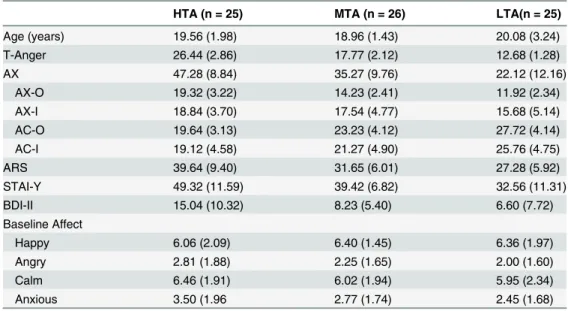
Table 1presents mean participant characteristics. Participants did not differ in terms of age or baseline affect ratings. HTA participants scored higher than MTA participants on the STAXI-2: T-Anger [t(49) = 12.33,p<.001], AXI [t(49) = 4.60,p<.001], AX-O [t(49) = 6.41,p< .001], AC-O [t(49) = -3.49,p<.001], ARS [t(49) = 3.63,p<.001], STAI-Y [t(49) = 3.73,p< .001], and BDI-II [t(49) = 2.97,p<.01]. HTA participants also scored higher than LTA partici-pants on the T-Anger [t(48) = 21.96,p<.001], AXI [t(48) = 8.37,p<.001], AX-O [t(48) = 9.28,p<.001], AX-I [t(48) = 2.50,p<.02], AC-O [t(48) = -7.78,p<.001], AC-I [t(48) = -5.04,p<.001], ARS [t(48) = 5.56,p<.001], and STAI-Y [t(48) = 5.18,p<.001]. MTA partic-ipants scored higher than LTA particpartic-ipants on the T-Anger [t(49) = 10.31,p<.001], AXI [t (49) = 4.27,p<.001], AX-O [t(49) = 3.47,p<.001], and AC-O [t(49) = -3.88,p<.001].
Table 1. Experiment 1: Mean participant characteristics.
HTA (n = 25) MTA (n = 26) LTA(n = 25)
Age (years) 19.56 (1.98) 18.96 (1.43) 20.08 (3.24)
T-Anger 26.44 (2.86) 17.77 (2.12) 12.68 (1.28)
AX 47.28 (8.84) 35.27 (9.76) 22.12 (12.16)
AX-O 19.32 (3.22) 14.23 (2.41) 11.92 (2.34)
AX-I 18.84 (3.70) 17.54 (4.77) 15.68 (5.14)
AC-O 19.64 (3.13) 23.23 (4.12) 27.72 (4.14)
AC-I 19.12 (4.58) 21.27 (4.90) 25.76 (4.75)
ARS 39.64 (9.40) 31.65 (6.01) 27.28 (5.92)
STAI-Y 49.32 (11.59) 39.42 (6.82) 32.56 (11.31)
BDI-II 15.04 (10.32) 8.23 (5.40) 6.60 (7.72)
Baseline Affect
Happy 6.06 (2.09) 6.40 (1.45) 6.36 (1.97)
Angry 2.81 (1.88) 2.25 (1.65) 2.00 (1.60)
Calm 6.46 (1.91) 6.02 (1.94) 5.95 (2.34)
Anxious 3.50 (1.96 2.77 (1.74) 2.45 (1.68)
Note: Standard deviations appear in parentheses. HTA = High Trait Anger; MTA = Medium Trait Anger; LTA = Low Trait Anger; TAS = Trait Anger Scale; AXI = Anger Expression Index; AX-O = Anger Expression–Out; AX-I = Anger Expression–In; AC-O = Anger Control–Out; AC-I = Anger Control–In;
ARS = Anger Rumination Scale; STAI-Y = State-Trait Anxiety Inventory, Form Y; BDI-II = Beck Depression Inventory, Second Edition.
Memory Qualities. Table 2presents mean anger-relatedness scores. A 3 (Trait Anger) x 3 (Cue Type) mixed model analysis of covariance (ANCOVA) that controlled for depression severity (BDI) indicated significant main effects of Trait Anger,F(2, 74) = 4.68,p<.01,ηp2=
.11 and Cue Type,F(2, 73) = 80.86,p<.001,η2= .69 but a nonsignificant interaction,F(2, 73) = .18,p>.05,ηp2= .04. Overall, HTA participants received higher scores than MTA [t(49) =
3.56,p<.001] and LTA participants [t(48) = 3.78,p<.001]. In contrast, MTA and LTA par-ticipants received similar scores [t(49) = 0.38,p>.71]. As expected, memories generated in response to angry cues received higher scores than memories generated in response to ambigu-ous [t(75) = 13.89,p<.001] and positive cues [t(75) = 21.65,p<.001]. Memories generated in response to positive cues received lower scores than memories generated in response to ambig-uous cues,t(75) = 7.34,p<.001.
Memory Content. Table 3presents the mean number of memories coded into each of the three self-related content categories (self-agent, self-target, other). A 3 (Trait Anger) x 3 (Cue Type) x 3 (Content Category) multivariate analysis of variance (MANOVA) indicated a signifi-cant overall effect,F(18, 134) = 2.01,p<.05,ηp2= .16. Separate 3 (Trait Anger) x 3 (Content
Category) ANCOVAs that controlled for depression were subsequently conducted across Cue Type. Analyses indicated that for angry cues, there was a significant main effect for Content,F
(2, 73) = 23.55,p<.001,η2= .39, and a significant interaction effectF(4, 148) = 4.15,p<.003,
ηp2= .10 but a nonsignificant main effect for Trait Anger,F(2, 74) = 2.34,p>.05,ηp2= .06.
Par-ticipants recalled more Self-Agent memories than Self-Target [t(77) = 8.52,p<.001] and Other memories [t(77) = 3.34,p<.001], and more Other memories than Self-Target memories [t(77) = 2.52,p<.02]. However, HTA participants recalled more Self-Agent memories than LTA [t(48) = 5.35,p<.001] and MTA [t(49) = 2.38,p<.02] participants. MTA participants also recalled more Self-Agent memories than LTA participants [t(49) = 2.98,p<.001]. In con-trast, HTA participants recalled fewer Self-Target memories than MTA [t(49) = 2.03,p<.05] and LTA [t(48) = 2.94,p<.01]. Finally, LTA participants recalled more Other memories than
Table 2. Experiment 1: Mean anger-relatedness scores.
HTA (n = 25) MTA (n = 26) LTA(n = 25)
Angry 4.72 (1.09) 3.69 (1.10) 3.53 (1.17)
Ambiguous 2.53 (1.24) 1.88 (0.88) 1.90 (0.88)
Positive 1.34 (0.59) 1.10 (0.24) 1.06 (0.18)
Note: Standard deviations appear in parentheses. HTA = High Trait Anger; MTA = Medium Trait Anger; LTA = Low Trait Anger.
doi:10.1371/journal.pone.0151349.t002
Table 3. Experiment 1: Mean number of self-agent, self-target, and other memories.
HTA HTA MTA MTA
S-Agt S-Tar Other S-Agt S-Tar Other S-Agt S-Tar Other
Angry 3.68 (1.14) 0.16 (0.37) 0.80 (0.71) 2.92 (1.13) 0.46 (0.65) 1.19 (0.94) 2.00 (1.08) 0.68 (0.80) 1.88 (1.01) Ambiguous 2.48 (1.29) 1.00 (0.96) 1.16 (0.99) 2.19 (1.36) 0.69 (0.68) 1.73 (1.34) 2.28 (1.21) 0.88 (1.05) 1.60 (1.15) Positive 2.56 (1.04) 1.92 (1.04) 0.20 (0.50) 2.42 (1.06) 1.77 (1.07) 0.50 (0.65) 2.36 (0.95) 1.80 (0.76) 0.56 (0.87)
Note. Standard deviations appear in parentheses. HTA = High Trait Anger; MTA = Medium Trait Anger; LTA = Low Trait Anger; S-Agt = Self-Agent; S-Tar = Self-Target.
Note: Standard deviations appear in parentheses. HTA = High Trait Anger; MTA = Medium Trait Anger; LTA = Low Trait Anger; S-Agt = Self-Agent; S-Tar = Self-Target.
HTA participants [t(48) = 4.37,p<.001], but a similar number to MTA participants [t(49) = 1.68,p>.05].
For ambiguous cues, there was a significant main effect for Content [F(2, 73) = 7.04,p< .002,ηp2= .16]. Participants recalled more Self-Agent memories than Self-Target [t(370) =
5.80,p<.001] and Other memories [t(370) = 3.03,p<.01], and more Other memories than Self-Target memories [t(370) = 3.22,p<.001]. For positive cues, there was a significant main effect for Content [(2, 73) = 56.88,p<.001,ηp2= .61]. Participants recalled more Self-Agent
memories than Self-Target [t(77) = 4.26,p<.001] and Other [t(77) = 7.73,p<.001] memo-ries, and more Self-Target memories than Other memories [t(77) = 2.90,p<.005].
These findings indicate an autobiographical memory pattern associated with trait anger. Specifically, HTA appears to be strongly associated with a tendency to recall angry memories that are thematically aligned with views of the self as an‘angry’individual; that is, as someone who experiences anger-related emotions and behaviors. These findings are consistent with the Self-Memory System Model proposition that an individual’s working self-image will shape the nature of their autobiographical recall. We next considered the impact of manipulating state anger and correspondingly, individuals’self-image, on autobiographical memory in Experi-ment 2.
Experiment 2
Experiment 2 investigated the impact of state anger on autobiographical memory by compar-ing the memories recalled by angry and non-angry participants. Previous research has used a range of paradigms to elicit anger in the laboratory [32,33]. One widely used technique involves interpersonal provocation in which participants are asked to perform a task, during or following which they are deliberately insulted by the experimenter or a confederate [34]. In Experiment 2 medium-high trait anger participants were either provoked or not provoked in order to induce anger in half the participants; participants then completed the AMT. On the basis of the SMS model, we propose that the interpersonal nature of the provocation would prompt provoked individuals to have more highly activated self-representations related to being victims of goal obstruction and injustice than non-provoked participants. Accordingly, we expected non-provoked participants to behave similarly to HTA individuals in Experiment 1 and recall more memories to angry cues in which they described themselves as the agent of anger-related emotions. Further, we expected provoked participants to recall more memories to angry cues in which they described themselves as targets of injustice and insult by others. Finally, we expected participants to demonstrate interpretation biases to ambiguously-angry cues: it was predicted that non-provoked participants would recall more memories in which they were the agent of the emotional experience, whereas provoked participants would recall more memories in which they were the target of the semotional experience. Memories recalled to ambiguous cues from both groups were expected to be associated with higher levels of anger-relatedness compared to those recalled to positive cues.
Method
Participants and Design
version of the STAXI-2: T-Anger one week prior to the study. Participants scored in the medium-high range 15–38 (M= 21.56,SD= 6.03) on the full version of the STAXI-2: T-Anger.
Measures
Participants completed the STAXI-2: T-Anger, STAXI-2: AX, ARS, STAI-Y, and BDI-II (see Experiment 1). Participants also completed the PANAS-X, a widely used 24-item self-report measure that assesses state affect at given points in time.
Participants completed a 15-item list of anagrams [34]. Provoked participants completed a set comprising difficult anagrams (e.g., dmmpaiunneo = pandemonium). Non-Provoked par-ticipants completed a set comprising easy anagrams (e.g., rfsto = frost). All parpar-ticipants were given 4 minutes to complete the anagram task. The AMT was identical to Experiment 1.
Procedure
Participants completed self-report personality measures (STAXI-2: T-Anger, STAXI-2: AX, ARS, STAI-Y) one week prior to attending the experimental session. They were individually tested at the time of the experiment, and their responses were filmed. On arrival in the labora-tory, they were told that the study was investigating the relationship between cognitive abilities and autobiographical memory. This study was approved by the UNSW Human Research Eth-ics Committee. Following written informed consent, participants completed the PANAS-X and the BDI-II to assess their current affective states. They were then asked to complete a set of ana-grams (the difficulty of which depended on their allocated group) as a measure of their cogni-tive ability. The experimenter left the laboratory for three-minutes to score participants’
performance; responses were marked using either a red pen (provocation group) or green pen (no-provocation group). Upon her return, irrespective of their actual performance on the ana-gram task, she presented participants with feedback regarding their scores. Provoked partici-pants were insulted in an irritated and exasperated tone of voice:‘‘You really got a lot of these wrong. This data is useless to me. We should probably just start all over, but to be perfectly honest with you, I don’t want to waste my time.”Non-Provoked participants were told in a neutral tone of voice:“Your performance on this task was fine. We can use this data. In fact, you performed within the average range. This is generally what we’ve found from other people around your age at university.”
Following feedback, participants were lead through instructions for the AMT and practice trials. The experimenter then told Provoked participants, again in an irritated tone of voice:
“Let’s see if you can do better on this task than you did on the anagram task.”She told Non-Provoked participants in a neutral tone:“You’re performing fine so far. You seem to know what to do.”Participants then proceeded to complete the AMT. At the conclusion of the AMT, participants completed a second PANAS-X which was modified to assess their affective reac-tions at the time immediately following the provocation. Participants were also asked to rate the extent to which they thought about their anagram performance during completion of the AMT (1 =“I didn’t think about it at all”; 9 =“I thought about it the whole time”). They were then debriefed and thanked for their participation.
Scoring
Memory content was coded in an identical manner to Experiment 1. A second independent rater coded 25% of participants’responses. The mean inter-rater reliability was 0.88 (p<.001) for self-relatedness and 0.93 (p<.001) for anger-relatedness.
based on the Facial Action Coding System (FACS; [35], which is a system used to categorize facial muscle movement or‘facial action units’(FAUs) in the expression of emotions. For the purposes of this study, FAUs specific to the expression of anger were identified, and included: (a) inner brow lowerer, (b) upper lip raiser, (c) lid tightener, and (d) lip tightener. Participants were scored on the degree to which they displayed movement in these FAUs using an 8-point Likert-scale (0 =no movement, 7 =extreme movement). Participants were additionally scored on the global intensity of expression using an 8-point Likert scale (1 =not at all angry, 8 =
extremely angry). An independent rater coded 25% of facial expressions. The mean inter-rater reliability was 0.90 (p<.001) for the four FAUs and 0.87 (p<.001) for global intensity.
Data Analysis
Participant characteristics were assessed between induction conditions by multiple compari-sons that set a Bonferroni-adjusted alpha (p= .05/9 = .006). Anger-relatedness was analysed with 2 (Provocation Group) x (3) (Cue Type) mixed model ANCOVA that controlled for depression severity. Memory content was analyzed using a 2 (Provocation Group) x 3 (Cue Type) x 2 (Content Category) multivariate analysis of variance (MANOVA) indicated a signifi-cant overall effect [F(6, 43) = 2.32,p<.05,ηp2= .24], followed by separate. 2 (Provocation Group) x 3 (Content) ANOCVAs.
Results and Discussion
Participant Characteristics
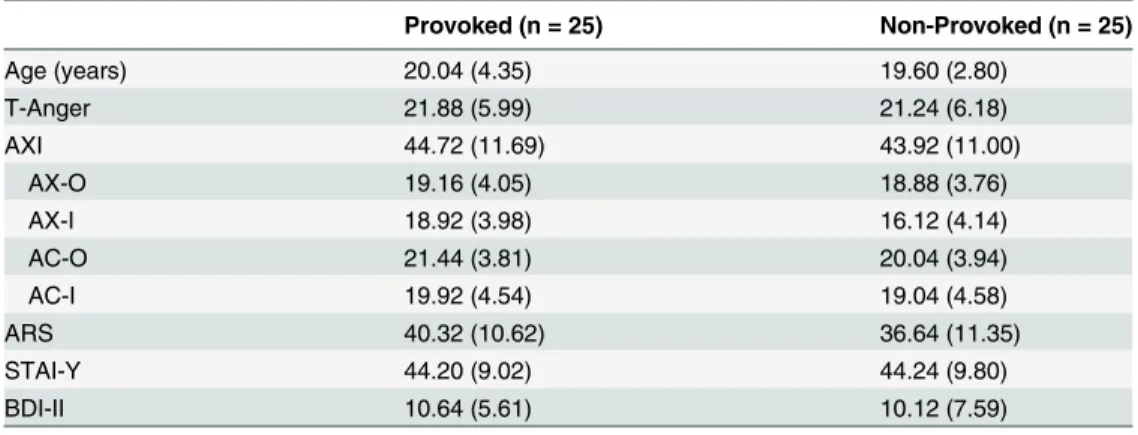
Table 4presents mean participant characteristics. There were no differences between groups in terms of participants’age, or scores on the STAXI-2: T-Anger, STAXI-2: AXI, AX-O, AC-O, AC-I, ARS, STAI-Y, or BDI-II scores.
Manipulation Checks
Table 5presents participants’ratings on the PANAS hostility subscale pre- and post-anagram feedback. A 2 (Provocation Group) x (2) (Time) mixed model ANOVA indicated a significant interaction effect [F(1, 47) = 16.47,p<.001,ηp2= .03]. Provoked participants scored higher on
Table 4. Experiment 2: Mean participant characteristics.
Provoked (n = 25) Non-Provoked (n = 25)
Age (years) 20.04 (4.35) 19.60 (2.80)
T-Anger 21.88 (5.99) 21.24 (6.18)
AXI 44.72 (11.69) 43.92 (11.00)
AX-O 19.16 (4.05) 18.88 (3.76)
AX-I 18.92 (3.98) 16.12 (4.14)
AC-O 21.44 (3.81) 20.04 (3.94)
AC-I 19.92 (4.54) 19.04 (4.58)
ARS 40.32 (10.62) 36.64 (11.35)
STAI-Y 44.20 (9.02) 44.24 (9.80)
BDI-II 10.64 (5.61) 10.12 (7.59)
Note: Standard deviations appear in parentheses. T-Anger = Trait Anger Scale; AXI = Anger Expression Index; AX-O = Anger Expression–Out; AX-I = Anger Expression–In; AC-O = Anger Control–Out;
AC-I = Anger Control–In; ARS = Anger Rumination Scale; STAI-Y = State-Trait Anxiety Inventory, Form Y;
BDI-II = Beck Depression Inventory, Second Edition.
the hostility scale following anagram feedback compared to baseline. In contrast, Non-Pro-voked participants scored lower on the hostility scale following anagram feedback compared to baseline.Table 5also presents facial expression scores following anagram feedback. Provoked participants demonstrated significantly more anger-related eye movements than Non-Pro-voked participants, [t(46) = 2.62,p<.03]. There were no differences between the two groups on anger-related eyebrow [t(46) = 0.43,p>.05] or mouth movement scores [t(46) = 1.02, p>.05]. Collectively, in view of PANAS and facial expression scores, it appears that the provo-cation manipulation successfully induced angry affect in Provoked participants.
Anger-Relatedness
Table 5presents mean anger-relatedness scores. A 2 (Provocation Group) x (3) (Cue Type) mixed model ANCOVA that controlled for depression indicated a significant main effect of Cue Type [F(2, 46) = 335.95,p<.001,ηp2= .94] but a nonsignificant main effect for Provoca-tion Group [F(1, 47) = 2.72,p>.05,ηp2= .05] and a nonsignificant interaction [F(2, 46) = 2.07, p>.05,ηp2= .08]. As expected, memories generated in response to angry cues received higher
anger-relatedness scores than memories generated in response to ambiguous [t(49) = 20.38,p <.001] and positive cues [t(49) = 29.28,p<.001]. Memories generated in response to positive cues received lower scores than memories generated in response to ambiguous cues [t(49) = 9.90,p<.001].
Memory Content
Table 6presents the mean number of memories coded into each of the three self-related con-tent categories (self-agent, self-target, other). A 2 (Provocation Group) x 3 (Cue Type) x 2 (Content Category) multivariate analysis of variance (MANOVA) indicated a significant over-all effect [F(6, 43) = 2.32,p<.05,ηp2= .24]. Separate 2 (Provocation Group) x 3 (Content) ANOCVAs that controlled for depression were subsequently conducted across angry, ambigu-ous, and positive cues. Analyses indicated that for angry cues, there was a significant main effect for Content, [F(2, 46) = 13.44,p<.001,ηp2= .37], and a significant interaction effect
[F(2, 46) = 5.12,p<.01,ηp2= .18] but a nonsignificant main effect for Provocation Group [F(1, 47) = 2.02,p>.05,ηp2= .001]. Participants recalled more Agent memories than
Self-Target [t(49) = 6.14,p<.001] and Other [t(49) = 3.57,p<.001] memories, and more Other
Table 5. Experiment 2: Mean PANAS ratings, facial expression scores, and anger-relatedness scores.
Provoked Non-Provoked
PANAS–Hostility
Pre-Feedback 1.24 (0.39) 1.50 (0.77)
Post-Feedback 1.62 (0.74) 1.29 (0.51)
Facial Expression
Eyebrows 1.10 (0.45) 1.17 (0.57)
Eyes 1.71 (0.91) 1.21 (0.59)
Mouth 3.63 (1.61) 3.13 (1.77)
Anger-Relatedness
Angry 5.61 (1.01) 5.08 (0.90)
Ambiguous 2.66 (0.88) 2.45 (0.78)
Positive 1.34 (0.30) 1.36 (0.63)
Note: Standard deviations appear in parentheses.
memories than Self-Target memories [t(49) = 2.59,p<.01]. Whereas Non-Provoked partici-pants recalled more Self-Agent memories than Provoked participartici-pants [t(48) = 2.65,p<.01], Provoked participants recalled more Self-Target memories than Non-Provoked participants [t
(48) = 2.56,p<.01]. For ambiguous cues, there was a significant main effect for Content [F(2, 46) = 25.38,p<.001,ηp2= .53], but a nonsignificant effect for Provocation Group [F(1, 47) =
2.00,p>.05,ηp2= .04] and the interaction [F(2, 46) = 2.36,p>.05,ηp2= .09]. Participants
recalled more Self-Agent memories than Self-Target [t(49) = 6.82,p<.001] and Other memo-ries [t(49) = 2.30,p<.02], and more Other memories than Self-Target memories [t(49) = 4.60, p<.001]. For positive cues, there was a significant main effect for Content [F(2, 46) = 137.94, p<.001,ηp2= .86] but a nonsignificant main effect for Provocation Group [F(1, 47) = 1.96,p
>.05,ηp2= .04] and a nonsignificant interaction [F(2, 46) = 0.33,p>.05,ηp2= .01].
Partici-pants recalled more Self-Agent memories than Self-Target [t(49) = 3.47,p<.001] and Other [t (49) = 15.88,p<.001] memories, and more Self-Target memories than Other memories [t(49) = 11.26,p<.001].
Finally, there were also no differences between groups in terms of the extent to which they thought about their performance on the anagram task during the AMT, t(42) = 1.19, p>.24.
These findings provide initial evidence of an autobiographical memory pattern associated with state anger that was independent of mood congruency, emotionality and affective tone effects. Specifically, anger induced via interpersonal provocation appears to be associated with the tendency to recall angry memories that are thematically and emotionally aligned with views of the self as the target of anger and injustice. In contrast, as in Experiment 1, in the absence of interpersonal provocation, angry memories are more likely to be aligned with views of the self as the agent of anger-related emotion. Both these findings are consistent with the Self-Memory System Model’s proposition that an individual’s current, activated working self-image will shape the nature of their autobiographical recall. Moreover, findings partly indicate that when provoked, participants are less likely to recall ambiguously-angry memories associ-ated with views of the self as the agent of anger, which may indicate increased sensitivity biases to ambiguous information.
General Discussion
Collectively, we observed reliable effects of HTA on the nature of recalled memories. Specifi-cally, HTA participants in Experiment 1 recalled more angry memories in which they described themselves as the primary agent of anger and related emotions compared to MTA and LTA participants. These participants were mimicked by Non-Provoked HTA (i.e., control) participants in Experiment 2, who also recalled more angry memories in which they were the agent of anger and related emotions compared to Provoked HTA participants. These findings are in line with our proposition that HTA may generally be associated with views of oneself as an angry person, and that HTA individuals will generate memories consistent with this
self-Table 6. Experiment 2: Mean number of self-agent, self-target, and other memories.
Provoked Non-Provoked
S-Agent S-Target Other S-Agent S-Target Other
Angry 1.96 (1.10) 1.12 (0.97) 1.36 (1.04) 2.84 (1.25) 0.52 (0.65) 1.36 (1.08)
Ambiguous 2.00 (1.29) 0.76 (0.83) 1.92 (1.22) 2.84 (1.21) 0.60 (0.82) 1.44 (1.04)
Positive 2.56 (0.77) 1.92 (0.81) 0.28 (0.54) 2.76 (0.93) 1.92 (0.76) 0.24 (0.44)
Note: Standard deviations appear in parentheses. S-Agent = Self-Agent; S-Target = Self-Target.
perception. These findings are also consistent with evidence from the broader psychopathology literature that individuals with complicated grief and PTSD tend to recall memories consistent with their self-image [21,23]. Thus, in terms of the Self-Memory System Model, trait anger may have constrained the accessibility and retrieval of particular autobiographical information via differentially activating self-representations associated with personal anger proneness and reactivity; this interpretation is speculative because we did not directly index
self-representations.
Provoked HTA participants in Experiment 2 displayed noticeable differences in their pat-terns of recall compared to Non-Provoked participants: they recalled more angry memories in which they were the primary target of anger and injustice and fewer memories to ambiguously-angry cues in which they were the primary agent of anger. These findings indicate that elevated state anger can significantly alter the nature of HTA individuals’autobiographical memories. Specifically, these findings are in line with our proposition that when angered (via interpersonal provocation), HTA individuals have activated views of themselves as the subject of injustice, and accordingly retrieve autobiographical information consistent with this image (or ignore information conflicting with this self-image). More generally, these findings suggest that manip-ulating state affect may alter goals, representations, and images associated with the working self, which in turn impacts the construction and retrieval of autobiographical information.
An individual’s autobiographical knowledge base contains a range of negative, anger-related experiences (as well as positive and neutral experiences). The findings from Experiments 1 and 2 distinguish between the impact of anger as stable, personality construct and anger as a tran-sient state on retrieval of information from the autobiographical knowledge base. The pattern of findings across the two studies provides strong support for the notion that accessibility of anger-related autobiographical memories, which is closely aligned with the working self, is dif-ferentially influenced by trait and state anger factors.
It is important to recognize that Provoked HTA participants in Experiment 2 demonstrated elevated levels of state anger in a specific context; anger representations were activated and retrieval searches were guided via an interaction that was highly salient, provocative, and inter-personal [36] [37]. In light of these circumstances, changes to state affect and the working self seemed to facilitate the recall of memories that promoted, and perhaps even reinforced, images of the self as targets (rather than agents) of anger and injustice. Thus, it is possible that changes in the working self that occur when state anger is induced—but in a context free of interper-sonal provocation (e.g., via exposure to anger-inducing material [38])—may motivate alternate patterns in the content of recalled autobiographical memories.
Our findings shed new light on how autobiographical memory may function in angry indi-viduals and the role of the dynamic working self in the retrieval of anger-related autobiographi-cal information. We note that we cannot exclude the possibility that the results may be
influenced by mood congruency effects [39]. These studies did not closely assess emotional reactivity in association with changing anger levels. Future studies should consider the role of anger in the context of other emotional states to isolate the effect of anger on autobiographical memory from other emotional states.
absence of provocation (Experiment 1) HTA participants generated memories which described themselves as the primary instigator of anger, following provocation (Experiment 2) they described themselves more so as the target or recipient of anger. Collectively, these findings suggest that both trait and state anger are associated with an underlying retrieval search bias specific to angry memories and also, to a lesser extent, ambiguously-angry memories. This memory search bias may be related to other cognitive processes associated with HTA. In par-ticular, these findings are consistent with evidence indicating that HTA individuals display selective attention biases to anger-related stimuli in the absence of provocation [40,41] as well as following provocation [42–44]. These findings are also in line with evidence highlighting that HTA individuals display reasoning biases to ambiguously hostile information [45,46]. Taking into account the distinct patterns in the content of recalled memories across the two studies, this search bias may also emerge from current activations in an individual’s self-image.
These findings have implications for understanding the way in which anger shapes the working self and subsequently, the way in which the self interacts with autobiographical infor-mation to propagate or maintain anger symptoms. General anger-proneness or activated views of oneself as a victim of injustice and the retrieval of memories consistent with either or both of these images may contribute to ongoing emotional reactivity, and even increased vigilance to anger-provoking stimuli, when confronted by potential threat and injustice. Relatedly, the cyclical interaction between anger, the self and autobiographical memory may reduce an angry individual’s ability to exert effortful control (i.e., inhibit dominant responses, detect errors, and engage in planning [47]) in order to regulate anger [48]. In turn, these factors may contribute to the maintenance of anger reactions.
We acknowledge limitations of the present research. First, it is possible that the mood induction used in Experiment 2 promoted a ruminative response, which in turn may have influenced the content of recalled memories. We did not index rumination in relation to the specific experimental tasks, including the provocation procedure, and so we cannot conclude the role that rumination may have played in the observed retrieval patterns. In light of evidence that rumination impacts on autobiographical memories [49,50], future research should study the role of rumination following anger inductions and the impact on autobiographical mem-ory. Second, we did not measure physiological arousal, which is a typical feature of state anger [51]. Future studies should experimentally manipulate arousal levels to index the impact of physiological arousal because this can impact on executive control capacity, which in turn influences autobiographical retrieval [52]. Third, although the mood induction was successfully administered, social demands associated with the university experimental setting (e.g., univer-sity students participating in exchange for course credit) may have limited the degree to which participants experienced/expressed anger. We were not able to accurately index the extent to which participants were aware of the intent of the anger provocation, which may have influ-enced their responses. Future studies are needed to examine the generalizability of these find-ings to community and clinical populations. Fourth, it is possible that numerous other factors may have driven the observed effects, such as sex, depression, attitudinal factors, or sociode-mogrpahic variables; future studies need to be adequately powered and use suitable measures to control for these variables. Fifth, we did not include a LTA control group in Experiment 2. Finally, we did not index the full range of facial responses according to the Ekman scoring sys-tem for facial emotion expression [35]; this may have provided a more accurate index of anger expression.
This suggests that concentrated efforts to change one’s experiences of anger (maladaptive) self-image may produce powerful effects in memory retrieval and anger symptoms. Developing the research base of the role of autobiographical memory associated with anger has the potential to markedly enhance the current models of anger.
Supporting Information
S1 Study 1 Data.
(SAV)
S2 Study 2 Data.
(SAV)
Author Contributions
Conceived and designed the experiments: LH RAB. Performed the experiments: LH. Analyzed the data: LH RAB. Wrote the paper: LH RAB.
References
1. Conway MA, Pleydell-Pearce CW (2000) The construction of autobiographical memories in the self-memory system. Psychological Review 107: 261–288. PMID:10789197
2. Fivush R, McDermott Sales J, Bohanek JG (2008) Meaning making in mothers' and children's narra-tives of emotional events. Memory 16: 579–594. doi:10.1080/09658210802150681PMID:18569686
3. Williams JMG, Barnhofer T, Crane C, Hermans D, Raes F, Watkins E., et al. (2007) Autobiographical memory specificity and emotional disorder. Psychological Bulletin 133: 122–148. PMID:17201573
4. Evans J, Williams JM, O'Loughlin S, Howells K (1992) Autobiographical memory and problem-solving strategies of parasuicide patients. Psychol Med 22: 399–405. PMID:1615107
5. Williams JMG (1996) Depression and the specificity of autobiographical memory. In: Rubin DC, editor. Remembering Our Past: Studies in Autobiographical Memory. Cambridge: Cambridge University Press. pp. 244–267.
6. Sutherland K, Bryant RA (2008) Autobiographical memory and the self-memory system in posttrau-matic stress disorder. J Anx Disord 22: 555–560.
7. Sutherland K, Bryant RA (2008) Social problem solving and autobiographical memory in posttraumatic stress disorder. Behav Res Ther 46: 154–161. PMID:18022601
8. Maccallum F, Bryant RA (2010) Impaired autobiographical memory in complicated grief. Behaviour Research and Behav Res Ther 48: 328–334.
9. Maccallum F, Bryant RA (2011) Autobiographical memory following cognitive behaviour therapy for complicated grief. J Behav Ther Expel Psychiatry 42: 26–31.
10. Kashdan TB, Breen WE, Afram A, Terhar D (2010) Experiential avoidance in idiographic, autobiograph-ical memories: construct validity and links to social anxiety, depressive, and anger symptoms. J Anx Disord 24(5):528–34.
11. Fabiansson EC, Denson TF, Moulds ML, Grisham JR, Schira MM (2012) Don't look back in anger: neu-ral correlates of reappraisal, analytical rumination, and angry rumination during recall of an anger-inducing autobiographical memory. Neuroimage 59(3):2974–81. doi:10.1016/j.neuroimage.2011.09.
078PMID:22015853
12. Urbanowitsch N, Gorenc L, Herold CJ, Schroder J. (2013) Autobiographical memory: a clinical perspec-tive. Front Behav Neurosci; 7:194. doi:10.3389/fnbeh.2013.00194PMID:24339804
13. Moore SA, Zoellner LA (2007) Overgeneral autobiographical memory and traumatic events: An evalua-tive review. Psychol Bull 133(3):419–37. PMID:17469985
14. Berkowitz L, Harmon-Jones E (2004) Toward an understanding of the determinants of anger. Emotion 4: 107–130. PMID:15222847
15. Novaco RW, Stemmler G, Spielberger C (2010) Anger and psychopathology. In: Potegal GSCS M., edi-tor. International handbook of anger New York:: Springer. pp. 465–497.
Constituent andconcomitant biological, psychological, and social processes New York: Springer. pp. 287–310.
17. Lewis M (2010) The development of anger. In: Potegal GSCS M., editor. International handbook of anger. New York: Springer. pp. 177–191.
18. Ratnasingam P, Bishop GD (2007) Social support schemas, trait anger, and cardiovascular responses. Int J Psychophysiol 63: 308–316. PMID:17275113
19. Wenzel A, Jordan J (2005) Autobiographical memory in angry and anxious individuals. Behav Res Ther 43: 1099–1109. PMID:15967178
20. Owen JM (2011) Transdiagnostic cognitive processes in high trait anger. Clin Psychol Rev 31: 193–
202. doi:10.1016/j.cpr.2010.10.003PMID:21094569
21. Maccallum F, Bryant RA (2008) Self-defining memories in complicated grief. Behav Res Ther 46: 1311–1315. doi:10.1016/j.brat.2008.09.003PMID:18977471
22. McNally RJ, Lasko NB, Macklin ML, Pitman RK (1995) Autobiographical memory disturbance in com-bat-related posttraumatic stress disorder. Behav Res Ther 33: 619–630. PMID:7654154
23. Sutherland K, Bryant RA (2005) Self-defining memories in post-traumatic stress disorder. Br J Clin Psy-chol 44: 591–598. PMID:16368036
24. Williams JM, Broadbent K (1986) Autobiographical memory in suicide attempters. J Abnorm Psychol 95: 144–149. PMID:3711438
25. Spielberger CD, Sydeman SJ, Owen AE, Marsh BJ (1999) Measuring anxiety and anger with the State-Trait Anxiety Inventory (STAI) and the State-State-Trait AngerExpression Inventory (STAXI). In: Maruish ME, editor. The use of psychological testing for treatment planning and outcomes assessment Mahwah, NJ: Lawrence Erlbaum. pp. 993–1021.
26. Buss AH, Durkee A (1957) An inventory for assessing different kinds of hostility. J Counsel Psychol 21:343–9.
27. Sukhodolsky DG, Golub A, Cromwell EN (2001) Development and validation of the anger rumination scale. Pers Ind Differ 31: 689–700.
28. Spielberger CD, Gorsuch R.L., Lushene R., Vagg P.R., Jacobs G.A. (1983) Manual for the State-Trait Anxiety Inventory. Palo Alto, CA.
29. Beck AT, Steer RA, Brown GK (1996) Beck Depression Inventory-Second Edition. San Antonio, TX: The Psychological Corporation.
30. Watson D, Clark LA (1991) The PANAS-X: Manual for the Positive and Negative Affect Schedule–
Expanded Form. University of Iowa: Department of Psychology Publications.
31. Kućera H, Francis WN (1967) Computational analysis of present-day American English. Providence, RI: Brown University Press.
32. Harmon-Jones E, Amodio DM, Zinner LR (2007) Social psychological methods in emotion elicitation. In: Allen JACJJB, editor. Handbook of emotion elicitation and assessment. New York: Oxford Univer-sity Press. pp. 91–105.
33. Lobbestael J, Arntz AR, Wiers RW (2008) How to push someone's buttons: a comparison of four anger-induction methods. Cogn Emot 22: 353–373.
34. Denson TF, White AJ, Warburton WA (2009) Trait displaced aggression and psychopathy differentially moderate the effects of acute alcohol intoxication and rumination on triggered displaced aggression. J Res Pers 43: 673–681.
35. Ekman P, Friesen WV, Hager JC (2002) Facial action coding system. Salt Lake City, UT: Research Nexus, Network Research Information.
36. Christie IC, Friedman BH (2004) Autonomic specificity of discrete emotion and dimensions of affective space: A multivariate approach. Int J Psychophysiol 51: 143–153. PMID:14693364
37. Engebretson TO, Sirota AD, Niaura RS, Edwards K, Brown WA (1999) A simple laboratory method for inducing anger: a preliminary investigation. J Psychosom Res 47: 13–26. PMID:10511418
38. Harmon-Jones E, Sigelman JD, Bohlig A, Harmon-Jones C (2003) Anger, coping, and frontal cortical activity: The effect of coping potential on anger-induced left frontal activity. Cognit Emot 17: 1–24.
39. Bower G (1981) Mood and memory. Amer Psycholog 36: 129–148.
40. Smith P, Waterman M (2005) Sex differences in processing aggression words using the emotional Stroop task. Aggress Behav 31: 271–282.
42. Wilkowski BM, Robinson MD (2010) The anatomy of anger: An integrative cognitive model of trait anger and reactive aggression. J Pers789–38.
43. Cohen DJ, Eckhardt CI, Schagat KD (1998) Attention allocation and habituation to anger-related stimuli during a visual search task. Aggress Behav 24: 399–409.
44. Eckhardt CI, Cohen DJ (1997) Attention to anger-relevant and irrelevant stimuli following naturalistic insults. Pers Ind Diff 23: 619–629.
45. Epps J, Kendall PC (1995) Hostile attributional bias in adults. Cogn Ther Res 19: 159–178.
46. Wenzel A, Lystad C (2005) Interpretation biases in angry and anxious individuals. Behav Res Ther 43: 1045–1054. PMID:15967175
47. Wilkowski BM, Robinson MD (2010) The anatomy of anger: An integrative cognitive model of trait anger and reactive aggression. J Pers 78:9–38. doi:10.1111/j.1467-6494.2009.00607.xPMID:
20433611
48. Wilkowski BM, Robinson MD (2008) Guarding against hostile thoughts: Trait anger and the recruitment of cognitive control. Emotion 8: 578–583. doi:10.1037/1528-3542.8.4.578PMID:18729588
49. Watkins E, Teasdale JD, Williams RM (2000) Decentring and distraction reduce overgeneral autobio-graphical memory in depression. Psychol Med 30: 911–920. PMID:11037099
50. Watkins E, Teasdale JD (2001) Rumination and overgeneral memory in depression: effects of self-focus and analytic thinking. J Abnorm Psychol 110: 353–357. PMID:11358029
51. Chida Y, Hamer M (2008) Chronic psychosocial factors and acute physiological responses to labora-tory-induced stress in healthy populations: a quantitative review of 30 years of investigations. Psychol Bull 134: 829–885. doi:10.1037/a0013342PMID:18954159

![Table 5 presents mean anger-relatedness scores. A 2 (Provocation Group) x (3) (Cue Type) mixed model ANCOVA that controlled for depression indicated a significant main effect of Cue Type [F(2, 46) = 335.95, p < .001, η p 2 = .94] but a nonsignificant ma](https://thumb-eu.123doks.com/thumbv2/123dok_br/17250720.245692/10.918.298.867.135.367/presents-relatedness-provocation-controlled-depression-indicated-significant-nonsignificant.webp)

