Submitted8 July 2016
Accepted 22 November 2016
Published22 December 2016
Corresponding author
Stephanie M. Rosales, [email protected]
Academic editor
Peter Prentis
Additional Information and Declarations can be found on page 17
DOI10.7717/peerj.2819
Copyright
2016 Rosales and Vega Thurber
Distributed under
Creative Commons CC-BY 4.0
OPEN ACCESS
Brain transcriptomes of harbor seals
demonstrate gene expression patterns of
animals undergoing a metabolic disease
and a viral infection
Stephanie M. Rosales and Rebecca L. Vega Thurber
Department of Microbiology, Oregon State University, Corvallis, OR, United States
ABSTRACT
Diseases of marine mammals can be difficult to diagnose because of their life history and protected status. Stranded marine mammals have been a particularly useful resource to discover and comprehend the diseases that plague these top predators. Additionally, advancements in high-throughput sequencing (HTS) has contributed to the discovery of novel pathogens in marine mammals. In this study, we use a combination of HTS and stranded harbor seals (Phoca vitulina) to better understand a known and unknown brain disease. To do this, we used transcriptomics to evaluate brain tissues from seven neonatal harbor seals that expired from an unknown cause of death (UCD) and compared them to four neonatal harbor seals that had confirmed phocine herpesvirus (PhV-1) infections in the brain. Comparing the two disease states we found that UCD animals showed a significant abundance of fatty acid metabolic transcripts in their brain tissue, thus we speculate that a fatty acid metabolic dysregulation contributed to the death of these animals. Furthermore, we were able to describe the response of four young harbor seals with PhV-1 infections in the brain. PhV-1 infected animals showed a significant ability to mount an innate and adaptive immune response, especially to combat viral infections. Our data also suggests that PhV-1 can hijack host pathways for DNA packaging and exocytosis. This is the first study to use transcriptomics in marine mammals to understand host and viral interactions and assess the death of stranded marine mammals with an unknown disease. Furthermore, we show the value of applying transcriptomics on stranded marine mammals for disease characterization.
SubjectsBioinformatics, Marine Biology, Microbiology, Veterinary Medicine, Virology
Keywords Marine mammal, Phocine herpesvirus, Fatty acid metabolism, High-throughput sequencing,Burkholderia
INTRODUCTION
The combination of high-throughput sequencing (HTS) and stranded marine mammals for disease discovery
remain unknown. In 2007, it was reported that only 56% of marine mammal mortality events had a known cause of death (Gulland & Hall, 2007), leaving the pathogens and physiological causes of many diseases to be discovered. However, the introduction of high-throughput sequencing (HTS) has led to the identification of many more marine mammal pathogens, such as seal and California sea lion anellovirus, phocine herpesvirus 7, and seal parvovirus (Ng et al., 2009;Ng et al., 2011;Bodewes et al., 2013;Kuiken et al., 2015). Therefore, the combination of stranded animals and HTS are vital resources for the discovery of marine mammal diseases.
HTS and gene expression studies to understand disease in marine mammals
Although the discovery of new diseases can aid in the conservation of marine mammal populations, there is also a need to further describe known marine mammal diseases that are not fully understood. For example, phocine herpesvirus-1 (PhV-1) was discovered in 1985 and is highly abundant in North American harbor seal adults (99%). It is particularly pathogenic to young seals causing ∼46% mortality (Osterhaus et al., 1985;
Harder et al., 1996;Gulland et al., 1997). Despite PhV-1′s deleterious impacts, we have little
understanding of the effects of PhV-1 on host gene expression. Previous marine mammal studies have identified pinniped immune responses against PhV-1 using enzyme-linked immunosorbent (ELISA), but this offers minimal information about the disease (Harder et al., 1998). Marine mammal studies have applied targeted gene expression techniques using RT-qPCR to examine immune and endocrine responses to immunotoxins and physiological changes (Neale et al., 2005;Hammond, 2005;Tabuchi et al., 2006). However, ELISA and RT-qPCR target a limited number of host gene expressions; thus they do not represent the global host response.
HTS is a powerful resource for assessment of both the etiology of a disease and the response of the host during disease events. For example, using transcriptomic analysis, scientists were able to determine that a toxin caused a mass mortality event of abalone, pinpoint the origin of the toxin, and access the genetic effects on the abalone population (De Wit et al., 2014). However, transcriptomic analysis has rarely been used to comprehend the effects of stressors and diseases on marine mammal health. There has been some increase in marine mammal transcriptomic studies, such as a study byHoffman et al. (2013)which suggested thatpost-mortemsamples can be reliable resources for genomic studies. Yet, there have been few studied that use transcriptomics to measure physiological stress responses in marine mammals, and there have been no studies that looked at pathogen responses in these megafauna (Mancia et al., 2014;Niimi et al., 2014;Khudyakov et al., 2015a;Khudyakov et al., 2015b;Fabrizius et al., 2016).
Former work on a harbor seal stranding event using HTS
or ‘‘UCD.’’ These seven animals had neuronal necrosis in the cortex and cerebellum, which veterinarians hypothesized was due to hypoxia, exposure to toxins, poor nutrition, or a viral infection. However, a viral etiology was thought to be the most likely culprit given the distri-bution and characteristics of the brain lesions, and general gross pathology of the animals. Additionally, we used PhV-1 infected harbor seals, to benchmark our methods and to compare our analysis to animals with a described disease. Our analysis showed no evidence of a viral infection in UCD samples, but we were able to detect PhV-1 in PhV-1 infected samples. Interestingly, in our study, we found a significant presence ofBurkholderiabacteria in UCD animals. Yet, necropsy reports were contradictory to this finding suggesting that eitherBurkholderiawere part of a secondary or opportunistic infection or elusive in the original dissections (Rosales & Vega Thurber, 2015). Therefore, this leaves the cause of death of this cohort of UCD animals unresolved.
In this study, we further evaluated this dataset by using transcriptomic analysis to better understand the cause of death of the seven neonatal harbor seals that died from an unknown brain disease. Additionally, we aimed to use transcriptomics to characterize the gene expression of four neonatal harbor seals with a known PhV-1 brain infection. We hypothesized that animals responding to a PhV-1 infection should exhibit increases in host-virus response genes, while UCD animals would have characteristic gene repertoires of animals with a bacterial infection and/or hypoxia, exposure to toxins, or poor nutrition. To examine this, we looked at significant gene expression alterations of UCD and PhV-1 infected harbor seals.
MATERIALS AND METHODS
This work was authorized by the National Marine Fisheries (NMFS) for possession of tissue samples from stranded marine mammals. This work is in compliance with the Marine Mammal Protection Act (MMPA) regulation 50 CR 216.22 and 216.37.
In this study, we aimed to use transcriptomics to identify the cause of death of harbor seals that died from an unidentified brain disease and to characterize host pathways of harbor seals during a PhV-1 infection. For transcriptome analysis, 11 harbor seal brain tissue samples were evaluated. The harbor seal brain tissues were kindly provided by the Marine Mammal Center (MMC) in Sausalito, CA, USA, where the animals expired. Brain tissues were stored at−80◦C and belonged to the cerebrum with the exception of
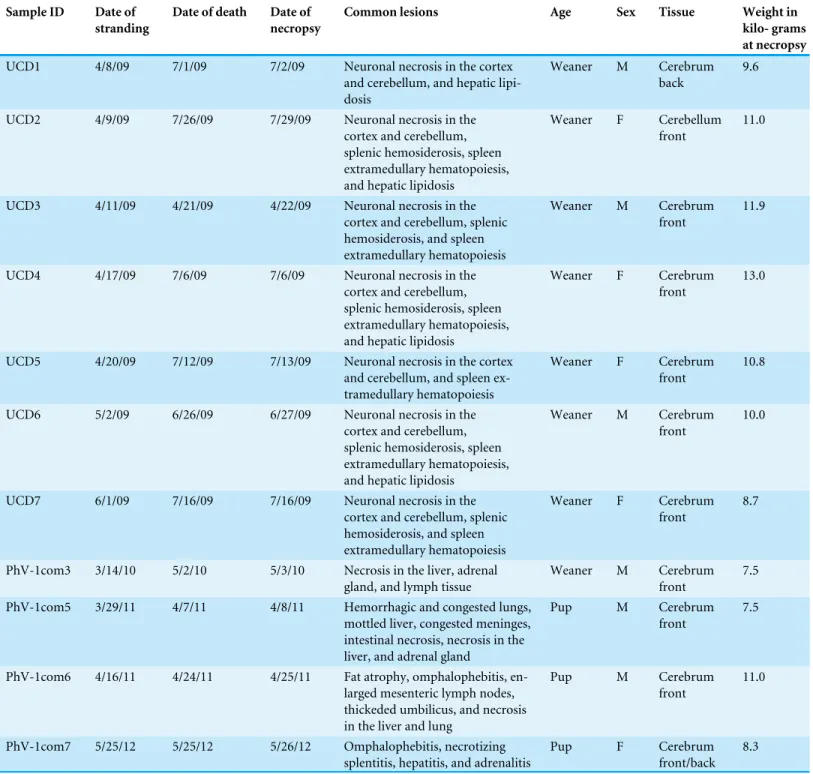
sample UCD2, which was tissue from the cerebellum. Stranded animals were collected from 2009–2012, and necropsied from fresh carcasses soon after death (Table 1, Date of necropsy). Samples ranged in age at the time of stranding, from weaner (<1 month,n=8) to pup (<1 year, n=3). All UCD harbor seals had neuronal necrosis in the cortex and
cerebellum. Other common disease signs described in these animals were: hepatic lipidosis (4/7), spleen hemosiderosis (5/7), and spleen extramedullary hematopoiesis (6/7).Table 1 details a summary of necropsy reports.
Transcriptome library preparation
Table 1 Stranding information for harbor seal samples used in this study.
Sample ID Date of stranding
Date of death Date of necropsy
Common lesions Age Sex Tissue Weight in kilo- grams at necropsy
UCD1 4/8/09 7/1/09 7/2/09 Neuronal necrosis in the cortex and cerebellum, and hepatic lipi-dosis
Weaner M Cerebrum back
9.6
UCD2 4/9/09 7/26/09 7/29/09 Neuronal necrosis in the cortex and cerebellum, splenic hemosiderosis, spleen extramedullary hematopoiesis, and hepatic lipidosis
Weaner F Cerebellum front
11.0
UCD3 4/11/09 4/21/09 4/22/09 Neuronal necrosis in the cortex and cerebellum, splenic hemosiderosis, and spleen extramedullary hematopoiesis
Weaner M Cerebrum front
11.9
UCD4 4/17/09 7/6/09 7/6/09 Neuronal necrosis in the cortex and cerebellum, splenic hemosiderosis, spleen extramedullary hematopoiesis, and hepatic lipidosis
Weaner F Cerebrum front
13.0
UCD5 4/20/09 7/12/09 7/13/09 Neuronal necrosis in the cortex and cerebellum, and spleen ex-tramedullary hematopoiesis
Weaner F Cerebrum front
10.8
UCD6 5/2/09 6/26/09 6/27/09 Neuronal necrosis in the cortex and cerebellum, splenic hemosiderosis, spleen extramedullary hematopoiesis, and hepatic lipidosis
Weaner M Cerebrum front
10.0
UCD7 6/1/09 7/16/09 7/16/09 Neuronal necrosis in the cortex and cerebellum, splenic hemosiderosis, and spleen extramedullary hematopoiesis
Weaner F Cerebrum front
8.7
PhV-1com3 3/14/10 5/2/10 5/3/10 Necrosis in the liver, adrenal gland, and lymph tissue
Weaner M Cerebrum front
7.5
PhV-1com5 3/29/11 4/7/11 4/8/11 Hemorrhagic and congested lungs, mottled liver, congested meninges, intestinal necrosis, necrosis in the liver, and adrenal gland
Pup M Cerebrum
front
7.5
PhV-1com6 4/16/11 4/24/11 4/25/11 Fat atrophy, omphalophebitis, en-larged mesenteric lymph nodes, thickeded umbilicus, and necrosis in the liver and lung
Pup M Cerebrum
front
11.0
PhV-1com7 5/25/12 5/25/12 5/26/12 Omphalophebitis, necrotizing splentitis, hepatitis, and adrenalitis
Pup F Cerebrum
front/back 8.3
in TRIzol (Life Technologies, Carlsbad, CA, USA). The homogenate was centrifuged for 10 min at 12,000×g at 4◦C, and the supernatant transferred to a clean tube. For every 1 mL of
Trizol, 0.2mL of chloroform was added to the supernatant, vortexed briefly, and centrifuged at 10,000×g for 18 min at 4◦C. The aqueous layer was then transferred to a clean tube
column for extraction as recommended by the manufacturer (Qiagen, Hilden, Germany). To remove DNA, samples were exposed to 2U of Turbo DNase (Life Technologies) for 9 h at
37◦C. Harbor seal rRNA was removed using the Ribo-Zero Kit Gold (Human-Mouse-Rat)
from Epicentre (WI, USA) following the manufacturer’s directions. High-quality RNA was converted to cDNA using superscript II Reverse Transcriptase (Life Technologies). Libraries were prepared for each of the 11 samples using the TruSeq paired-end cluster kit v.3 from Illumina (San Diego, CA, USA). Libraries were sequenced on two lanes of the Illumina Hi-Seq 2000 platform. Each lane had a random mixture of both harbor seal groups (UCD and PhV-1 infected animals).
Bioinformatic quality control and analysis
Using FqTrim the data was quality filtered with a minimum Phred score of 30. Sequences were trimmed and adapters and poly-A tails removed (Geo Pertea, 2015). In addition, post- FqTrim sequences were trimmed a second time, to ensure all sequence lengths were a minimum of 75 bps long. Transcriptome assembly was then conducted using a
combination of transcriptome-guided andde novomethods. All quality assured sequence
reads from both libraries were combined and aligned to the hypothetical Weddell seal, Leptonychotes weddellii, transcriptome (NCBI accession: PRJNA232772), using the program Bowtie2-2.2.3 (Langmead & Salzberg, 2012). Aligned sequences were then used to build ade novoharbor seal transcriptome using Trinity 2.0.6 with parameters –single, and –full-cleanup (Haas et al., 2013). Statistics for the assembly were obtained with Transrate v1.0.3 (Smith-Unna et al., 2016). The longest representative transcript for each component or subcomponent in the transcriptome assembly was selected using trinity_reps.pl (https://goo.gl/EGq7I6). To calculate the number of transcripts for each library, the 11 libraries were first individually aligned against the de novotranscriptome using trinity’s align_and_estimate_abundance.pl with options –aln_method bowtie2 – and –trinity_mode–prep_reference (Haas et al., 2013). The aligned sequences from each library were counted using the script SamFilter_by_components.pl (http://goo.gl/kkvqdK).
Differentially expressed genes (DEGs) between UCDs and PhV-1 infected seals
To normalize gene counts and determine differentially expressed genes (DEGs) between animals infected with PhV-1 and those with an unknown cause of death (UCD), the count data were analyzed using R version 3.2.2 with software packages Bioconductor 3.1 and DESeq2-1.8.2. For each gene, DESeq2 fits a log generalized linear model with a negative binomial distribution to normalize genes abundances (Love, Huber & Anders, 2014). Transcripts were significantly different if they had at least an adjusted p-value≤0.05.
Importantly, since in this study we compared two diseases with no true control samples, a positive log fold change was considered up-regulated in UCD samples, while if the log fold change was negative it was considered up-regulated in PhV-1 infected samples.
Gene Ontology (GO) enrichment analysis
The transcriptome assembly was then annotated with an e-value of ≤10−20 using
gene names to transcripts using the UniProt database downloaded in 2014 (Magrane & Consortium, 2011). Gene ontology (GO) was assigned to the annotated transcriptome with the script GOFromGeneAnnotation.pl (http://goo.gl/jJ4vg9). Transcript IDs with assigned GO terms were then combined with their respective DESeqp-values.
The software package ErmineJ 3.0.2 was then applied to evaluate the biological pathways associated with each differentially expressed GO term (Lee et al., 2005). The analysis was run with the options: gene score resampling (GSR, which does not require a threshold and thus evaluates allp-values), a maximum gene set of 100, a minimum gene set of 20, a maximum iteration of 200,000, and full resampling. GO terms with GOp-values≤0.05 and a multifunctionality of≤0.85 were semantically summarized and visualized with REViGO
with an allowed similarity of 0.90, the most conservative setting (Supek et al., 2011).
KEGG analysis
For KegArray analysis, the harbor seal transcriptome was translated to protein reads with
TransDecoder 2.0 (Haas et al., 2013). The program KAAS (KEGG Automatic Annotation
Server) was used to annotate translated transcripts with BLASTx against a manually curated KEGG GENES database (Kanehisa, 2000;Moriya et al., 2007). The KAAS options used were ‘partial genome’ and ‘bi-directional best hit’ (BBH). KEGG ontology (KO) assignments with a respective DESeq padj value≤ 0.05 were used for further analysis.
KegArray was then utilized to map KO pathways and CytoKegg, (a Cytoscape application
(http://apps.cytoscape.org/apps/cytokegg)) to visualize specific KO pathways.
Spearman correlation analysis
To evaluate correlations between the significantly high fatty acid metabolic genes in UCDs and the significantly highBurkholderiatranscript abundances, we conducted a Spearman correlation analysis. All UCD normalized (by DESeq2) transcript counts that fell within the fatty acid metabolism GO category by ErmineJ were used for this analysis. Also, UCD
Burkholderia normalized (by DESeq2) transcript abundance values from our previous research were obtained (Rosales & Vega Thurber, 2015). A Spearman correlation analysis was then conducted with R 3.2.2 using function cor.test.
RESULTS
Harbor seal brain transcriptome assembly
In this study, we generated 11 harbor seal brain transcriptome libraries to distinguish genes expressed in the brains of harbor seals during a PhV-1 infection and from an unknown etiology. Of note, from here on, we will refer to PhV-1 infected samples as PhV-1 comparative or PhV-1com as they were referred to as ‘‘comparative’’ in previous work (Rosales & Vega Thurber, 2015). From the 11 libraries, the Hi-Seq 2,000 produced a total of 546,003,190 reads of 100 bps in length. Libraries ranged from 41,767,080 to
58,031,096 sequences, with means of 47,800,849 (SEM =1,199,797) and 52,849,311
(SEM=1,929,808) sequences, for UCD and PhV-1com samples, respectively. The data
To build the harbor seal transcriptome necessary for our downstream analyses, we used a combination of a transcriptome guided approach with theLeptonychotes weddellii
transcriptome (NCBI accession:PRJNA232772) andde novomethods. The 11 libraries were aligned to theLeptonychotes weddelliihypothetical transcriptome. A total of 163,769,951 sequences aligned which equated to 27.43% of the total data. These sequences were then used for thede novoconstruction of the harbor seal transcriptome and is available on figshare (https://dx.doi.org/10.6084/m9.figshare.3581712.v1). Next, each library was aligned to the harbor sealde novotranscriptome with alignments ranging from 17.1% to 28.05% and there were no significant differences between PhV-1com and UCD alignments (Welch Two Samplet-test,p-value=0.2825).
UCD and PhV-1 infected seals show distinct gene expression profiles
The transcriptome guided and de novo approach resulted in a harbor seal brain
transcriptome of 32,856 transcripts. Next, the longest representative read was selected for each component and 29,512 transcripts remained with an average length of 269 bps. The maximum transcript length was 54,385 bps, with a minimum length of 224 bps
(Figs. S1AandS1B). Using BLASTx, 25,840 (∼87.5%) transcripts had significant similarity
to proteins in the UniProt database. A total of 1,962 differentially expressed genes (DEG) were identified as measured by a padj of≤0.05 (the data is available on figshare
https://dx.doi.org/10.6084/m9.figshare.3767307.v1 andhttps://dx.doi.org/10.6084/m9.
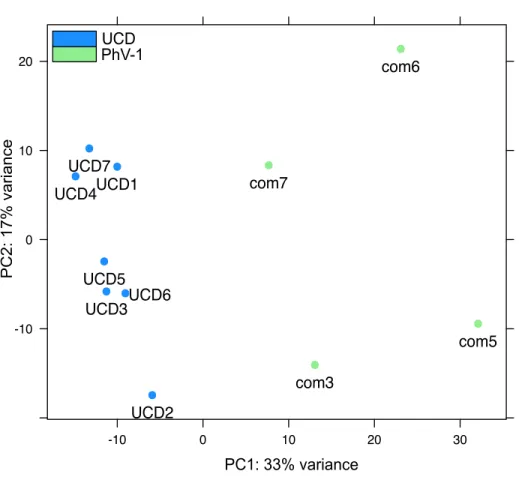
figshare.3766986.v1). Datasets appear to have distinct gene expression profiles, with UCD
samples exhibiting tighter clustering than PhV-1com samples (Fig. 1).
Functional annotation of differently expressed genes distinguishes UCD from PhV-1 infected harbor seals
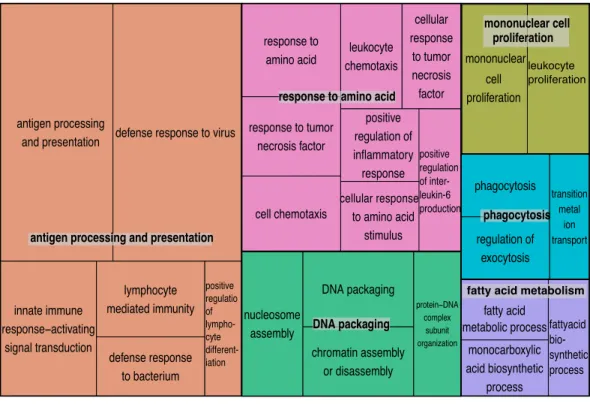
We explored enriched gene categories in the data by performing a gene ontology (GO) analysis. In our pipeline, we identified 19,788 GO terms in the harbor seal transcriptome. After filtering based on GO term p-values and multifunctionality (values generated by ErmineJ), 32 GO terms remained and from these terms the four most significantly enriched were: (1) ‘‘antigen processing and presentation’’ (p-value =1.00e−12), (2) ‘‘defense response to virus’’ (p-value=1.00e−12), (3) ‘‘response to virus’’ (p-value=
1.00e−12), and (4) ‘‘innate immune response-activating signal transduction’’ (p-value
PhV-1
PC1: 33% variance
P
C2:
17%
var
iance
Figure 1 Batch effects on transcripts from the brain tissue of harbor seal samples.Principal Coordinate
Analysis (PCA) of all annotated transcripts in both PhV-1com and UCD harbor seals.
(Fig. 3). In addition, three out of four PhV-1com samples showed gene enrichment for
bacterial infection, but a bacterial host response was not apparent in UCDs (Fig. S2).
KEGG analysis reveals host responses to phocine herpesvirus-1 infection
antigen processing and presentation
defense response to bacterium
defense response to virus
innate immune response−activating
signal transduction lymphocyte mediated immunity positive regulatio of lympho-cyte
different-iation chromatin assembly
or disassembly DNA packaging
nucleosome assembly
protein−DNA complex subunit organization fattyacid bio-synthetic process fatty acid metabolic process monocarboxylic acid biosynthetic process mononuclear cell proliferation phagocytosis regulation of exocytosis transition metal ion transport cell chemotaxis cellular response to amino acid
stimulus cellular response to tumor necrosis factor leukocyte chemotaxis positive regulation of inflammatory response positive regulation of inter-leukin-6 production response to amino acid
response to tumor necrosis factor
antigen processing and presentation
DNA packaging
mononuclear cell proliferation
phagocytosis response to amino acid
fatty acid metabolism leukocyte proliferation
Figure 2 Semantically summarized GO terms.Tree map summary of 32 significantly enriched GO
terms (p-value≤0.05, and multifunctionality≤0.85) of both UCD and PhV-1 samples. The blocks are clustered by related terms and the size of the boxes are based on log10 transformedp-values from GO enrichment analysis. Larger boxes represent more significantp-values.
Correlations ofBurkholderia and UCD fatty acid genes
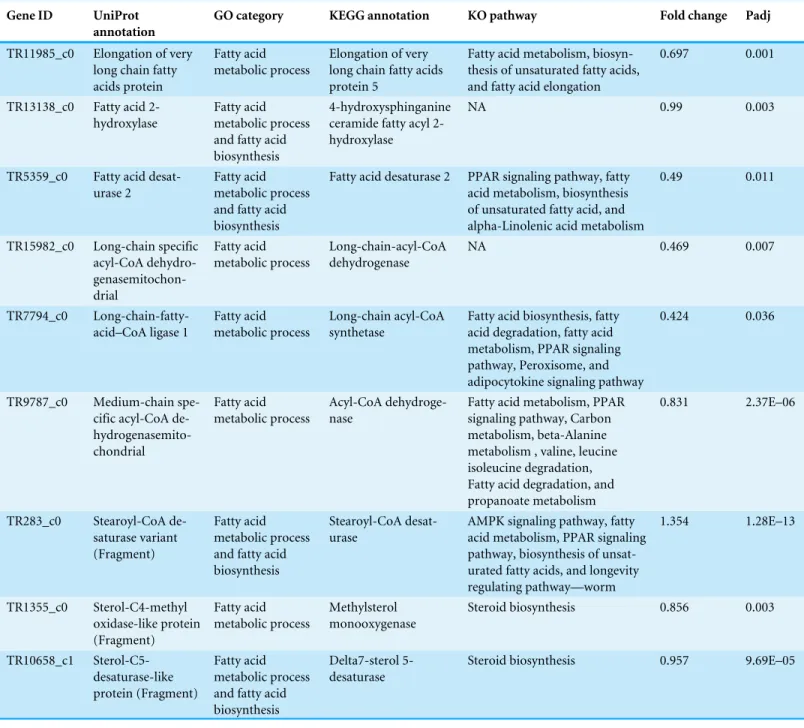
We further evaluated transcripts assigned to fatty acid metabolism by GO enrichment analysis. Transcripts that were significantly up-regulated in the fatty acid metabolism category (padj≤0.05) in UCD animals were compared to KAAS annotation (Table 2). The transcript annotations were similar using both the UniProt database and the KEGG GENES database (Table 2). In addition, since UCD animals showed significant expression of fatty acids metabolism and our earlier study showed significant levels ofBurkholderia RNA we looked for a correlation between these two factors (Rosales & Vega Thurber, 2015). A Spearman correlation of the data yielded a significant correlation of fatty acid metabolism genes andBurkholderiatranscript abundance across the samples (rs=0.809 and ap-value
=0.004).
DISCUSSION
PhV- PhV- PhV- PhV- UCD7 UCD1 UCD6 UCD2 UCD3 UCD4 UCD5 com6 com7 com5 com3
2 1 0 -1 -2 Color Key Row Z-Score
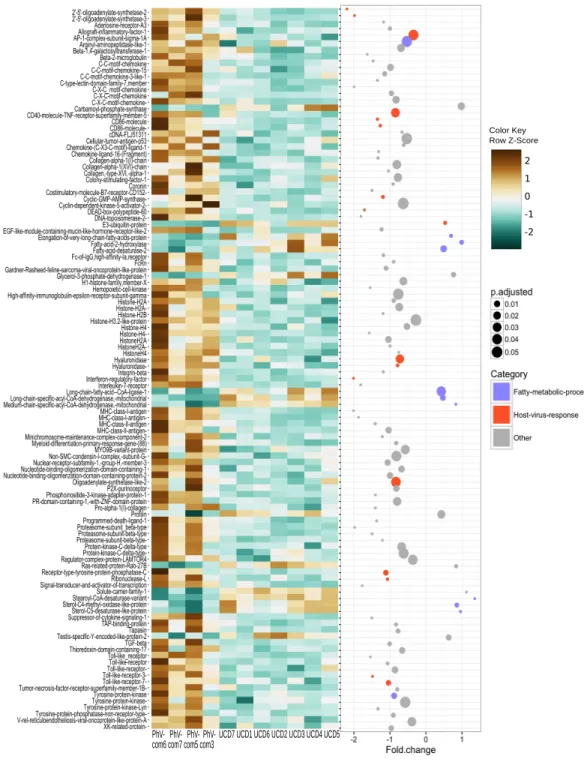
Figure 3 Significant differentially expressed genes (padj≤0.05) within GO categories that were
+u +p +p +p +p +p +p +p
+p +p + +p +p +p +p +p +p +p +
+p +p -p
+p K02308
K19445 K19443 K11299 K03120... K04451 K03006 K04498 K15409 K19442 K10054 K19443 K15413 K19436 RIG-I-like receptor signaling pathway K05411... K02087... K03097... K14840 K15410 Antigen processing and presentation K19440 K19439 Ubiquitin mediated proteolysis K19441 K11674 K19444 K14966 Spliceosome K03156 K05406... K12499 K12890... K14624 K05405 K04519 K05414 K05433 K14217 K02580... K04448... K04440 K07210 K04734... K04467 K07209 K02207 K03094 K11838 K19436 K03875 K03347 K11220 K11220... K19440 K19446 K06751 K04693 K19447 K05653... Jak-STAT signaling pathway K02373 K04398 K19447 K04389 K04390 K02580... K04734 K03156 K19439 K19448 K03158 K02187 Apoptosis K08738 K19436 K02296 K02223 Circadian rhythm K02633 K19437 K19443 K12886 K14284 K03097... K12881 K15414 Spliceosome K05130... K05132... K11217... K04696 K04687 K05414... K19443 K11217... K05152 K15411 K10159 K06081... K03172... K07293 K19256 K05468 K19255 K19434... K03990 K03994 K15412 K05477 K19264 Complement and coagulation cascades K06269 K19437 K16194... K06505 K03237 K01165 K06752 K14216 K19255 K19438 K12648 K12647 K05842 K04729 K10161 K03175 K12646 K05401 Toll-like receptor signaling pathway K07211 K05410 K04403... K04427
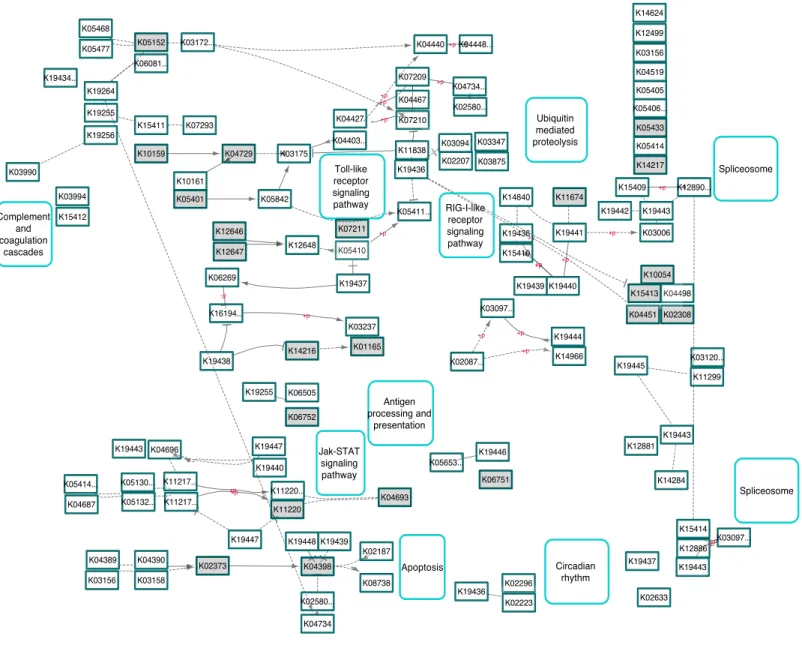
Figure 4 KEGG pathway involved in human herpes-simplex-1 (HSV-1) showing similarities in host gene responses upon a PhV-1 infection.
Highlighted gray boxes represent terms that were significantly enriched DEGs in PhV-1 infected seals (DESeq2 padj≤0.05).
host pathways involved during a PhV-1 infection in the brains of four young harbor seals.
Gene expression of harbor seal brains with an unknown cause of death (UCD)
Table 2 Transcripts in UCD samples involved in fatty acid metabolism.Fatty acid metabolism transcripts that were significantly up-regulated (DEGs padj≤0.05) in UCD harbor seals and annotated using UniProt, GO terms, KEGG GENES and KO pathways.
Gene ID UniProt annotation
GO category KEGG annotation KO pathway Fold change Padj
TR11985_c0 Elongation of very long chain fatty acids protein
Fatty acid metabolic process
Elongation of very long chain fatty acids protein 5
Fatty acid metabolism, biosyn-thesis of unsaturated fatty acids, and fatty acid elongation
0.697 0.001
TR13138_c0 Fatty acid 2-hydroxylase
Fatty acid metabolic process and fatty acid biosynthesis
4-hydroxysphinganine ceramide fatty acyl 2-hydroxylase
NA 0.99 0.003
TR5359_c0 Fatty acid desat-urase 2
Fatty acid metabolic process and fatty acid biosynthesis
Fatty acid desaturase 2 PPAR signaling pathway, fatty acid metabolism, biosynthesis of unsaturated fatty acid, and alpha-Linolenic acid metabolism
0.49 0.011
TR15982_c0 Long-chain specific acyl-CoA dehydro- genasemitochon-drial Fatty acid metabolic process Long-chain-acyl-CoA dehydrogenase
NA 0.469 0.007
TR7794_c0 Long-chain-fatty-acid–CoA ligase 1
Fatty acid metabolic process
Long-chain acyl-CoA synthetase
Fatty acid biosynthesis, fatty acid degradation, fatty acid metabolism, PPAR signaling pathway, Peroxisome, and adipocytokine signaling pathway
0.424 0.036
TR9787_c0 Medium-chain spe-cific acyl-CoA de- hydrogenasemito-chondrial Fatty acid metabolic process Acyl-CoA dehydroge-nase
Fatty acid metabolism, PPAR signaling pathway, Carbon metabolism, beta-Alanine metabolism , valine, leucine isoleucine degradation, Fatty acid degradation, and propanoate metabolism
0.831 2.37E–06
TR283_c0 Stearoyl-CoA de-saturase variant (Fragment)
Fatty acid metabolic process and fatty acid biosynthesis
Stearoyl-CoA desat-urase
AMPK signaling pathway, fatty acid metabolism, PPAR signaling pathway, biosynthesis of unsat-urated fatty acids, and longevity regulating pathway—worm 1.354 1.28E–13 TR1355_c0 Sterol-C4-methyl oxidase-like protein (Fragment) Fatty acid metabolic process Methylsterol monooxygenase
Steroid biosynthesis 0.856 0.003
TR10658_c1 Sterol-C5-desaturase-like protein (Fragment)
Fatty acid metabolic process and fatty acid biosynthesis
Delta7-sterol 5-desaturase
Steroid biosynthesis 0.957 9.69E–05
Notes.
PPAR, peroxisome proliferator-activated receptors.; AMPK, adenosine monophosphateactivated protein kinase.
of death, thus supporting the notion that these harbor seals died from the same disease (Fig. 1).
UCD harbor seal gene response to bacteria
animals exhibit high fatty acid metabolic process gene expression (Fig. 3). In this study, we found a significant correlation betweenBurkholderiaand fatty acid genes. It is possible that fatty acid metabolism is triggered by and/or provides an environment that promotes the growth ofBurkholderia, but substantial research needs to be conducted to confirm this correlation. To our knowledge, there is no documentation ofBurkholderiaincreasing due to high fatty acid production, but there is evidence thatBurkholderiacan grow competitively in humans during metabolically stressful situations (Schwab et al., 2014).
In addition, in this study, we found that significantly expressed DEGs for ‘‘response to bacteria’’ were up-regulated in the majority of PhV-1 infected samples (three out of four) and not upregulated in UCDs. Since UCD samples had a significant abundance of
Burkholderiait was expected that UCD animals would have an upregulated gene expression to ‘‘response to bacteria’’ (Fig. S2). However, in our previous study, we noted that the microbiome was significantly less abundant in UCD animals when compared to PhV-1 infected animals. Thus it is likely that the low abundance of bacteria in UCD animals compared to PhV-1 infected animals drives this gene expression pattern.
Fatty acid metabolism associated with harbor seal strandings
To reiterate, in our GO summary analysis there was no indication of a viral infection, but we did find ‘‘fatty acid metabolism’’ genes enriched in UCD animals. In fact, the DEG analysis demonstrated that this GO group was the most significantly up-regulated category in UCD animals (Fig. 3). Using KEGG analysis, we further substantiated the involvement of these genes in fatty acid metabolism (or related pathways involved in lipid and fat metabolism e.g., steroid biosynthesis) (Table 2). Fatty acid metabolism genes are important for fundamental cellular functions such as those involved in the formation of phospholipids and glycolipids, as well as in the energetics for the cell cycle, like cell proliferation, differentiation, and energy storage.
In marine mammals, esterified fatty-acids (NEFA) can be used as a proxy for nutritional health (Trites & Donnelly, 2003). For example, if gray seal pups fast for over a month they show elevated NEFAs and reduced glucose (Rea et al., 1998). Although, given that UCD samples were in a rehabilitation center and had normal weight measurements (Table 1), UCD harbor seals do not appear to have died from starvation. In mammals, fatty acids are mostly acquired through dietary means except in the liver and adipose tissue where fatty acid pathways are utilized (Kuhajda, 2000). Thus, high fatty acid gene activity, in regions other than the liver or adipose tissues, can be symptomatic of metabolic diseases other than starvation. As an example, cells with up-regulated fatty acid synthase (FAS) can be a sign of tumorigenesis (Kuhajda, 2000).
A possible mode of death for UCDs is that these animal were unable to adequately take in nutrients since a lack of adequate dietary intake of some fatty acids can lead to an increase in fatty acid metabolism in the brain (Innis, 2008). To illustrate, if an animal has an insufficient intake ofω-3 fatty acids, then the brain increases inω-6 fatty acid
content. In a developing brain, this increase in ω-6 fatty acids can lead to problems
disease (Jaber et al., 2004). Interestingly, UCD necropsies reported that four animals had hepatic lipidosis, which is a disease attributed to toxins, starvation, or nutrient deprivation in weaning animals (Jaber et al., 2004).
Fatty acids, specifically, can be used to detect chemical or toxic stress in marine organisms (Filimonova et al., 2016). Since, these animals did not appear to be starved, this suggest that nutrient depletion or toxin exposure may have been involved in the die-off of UCDs because (1) these were neonatal harbor seals (with a developing brain), (2) the coincident description of the necropsy reports, and (3) the fatty acid metabolic shifts in the brains of these animals. Other common lesions found in UCDs were spleen hemosiderosis and spleen extramedullary hematopoiesis. These syndromes have been associated with other metabolic diseases, but we are unsure if they are directly related to high fatty acid gene expression in the brains of these neonatal seals.
As mentioned, fatty-acid markers have been used to detect stress responses in marine organisms (Trites & Donnelly, 2003;Filimonova et al., 2016). The transcripts detected in this study have the potential to be used as biomarkers for stranded animals with an elusive etiology or marine mammals that died from necrosis of the brain tissue. Gathering such information may aid in better understanding this mysterious disease and help to properly diagnose other animals.
Gene expression of harbor seal brains infected with phocine herpesvirus-1
The gene response of harbor seals infected with PhV-1 is mostly unknown, but our data
now illuminates some understanding of this interaction. The HSV-1 KEGG Pathway (Fig.
4) shows evidence that PhV-1 promotes some host gene responses similar to other viruses in the subfamilyAlphaherpesvirinae.Although, it appears that there are still many pathways that differ between HSV-1 and PhV-1. However, it is likely that PhV-1 host response may better parallel other viruses from its genusVaricellovirus,like bovine herpesvirus-1 (BHV-1). In BhV-1, the host immune system has been shown to respond in three stages: early cytokines, late cytokines, and cellular immunity or adaptive immunity (reviewed inBabiuk, Van Drunen Littel-van den Hurk & Tikoo, 1996). Although our data is non-temporal, the summarized enriched GO analysis illustrates evidence for aspects of each of these three predefined temporal stages (Fig. 2). For example, ‘‘response to amino acid’’ (Fig. 2pink blocks) provides evidence of the early cytokine immune responses in stage 1. At the same time our DEG analysis shows that Toll-like receptors (TLR) are significantly expressed in these animals (p-value < 0.001); thus we speculate that TLR3 and TLR7 may be involved in the detection of PhV-1 in harbor seal brain cells (Fig. 3). TLR7 is part of a TLR group that can detect viral Pathogen- associated molecular patterns (PAMPs) within endosomes and lysosomes (Heil et al., 2004) and TLR-3 is known to activate an antiviral state within an infected cel1 (Tabeta et al., 2004). Thus, we reason that TLR3 and TLR7 ultimately lead to the induction of a nonspecific positive regulation inflammatory response seen in these animals (Fig. 2, pink blocks ‘‘positive regulation of inflammatory response’’).
(Babiuk, Van Drunen Littel-van Den Hurk & Tikoo, 1996). Cell chemotaxis and leukocyte chemotaxis are needed for recruitment of cells and could be responsible for attracting cells to the site of a PhV-1 infection, while interleukin-6 promotes macrophage differentiation. Differentiated macrophages can then secrete cytokines, like tumor necrosis factor (TNF)
(Fig. 2. pink blocks). The early and late stage cytokine activity is depicted in the summarized
GO category ‘‘mononuclear cell proliferation’’ (Fig. 2 yellow blocks). Once at the site of infection leukocytes are likely to proliferate, while late stage cytokines can cause proliferation of mononuclear cells, such as T-cells, B cells, and Natural Killer cells (NK cells).
The most pronounced category in this data is the last stage or cellular immunity
(Fig. 2orange blocks). Antigen processing and presentation is an important step in
developing cellular immunity, which occurs when an antigen, like PhV-1, is processed into proteolytic peptides and loaded onto MHC class 1 or II molecules on a cell. We found that ‘‘antigen processing and presentation’’ is a highly enriched GO category (p-value <0.001) and that transcripts for MHC I and II are highly expressed in PhV-1 infected samples
(Fig. 3, padj < 0.0001), demonstrating that the immune system of these young harbor
seals was able to develop an adaptive immune response to PhV-1. Furthermore, the ‘‘phagocytosis’’ category data, suggest that a cellular mechanism to clear PhV-1 infected cells in harbor seals brains might be phagocytosis, as it was an enriched GO category
(Fig. 2, teal blocks). However, we cannot refute the possibility that phagocytosis may be
a route for viral entry into the cell. Recently in equine herpesvirus-1 (EHV-1), from the genusVaricellovirus, there was an indication of a phagocytic mechanism for EHV-1 to enter some cells (Laval et al., 2016). Alternatively, or in conjunction, PhV-1 may have appropriated the host exocytosis pathway to egress from the cell, as has been noted in other alphaherpesviruses (Fig. 2, teal block ‘‘regulation of exocytosis’’) (Hogue et al., 2014).
DNA packaging during a PhV-1 infection
Another category enriched in our GO analysis was ‘‘DNA packaging’’ (Fig. 2, green block), which occur when a chromatin structure is formed from histones to create nucleosomes (Felsenfeld, 1978). Here, we predict that PhV-1 hijacked the host DNA packaging pathway. Presently, there is controversy about the role of DNA packaging during herpesvirus infections. At least three different states of DNA packaging occur during a herpesvirus infection. Within the viral particle the double stranded genome is not packaged, but in the latent state of the virus, it associates with cellular nucleosomes forming a cellular chromatin-like structure (Lee, Raja & Knipe, 2016). The controversy arises from the lytic or replication cycle. Studies show varying degrees of chromatin with herpesvirus DNA and these variations in chromatin may be associated with viral transcription (Herrera & Triezenberg, 2004; Lacasse & Schang, 2012; Lee, Raja & Knipe, 2016). We suspect that PhV-1 was either entering the latent phase and/or that chromatin formation was occurring because of active viral transcription.
role of H3.2 in herpesvirus is more elusive (Placek et al., 2009). Although, the role of H3.2 in the latent phase cannot be disregarded since H3 has been associated with both the latent and lytic phases (Kubat et al., 2004;Wang et al., 2005;Kutluay & Triezenberg, 2009). Our results suggest that DNA packaging is important for PhV-1, but the exact role of DNA packaging in PhV-1 requires further research.
Caveats and considerations
Marine mammal diseases can be difficult to diagnose given their protected status and the challenge to gather conventional control samples for studies. For this research, we used two disease states, one known and one unknown. Our study shows that this method can yield valuable insight into host responses to infection, but we recognize the limitations to this approach. For instance, we were limited to evaluating up-regulated genes and consequently, we did not evaluate any down-regulated genes that may have been meaningful for understanding the diseases.
In addition, it is probable that there are shared genes or pathways in both diseases, and this commonality would not have been apparent in our DEG analysis between the two groups. As an example, it is known that host fatty acids are also up-regulated during viral infections; thus fatty acid DEGs in the UCD animals may actually have been even more numerous had we compared UCD animals with a different group of animals that did not have a viral infection (Jackel-Cram, Babiuk & Liu, 2007;Heaton et al., 2010;
Spencer et al., 2011).
Finally, there is the potential that genes identified as up-regulated in one disease state are actually a result of down-regulated genes in the other disease state. However, since we knew that PhV-1 was an infectious agent in one cohort of animals and since we attained necropsy reports with probable causes of UCD disease, we were able to confidently tease apart our results with this information. Optimistically, with the increased use of HTS methods, we expect that more transcriptome studies on marine mammals will become available and this may help diminish these caveats.
In addition, it is apparent that the sequence alignment rates in this study were low and this is likely because alignments were conducted using the Weddell seal transcriptome and not the genome. Using the Weddell seal genome, a greater portion of the data aligned (76.51%). Our results are in compliance with previous research where alignments to the transcriptome are lower than alignments to the genome of an organism (Conesa et al., 2016). In spite of this, it is still a valid approach to use the transcriptome with the caveat that novel genes are not likely to be identified (Conesa et al., 2016). In this study, we did not use a genome-guided approached since this method resulted in up to 1,323,851 transcripts, which is overly abundant. In addition, in the genome-guided approach, only 4.9% of the data represented ORFs and the N50 score was 1,136. However, the transcriptome guided method resulted in 32,856 transcripts with 65.9% of transcripts accounting for ORFs and an N50 of 1,994 (Table S1).
apparent. In addition, it is important to note that PhV-1 typically infects the adrenal glands of seals and the infection does not always reach the brain (Gulland et al., 1997;
Goldstein et al., 2005). Since viruses infect organs differently, PhV-1 may not replicate in the same manner in the brain as it does the adrenal glands. Future studies may focus on comparing transcriptomes from the brain, adrenal glands, and other PhV-1 affected organs to determine any differences between the host organs and virus interactions.
CONCLUSION
This is the first study to evaluate transcriptomes to better understand virus-host interactions and brain tissue responses to an unknown disease in marine mammals. In samples with a PhV-1 brain infection, we identified pathways involved in innate and adaptive immunity, as well as DNA packaging transcripts. We now have a better understanding of PhV-1 gene expression in brain tissue of pinnipeds, which may lead to improved management and treatment of PhV-1 infections. However, more work including time series data is needed to comprehend the mechanism and progression of this disease. In addition, with this analysis, we were able to further confirm our results, from our previous work, that UCD animals did not die from a viral infection. Instead, we found that fatty acid metabolic genes were highly up-regulated in UCD animals. It is unknown what may have caused a manifestation of fatty acid metabolism dysregulation in the brains of UCD harbor seals, but it is probable that it may have been linked to exposure to toxins or nutrient depletion.
ACKNOWLEDGEMENTS
We thank the Marine Mammal Center in Sausalito, CA, USA, for providing harbor seal tissue samples and necropsy reports. We also like to thank Dr. Eli Meyer at Oregon State University for his mentorship and assistance with transcriptome analysis.
ADDITIONAL INFORMATION AND DECLARATIONS
Funding
This work was supported by Sea Grant Starter Grant # NA010AR4170059 NA223B R700 to RVT and an NSF Graduate Research Fellowship #2012136295 to SMR. The funders had no role in study design, data collection and analysis, decision to publish, or preparation of the manuscript.
Grant Disclosures
The following grant information was disclosed by the authors: Sea Grant Starter: NA010AR4170059.
NSF Graduate Research Fellowship: 2012136295.
Competing Interests
Author Contributions
• Stephanie M. Rosales conceived and designed the experiments, performed the
experiments, analyzed the data, contributed reagents/materials/analysis tools, wrote the paper, prepared figures and/or tables.
• Rebecca L. Vega Thurber contributed reagents/materials/analysis tools, reviewed drafts of the paper.
Animal Ethics
The following information was supplied relating to ethical approvals (i.e., approving body and any reference numbers):
This work was authorized by the National Marine Fisheries (NMFS) for possession of tissue samples from stranded marine mammals. This work is in compliance with the Marine Mammal Protection Act (MMPA) regulation 50 CR 216.22 and 216.37.
Ethics
The following information was supplied relating to ethical approvals (i.e., approving body and any reference numbers):
This work was authorized by the National Marine Fisheries (NMFS) for possession of tissue samples from stranded marine mammals. This work is in compliance with the Marine Mammal Protection Act (MMPA) regulation 50 CR 216.22 and 216.37.
DNA Deposition
The following information was supplied regarding the deposition of DNA sequences: Rosales, Stephanie (2016): Brain transcriptomes of harbor seals demonstrate gene expression patterns of animals undergoing a metabolic disease and a viral infection. figshare.
https://dx.doi.org/10.6084/m9.figshare.3581712.v1
Data Availability
The following information was supplied regarding data availability:
The raw sequence data supporting the conclusions of this article is available in
the European Nucleotide Archive repository, using accession number: PRJEB11686
(http://www.ebi.ac.uk/ena/data/view/PRJEB11686)
Supplemental Information
Supplemental information for this article can be found online athttp://dx.doi.org/10.7717/
peerj.2819#supplemental-information.
REFERENCES
Babiuk LA, Van Drunen Littel-van den Hurk S, Tikoo SK. 1996.Immunology of bovine
herpesvirus 1 infection.Veterinary Microbiology53:31–42
DOI 10.1016/S0378-1135(96)01232-1.
Kuiken T, Smits SL, Osterhaus ADME. 2013.Novel B19-like parvovirus in the brain of a harbor seal.PLoS ONE8:e79259DOI 10.1371/journal.pone.0079259.
Conesa A, Madrigal P, Tarazona S, Gomez-Cabrero D, Cervera A, McPherson A,
Szcześniak MW, Gaffney DJ, Elo LL, Zhang X, Mortazavi A. 2016.A survey of best
practices for RNA-seq data analysis.Genome Biology17:13
DOI 10.1186/s13059-016-0881-8.
De Wit P, Rogers-Bennett L, Kudela RM, Palumbi SR. 2014.Forensic genomics as a
novel tool for identifying the causes of mass mortality events.Nature Communica-tions5:3652 DOI 10.1038/ncomms4652.
Fabrizius A, Hoff ML, Engler G, Folkow LP, Burmester T. 2016.When the brain goes
diving: transcriptome analysis reveals a reduced aerobic energy metabolism and increased stress proteins in the seal brain.BMC Genomics17:583
DOI 10.1186/s12864-016-2892-y.
Felsenfeld G. 1978.Chromatin.Nature271:115–122DOI 10.1038/271115a0.
Filimonova V, Gon¸calves F, Marques JC, De Troch M, Gon¸calves AMM. 2016.Fatty
acid profiling as bioindicator of chemical stress in marine organisms: a review.
Ecological Indicators67:657–672DOI 10.1016/j.ecolind.2016.03.044.
Geo Pertea. 2015.fqtrim: v0.9.4 release [Data set].Zenodo.DOI 10.5281/zenodo.20552.
Goldstein T, Mazet JAK, Lowenstine LJ, Gulland FMD, Rowles TK, King DP, Aldridge
BM, Stott JL. 2005.Tissue distribution of phocine herpesvirus-1 (PhHV-1) in
infected harbour seals (Phoca vitulina) from the central californian coast and a comparison of diagnostic methods.Journal of Comparative Pathology133:175–183
DOI 10.1016/j.jcpa.2005.04.006.
Gulland FMD, Hall AJ. 2007.Is marine mammal health deteriorating? Trends
in the global reporting of marine mammal disease.EcoHealth4:135–150
DOI 10.1007/s10393-007-0097-1.
Gulland FMD, Lowenstine LJ, Lapointe JM, Spraker T, King DP. 1997.Herpesvirus
infection in stranded pacific harbor seals of Coastal California.Journal of Wildlife Diseases33:450–458DOI 10.7589/0090-3558-33.3.450.
Haas BJ, Papanicolaou A, Yassour M, Grabherr M, Blood PD, Bowden J, Couger MB, Eccles D, Li B, Lieber M, MacManes MD, Ott M, Orvis J, Pochet N, Strozzi F, Weeks N, Westerman R, William T, Dewey CN, Henschel R, LeDuc RD, Friedman
N, Regev A. 2013.De novotranscript sequence reconstruction from RNA-seq
using the Trinity platform for reference generation and analysis.Nature Protocols
8:1494–1512DOI 10.1038/nprot.2013.084.
Hammond JA. 2005.Molecular cloning and expression of leptin in gray and harbor seal
blubber, bone marrow, and lung and its potential role in marine mammal respiratory physiology.AJP: Regulatory, Integrative and Comparative Physiology289:R545–R553
DOI 10.1152/ajpregu.00203.2004.
Harder TC, Harder M, De Swart RL, Osterhaus ADME, Liess B. 1998.Major
immunogenic proteins of phocid herpesviruses and their relationships to proteins of canine and feline herpesviruses.Veterinary Quarterly20:50–55
Harder TC, Harder M, Vos H, Kulonen K, Kennedy-Stoskopf S, Liess B, Appel MJG,
Osterhaus ADME. 1996.Characterization of phocid herpesvirus-1 and -2 as putative
alpha- and gammaherpesviruses of North American and European pinnipeds.
Journal of General Virology77:27–35DOI 10.1099/0022-1317-77-1-27.
Heaton NS, Perera R, Berger KL, Khadka S, LaCount DJ, Kuhn RJ, Randall G. 2010. Dengue virus nonstructural protein 3 redistributes fatty acid synthase to sites of viral replication and increases cellular fatty acid synthesis.Proceedings of the National Academy of Sciences of the United States of America107:17345–17350
DOI 10.1073/pnas.1010811107.
Heil F, Hemmi H, Hochrein H, Ampenberger F, Kirschning C, Akira S, Lipford G,
Wagner H, Bauer S. 2004.Species-specific recognition of single-stranded RNA via
toll-like receptor 7 and 8.Science303:1526–1529DOI 10.1126/science.1093620.
Herrera FJ, Triezenberg SJ. 2004.VP16-dependent association of chromatin-modifying
coactivators and underrepresentation of histones at immediate-early gene pro-moters during herpes simplex virus infection.Journal of Virology78:9689–9696
DOI 10.1128/JVI.78.18.9689-9696.2004.
Hoffman JI, Thorne MA, Trathan PN, Forcada J. 2013.Transcriptome of the dead:
char-acterisation of immune genes and marker development from necropsy samples in a
free-ranging marine mammal.BMC Genomics14:52DOI 10.1186/1471-2164-14-52.
Hogue IB, Bosse JB, Hu J-R, Thiberge SY, Enquist LW. 2014.Cellular mechanisms of
alpha herpesvirus egress: live cell fluorescence microscopy of pseudorabies virus exocytosis.PLoS Pathogens10:e1004535DOI 10.1371/journal.ppat.1004535.
Innis SM. 2008.Dietary omega 3 fatty acids and the developing brain.Brain Research
1237:35–43DOI 10.1016/j.brainres.2008.08.078.
Jaber JR, Perez J, Arbelo M, Andrada M, Hidalgo M, Gomez-Villamandos JC, Van Den
Ingh T, Fernandez A. 2004.Hepatic lesions in cetaceans stranded in the Canary
Islands.Veterinary Pathology41:147–153DOI 10.1354/vp.41-2-147.
Jackel-Cram C, Babiuk LA, Liu Q. 2007.Up-regulation of fatty acid synthase promoter
by hepatitis C virus core protein: genotype-3a core has a stronger effect than genotype-1b core.Journal of Hepatology46:999–1008
DOI 10.1016/j.jhep.2006.10.019.
Kanehisa M. 2000.KEGG: kyoto encyclopedia of genes and genomes.Nucleic Acids
Research28:27–30DOI 10.1093/nar/28.1.27.
Khudyakov JI, Champagne CD, Preeyanon L, Ortiz RM, Crocker DE. 2015b.Muscle
transcriptome response to ACTH administration in a free-ranging marine mammal.
Physiological Genomics47:318–330DOI 10.1152/physiolgenomics.00030.2015.
Khudyakov JI, Preeyanon L, Champagne CD, Ortiz RM, Crocker DE. 2015a.
Tran-scriptome analysis of northern elephant seal (Mirounga angustirostris) muscle tissue provides a novel molecular resource and physiological insights.BMC Genomics
16:64DOI 10.1186/s12864-015-1253-6.
Kubat NJ, Tran RK, McAnany P, Bloom DC. 2004.Specific histone tail modification
Kuhajda FP. 2000.Fatty-acid synthase and human cancer: new perspectives on its role in
tumor biology.Nutrition16:202–208DOI 10.1016/S0899-9007(99)00266-X.
Kuiken T, Bodewes R, Contreras GJS, García AR, Hapsari R, Van de Bildt MWG,
Osterhaus ADME. 2015.Identification of DNA sequences that imply a novel
gammaherpesvirus in seals.Journal of General Virology96:1109–1114
DOI 10.1099/vir.0.000029.
Kutluay SB, Triezenberg SJ. 2009.Role of chromatin during herpesvirus infections.
Biochimica et Biophysica Acta (BBA)—General Subjects1790:456–466
DOI 10.1016/j.bbagen.2009.03.019.
Lacasse JJ, Schang LM. 2012.Herpes simplex virus 1 DNA is in unstable nucleosomes
throughout the lytic infection cycle, and the instability of the nucleosomes is independent of DNA replication.Journal of Virology86:11287–11300
DOI 10.1128/JVI.01468-12.
Langmead B, Salzberg SL. 2012.Fast gapped-read alignment with Bowtie 2.Nature
Methods9:357–359DOI 10.1038/nmeth.1923.
Laval K, Verhasselt B, Nauwynck HJ, Favoreel HW, Van Cleemput J, Poelaert KCK,
Brown IK. 2016.Entry of equid herpesvirus 1 into CD172a+monocytic cells.
Journal of General Virology97:733–746DOI 10.1099/jgv.0.000375.
Lee HK, Braynen W, Keshav K, Pavlidis P. 2005.ErmineJ: tool for functional analysis of
gene expression data sets.BMC Bioinformatics6:1–8DOI 10.1186/1471-2105-6-269.
Lee JS, Raja P, Knipe DM. 2016.Herpesviral ICP0 protein promotes two waves of
heterochromatin removal on an early viral promoter during lytic infection.MBio
7:e02007-15DOI 10.1128/mBio.02007-15.
Love MI, Huber W, Anders S. 2014.Moderated estimation of fold change and dispersion
for RNA-seq data with DESeq2.Genome Biology15:1–21
DOI 10.1186/s13059-014-0550-8.
Magrane M, Consortium U. 2011.UniProt Knowledgebase: a hub of integrated protein
data.Database2011:bar009–bar009DOI 10.1093/database/bar009.
Mancia A, Ryan JC, Van Dolah FM, Kucklick JR, Rowles TK, Wells RS, Rosel PE, Hohn
AA, Schwacke LH. 2014.Machine learning approaches to investigate the impact of
PCBs on the transcriptome of the common bottlenose dolphin (Tursiops truncatus).
Marine Environmental Research100:57–67DOI 10.1016/j.marenvres.2014.03.007.
Moriya Y, Itoh M, Okuda S, Yoshizawa AC, Kanehisa M. 2007.KAAS: an automatic
genome annotation and pathway reconstruction server.Nucleic Acids Research
35:W182–W185DOI 10.1093/nar/gkm321.
Neale JCC, Kenny TP, Tjeerdema RS, Gershwin ME. 2005.PAH- and PCB-induced
alterations of protein tyrosine kinase and cytokine gene transcription in harbor seal (Phoca Vitulina) PBMC.Clinical and Developmental Immunology12:91–97
DOI 10.1080/17402520500116624.
Ng TFF, Suedmeyer WK, Wheeler E, Gulland F, Breitbart M. 2009.Novel anellovirus
Ng TFF, Wheeler E, Greig D, Waltzek TB, Gulland F, Breitbart M. 2011.Metagenomic identification of a novel anellovirus in Pacific harbor seal (Phoca vitulina richardsii) lung samples and its detection in samples from multiple years.Journal of General Virology92:1318–1323DOI 10.1099/vir.0.029678-0.
Niimi S, Imoto M, Kunisue T, Watanabe MX, Kim E-Y, Nakayama K, Yasunaga G,
Fujise Y, Tanabe S, Iwata H. 2014.Effects of persistent organochlorine exposure on
the liver transcriptome of the common minke whale (Balaenoptera acutorostrata) from the North Pacific.Ecotoxicology and Environmental Safety108:95–105
DOI 10.1016/j.ecoenv.2014.06.028.
Osterhaus ADME, Groen J, Vries PD, Uytdehaag FGCM, Klingeborn B, Zarnke R.
1988.Canine distemper virus in seals.Nature335:403–404DOI 10.1038/335403a0.
Osterhaus ADME, Yang H, Spijkers HEM, Groen J, Teppema JS, Van Steenis G.
1985.The isolation and partial characterization of a highly pathogenic
her-pesvirus from the harbor seal(Phoca vitulina).Archives of Virology86:239–251
DOI 10.1007/BF01309828.
Placek BJ, Huang J, Kent JR, Dorsey J, Rice L, Fraser NW, Berger SL. 2009.The histone
variant H3.3 regulates gene expression during lytic infection with herpes simplex virus type 1.Journal of Virology83:1416–1421DOI 10.1128/JVI.01276-08.
Rea LD, Castellini MA, Fadely BS, Loughlin T. 1998.Health status of young Alaska
Steller sea lion pups (Eumetopias jubatus) as indicated by blood chemistry and hematology.Comparative Biochemistry and Physiology Part A: Molecular & Integrative Physiology120:617–623DOI 10.1016/S1095-6433(98)10074-0.
Rosales SM, Vega Thurber R. 2015.Brain meta-transcriptomics from harbor seals
to infer the role of the microbiome and virome in a stranding event.PLoS ONE
10:e0143944DOI 10.1371/journal.pone.0143944.
Schwab U, Abdullah LH, Perlmutt OS, Albert D, Davis CW, Arnold RR, Yankaskas
JR, Gilligan P, Neubauer H, Randell SH, Boucher RC. 2014.Localization of
Burkholderia cepaciacomplex bacteria in cystic fibrosis lungs and interactions with
pseudomonas aeruginosa in Hypoxic Mucus.Infection and Immunity82:4729–4745
DOI 10.1128/IAI.01876-14.
Smith-Unna R, Boursnell C, Patro R, Hibberd JM, Kelly S. 2016.TransRate:
reference-free quality assessment ofde novotranscriptome assemblies.Genome Research
26:1134–1144DOI 10.1101/gr.196469.115.
Spencer CM, Schafer XL, Moorman NJ, Munger J. 2011.Human cytomegalovirus
induces the activity and expression of acetyl-coenzyme a carboxylase, a fatty acid biosynthetic wnzyme whose inhibition attenuates viral replication.Journal of Virology85:5814–5824DOI 10.1128/JVI.02630-10.
Supek F, Bošnjak M, Škunca N, Šmuc T. 2011.REVIGO summarizes and visualizes long
lists of gene ontology terms.PLoS ONE6:e21800
DOI 10.1371/journal.pone.0021800.
Tabeta K, Georgel P, Janssen E, Du X, Hoebe K, Crozat K, Mudd S, Shamel L, Sovath
S, Goode J, Alexopoulou L, Flavell RA, Beutler B. 2004.Toll-like receptors 9 and 3
infection.Proceedings of the National Academy of Sciences of the United States of America101:3516–3521DOI 10.1073/pnas.0400525101.
Tabuchi M, Veldhoen N, Dangerfield N, Jeffries S, Helbing CC, Ross PS. 2006.
PCB-related alteration of thyroid hormones and thyroid hormone receptor gene expres-sion in free-ranging harbor seals (Phoca vitulina).Environmental Health Perspectives
114:1024–1031.
Trites AW, Donnelly CP. 2003.The decline of Steller sea lions Eumetopias jubatus
in Alaska: a review of the nutritional stress hypothesis.Mammal Review33:3–28
DOI 10.1046/j.1365-2907.2003.00009.x.
Vedros NA, Smith AW, Schonewald J, Migaki G, Hubbard RC. 1971.Leptospirosis
Epizootic among California Sea Lions.Science 172:1250–1251
DOI 10.1126/science.172.3989.1250.
Wang Q-Y, Zhou C, Johnson KE, Colgrove RC, Coen DM, Knipe DM. 2005.
Her-pesviral latency-associated transcript gene promotes assembly of heterochro-matin on viral lytic-gene promoters in latent infection.Proceedings of the Na-tional Academy of Sciences of the United States of America102:16055–16059