O
h
r
c
i
r
g
a
in
e
a
s
l
R
e
F. Demet Ince1, Banu Arslan2, Y. Cem Kaplan3, Hamit Ellidağ2 1Department of Medical Biochemistry, Tepecik Education and Research Hospital, İzmir, 2Department of Medical Biochemistry, Ataturk Education and Research Hospital, Ankara, 3Department of Medical Pharmacology, Katip Celebi University, İzmir, Türkiye Uncertainty in the Measurement of Blood Ethanol
The Evaluation of Uncertainty
for the Measurement of Blood Ethanol
Kan Etanol Ölçümü için
Belirsizliğin Değerlendirilmesi
DOI: 10.4328/JCAM.4316 Received: 19.01.2016 Accepted: 17.02.2016 Printed: 01.09.2016 J Clin Anal Med 2016;7(5): 648-51
Corresponding Author: Fatma Demet Arslan Ince, Department of Medical Biochemistry, Tepecik Education and Research Hospital, Yenişehir, İzmir, Turkey.
GSM: +905056468214 F.: +90 2324330756 E-Mail: [email protected] Özet
Amaç: Adli tıpta, etanol düzeylerinin ölçülmesi bireylere karşı açılan davalar
-da önemlidir. Her ölçüm sonucu belli bir miktar belirsizliğe sahiptir. Bu çalış
-manın amacı, alkol dehidrojenaz yöntemi kullanılarak yapılan etanol ölçümün
-de belirsizliği belirlemek, aynı zamanda -değişkenliğin kaynaklarını ve bunla
-rın belirsizliğe olan katkıla-rını değerlendirmektir. Gereç ve Yöntem: Etanol için tekrarlanabilirlik, kalibratör belirsizliği ve stabilite belirsizliği belirlendi. Bun
-ların standart belirsizlikleri hesaplandıktan sonra her bir değerin kareleri top
-landı ve bu değerin kare kökleri alınarak kombine standart belirsizlik değeri bulundu. Genişletilmiş belirsizlik, kombine standart belirsizlik değerinin kap
-sam faktörü (k=2, %95 güven aralığı) ile çarpımından elde edildi. Bulgular: Etanol için ölçüm belirsizliği, %8.5 (%95 güven aralığında) olarak saptandı. Eşik değerdeki sonuç (50 mg/dL), 50±4.3 mg/dL (%95 güven aralığında) ola
-rak rapor edildi. Tartışma: Alkol ölçümü yapan akredite bir laboratuvarda so
-nuçların doğruluğunu ve güvenilirliğini sağlamak için ölçüm belirsizliği he
-saplanmalıdır. Preanalitik, analitik ve post analitik aşamalarda sonuçları et
-kileyebilecek hata kaynakları tespit edilmeli ve belirsizlik değeri verilmelidir.
Anahtar Kelimeler
Etanol; Belirsizlik; Alkol Dehidrojenaz
Abstract
Aim: In forensic medicine, measurement of ethanol levels is important in
law-suits iled against individuals. Each measurement result has a certain amount of uncertainty. The objective of this study is to determine uncertainty of
ethanol measurement using the alcohol dehydrogenase method, and also to evaluate sources of variability and their contributions to uncertainty. Ma-terial and Method: Repeatability, calibrator uncertainty, and stability
un-certainty were determined for ethanol measurement. Ater their standard
uncertainties were calculated, the squares of each value were summed and the combined standard uncertainty value was found with the square roots of that value. The expanded uncertainty value was obtained by multiplying the
combined standard uncertainty value by a coverage factor (k=2; conidence interval, 95%). Results: The uncertainty of measurement for ethanol was found to be ±8.5% (conidence interval, 95%). The result at threshold level
(50 mg/dL) was reported as 50±4.3 mg/dL (conidence interval, 95%). Dis
-cussion: Measurement uncertainty should be estimated to ensure accuracy and reliability of the results in an accredited laboratory performing alcohol
measurement. Sources of error that might afect the results during the pre-analytical, pre-analytical, and post-analytical phases should be identiied and the
uncertainty value should be calculated.
Keywords
Ethanol; Uncertainty; Alcohol Dehydrogenase
Introduction
Although alcohol, ater cofee, is the second most commonly consumed addictive substance afecting mental and physi-cal activity; it is also the most frequently tolerated drink ater cofee [1]. Therefore, in many countries the determination of permissible blood alcohol levels as part of traic regulations has been afected not just by scientiic justiications but also by societal tendencies. In many regions of the world there are legal blood alcohol limits for drivers of motor vehicles. In com-pliance with the Road Traic Act in Turkey, drivers of private taxis, taxicabs, minibuses, buses, lorries, and trailers are not al-lowed to drive while drunk. Private car drivers are not permit-ted to drive with a blood alcohol concentration greater than 50 mg/dL (according to Road Traic Act # 2918 dated 6.16.1985 in Turkey). Governments of Austria, Denmark, France, Australia, Canada and The Netherlands have legal limits of 50 mg/dL for blood alcohol concentration for motor vehicle drivers. Limits of permissible alcohol intake vary by country (US, 50-80 mg/dL; UK, 80 mg/dL; Japan, 30 mg/dL; Sweden, 20 mg/dL; Norway, 20 mg/dL; Russia, 20 mg/dL; Poland, 30 mg/dL; Hungary and Romania, 0 mg/dL) [1].
The most practical tool for the breath test is the alcoholometer. It is the prevalent tool used for traic control. Although this method, which has a margin of error, is not sensitive enough, it is still considered a satisfactory method to determine a driver’s blood alcohol concentration. Certainly, if alcohol consumption is close to the legal limit, a blood analysis should also be per-formed. The main concern is that erroneous results of blood alcohol measurements mislead legal authorities. Therefore, laboratory test results should be accurate and reliable.
Measurement uncertainty is a parameter characterizing the dispersion of the values attributed to a reasonably measured quantity according to Eurachem/CITAC Guide CG 4 “Quantify-ing Uncertainty in Analytical Measurement” (QUAM). In other words, it demonstrates the extent to which the result represents the true value. Relevant international standards (as “Guidelines for Evaluating and Expressing the Uncertainty of NIST Mea-surement Results” prepared by National Institute of Standards and Technology and “EP29-A: Expression of Measurement Uncertainty in Laboratory Medicine” prepared by Clinical and Laboratory Standards Institute) have been included in the work-ing procedures of many disciplines engaged in calibration and testing procedures. Measurement uncertainty is one of the gen-eral requirements demonstrating adequacy of a laboratory in compliance with ISO/IEC 17025 and ISO 15189 (prepared by International Organization for Standardization). Because of this requirement, measurement uncertainty is being used by accred-ited laboratories. However, to date only a few studies have been published on measurement uncertainty focused on the needs of forensic medical matters [2-6].
For threshold blood alcohol levels, calculation and reporting of measurement uncertainty by the laboratory will increase the re-liability of the results, which might ease the relatively important decision-making process of legal authorities. The objective of this study is to evaluate sources of variability and to investi-gate their contribution to uncertainty of measurement of blood alcohol levels.
Material and Method
Blood alcohol levels were measured using the alcohol dehydro-genase method (3L36-20, MULTIGENT Ethanol Reagent, Ab-bott Diagnostic, GmbH & Co. KG, Germany) on Architect c8000 analysers (Abbott Diagnostic, GmbH & Co. KG, Germany). Measurement uncertainty is classiied as Type A or B according to Eurachem/CITAC Guide CG 4 “Quantifying Uncertainty in An-alytical Measurement” (QUAM). Type A is an uncertainty value calculated using statistical methods, while Type B is estimated based on non-statistical methods based on values provided by the manufacturers. The uncertainty related to stability and of repeatability are considered as Type A. The uncertainty related to the calibrator is considered as Type B.
Repeatability (urep): The control samples of 50 mg/dL (3L36-10, MULTIGENT Ethanol 50 Control, Abbott Diagnostic, GmbH & Co. KG, Germany) were analyzed repetitively for 20 times (n = 20) within run, and then the coeicient of variation (CV) was estimated. To comply with the normal distribution of data, the standard uncertainty (urep) was calculated as CV of the result of 20 measurements divided by the square root of n (√n) (Type A).
urep = CV / √n
Calibrator uncertainty (ucal): The uncertainty values related to the calibrator (3L3602, MULTIGENT Ethanol 100 Cal, Abbott Diagnostic, GmbH & Co. KG, Germany) provided by the manu-facturer were used. The uncertainty value of the ethanol cali-brator (Cal) at a concentration of 100 mg/dL was estimated as 6.7 mg/dL.
Ccal, concentration of the calibrator; and ucer, uncertainty of the calibrator, are recorded in the certiicate. Coverage factor (k) is given as k = 2, since a 95% conidence level is used (Type B).
Relative standard uncertainty (ucal) = 100 × ucer / k × Ccal Stability uncertainty (ustab): The study group consisted of 20 drivers who drink alcohol. Written informed consent was ob-tained from each participant before inclusion in the study. The procedures were in accordance with the guidelines of the Hel-sinki Declaration on human experimentation. Blood samples collected into gel-barrier sampling vacuum tubes (Vacutainer®) were centrifuged at 3000 rpm at 25oC for 5 minutes without opening tube caps. Time interval from opening of sample tube caps to the pipetting the sample into the device is thought to be at most 30 minutes. Blood samples (n=20) with certain se-rum ethanol levels (50-100 mg/dL) were analyzed at baseline and again 30 minutes later. For each concentration, mean of diferences% (dif%) was calculated. Assuming compatibility with rectangular distribution, the standard uncertainty was cal-culated dividing mean of diferences by a square root of 3 (√3) (Type A).
ustab = dif% / √3
Combined standard uncertainty (uc): Ater all standard un-certainties were determined, the squares of each value were summed up and the combined standard uncertainty was found by taking the sum’s square root.
(uc)2 = (urep)2 + (ucal)2 + (ustab)2
Expanded uncertainty (U): The value of the combined standard uncertainty was obtained by multiplying by a coverage factor (k = 2) within the 95% conidence level.
Journal of Clinical and Analytical Medicine | 649
U = k × uc
Results
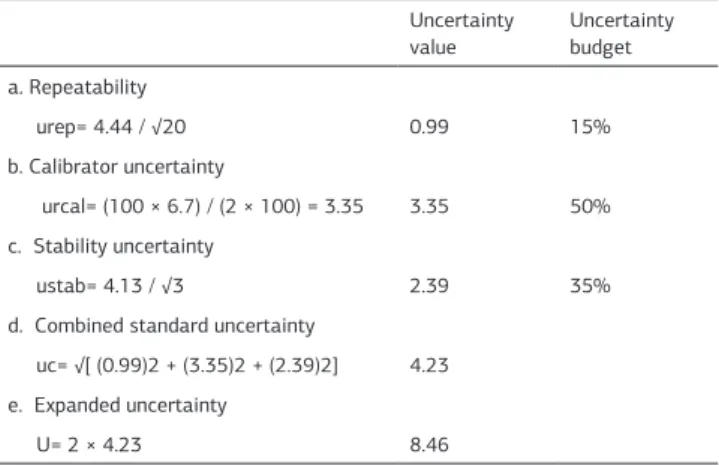
In our study, repeatability, calibrator, stability and expanded uncertainty values of ethanol were estimated. Standard uncer-tainty values and ratios are given in Table 1. In our study, the
measurement uncertainty of ethanol within 95% conidence level was found as ±8.5%. The result at threshold level (50 mg/ dL) was reported as x±U mg/dL, ie. 50±4.3 mg/dL.
Discussion
In forensic medicine, measurement of ethanol levels is impor-tant in lawsuits iled against individuals. In these cases, the method of measurement should be validated and, preferably, it should be constantly audited with quality assurance programs including internal and external quality control systems. How-ever, uncertainty of the measurement results cannot be avoid-ed. Therefore, when evaluating the results, uncertainty value should be taken into consideration.
One of the advantages of calculating measurement uncertain-ty is that it enables us to learn whether the method used has met the known performance criteria of that method. In other words, since measurement uncertainty corresponds to a total error, measurement uncertainty allows us to make evaluations based on acceptable error, which in turn provides information about the performance status of our method. Our uncertainty value (8.5%) was lower than acceptable error values (±15% and ±25%, respectively) of The College of Physicians and Surgeons of Saskatchewan and New York State Department of Health [7]. Another advantage of calculating measurement uncertainty is that the source of measurement uncertainty can be deter-mined during the calculation process. Indeed, identiication of the sources of uncertainty will lead the way to eliminate or to minimize the impact of these sources on measurement accu-racy. Kristiansen et al. measured ethanol levels using the gas chromatographic method and estimated maximal measure-ment uncertainty as 4.95% for diferent blood ethanol concen-trations. They suggested that mostly the analytical component (90%) and then to a lesser extent, traceability (<4%), matrix efect (<0.5%), and blood water content (<0.39%) contributed to the measurement uncertainty. They suggested that the ratio of the analytical component can be reduced by increasing the number of repeats [2]. However, Gullberg et al. indicated that
a single measurement can only estimate ±20% of the actual blood alcohol concentration [6].
Fung et al. calculated total uncertainty (random and system-atic error) value for measurement of blood alcohol as 4% using certiied ethanol reference standards [5]. Generally, in a labo-ratory operating under good quality control system manage-ment, random error caused by the devices used is negligibly small in importance. Rather, errors stemming from improper use of the devices are thought to have an important impact on uncertainty. However, in a study performed by Fung et al., the authors demonstrated that deviation from the average values originating from improper use of the devices was only 0.3% without any practical signiicance as for uncertainty. Our re-sults also support their studies. When we analyzed our sources of uncertainty, the greatest contribution to uncertainty is from calibrators. The second most contributing factor was impaired stability of ethanol in an open tube. This inding indicates the importance of processing ethanol in blood samples as soon as possible ater opening the caps of sampling tubes to ensure re-liability of the analytical result. Shorter-term studies performed at diferent time points may prove that the contribution of sta-bility to uncertainty is relatively lesser and variable.
When legal consequences of the reported serum ethanol mea-surement results are taken into account, laboratory results should be accurate, reliable, and precise. Based on the consen-sus decision of the College of American Pathologists (CAP), al-lowable error for AxSym (Abbott Diagnostic, GmbH & Co. KG, Germany) analysers is ±80% [7]. Even the accuracy among the results of gas chromatography has been debated. Therefore, when starting to use “a standard and well-established test method” for ethanol measurement in the laboratory, measure-ment uncertainty should be estimated. This value will ensure comparability and reliability of the test results reported by dif-ferent laboratories. Besides, during calculation of uncertainty, laboratory specialists will identify all sources of error efective on the results of the measurement and determine their impact on the results obtained.
The uncertainty value determined for ethanol tests gains spe-cial importance in the evaluation of borderline values. For ex-ample, our result reported as 50 mg/dL is above the cut-of value and seems to exceed the permissible limit, when estimat-ed uncertainty value (8.5%) in this study is taken into consid-eration. In reality, it might correspond to a value between 45.7 and 54.3 mg/dL. In this case, this estimated blood alcohol level (50 mg/dL) may not deinitively signify alcohol consumption of the individual above permissible legal limits. Conversely, a blood ethanol level of 48 mg/dL may not absolutely indicate that this individual has consumed alcohol below permissible legal limits. Measurement uncertainty should be estimated to ensure ac-curacy and reliability of the results in an accredited laboratory performing alcohol measurement. Accordingly, legal authori-ties making interpretations based on these results should be informed about the subject matter, which is important for the proper progression of the legal procedure.
Competing interests
The authors declare that they have no competing interests. Table 1. The uncertainty values and its ratios.
Uncertainty value
Uncertainty budget a. Repeatability
urep= 4.44 / √20 0.99 15%
b. Calibrator uncertainty
urcal= (100 × 6.7) / (2 × 100) = 3.35 3.35 50%
c. Stability uncertainty
ustab= 4.13 / √3 2.39 35%
d. Combined standard uncertainty
uc= √[ (0.99)2 + (3.35)2 + (2.39)2] 4.23
e. Expanded uncertainty
U= 2 × 4.23 8.46
| Journal of Clinical and Analytical Medicine 650
References
1. Hancı İH, Aşıcıoğlu F, Arslan Ç, Coşkunol H, Şirin H, Dener Y, et al. “Türk Ceza Yasasına Göre Alkollü Araç Kullanmanın Güvenli Sürüş Yeteneğine Etkileri” Çalıştay
Sonuç Bildirgesi. Adli Bilimler Dergisi 2009;8(4):3-10.
2. Kristiansen J, Petersen HW. An Uncertainty Budget for the Measurement of Eth-anol in Blood by Headspace Gas Chromatography. J Anal Toxicol 2004;28(6):456-63.
3. Sklerov JH, Couper FJ. Calculation and veriication of blood ethanol measurement
uncertainty for headspace gas chromatography. J Anal Toxicol 2011;35(7):402-10.
4. Wiergowski M, Galer K, Szpiech B, Regula K. Uncertainty of measurement as
an integral part of the result and a tool of quality of work improvement for the
chemical-toxicology laboratory. Arch Med Sadowej Kryminol 2005;55(1):74-9. 5. Fung WK, Chan KL, Mok VK, Lee CW. The statistical variability of blood al -cohol concentration measurements in drink-driving cases. Forensic Sci Int 2000;110(3):207-14.
6. Gullberg RG, Jones AW. Guidelines for estimating the amount of alcohol con-sumed from a single measurement of blood alcohol concentration: re-evaluation of Widmark’s equation. Forensic Sci Int 1994;69(2):119-30.
7. Harr KE, Flatland B, Nabity M, Freeman KP. ASVCP guidelines: allowable total error guidelines for biochemistry. Vet Clin Pathol 2013;42(4):424-36.
How to cite this article:
Ince FD, Arslan B, Kaplan YC, Ellidağ H. The Evaluation of Uncertainty for the
Measurement of Blood Ethanol. J Clin Anal Med 2016;7(5): 648-51.
Journal of Clinical and Analytical Medicine | 651