with Biases in the Semantic Perception of Lexical
Material
Ira Trofimova*
Collective Intelligence Laboratory, Department of Psychiatry and Behavioral Neurosciences, McMaster University, Hamilton, Canada
Abstract
The lexical approach is a method in differential psychology that uses people’s estimations of verbal descriptors of human behavior in order to derive the structure of human individuality. The validity of the assumptions of this method about the objectivity of people’s estimations is rarely questioned. Meanwhile the social nature of language and the presence of emotionality biases in cognition are well-recognized in psychology. A question remains, however, as to whether such an emotionality-capacities bias is strong enough to affect semantic perception of verbal material. For the lexical approach to be valid as a method of scientific investigations, such biases should not exist in semantic perception of the verbal material that is used by this approach. This article reports on two studies investigating differences between groups contrasted by 12 temperament traits (i.e. by energetic and other capacities, as well as emotionality) in the semantic perception of very general verbal material. Both studies contrasted the groups by a variety of capacities: endurance, lability and emotionality separately in physical, social-verbal and mental aspects of activities. Hypotheses of ‘‘background emotionality’’ and a ‘‘projection through capacities’’ were supported. Non-evaluative criteria for categorization (related to complexity, organization, stability and probability of occurrence of objects) followed the polarity of evaluative criteria, and did not show independence from this polarity. Participants with stronger physical or social endurance gave significantly more positive ratings to a variety of concepts, and participants with faster physical tempo gave more positive ratings to timing-related concepts. The results suggest that people’s estimations of lexical material related to human behavior have emotionality, language- and dynamical capacities-related biases and therefore are unreliable. This questions the validity of the lexical approach as a method for the objective study of stable individual differences.
Citation:Trofimova Ira (2014) Observer Bias: An Interaction of Temperament Traits with Biases in the Semantic Perception of Lexical Material. PLoS ONE 9(1): e85677. doi:10.1371/journal.pone.0085677
Editor:Philip Allen, University of Akron, United States of America
ReceivedMay 10, 2013;AcceptedDecember 5, 2013;PublishedJanuary 27, 2014
Copyright:ß2014 Trofimova Ira. This is an open-access article distributed under the terms of the Creative Commons Attribution License, which permits unrestricted use, distribution, and reproduction in any medium, provided the original author and source are credited.
Funding:This author has no support or funding to report.
Competing Interests:This author has declared that no competing interests exist. * E-mail: [email protected]
Introduction
Language, emotionality and energetic capacities likely impose biases in perception of lexical material
Social bias of language. Language is an invention of group dynamics, which functions to facilitate socialization, an exchange of information and to synchronize group activity. The social function of language therefore serves the needs of the society more than the needs of an individual. This explains why there are several language-related biases in our lexicon. For example:
– there are more behavioral descriptors of people in active states than in relaxed states;
– there are more words related to social than physical aspects of behavior;
– there are more words in our language describing negative emotions than positive emotions [1], and negative descriptors receive more attention [2–4]
– there are more words describing energetic aspects of behavior than plasticity or tempo of actions.
Contrary to the bias of lexical descriptors in human language, healthy people are in a positive or balanced emotional state no less often than in a negative one, even when there are fewer words related to the positive states; people spend on average a minimum of half a day on either sleeping, napping, sitting while eating, driving, waiting, watching, or not engaging in intense activities. Unless we are talking about teenagers, people are involved in communication no more than in physical or intellectual activities. Furthermore, every action has a certain plasticity of construction and a tempo, i.e. not just the energetic, but also the lability aspects of actions are also present in every performance. These differences between the ratios in language descriptors and the ratios of actual occurrences of certain behaviors, demonstrate a language bias, compromising the validity of the public’s evaluations which use lexical descriptors.
charac-teristics tend to either enhance or diminish each other’s visibility when they play as an ensemble.
For example, high sociability (social endurance) is more noticeable in people with a high tempo of speech, or with high empathy, or with high impulsivity and adventure seeking. That does not mean that people with a low tempo of speech, or well-regulated people, or people avoiding risks cannot have high sociability. At the other extreme, well-regulated, intelligent and secure people, who have a low need for social approval and therefore low socialization, were thrown together by the lexical approach models into one (‘‘introvert’’) group with unempathic (psychopathic or autistic) people and/or people with low physical energy. Research into flat affect shows that patients with this symptom may be more affectively responsive than has usually been assumed. According to patients’ reports as well as electrodermal measures of arousal, flat-affect patients actually have the same or even a higher affective response that do normal individuals [9–10]. It has been suggested that the discrepancy between the experience and expression of emotion (‘‘affective incongruence’’) may result from neuromuscular abnormalities that prevent normal (or even abnormally intense) emotions from being expressed in normal ways [11].
Anxious people were inferred to have a strong inhibitory system, and impulsive people were inferred to have a strong activation system. In clinical practice, however, anxious patients, especially children, show higher impulsivity and inability to focus than non anxious people. Another confusion is the attribution of impulsivity to highly active people with approach and sensation seeking tendencies, and of low-risk and low impulsivity to highly intellectual people. In reality, intellectual people are endowed with all kinds of ‘‘temperament packages’’, including high or low sociability, with or without autistic tendencies, as well as with or without impulsivity, sensation seeking or high verbal-social tempo. Indeed in self-confident and/or energetic people, impulsivity is more visible when present, but depressed people, especially people with comorbid depression and anxiety, who report fatigue and slow-down also have impulsivity symptoms [12]. Such attribution errors are common, because a group of traits with similar behavioral appearances is more noticeable and can be attributed to one factor more readily than in cases where the same traits have ‘‘conflicting’’ directions.
Emotionality bias of cognition. Another factor that com-promises the objectivity of people’s evaluations: an impact of emotionality on cognition. Findings in neuropsychology showed that emotional evaluation always comes prior to the detailed cognitive assessment of the events, due to the lead of subcortical brain structures in information processing. Both subcortical and cortical structures are involved in emotional processing via multiple routes [13–16]. Vuilleumier and colleagues in their fMRI studies of the amygdala and related brain structures found a key role of these structures not only in emotional processing, but also in attention and perception [17–18]. Their results showed that emotional processes can modify perception – an effect that they called ‘‘emotional attention’’ [19]. Similar interlocking between emotionality and cognition was described be Pessoa [20–21]. Adolphs, Tranel and Buchanan [22] reported that enhanced memory for the visual details of a negative item within the affective-attentional network does not lead to the successful encoding ofall details of an item’s presentation. Activity in these affective processing regions showed no correspondence (in the case of the amygdala) or a negative relation (in the case of the orbito-frontal cortex, striatum, and anterior cingulate gyrus) to the successful encoding of the task performed with an item. This means that even though emotional processing dominates the first
stages of evaluation and creates emotionality bias, it misses important details of the perceived objects.
These neuropsychological findings, which showed how uncon-scious emotional processing can affect human cognition, were reflected in theories of emotionality, offering the concepts of ‘‘primary appraisals’’ [23], ‘‘basic emotions’’ [24–25], ‘‘core affects’’ [26], ‘‘somatic markers’’ [27] as pre-cognitive emotional dispositions [28–29]. This was in line with common observations from clinical psychology and psychiatry on biased perceptions of patients with mood disorders, based on the same neurochemical factors as temperament. The presence of a background emotion-ality seems to be a built-in primary biological component of semantic processing (facilitating approach-withdrawal behavioral reaction) not only in humans, but also in other animals, including the most primitive ones [30]. More recently direct studies of the impact of emotionality on the semantic perception of amodal lexical material reported a negative bias in the semantic perception of socially anxious and neurotic people [31–33].
With such a strong and direct impact on cognition, emotionality can collapse the structure of perceived phenomena into just two dimensions related to emotional valence. There are indeed two valence-based biases noted in neurophysiological studies of emotionality.
First, emotional arousal has a well-documented negativity bias [1–4] [34–36]. There are more cognitively distinct negative emotions than positive ones [37–38], and people appeared more likely to feel multiple positive emotions at one time than multiple negative ones [39]. A negative default reaction has been observed in human affective judgments [40–41], judgements of objects, events, or choices [42–43], and event-related brain potentials to affective stimuli [44]. Meta-analysis of autonomic activity in response to all negative emotions combined compared with all positive emotions combined also showed a negativity bias. The components of autonomic response (diastolic blood pressure, blood volume, cardiac output, left ventricular ejection time, pre-ejection period, pulse transit time, heart rate) had significantly greater activation during negative than positive emotions, and no autonomic responses showed the opposite pattern [44].
Second, socialization and perceived social support was found to have a positive emotionality bias. Mu-opioid receptors (MOP) inducing positive emotionality were found to be important players in the perception of social support [45] and in motivation by possible engagements in activities [46]. The impact of MOP and oxytocin on perceived social support and affiliative behavior was found to include dopamine (DA) release: both MOP and oxytocin induce this release during pro-social behavior. DA release in projections between NA, VTA and medial PFC also plays an important role in affiliative behaviour [24], [47], and an activation of the 5-HT2A receptor in hypothalamus reportedly increases hormonal levels of oxytocin, prolactin, ACTH, corticosterone, and rennin [48]. There are numerous reports on the role of oxytocin in perceived social support [47], [49–50], in affiliative behavior, and the formation of social memories [47]. Moreover, gonadal steroids, and vasopressin were found to have modulating effects on sensory, perceptual, and attentional processing of affiliative stimuli [49]. There are obvious evolutionary benefits for the development of a positive reinforcement system for socialization in humans, which we do not discuss here.
cognition. As a result their biases will more likely appear in human estimations and even in the lexicon. The unconscious contribution of emotionality to cognitive processes raises concerns about the scientific validity of models that are based on people’s evaluations, and not on experimental or clinical work.
Capacities-related bias in estimations of lexical material. Physical and social capacities were found to be interlocked with the way how people evaluate stimuli. For example, physical exercises were found to shift perception to more positive evaluations and even to endorphin-based improve-ment of depressive symptoms [51–54]. People with higher endurance in communication were reported to perceive neutral abstract concepts significantly more positively [31] and per-formed better on recall or categorization of emotionally positive words [32–33], than other temperament groups in these studies. A series of theories of embodiment, which echoed James-Lange theories emerged in cognitive psychology during the past 20 years [55–63].
Trofimova [31], in her study of the impact of sex and temperament on the perception of common words, described the phenomenon of «projection through capacities». Such a phenom-enon emerges when a person’s evaluations depend on their capacity to handle the events, and such evaluations therefore have bipolar outcomes (‘‘can handle’’ or ‘‘cannot’’) with corresponding positive or negative emotional dispositions towards the subject of evaluation. In projection through capacities, individual informa-tion processing therefore has a capacity-related bias, as the individual registers mostly those aspects of objects or of a situation that they can properly react to and deal with according to their inherent capacities (including a capacity to avoid harm). The interlocking of energetic capacities with emotional valence is in line with the idea of embodiment in cognition (supporting James-Lange theory) and the findings that the same neurochemical agents (neuropeptides and monoamine neurotransmitters) are involved in both energetic and emotional regulation of behavior. Such interlocking between energetic status and emotionality suggested that the largest dimensions in lexical approach models, i.e. Extraversion and Neuroticism, are not independent and essentially represent one dimension, and that executive and evaluative systems regulating human behavior might have a much closer interaction than was previously thought. This questions the benefits of a dimensionality-oriented approach in differential psychology, including the use of factor analysis, which relies on the independence of dimensions.
Lexical approach models might not be applicable to investigations in biology of individuality, due to language, capacities and emotionality biases
The lexical approach in differential psychology involves people estimating very long lists of words for describing human traits and characteristics. A factor analysis is then applied in order to classify the traits into factors presented as dimensions of personality. The lexical approach was used by Cattell to derive his 16-factor model [64] and by a number of researchers proposing 5-factor models [64–71]. The modern 5-factor model was named the ‘‘Big Five’’ by Goldberg, and was intensively promoted around the world by McCrae and Costa [71].
Since phenomenon of personality is to a large extent a product of individual’s socialization it would be natural to investigate how linguistic processes reflect the human perception of individual differences. This is a subject of investigation of cognitive psychology and, to a degree, personality psychology. The problem with the lexical approach arises when researchers manipulating the lists of verbal descriptors of personality present their models
not as an interesting artifact of human verbal cognition or socialization processes, but as revealing a real core of biologically based individual differences in humans.
For example, researchers of the Big Five model claimed that it is capable of reflecting the structure of the biological systems of individuality (called either ‘‘first order’’ or ‘‘second order personality traits’’ within the lexical approach, and which are called ‘‘temperament’’here), just by application of factor analysis to the lists of personality descriptors. (Note that temperament was a topic of research for over 100 last years, especially in European tradition in the work of Kant, Pavlov, Heymans, Wundt, Stern, Lasursky, Jung, Adler, Kretschmer, Spranger, Teplov, Nebylizyn, Eysenck, Thayer, Gray, Tellegen, Rusalov, Netter, Watson and Tellegen, Strelau, etc. Historically the North-American tradition of temperament research was scattered within three different disciplines: developmental psychology, psychiatry and personality theory looking for biologically based traits using a lexical approach. This might explain frequent misconception on North American psychology that ‘‘temperament is the same as person-ality’’). In other words, the conclusions on the structure of biologically based traits were made using cognitive psychology methods.
The main assumption of the lexical approach is that correlations between common verbal descriptors of personality correspond to correlations between biologically based systems of human individ-uality. Only if this is true then the models of lexical approach can claim that they found a structure of the biologically based systems of individuality, and not just the nature of verbal descriptors themselves. To sort out whether or not the relationships between verbal descriptors can be considered as a representation of relationships within real biological systems of individuality we should look at: 1) nature of the descriptors (their source, scientific validation, possible biases), and 2) completeness of the list and any asymmetries in distribution of these descriptors that might lead to biases in resulting factors (keep in mind that the size of factors and the pattern of loadings are the direct reflection of such relationships).
1) In terms of the nature of lexical descriptors or their perception, the arguments above showed that they have at least three well-recognized types of biases: the socialization-bias of descriptors themselves, capacities-related (embodiment) bias and an emotionality bias in cognition. There are too many words related to socialization, in comparison to other words (socializa-tion-language bias); there is a negativity bias in words related to emotionality; and there are more words related to energetic rather plasticity aspects of activities (capacities bias). Due to social and emotionality biases in our lexicon, if we collect all words related to individual differences and apply either factor analysis or just common perception in order to group these descriptors into conflating characteristics, the largest factors (groups) will be a) the words separated by the criteria of pro-social and socially-pragmatic values (Extraversion, or Activity are the candidate names) and b) the words contrasted by emotional valence, with a prevalence of negative emotionality, due to the prevalence of such words in human lexicon.
and very strong, it is not a surprise that two factors of the Big Five model (Extraversion and Neuroticism) consistently appeared in the personality research performed in various cultures, and three other factors (Openness to Experience, Conscientiousness and Agree-ableness) failed to show the same consistency across cultures or even within the same culture for different age groups [76–77]. The outcomes of the lexical approach in its contribution to differential psychology were, therefore, rather modest. Testing thousands just to confirm the relative independence of the two major dimensions of temperament would seem a rather expensive enterprise, especially since these two dimensions were already described in differential psychology for at least a century.
The emotionality bias in cognition implies that higher emotional people might have a greater bias and less ability to distinguish between non-evaluative criteria of assessment than lower emotional people. If so, there is a possibility that, if we rely on the estimations of verbal material by lower emotional people, it will diminish the emotionality bias (even though the language bias will remain). On the other hand, the estimations of lower emotional people might bring more contextual diversity, which would produce so much variance that it would result in too large a portion of variance unexplained by the resulting factors. The first possibility would improve the validity of the lexical approach, and the second possibility would not. The lexical approach does not differentiate between high-emotional and low-emotional people, but it is not clear if using it with low-emotional people would make any difference. Based on the reported emotionality bias in cognition, there are high chances that this bias affects the results of factor analysis, gluing criteria of estimations of highly emotional people in evaluative manner.
The existence of language- and emotionality biases in verbal descriptors of human behavior has serious implications for the use of the lexical approach in differential psychology. If these biases indeed exist then the models of lexical approach reflect only relationships between the lexical descriptors of human individuality, and not biologically based systems of this individ-uality. For this reason science usually does not rely on inexpert evaluations of words describing natural phenomena, but exper-iments and natural observations of these phenomena are used instead, especially when it comes to claims in regards to biology and physiology.
This paper investigates if and how these biases show up in different temperament groups, but before we focus on the details of the study, let us briefly comment here on the second key flaw in the clam of the lexical approach related to a discovery of biological systems of individuality.
2) As noted, in order for lexical approach models to reflect the nature of phenomena under study (biological systems of individ-uality) their lists of descriptors should be complete and should arise within the scientific, not the general, community. Eschewing experimental and physiological techniques for investigation of what biological regulatory systems indeed exist, lexical approach researchers also insist that their concept of personality is practically equal to the concept of temperament. In American psychology every time that a study on temperament is performed, it is common for reviewers to demand the inclusion of references to findings from some lexical approach study.
Meanwhile temperament is defined as the most consistent, biologically based dynamical aspects of behavioral regulation, which are relatively independent from educational and socio-cultural impact [78–84]. Similarly to other factors which depend on neurochemistry and neurophysiology of the body (such as sex and age), temperament should be treated as comprising the biological systems of human individuality, and not personality.
Similarly to the interaction of sex- and age with social factors leading to specific personality peculiarities, temperament also interacts with socialization factors; it is a different, more basic and older concept than personality, and has its own research field. There is more than a century of findings from experimental studies on the structure of temperament, clinical work in differential psychology or studies in neuropsychology by Pavlov, Spranger, Stern, Lasursky, Jung, Teplov, Nebylizyn, Eysenck, Rusalov, Strelau, Cloninger, Robbins and Everitt, Halgren and Marinkovic and many prominent neuropsychologists ([78–93] – see the review of temperament models and references in [28–29], [83], [94]).
On this criterion of completeness the lexical approach also shows significant flaws: it completely misses the regulatory characteristics related to lability of behaviour (plasticity-rigidity, tempo of verbal or physical activities). Yet, these characteristics are well-known for being based on biological systems. Pathologically low plasticity (perseverance) has been described in clinical cases of frontal lobe damage for over 70 years. Contrary to unification of endurance and tempo under one dimension of Extraversion in the Big Five model, these characteristics are based on different biological systems: just consider the difference between capacities used by marathoners and sprinters.
More specifically, it was suggested that temperament appeared to regulate three dynamical aspects of activities (energetic, programming-lability and sensitivity-orientational), multiplied by two probabilistic levels of regulation (stereotypical, learned vs. new or complex activities). There also are different traits regulating three distinct functional aspects activities of activities (motor vs. social vs. mental) and there are, of course, at least three types of emotionality traits (neuroticism, confidence and impulsivity), which do not substitute for energetic or plasticity components of behavioral regulation [28–29], [83], [94], [95]. These dynamic properties, described by the concept of temperament, traditionally were considered separately from content-related aspects of behaviour, such as values, beliefs, knowledge, motives, preferences, i.e. the key components of personality. After all, content-related aspects were thought to be mainly based on socio-cultural factors, and temperament is based on biological factors. Ever since it was described by the physicians Hippocrates and Galen 2500 year ago, European researchers of temperament linked it to the properties of nervous systems, neurochemistry and endocrinal regulation of the body.
This work showed much higher, nonlinear, dimensionality and complexity in biological regulation of behavior, even though these models also included emotionality and energetic dimensions. After all it is hard to believe that complex human behavior would be regulated just by two biological systems. Robbins and Everitt [92] pointed out in regards to the concept of Extraversion that ‘‘various indices of arousal do not intercorrelate to a high degree, as would be expected of a unitary construct (Eysenck, 1995), and putative manipulations of arousal, whether pharmacological or psychological, do not interact in a manner suggestive of an underlying unidimensional continuum’’ (p.703). Instead they described not one, but rather four reticular arousal systems, related to four types of neurotransmitters.
There have been practically no studies (except the cited three [31–33]), which directly investigated all named biases in the semantic perception of verbal material. One of the main reasons for this is the methodological challenges involved in studies perception of the meaning, i.e. semantic perception.
Methodological considerations of studies investigating the semantic perception of lexical material
attribute to the words. Meaning appeared to be individually unique and different not only between people from different cultures, social and family background, but also between all individuals. Many parametric methods appeared to be useless in measuring meaning, as what psychomantics does looks like comparing oranges and apples.
The first success in identifying commonalities in semantic perception came with Kelly’s [96] theory of personal constructs. This theory suggested that people assess events and objects using criteria (‘‘constructs’’) of a bipolar nature. Subsequently, a branch of cognitive psychology, psychosemantics, was established and flourished after Osgood [97] demonstrated the existence of at least three universal dimensions in semantic perception in people from 24 cultures. Osgood named the three most commonly found factors ‘‘Evaluation’’ (which included, for example, the scales ‘‘pleasant-irritating’’, ‘‘clear-dirty,’’ ‘‘kind-cruel’’), ‘‘Activity’’ (‘‘en-ergetic-constrained’’, ‘‘monotonous-keen’’, ‘‘fast-slow’’) and ‘‘Po-tency’’ or ‘‘Power’’ (‘‘strong-weak’’, ‘‘firm-flimsy’’, ‘‘massive-miniature’’). Eventually it was noticed that Osgood’s factors present predominantly evaluative (emotional) criteria for the assessment of objects.
The evaluative nature of Osgood’s three dimensions of semantic perception was often presented as a criticism of Osgood’s findings, but what is important in the context of this paper is that the scales had a tendency to glue together into factors in a rather consistent manner, regardless of the objects of estimation. The fact that the scales’ grouping was not related to the specifics of objects, was bad news for the lexical approach. This meant that people, as observers, had some intrinsic structures in their semantic space that could impose consistent biases on their estimations.
At the same time, studies of human and animal cognition showed that our perceptual processing is organized not only around assessing the valence of objects or events, but also around probabilistic features. Subsequent studies in psychosemantics found a few additional universal dimensions: ‘‘Typicality’’, or ‘‘Probability’’ (‘‘typical-exclusive’’, ‘‘regular-rare’’) [31], [98], ‘‘Improvement’’, or ‘‘Organization’’ (‘‘organized–non-organized’’, ‘‘regular-spasmodic’’ ‘‘constant-changeable’’, ‘‘precise-indefinite’’), ‘‘Reality’’ (‘‘imaginary-real’’, ‘‘evident-fantastic’’, ‘‘abstract-con-crete’’), ‘‘Complexity’’ (‘‘complex-simple’’, ‘‘mysterious-usual’’, ‘‘unlimited-limited’’), Stimulation (‘‘interesting-boring’’, ‘‘trivial-new’’) [31], [99–100], and other small factors. These findings suggested that people might be using non-evaluative criteria (complexity, organization, stability and probability of occurrence) and evaluative, emotion-based (‘‘good-bad’’, ‘‘exciting-boring’’) criteria independently. Such independence of non-evaluative criteria in semantic perception would validate the lexical approach method.
A common way to extract biases in meaning attribution is to apply projective methods, using material of a very general nature, which is open to individual interpretation. Projective Semantics [31], [101] based on Osgood’s [97] Semantic Differential method (SD), asks people to estimate well-known general concepts using common adjectives in the form of bipolar scales. These scales are then grouped into a small number of factors to facilitate the analysis. The difference between the Semantic Differential and the Projective Semantic methods is that the SD studies conducted by Osgood or his followers used various numbers (between 15 and thousands) of diverse adjectives and concepts to be assessed. The Projective Semantic method uses primarily concepts of a very specific nature: these nouns correspond to the 7 groups (factors) of adjective-scales, which were those most consistently found in cross-cultural studies, as described in the previous paragraphs. Seven
types of adjective scales and seven types of concepts describing the same aspects of reality as the scales establish theobject-scale symmetry
(OSS) between scales and objects, which improves the sensitivity of the method to any bias in responses.
For example, if there are no differences between participants in the perception of the common words, then the concepts ‘‘Reality’’, ‘‘Present’’ are expected to be assessed unequivocally as ‘‘very real’’ on adjectives such as ‘‘real-imagined’’ (i.e. scales of the Reality factor); the concepts ‘‘Complexity’’, ‘‘Chaos’’ as ‘‘very complex’’ along the scales of the Complexity factor, the concepts ‘‘Beauty’’, ‘‘Freedom’’ are expected to be on the positive pole on the Evaluation scales, ‘‘Time’’, ‘‘Development’’ – on the negative pole of the scales of the Stability factor, etc. It is expected that a deformation of this symmetric and very basic matrix would reveal underlying biases of two types: in either using certain scales and/or in the assessment of certain concepts. The concepts are chosen to correspond not only to the groups (factors) of scales, but also to temperament traits, i.e. to the dynamical characteristics of behaviour (Effort, Work, Relaxation – to scales measuring endurance; Speed, Motion – to scales related to Tempo and Plasticity of activity; Prestige, Reputation, Beauty – to Emotion-ality scales) and to the scales related to different areas of activity, such as physical (Motion, Work, Speed), social (Society, Person, My contemporary) and intellectual (Complexity, Chaos, Time, History).
Before we summarize the hypothesis and methods, the following requirements should be mentioned, which narrowed the focus of our study:
a) A concern about an impact of culture and educationon the semantic perception of lexical material. Since Luria’s experiments in the 1930s within low-educated cultures it was shown that culture is an important determinant of which kinds of non-evaluative criteria people use for classification and evaluation (See [102] for review). One component of the educational impact is a previous functional experience related to the objects of assessment. We agree with Cree and McRae’s [103] differentiation between amodal semantics, sensory/ functional semantics and domain-specific semantics (which classifies objects according to concrete, knowledge-based features). The assumptions of the lexical approach relate to amodal semantic perception as this approach was applied to the concepts of personality and human character, and searched for cross-cultural universality. Our study therefore should, similar to the lexical approach, focus on amodal (and not so much on sensory/functional or feature-specific) semantic perception using the most common lexical material, accessible for all cultures and educational levels.
language processing was found to be an important compo-nent of disposition for semantic retrievals [59–63]. Moreover, it was shown that the brain appears to process meaning attribution to words in a modality-specific manner when it comes to concrete activities and objects [61], [109–114]. To control these effects, in addition to the application of amodal lexical material, a setting up of physically identical conditions for all subjects would help to minimize a possible situational embodiment-related bias (i.e. bias based on the specifics of body-object interaction in a given moment). The difference between the majority of embodiment studies using tasks of specific modalities and this study is that the experimental groups of the former were contrasted by more diffuse (unrelated to specific actions) dynamical aspects of behavioral regulation: endurance, changeability, directionality of behav-ior. In contrast to the well-defined anatomy of motor and sensory systems, temperament is based on the neurochemistry of the body (neurotransmitters, neuropeptides, opioid recep-tors and hormones), and therefore this study presents a different aspect of embodiment research.
Goals, hypothesis and methodological considerations of the present studies
One of the assumptions behind the lexical approach, which this study challenged, is that existing relations between features of human behavior will be adequately reflected in correlations between lexical descriptors of behavior without any language or emotionality bias. Therefore, one of the goals of our study was to investigate whether temperament groups, which are contrasted by the energetic and sensory capacities perceive lexical material differently. More generally, it was investigated if semantic perception of lexical material differed between these contrast groups for verbal non-evaluative criteria of organization, proba-bility, complexity and stability. The first, the projection through capacities hypothesis, was based on embodiment theories and on reports describing the interlocking between capacities and emotionality, and between emotionality and cognition. According to this hypothesis people with higher endurance or tempo in either physical or social aspects of behaviour perceive objects, even amodal verbal material, in more positive terms in comparison to their opposite temperament groups.
It is not at all clear, however, whether people with higher social-verbal endurance and tempo of speech have more adequate semantic perception of lexical material than people with higher intellectual or physical endurance. These people might either have a more detailed perception of social concepts, or, alternatively, the social nature of language might create a positive bias in their perception in favor of socialization-related concepts. Mental (intellectual endurance) is expressed in individual attentive abilities. It is possible that people with higher scores on this trait might have more adequate use of criteria in the assessment of abstract concepts.
Moreover, the logic of embodiment theory suggests that lability traits of temperament (ability to restructure actions and tempo of performance) might have an impact on the perception of time-related lexical constructs. To date there has been practically no research focusing on the semantic perception of time concepts by people with different speeds of performance. The only study with such focus was conducted by Trofimova [31], which used a small number of scales and concepts. This study reported that participants with higher physical tempo perceived abstract concepts as more fast, more energetic and acute whereas participants with higher verbal tempo perceived the same object
as more constant. As an indirect indication of the body’s-tempo-related bias in the perception of action verbs, several studies showed a presence of motor activation during the processing of these verbs [112–113], [115–116]. Based on these results we hypothesized that people with a stronger dynamical (tempera-mental) system generating atempoof performance will project more energetic and speedy properties to abstract concepts than people with slower tempo.
Our second goal of the study was related to the assessment of a possible impact of language (socialization) bias, especially in the perception of lexical material by people with high social-verbal capacities. The second, language bias hypothesis, suggested that people with stronger endurance and tempo in verbal-social activities would differ from people with stronger motor-physical or intellectual endurance in their semantic perception of lexical material. Moreover, as a part of this hypothesis we investigated if temperament traits which are not related to socialization or emotionality (such as plasticity and tempo) will have any interaction with semantic perception of lexical material.
The third goal of this study was to investigate if there is a conflating impact of emotionality bias in the use of non-emotional criteria of estimations. If there is no such emotionality bias, then the non-evaluative (probabilistic or structural) criteria would be used independently from evaluative criteria in semantic process-ing. If there is such emotionality bias, the polarity of non-evaluative criteria would be conflated with the valence of evaluative criteria. Our emotionality bias hypothesis suggests that emotional dispositions create a universal, object-independent bias in meaning attribution, and that this bias is especially strong in amodal semantic perception (i.e. when no concrete feature-specific objects are given, and a person has to assess abstract lexical material). We hypothesize that this bias might be so strong that it forces non-evaluative criteria to follow the valence of emotional evaluative criteria. In this case the background emotional component of semantic perception would correlate (or ‘‘glue’’) parameters of assessment into the factors regardless of the objective features of these elements.
At this point we have three hypotheses, which relate to capacities-, language- and emotionality biases in semantic perception. In order to separate these biases in our investigation we had to use experimental groups that were contrasted by various aspects of physical, social and intellectual capacities and emotion-ality. Temperament traits are hard to monitor in short-term experiments, as they emerge only as consistent behavioral patterns in a variety of situations over long periods of time. Such monitoring is especially challenging if we need to study all traits at once. Neurophysiological methods for separating contrast temperament groups are also not developed yet, as temperament traits are based more on neurochemical processes rather than brain morphology, visible in neuroimagery studies. For these reasons the main instruments to diagnose temperament are validated temperament tests.
Such an integrated approach (admittedly complicating the readability of the results) was necessary to analyze for the possibility of interactions between the three described biases in the perception of the participants of the study.
In sum, to test our hypothesis we used 12 independent variables, corresponding to 12 temperament traits. Dependent variables were not single measures, but patterns of relationships between multiple semantic measures (scales). The analysis was focused on both quantitative (statistically significant differences) and qualitative effects (the way that these differences were grouped along the poles and features of the scales). We expected the following:
(1) If the ‘‘projection through capacities’’ hypothesis is true, the results would show: a) that people with higher endurance attribute more positive meaning to neutral common words than people with low endurance; b) that people with higher tempo would have universally higher estimations to timing-related concepts (Time, Motion, Development, Speed) than other tempera-ment groups.
(2) If the ‘‘language bias’’ hypothesis is true, a temperament group with higher verbal-social endurance will give more positive estimations of concepts than other temperament groups, due to their better verbal capacities;
(3) If the ‘‘emotionality bias’’ hypothesis is true, then a) the differences in estimations on non-evaluative scales (describing probability, complexity and organization aspects of concepts) would follow the same polarity as on evaluative scales (which belong to Evaluation or Stimulation factors); b) emotional reactivity, as an expectation of a failure, will affect the estimations of people with higher emotionality or neuroticism, emerging as a universal negative evaluative bias in their estimations.
Method, Study 1
Sample
846 undergraduate psychology students of McMaster University and Brock University (Southern Ontario) (85% of the sample) and volunteers from the same area aged 17–52, M/F = 331/545 participated in this study in 2000–2003. All participants were fluent in English. After validity procedures were applied the final sample included 312 men,Mage6SD = 21.967.4 and 506 women
Mage6SD = 20.565.4.
Procedure
The study received an approval from the McMaster University Ethics Committee for all procedures. All subjects received debriefing and signed an informed consent form and then completed the Extended Structure of Temperament Question-naire and participated in the experiment. University students received a practicum credit for their participation.
The Extended Structure of Temperament Questionnaire (STQ-150) [83], [95], [117–118] has 150 statements to be answered with a Likert scale format: ‘‘strongly disagree (1),’’ ‘‘disagree (2),’’ ‘‘agree (3),’’ ‘‘strongly agree (4)’’. Six items are assigned to the validity scale, and 144 items to 12 temperament scales (12 items each). (A brief summary of the validation history of the Extended and Compact STQ is given in Text S1). The scales are as follows (alpha values are given in parenthesis based on the data in this study):
1–3. Scales of Motor, Social and Intellectual Endurance (‘‘Ergonicity’’) (ERM, ERS, ERI), assessing the ability of an
individual to sustain prolonged physical (alpha = 0.83), social (0.83) or mental (0.73) activity respectively.
4–6. Scales of Motor, Social and Intellectual Tempo (TMM, TMS, TMI) assessing the speed of manipulations with objects (0.72), tempo of verbal activity (such as talking and reading) (0.75) and tempo of performing intellectual tasks (0.70) respectively.
7–9. The scales of Motor, Social and Intellectual Plasticity (PLM, PLS, PLI) assessing the ability to adapt quickly to changes in instructions or circumstances in object-related operations (0.71), communication (0.77) or intellectual activity (0.71) respectively.
10–12. The scales of Motor, Social and Intellectual Emotion-ality (EMM, EMS, EMI) – assessing sensitivity to failure and to success in physical (0.74), social (0.71) and mental (0.75) activities respectively.
Protocols having scores of 18–24 on the Validity scale were considered invalid as the respondents were likely to demonstrate a positive impression bias in their responses.
The Semantic Task experiment used 60 6-point bipolar scales to estimate the 29 general concepts (Table 1) chosen according to the Projective Semantic method as described above. Each concept was presented by the program ‘‘Expan’’ on a computer monitor at the top of the screen along with each of the bipolar evaluating scales placed horizontally at the middle of the screen (i.e. 1740 screens were presented for the estimation). Both poles of the scales had 3 degrees of freedom (‘‘very much’’, ‘‘some-what’’, ‘‘weakly’’). The order of scales and concepts was changed for each protocol to avoid the consecutive use of several scales related to one factor.
Statistical processing
To avoid the impact of a social desirability or negative impression bias, the contrast temperament groups were selected, not based on the T-scores on the STQ, but based on the relative rank of the position of a score on a given scale in relation to scores on the other scales within an individual temperament’s profile. The implication was that participants might over/underestimate the expression of their dynamical traits under the influence of social expectations, but they could be more objective about which temperament characteristic is stronger or weaker in comparison to their other characteristics. For each protocol, the scores on 12 scales were transformed into 12 ranks. The protocols were sorted into three groups with lowest, middle and highest ranks and the contrast (i.e. lowest (1–4) and highest (9–12)) groups were processed further. Table 2 shows the sizes of the contrast groups, and Table 3 shows the statistical details related to temperament scores. The differences in estimations were assessed with the Mann-Whitney U test, separately for men’s and women’s contrast temperament groups (based on 12 scales of the STQ-150). To control multiple comparisons using the Bonferroni correction the significance of differences was set top,0.0063.
Results, Study 1
attractors: (Prestige, Reputation, Beauty, Freedom), ‘‘Reality’’ (Reality, Present, Life), ‘‘Work’’ (Work, Task, Activity, Effort), ‘‘Time’’ (Time, Speed, Motion, Development), and ‘‘PastFut’’ (Past, Future). Other concepts did not show noticeable significant differences in contrast temperament groups, except 2 cases: ‘‘Power’’ in the male Social Tempo contrast group, and ‘‘Simplicity’’, ‘‘Order’’ in the female group contrasted by Motor Tempo (marked as SimpOr in the Figure 1).
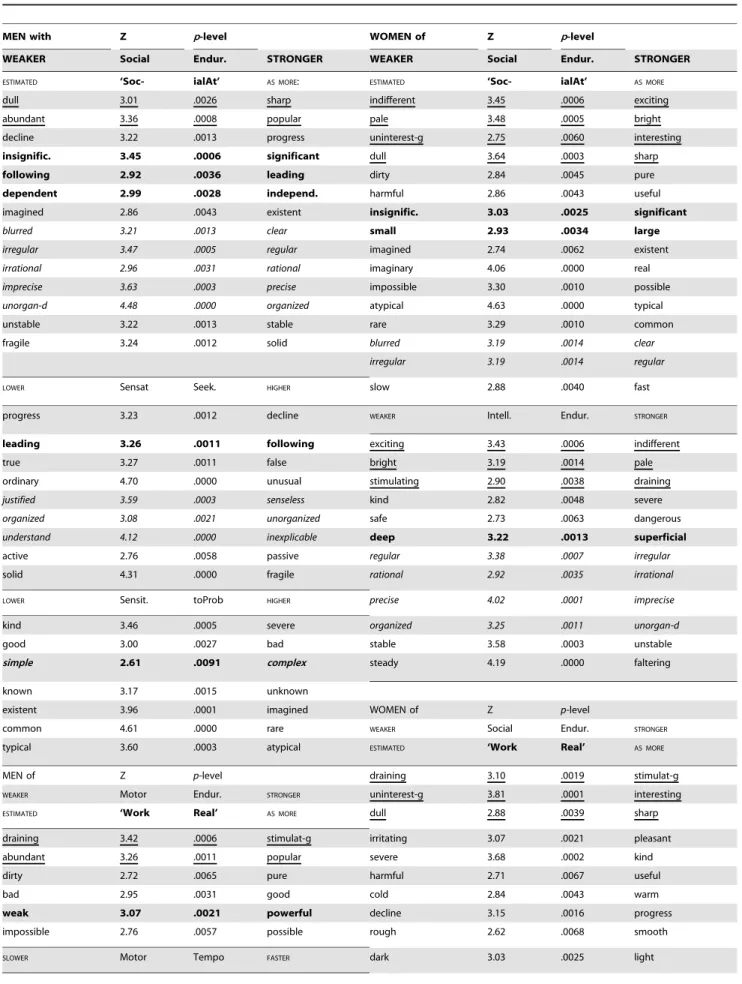
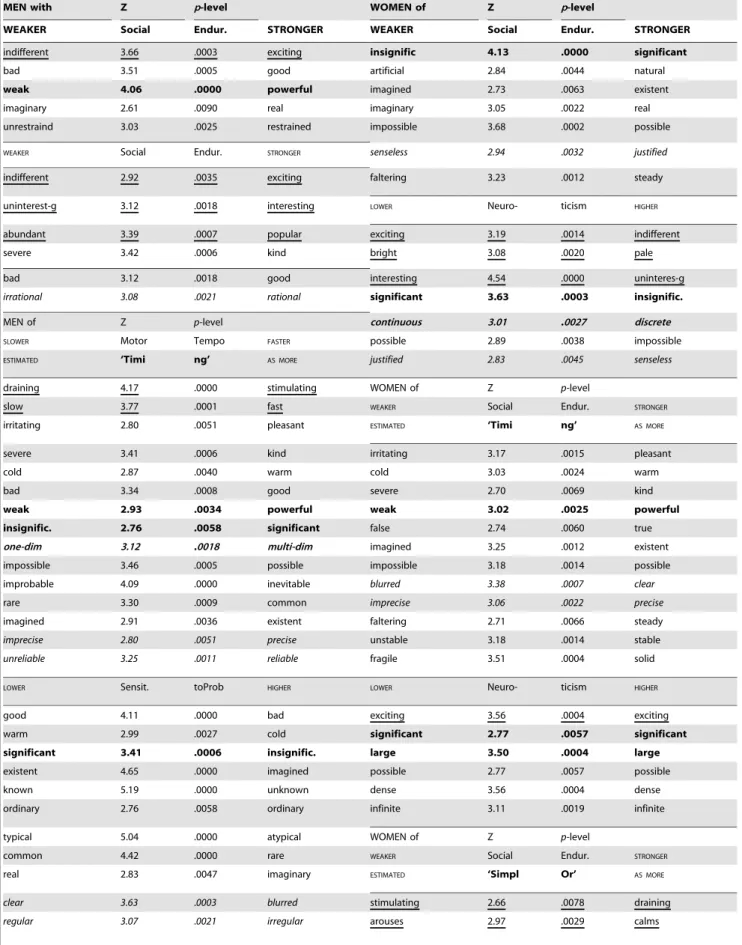
In more detail, Figure 1 assigns a specific color pattern to each of 7 factors (connotative groups), to facilitate the perception of the spectrum of significant differences. The height of the pattern is proportional to the number of scales related to the particular factor that showed significant differences, with greater heights representing more scales (see Table 4, Table S1 for statistical details). The position of the patterns with respect to the zero line
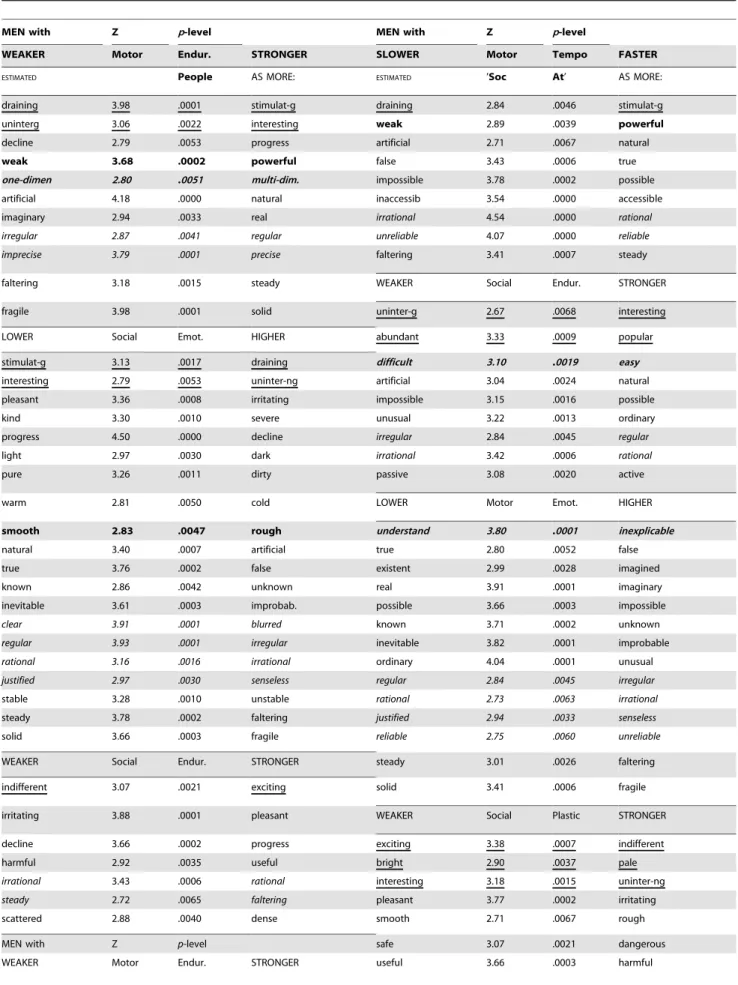
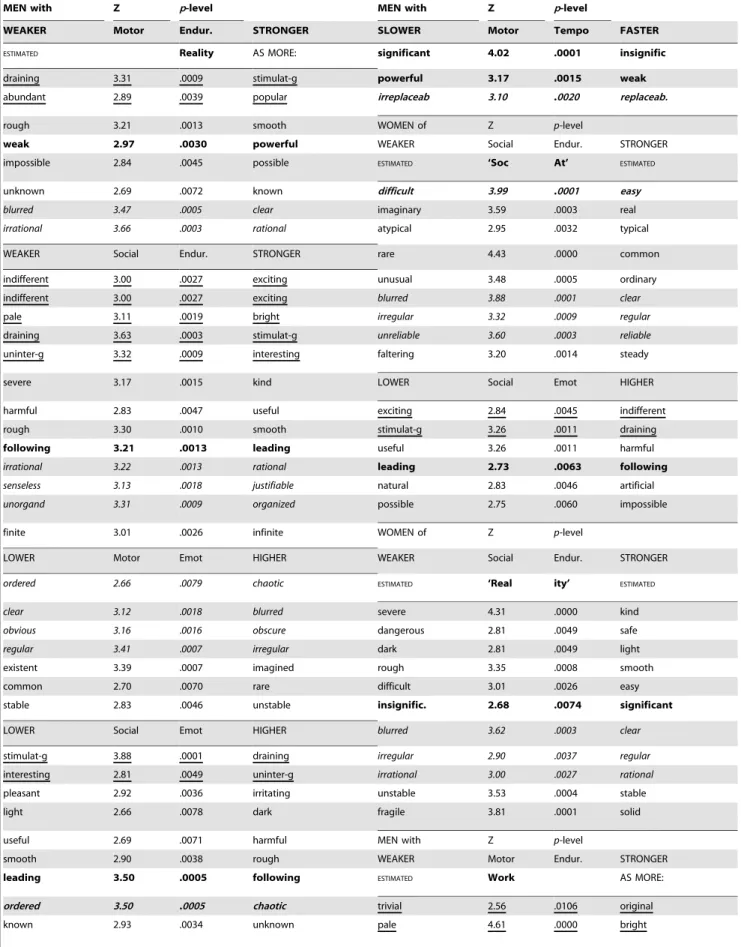
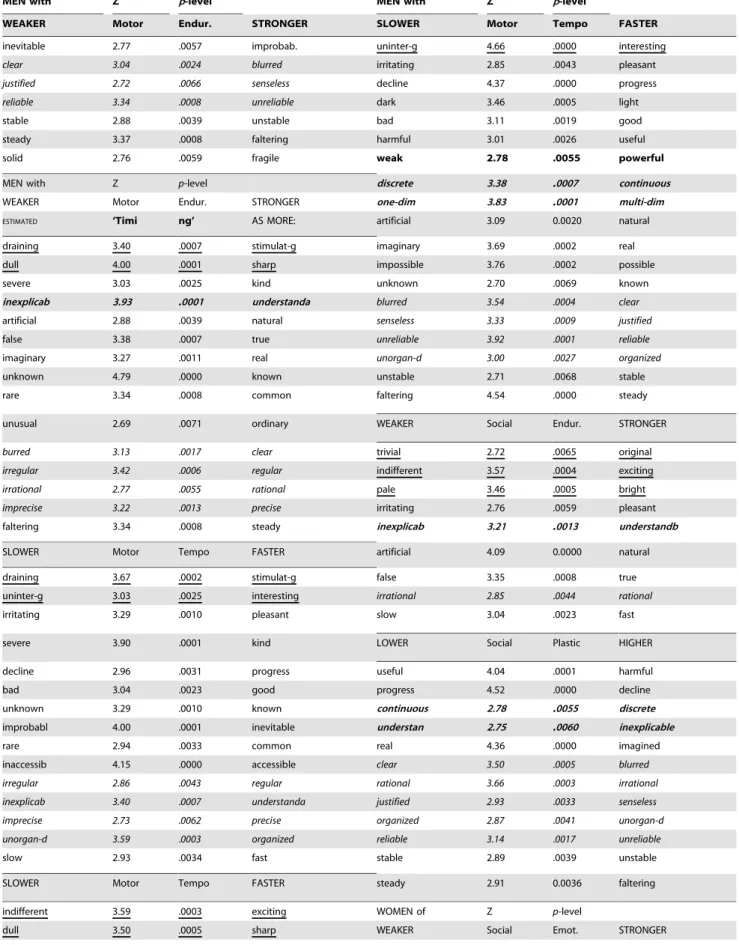
indicates the polarity of estimations preferred by the group with the higher scores on a given trait, i.e. to which side of the scale this group’s means were closer. The above 0 position indicates that means were closer to the positive pole of the scale; below 0– to the negative pole, see Table 1 for the assignment of poles. For example, for the concepts of social attractors, Figure 1, Table 4 (and Table S1) shows that in total 10 scales had significant differences in the male group contrasted by Social-verbal Endurance trait. From the height of each pattern one deduces that there were significant differences on the scales of the Stimulation (2 scales), Probability (2 scales), Organization (3 scales), Stability (1 scale) and Complexity (1 scale) factors. This stacked column shows that the estimations of socially energetic men are significantly closer to the positive poles on Stimulation, Probability and Organization descriptors and to the negative pole Table 1.The list of scales (grouped into 7 factors) and concepts used in the Study 1.
Scales: Scales: Concepts:
+pole2pole +pole2pole
‘‘Stimulation’’ complex-simple Activity
original – trivial continuous-discrete Future
exciting-indifferent inexplicable-understandable Faith
bright – pale difficult - easy Time
stimulating-draining ‘‘Reality/Probability’’ Society
interesting-uninteresting natural-artificial Movement
unusual-ordinary true-false Life
arouses – calms existent-imagined Unknown person
sharp – dull real – imaginary Task
‘‘Evaluation’’ possible-impossible History
pleasant-irritating known-unknown Beauty
kind – severe inevitable-improbable Present
progress-decline typical-atypical Relaxation
light – dark common-rare Order
pure(clean)-dirty ‘‘Organization’’ Prestige
good – bad clear – blurred Past
warm – cold regular – irregular My contemporary
useful – harmful rational – irrational Work
mine – not mine justified – senseless Development
soft – rigid obvious – obscure Reality
‘‘Power’’ reliable – unreliable Reputation
massive-delicate precise – imprecise Freedom
rough – smooth organized-unorganized Power
large – small assembled-unassembled Speed
deep-superficial planned- spontaneous Complexity
resonant – tinny ‘‘Stability/Limits’’ Simplicity
powerful – weak stable – unstable Effort
leading-following steady – faltering Chaos
significant-insignificant Constant– changeable Person
‘‘Complexity’’ fixed – flowing
multi-dimensional – one-dimensional restrained-unrestrained
chaotic – ordered limited – boundless
diverse – uniform finite – infinite
on Stability and Complexity adjectives than those given by lower energetic men. Similarly, for the same concepts and the same temperament group (high Social Endurance), but in the female
sub-sample, there were 9 scales, with the height of the patterns indicating significant differences on 4 Probability scales, 3 Organization scales, and also 1 Stability and 1 Complexity scale, with highly social women preferring the positive poles of the eight scales.
The results show that in terms of capacity-biases effects, a high number of statistically significant differences were found for male groups contrasted by physical (Motor) Endurance. Men with reported stronger physical endurance estimated work- and time-related concepts significantly more positively than men with reported weaker endurance. The same positive bias, but with a smaller number of statistically significant differences, was found in male estimations of people- and reality related concepts and social attractors. Temperament groups contrasted by Social-verbal Endurance (ERS) showed a positive bias in estimations of socially energetic participants, which was consistent across two sex groups and all groups of concepts.
In terms of lability-related temperamental traits, males with higher scores on the scale of Motor Tempo had significantly more positive estimations of timing-related concepts than the opposite temperament group, but this was not the case for female groups. At the same time males with a faster Tempo of Social-verbal activities had significantly more negative estimations of Power and Timing-related concepts than males with a slower Social Tempo. Men with higher Social Plasticity gave significantly more negative estimations to social attractors and work-related concepts than men with lower Social Plasticity scores.
The differences between social, physical and intellectual endurance were that 1) higher social-verbal endurance was associated with a more general positive bias in estimations, and that 2) intellectual endurance (ERI), i.e. the ability to stay focused on a mental task, was associated in females with a bias that was opposite to social and physical types of endurance. Women with a higher ERI estimated social attractors, work-related and timing-related concepts with more negative bias than women with the lower ERI scores. Men with higher ERI scores however gave more positive estimations of reality-related concepts than males with lower ERI.
Table 2.Sizes of the temperament contrast groups.
Study 1 Men Women Study 2 Men Women
STQ-150 scales w/s w/s STQ-77 scales w/s w/s
Motor Endurance,ERM 92/141 182/157 Motor Endurance 44/51 91/71
Intellectual Endurance, ERI 110/92 169/166 Intellectual Endurance, ERI 52/40 93/55
Social Endurance, ERS 93/125 125/155 Social Endurance,ERS 44/45 45/90
Motor Plasticity, PLM 77/100 151/138 Plasticity, PL 39/31 52/62
Intellectual Plasticity 90/84 139/133 Sensitivity to probabilities, PRO 36/50 78/63
Social Plasticity, PLS 74/106 164/162 Empathy, EMP 30/51 58/71
Motor Tempo, TMM 80/74 150/166 Motor Tempo, TMM 49/51 81/60
Intellectual Tempo, TMI 63/103 149/132 Sensitivity to sensations, SS 42/46 62/67
Social Tempo, TMS 101/103 91/149 Social Tempo, TMS 51/36 54/70
Motor Emotion-ty, EMM 111/78 130/140 Self- confidence, SLF 33/40 71/75
Intellectual Emotion-ty 91/95 157/195 Impulsivity, IMP 58/33 73/63
Social Emotion-ty, EMS 123/96 140/195 Neuroticism, NEU 43/49 59/88
Note:w/s means the number of individuals withweaker/stronger expression of a given trait. Three degrees of the strength of a trait (weak, medium and strong) were derived from the ranking of the 12 scores in individual temperament profiles (4 traits per degree).
doi:10.1371/journal.pone.0085677.t002
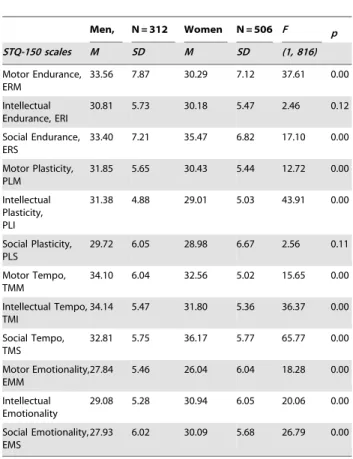
Table 3.Means (M), and standard deviations (SD) and ANOVA effects (F, p) of sex differences in means on STQ-150 scales (Study 1).
Men, N = 312 Women N = 506 F p
STQ-150 scales M SD M SD (1, 816)
Motor Endurance, ERM
33.56 7.87 30.29 7.12 37.61 0.00
Intellectual Endurance, ERI
30.81 5.73 30.18 5.47 2.46 0.12
Social Endurance, ERS
33.40 7.21 35.47 6.82 17.10 0.00
Motor Plasticity, PLM
31.85 5.65 30.43 5.44 12.72 0.00
Intellectual Plasticity, PLI
31.38 4.88 29.01 5.03 43.91 0.00
Social Plasticity, PLS
29.72 6.05 28.98 6.67 2.56 0.11
Motor Tempo, TMM
34.10 6.04 32.56 5.02 15.65 0.00
Intellectual Tempo, TMI
34.14 5.47 31.80 5.36 36.37 0.00
Social Tempo, TMS
32.81 5.75 36.17 5.77 65.77 0.00
Motor Emotionality, EMM
27.84 5.46 26.04 6.04 18.28 0.00
Intellectual Emotionality
29.08 5.28 30.94 6.05 20.06 0.00
Social Emotionality, EMS
27.93 6.02 30.09 5.68 26.79 0.00
In terms of emotionality effects, non-evaluative scales followed the polarity of evaluative scales in a very consistent manner (Fig. 1, Table 4). For example, whenever a temperament group assessed the concepts as more ‘‘good’’ and ‘‘interesting’’ (i.e. with more positive estimations on the scales of Evaluation and Stimulation factors than the contrast group), it would also assess these concepts as more ‘‘organized’’, ‘‘probable’’, ‘‘real’’ and ‘‘stable’’ (i.e. also with positive estimations on the scales of Organization, Probabil-ity-Reality and Stability factor.
The impact of Emotionality traits was not universal across objects (concepts). It was specific to possible areas of failures and was gender-specific. The most dramatic number of significant differences was observed in temperament groups contrasted by Social Emotionality and Social Endurance. Socially emotional men saw people-related, reality (life)-related concepts and social attractors as more draining, uninteresting, irritating, severe, dark, dirty, cold, false, unknown, improbable, irregular, irrational, senseless, and unstable than socially low-emotional men. Female Figure 1. The number of statistically significant differences in estimations of contrast temperament groups, Study 1.Axis Y: the total number of significant differences; the sign indicates the pole of the scales chosen by the group with the higher scores on a given temperament trait. The colours represent the spectrum of these differences along seven factors to which the scales are associated. Axis X: groups of concepts (see text for details).
Table 4.Selected list of the significant differences in estimations of contrast temperament groups, Study 1.
MEN with Z p-level MEN with Z p-level
WEAKER Motor Endur. STRONGER SLOWER Motor Tempo FASTER
ESTIMATED People AS MORE: ESTIMATED ’Soc At’ AS MORE:
draining 3.98 .0001 stimulat-g draining 2.84 .0046 stimulat-g
uninterg 3.06 .0022 interesting weak 2.89 .0039 powerful
decline 2.79 .0053 progress artificial 2.71 .0067 natural
weak 3.68 .0002 powerful false 3.43 .0006 true
one-dimen 2.80 .0051 multi-dim. impossible 3.78 .0002 possible
artificial 4.18 .0000 natural inaccessib 3.54 .0000 accessible
imaginary 2.94 .0033 real irrational 4.54 .0000 rational
irregular 2.87 .0041 regular unreliable 4.07 .0000 reliable
imprecise 3.79 .0001 precise faltering 3.41 .0007 steady
faltering 3.18 .0015 steady WEAKER Social Endur. STRONGER
fragile 3.98 .0001 solid uninter-g 2.67 .0068 interesting
LOWER Social Emot. HIGHER abundant 3.33 .0009 popular
stimulat-g 3.13 .0017 draining difficult 3.10 .0019 easy
interesting 2.79 .0053 uninter-ng artificial 3.04 .0024 natural
pleasant 3.36 .0008 irritating impossible 3.15 .0016 possible
kind 3.30 .0010 severe unusual 3.22 .0013 ordinary
progress 4.50 .0000 decline irregular 2.84 .0045 regular
light 2.97 .0030 dark irrational 3.42 .0006 rational
pure 3.26 .0011 dirty passive 3.08 .0020 active
warm 2.81 .0050 cold LOWER Motor Emot. HIGHER
smooth 2.83 .0047 rough understand 3.80 .0001 inexplicable
natural 3.40 .0007 artificial true 2.80 .0052 false
true 3.76 .0002 false existent 2.99 .0028 imagined
known 2.86 .0042 unknown real 3.91 .0001 imaginary
inevitable 3.61 .0003 improbab. possible 3.66 .0003 impossible
clear 3.91 .0001 blurred known 3.71 .0002 unknown
regular 3.93 .0001 irregular inevitable 3.82 .0001 improbable
rational 3.16 .0016 irrational ordinary 4.04 .0001 unusual
justified 2.97 .0030 senseless regular 2.84 .0045 irregular
stable 3.28 .0010 unstable rational 2.73 .0063 irrational
steady 3.78 .0002 faltering justified 2.94 .0033 senseless
solid 3.66 .0003 fragile reliable 2.75 .0060 unreliable
WEAKER Social Endur. STRONGER steady 3.01 .0026 faltering
indifferent 3.07 .0021 exciting solid 3.41 .0006 fragile
irritating 3.88 .0001 pleasant WEAKER Social Plastic STRONGER
decline 3.66 .0002 progress exciting 3.38 .0007 indifferent
harmful 2.92 .0035 useful bright 2.90 .0037 pale
irrational 3.43 .0006 rational interesting 3.18 .0015 uninter-ng
steady 2.72 .0065 faltering pleasant 3.77 .0002 irritating
scattered 2.88 .0040 dense smooth 2.71 .0067 rough
MEN with Z p-level safe 3.07 .0021 dangerous
Table 4.Cont.
MEN with Z p-level MEN with Z p-level
WEAKER Motor Endur. STRONGER SLOWER Motor Tempo FASTER
ESTIMATED Reality AS MORE: significant 4.02 .0001 insignific
draining 3.31 .0009 stimulat-g powerful 3.17 .0015 weak
abundant 2.89 .0039 popular irreplaceab 3.10 .0020 replaceab.
rough 3.21 .0013 smooth WOMEN of Z p-level
weak 2.97 .0030 powerful WEAKER Social Endur. STRONGER
impossible 2.84 .0045 possible ESTIMATED ‘Soc At’ ESTIMATED
unknown 2.69 .0072 known difficult 3.99 .0001 easy
blurred 3.47 .0005 clear imaginary 3.59 .0003 real
irrational 3.66 .0003 rational atypical 2.95 .0032 typical
WEAKER Social Endur. STRONGER rare 4.43 .0000 common
indifferent 3.00 .0027 exciting unusual 3.48 .0005 ordinary
indifferent 3.00 .0027 exciting blurred 3.88 .0001 clear
pale 3.11 .0019 bright irregular 3.32 .0009 regular
draining 3.63 .0003 stimulat-g unreliable 3.60 .0003 reliable
uninter-g 3.32 .0009 interesting faltering 3.20 .0014 steady
severe 3.17 .0015 kind LOWER Social Emot HIGHER
harmful 2.83 .0047 useful exciting 2.84 .0045 indifferent
rough 3.30 .0010 smooth stimulat-g 3.26 .0011 draining
following 3.21 .0013 leading useful 3.26 .0011 harmful
irrational 3.22 .0013 rational leading 2.73 .0063 following
senseless 3.13 .0018 justifiable natural 2.83 .0046 artificial
unorgand 3.31 .0009 organized possible 2.75 .0060 impossible
finite 3.01 .0026 infinite WOMEN of Z p-level
LOWER Motor Emot HIGHER WEAKER Social Endur. STRONGER
ordered 2.66 .0079 chaotic ESTIMATED ‘Real ity’ ESTIMATED
clear 3.12 .0018 blurred severe 4.31 .0000 kind
obvious 3.16 .0016 obscure dangerous 2.81 .0049 safe
regular 3.41 .0007 irregular dark 2.81 .0049 light
existent 3.39 .0007 imagined rough 3.35 .0008 smooth
common 2.70 .0070 rare difficult 3.01 .0026 easy
stable 2.83 .0046 unstable insignific. 2.68 .0074 significant
LOWER Social Emot HIGHER blurred 3.62 .0003 clear
stimulat-g 3.88 .0001 draining irregular 2.90 .0037 regular
interesting 2.81 .0049 uninter-g irrational 3.00 .0027 rational
pleasant 2.92 .0036 irritating unstable 3.53 .0004 stable
light 2.66 .0078 dark fragile 3.81 .0001 solid
useful 2.69 .0071 harmful MEN with Z p-level
smooth 2.90 .0038 rough WEAKER Motor Endur. STRONGER
leading 3.50 .0005 following ESTIMATED Work AS MORE:
ordered 3.50 .0005 chaotic trivial 2.56 .0106 original
Table 4.Cont.
MEN with Z p-level MEN with Z p-level
WEAKER Motor Endur. STRONGER SLOWER Motor Tempo FASTER
inevitable 2.77 .0057 improbab. uninter-g 4.66 .0000 interesting
clear 3.04 .0024 blurred irritating 2.85 .0043 pleasant
justified 2.72 .0066 senseless decline 4.37 .0000 progress
reliable 3.34 .0008 unreliable dark 3.46 .0005 light
stable 2.88 .0039 unstable bad 3.11 .0019 good
steady 3.37 .0008 faltering harmful 3.01 .0026 useful
solid 2.76 .0059 fragile weak 2.78 .0055 powerful
MEN with Z p-level discrete 3.38 .0007 continuous
WEAKER Motor Endur. STRONGER one-dim 3.83 .0001 multi-dim
ESTIMATED ‘Timi ng’ AS MORE: artificial 3.09 0.0020 natural
draining 3.40 .0007 stimulat-g imaginary 3.69 .0002 real
dull 4.00 .0001 sharp impossible 3.76 .0002 possible
severe 3.03 .0025 kind unknown 2.70 .0069 known
inexplicab 3.93 .0001 understanda blurred 3.54 .0004 clear
artificial 2.88 .0039 natural senseless 3.33 .0009 justified
false 3.38 .0007 true unreliable 3.92 .0001 reliable
imaginary 3.27 .0011 real unorgan-d 3.00 .0027 organized
unknown 4.79 .0000 known unstable 2.71 .0068 stable
rare 3.34 .0008 common faltering 4.54 .0000 steady
unusual 2.69 .0071 ordinary WEAKER Social Endur. STRONGER
burred 3.13 .0017 clear trivial 2.72 .0065 original
irregular 3.42 .0006 regular indifferent 3.57 .0004 exciting
irrational 2.77 .0055 rational pale 3.46 .0005 bright
imprecise 3.22 .0013 precise irritating 2.76 .0059 pleasant
faltering 3.34 .0008 steady inexplicab 3.21 .0013 understandb
SLOWER Motor Tempo FASTER artificial 4.09 0.0000 natural
draining 3.67 .0002 stimulat-g false 3.35 .0008 true
uninter-g 3.03 .0025 interesting irrational 2.85 .0044 rational
irritating 3.29 .0010 pleasant slow 3.04 .0023 fast
severe 3.90 .0001 kind LOWER Social Plastic HIGHER
decline 2.96 .0031 progress useful 4.04 .0001 harmful
bad 3.04 .0023 good progress 4.52 .0000 decline
unknown 3.29 .0010 known continuous 2.78 .0055 discrete
improbabl 4.00 .0001 inevitable understan 2.75 .0060 inexplicable
rare 2.94 .0033 common real 4.36 .0000 imagined
inaccessib 4.15 .0000 accessible clear 3.50 .0005 blurred
irregular 2.86 .0043 regular rational 3.66 .0003 irrational
inexplicab 3.40 .0007 understanda justified 2.93 .0033 senseless
imprecise 2.73 .0062 precise organized 2.87 .0041 unorgan-d
unorgan-d 3.59 .0003 organized reliable 3.14 .0017 unreliable
slow 2.93 .0034 fast stable 2.89 .0039 unstable
SLOWER Motor Tempo FASTER steady 2.91 0.0036 faltering
indifferent 3.59 .0003 exciting WOMEN of Z p-level
groups contrasted by Social Emotionality differed in their estimations of timing-related (Time, Speed, Motion, Develop-ment), and work-related concepts (Work, Effort, Task, Activity). Socially emotional females saw these concepts more negatively than low-emotional females. Not shown in the Figures or Tables: females with higher Social Emotionality estimated people-related concepts as less interesting (p= 0.0017), and life/reality-related concepts as more negative along fours scales of the Evaluation and Stimulation factor) than low-emotional females (p= 0.0000– 0.0048).
A differential impact of Emotionality related to physical-Motor activities (EMM) in male contrast temperament groups was observed for people-related concepts: men with higher scores in this type of emotionality estimated the concepts Person, Unknown person, Society and My contemporary as more simple and overall more positive than low-emotional men. There were sex differences in contrast EMM groups also in estimations of social attractors and reality-related concepts: while female contrast groups did not show many differences (one in each group of concepts). Men with higher EMM scores estimated social attractors as significantly more imaginary, impossible and unusual, and reality-related concepts as chaotic, irregular, rare, imagined and unstable than low-emotional men.
Overall, male groups had a much higher number of statistically significant differences between contrast temperament groups than females. Males also had more diverse scores on temperament scales than women (their standard deviation was higher than femaleSDs on 9 out of 12 scales (exceptions were Social Plasticity, Motor and Intellectual Emotionality scales) (Tables 2 and 3). An ANOVA comparison of the means revealed male superiority in six temperament scales: Motor-physical Endurance (ERM) (at
p,0.0000), Motor Plasticity (PLM), Motor Tempo (TMM) (at
p,0.0025-0.0029), Intellectual Endurance (ERI) (at p,0.0042),
Intellectual Plasticity (PLI) and Intellectual Tempo (TMI) (at
p,0.0000). Females had superiority in Social Endurance (ERS) (at
p,0.003), Social-verbal Tempo (TMS) (atp,0.0000), and higher Emotionality in Intellectual (EMI) and Social (EMS) aspects of activities (atp,0.0000). The scales of Social Plasticity (PLS) and Emotionality in motor-physical (EMM) activities did not show significant sex differences (Table 3).
The data is deposited on the server of McMaster University, Faculty of Health Sciences at: http://fhs.mcmaster.ca/cilab/ DataPLOS1.xls.
Method, Study 2
This study was investigating the same hypothesis as the Study 1 using a partially different version of the temperament measure.
Sample
378 undergraduate psychology students of McMaster University (Southern Ontario) (81% of the sample) and volunteers from the same area aged 17–53, M/F = 140/238 participated in this study in 2006–2008. All participants were fluent in English. After validity procedures were applied the final sample included 131 men, Mage 6 SD = 21.266.97 and 219 women Mage 6 SD
= 20.065.23.
Procedure
All subjects received debriefing, signed an informed consent form, then completed the Compact Structure of Temperament Questionnaire (STQ-77) and participated in the Semantic Task experiment.
The Compact Structure of Temperament Questionnaire (STQ-77) [83], [94], [119–120] has 77 statements, assigned to 12 temperamental scales (6 items each) and the validity scale (5 items) Table 4.Cont.
MEN with Z p-level MEN with Z p-level
WEAKER Motor Endur. STRONGER SLOWER Motor Tempo FASTER
severe 2.91 .0036 kind ESTIMATED ‘Timi ng’ AS MORE:
harmful 3.59 .0003 useful kind 3.21 .0013 severe
superficial 3.11 .0019 deep pleasant 2.90 .0038 irritating
impossible 2.70 .0069 possible light 3.23 .0012 dark
unreliable 3.19 .0014 reliable safe 3.52 .0004 dangerous
unorgan-d 2.81 .0049 organized light 2.76 .0058 dark
soft 2.78 .0054 rigid useful 3.63 .0003 harmful
significant 3.47 .0005 insignific.
easy 2.78 .0054 difficult
natural 3.31 .0009 artificial
real 2.86 .0042 imagined
common 3.79 .0001 rare
obvious 3.22 .0013 obscure
rational 2.69 .0072 irrational
infinite 2.69 .0071 finite
The font alternates between the scales of the Stimulation factor (underlined), Evaluation (normal),Power(bold), Complexity (bold italic), Reality-Probability (normal), Organization(italic) and Stability-Limitation (normal). Groups of concepts: ‘‘People’’(Person, Unknown person, My contemporary, Society), ‘‘SocialAt’’ (social attractors: (Prestige, Reputation, Beauty, Freedom), ‘‘Reality’’ (Reality, Present, Life), ‘‘Work’’ (Work, Task, Activity, Effort), ‘‘Time’’ (Time, Speed, Motion, Development), PastFut’’ (Past, Future). ‘‘SimpOr’’ (Simplicity, Order).
listed below. Subjects respond according to a Likert scale format: ‘‘strongly disagree (1),’’ ‘‘disagree (2),’’ ‘‘agree (3),’’ ‘‘strongly agree (4)’’. The scales are:
1–3: Endurance group, scales of Motor, Social and Intellectual Endurance: the ability of an individual to sustain prolonged
physical (ERM, apha = 0.85), social (ERS, 0.80) or mental (ERI, 0.71) activity.
4–5: Lability group, scales of Motor and Social Tempo: preferred speed of physical activity (TMM, 0.70), speed of speech and reading and of other verbal activities (TMS, 0.75) and Plasticity scale, assessing the ability to adapt quickly to changes in Figure 2. The number of statistically significant differences in estimations of contrast temperament groups, Study 2.Axis Y: the total number of significant differences; the sign indicates the pole of the scales chosen by the group with the higher scores on a given temperament trait. The colours represent the spectrum of these differences along seven factors to which the scales are associated. Axis X: groups of concepts (see text for details).