J of Evolution of Med and Dent Sci/ eISSN- 2278-4802, pISSN- 2278-4748/ Vol. 3/ Issue 31/July 31, 2014 Page 8579
EVALUATION OF AUDITORY & BRAINSTEM RESPONSES IN
HYPERBILIRUBINEMIC INFANTS
Bhagya V1, S. V. Brid2, Harini3, Akhila Vinod4, Sonam Dhawal5
HOW TO CITE THIS ARTICLE:
Bhagya V, S. V. Brid, Harini, Akhila Vinod, Sonam Dhawal. Evaluation of Auditory & Brainstem Responses in Hyperbilirubinemic Infants. Journal of Evolution of Medical and Dental Sciences 2014; Vol. 3, Issue 31, July 31; Page: 8579-8584, DOI: 10.14260/jemds/2014/3089
ABSTRACT: OBJECTIVE: Jaundice is a common finding in neonates affecting 70% of term and 80% of preterm neonates during the first week of life. So the objective of this study is to evaluate auditory and brainstem responses in hyper bilirubinemic infants and to see if there is any statistically significant increase in latencies of wave I and V waves. To initiate rehabilitative procedure as early in life as possible a screening method to detect auditory disabilities in hyper bilirubinemic infants is of great importance. So the present study is done to know the incidence of hearing loss in hyper bilirubinemic infants & to evaluate the waves I and V in those subjects. METHODS: 45 Infants with hyper bilirubinemia>12mg% & with no other risk factor who visited pediatric OPD of Bapuji Child Health Centre were evaluated using RMS EMG. EP MARK –II machine. Latencies of Waves I and V and interpeak latency of I-V were recorded. RESULTS: On one sample t-test, latency of wave I and IPL I-V were significantly increased (p-value <0.001), latency of V was prolonged which was statistically significant (p-value <0.01). Hearing impairment in the affected infants and complete deafness where none of the waves were recorded signify that it is a risk factor for deafness. CONCLUSION: Since hyper bilirubinemia is a risk factor for hearing impairment, their hearing screening by BERA at the earliest will help in their earliest initiation of rehabilitation when the brain is sensitive to the development of speech & language.
KEYWORDS: Hyper bilirubinemia; wave V; brainstem responses; infants. MESHTERMS: Deafness; BERA; infants.
INTRODUCTION: Jaundice is a common finding in neonates affecting 70% term and 80% of preterm neonates during the 1st week of life. Neonatal Hyper bilirubinemia is an adverse perinatal clinical
event that places the affected neonate at an increased risk of hearing impairment.1 After delivery of
the fetus and entrance to a new environment; neonate encounters a critical situation with increased oxygen concentration and increased production of bilirubin.2
If indirect bilirubin is increased this form of bilirubin can cross blood-brain barrier and precipitate in different parts of nervous system, such as basal ganglia, brainstem, cerebellum and hippocampus. Although most infantile hyper bilirubinemia (60%) are physiologic and harmless,3
even short-term increases in bilirubin level can induce temporary or permanent changes in evoked potentials such as increase in threshold and wave latency(I-V) in ABR, which shows sensitivity of both peripheral and central auditory systems to bilirubin.
J of Evolution of Med and Dent Sci/ eISSN- 2278-4802, pISSN- 2278-4748/ Vol. 3/ Issue 31/July 31, 2014 Page 8580 Deafness in 1st three years of life may impair the full development & maturation of auditory system and it is well known that deafness in infancy and childhood interferes with normal development of speech and language. In the absence of normal speech, child's ability to communicate is restricted and this has a negative impact on child's social, emotional, cognitive and academic development.4 Consequently, as a child grows into adulthood, his/her vocational and academic
potential is significantly attenuated and family/society is left to bear the cost of the care of an otherwise healthy individual for life.
To prevent this and to initiate rehabilitative procedure as early in life as possible a screening method to detect auditory disabilities in newborns is of great importance. Although many methods like -behavioral audiometry, impedance audiometry, respiratory and cardiac responses and crib movement systems are evaluated, BERA which yields information on threshold sensitivity of peripheral part of auditory apparatus and on conduction velocity in brainstem4 is the satisfactory
procedure which can be performed with ease in children.
OBJECTIVES: So the present study is done to know the incidence of hearing loss in hyper bilirubinemic infants to evaluate the waves I, V and IPL I-V in those infants.
MATERIALS AND METHODS: 45 Infants with hyper bilirubinemia>12mg% who visited pediatric OPD of Bapuji Child Health Centre were selected for the study. All patients were administered the test procedures with prior appointment. An ENT check-up was done to rule out the possibility of wax, ear infection, middle ear problems etc. The parents’ were instructed to wash the scalp of the child thoroughly as a requirement of the test. Prior to the test, each child was examined by the pediatrician and the dosage for sedation was prescribed. Drug used for sedation was syrup Triclofos 20mg/kg body wt.
The instrument used was RMS EMG. EP MARK –II machine which is a fully computerized machine manufactured by RMS RECORDERS & MEDICARE SYSTEM Chandigarh. Test was carried out in pre–cooled, quiet, dimly lit room with subject relaxed in supine position with eyes closed. The skin was cleaned with spirit and OMEN abrasive skin preparatory paste. The silver electrode were placed as follows: Cz–vertex, both mastoid, (Ai and Ac) forehead (ground). Resistance was not more than 1ohm. Electrode electrolyte gel was used and electrodes were fixed.
Acoustically shielded THD 32 ear phones were placed on the ear and head bands were adjusted. Monoaural auditory stimulus consisting of rare faction clicks of 100 microseconds with intensities starting from 30 dB to 100 dB were delivered through electrically shielded earphones at a rate of 11.1/sec. Contralateral ear was masked. The filter settings used were 150Hz–3000Hz. The polarity used was alternate and the analysis time was 10m/sec. About 2, 000 responses were averaged. Latencies of Waves I, III& Vand inter peak latency of I-V were recorded. The existence of peak V was considered as sound stimulus heard and perceived by the auditory mechanism. The threshold for each ear was confirmed.
The guidelines used for the confirmation of peak V were as follows:
Peak V occurs around latency of 5.7 m/sec with S.D. of 0.25 (as per our norms).
J of Evolution of Med and Dent Sci/ eISSN- 2278-4802, pISSN- 2278-4748/ Vol. 3/ Issue 31/July 31, 2014 Page 8581 Normal latency of wave Ifor infants is 1.47+/-0.19, of wave V is 6.06+/-0.26, and IPL I-V is 4.58+/-0.245
RESULTS: Out of 45 infants, in 15 cases we were not able to record any waves even at 100 dB and in 1 case there were no waves on Lt. side even at 100 dB, only we could record waves on Rt. ear at 100 dB signifying profound hearing impairment in both the ears.
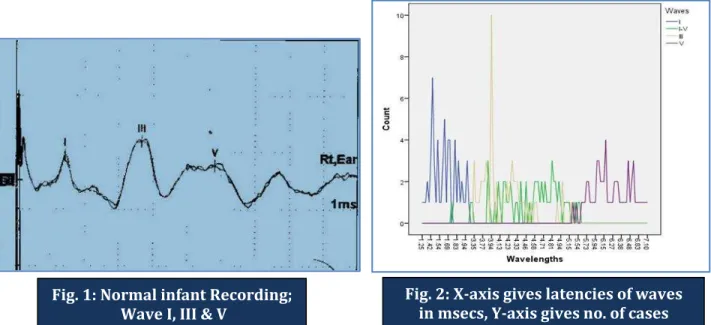
Of the 29 cases where we were able to record wave I and V, latencies and inter peak latencies(IPL) were prolonged, Wave I latency was1.62± 0.19, for wave V was 6.21±0.47and IPL I-V was 4.47±0.65.
On one sample t-test (Fig 2), latency of wave I and IPL I-V were significantly increased (p-value <0.001), latency of wave V was prolonged which was statistically significant (p-(p-value <0.01). Hearing impairment in the affected infants and complete deafness where none of the waves were recorded signify that hyper bilirubinemia is a risk factor for deafness.
All the above cases were sent for further rehabilitative procedures as per their requirement. High risk neonates should undergo screening for hearing impairment. 6
DISCUSSION: Hyper bilirubinemia is one of the most important problems during infantile period. In its severe form, it affects brain and causes kernicterus. This disease is caused due to precipitation of bilirubin in nervous tissue. Basal ganglia, various nuclei in the brainstem, cerebellum and hippocampus are the most affected organs. Damage to these structures can cause cerebral palsy, mental retardation and sensorineural or central hearing loss.7 Although most studies have noticed
the effects of hyper bilirubinemia on the brain stem, it seems that this disorder affects cochlea as well (at least the region involved in the processing of high frequencies).
This study shows the presence of the auditory neuropathy in about 5.5% of hearing impaired infants. Thirteen (19.2%) of 68 at risk neonates in an intensive care nursery with one or more adverse perinatal clinical factors were diagnosed to have hearing impairment by BERA testing. Among risk factors only 2 factors have been significantly correlated to hearing impairment in the affected neonates [viz; hyper bilirubinemia at level exceeding indication for exchange transfusion& birth weight (<1500gm)].8
Isman Jafar et al9 found that increase in BERA latency in neonates with hyper bilirubinemia is
more significant for the later waves (III and V) than for the earlier waves, and that the I-V interval increased significantly. These results suggest that there is also central auditory impairment after neonatal hyper bilirubinemia, in addition to peripheral auditory impairment.
The present study also shows the prolonged latencies in interlatencies I-III, I-V and also wave V. There was no peripheral nerve impairment (prolong wave I) in this study. This study shows that in moderate hyper bilirubinemia (10-20mg/dl), neurotoxicity is uncommon, and did not have strong correlation with BERA abnormality. Other studies with higher bilirubin level were conducted by Jiang10 (>20mg/dl), Sharma11 and Agarwal, 12 also Gupta13 (>30mg/dl), showed strong relation
between the bilirubin level and BERA abnormality.
Dorothy et al14 found the sensitivity of BAEP as a screening test to be 100%, specificity of the
J of Evolution of Med and Dent Sci/ eISSN- 2278-4802, pISSN- 2278-4748/ Vol. 3/ Issue 31/July 31, 2014 Page 8582 By this study we can observe that infants exposed to neonatal jaundice are prone for some hearing abnormality which correlates with earlier school of thoughts as quoted below. Previous studies 15 have found either that many individual neonatal variables such as high serum bilirubin
concentration, low Pao2 or cyanotic attacks were associated with hearing loss. Bilirubin can deleteriously affect the auditory pathway anywhere along its course in the brain stem, although the cochlear nucleus is usually most involved.16, 17
A causative relationship between neonatal jaundice and irreversible brainstem damage has been established on the basis of clinicopathologic correlations, audiometry and epidemiologic data. The finding of evidence of an apparently specific functional lesion of hyper bilirubinemia, indicating severe neural damage but sparing of cochlear hair cells, has reinforced the contention that bilirubin toxicity involves the neural auditory pathways rather than the cochlea.18
Bilirubin can deleteriously affect the auditory pathway anywhere along its course in the brainstem although the cochlear nucleus is usually most involved leading on to hearing impairment.19, 20 Improved brain functions after phototherapy and /or exchange transfusion may be
due to removal of bilirubin from brainstem.
But persistence of abnormalities in some cases may be due to permanent damage caused by axonal degeneration and loss of myelin rather than hair cell loss.21So this hearing impairment has to
be detected in the early stages and proper rehabilitative measures are taken at the earliest so that further developmental milestones are not delayed.
BERA as a screening procedure will give an idea of degree of hearing impairment. BERA is the only tool which can confirm the normal sensitivity of hearing whenever required and is very useful in early detection of hearing loss and planning rehabilitative procedures.
CONCLUSION: Since hyper bilirubinemia is a risk factor for hearing impairment, their hearing screening by BERA at the earliest will help in their earliest initiation of rehabilitation when the brain is sensitive to the development of speech and language. So this hearing impairment has to be detected in the early stages and proper rehabilitative measures are taken at the earliest so that further developmental milestones are not delayed.
Type of treatment, either phototherapy or blood exchange has no effect on the prevention of auditory neuropathy; therefore, appropriate measures (OAE and ABR) must be taken in the case of bilirubin higher than 20mg/dl. It should be mentioned that periodic assessment of the auditory system in hyper bilirubinemia is recommended because it is likely that the effects of hyper bilirubinemia on CNS can be reversible and hearing impairment may improve after a period [7].
Further studies are needed to know the bilirubin levels and their level of auditory impairment so that toxicity of bilirubin on hearing can be quantified.
I would like to express my sincere thanks to all the staff of Department of Physiology, JJM Medical College, Davangere as well as staff and subjects of Bapuji Child Health Institute, Davangere and Dr. Bhagya Jyothi, dept. of community dentistry, Bapuji Dental College & Hospital, Davangere who have helped me in making this work a reality.
REFERENCES:
J of Evolution of Med and Dent Sci/ eISSN- 2278-4802, pISSN- 2278-4748/ Vol. 3/ Issue 31/July 31, 2014 Page 8583 2. Hayes D. Universal screening for infant hearing impairment. Pediatrics 1994; 94 (6pt 1): 954-5. 3. Sheykholeslami K, Kaga K. Otoacoustic emissions and auditory brainstem responses after
neonatal hyper bilirubinemia. Int J Pediatr Otorhinolaryngol 2000; 52 (1): 65-73.
4. Kumar A, Dhanda R. The identification and management of deaf children. Indian J Pediatr.1997; 64:785-792.
5. Mishra UK, Kalita J. Clinical neurophysiology: nerve conduction, electromyography, evoked potentials. 2nd ed. N. Delhi: Reed Elsevier India Private Ltd; 2006. pp. 425.
6. Chadha S, Bais AS. Auditory Brainstem Responses in High risk and Normal newborns. Indian J Pediatr. 1997; 64: 777-784.
7. Mohammad Hossein Baradaranfar, Seid Atighechi, Mohammad Hossein Dadgarnia, Rozita Jafari, Ghasem Karimi, Abolfazl Mollasadeghi et al. Hearing status in neonatal hyper bilirubinemia by auditory brain stem evoked response and transient evoked otoacoustic emission. Acta Medica Iranica 2011; 49 (2) 109-112.
8. Gupta AK, Anand NK, Raj H. Evaluation of Risk Factors for Hearing Impairment in at Risk Neonates by Brainstem Evoked Response Audiometry (BERA).Indian J Pediatr. 1991; 58: 849-855.
9. IsamanJafar, Irawan Mangunatmadja, Rinawati Rohsiswatmo, Sudjatmiko, Ronny Suwento, Safarina G Malik. Brainstem evoked response auditory in healthy term neonates with hyper bilirubinemia. Paediatr Indones. 2010; 50: 144-8.
10.Jiang ZD, Chen C, Liu TT, Wolkinson AR. Changes in term neonates with hyper bilirubinemia. Pediatr Neurol.2007; 37:35-41.
11.Sharma P, Changhani NP, Meena KR, JoraR, Sharma, Gupta BD. Brainstem Evoked Response Audiometry (BERA) in neonates with hyperbilirubinemia. Indian J Pediatr.2006; 73: 413-6 12.Agarwal VK, Shukla Rakesh, Misra PK, Kapoor RK, Malik GK. Brainstem auditory evoked
response in newborn with hyper bilirubinemia. Indian J Pediatr.1998; 35:513-518.
13.Gupta AK, Mann SB. Is auditory response a bilirubin toxicity marker? Am J Otolaryngol.1998; 19: 232-6.
14. Dorothy A. Shannon, PhD, Jacob K. Felix, MD, FAAP, Allan Krumholz, MD, Phillip J. Goldstein, MD, and Kenneth C. Harris Hearing screening of High –Risk Newborns with Brainstem auditory Evoked potentials: A follow –up study. Pediatr.1984; 78:92-96.
15.Simmons FB. Patterns of deafness in newborns. Laryngoscope.1980; 90:448.
16.Chisin R, Perlman M, Sohmer H: Cochlear and brainstem responses inhearing loss following neonatal hyper bilirubinemia. Ann Otol Rhinol Laryngol.1979; 88:352.
17.Perlman M, Fainmesser P, Sohmer H, Tamari H, Wax Y, Pevsmer B: Auditory nerve –brainstem evoked responses in hyper bilirubinemic neonates. Pediatr.1983; 72:658.
18.Max Perlman, Pinchas Fainmesser, Haim Sohmer, Hanna Tamari, Yohanan Wax, Bella Pevsmer: Auditory nerve-brainstem evoked responses in hyper bilirubinemic neonates. Pediatrics.1983; 72: 659-665.
19.Chisin R, Perlman M, Sohmer H: Cochlear and brainstem re responses in hearing loss following neonatal hyper bilirubinemia. Ann Otol Rhinol Laryngol.1979; 88:352.
J of Evolution of Med and Dent Sci/ eISSN- 2278-4802, pISSN- 2278-4748/ Vol. 3/ Issue 31/July 31, 2014 Page 8584 21.Stockhard JJ, Rossiter VS. Clinical and pathological correlates of brainstem auditory response
abnormalities. Neurology 1977; 27: 316-325.
AUTHORS:
1. Bhagya V. 2. S. V. Brid 3. Harini 4. Akhila Vinod 5. Sonam Dhawal
PARTICULARS OF CONTRIBUTORS: 1. Associate Professor, Department of
Physiology, JJM Medical College, Davangere. 2. Professor and HOD, Department of
Physiology, JJM Medical College, Davangere. 3. Post Graduate, Department of Physiology, JJM
Medical College, Davangere.
4. Post Graduate, Department of Physiology, JJM Medical College, Davangere.
5. Post Graduate, Department of Physiology, JJM Medical College, Davangere.
NAME ADDRESS EMAIL ID OF THE CORRESPONDING AUTHOR: Dr. Bhagya V,
C-1, Chandragiri Apartments, Anjaneya Badavane,
Davangere-577004.
Email: [email protected] [email protected]
Date of Submission: 15/07/2014. Date of Peer Review: 16/07/2014. Date of Acceptance: 22/07/2014. Date of Publishing: 29/07/2014.
Fig. 1: Normal infant Recording; Wave I, III & V