Exploiting Publication Contents and
Collaboration Networks for Collaborator
Recommendation
Xiangjie Kong1, Huizhen Jiang1, Zhuo Yang1, Zhenzhen Xu1*, Feng Xia1, Amr Tolba2,3
1School of Software, Dalian University of Technology, Dalian, China,2Riyadh Community College, King Saud University, Riyadh, Saudi Arabia,3Mathematics and Computer Science Department, Faculty of Science, Menoufia University, Shebeen El-Kom, Menoufia, Egypt
Abstract
Thanks to the proliferation of online social networks, it has become conventional for researchers to communicate and collaborate with each other. Meanwhile, one critical chal-lenge arises, that is, how to find the most relevant and potential collaborators for each researcher? In this work, we propose a novel collaborator recommendation model called CCRec, which combines the information on researchers’publications and collaboration net-work to generate better recommendation. In order to effectively identify the most potential collaborators for researchers, we adopt a topic clustering model to identify the academic domains, as well as a random walk model to compute researchers’feature vectors. Using DBLP datasets, we conduct benchmarking experiments to examine the performance of CCRec. The experimental results show that CCRec outperforms other state-of-the-art methods in terms of precision, recall and F1 score.
Introduction
The current scale of the Internet has risen beyond the imagination of people due to its rapid development. Consequently, how to obtain useful and effective information has become a com-plex task as a result of information overload. Recommender systems and techniques reduce the problems and immensely help people by providing easier access to the relevant resources they really need.
Collaboration among researchers often occurs and it has been shown that research collabo-ration has impact on scientific productivity [1]. Therefore, collaboration recommendation becomes very necessary and has been attracting more and more researchers in recent years. Generally, collaboration recommendation can be grouped into two classes: 1) to recommend the most potential collaborators (MPCs) who have never collaborated with the target (i.e. to build new collaborations); 2) to recommend the most valuable collaborators (MVCs) who have ever collaborated with the target before (i.e. to reinforce old collaborations). Lopes et al. [2] worked on identifying new partners to execute joint research and enhancing the collaboration OPEN ACCESS
Citation:Kong X, Jiang H, Yang Z, Xu Z, Xia F, Tolba A (2016) Exploiting Publication Contents and Collaboration Networks for Collaborator Recommendation. PLoS ONE 11(2): e0148492. doi:10.1371/journal.pone.0148492
Editor:Sergio Gómez, Universitat Rovira i Virgili, SPAIN
Received:February 14, 2015
Accepted:January 19, 2016
Published:February 5, 2016
Copyright:© 2016 Kong et al. This is an open access article distributed under the terms of the Creative Commons Attribution License, which permits unrestricted use, distribution, and reproduction in any medium, provided the original author and source are credited.
Data Availability Statement:All relevant data are within the paper and its Supporting Information files.
Funding:This work was supported by National Natural Science Foundation of China under Grants No. 61203165 (XK) and 51209036 (ZX). The funders had no role in study design, data collection and analysis, decision to publish, or preparation of the manuscript.
of current partners for researchers. Chen et al. [3] proposed that the purpose of friends recom-mendation is to make new friends and keep the old ones. Research on enterprise social net-working [4] shows that users in a corporate context are interested in discovering valuable contacts not yet known to them, or connecting to weak ties, in addition to staying in touch with their close colleagues. Our previous work [5,6] focuses on recommending MVCs for researchers and enhancing the collaboration with colleagues in their academic social networks, which enables the researchers to collaborate with each other again. However, many scientists also initiate collaborations outside of their social networks. It is burdensome and fraught with risk of initiating collaboration with socially unconnected researchers. Therefore, unconnected researchers (MPCs) might be more valuable to be recommended. In this work, in contrast, CCRec has an aptitude for discovering new collaborators with high similarity (i.e. MPCs recommendation).
Considering the inherent requirements, a variety of methods related to collaborators recom-mendation have been proposed, which involve three main aspects: content-based, CF (collabo-rative filtering) based, social network-based and hybrid recommendation. Some traditional content-based methods extract researchers’academic features through tags of interests, user profiles, publications, etc. Gollapalli et al. [7] proposed models for computing the similarity between researchers based on expertise profiles extracted from their publications and academic home pages. Lopes et al. [2] considered researchers’publications area and the vector space model to make collaboration recommendation. CF based methods is famous and popular in recommender area. It is also well used in collaborators recommendation. Kim et al. [8] pro-posed a collaborative filtering method to provide an enhanced recommendation quality derived from user-created tags. Moreover, a large amount of recommender systems benefited from introducing social network. Ma et al. [9] analyzed how social network information can benefit recommender systems and proposed a method of improving the performance of rec-ommender systems by incorporating social network information. Huynh et al. [10] proposed a method based on a combination of probability theory and graph theory for modeling and ana-lysing co-author networks. They explored similar vertices of potential candidates for collabora-tion recommendacollabora-tion. Their main contribucollabora-tion involves taking the trend informacollabora-tion into considering when computing the similarity of vertices. Many other approaches [11,12] have been applied to large social networks to solve the link prediction problem, which is similar with relationship recommendation. Their works on social networks show good performance. Lich-tenwalter et al. [13] examined some important factors for link prediction and proposed a gen-eral framework. In our previous work [5,6], we also developed several features in academic social networks, which well enhanced the performance of our recommender model. Some hybrid collaboration recommendation models have been introduced in recent years. Lee et al. [14] exploited how well content-based, social network-based and hybrid recommendation algorithms predict co-author relationship. The given results show that a hybrid algorithm com-bining content and social networks information performs better. Some other brilliant hybrid algorithms can be found in [15], [16] and [17]. Recently, Chaiwanarom et al. [18] proposed a new hybrid algorithm for recommending appropriate collaborators in interdisciplinary com-puter science using degrees of collaborative forces, temporal evolution of research interest, and comparative seniority status. The result shows that it is effective and innovative.
academic features of researchers in different domains. Thus, it is imperative to consider aca-demic domains when recommending collaborators. Chen et al. [20] discussed CollabSeer, an open system to recommend potential research collaborators for researchers and scientists. They discovered collaborators based on the structure of co-author networks and the user’s topic of research interests. This previous work, along with e.g. [21], stimulated our inspiration to introduce a topic model in CCRec.
Here we propose a novel hybrid model by exploiting publication contents and collaboration networks for collaborators recommendation (CCRec). In summary, we make the following contributions in this paper: 1) To compute the most potential collaborators recommendation, we develop a model CCRec, which combines the content-based and social network-based methods. By adopting this procedure, our approach is more favourable in terms of achieving remarkable personalized collaborators recommendation. 2) To reveal researchers’academic features in different domains, we present the feature vectors by utilizing a topic clustering model and use a random walk model to compute researchers’influence in each domain. The results show that the method is effective. 3) We conduct extensive experiments on a subset of DBLP data set to evaluate the performance of CCRec in various scenarios. Moreover, we mea-sure four models for comparison. Promising results are presented and analyzed.
Methods
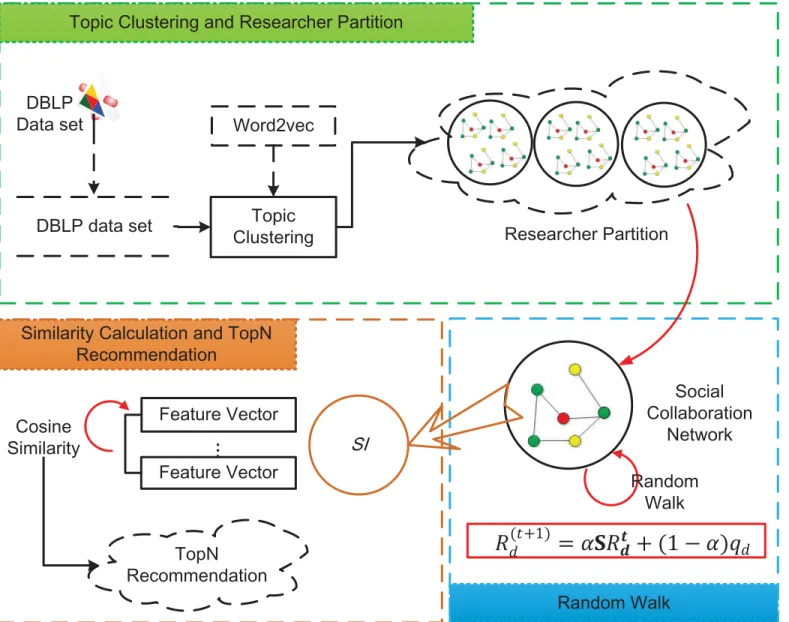
Our proposed recommendation scheme for CCRec is inspired by the reality and truth that a researcher usually desires to know other researchers who have similar research interests and strong influence in academia. As mentioned above, researchers often behave differently across multiple domains of interests. Such behaviors usually reveal the academic features of research-ers in different domains. Besides, as a social-based model, Random Walk with Restart recom-mendation model (RWR) has been proved to be competent for calculating the rank score of nodes in social networks derived from co-authorship [5]. Researchers’strength of influence in specific domains can be well reflected by RWR. In this work, we first adopt a content-based method to acquire multiple domains of interests. Secondly, we employ the social network-based method of RWR to measure the researchers’strength of influence in different domains. In the final step of our design, we use the feature vector to evaluate the similarity of researchers and then obtain the recommendation list. The detailed process is described below and the cor-responding pseudo-code is illustrated in Pseudo-code of the proposed scheme.Fig 1depicts the three main components of CCRec.
Topic Clustering and Researcher Partition
For another reason, LDA-based models require prior distributions which are always difficult to define [25]. Word2vec provides an efficient implementation of the continuous ofbag-of-words andskip-gramarchitectures for computing vector representations of words. It takes a text cor-pus as the input and produces the word vectors as the output. The final word vector file can be used as features in many NLP and machine learning applications. The word vectors can be also used for deriving word classes from huge data sets. This is achieved by performing K-means clustering on top of the word vectors. The output is a vocabulary file with words and their cor-responding domain IDs. In our CCRec model, The input titles are split into many sequential words. In addition, it is necessary to filter out some“Stop words”(https://code.google.com/p/ stop-words/),“of”,“the”,“and”, etc. When extracting words from titles, the set of preprocessed words can be used to outline the core contents of papers, which are signified as valuable and reliable corpus to denote a variety of academic topics. We run word2vec on this corpus, then the word vector can be automatically generated and the K-means clustering method is
Fig 1. The architecture of CCRec.Depicts the three main components of CCRec: topic clustering and researcher partition, random walk, similarity calculation and top-N recommendation.
executed. The output file includes all academic words and their corresponding domain IDs. Now that the academic topics are clustered and the words are marked to each topic. We use a matrixWto denote these mapping relations. If a wordwis marked to a topicd,Ww,dwill be 1, otherwise 0.
Algorithm 1Pseudo-code of the proposed scheme
1:SI init()
2:fordinDdo// Traverse domains setD. 3: S ComputeTransferMatrix(d) 4: SId,R,q InitVec()
5: fork 1 toMaxIterationdo
6: diff 0
7: fori 1 tolen(q)do
8: t=SId,i
9: SId;i¼
aPlenðqÞ
j¼1 Si;jSId;jþ ð
1 aÞq
i
10: diff diff+ (SId,i−t)
11: end for
12: ifdiff<MinDeltathen
13: break
14: end if
15: end for
16:end for
17:foru in Udo
18: forv in Udo
19: Simu,v CosSim(SIu,SIv)
20: end for
21:end for
22: RecommendTopN()
In addition, CCRec partitions researchers to specific domains through the following approaches: 1) Extract subject terms from the publication titles of researcheru(After filtering out the stop words). We useTuto represent the subject terms set of researcheru. 2) Traverse all the subject terms inTuand check the matrixW. The model tags the researcher for particular domains that contain these subject terms. We use the matrixAto denote the relations of a researcher and topics.Eq 1shows the process of computing the matrixA.
Au;d¼
1 9word w2T
u; that Ww
;d ¼
1
0 8word w2T
u; that Ww
;d 6¼
1 ð1Þ
(
According to the equation, ifAu,d= 1, the researcheruis marked to topicd. It should be emphasized that one researcher always belongs to several domains and there are also many researchers in one domain.Fig 2illustrates an example. Assuming that CCRec extracts 12 sub-ject terms from the publications titles of researcheru. After topic clustering, we can see that, three of these subject terms are affiliated to domaind1, seven tod2, and two tod3. Thus,
researcheruis tagged for domainsd1,d2andd3. i.e.Au,d1,Au,d2,Au,d3are all equal to 1. Through this method, each domain contains numerous researchers.
Feature Vector Calculation
be regarded as the feature vector elements of researchers. To computeSI, we adopt a social-net-work based model, the random walk with restart model RWR. In RWR, the rank score of a node is determined by the voting contributions from neighbors, which can be reflected by three factors: the out-degree of each neighbor, the count, and rank score of neighbors. The rank score in RWR can be used to represent the node’s importance in a social network. There-fore, we firstly model the social-networks. There are numerous researchers with similar research interests in domaind. Their co-author relationships are the most obvious and impor-tant links among researchers, which can be modeled by a social networkNd. Thus, there are many co-author networks corresponding to different domains. We run the RWR model on the co-author networksN, the generated rank score of each node in the domain is used to denote academic values, i.e.SI. The core equation of the RWR model is shown inEq (2)below:
Rðdtþ1Þ¼aSR ðtÞ
d þ ð1 aÞqd ð2Þ
whereRdrepresents the rank score vector of all researchers in domaind,qdis the initial vector R0, andαdenotes the damping coefficient. In normal random walk model,αtakes the value of 0.8, which has been confirmed in our experiments.Sis the transfer matrix, which drives the random walker skipping to next node with a probability. RWR is an iterative process. After limited iterations, the vectorRdwill be convergent. In this scenario,SId,u=Rd,u. That is, the final value of the vector itemRd,uis theSIof researcheruin domain d.
In addition, with the help of RWR, theSIin various domains is quantified for each researcher. To measure researchers’academic feature, we define the vectorFwithSIasFd,u=SId,u.
Collaboration Recommendation Based on Feature Vector Similarity
CCRec recommends collaborators for researchers based on their similarities. To measure the academic feature similarities of researchers, we borrow a standard method,cosine similarity (CS), as shown inEq (3). CS is employed to define the similarity between two usersu1andu2 Fig 2. Researcher Partition.Illustrates an example of partition researchers to several domains.
based on their feature vectorsFu1andFu2.
Simðu1;u2Þ ¼
Pn
i¼1ðFu1;iFu2;iÞ
ffiffiffiffiffiffiffiffiffiffiffiffiffiffiffiffiffiffi Pn
i¼1F 2 u1;i
q
ffiffiffiffiffiffiffiffiffiffiffiffiffiffiffiffiffiffiPn i¼1F
2 u2;i
q ð3Þ
Finally, we consider that researchers with high similarities have common interests. Therefore, they should be recommended to each other as potential academic collaborators. Hence, CCRec provides aTop-Nrecommendation list for each researcher.
Results
We conducted various experiments on DBLP dataset [26] from year 2000 to 2014, a computer science bibliography website hosted at University of Trier, Germany, which indexes more than 2.3 million articles on computer science and contains many links to home pages of computer scientists. Each DBLP record contains these attributes: authors, title, page number, publishing year, crossref, proceedings or journals, etc. We modeled the co-author networks on DBLP by this principle: the co-author relation is created when two researchers co-authored at least one paper. Inevitably, there are some isolated authors who create their work independently. Thus, they nearly have no relationship with other scholars. Furthermore, we define these isolated authors as the weak nodes, since their degree values are 0. It is clear that the weak nodes have little impact on the random walk. Therefore, we ignore the weak nodes. We also ignore the problem of author disambiguation and assume that each researcher has an independent name. We extracted the subsets of the entire data using the required information, which are all in the field of data mining involving 34 journals and 49 conferences. If we model a large social net-work on the data, it contains 59659 nodes (authors), 90282 edges (co-author relations) and the average degree is 1.531. We extracted all titles of these publications and filter out“stop word”, the generated 104587 keywords can be the corpus of word2vec model. The detailed statistics are shown inTable 1. We divided the data set into two parts: the data before year 2011 as a training set, and the data after 2011 as a testing set.
We embarked on benchmarking experiments involving CCRec. To evaluate the perfor-mance of CCRec model visually, we employed three popular metrics that are widely used in the recommender systems:Precision,RecallandF1[27]. The recommender system provides a rec-ommendation list. Comparing with the collaborator list in testing data set, there are four sets. A: recommended and collaborated. B: recommended but not collaborated. C: not recom-mended but collaborated. D: not recomrecom-mended and not collaborated. The performance of rec-ommender system can be well reflected by the intersection ratio of the four sets.
The definition of precision is:
Precision¼ lenðAÞ
lenðAÞ þlenðBÞ ð4Þ
Recall is:
Recall¼ lenðAÞ
lenðAÞ þlenðCÞ ð5Þ
Table 1. Statistics of Data Set from DBLP.
Nodes Edges Average Degree words
59659 90282 1.513 104587
F1 is defined as:
F1¼2ðPrecisionRecallÞ
PrecisionþRecall ð6Þ
We compared CCRec with the following four approaches: a random walk based model (ACRec), a common neighbors based model (CNRec), a topic based model (TBRec) and the basic random walk model (RWR). ACRec: a random walk recommendation model based on collaboration networks [5], which uses three academic factors to recommend collaborators based on the RWR. ACRec was demonstrated to do excellently in MVC recommendation. CNRec: a common neighbors based recommendation model [2], which is famous and widely used in social-network based recommendation. Considering a researcher without any co-author relation to target researcher, the more common co-co-authors they have, the more proba-bility it can be recommended. TBRec: a classical topic based model. In our experiments, we used LDA model to cluster the content of researcher’s publications and defined the feature vec-tors by the topic probability distribution. The recommendation is made by computing the cosine similarity of researcher’s feature vectors. RWR: conduct the recommendation by run-ning a basic random walk with restart model on the whole co-author network [5]. ACRec, CNRec and TBRec have been proved to be effective in academic collaborators recommendation and can be delegated as the highly accurate recommender systems. RWR is conducted for base-line model. Three groups of experiments were conducted: 1) Find the MVCs, who may have known each other before, or be active in adjacent circles, 2) Recommend MPCs, who have never cooperated with the target researcher before, 3) Evaluate how domains clustering impact the performance of CCRec. For each experiment, there were 500 domains clustered. we ran-domly chose 100 constant researchers who are at least somewhat active in academic activities. We generated collaborators recommendation for these 100 researchers, and then computed the average of precision, recall andF1. Figs3to6show the experimental analysis and result. The source data of the figures is inS1 File.
All experiments were performed using a 64-bit Linux-based operation system, Ubuntu 12.04 with a 4-duo and 32 GHz Intel CPU, 4-G Bytes memory. All the programs were imple-mented in Python.
Most Valuable Collaborators Recommendation
In our previous work [5], We proposed an ACRec model which generates the most valuable collaborators recommendation for researchers. In this section, we analyze the performance of CCRec and ACRec in terms of generating the most valuable collaborators recommendation. The comparative results are shown inFig 3.
A reflection ofFig 3substantiates that ACRec outperforms CCRec in terms of generating the most valuable collaborators recommendation. This is because, ACRec is based on the link-importance guiding random walk, which considers the walk distance and rank score and seeks the most valuable collaborators who may have known each other before, or are active in adja-cent circles. Thus, there is no obvious superiority for CCRec to find the most valuable collabo-rators in adjacent circles compared with ACRec. While, the superiority of CCRec lies in recommending MPCs as follows.
Most Potential Collaborators Recommendation
We define the Most Potential Collaborators as collaborators who are worthy of being recom-mended and have never cooperated with the target researcher. Generating recommendations pertaining to the most potential collaborators is of great significance as the new collaborators are more meaningful and practical in the reality of academia. In this section, we explored the performance of CCRec, ACRec, CNRec, TBRec and RWR when recommending the most potential collaborators.
Fig 4shows the performance of CCRec, ACRec, CNRec, TBRec and RWR in terms of preci-sion, recall andF1 with the number of recommended collaborators increasing. It can be observed that CCRec significantly outperforms ACRec, CNRec, TBRec and RWR all the time on these
Fig 3. Performance of CCRec and ACRec on most valuable collaborators recommendation.The abscissas denote the length of recommendation list. The ordinates respectively represent the values of precision, recall and F1.
doi:10.1371/journal.pone.0148492.g003
Fig 4. Performance of CCRec, ACRec, CNRec, TBRec and RWR on most potential collaborators recommendation.The abscissas denote the length of recommendation list. The ordinates represent the values of precision, recall and F1 respectively.
three metrics. CCRec shows a downwards trend for precision and an upwards trend for recall rate. In the case ofF1, it reaches a peak of 4.18% when recommending 21 researchers. FromFig 4, it is also evident that in relation to the generation of the most potential collaboration recom-mendations, CCRec and TBRec obviously outperforms ACRec, CNRec and RWR in terms of the evaluation metrics we utilized. Meanwhile, CCRec performs much better than TBRec.
Simply, CCRec outperforms other models with higher precision, recall andF1 on making the most potential collaborators. CCRec combines publications contents and collaboration net-works to define the feature vectors which are used to represent each researcher. Such a proce-dure has distinct advantages (e.g. rich information, more accurate to represent researchers’
feature) in recommending new collaborators. Moreover, we can conclude that, our previous work ACRec is good at MVC recommendation, and CCRec performs better on MPC recommendation.
Impact of Clustered Domains Number
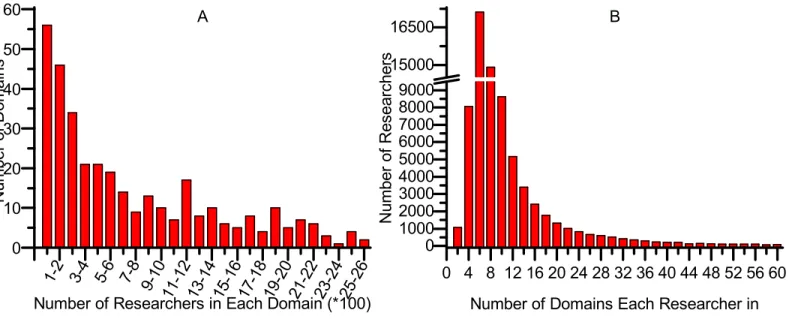
For previous experiments in this work, we clustered 500 topics based on DBLP data set and matched researchers to different domains. Here we analyzed the statistics of these domains. As described inFig 5, in terms of the number of researches in each domain, there are about 56 domains that contain up to 100 researchers, and two domains contain more than 2500 researchers. We can come to conclusion that, various domains show big difference in scales. What’s more, as shown inFig 5(B), most researchers are active in 2 to 20 domains. However, there is no clear standard to make the domains division. The statistics show inconsistency with different clustering granularity. In this section, we exploit the impact of clustered domains number on the performance of CCRec.
We adopted the following experiment settings: (1) Evaluate how the precision, recall andF1 score change with the number of collaborators recommended, (2) Generate the most potential collaborators recommendation for those 100 researchers selected above and (3) Recommend 21 potential collaborators for each researcher.Fig 6shows the experimental results.
According toFig 6, the number of clustered domains do have certain effects on the perfor-mance of CCRec. If the number of clustered domains is appropriate, theF1 score achieves
Fig 5. Statistics of data after topic clustering and researcher partition.
some enhancement. In this situation, when clustering the data mining academia into 500 domains, CCRec performs best over precision, recall andF1 score.
In summary, our proposed model, which combines content-based and social network-based methods shows improvement. Furthermore, in terms of precision, recall andF1, CCRec out-performs ACRec, CNRec, TBRec and RWR generating the most potential collaborators (MPCs) recommendations for academic researchers.
Conclusions
In this paper, we focused on how to find researchers’MPCs based on big scholarly data which is necessary in current academia. To this end, we proposed a novel recommendation model called CCRec, by combining the features of publications content and collaboration networks. A topic clustering model and a random walk model were adopted to obtain researchers features, and make MPCs recommendation for researchers. We conducted extensive experiments on a subset of DBLP data set to evaluate the performance of CCRec in comparison to other state-of-the-art models: ACRec, CNRec and TBRec, and a baseline model RWR. Our experimental results show that, CCRec outperforms other compared models in terms of precision, recall and F1 score. Due to the utilization of a topic clustering model, the problem of topic drift in aca-demic research has been solved to some extent.
Our research on CCRec reveals that the combination of content-based and network-based methods can improve the generation of effective academic collaborations. Nonetheless, there is still room for future study in this direction. We extracted the titles of publications as the corpus of the topic clustering model, which are not more comprehensive than the abstract and main body of publications. Additionally, specific metrics should be utilized to evaluate the impact of topic drift. As future work, more experiments and studies will be conducted.
Supporting Information
S1 File. The source data of Figs3–6. (XLSX)
Author Contributions
Conceived and designed the experiments: XK ZX FX AT. Performed the experiments: HJ ZY. Analyzed the data: XK HJ ZY. Wrote the paper: XK HJ ZY ZX FX AT.
Fig 6. The impact of clustered domains number on CCRec.The abscissas denote the length of recommendation list. The ordinates represent the values of precision, recall and F1 respectively.
References
1. Lee S, Bozeman B (2005) The impact of research collaboration on scientific productivity. Soc Stud Sci 35: 673–702. doi:10.1177/0306312705052359
2. Lopes GR, Moro MM, Wives LK, De Oliveira JPM (2010) Collaboration recommendation on academic social networks. In: Advances in Conceptual Modeling–Applications and Challenges, Springer. pp. 190–199.
3. Chen J, Geyer W, Dugan C, Muller M, Guy I (2009) Make new friends, but keep the old: recommending people on social networking sites. In: Proc. SIGCHI. pp. 201–210.
4. DiMicco J, Millen DR, Geyer W, Dugan C, Brownholtz B, Muller M. (2008) Motivations for social net-working at work. In: Proce. ACM CSCW. pp. 711–720.
5. Li J, Xia F, Wang W, Chen Z, Asabere NY, Jiang H. (2014) Acrec: a co-authorship based random walk model for academic collaboration recommendation. In: Proc. WWW. pp. 1209–1214.
6. Xia F, Chen Z, Wang W, Li J, Yang LT (2014) Mvcwalker: Random walk based most valuable collabora-tors recommendation exploiting academic faccollabora-tors. IEEE Trans Emerg Top Comput 2: 364–375. doi: 10.1109/TETC.2014.2356505
7. Gollapalli SD, Mitra P, Giles CL (2012) Similar researcher search in academic environments. In: Proc. ACM/IEEE JCDL. pp. 167–170.
8. Kim HN, Ji AT, Ha I, Jo GS (2010) Collaborative filtering based on collaborative tagging for enhancing the quality of recommendation. Electron Commer Res Appl 9: 73–83. doi:10.1016/j.elerap.2009.08. 004
9. Ma H, Zhou D, Liu C, Lyu MR, King I (2011) Recommender systems with social regularization. In: Proc. ACM WSDM. pp. 287–296.
10. Huynh T, Hoang K, Lam D (2013) Trend based vertex similarity for academic collaboration recommen-dation. In: Computational Collective Intelligence. Technologies and Applications, Springer. pp. 11–20. 11. Chen HH, Gou L, Zhang XL, Giles CL (2012) Discovering missing links in networks using vertex
similar-ity measures. In: Proc. ACM SAC. pp. 138–143.
12. Sun Y, Barber R, Gupta M, Aggarwal CC, Han J (2011) Co-author relationship prediction in heteroge-neous bibliographic networks. In: ASONAM. IEEE, pp. 121–128.
13. Lichtenwalter RN, Lussier JT, Chawla NV (2010) New perspectives and methods in link prediction. In: Proc. SIGKDD. pp. 243–252.
14. Lee DH, Brusilovsky P, Schleyer T (2011) Recommending collaborators using social features and mesh terms. Proceedings of the American Society for Information Science and Technology 48: 1–10. 15. Cohen S, Ebel L (2013) Recommending collaborators using keywords. In: Proc. WWW. pp. 959–962. 16. Petertonkoker J, Reinhardt W, Surve J, Sureka P (2014) Scientific recommendations to enhance
schol-arly awareness and foster collaboration. In: Recommender Systems for Technology Enhanced Learn-ing, Springer. pp. 283–306.
17. Xia F, Asabere NY, Liu H, Chen Z, Wang W (2014) Socially aware conference participant recommenda-tion with personality traits. IEEE Systems Journal. doi:10.1109/JSYST.2014.2342375
18. Chaiwanarom P, Lursinsap C (2014) Collaborator recommendation in interdisciplinary computer sci-ence using degrees of collaborative forces, temporal evolution of research interest, and comparative seniority status. Knowledge-Based Systems.
19. Tang J, Wu S, Sun J, Su H (2012) Cross-domain collaboration recommendation. In: Proc. SIGKDD. pp. 1285–1293.
20. Chen HH, Gou L, Zhang X, Giles CL (2011) Collabseer: a search engine for collaboration discovery. In: Proc. ACM/IEEE JCDL. pp. 231–240.
21. Li C, Cheung WK, Ye Y, Zhang X, Chu D, Li X. (2014) The author-topic-community model for author interest profiling and community discovery. Knowledge and Information Systems: 1–25.
22. Goldberg Y, Levy O (2014) word2vec explained: deriving mikolov et al.’s negative-sampling word-embedding method. arXiv preprint arXiv:14023722.
23. Blei DM, Ng AY, Jordan MI (2003) Latent dirichlet allocation. Journal of Machine Learning Research 3: 993–1022.
24. Hofmann T (1999) Probabilistic latent semantic indexing. In: Proc. 22nd annual international ACM SIGIR conference on Research and development in information retrieval. pp. 50–57.
26. Ley M (2009) Dblp: some lessons learned. Proceedings VLDB Endowment 2: 1493–1500. doi:10. 14778/1687553.1687577