Licenciado sob uma Licença Creative Commons DO): http://dx.doi.org. . / - . . .AO
[T]
Comparison of static balance of elderly women through two
methods: computerized photogrammetry and accelerometer
[)]
Comparação do equilíbrio estático de idosas avaliadas por meio de
dois métodos: fotogrametria computadorizada e acelerômetro
[A]
Dirciane Stieven de Oliveira[a], Gisele Oltramari[a], Rodrigo Costa Schuster[a], Daniel Tiago da Costa de Oliveira[b]*
[a] Faculdade da Serra Gaúcha FSG , Caxias do Sul, RS, Brazil
[b] Universidade do Vale do Rio dos Sinos Unisinos , Caxias do Sul, RS, Brazil
[R]
Abstract
Introduction: The aging process produces functional and structural deficits in the body, among these changes
we highlight the changes in balance. Objective: This study aims to compare the computed photogrammetry
and accelerometer to assess static balance in the elderly. Methods: This was an observational, cross-sectional
study. The study included female subjects participating in a mothers club, where the balance assessment was performed using computerized photogrammetry and accelerometer. Results: Average age . ± . [
-] years, with the majority of the sample . % consisted of elderly widows, followed by . % of married elderly. Most of the sample . % reported not working, eighty-six percent of the sample reported not hav-ing suffered falls in the last year. The vast majority of elderly studied . % reported not having suffered
350
fracture episode and . % reported having suffered fracture episode in the last three months, % of the sample owned anteriorization trunk, % had previous oscillation trunk and % had subsequent oscillation.
Conclusion: There were significant direct and a moderate to good between the measurements obtained in
photogrammetry and triaxial accelerometer correlations.
[P]
Keywords: Aging. Balance. Photogrammetry. Accelerometry. [B]
Resumo
Introdução: O processo de envelhecimento gera deficits funcionais e estruturais no organismo, dentre essas alterações podemos destacar as alterações no equilíbrio. Objetivo: O presente trabalho tem como objetivo comparar a fotogrametria computadorizada e o acelerômetro na avaliação do equilíbrio estático de idosos. Métodos: Trata-se de um estudo tipo observacional e transversal. Participaram do estudo 112 indivíduos do sexo feminino que participam de um clube de mães, onde foi realizada a avaliação do equilíbrio por meio da fotogrametria computadorizada e do acelerômetro. Resultados: Média de idade de 70,3 ± 5,8 [60-79] anos, a maior parte da amostra (47,3%) foi constituída por idosas viúvas, seguida de 41,1% de idosas casadas. Grande parte da amostra (73,2%) referiu não trabalhar, 86% da amostra referiu não ter sofrido quedas no último ano. A grande maioria das idosas estudadas (93,8%) referiu não ter sofrido episódio de fratura e 6,3% referiu ter sofrido episódio de fratura nos últimos três meses, 75% da amostra possuiu anteriorização de tronco, 63% apresentou oscilação anterior do tronco e 37% apresentou oscilação posterior. Conclusão: Observou-se correlações significativas, diretas e de magnitude moderada entre as medidas obtidas na f oto-gametria e o acelerômetro triaxial. [K]
Palavras-chave: Envelhecimento. Equilíbrio. Fotogrametria. Acelerometria.
components — sensory visual, somatosensory and vestibular , effector strength, range of motion, bio-mechanical alignment, flexibility and central pro-cessing. The integration of the various body systems under central command is critical for the control of body balance. The performance of these systems has a direct in the skills of the individual to perform daily tasks, i.e., the functional capacity. )n more than half of the cases, imbalance originates between and years, approximately and about % of elderly patients have the symptoms at this age .
To Kisner and Colby balance is the ability to align the segments of the body against gravity to keep or move the body center of mass within the avail-able support base without falling. The ability to move the body in balance, under the action of gravity, by the interaction of sensory and motor systems. To as-sess the balance, numerous methods and scales have been developed with the aim of establishing param-eters for identifying elderly with greater susceptibil-ity to suffer falls. Among them we can mention the Functional Reach Test FRT , the test Timed Up Introduction
Population aging is well established in developed countries and is constantly on the rise in develop-ing countries, such as Brazil , . Accorddevelop-ing to the )nstituto Brasileiro de Geografia e Estatística , in Brazil the combined decline in fertility and mortal-ity rates has caused changes in the age structure of the population, with a relative decrease in the younger population and the proportional increase of the elderly. The population over years of age is approximately % of the general population by the year , according to projections, the num-ber of people years old and over will increase
-fold, from , people in to .2 million
in .
and Go , , the Physical Performance Test , the Berg Balance Scale , ; and the March Evaluation and Performance Oriented Balance at Performance Oriented Mobility Assessment POMA .
According to Rebelatto et al. , falls are treated as a factor of great epidemiological relevance, social and economic in the world because it is the most common type of accident among the elderly. )ts complications are the leading cause of deaths in people over and promotes physical, psychological and social, as it leads to dependence and the reduction of daily and trust activities, changing the lifestyle of the elderly . Therefore, the importance of body balance, because the earlier the identification of the fastest balance deficit preventive physical therapy measures can be taken, thus avoiding the risk of falls and other compli-cations in this population. Functional assessment of body balance in the elderly is a process that assesses various systems involved in postural control mecha-nism. Various scales and functional tests have been developed with the purpose of identifying impaired balance and determine the risk factors for indepen-dence and falls in the elderly, as mentioned earlier. These scales and tests, have quantitative description of functional balance ability, and can be useful for generating hypotheses about the determinants of functional limitation observed, moreover, this type of evaluation measures in a balancing instrument, the correlation of an observer reliability intraexaminer .
Among these tools, today we can mention Computed and accelerometry photogrammetry. Computed photogrammetry developed by the appli-cation of photogrammetric principles to photographic images obtained in body movements. To these images Photointerpretation bases were applied, generating a new kinematics study tool . As for Mello and Watson , computerized photogrammetry is a tool used as an aid during physical examination to quantify postural changes and changes in static equilibrium. The accelerometry in health care is a method of kinematic motion analysis, normally used for biomechanical analysis. Allows through the use of accelerometers mensurarem accelerations of the evaluated object. These measurements to generate a sequence of product values representing the in-stantaneous value of the acceleration as a function of time . When this feature is exploited in the human body, one can study the acceleration caused or suffered by the body, with the data derived from the speed, spatial positioning and the inclination with
respect to gravity. The accelerometer has as its ba-sic principle the action of acceleration in a mass to produce force .
Thus the aim of this study was to compare the as-sessment of static equilibrium of elderly individuals using two different quantitative tools: computerized photogrammetry and the accelerometer. )n addition, we chose to evaluate the cervical position in the sagit-tal plane to evaluate the cervical posture of the popu-lation, taking into account that any cervical change can alter the balance of the elderly.
Methods
This research was characterized as a study of ob-servational and cross-sectional, which were applied two descriptive quantitative methods for evaluating the static equilibrium of elderly residents in the city of Caxias do Sul. The study was approved by the Ethics Committee on Workers’ Circle Research Caxiense/
FSG under number / .
The study comprised subjects female members of the Mothers Club in the city of Caxias do Sul, aged to years, who met the inclusion criteria and who wished to willingly participate in the study and signed the term of Consent.
)nclusion criteria were: female, aged to years, participants of the southern Caxias moth-ers club, wander so independently without auxil-iary aid device, have preserved cognition enough to understand the guidelines, express interest free to participate, sign the Consent Statement. Exclusion criteria were: having neurological or musculoskel-etal which cause changes in postural balance, device use auxiliary gear diagnosed with change labyrinth with cognitive change above , with severe visual change under medication effects that might interfere with balance and vestibular function, as hypnotics, sedatives, opioids antipsychotics and antihistamines, joint deformities in the lower limbs that limit walk-ing, individuals who refuse to sign the )nstrument of Consent.
To evaluate static balance by means of comput-erized photogrammetry was used a digital camera
Canon brand with . megapixel resolution , po-sitioned parallel to the floor, on a level tripod brand
352
positioned and aligned. A helmet with an aligned pointer to a plumb line, weighing approximately grams was aligned with the pinna law in order to assess the oscillations in the sagittal plane. All indi-viduals have adopted the standing position and with eyes closed for seconds, where the shooting took place. )n order to obtain the moment of greatest oscil-lation, the images were analyzed by Windows Movie Maker program, and at the moment of greater sway the image was recorded on the computer and analyzed in Software Auto CAD™ determining the values of fluctu-ating degrees. For the analysis of static balance through triaxial accelerometer we developed a software for the operating system Android . that was installed on a cell of Samsung™ brand. This software is able to read and interpret real-time data from the mobile device accelerometer and turn it into information relating to change the center of gravity of the individual.
For the assessment of the balance through the ac-celerometer, individuals used the same helmet that was carried out Photogrammetry Computed where this helmet has a socket for the mobile device. )n the same time it was done shooting for the registration of computed photogrammetry were captured oscil-lations with the accelerometer and the data were stored on a flash drive for further analysis.
Statistical analysis
The collected data were stored in a Microsoft Office Excel spreadsheet. Thus, descriptive sta-tistics to characterize the sample were used, which are described as mean and standard deviation. We used the Pearson’s correlation coefficient to verify the concurrent validity between the measurements ob-tained in Biofotogametria and Triaxial Accelerometer. According to Portney and Watkins , the correla-tions were classified as low or no . < r < . , reasonable . < r < . , moderate to good . < r < . and good to excellent r > . . All cal-culations were performed using SPSS for Windows version . and the significance level was α < . .
Results
The evaluated sample consisted of elderly women with a mean age of . ± . [ – ] years. The vast majority of the sample . % consisted
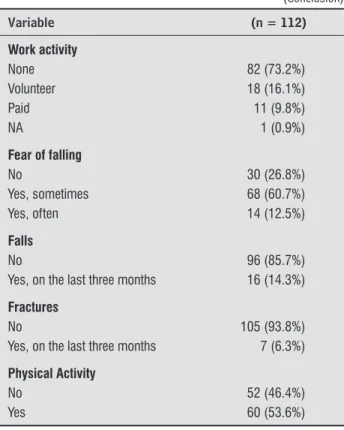
of elderly widows, followed by . % of married el-derly. Twenty-seven percent of the sample reported having completed primary, followed by % of the sample with incomplete primary. Most of the sample . % reported not working; . % reported do-ing volunteer work, . % reported performdo-ing paid work and . % could not answer.
)t was found that eighty-six percent of the sample reported having not suffered falls and % reported episode of decrease in the last three months. The vast majority of the studied elderly . % reported not having suffered episode of fracture and . % report-ed having sufferreport-ed fracture episode in the last three months. About half of the sample . % reported practicing some form of regular physical activity, ac-cording to data in Table .
Most of the sample % owned anterior cervi-cal. Sixty-three percent of the sample had anterior trunk oscillation and % had posterior oscillation, described in Table .
Concurrent validity
To establish the relationship between the perfor-mance of the accelerometer and the perforperfor-mance of computerized photogrammetry, already having its known validity, we used the correlation test to test the concurrent validation. There were significant cor-relations, direct and with good magnitude between the measurements obtained in Photogrammetry and Triaxial Accelerometer r = . ; p = . Table .
Table 1 - Sociodemographic and clinical characteristics of the participants
Variable (n = 112)
Gender
Male Female
0 (0%) 112 (100%)
Age
Between 60 to 69 years Between 70 to 79 years
51 (45.54%) 61 (54.46%)
Marital Status
Maiden Married Widow Divorced NA
4 (3.6%) 46 (41.1%) 53 (47.3%) 6 (5.4%) 2 (1.8%)
Table 1 - Sociodemographic and clinical characteristics of the participants
Variable (n = 112)
Work activity
None Volunteer Paid NA
82 (73.2%) 18 (16.1%) 11 (9.8%) 1 (0.9%)
Fear of falling
No
Yes, sometimes Yes, often
30 (26.8%) 68 (60.7%) 14 (12.5%)
Falls
No
Yes, on the last three months
96 (85.7%) 16 (14.3%)
Fractures
No
Yes, on the last three months
105 (93.8%) 7 (6.3%)
Physical Activity
No Yes
52 (46.4%) 60 (53.6%)
Note: NA = not applicable.
Table 2 - Range trunk and change in cervical posture mea-sured with computerized photogrammetry
Variable (n = 112)
Cervical anteriorization
No Yes
28 (25%) 84 (75%)
Trunk range
Anterior Posterior
71 (63.4%) 41 (36.6%)
Table 3 - Average swing degrees measured by computer photogrammetry and accelerometer
Variable Degrees
Computed photogrammetry 3.52°
Accelerometer 3.98º
Discussion
The increase in life expectancy and the conse-quent growth of the elderly population in Brazil is increasing concern for the well being and the main-tenance and/or the search for a better quality of life in this population. According to Ruwer et al. ag-ing impairs the central nervous system capability to process vestibular, visual and proprioceptive signals responsible for maintaining body balance. These de-generative processes are responsible for significant changes in the geriatric population, including shifting the balance, resulting in falls. According Bittar et al. falls are the most dangerous consequences of imbalance and difficulty in walking, taking the old isolation, decreased activities of daily living ADL , and low self-esteem.
)n the present study found that the average age of the study population was . years, where the vast majority of the sample . % consisted of elderly widows, followed by . % of married elderly. )n an epidemiological study by Pilger et al. with elderly where the goal was to describe the sociode-mographic and elderly health conditions in a city of Paraná State, Brazil, stood out the highest percentage of women . % , which may be related to greater female longevity compared to men. Other factors were also assigned as the lower exposure to risk factors than men, work-related environment, lower prevalence of smoking and alcohol use, differences in attitude towards disease and disability and the in-creased coverage of assistance gynecological , . )n relation to marital status of the research there was a predominance of widows . % , corroborating with our results, which can be explained by the fact that these women as widows, mostly end up living alone, and the tendency of widowed men is find an-other mate .
354
instability compared to their active counterparts physically. Also in the study by Freitas elderly with lower levels of physical activity had greater fluc-tuations in stabilometric variables, especially in the amplitude of postural sway and speed.
This study also shows that % of older have cer-vical anterior. Postural changes due to aging begin to manifest from years of age, where the height starts to decrease around an inch per decade . Besides the height, other changes resulting from advancing age also begin to manifest mainly in the sagittal plane, for example, increased kyphotic curvature of the thoracic spine, increase or decrease lumbar lor-dosis, increased knee flexion angle displacement the hip joint back and the trunk bending forward, above the hips, thus changing the body balance . With these changes the center of gravity is anterior, and therefore, the elderly end up having a bigger previous oscillation in relation to other changes .
)n a study by Nunes et al. with individu-als separated by age groups, with the lowest years and the largest , aimed to evaluate and compare the anteroposterior inclinations and the gravity center of the side, through a postural assessment software. The evaluations indicated a tendency for the anterior and lateralization of the center of gravity according to age group, that is, the older, the greater the risk of anterior trunk in the static posture. According Nashner , degree of posterior and lateral oscil-lation occurs while the balance is being maintained, and these oscillations define the limits of stability in the anterior direction, posterior and lateral, where the normal anteroposterior oscillations in adults is twelve degrees from the rearmost position prior to that over.
(ave Gatev et al. , states that during the main-tenance of upright posture, the angular displacement of the ankle, knee and hip do not exceed four degrees. Thus the reduction in range of motion in these joints would not be a determining factor for postural control in the elderly.
Another finding in this study was related to the average of degrees of postural sway, measured by computed photogrammetry, with the value of . °. A study by Baraúna et al. , in order to verify through computerized photogrammetry static bal-ance amputees, comparing them to non-amputee subjects, proved to be easy to apply in the evalua-tion of static balance, making it clear that it is a tool to assess the balance quantitatively. Baraúna et al.
believe that the evaluation of static equilibrium as a tool using computerized photogrammetry can be a support for the development of preventive and therapeutic approaches, thus avoiding complications due to imbalance.
)n a study by Carneiro et al. , aimed to verify the inter-rater reliability and )ntra-examiner of com-puted photogrammetry for postural assessment of head in side view in individuals. Performed by two examiners, resulted in excellent correlation between )ntra-examiner analysis, but for inter showed low reliability, being justified by the limited experience of the examiner with the method due to difficulties in the implementation of photogrammetry, and for data analysis. As the average for the degrees of os-cillation displayed on accelerometer, with values of
. °. According Mathie et al. , the motion sen-sors are accelerometers are sensitive to variations in body acceleration in one or three axes of the body, so they are able to directly and objectively quantify the frequency, intensity and duration of the motion. )n a systematic review by Azevedo et al. , on the methodological characteristics of studies in Latin America using motion sensors, eighty percent of the studies used accelerometers.
)n a study by O’Sullivan et al. aimed to de-termine the correlation between accelerometry and clinical patterns Berg Balance Scale and the TUG test , to characterize accelerometer responses and acceleration patterns between fallers and non-fallers, the authors report that the Berg Balance Scale, tends to be subjective, while the TUG quantifies a functional impairment of the individual, but it requires a sub-jective evaluation to balance the assessment. Other alternatives require sophisticated and expensive equipment, therefore, the accelerometer is a potential solution to the problem, reaching the conclusion that it was the first type study which showed a high cor-relation between the instruments and accelerometry can also distinguish between stabilizing responses to different equilibrium conditions, proving to be an efficient alternative, quantitatively measuring the balance of the elderly.
therapeutic interventions. )n the study by Dalton et al. in order to investigate the ability of a single triaxial sensor detecting a motion deficiency in indi-viduals with pre-manifest and manifest (untington’s disease (D , the sensor showed excellent agreement. And therefore the main objective of the study, the evaluation of static balance in the elderly by the meth-ods of computerized photogrammetry and acceler-ometry, it was observed that the accelerometer can be effective to measure postural sway elderly, thus minimizing the possible errors in the implementa-tion and analysis of computerized photogrammetry.
Conclusion
The accelerometer shown in this study, to be an effective evaluation tool for the static equilibrium of the elderly. )mportantly also, which is a user-friendly tool, requires little time, besides being handy and por-table allowing the evaluation of volunteers in differ-ent locations. Through this instrumdiffer-ent, the physical therapist can monitor and better monitor his patient to develop a treatment plan. )t is suggested yet to be realized more studies comparing the accelerometer and Computed photogrammetry in order to prove their reliability, since there are no studies in the lit-erature comparing the two assessment tools.
References
. Carvalho JAM, Garcia RA. O envelhecimento da popu-lação brasileira: um enfoque demográfico. Cad Saúde Pública. ; : - .
. Garrido R, Menezes PR. O Brasil está envelhecendo: boas e más notícias por uma perspectiva epidemi-ológica. Rev Bras Psiquiatr. ; Supl. : - . . )nstituto Brasileiro de Geografia e Estatística.
Per-fil dos idosos responsáveis por domicílios no Brasil. [cited , Apr ]. Available from: www.ibge. gov.br/home/presidencia/noticias/ pidoso. sht
. Maciel ACC, Guerra RO. Prevalência e fatores asso-ciados ao déficit de equilíbrio em idosos. R Bras Ci e Mov. ; : - .
. Gazzola JM, Perracini MR, Ganança MM, Ganança FF. Fatores associados ao equilíbrio funcional em idosos com disfunção vestibular crônica. Rev Bras Otorrino-laringol. ; : - .
. Ruwer SL, Rossi AG, Simon LF. Equilíbrio em idosos. Rev Bras Otorrinolaringol. ; : - . . Kisner C, Colby LA. Exercícios terapêuticos:
funda-mentos e técnicas. . ed. Barueri: Manole; . . Duncan PW, Weiner DK, Chandler J, Studenski S.
Functional reach: a new clinical measure of bal-ance. J Gerontol. ; :M - .
. Podsiadlo D, Richardson S. The timed Up & Go : a test of basic functional mobility for frail elderly per-sons. J Am Geriatr Soc. ; : - .
. Smith PS, (embree JA, Thompson ME. Berg Balance Scale and Functional Reach: determining the best clinical tool for individuals post acute stroke. Clin Rehabil. ; : - .
. Berg KO, Wood-Dauphinee SL, Williams J), Gayton D. Measuring balance in the elderly: preliminary development of an instrument. Physiother Can.
; : - .
. Tinetti ME, Baker D), Garret PG, Gottschalk CM, Koch ML, (orwitz R). Yale F)CS)T: risk factor abate-ment strategy for fall prevention. J Am Geriatr Soc.
; : - .
. Rebelatto JR, Castro AL, Sako FK, Aurichio TR. Equilíbrio estático e dinâmico e o índice de massa corporal. Fisioter Mov. ; : - .
. Ricieri DV. Validação de um protocolo de fotograme-tria computadorizada e quantificação angular do movimento tóraco-abdominal durante a ventilação tranq“ila [dissertação]. Uberlândia: Centro Univer-sitário do Triângulo; .
. Mello MS), Maia JN, Silva DAL, Carvalho CC. Avalia-ção postural em pacientes submetidas à mastectomia radical modificada por meio da fotogrametria com-putadorizada. Rev Bras Cancerol. ; : - . . Watson AWS. Procedure for the production of high
quality photographs suitable for the recording and evaluation of posture. Rev Fisioter Univ São Paulo.
356
. Robertson G, Caldwell G, (amill J, Kamen G. Whittlesey S. Research methods in biomechanics. Champaign: (uman Kinetics; .
. Balbinot A, Brussamarello VJ. )nstrumentação e fun-damentos de medidas. Rio de Janeiro: LT C; . v. . . Portney LG, Watkins MP. Foundations of clinical re-search: appications to practice. rd ed. New Jersey: Prentice (all (ealth; .
. Bittar RSM, Pedalini MEB, Bottino MA, Formigoni LC. Síndrome do desequilíbrio no idoso. Pró-fono.
; : - .
. Pilger C, Menon M(, Mathias TAF.Características so-ciodemográficas e de saúde de idosos: contribuições para os serviços de saúde.Rev Latino-Am. Enfer-magem. ; : - .
. Silva RC, Malina RM. Nível de atividade física em ado-lescentes do município de Niterói, Rio de Janeiro, Bra-sil. Cad Saúde Pública. ; : - .
. Baldin CB, Fortes VLF. Viuvez feminina: a fala de um grupo de idosas. Rev Bras de Ciên do Envelh (um.
; : - .
. Freitas ERFS. Prática habitual de atividade física afeta o equilíbrio de idosas? Fisioter Mov. ; : - . . Shephard R. Envelhecimento, atividade física e saúde.
São Paulo: Phort; .
. Kendall FP, McCreary EK, Romani WA, Rodgers MM, Provance PG. Músculos: provas e funções com postura e dor. Trad. Lilia Breternitz Ribeiro. . ed. Barueri: Manole; .
. Nunes ADM, Fonseca LCS, Scheicher ME. Comparação das inclinações lateral e anteroposterior no equilíbrio estático entre jovens, adultos e idosos. Rev Bras Geri-atr Gerontol. ; : - .
. Nashner LM. Sensory, neuromuscular, and biomechan-ical contributions to human balance. )n: Proceedings of the American Physical Therapy Association Forum;
Jun - ;Nashville, TN, USA.
. Gatev P, Thomas S, Kepple T, (allett M. Feedforward ankle strategy of balance during quiet stance in adults. J. Physiol. ; Pt : - .
. Baraúna MA, Duarte F, Sanchez (M, Canto RST, Malusa S, Campelo-Silva CD, et al. Avaliação do equilíbrio estáti-co em indivíduos amputados de membros inferiores através da biofotogrametria computadorizada. Rev Bras Fisioter. ; : - .
. Carneiro PRC, Cardoso BS, Cunha CM, Teles LCS. Con-fiabilidade inter e intraexaminador da avaliação pos-tural da cabeça por fotogrametria computadorizada. Fisioter Pesqui. ; : - .
. Mathie MJ, Coster ACF, Lovell N(, Celler BG. Acceler-ometry: providing an integrated, practical method for long-term, ambulatory monitoring of human move-ment. Physiol Meas. ; :R - .
. Azevedo AMP, Ferreira ACD, Silva PPC. Característi-cas metodológiCaracterísti-cas de estudos realizados na América Latina usando sensores de movimento: revisão sis-temática. R Bras Ci e Mov. ; : - . . O’Sullivan M, Blake C, Cunningham C, Boyle G,
Finu-cane C. Correlation of accelerometry with clinical balance tests in older fallers and non-fallers. Age Ageing. ; : - .
. Weiss A, (erman T, Plotnik M, Brozgol M, Maidan ), Giladi N, et al. Can an accelerometer enhance the utility of the Timed Up & Go Test when evaluating patients with Parkinson’s disease? Med Eng Phys.
; : - .
. Dalton A, Khalil (, Busse M, Rosser A, van Deursen R, Ólaighin G. Analysis of gait and balance through a single triaxial accelerometer in presymptomatic and symptomatic (untington’s disease. Gait Posture.
; : - .
Received: / /
Recebido: / /
Approved: / /