ANNALS OF THE UNIVERSITY OF ORADEA FASCICLE OF TEXTILES, LEATHERWORK
STORAGE OPTIMIZATION IN AN EXISTING BUSINESS LEATHER
GOODS
MALCOCI Marina1, MOTELICA Elena2
1, 2 Tehnical University of Moldova, Chisinau, Republic of Moldova, E-Mail: [email protected]
Corresponding author: Malcoci Marina, E-mail: [email protected]
Abstract: The deposit is the sector in a business where profit can be calculated exactly and improved logistics cost reduction, increased efficiency, optimization of distribution, surveillance elements of the supply chain, traceability - continuous monitoring, improved quality of supplies / services to customers. The study presented in this paper was conducted in the company of handbags S.A. Artima, in Chisinau. The organization has analyzed a large number of storage areas, all meeting the confort function, but that is not used within the storage area. As a storage facility used deposit old buildings that are located within the enterprise and deposits from building company. Analyzing the current situation we can conclude only negative: large number of deposits, leading to loss of control and stored products; storage located at a distance from each other, which leads to the increase of the supply materials for the production sectors. To establish and analyze the negative points above, the paper calculated the actual extent of area use and storage facilities. According to figures obtained, we see that the surfaces of all deposits not used to the fullest. The best result is recording finished goods warehouse, where the coefficient of area use record figure of 0,86, which means that 14% are used for the space between the goods stored, the space motion. A result very little is recording central warehouse supplies, use the volume coefficient is 0,20. In this paper, several recommendations that will make enterprise the following benefits: improved productivity; increase in the accuracy of data; increase customer loyalty and increase their expectations.
Key words: deposits, functions, objectives, enterprise, classification
1. INTRODUCTION
According concept between production and transport logistics, transport and consumer must necessarily be deposits. The existence of deposits is related to the need to maintain stocks. Storage is considered an activity of the product according to the quantity and quality required, in the right place at the right time. Role deposit consists of [1]: coordinating supply and demand; achieve cost savings; continuation or postponement of production / processing; achievement of marketing objectives.
The diversity of work being performed in different repositories, it is basically the same, or very similar. This is due to the fact that different types of storage to meet specific functions. For each warehouse, range of functions and their importance depends on many factors, including the owner and user storage space, their political peculiarities suppliers and customer base, scale user activity and products covered storage. In logistic systems, deposits can perform the following main functions [1, 2]: keeping the goods, raw materials, semi-finished; strengthening supply; dividing the batch creating a structure type; providing value-added services; preparing batches of raw material through manufacturing; forming a logical chain service system. Performance of the functions presented in operations requires handling the products. These operations fall into the following categories: loading and unloading; movements to and from the storage area; the execution orders.
identifying and removing unused properties; providing timely and complete information on the dynamics of stocks; keeping the optimum materials and finished products; reduced costs for storage, handling, transport.
2. CALCULATION OF SURFACE DEPOSITS
The deposits are characterized by area, volume, number of days of storage, respectively optimum height. The storage area can be structured as [6]:
• Area: reception area (unloading training load units, reception quantitative and qualitative); storage (storage, storage, conditioning, packaging purposes of loading and unloading of raw materials and finished products from storage); surface delivery (order for delivery, preparation for sale, making consignments for dispatch to customers).
• Auxiliary area: offices; spaces organizational processes related to inventory management; laboratories for quality control of raw materials and finished products; social spaces, sanitary transport; movement corridors.
For smooth running of the production activity following deposits are required main storage materials; warehouse of finished products; deposit recoverable materials.
a)The surface deposit materials
Total storage of raw materials (leather, artificial leather auxiliaries) is determined by the relationship:
ST = Su+Sa [m2] (1)
where: Su - area occupied actually stored materials; Sa - auxiliary surface including: reception area, reception of goods; handling and movement; collection surface-shipment; area occupied by furniture technology for recording.
Auxiliary surface is determined by the relationship:
Sa = Su·K [m2] (2)
where: K = 0,4 to 0,5 is ratio of the area of use.
The storage capacity is calculated for regulatory storage for 20 days. Storage of raw material by material can be made by stacking or palletizing.
When stored by stacking area capacity is calculated by the following equation:
h z g l N Q h V S
Su = s = = f ⋅ c ⋅ ⋅ ⋅ (3)
where: Ss is the area occupied by the stack; Nc - consumption norm or requirement material [m / day];
l - width is in m; g - the thickness of a layer of material, in m; z - equal to the number of days of storage 20 days; h - the height of the stacks: 1,5 - 2 m.
When storing several types of material:
Su= Su1+ Su2+ Su3+…+ Sun [m2] (4)
Stacks can be performed on the floor or shelf deposit. When storing the relationship palletizing calculation is:
cel cel u
S N S
⋅ =
4 [m
2]
(5)
where: Ncel is the number of cells in which the shelf blades are inserted; Scel - the surface of a
cell rack.
c c cel
q S
ANNALS OF THE UNIVERSITY OF ORADEA FASCICLE OF TEXTILES, LEATHERWORK
Sc = nf · Qf · z · nsc · Nc (7)
where: Nc - material requirements or consumption norm; Sc - current stock; Qf - production
task in pairs / minutes • man; nsc - number of exchanges; z - number of days of storage is 20 days; qc - the ability of a cell [m2] or [kg].
b) Area warehouse for finished products
The capacity of the warehouse is designed for a period of 10 days. Storage of finished products is done in cartons sits on the shelf or directly on the floor.
Surface deposit:
ST = Su+Sa = Su + (0,4÷0,5) Su = Su · (1+(0,4÷0,5)) (8)
The usable area is the relationship:
cel cel u
S N S
⋅ =
4 [m
2]
(9)
pcel f cel
n Q
N = ⋅10 (10)
where: Qf is the task of production; 10 - the number of days stored; npcel - the number of products in a
compartment set according to the number of a box and the number of boxes that can be placed in a palette.
Assessment of actual utilization of storage areas and is achieved through the following coefficients [7] surface utilization coefficient; coefficient of utilization position; coefficient of utilization of the volume; coefficient using landfill capacity over time; total cost per unit stored.
• Use of the surface coefficient (Kus), which represents the degree of utilization of the total area of the actual storage (Sd) and the total area of the deposit (Sdt):
Sdt Sd
Kus = (11)
• Height warehouse utilization coefficient (Kuî), by which it determines the use of warehouse height is calculated as the ratio between the average height of the deposit (Îm) and the maximum useful height (Îmu):
Îmu Îm
Kuî= (12)
• The coefficient of utilization of the volume (Kuî), which is the percentage use of the volume of the deposit being calculated as the product of the coefficient of use of the surface (Kus) and the pumping rate of the user (Kuî):
Kuî Kus
Kuî = ⋅ (13) • Coefficient while using landfill capacity, calculated as the ratio of the product of the amount deposited (Qd) and days of operation of the landfill (Zf) and the product from the warehouse capacity (Cd) by calendar days of the year (365):
365 ⋅
⋅ =
Cd Zf Qd
Qd Che A Vi
CTud = ⋅ + (15)
where: Vi is the value of all fixed assets inventory in the warehouse; A - the depreciation of fixed assets; Che - operating expenses; Qd-quantity stored.
3. DEPOSITS CHARACTERISTIC OF THE LEATHER GOODS ENTERPRISE
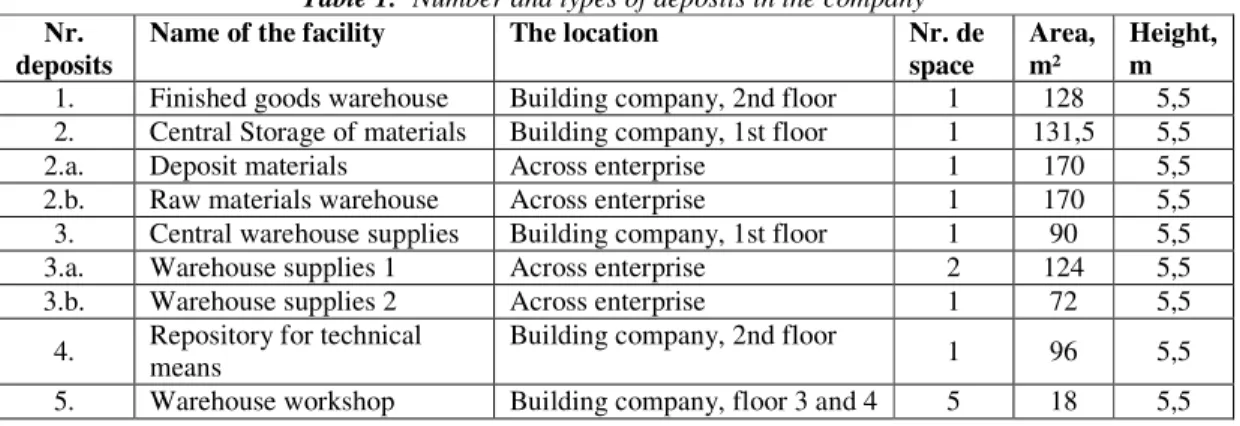
The deposit is the sector in a business where profit can be calculated exactly and improved logistics cost reduction, increased efficiency, optimization of distribution, surveillance elements of the supply chain, traceability - continuous monitoring, improved quality of supplies/services customer [8]. The study presented in this paper was conducted in the company of handbags S.A. Artima, in Chisinau. The enterprise has analyzed a large number of storage areas, all meeting the confort function, but that is not used within the storage area. As a storage facility used deposit old buildings that are located within the enterprise and deposits from building company. The number, type, size and location of the place deposits in the company specified in table 1.
Table 1: Number and types of deposits in the company Nr.
deposits
Name of the facility The location Nr. de
space
Area, m²
Height, m
1. Finished goods warehouse Building company, 2nd floor 1 128 5,5
2. Central Storage of materials Building company, 1st floor 1 131,5 5,5
2.a. Deposit materials Across enterprise 1 170 5,5
2.b. Raw materials warehouse Across enterprise 1 170 5,5
3. Central warehouse supplies Building company, 1st floor 1 90 5,5
3.a. Warehouse supplies 1 Across enterprise 2 124 5,5
3.b. Warehouse supplies 2 Across enterprise 1 72 5,5
4. Repository for technical means Building company, 2nd floor 1 96 5,5
5. Warehouse workshop Building company, floor 3 and 4 5 18 5,5
Finished goods warehouse (figure 1) is a space where products are packaged and stored. Because the final product is packed in boxes 1-3 products each space is equipped with equipment. Here is the output stored until delivery, which usually occur every week. In terms of location, is favorably located as it is close to the elevator.
Fig. 1: Finished products warehouse Fig. 2: Central Storage of materials
In the central warehouse of materials (figure 2) are kept baled material, rolls of paper, cardboard, polypropylene rolls, thread, elastic tape, velcro, Astrakhan, as well as adhesives, ie all basic and auxiliary materials which products are made.
ANNALS OF THE UNIVERSITY OF ORADEA FASCICLE OF TEXTILES, LEATHERWORK
Warehouse supplies (figure 3) consists of a central space in the building enterprise located on the 1st floor, just two storage for supplies and accessories located in the building across company. Warehouse supplies office is located in building enterprise space on the 1st floor, where it is stored and kept supplies. The store located on the 1st floor, central warehouse supplies are stored and maintained so as accessories, zipper, eyelets, rivets, tags, and other accessories and supplies small size and is launched directly in production.
For keeping of delivery and accessories are in stock, and the remaining models no longer produced is used warehouse building across company. Also, store supplies 2 (figure 4) are stored as products such as wheels, handles mechanical, carcasses, etc. In these spaces not used any type of machine, since this type of accessories is kept in large size boxes on the floor.
Fig. 3: Central warehouse supplies Fig. 4: Warehouse supplies two
Repository for technical means of production is the space of sections which currently operates. Here are stored the old machinery or inoperative. Within each section are producing technological flows, each flow sheet has each workshop deposit. The deposit is located in the workshop production floor sections 3 and 4, there are kept supplies needed for a week to plan production. Each workshop warehouse has fixed storage shelves of delivery and accessories.
From the above we can conclude only negative: number of deposits, leading to loss of control and stored products; outdated equipment that occupies a lot of space; lack of specialized equipment needed for the activity in the deposits; storage located at a distance from each other, which leads to the increase of the supply materials for the production sectors.
To establish and analyze the negative points above, below calculated actual level of use of the areas and storage spaces. The data obtained are shown in table 2.
Table 2: Coefficients determining the actual level of use of storage and areas Name of the facility Use of the surface
coefficient
The coefficient of use of height
The coefficient of utilization of the volume
Finished goods warehouse 0,86 0,45 0,39
Central Storage of materials 0,79 0,27 0,21
Deposit materials 0,70 0,27 0,19
Raw materials warehouse 0,70 0,27 0,19
Central warehouse supplies 0,55 0,36 0,20
Warehouse supplies 1 0,48 0,45 0,22
Warehouse supplies 2 0,67 0,36 0,24
Repository for technical means 0,93 0,27 0,25
Warehouse workshop 0,67 0,36 0,24
The coeficineţii give as close to 1, so the storage area is used as efficiently as possible.
Minimum allowable occupancy areas, height and volume is 0,66. According to figures obtained, we see that the surfaces of all deposits not used to the fullest. The best result is recording finished goods warehouse, where the coefficient of area use record figure of 0,86, which means that 14% are used for the space between the goods stored, the space motion. But all that storage does not use his height to the maximum, which is observed by the coefficient of utilization that reaches heights of 0,45, which leads to the use ineficentă room volume, only 39%. All other results it is observed that the surface
Similarly, the coefficient of utilization of the storage volume supplies 1 and 2 recorded 0,22 to 0,24. Although these deposits are kept out of production or the products in stock, room volume is used inefficiently. Products stored in these rooms could be transferred to the central warehouse supplies, if it has the right machine. Other storage also does not record high coefficient.
The calculations can be noted that the concentration of all products stored can be done in several central areas where they would dispose of specialized equipment such as racks of different types and electric height for seating products.
4. CONCLUSIONS
Analysis of the deposits in the leather goods enterprise allowed the following conclusions: • In the enterprise used a large number of storage spaces. This highlights the many negative aspects, such as: distance in e storage areas; records stored on raw ineffective.
• Old equipment, and even absence. Because of the lack of storage equipment, bales of material are deposited directly on the floor, which takes up only the surface of the deposit, while its height is used. Old equipment, such as racks, used for storing accessories.
• Renting storage space across the enterprise and use of income given to purchase equipment and warehouse management system.
These proposals will bring enterprise the following benefits: improved productivity; increase in the accuracy of data; increase customer loyalty and increase their expectations; reduce and streamline routes and movement of raw materials and finished products; reducing storage space by more efficient use of height; reduce cases of missing stock; organization and efficient use of storage space; increase product quality.
REFERENCES
[1] Distribution and logistics of goods, Lecture notes. University "George Bacovia" Bacau, 2005. http://ru.scribd.com/doc/37676010/Distributia-Si-Logistica-Marfurilor (accessed on 08.04.2014).
[2] V. Volgin. Logistics storage of goods: A Practical Guide. Publisher: Dashkov and Co., Moscow, 2010.
[3] H. J. Harrington, J. S. Harrington. Total management company XXI century. Teora, Bucharest, 2000.
[4] D. Fundătură, G. Papari. Logistics supply and disposal of products. Amarcord Publishing
House, Timisoara, 2005.
[5] I. Afanassenko, В. Borisova. Logistics Support: Textbook for universities. Publisher: Piter,
2010.
[6] E. A. Budac, L. G. Baragan. Commercial Management. Universitaria Publishing House, Craiova, 2012.
[7] J. Sirbu. Production management. Risoprint Publishing, Cluj-Napoca, 2005.