DANIELLA BORGES MACHADO
MÁ OCLUSÃO EM PRÉ-ESCOLARES: UMA ANÁLISE DO SB BRASIL 2010
Faculdade de Odontologia Universidade Federal de Minas Gerais
DANIELLA BORGES MACHADO
MÁ OCLUSÃO EM PRÉ-ESCOLARES: UMA ANÁLISE DO SB BRASIL 2010
Dissertação apresentada ao Colegiado de Pós-Graduação da Faculdade de Odontologia da Universidade Federal de Minas Gerais, como requisito parcial para a obtenção do título de Mestre em Odontologia
Área de Concentração: Saúde Coletiva
Orientadora: Profa. Dra. Ana Cristina Borges de Oliveira Coorientadora: Profa. Dra. Viviane Elisângela Gomes
Faculdade de Odontologia Universidade Federal de Minas Gerais
M149m Machado, Daniella Borges.
2013 Má oclusão em pré-escolares: uma análise do SB T Brasil 2010/ Daniella Borges Machado, 2013.
43 fls.: il.
Orientadora: Ana Cristina Borges de Oliveira Co-orientadora: Viviane Elisângela Gomes
Dissertação (Mestrado) - Universidade Federal de Minas Gerais,
Faculdade de Odontologia.
1. Má oclusão - epidemiologia -Teses. 2. Inquéritos de saúde bucal -
Teses. I. Oliveira, Ana Cristina Borges de. II. Gomes, Viviane
Elisângela. III.Universidade Federal de Minas Gerais. Faculdade de
Odontologia. IV. Título.
DEDICATÓRIA
À Deus, por estar sempre ao meu lado em minha vida.
À minha mãe, por ter me ajudado a subir cada degrau para que eu pudesse chegar até aqui.
Ao meu eterno pai, que mesmo em outra dimensão, nunca me abandonou.
À minha irmã, Nelma, por ser o meu apoio, minha amiga para todos os momentos, sempre ao meu lado!
AGRADECIMENTOS
À minha orientadora, Profa. Dra. Ana Cristina Borges de Oliveira, pelo incentivo, desde o início me preparando para um dia ser mestre, sempre confiando e me ajudando em todos os momentos. Levarei comigo para sempre.
À minha coorientadora, Profa. Dra. Viviane Elisângela Gomes, por ser uma grande incentivadora, e sempre me fazer acreditar que tudo ia dar certo!
À Profa. Dra. Efigênia Ferreira e Ferreira, por ser a parte positiva da minha carreira, por ser amiga, companheira, um exemplo de profissional e caráter humano!
À Profa. Dra. Andréa Clemente Palmier por ter feito parte da banca de pré-defesa e por ter feito sugestões que contribuíram muito para o avanço deste trabalho.
A todos os meus queridos colegas do Mestrado,
RESUMO
Objetivo: identificar os fatores associados à prevalência de mordida aberta anterior em crianças brasileiras com cinco anos de idade. Métodos: foi realizado um estudo transversal analítico com dados do inquérito epidemiológico nacional de saúde bucal-SB Brasil 2010. O desfecho estudado foi a mordida aberta, classificada em presente e ausente. As variáveis independentes foram classificadas em individuais, sociodemográficas e clínicas. Os dados foram analisados por meio das análises bivariada e multivariada através do programa estatístico SPSS (versão 18.0) com nível de significância de 95%. Resultados: a prevalência de mordida aberta anterior foi de 12,1% entre as crianças investigadas. A análise multivariada mostrou que os pré-escolares residentes na Região Sul do Brasil apresentaram uma chance 1,8 vezes maior de serem diagnosticados com a mordida aberta anterior. As crianças identificadas com alguma alteração de sobressaliência tiveram 14,6 vezes maior chance de pertencerem ao grupo de crianças com mordida aberta. Os pré-escolares diagnosticados com a mordida cruzada posterior apresentaram 60,0% de chance de serem identificados com a mordida aberta anterior. Conclusão: a mordida aberta anterior apresentou associação significativa com a região brasileira em que as crianças viviam, com a presença de alguma alteração de sobressaliência e com a prevalência de mordida cruzada posterior.
ABSTRACT
Malocclusion in preschool children: an analysis of SB Brasil 2010
Aim: identify factors associated with the prevalence of anterior open bite among five year old Brazilian children. Methods: a cross-sectional analytical study was undertaken using data from the National Survey of Oral Health (SB Brasil 2010). The outcome variable was anterior open bite, which was classified as present or absent. The independent variables were classified by individual, and by sociodemographic and clinical factors. Data was analyzed through bivariate and multivariate analysis using the SPSS statistical program (version 18.0) with a 95% level of significance. Results: the prevalence of anterior open bite among the children was 12.1%. Multivariate analysis showed that pre-school children living in the South region of Brazil had an increased chance of 1.8 timesof having anterior open bite. Children identified with alteration in overjet had a 14.6 times greater chance of having anterior open bite. Conclusion: there was a significant association between anterior open bite and the region of Brazil where the children lived and alteration in overjet.
LISTA DE ABREVIATURAS E SÍMBOLOS
CAPES Coordenação de Aperfeiçoamento de Pessoal de Nível Superior
CI Confidence interval
deft decayed, extracted, filled teeth
FAPEMIG Fundação de Amparo à Pesquisa do Estado de Minas Gerais IBGE Instituto Brasileiro de Geografia e Estatística
OR Odds ratio
SB Saúde Bucal
SPSS Statistical Package for Social Science
UFMG Universidade Federal de Minas Gerais WHO World Health Organization
X2 Qui-Quadrado
% Percentual
< Menor
> Maior
LISTA DE TABELAS E FIGURAS
Figure 1- The Foster and Hamilton index ………... 20 Figure 2- Independent variables and their categories ……….. 21 Table 1- Distribution of the sample according to the prevalence of anterior open bite and associated factors. Brazil, 2010 …………...………...
23
Table 2- Multiple logistic regression models explaining the prevalence of open bite in children aged 5 years. Brazil, 2010 ………..
SUMÁRIO
1 CONSIDERAÇÕES INICIAIS ... 12
2 Artigo ... 15
3 CONSIDERAÇÕES FINAIS ... 33
4 REFERÊNCIAS GERAIS ... 34
5 ANEXOS ... 38
ANEXO A: normas de publicação do periódico The Angle Orthodontist ... 39
1 CONSIDERAÇÕES INICIAIS
Dentre os problemas bucais que mais incomodam a população brasileira, pode-se dizer que os mais prevalentes e graves são as doenças cárie e periodontal e as más oclusões. Em saúde pública, os dois primeiros agravos recebem rotineiramente tratamento curativo ou cuidados preventivos. No entanto, a preocupação com o tratamento ou com as questões preventivas e interceptativas relacionadas às más oclusões muitas vezes não é levada em consideração nos planejamentos de medidas de saúde pública voltadas para a população brasileira, principalmente para as crianças.
É importante que se tenha um maior interesse na detecção precoce e tratamento das más oclusões e uma ênfase maior nos procedimentos preventivos, sendo essencial a obtenção de informaçãoes em crianças pré-escolares (TROTTMAN e ELSBACH, 1996). Ainda há muito que se descobrir sobre os efeitos dos fatores de risco sociais e biológicos associados à mordida aberta na dentição decídua (PERES et al., 2007a; b).
As más oclusões, assim como o diabetes e as doenças coronarianas, destacam-se como uma das doenças do mundo moderno. A etiologia das alterações oclusais está associada a quadros de alergia respiratória, uso de dietas macias, hábitos bucais deletérios, perda prematura de dentes decíduos e ausência do hábito de amamentação natural, dentre outros fatores causais (EMMERICH et al., 2004).
bucais da população foi realizado em 2010. Os resultados identificaram mordida aberta em 12,1% das crianças brasileiras com 5 anos de idade (BRASIL, 2011).
A mordida aberta anterior pode requerer assistência profissional durante a fase de dentição decídua para aconselhamento do abandono de hábitos de sucção não nutritiva, muitas vezes associando-se ou não o tratamento ortodôntico interceptativo ou não.
O interesse clínico pela etiologia e diagnóstico precoce da mordida aberta anterior justifica as investigações epidemiológicas. Em alguns casos, algumas intervenções são necessárias não apenas para prevenir alterações dentofaciais, mas também para eliminar a perpetuação de fatores que possam modificar o padrão de mastigação e fala, como a interposição da língua entre os incisivos (ROMERO et al., 2011).
Conhecer as características bucais dos diferentes grupos populacionais por meio de estudos epidemiológicos é algo essencial para o desenvolvimento de políticas públicasadequadas. De acordo com EMMERICH et al. (2004), é importante que sejam incorporadas medidas preventivas e de promoção da saúde direcionadas ao atendimento preventivo e interceptativo das más oclusões. Essas medidas devem adotar uma perspectiva multiprofissional e interdisciplinar, sendo aplicadas em idades precoces.
2 ARTIGO
FACTORS ASSOCIATED WITH THE PREVALENCE OF ANTERIOR OPEN BITE AMONG PRESCHOOL CHILDREN
Running Title: Anterior open bite among pre-school children
ABSTRACT
Objective: identify factors associated with the prevalence of anterior open bite among five years old Brazilian children. Materials and Methods: a cross-sectional study was undertaken using data from the National Survey of Oral Health (SB Brazil 2010). The outcome variable was anterior open bite, which was classified as present or absent. The independent variables were classified by individual, sociodemographic or clinical factors. Data was analyzed through bivariate and multivariate analysis using the SPSS statistical program (version 18.0) with a 95% level of significance. Results: the prevalence of anterior open bite was 12.1%. Multivariate analysis showed that pre-school children living in the South region of Brazil had an increased chance of 1.8 times of having anterior open bite (CI 95%: 1.16-3.02). Children identified with alteration in overjet had a 14.6 times greater chance of having anterior open bite (CI 95%: 8.98-24.03). Conclusion: there was a significant association between anterior open bite and the region of Brazil where the children lived and alteration in overjet.
INTRODUCTION
With the worldwide reduction in dental caries, including in Brazil, other oral abnormalities have become prominent.1,2 Among these are malocclusions, which may be associated with genetic, environmental and behavioral factors, resulting in functional and aesthetic problems.3
Anterior open bite and posterior crossbite have been identified as the most common occlusal abnormalities in the primary dentition.4,5 Anterior open bite is characterized by a lack of occlusal contact in the anterior region, while the remaining teeth are in occlusion.6,7,8
Anterior open bite is most prevalent in primary dentition, with a prevalence of between 6.2% and 50.0% worldwide, varying according to the population group studied.3,4,5,7,8,10,11,12 This is most likely to be associated with an increase in overbite during the mixed dentition period, and the self-correcting nature of the majority of cases of anterior open bite in primary dentition.5,13,14 When the nonnutritive sucking habits are no longer present in children, the anterior open bite tends to disappear. Thus, it is important to advise parents that these habits should be removed before eruption of the upper permanent incisors, i.e., before the age of 6 years.3,5,9,11,13,14,15 Góis et al.15 showed that children with previous anterior open bite in primary dentition had 70.1% of self-correcting in the transition from primary to mixed dentition. The anterior open bite is considered one of the most difficult occlusal abnormalities to correct in the permanent dentition, especially with respect to stability.3,4,5,8,9,10,11
psychosocial impact, predisposing the individual to low self-esteem, social alienation due to bullying, and behavioral disorders, with potential negative impact on the quality of life.16
The importance of studies related to occlusal characteristics present in primary dentition, focus on preventing malocclusion abnormalities in permanent dentition, or to correct previously detected abnormalities, is therefore clear.15,17,18,19,20,21
The aim of this study was to identify factors associated with the prevalence of anterior open bite among five years old children.
MATERIALS AND METHODS Type of Study
A cross-sectional analytical study was performed. Data from the Epidemiological Survey of the Oral Health Conditions of the Brazilian Population, known as “SB Brasil
2010”, was used.2
Ethical considerations
The Brazilian Oral Health Project was submitted to and approved by the National Ethics Council on Human Research. A letter of free and informed consent was obtained from all the individuals who participated in the study.2
Study Population
The population of Brazil is approximately 190.7 million, consisting of 2.9 million five year old children.22
National Oral Health Survey (SB Brasil 2010)
The epidemiological survey SB Brasil 2010 evaluated the oral health conditions of the Brazilian population in urban and rural areas, classified by different age ranges. The study surveyed 37, 519 individuals resident in 26 state capitals, in the Distrito Federal (“Federal District”) and in 150 municipal districts of varying population size, located in the countryside.2
The database created by this study is part of the public domain and freely accessible, and can be viewed on the website of the Brazilian Health Department.2
Data Collection
The data was collected in the home of each participant, and included an oral examination and a questionnaire. Dental teams were composed of an examiner and an assistant, who performed clinical data collection, using instruments (oral mirror and periodontal probe) recommended by the World Health Organization.23
Figure 1- The Foster and Hamilton index.
Diagnostic Diagnostic Criteria
Canine relationship
Class I: the tip of the upper primary canine tooth in the same vertical plane as the distal surface of the lower primary canine tooth in centric occlusion).
Class II: the tip of the upper primary canine tooth in anterior relationship to the distal surface of the lower primary canine tooth in centric occlusion.
Class III: the tip of the upper primary canine tooth in posterior relationship to the distal surface of the lower primary canine tooth in centric occlusion.
Overjet Normal: a positive incisor overjet not exceeding 2 mm. measured on the primary upper central incisors.
With alteration:
Increased: a positive incisor overjet of more than 2 mm.
Edge-to-edge: upper and lower primary central incisors in an edge-to-edge position in centric occlusion.
Anterior crossbite: the lower primary central incisors in anterior relationship to the upper primary central incisors in centric occlusion.
Overbite Normal: the incisal tips of the primary lower central incisors contacting the palatal surfaces of the upper primary central incisors in centric occlusion.
With alteration:
Reduced: the incisal tips of the primary lower central incisors not contacting the upper incisors or the palate in centric occlusion, there being a positive overbite.
Anterior open bite: the incisal tips of the lower primary central incisors being below the level of the incisal tips of the upper primary central incisors in centric occlusion.
Deep bite: the incisal tips of the lower primary central incisors touching the palate in centric occlusion.
Posterior crossbite
Present: the upper primary molars occluding in lingual relationship to the lower primary molars in centric occlusion.
Absent
Source: Foster and Hamilton (1969)
Sample Calculation
A probability sampling technique using conglomerates was employed by the survey. Three stratifications were used. The first of these used Domains and Primary Sampling Units: capitals and municipal districts from the countryside, according to macroregion. The second consisted of the subdivision of the participating municipal districts: 27 capitals plus 30 municipal districts from the countryside of each region of Brazil. The third stratification used a lottery to guarantee representativeness in the municipal districts, census sectors, and residences.
z, variance, mean deft, acceptable margin of error, effect of design and non-reply rate were used to calculate the sample size, and were taken from SB Brasil 2003.1
Calibration
Each field work team was properly trained in workshops of 20 hours (6 classes). Training was divided into phases as follows: 4 hours of theory, 2 hours of practical training, 8 hours for calibration, 2 hours of final discussion and 4 hours of fieldwork strategy.
The consensus calibration technique was used, calculating the correlation between each examiner and the results obtained by the consensus of the team. The model proposed by the WHO was used as a reference. The Kappa coefficient was calculated, weighted for examiner, age-group and medical complaint, with a value of 0.65 adopted as the minimum acceptable limit.2
Studied Variables
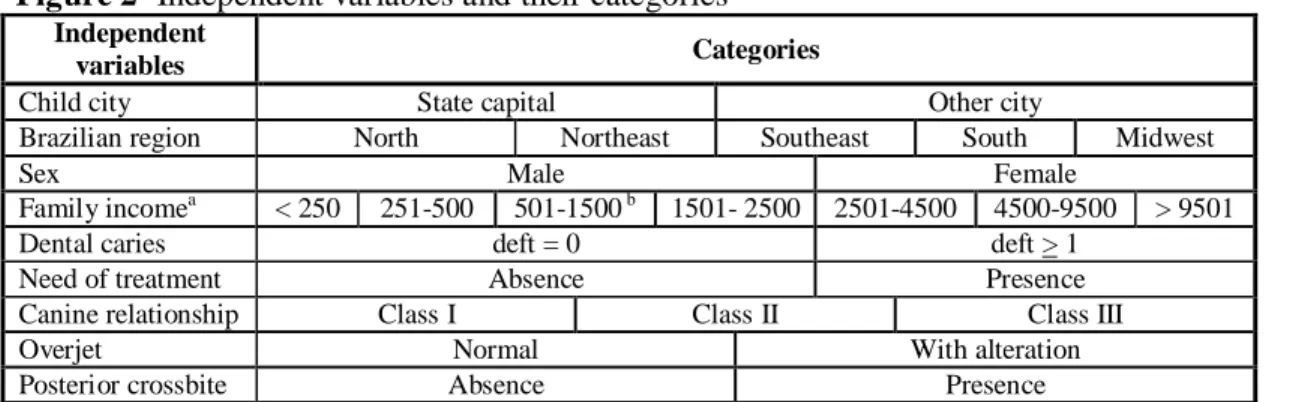
The dependent variable was anterior open bite. Figure 2 describes the independent variables.
Figure 2- Independent variables and their categories Independent
variables Categories
Child city State capital Other city
Brazilian region North Northeast Southeast South Midwest
Sex Male Female
Family incomea < 250 251-500 501-1500 b 1501- 2500 2501-4500 4500-9500 > 9501
Dental caries deft = 0 deft > 1
Need of treatment Absence Presence
Canine relationship Class I Class II Class III
Overjet Normal With alteration
Posterior crossbite Absence Presence
a
Data Analysis
Data was analyzed using the Statistical Package for Social Sciences (SPSS for Windows, version 18.0, SPSS Inc, Chicago, IL, USA) software program. Firstly, bivariate analysis of the data was performed. The X2 test was used to verify the association between the dependent variable (anterior open bite) and the independent variables (city of residence of child, region of Brazil, gender, family income, dental caries, need for treatment of dental caries, canine relationship, overjet, posterior crossbite) (p<0.05). In order to identify the independent impact of each variable studied, multiple logistic regression was performed. The independent variables were inserted into the logistic model on a decreasing scale according to their statistical significance (p<0.25, stepwise backward procedure).
RESULTS
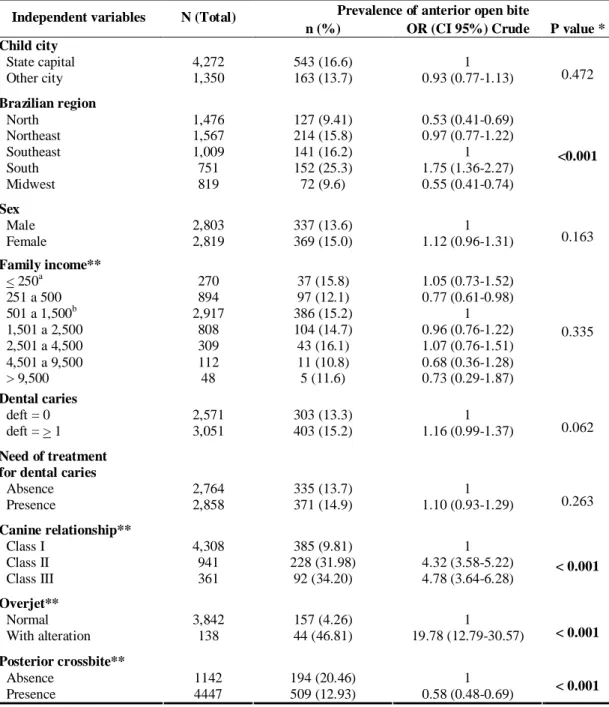
Table 1- Distribution of the sample according to the prevalence of anterior open bite and associated factors. Brazil. 2010. (N=5,622)
Prevalence of anterior open bite Independent variables N (Total)
n (%) OR (CI 95%) Crude P value * Child city
State capital 4,272 543 (16.6) 1
Other city 1,350 163 (13.7) 0.93 (0.77-1.13) 0.472
Brazilian region
North 1,476 127 (9.41) 0.53 (0.41-0.69)
Northeast 1,567 214 (15.8) 0.97 (0.77-1.22)
Southeast 1,009 141 (16.2) 1
South 751 152 (25.3) 1.75 (1.36-2.27)
Midwest 819 72 (9.6) 0.55 (0.41-0.74)
<0.001
Sex
Male 2,803 337 (13.6) 1
Female 2,819 369 (15.0) 1.12 (0.96-1.31) 0.163
Family income**
< 250a 270 37 (15.8) 1.05 (0.73-1.52)
251 a 500 894 97 (12.1) 0.77 (0.61-0.98)
501 a 1,500b 2,917 386 (15.2) 1
1,501 a 2,500 808 104 (14.7) 0.96 (0.76-1.22)
2,501 a 4,500 309 43 (16.1) 1.07 (0.76-1.51)
4,501 a 9,500 112 11 (10.8) 0.68 (0.36-1.28)
> 9,500 48 5 (11.6) 0.73 (0.29-1.87)
0.335
Dental caries
deft = 0 2,571 303 (13.3) 1
deft = > 1 3,051 403 (15.2) 1.16 (0.99-1.37) 0.062
Need of treatment for dental caries
Absence 2,764 335 (13.7) 1
Presence 2,858 371 (14.9) 1.10 (0.93-1.29) 0.263
Canine relationship**
Class I 4,308 385 (9.81) 1
Class II 941 228 (31.98) 4.32 (3.58-5.22)
Class III 361 92 (34.20) 4.78 (3.64-6.28) < 0.001
Overjet**
Normal 3,842 157 (4.26) 1
With alteration 138 44 (46.81) 19.78 (12.79-30.57) < 0.001
Posterior crossbite**
Absence 1142 194 (20.46) 1
Presence 4447 509 (12.93) 0.58 (0.48-0.69) < 0.001
OR: Odds ratio; CI 95%: Confidence interval.
* X2 Test / ** missing values / a R$ ( R$ 1.00 = US$ 0.49) / b average family income of the population
Preschool children diagnosed with alteration in overjet had a 14.7 greater chance of suffering from open bite (OR=14.69 [CI 95%: 8.98-24.03]).
Table 2- Multiple logistic regression models explaining the prevalence of open bite in children aged 5 years. Brazil. 2010.
Categories OR adjusted [CI] P value*
South region of Brazil 1.87 (1.16-3.02) < 0.001
Overjet with alteration 14.69 (8.98-24.03) < 0.001
Presence of posterior crossbite 0.62 (0.44-0.87) 0.006
OR: Odds ratio; CI 95%: Confidence interval.
DISCUSSION
The prevalence of anterior open bite in the studied population of five year old children was 12.1%.2 However, there is considerable variation in such epidemiological data in worldwide literature (6.2% to 50.0%), including when the same regions in Brazil are compared.3,4,5,7,9,10,11 A direct comparison of the results of different studies isdifficult because of the variation of diagnostic and classification criteria from an epidemiological perspective. Variations in study design, sample criteria and methods of analyzing results can also result in this discrepancy of data.
a higher percentage of anterior open bite in primary dentition, when compared with studies undertaken in the southeastern and northeastern regions.3,4,10,11
Regional and cultural variations of each city should be considered and are the most probable explanation for the different prevalences of anterior open bite found in other studies. A survey undertaken in Belo Horizonte, in the Southeast region of Brazil, found a prevalence of anterior open bite of 7.9% among 1,069 preschool children.4 In São Paulo, also in the south east, a prevalence of 22.4% was found among 309 children examined.3 A study in Recife, in the Northeast region of Brazil, found that 30.2% of 1,308 five year old children had anterior open bite.11 Peres et al.19 detected that 46.3% of 359 children in Pelotas, in the South region of Brazil, had anterior open bite in primary dentition. Studies outside Brazil also demonstrate a range of different results, with a prevalence of anterior open bite among preschool children varying from 13.0% in Italy to 50.0% in Sweden.5,9
The statistical significance found between prevalence of anterior open bite and the region of residence of the children can also be related to diverse racial characteristics in Brazil. The origin and formation of the population of Brazil is one of the most diverse in the world, with bi or tri hybrid miscegenation prevailing in some regions. The regions of Brazil reveal great complexity and racial diversity through their physical and cultural characteristics. In this way, differences in race and sociodemographic character may influence the prevalence of malocclusion among the population.25 For example; there is a significant difference of prevalence of malocclusion in American children aged 3 to 5 years between the Caucasian and Afro American races, while no difference between genders was found.17
transversal and sagittal abnormalities, which share the same etiological factors, may be associated with anterior open bite.
From 8 to 50 years of age, the prevalence of anterior open bite remains at approximately 3.5%, which seems to indicate the necessity of interceptive and corrective treatment after 8 years of age.12 A study undertaken by Tomita et al.25 in São Paulo, Brazil, identified a prevalence of malocclusion of 51.3% among boys and 56.9% among girls, with this value being significantly higher in the group of children aged 3 years.
Considering that the presence of anterior open bite is directly related to nonnutritive sucking habits, the increased prevalence of malocclusion at a younger age can be associated with an increased incidence of this habit among younger children. A longitudinal study of 386 children (children began the study with 3 years of age and were examined again at 7 years of age) performed in Sweden found that the prevalence of anterior open bite diminished from 50.0% to 10.0% in children of 7 years of age, a statistically significant result. The prevalence of non-nutritive sucking habits diminished from 66.0% to 4.0% between 3 and 7 years of age.5
Oral respiration may also contribute significantly to the etiology of dentofacial abnormalities in children during growth.20,29,30 A study performed among preschool children in Brazil showed that children who had the habit of sucking a pacifier after two years of age and those who were oral breathers had a greater chance of having malocclusion.20 A study of schoolchildren aged between 7 and 15 years in Lithuania found a significant association between nasal obstruction and increased overjet, open bite and maxillary growth.31
factors such as the presence of harmful habits, facial and respiratory patterns, which are etiological factors of this malocclusion, were also not investigated. This is most probably due to the comprehensive character of the other variables studied, as well as the necessity of collecting brief data because of the large sample size. The data provided, however, is an accurate indicator of the prevalence of anterior open bite in the different regions of Brazil. Such data is important for the strategic planning of government programs for the prevention, interception and treatment of open bite.
The present study alerts the management of oral health care programs to the need for preventive measures that can deter or at least reduce the prevalence of this and other malocclusions among the infant population. In Brazil, the road to universal dental care for the population remains long, especially for the infant population. Orthodontic treatment should not only be considered vanity. The functional and psychological impact of anterior open bite is greater when the problem is more severe in this situation, the child may often become target of jokes and name-calling. This psychological aggression can results in behavioral disorders and personality maladjustments.
CONCLUSION
Children living in the south of Brazil showed greater chance of being diagnosed with anterior open bite.
ACKNOWLEDGEMENTS
Authors of this study would like to thank the Brazilian Ministry of Health Department of Oral Health for providing data from the epidemiological survey on oral health conditions of the Brazilian population.
FINANCIAL SUPPORT
This study was supported by the State of Minas Gerais Research Foundation (FAPEMIG) and by Coordination of Improvement of Higher Education Personnel (CAPES), Brazil.
REFERENCES
1. Brasil. Ministério da Saúde. Secretaria de Atenção à Saúde. Projeto SB Brasil 2003: condições de saúde bucal da população brasileira 2002-2003. Resultados principais. Brasília: Ministério da Saúde; 2004. Available at:
http://portalweb02.saude.gov.br/portal/arquivos/pdf/relatorio_brasil_sorridente.pdf. Accessed July 12, 2012. [Portuguese]
2. Brasil. Ministério da Saúde. Secretaria de Vigilância em Saúde. Secretaria de Atenção à Saúde. Coordenação Nacional de Saúde Bucal. SB 2010. Pesquisa Nacional de Saúde
Bucal. Resultados principais. Brasília: MS, 2011. Available at: http://dab.saude.gov.br/cnsb/sbbrasil/download.htm. Accessed July 12, 2012. [Portuguese]
4. Carvalho AC, Paiva SM, Scarpelli AC, Viegas CM, Ferreira FM, Pordeus IA. Prevalence of malocclusion in primary dentition in a population-based sample of Brazilian preschool children. Eur J Paediatr Dent. 2011;12:107-111.
5. Dimberg L, Lennartsson B, Söderfeldt B, Bondemark L. Malocclusions in children at 3 and 7 years of age: a longitudinal study. Eur J Orthod. 2011;33:1-7.
6. Fränkel R, Fränkel C. A functional approach to treatment of skeletal open bite. Am J
Orthod. 1983;84:54-68.
7. Silva Filho OG, Gomes Gloncalves RJ, Maia FA. Sucking habits: clinical management in dentistry. J Clin Pediatr Dent. 1991;15:137-156.
8. Artese A, Drummond S, Nascimento JM, Artese F. Criteria for diagnosing and treating anterior open bite with stability. Dental Press J Orthod. 2011,16:136-161. [Portuguese]
9. Viggiano D, Fasano D, Monaco G, Strohmenger L. Breast feeding, bottle feeding, and non-nutritive sucking; effects on occlusion in deciduous dentition. Arch Dis Child. 2004;89:1121-1123.
10. Peres KG, Latorre MR, Sheiham A, Peres MA, Victora CG, Barros FC. Social and biological early life influences on the prevalence of open bite in Brazilian 6-year-olds. Int J
11. Vasconcelos FM, Massoni AC, Heimer MV, Ferreira AM, Katz CR, Rosenblatt A. Non-nutritive sucking habits, anterior open bite and associated factors in Brazilian children Aged 30-59 Months. Braz Dent J. 2011;22:140-145.
12. Proffit WR, Fields HW Jr, Moray LJ. Prevalence of malocclusion and orthodontic treatment need in the United States: estimates from the NHANES III survey. Int J Adult
Orthodon Orthognath Surg. 1998;13:97-106.
13. Worms FW, Meskin FH, Isaacson RJ. Open-bite. Am J Orthod. 1971;59:589-595.
14. Klocke A, Nanda RS, Kahl-Nieke B. Anterior open bite in the deciduous dentition: longitudinal follow-up and craniofacial growth considerations. Am J Orthod Dentofacial
Orthop. 2002;122:353-358.
15. Góis EG, Vale MP, Paiva SM, Abreu MH, Serra-Negra JM, Pordeus IA. Incidence of malocclusion between primary and mixed dentitions among Brazilian children: a 5-year longitudinal study. Angle Orthod. 2012;82:495-500.
16. Seehra J, Newton JT, Dibiase AT. Interceptive orthodontic treatment in bullied adolescents and its impact on self-esteem and oral-health-related quality of life. Eur J
Orthod. 2012. [Epub ahead of print]
18. Katz CR, Rosenblatt A, Gondim PP. Nonnutritive sucking habits in Brazilian
children: Effects on deciduous dentition and relationship with facial morphology. Am J
Orthod Dentofacial Orthop. 2004;126:53-57.
19. Peres KG, Barros AJ, Peres MA, Victora CG. Effects of breastfeeding and sucking habits on malocclusion in a birth cohort study. Rev Saúde Pública. 2007, 41:343-350.
20. Góis EG, Ribeiro-Júnior HC, Vale MP, Paiva SM, Serra-Negra JM, Ramos-Jorge ML, Pordeus IA. Influence of nonnutritive sucking habits, breathing pattern and adenoid size on the development of malocclusion. Angle Orthod. 2008;78:647-654.
21. Onyeaso CO, Isiekwe MC. Occlusal changes from primary to mixed dentitions in Nigerian children. Angle Orthod. 2008;78:64-69.
22. Instituto Brasileiro de Geografia e Estatística. Censo demográfico 2010. Rio de Janeiro, 2010. Available at:
ftp://ftp.ibge.gov.br/Censos/Censo_Demografico_2010/Caracteristicas_Gerais_Religiao_D eficiencia/tab1_1.pdf. Accessed December 27, 2012. [Portuguese]
23. World Health Organization. Oral Health Surveys: basic methods. 4th ed. Geneva, Switzerland: World Health Organization; 1997.
25. Tomita NE, Bijella VT, Franco LJ. The relationship between oral habits and malocclusion in preschool children. Rev Saúde Pública. 2000;34:299-303 [Portuguese].
26. Cangialosi TJ. Skeletal morphologic features of anterior open bite. Am J Orthod. 1984;85:28-36.
27. Ngan P, Fields HW. Open bite: a review of etiology and management. Pediatr Dent. 1997;19:91-98.
28. Greenlee GM, Huang GJ, Chen SS, Chen J, Koepsell T, Hujoel P. Stability of treatment for anterior open-bite malocclusion: a meta-analysis. Am J Orthod Dentofacial
Orthop. 2011;139:154-169.
29. Cheng M, Enlow DH, Papsedero M, Broabent Jr BH, Oyen O, Sabat M. Developmental effects of impaired breathing in the face of the growing child. Angle
Orthod. 1988;58:309-320.
30. Cuccia AM, Eotti M, Caradonna D. Oral breathing and head posture. Angle Orthod. 2008;78:77-82.
31. Lopatienė K, Babarskas A. Malocclusion and upper airway obstruction. Medicina.
2002;38:277-283.
3 CONSIDERAÇÕES FINAIS
Ao verificar-se a grande transformação epidemiológica que a saúde bucal apresenta no Brasil, com um declínio significativo da doença cárie na população infantil e um aumento considerável na identificação da má oclusão na população, é necessário que sejam viabilizados e incorporados, cada vez mais, procedimentos ortodônticos preventivos, interceptativos e curativos nas políticas públicas de saúde bucal.
A mordida aberta anterior é um tema de grande importância visto que a conduta precoce nos tratamentos reflete em ganho biológico ao crescimento craniofacial, o tratamento iniciado durante a dentadura decídua, com o propósito de corrigir ou interceptar a mordida aberta, torna possível reduzir a necessidade ou a duração do tratamento na dentadura permanente. Obviamente, o tipo de tratamento a ser instituído dependerá da morfologia e da magnitude da má oclusão. Muitas vezes esses problemas escapam da área de conhecimento e de atuação do cirurgião-dentista, sendo necessária uma intervenção multidisciplinar, visto que a mordida aberta anterior é uma má oclusão que apresenta uma prevalência alta, tendo um comprometimento tanto estético quanto funcional e social para o indivíduo acometido.
É de grande valia que os profissionais de saúde e professores da rede de ensino pré-escolar sejam orientados e capacitados para atuarem com medidas que conscientizem e esclareçam as crianças e pais/responsáveis sobre a forte influência dos hábitos de sucção não nutritiva e da amamentação artificial no aparecimento das más oclusões na população infantil.
4 REFERÊNCIAS GERAIS
1. Artese A, Drummond S, Nascimento JM, Artese F. Criteria for diagnosing and treating anterior open bite with stability. Dental Press J Orthod 2011, 16:136-161. [Portuguese]
2. Brasil. Ministério da Saúde. Secretaria de Vigilância em Saúde. Secretaria de Atenção à Saúde. Coordenação Nacional de Saúde Bucal. SB2010. Pesquisa Nacional de Saúde Bucal. Resultados principais. Brasília: MS, 2011. Disponível em: http://dab.saude.gov.br/cnsb/sbbrasil/download.htm. Acesso: 12 jul. 2012. [Portuguese]
3. Brasil. Ministério da Saúde. Secretaria de Atenção à Saúde. Projeto SB Brasil 2003: condições de saúde bucal da população brasileira 2002-2003. Resultados principais. Brasília: Ministério da Saúde; 2004. Disponível em: <http://portalweb02.saude.gov.br/portal/arquivos/pdf/relatorio_brasil_sorridente.pd f>. Acesso: 12 jul. 2012. [Portuguese]
4. Cangialosi TJ. Skeletal morphologic features of anterior open bite. Am J Orthod 1984; 85:28-36.
5. Carvalho AC, Paiva SM, Scarpelli AC, Viegas CM, Ferreira FM, Pordeus IA. Prevalence of malocclusion in primary dentition in a population-based sample of Brazilian preschool children. Eur J Paediatr Dent 2011; 12: 107-111.
6. Cheng M, Enlow DH, Papsedero M, Broabent Jr BH, Oyen O, Sabat M. Developmental effects of impaired breathing in the face of the growing child. Angle Orthod 1988; 58: 309-320.
8. Dimberg L, Lennartsson B, Söderfeldt B, Bondemark L. Malocclusions in children at 3 and 7 years of age: a longitudinal study. Eur J Orthod 2011; 33:1-7.
9. Emmerich A, Fonseca L, Elias AM, Medeiros UV. Relação entre hábitos bucais, alterações oronasofaringianas e mal-oclusões em pré-escolares de Vitória, Espírito Santo, Brasil. Cad Saúde Pública 2004; 20: 689-697
10. Foster TD, Hamilton MC. Occlusion in the primary dentition: study of children at 2t to 3 years of age. Br Dent J 1969; 76-79.
11. Fränkel R, Fränkel C. A functional approach to treatment of skeletal open bite. Am J Orthod 1983; 84:54-68.
12. Góis EG, Ribeiro-Júnior HC, Vale MP, Paiva SM, Serra-Negra JM, Ramos-Jorge ML, Pordeus IA. Influence of nonnutritive sucking habits, breathing pattern and adenoid size on the development of malocclusion. Angle Orthod 2008; 78: 647-654.
13. Greenlee GM, Huang GJ, Chen SS, Chen J, Koepsell T, Hujoel P. Stability of treatment for anterior open-bite malocclusion: a meta-analysis. Am J Orthod Dentofacial Orthop 2011; 139:154-169.
14. Instituto Brasileiro de Geografia e Estatística - IBGE. Censo demográfico 2010. Rio de Janeiro, 2010. Disponível em:
<ftp://ftp.ibge.gov.br/Censos/Censo_Demografico_2010/Caracteristicas_Gerais_R eligiao_Deficiencia/tab1_1.pdf>. Acesso: 09 nov. 2012. [Portuguese]
16. Klocke A, Nanda RS, Kahl-Nieke B. Anterior open bite in the deciduous dentition: longitudinal follow-up and craniofacial growth considerations. Am J Orthod Dentofacial Orthop 2002; 122:353-358.
17. Lopatienė K, Babarskas A. Malocclusion and upper airway obstruction. Medicina
2002; 38: 277-283.
18. Ngan P, Fields HW. Open bite: a review of etiology and management. Pediatr Dent 1997;19:91-98.
19. Onyeaso CO, Isiekwe MC. Occlusal changes from primary to mixed dentitions in Nigerian children. Angle Orthod 2008; 78:64-69.
20. Peres KG, Barros AJ, Peres MA, Victora CG. Effects of breastfeeding and sucking habits on malocclusion in a birth cohort study. Rev Saúde Pública 2007a, 41:343-350.
21. Peres KG, Latorre MR, Sheiham A, Peres MA, Victora CG, Barros FC. Social and biological early life influences on the prevalence of open bite in Brazilian 6-year-olds. Int J Paediatr Dent 2007b; 17: 41-49.
22. Proffit WR, Fields HW Jr, Moray LJ. Prevalence of malocclusion and orthodontic treatment need in the United States: estimates from the NHANES III survey. Int J Adult Orthodon Orthognath Surg 1998;13:97-106.
23. Romero CC, Scavone-Junior H, Garib DG, Cotrim-Ferreira FA, Ferreira RI. Breastfeeding and non-nutritive sucking patterns related to the prevalence of anterior open bite in primary dentition. J Appl Oral Sci 2011; 19:161-168.
25. Silva Filho OG, Gomes Gloncalves RJ, Maia FA. Sucking habits: clinical management in dentistry. J Clin Pediatr Dent 1991; 15:137-156.
26. Tomita NE, Bijella VT, Franco LJ. The relationship between oral habits and malocclusion in preschool children. Rev Saúde Pública 2000b, 34: 299-303 [Portuguese].
27. Trottman A, Elsbach HG. Comparison of malocclusion in preschool black and white children. Am J Orthod Dentofac Orthop 1996; 110:69-72.
28. Vasconcelos FM, Massoni AC, Heimer MV, Ferreira AM, Katz CR, Rosenblatt A. Non-nutritive sucking habits, anterior open bite and associated factors in Brazilian children aged 30-59 months. Braz Dent J 2011; 22:140-145.
29. Viggiano D, Fasano D, Monaco G, Strohmenger L. Breast feeding, bottle feeding, and non-nutritive sucking; effects on occlusion in deciduous dentition. Arch Dis Child 2004; 89: 1121-1123.
30. World Health Organization. Oral Health Surveys: basic methods. 4 ed. Geneva: WHO, 1997.
31. Worms FW, Meskin FH, Isaacson RJ. Open-bite. Am J Orthod 1971; 59: 589-595.
ANEXO A
Normas de publicação do periódico The Angle Orthodontist
Online Submission Instructions
Please organize and enter your Original Article manuscript using the following headings (Case reports and other types of articles may vary):
COVER LETTER FILES - You can have as many cover letters as you need. - Manuscripts must contain the following:
Title Page - Please use one cover letter to show the demographic data of all authors. The page should show the title of the manuscript and the authors in the order requested by you. After each author a superscript letter such as a,b,etc should be accompanied by demographic information for that author. For example:
Joseph A. Smitha; Jane K. Doeb; Susan Al-Kiric
a
Professor, Department of Orthodontics, School of Dentistry, University of XYZ, Fargo, North Dakota
b
Professor and Department Chair, Department of Orthodontics, School of Dentistry, University of ABC, Portland, California
c
Private practice, Ankara, Turkey
Corresponding author: Dr. Jane K. Doe, Professor and Department Chair, Department of Orthodontics, Room 500, School of Dentistry, University of ABC, 1314 Main Street, Portland, California 87765
Copyright Releases - The following written statement, signed by one of the authors and acting on behalf of all of the authors, must accompany all manuscripts: electronic signatures are acceptable.
"The undersigned author transfers all copyright ownership of the manuscript (fill in the title of your manuscript) to The Angle Orthodontist in the event the work is published. The undersigned author warrants that the article is original, is not under consideration for publication by another journal and has not been previously published. I sign for and accept responsibility for releasing this material on behalf of any and all coauthors."
Direct quotations, tables or images that have appeared elsewhere in copyrighted material must be accompanied by a signed release from the copyright owner. Complete information identifying the source of the material is required.
Patient Releases - A signed release must be obtained for all images that contain identifiable patients or human subjects. These releases must be retained indefinitely by the Corresponding Author. A cover letter must be submitted with the manuscript attesting to the fact that all applicable patient releases were obtained and are on file with the Corresponding Author.
Each release statement must be on a separate page, include the manuscript title, all authors' names and contain a copy of the following statement signed by the patient:
"I hereby grant all rights to publish photographs or other images of me in the above manuscript where I appear as a patient or subject without payment of any kind. I have been informed that any images of me that do appear may be modified."
ARTICLE FILE
Articles must be original and written in clear English. The total article file must be entered as one document and must contain the Title, Abstract, Text References and Figure Legends. The article file and any of its revisions must not exceed a maximum of 3500 words. To determine the number of words in your document, go to the toolbar, click on tools and then click on word count.
Please note that The Angle Orthodontist does not use End Notes in the Article File.
Please enter only the following items in the article file: TITLE
ABSTRACT - The Angle Orthodontist uses a structured abstract which must be limited to 250 words. The abstract should conform to the following outline and not contain an introduction, literature review or discussion. An unstructured abstract is satisfactory for a case report.
Objective: List the specific goal(s) of the research.
Materials and Methods: Briefly describe the procedures you used to accomplish this work. Leave the small details for the manuscript itself.
Results: Identify the results that were found as a result of this study.
Conclusion: List the specific conclusion(s) that can be drawn based on the results of this study. The Conclusions should speak to the Objective.
ARTICLE FILE - An original article text (3500 words or less) will contain the following in order: INTRODUCTION - This section states the purpose of the research and the basis for why this project was undertaken and restates a clear measurable objective.
MATERIALS AND METHODS -This section states exactly what was done and should enable a reader to replicate the work. Materials or methods described elsewhere in the literature can be referenced without repeating these details. Identify teeth using the full name of the tooth or the FDI annotation. If human subjects or animals were involved in the work, this section must contain a statement that the rights of the human or animal subjects were protected and approval was obtained from an identified institutional review board, or its equivalent.
DISCUSSION - Only this section allows you freedom to interpret your data and to give your opinion of the value of your findings relative to previous work. All opinions must be limited to this section.
CONCLUSION - This section states what conclusions can be drawn specifically from the research reported. Bullet points are preferred. Do not repeat material from other sections.
REFERENCES - References cited must refer to published material. Number references
consecutively in order of their appearance in the manuscript using superscript and Arabic
numerals. References to "personal communication" or unpublished theses are not acceptable. The style and punctuation of references should strictly conform to American Medical Association
Manual of Style: A Guide for Authors and Editors, 9th ed (Baltimore, Md: Williams & Wilkins;
1998). Consult previous issues of The Angle Orthodontist for guidance (Available at http://www.angle.org ).
FIGURE LEGENDS - All figures must be numbered sequentially in the manuscript and a legend for each figure must appear in this section.
TABLE FILES
Each table must be in WORD or EXCEL format and entered as a separate file. Each table must have its own legend accompanying it, numbered with Arabic numerals and sequentially referred to in the text. All abbreviations used in the table must be defined in a footnote. Use * P=.05; ** P=.01; *** P=.001; ****P=.0001 as needed. Tables cannot be in pictorial or image formats. Pictorial or image formats are figures and must be entered as figures.
FIGURE FILES
Each figure must be of sufficient resolution for high quality publication usually in TIFF or EPS format. All images need to be at 300 DPI when the figure is of the size to be used in publication.
If you enter a large image at 300 DPI and reduce it to a much smaller size for publication, this will increase the DPI and the image will be very heavy and slow to open electronically. If you enter a small image (such as a 35 mm picture) and plan to enlarge it for publication, it needs to be entered at more than 300 DPI since enlargement will only reduce the resolution.
Figures in WORD or presentation software such as PowerPoint, Corel Draw or Harvard Graphics do not contain sufficient resolution for publication and will not be accepted. Authors will be charged for publication of figures in color.
All manuscript figures are submitted in the usual manner as color or black and white. If you want any of these figures to also be available in 3D, you may also submit a 3D version of that figure as a .u3D file embedded in a PDF (i.e., you submit Figure 1 in a normal TIFF or EPS format PLUS a .u3D file embedded in a PDF file of Figure 1. The 3D file of any submitted 3D figure will be available to manuscript reviewers and, if the manuscript is accepted, in the online version.
Review Process
After you have entered your manuscript, you will receive automated responses from the system as the manuscript is processed. You may also follow the progress of your manuscript via the web site and your own password you created when you first entered the system.
A manuscript returned to an author with suggested revisions must be returned within 3 months. Revised manuscripts returned after this time will be considered new submissions.
After the revisions are complete, the editor will submit the manuscript to the printer and an
electronic copy of your galley proof will be sent to you for corrections and final approval. Expect the figures in the galley proof to be of low resolution for ease of transmission. The final publication will contain your high quality figures.
General Information
The E. H. Angle Education and Research Foundation invites manuscripts concerning the dental and craniofacial complex. Original research, systematic reviews and case report articles as well as guest editorials and letters to the editor are welcome.
Articles are peer reviewed and subject to editorial revision. Statements and opinions expressed in articles are not necessarily those of the editor or publisher. The editor and the publisher disclaim any responsibility or liability for such material.
ANEXO B