Swallowing disorders
after ischemic stroke
Gabriela Camargo Remesso1, Márcia Maiumi Fukujima2,
Ana Lúcia de Magalhães Leal Chiappetta1, Adriana Leico Oda1, Alexandre Santos Aguiar3, Acary de Souza Bulle Oliveira2,
Gilmar Fernandes do Prado2
ABSTRACT
Objective: To investigate occurrences of swallowing disorders after ischemic stroke. Method: This was a retrospective study on 596 medical files. The inclusion criterion was that the patients needed to have been hospitalized with a diagnosis of ischemic stroke; the exclusion criteria were the presence of associated cardiac problems and hospital stay already more than 14 days. Results: 50.5% were men and 49.5% women; mean age 65.3 years (SD=±11.7) (p≤0.001). Among the risk factors, 79.4% had hypertension, 36.7% had diabetes (p≤0.001) and 42.7% were smokers. 13.3% of the patients died. Swallowing disorders occurred in 19.6%, among whom 91.5% had mild difficulty and 8.5% had severe difficulty. 87.1% had spontaneous recovery after a mean of 2.4 months. A lesion in the brainstem region occurred in 6.8% (p≤0.001). Conclusion: Swallowing disorders occurred in almost 20% of the population and most of the difficulty in swallowing found was mild. The predictors for swallowing disorders were older age, diabetes mellitus and lesions in the brainstem region.
Key words: swallowing disorders, dysphagia, stroke, epidemiology. Alteração da deglutição após acidente cerebrovascular isquêmico
RESUMO
Objetivo: Verificar alteração da deglutição após acidente cerebrovascular isquêmico (AVCI). Método: Estudo retrospectivo de 596 prontuários. Critérios de inclusão: pacientes hospitalizados com diagnóstico de AVCI. Critérios de exclusão: pacientes com problemas cardíacos associados e com mais de 14 dias de internação. Resultados: 50,5% homens e 49,5% mulheres, idade média 65,3 anos (DP=±11,7) (p≤0,001). Entre os fatores de risco, 79,4% hipertensão arterial, 36,7% diabetes (p≤0,001), 42,7% tabagismo. Óbito ocorreu em 13,3% dos pacientes. Alteração de deglutição ocorreu em 19,6%, sendo 91,5% com dificuldade leve e 8,5% com dificuldade grave; 87,1% tiveram recuperação espontânea com tempo médio de 2,4 meses. A lesão em região de tronco encefálico ocorreu em 6,8% (p≤0,001). Conclusão: A alteração da deglutição ocorreu em quase 20% da população e a dificuldade de deglutição mais encontrada foi a leve. Os fatores preditores para alteração de deglutição foram aumento da idade, diabetes mellitus e lesão em região de tronco encefálico.
Palavras-Chave: alteração da deglutição, disfagia, acidente cerebrovascular, epidemiologia.
Correspondence
Gabriela Camargo Remesso Av. Leôncio de Magalhães 1004 / cj. 82 02040-001 São Paulo SP - Brasil E-mail: [email protected]
Received 2 September 2010 Received in final for 21 June 2011 Accepted 28 June 2011
Department of Emergency Medicine and Evidence-Based Medicine, Federal University of São Paulo (UNIFESP), São Paulo SP, Brazil: 1Speech Therapist; 2MD, PhD; 3MD, Research Consultant for SPS Consulting.
Cerebrovascular disease is the leading cause of death in Brazil and occurs most frequently in individuals who are at least 60 years of age. It is the most disabling
disease and has great social, economic and psychological impact1,2.
inci-dence ranging from 18% to 81% in the acute phase and with prevalence of 12% among such patients3-5. Studies making objective assessments through swallowing ex-aminations have shown that the prevalence of aspira-tion may reach 55%, and that around 45% of the cases re-sult in death6,7. Among the most frequent complications of dysphagia are increased mortality, pulmonary risks such as aspiration pneumonia, dehydration, malnutrition and long-term hospitalization3,4,8,9. Surveys have shown that the predictors of dysphagia in clinical assessments include older age, greater severity of stroke, wet vocal quality, abnormal palatal relex, weak or absent cough, abnormal voluntary cough, coughing with swallowing and injury sustained in controlling secretions9,10.
Ischemic stroke occurs more frequently than hem-orrhagic stroke, although the hemhem-orrhagic type is more likely to cause greater severity of dysphagia11,12. Re-garding the topography of the lesion, it is important to show that cortical lesions may give rise to diiculty in controlling the voluntary movements of chewing, thus impairing transportation of the food bolus during the oral and pharyngeal phase of swallowing, and increasing the chances of tracheal aspiration. Brainstem lesions are less frequent, but result in severe impairment of swal-lowing because of the location of most of the nuclei of the cranial nerves3,11,12.
Studies have suggested that the recovery from dys-phagia occurs soon after the stroke, taking between two and four weeks. It has also been shown that, six months after the stroke, deglutition abnormalities are present in 50% of such patients9,13,14.
he objective of this study was to investigate occur-rences of swallowing disorders after an ischemic stroke.
METHOD
his study was based on retrospective analyses on 596 medical iles of patients who had an ischemic stroke between November 1998 and December 2006. Of these, 299 (50.1%) were women and 297 (49.9%) were men. hey were treated at the Federal University of São Paulo (UNIFESP/EPM), and were participants in a clinical trial on transesophageal echocardiography and doses of as-pirin that was partly published in February 20052.
he inclusion criterion was that the patients needed to have been hospitalized with a diagnosis of ischemic stroke confirmed by clinical examination and com-puted tomography or magnetic resonance imaging. he exclusion criteria were the presence of associated cardiac problems and hospital stay already more than 14 days.
he study consisted of collecting demographic and clinical data relating to patient identiication (gender, age and education), risk factors (hypertension, diabetes
mellitus, cerebrovascular disease, peripheral vascular disease, body mass index, smoking and alcoholism) and swallowing disorders (mild or severe, as classiied by the medical staf ). he topography of the lesion was classi-ied from CT or MRI diagnostic imaging examinations as right hemisphere, left hemisphere, multiple lesions (in both hemispheres), brainstem or cerebellum. Occur-rences of death were also analyzed.
he evaluation of swallowing was performed by the medical team, and it began with direct questions about patients’ food intake and their complaints about swal-lowing diiculties. hese swalswal-lowing complaints were classiied as mild when oral control was uncoordinated and ejection of the bolus was slow, with no choking or coughing during or after swallowing (patient com-plaints about chewing). Severe disorders occurred when the patient presented great diiculty in swallowing food, with constant presence of coughing and choking during feeding. he swallowing disorders were classiied based on criteria established in a previous study: “Neurogenic Oropharyngeal Dysphagia After Stroke”11.
Consent statements were previously obtained in re-lation to the clinical trial2. Because the present study was a retrospective analysis of medical records, no free and informed consent statement was requested speciically for this analysis.
his research was reviewed and approved by the Re-search Ethics Committee of the Federal University of São Paulo / Escola Paulista de Medicina, under para-graph 197/08. It was deemed not to involve risk and not to require consent. he study was presented to obtain the title of Neurological Rehabilitation Specialist, in the De-partment of Neurology, Federal University of São Paulo / Escola Paulista de Medicina.
In the univariate analysis, the chi-square test was ap-plied to dichotomous variables and the Student t test to numerical variables. In multivariate analysis to detect predictors for swallowing disorders and spontaneous re-covery from swallowing disorders, the variables selected were those in which the signiicance tests in the univar-iate analysis resulted in p≤0.15. To determine whether diferences existed, we adopted the value of p<0.05. he analysis had two phases. he irst compared patients with swallowing disorder and patients without swallowing disorder. In the second, only the subgroup with swal-lowing disorders was analyzed, regardless of whether spontaneous recovery occurred or not.
RESULTS
years and over. he educational data showed that the pa-tients had had an average of 4.6 years of school educa-tion (SD=±4), with a range from illiterate to 27 years of education (Table 1).
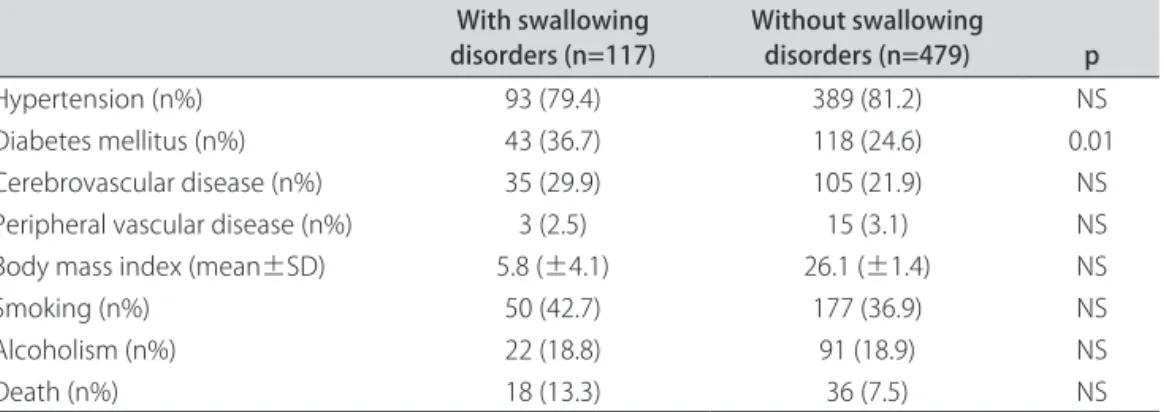
Regarding the risk factors analyzed in the group of patients with swallowing disorders, 36.7% of these pa-tients presented diabetes mellitus, which was statistically signiicant (p=0.010), 29.9% presented cerebrovascular disease, 7% were smokers and 13.3% died (Table 2).
Regarding the topography of the neurological injury, 6.8% of the patients had brainstem lesions and this was signiicantly greater (p≤0.001) for the group with swal-lowing disorders (Table 3).
he search for predictors for swallowing disorders, using logistic regression, revealed that age, stroke in the brainstem region and diabetes mellitus acted as predic-tors for swallowing disorders. he relative risks and their conidence intervals are shown in Table 4.
Table 1. Sociodemographic data.
With swallowing disorders Without swallowing disorders p
n (%) 117 (19.7) 479 (80.33)
Gender n (%) NS
Male 59 (50.5) 238 (49.6)
Female 58 (49.5) 241 (50.3)
Age (mean±SD) 65.3 (±11.7) 61.2 (±12.2) <0.001
Schooling n (%) NS
0-4 years 77 (65.8) 316 (65.9)
5-8 years 20 (17.1) 85 (17.7)
9-12 years 14 (11.9) 60 (12.5)
>12 years 6 (5.1) 16 (13.3)
Descriptive statistical analysis and t test. NS: not signiicant; SD: standard deviation.
Table 2. Analysis on risk factors and deaths in the group presenting swallowing disorders.
With swallowing
disorders (n=117) Without swallowing disorders (n=479) p
Hypertension (n%) 93 (79.4) 389 (81.2) NS
Diabetes mellitus (n%) 43 (36.7) 118 (24.6) 0.01
Cerebrovascular disease (n%) 35 (29.9) 105 (21.9) NS Peripheral vascular disease (n%) 3 (2.5) 15 (3.1) NS Body mass index (mean±SD) 5.8 (±4.1) 26.1 (±1.4) NS
Smoking (n%) 50 (42.7) 177 (36.9) NS
Alcoholism (n%) 22 (18.8) 91 (18.9) NS
Death (n%) 18 (13.3) 36 (7.5) NS
Descriptive statistical analysis and t test. NS: not signiicant; SD: standard deviation.
Table 3. Topography of lesion in the group presenting swallowing disorders.
With swallowing
disorders (n=117) Without swallowing disorders (n=479) p
Right hemisphere (n%) 46 (39.3) 185 (38.6) NS
Left hemisphere (n%) 47 (40.1) 218 (45.5) NS
Multiple (n%) 10 (8.5) 42 (8.6) NS
Brainstem (n%) 8 (6.8) 13 (2.6) 0.022
Cerebellum (n%) 4 (3.4) 23 (4.8) NS
Descriptive statistical analysis and t test. NS: not signiicant.
Table 4. Predictors for swallowing disorders.
Relative
risk Lower limit of 95% CI Upper limit of 95% CI
Age 1.03 1.01 1.05
Diabetes mellitus 1.70 1.25 2.15
Brainstem 2.59 1.61 3.57
Swallowing disorders occurred in 117 patients (19.6%), with mild disorders in 107 (91.5%) and severe disorders in 10 (8.5%). Spontaneous recovery occurred in 102 patients (87.3%). he time taken for spontaneous recovery to occur ranged from 1 to 16 months with an average of 2.4 months (SD=± 2.7).
DISCUSSION
Studies on the incidence of dysphagia after stroke are common because stroke is a neurological disorder that afects many people around the world, particularly those over 60 years of age. he risk factors of hypertension, diabetes mellitus and smoking, associated with stress and sedentary lifestyles, are the biggest cause of stroke. In most cases, stroke can lead to motor sequelae, func-tional disability and language deicit. Dysphagia can also occur, and the early symptoms depend on the location of the neurological injury. Studies have varied with regard to the time at which swallowing assessments are made (which may be from the acute to the chronic phase), the protocols used, the professionals who perform the eval-uation and the use of speciic tests for diagnosing swal-lowing diiculties.
In relation to gender, the sample was homogeneous and did not show any diferences. his was also found in other studies: in one with 1,581 patients, 51.1% were men; while in another with 400 patients, 52.2% were men. In a study with a smaller number (128 patients), 64% were male14-16.
he age of the patients who presented swallowing dis-orders averaged 65 years, which was in agreement with other studies, in which the greater number of swallowing disorders was found at the ages of 65 to 74 years4,14,17. An-other study found that greater age (≥70 years) was a pre-dictive factor for swallowing disorders10. We believe that the greater the age is, the greater the chances are that the aging body becomes phonoarticulatory (lips, tongue and cheeks), which would undermine the functions of the stomatognathic system (chewing, swallowing, respi-ration, voice and speech) and subsequently cause swal-lowing disorders, especially after stroke4,10,14,17.
he number of patients with an education level of be-tween 0 and 4 years (66.1%) was higher than the numbers in other educational levels. his was concordant with an-other study, in which 71.4% of the patient sample had a similar educational level, typical of a developing country like Brazil16.
Regarding risk factors, diabetes mellitus was a pre-dictor for swallowing disorders. Other studies in the liter-ature found that dysphagia, urinary incontinence and dia-betes mellitus were independent predictors for increased levels of infections after stroke. Most of the patients had hypertension, followed in frequency by diabetes
mel-litus, and smoking was in third place. These findings were similar to other studies on risk factors for stroke15,16.
he topography of lesions in patients with swallowing disorders was similar for the right and left hemispheres (39.3% and 40.1%). On the other hand, the small number of patients with lesions in both hemispheres (8.5%) was discordant with other studies, which showed that 51.8% of the patients with swallowing disorders had lesions in both hemispheres18, and that 63.6% had the largest lesion in the right hemisphere19.
Presence of brainstem lesions was predictive for swal-lowing disorders. Lesions in this region could afect the sensitivity of the oral cavity, tongue and cheeks, and could trigger swallowing disorders and laryngeal elevation20-23.
Swallowing disorders were found in almost 20% of the patients, according to a study on a large number of patients (n=1581). he incidence of dysphagia in that study (19.9%) was very similar to our indings15. However, the incidence of dysphagia may vary according to the time elapsed after the stroke, the severity of the stroke and the method of assessing the swallowing complaint and locating the lesion, i.e. by clinical means or by using instruments like videoluoroscopy or endoscopy. hus, studies have shown a range from 18 to 81%3-5,10,14,22.
Slight diiculty in swallowing was more frequently found (91.5%), and this was similar to a study conducted in Brazil, in which 70% of the patients showed a mild dis-order4. he explanation for our results is that our sample excluded severe cases and patients who had already been in hospital for more than 14 days. Such cases would be more likely to show abnormalities of swallowing. Our patients were seen at the clinic within 30 days after hos-pital discharge, which was in accordance with the litera-ture, which shows that swallowing disorders are greatest in severe stroke cases and in the acute phase of stroke13. Spontaneous recovery occurred in almost 90% of the sample, with an average time elapsed of two months. Only 12% did not recover and continued to have com-plaints relating to swallowing. These results were in agreement with other studies that showed that recovery of swallowing occurred over the irst few weeks after the event, and that swallowing disorders only remained in a small number of patients9,10,13,14. A study using functional magnetic resonance imaging among dysphagia patients showed that among patients who had recovered within a short period of time, cortical maps in the hemisphere not afected by stroke explained this as reorganization in the cortex5.
mal-nutrition. It is thus an independent sign of worse out-comes and increased mortality after stroke12,13. Recog-nizing this is extremely important for the performance of the speech therapy team in relation to stroke patients, in order to prevent and reduce hospital admissions and re-admissions due to aspiration pneumonia, thereby aiming to stabilize the nutritional characteristics and improve the patients’ quality of life24,25.
In conclusion, sallowing disorders after a stroke oc-curred in almost 20% of the population and the diiculty in swallowing was most frequently mild.
REFERENCES
1. Lotufo AP, Bensenor IM. Stroke mortality in São Paulo (1997-2003). Arq Neuropsiquiatr 2004;62:1008-1011.
2. Fukujima MM, Tatiani SB, Aguiar AS, et al. Transesophageal echocardiog-raphy discloses unexpected cardiac sources of embolus in stroke patients aged more than 45 years. Arq Neuropsiquiatr 2005;63:941-945. 3. Martino R, Foley N, Bhogal S, Diamant N, Speechley M, Teasell R.
Dysphagia after stroke, incidence, diagnosis, and pulmonary complications. Stroke 2005;36:2756.
4. Schelp AO, Cola PC, Gatto AR, Silva RG, Carvalho LR. Incidência de disfagia orofaríngea após acidente vascular encefálico em hospital público de referência. Arq Neuropsiquiatr 2004;62:503-506.
5. Singh S, Hamdy S. Dysphagia in stroke patients. Postgrad Med J 2006;82:383-391.
6. Perman AL. Dysphagia: populations at risk and methods diagnosis. Nut Clin Prat (Suppl) 1999;14:S2-S9.
7. Cook IJ, Kahrilas PJAGA. Techinical review on management of oropharyn-geal dysphagia. Gastroenterology 1999;116:456-579.
8. Carnaby G, Hankey GJ, Pizzi J. Behavioural intervention for dysphagia in acute stroke: a randomized controlled trial. Lancet Neurol 2006;5:31-37. 9. Ramsey DJC, Smithard DG. Early assessments of dysphagia and aspiration
and aspiration risk in acute stroke patients. Stroke 2003;34:1252. 10. Mann G, Hankey GJ. Initial clinical and demographic predictores of
swal-lowing impairment folswal-lowing acute stroke. Dysphagia 2001;16:208-215.
11. Silva RG. Disfagia neurogênica em adultos pós-acidente vascular ence-fálico: identificação e classificação. Dissertação de Mestrado, Universidade Federal de São Paulo, São Paulo 1997.
12. Paciaroni M, Mazzotta G, Corea F, et al. Dysphagia following stroke. Eur Neurol 2004; 51:162-167.
13. Smithard DG, O’Neill PA, Park C, Morris J, Wyatt R, England R. Complica-tions and outcomes after acute stroke. Stroke 1996;27:1200-1204. 14. Mann G, Hankey GJ, Cameron D. Swallowing function after stroke,
prog-nosis and prognostic factors at 6 months. Stroke 1999;30:744-748. 15. Roquer J, Campello AR, Gomis M. Sex differences in first-ever acute stroke.
Stroke 2003;34:1581-1585.
16. Shafaee MAA, Ganguly SS, Asmi ARA. Percepcion of stroke and knowl-edge of potential risk factores among Omani patients at increased risk for stroke. BMC Neurology 2006;6:38.
17. Ros L, García M, Prat J, et al. Predictors of nosocomial infection in acute stroke. Relation with morbimortality and outcome. Med Clin (Barc) 2007;128:441-447.
18. Parker C, Power M, Hamdy S, Bowen A. Awareness of dysphagia by patients following stroke predicts swallowing performance. Dysphagia 2004;19:28-35.
19. Daniels SK, Brailey K, Foundas AL. Lingual discordination and dysphagia follwing acute stroke:analyses os lesion localization. Dysphagia 1999; 14:85-92.
20. Veis SL, Logemann JA. Swallowing disorders in persons with cerebrovas-cular accident. Arch Phys Med Rehabil 1985;66:372-375.
21. Martino R, Terrault N, Ezerzer F, Mikulis D, Diamant NE. Dysphagia in a pa-tient with medullary syndrome: insight into the central control of swal-lowing. Gastroenterology 2001;121:420-426.
22. Barros AFF, Fabio SRC, Furkin AM. Correlação entre os achados clínicos da deglutição e os achados da tomografia computadorizada de crânio em pacientes com acidente vascular cerebral isquêmico na fase aguda da doença. Arq Neuropsiquiatr 2006;64:1009-1014.
23. Leder SB, Espinosa JF. Aspiration risk after acute stroke: comparison of clinical examination and fibroscopic evaluation of swallowing. Dysphagia 2002;17:214-218.
24. Padovani AR, Moraes AP, Mangili LD, Andrade CRF. Protocolo fonoaudi-ológico de avaliação do risco para disfagia (PARD). Rev Soc Bras Fonoaudiol 2007;12:199-205.