STRATEGIES USED BY CHILDREN WITH TYPICAL
AND ATYPICAL PHONOLOGICAL DEVELOPMENT DURING
THE BLOCKED SYLLABLE ACQUISITION
Estratégias adotadas por crianças com desenvolvimento fonológico
típico e atípico no domínio da sílaba travada
Carolina Lisbôa Mezzomo(1), Diéssica Zacarias Vargas(2), Roberta Freitas Dias(2)
(1) Programa de Pós-Graduação em Distúrbios da
Comunica-ção Humana da Universidade Federal de Santa Maria – UFSM, Santa Maria, RS, Brasil.
(2) Universidade Federal de Santa Maria – UFSM, Santa
Maria, RS, Brasil.
Source of research assistance: scholarship by Coordination for the Improvement of Higher Education Personnel – CAPES.
Research performed at Universidade Federal de Santa Maria, Speech-language Department
Conlict of interest: non-existent
planning, as well as phonological memory and auditory processing1.
Moreover, during this period of language acqui-sition, in order to acquire the sounds which are part of their environment’s language, the learner uses some repair strategies. These strategies are used as an attempt to adapt the performance of the target-system to their phonological target-system, simplifying their productions in a natural movement of adaptation of the output with their skills1,2.
The children with typical acquisition use these repair strategies for a certain period, according to
the characteristics of each phoneme1,2. However,
when the use of those strategies remain beyond the period of typical acquisition there is phonological disorder3,4.
INTRODUCTION
Since the beginning of their speech productions, children face a conlict between the adult target phonological system and the limitations about their abilities of categorization, articulation and motor
ABSTRACT
Purpose: to study the use of repair strategies by children with typical and atypical speech development through an analysis guided by the syllable from a target with simple coda. Methods: speech data from 24 children with typical speech development and from 12 children with atypical speech development were analyzed. The children’s ages were between 1:0 and 4:0 and between 4:1 and 7:0, respectively. The analyzed dependant variable included the following syllabic variants: syllable omission, coda omission, epenthesis, metathesis, and coalescence. The statistical analysis was accomplished
through the use of the Statistical Program VARBRUL. Results: it was possible to verify the use of
repair strategies such as coda omission, coalescence, epenthesis, and metathesis in the children with speech disorders. The group with typical speech development presented higher occurrence of syllable omission. The variable age was signiicant for coda omission. When observing the variable sex, the girls with atypical speech development seem to use repair strategies more frequently, while the boys omit coda more often. Both groups tend to preserve the word inal position. The extrametrical positions were more favorable for coda omission in the group with atypical speech acquisition. The post-stressed position is more favorable for coda omission and the stressed position is favorable for syllable omission in the group with typical development. Conclusion: the groups used different repair strategies during the blocked syllable acquisition. The group with typical acquisition prefers to omit the syllable, while the group with phonological disorders used the other analyzed repair strategies.
neurological, psychological or cognitive alterations. Besides, the parents and/or responsible for the children authorized, through Informed Consent term, the use of the speech samples of their children in researches about language and speech acquisition and development.
For both groups, it was performed speech-language screening, including speech-language, voice, orofacial motricity evaluation and auditory screening12. To collect the data, the used instrument
was the Children Phonological Assessment – CPA, through which it was possible to observe and to evaluate all present phonemes and syllables of Brazilian Portuguese8.
The investigated dependent variable included the following variants, without segmental precision:
correct production of the blocked syllable (porta
(door), pojta, polta); syllable omission (porta – [‘ta]), coda omission (porta – [´pta], epenthesis (porta - [p
´rota], metathesis (porta – [´pr ta] and coalescence (calça (pants) – [´ksa].
In this study, it will be referred data about the repair strategies, not the correct production of the blocked syllable.
The considered intervenient variables were:
• Age: age group from 1:0 to 3:11;29 for typical
data and from 4:0 to 6:11;29 for the atypical data, with intervals of six months.
• Gender: female and male.
• Tonicity: pretonic (carteira - wallet); tonic (carta - letter); post-tonic (garagem - garage).
• Number of syllables: monosyllables (mar -
sea); disyllables (colar - necklace); trisyllables (perfume); polysyllables (tartaruga - turtle).
• Precedent syllabic context: zero (carta – letter);
open syllable with simple onset (lápis - pencil);
open syllable with complex onset (pratos -
plates); blocked syllable with simple coda and simple onset (pastas - folders); blocked syllable
with simple coda and complex onset (fraldas -
diapers); blocked syllable with complex coda and simple onset (caixas - boxes); blocked syllable
with complex coda and complex onset (
trans-porte - transportation).
• Following syllabic context: zero (lor - lower);
open syllable with simple onset (arma - gun);
open syllable with complex onset (iltro - ilter);
blocked syllable with simple coda and simple
onset (também - also); blocked syllable with
simple coda and complex onset (compras -
shopping); blocked syllable with complex coda The blocked syllabic structure, formed by
consonants, is one of the last structures to be acquired during the period of language acquisition. It occurs because of its level of complexity. Based on performed studies, in Brazilian Portuguese, the acquisition of syllabic structures happens in the following order: V, CV > CVV à CVC à CCV5-7.
Regarding the acquisition of syllable struc-tures, the theoretical perspective from the natural phonology recognizes the following repair strat-egies: cluster reduction, omission of non-stressed syllable, omission of inal fricative, omission of inal liquid, omission of liquid between vowels, omission of initial liquid, metathesis and epenthesis8.
Several researches had the purpose of verifying the intervenient variables during the acquisition of the segment which is in the coda position, by children with typical phonological development4,9,10.
Considering the syllabic complexity of the blocked structure, it is believed that intervenient factors may
inluence the hold of this structure1,11. Those
inter-venient factors, which are detailed and exempliied in the method may be linguistic (tonicity, number of syllables, precedent phonological context, following phonological context, word position, complexity of the syllable onset, segmental complexity of the coda element, position of the (C)VC syllable in relation to the metrical foot, type of phonological development) and extralinguistic (gender and age).
However, such aspects were not investigated yet, because researches focus mainly the study of segmental acquisition, not syllabic acquisition. Because of this, it is important to perform this study, which has the purpose of studying and comparing how children with typical and atypical phonological development use repair strategies through a syllable
guided analysis (phonology and acquisition basic
unit) in targets with simple coda.
METHODS
The speech data of the sample were selected from two data bases of a university. The research projects were approved by the Research Ethics Committee, n. 052/2004 and 064/2004.
atypical development. These words are related to the blocked syllable production, which were catego-rized through a form at Microsoft Access. Then, it was performed an analysis through the Statistical program VARBRUL in Windows environment – Varbwin, with 5% margin of error. The VARBRUL performs probabilistic analysis in binary way, designating relative weighs (probability). The relative weighs or probabilities of repair strategies occurrence regarding blocked syllables come from statistical interaction. Values with relative weigh under .50 ware considered as unfavorable to the analyzed item, probability numbers from .50 to .59 were considered as neutral and values equal or above .60 were considered as favorable.
RESULTS
The results obtained through this study showed that there is higher frequency of use of repair strategies such as coda omission, metathesis and syllable omission by children with phonological disorder. About the group with typical phonological acquisition, it was detected higher frequency of coda and syllable omission.
• Onset complexity in the syllable: complex onset
(fralda - diaper); simple onset (pasta - folder); syllable without onset (erva - herb).
• Segmental complexity of the coda element:
nasal (doente - sick); lateral (talco - talc); non lateral (carne - meat); fricative (espera - wait).
• Position of the (C)VC syllable in relation to the metric foot: extrametrical syllable ((ar.vo)<res>
- trees); extrametrical ((la.pi<s>) - pencil); head
of the metrical foot ((por.ta) - door); out of the metric foot (esco(var) - brush).
• Type of phonological development: typical or
phonological disorder.
It is useful to emphasize that in Brazilian Portuguese (BP), the metrical foot refers to the way the accents are attributed. Authors refer that the BP presents a syllable-timing, which is a binary foot with the head (strong syllable of the foot) with predominance to the left. The paroxytone pattern accent in BP is presented by the metrical foot and this mapping occurs from the right to the left, and it can be sensitive to the syllabic weigh13.
It was obtained a corpus with 2029 words, 1033 from the typical development and 996 from the
*Statistical analysis: Statistical program VARBRUL (p< 0.05) **For this study, the correct production was not considered
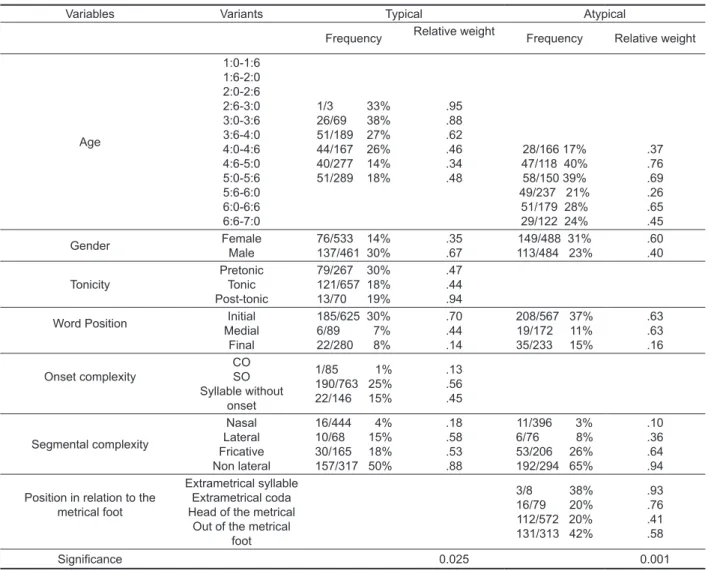
favorable – from 1:0 to 2:6, while in the group with atypical development the intermediate age groups – 4:6 to 5:6 – are the most susceptible to coda omission (Table 1).
Besides, when analyzing the extralinguistic variables which inluenced the coda omission, it was perceived that in the group with typical phono-logical acquisition the initial age groups are the most
Table 1 – Selected variables in the strategy coda omission
Variables Variants Typical Atypical
Frequency Relative weight Frequency Relative weight
Age 1:0-1:6 1:6-2:0 2:0-2:6 2:6-3:0 3:0-3:6 3:6-4:0 4:0-4:6 4:6-5:0 5:0-5:6 5:6-6:0 6:0-6:6 6:6-7:0
1/3 33% 26/69 38% 51/189 27% 44/167 26% 40/277 14% 51/289 18%
.95 .88 .62 .46 .34 .48 28/166 17% 47/118 40% 58/150 39% 49/237 21% 51/179 28% 29/122 24%
.37 .76 .69 .26 .65 .45 Gender Female Male
76/533 14% 137/461 30%
.35 .67
149/488 31% 113/484 23%
.60 .40 Tonicity Pretonic Tonic Post-tonic
79/267 30% 121/657 18% 13/70 19%
.47 .44 .94
Word Position MedialInitial
Final
185/625 30% 6/89 7% 22/280 8%
.70 .44 .14
208/567 37% 19/172 11% 35/233 15%
.63 .63 .16
Onset complexity COSO Syllable without
onset
1/85 1% 190/763 25% 22/146 15%
.13 .56 .45 Segmental complexity Nasal Lateral Fricative Non lateral
16/444 4% 10/68 15% 30/165 18% 157/317 50%
.18 .58 .53 .88
11/396 3% 6/76 8% 53/206 26% 192/294 65%
.10 .36 .64 .94
Position in relation to the metrical foot
Extrametrical syllable Extrametrical coda
Head of the metrical Out of the metrical
foot
3/8 38% 16/79 20% 112/572 20% 131/313 42%
.93 .76 .41 .58
Signiicance 0.025 0.001
* Statistical analysis: Statistical program VARBRUL (p< 0.05)
In relation to the variable gender, girls with phonological disorders seem to use more repair strategies – coda omission – than boys with this impairment, because in the group with typical acqui-sition the boys are more favorable to the analyzed item (Table 1).
Regarding the variable tonicity, this item was selected only for the group with typical acquisition, with the post-tonic position as favorable for coda omission.
In relation to the onset complexity, only for the group with typical acquisition the structure simple onset was the most favorable for coda omission. About segment complexity, the nasals and laterals were the most preserved in both groups. They were less probable to be omitted, with low relative weighs (Table 1).
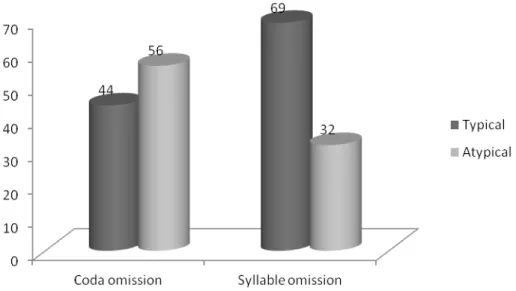
omission, while the tonic position is favorable for syllable omission. Moreover, for syllable omission the age was a relevant factor for the group with typical acquisition, and the initial age groups (1:6 to 2:6) are the most favorable for this item (Table 2). inluences of the studied variables, as it is observed
in Figure 2.
The variable tonicity was selected only for the group with typical phonological development. The post-tonic position is favorable for the coda
* Statistical analysis: Statistical program VARBRUL (p< 0.05)
Figure 2 – Probability of occurrence of coda omission and syllable omission
Table 2 – Variables selected in the repair strategy syllable omission
Variables Variants Typical Atypical
Frequency Relative weight Frequency
Age
1:0-1:6 1:6-2:0 2:0-2:6 2:6-3:0 3:0-3:6 3:6-4:0 4:0-4:6 4:6-5:0 5:0-5:6 5:6-6:0 6:0-6:6 6:6-7:0
0/3 0% 6/28 21% 4/50 8% 2/54 4% 1/84 1% 0/297 0%
-.92 .59 .57 .22
-2/167 1% 0/118 0% 2/155 1% 0/240 0% 0/183 0% 0/125 0%
Tonicity
Pretonic Tonic Post-tonic
11/125 9% 2/91 2% 0/72 0%
.14 .92
-3/305 1% 0/625 0% 1/66 2%
Position in relation to the metrical foot
Extrametrical syllable Extrametrical coda
Head of the metrical Out of the metrical foot
0/6 0% 0/67 0% 1/91 1% 12/125 10%
-.02 .95
1/8 13% 0/82 0% 0/588 0% 3/318 1%
Signiicance 0.038
Agreeing with the literature1, the fricative and
non-lateral liquids sound classes are the most favorable for coda omission in phonological disorders. In the group with typical acquisition, only the non-lateral liquid was favorable for this item.
Regarding the metrical foot, this variable was selected only for the group with phonological disorders, in which it was detected that the extra-metrical positions are the most favorable for coda omission, agreeing with studies performed with subjects with verbal dyspraxia, in which the head of the metrical foot also tends to be preserved20,21.
In relation to the syllable omission, some items were similar to the coda omission, such as the age, which also inluences the group with typical acqui-sition, acting in a similar way. In this case, the initial age groups are the most favorable for omission4,10.
It disagrees with literature4-5,22,23, in which the
syllable that presents the accent in Brazilian Portuguese usually favors the articulatory precision because of stronger acoustical characteristics. In this study, the tonic syllable was favorable for syllable omission in the group with typical acquisition. In relation to the metrical foot for the same group, the “head” was preserved, because it is unfavorable for syllable omission, while the syllable which is out of the metrical foot was favorable for omission.
Besides, as it is observed in igure 2, it was veriied that there is higher probability that the group with typical acquisition omits the syllable, while the group with atypical acquisition favors coda omission. It may happen because individuals with typical acquisition belong to initial age groups, omitting the syllable, while the subjects with disorders, because they are older, they express better phonological knowledge24,25 when they preserve the syllable and
omit the coda.
The results of this research may help the diagnosis between the groups, because there were differences between the strategies used by children with typical and atypical acquisition. Moreover, the indings from this study may help the choice of targets to be worked in Speech-language therapy, shortening the time of treatment. It must be emphasized the individual variability, as the data presented in this study used with care in evaluation and speech-language therapy. Also, this study is restricted to the variant spoken in the south of Brazil. Other researches should be performed in different parts of the country.
CONCLUSION
DISCUSSION
In Figure 1 it was possible to verify that there are similar repair strategies used by the group with typical as by the group with atypical acqui-sition. It agrees with literature which mentions that it is possible observe similar strategies for both groups14,15.
Regarding the repair strategy coda omission, it was detected that the age is statistically signiicant for this item. The group with typical acquisition in the initial age groups is the most favorable and also the group with phonological disorders in inter-mediate age groups. These results seem to agree with literature, because the probability of using coda is higher as children get older. Some transitory decreases are possible during its production4,10.
Besides, the variable gender also inluences the coda omission, because in phonological disorder girls are more susceptible to use this repair strategy. This fact agrees with studies in which boys with phonological disorders presented better results in metalinguistic abilities16,17. In the group with typical
acquisition, boys are more favorable for coda omission, what agrees with a study in which boys with typical phonological development presented a tendency of phonological precision, with higher probabilities of coda correct production10.
The syllable tonicity favors the completion of the coda position, by the segments which may occupy such position in typical phonological development4,9,
agreeing with data obtained in this study about coda omission, because for this same group the tonic syllable is the most preserved for this item.
About word position, the initial positions in both groups are the most favorable for coda omission, agreeing with other studies, because even for the coda acquisition, the inal position is irst acquired because it is a more salient and marked structure18,19.
According to the results obtained in this study, this position tends to be more preserved as well.
In relation to onset complexity in the group with typical acquisition, the structure simple onset was the most favorable for coda omission, agreeing with literature, because this is one of the irst structures to be acquired5,7. As the nasal as the lateral sound
female gender favors this same item for the group with atypical acquisition.
Also about coda omission, the tonicity inlu-ences the group with typical acquisition and the tonic syllable is the most preserved, as well as the metrical foot is signiicant for the group with atypical acquisition. In this case, the extrametrical syllables are the most favorable for coda omission. The segmental complexity acts in a similar way for both groups, because the non-lateral liquid is the most favorable for coda omission.
In relation to syllable omission, the variables were signiicant only for the group with typical acquisition.
It shows that this speech pathology may be characterized more as a medium disorder of phono-logical development than as a linguistic disorder. compared with children with phonological disorders
through an analysis guided by the syllable. While there is higher probability that the group with typical acquisition omits the syllable, the group with atypical acquisition presents more signiicant probability of omitting the coda.
Besides, for coda omission, the extralinguistic variables such as gender and age inluence the groups in a different way, because in the group with typical phonological acquisition the most preco-cious ages (1:0 to 2:6) are the most favorable for coda omission, and in the group with atypical development the intermediate age groups (4:6 to 5:6) are the most favorable for this same item. About the variable gender, it acts differently in both groups, while the male gender is favorable of coda omission for the group with typical acquisition, the
RESUMO
Objetivo: estudar o uso das estratégias de reparo em crianças com desenvolvimento fonológico
típico e atípico mediante uma análise guiada pela sílaba no alvo com coda simples. Métodos: foram
analisados dados de fala de 24 crianças com aquisição fonológica típica e 12 com desenvolvimento atípico, com idades entre 1:0 a 4:0 e 4:1 a 7:0, respectivamente. A variável dependente investigada incluiu as seguintes variantes silábicas: omissão da sílaba, omissão da coda, epêntese, metátese e coalescência. Por meio do Pacote Computacional VARBRUL realizou-se a análise estatística dos
dados, com margem de erro de 5%. Resultados: veriicou-se o uso das estratégias de reparo como
omissão da coda, coalescência, epêntese e metátese, nas crianças com desvio. Já no grupo com
aquisição típica veriicou-se maior ocorrência da omissão da sílaba. Para a omissão da coda, a
variá-vel idade foi signiicante. Quanto ao sexo, as meninas com desvio fonológico parecem utilizar mais estratégias de reparo, enquanto no grupo com aquisição típica os meninos parecem omitir mais a coda. A posição inal da palavra tende a ser mais preservada em ambos os grupos. As posições
extra-métricas são as mais favoráveis para omissão da coda no grupo com aquisição atípica. A posição
postônica é a mais favorecedora à omissão da coda e a tônica favorece a omissão da sílaba no grupo
com aquisição típica. Conclusão: os grupos utilizam diferentes estratégias de reparo na aquisição
da sílaba travada. O grupo com aquisição típica prefere omitir a sílaba já o grupo desviante utiliza as demais estratégias de reparo investigadas.
Dissertação (Mestrado em Letras) - PPGDCH, UFSM, Santa Maria, 2009.
12. Barrett KA. Triagem auditiva de escolares. In: KATZ, J. Tratado de Audiologia Clínica. 4. ed. São Paulo: Manole, 1999. cap. 31, p.472-85.
13. Bisol L. O acento e o pé binário. Letras de Hoje. In: Fonologia: Análises não-lineares. Letras de Hoje. 1994;29(4):25-36.
14. Ferrante C, Van Borsel J, Pereira MMB. Análise dos processos fonológicos em crianças com desenvolvimento fonológico normal Rev Soc Bras Fonoaudiol. 2009;14(1):36-40.
15. Ghisleni MRL, Keske-Soares M, Mezzomo CL. O uso das estratégias de reparo, considerando a gravidade do desvio fonológico evolutivo. Rev CEFAC (Impresso). 2010;12:766-71.
16. Dias RF, Melo RM, Mezzomo CL, Mota HB. Variáveis extralinguísticas, sexo e idade, na consciência do próprio desvio de fala. Pró-Fono R Atual. Cient. 2010;22(4):439-44.
17. Souza APR, Pagliarin KC, Ceron MI, Deuschle VP, Keske-Soares M. Desempenho por tarefa em consciência fonológica: gênero, idade e gravidade do desvio fonológico. Rev CEFAC. 2009;11(4):571-8. 18. Mezzomo CL. Aquisição da coda no português brasileiro: uma análise via teoria de princípios e parâmetros, 2003 [Tese]. Porto Alegre: Programa de pós-graduação em letras, Pontifícia Universidade Católica do Rio Grande do Sul, 2003.
19. Rigatti AP, Fonseca RP, Ramos APF. Aquisição normal e desviante do rótico alveolar simples em dois dialetos do português brasileiro. Pró-Fono R Atual. Cient. 2001;13(2):157-64.
20. Rechia IC, Souza APR, Mezzommo CL. Processos de apagamento na fala de sujeitos com dispraxia verbal. Rev CEFAC. 2010;12:421-6. 21. Rechia IC, Souza APR, Mezzomo CL, Moro MP. Processos de substituição e variabilidade articulatória na fala de sujeitos com dispraxia verbal. Rev Soc Bras Fonoaudiol. 2009;14(3):547-52. 22. Keske-Soares M; Mota HB; Pagliarin KC; Ceron MI. Estudo sobre os ambientes favoráveis à produção da líquida não-lateral /r/ no tratamento do desvio fonológico. Rev Soc Bras Fonoaudiol. 2007;12(1):48-54.
23. Gonçalves GF, Keske-Soares M, Checalin, MA. Estudo do papel do contexto linguístico no tratamento do desvio fonológico. Rev Soc Bras Fonoaudiol. 2010;15(1):96-102.
24. CIELO CA. Habilidades em Consciência Fonológica em Crianças de 4 a 8 anos de Idade. Pró-Fono R Atual. Cient. 2002;14(3):301-12.
REFERENCES
1. Lamprecht RR, Bonilha GFG, Freitas GCM, Matzenauer CLB, Mezzomo CL, Oliveira CC, Ribas LP. Aquisição Fonológica do Português: Peril de desenvolvimento e subsídios para terapia. Artmed: Porto Alegre, 2004.
2. Mota HB; Silva APS; Mezzomo CL. Mudanças fonológicas na terapia de sujeitos com desvio fonológico utilizando ‘contraste’ e ‘reforço’ do traço [voz]. Letras de Hoje. 2008;43(3):7-14.
3. Grunwell P. Os desvios fonológicos evolutivos numa perspectiva linguística. In: Yavas M, organizador. Desvios fonológicos em crianças: teoria, pesquisa e tratamento. Porto Alegre: Mercado Aberto; 1990. p.53-77.
4. Mezzomo CL, Mota HB, Dias RF, Giacchini V. Fatores relevantes para aquisição da coda lexical e morfológica no português brasileiro. Rev. CEFAC. 2010;12(3):412-20.
5. Mezzomo CL. Aquisição dos fonemas na posição de coda medial do português brasileiro, em crianças com desenvolvimento fonológico normal. Letras de Hoje. 2001;36(125):707-14.
6. Keske-Soares M, Blanco APF, Mota HB. O desvio fonológico caracterizado por índices de substituição e omissão. Rev Soc Bras de Fonoaudiol. 2004; 9(1):10-8.
7. D’Angelis WR. Sistema fonológico do Português: rediscutindo o consenso. DELTA. 2008;18(1):1-24. 8. Yavas M, Hernandorena CLM, Lamprecht RR. Avaliação fonológica da criança. Porto Alegre: Artes Médicas, 1991.
9. Mezzomo CL, Baesso JS, Athayde ML, Dias RF, Gicchini V. O papel do contexto fonológico no desenvolvimento da fala: implicações para a terapia dos desvios fonológicos evolutivos. Letras de Hoje. 2008;43(3):15-21.
10. Athayde ML, Baesso JSB, Dias RF, Giacchini V, Mezzomo CL. O papel das variáveis extralinguísticas idade e sexo no desenvolvimento da coda silábica. Rev Soc Bras Fonoaudiol. 2009;14(3):293-9. 11. Baesso, J. O uso de estratégias de reparo nos constituintes coda e onset complexo por crianças com aquisição fonológica normal e desviante 2009.
Received on: November 08, 2011 Accepted on: January 24, 2013
Mailing address:
Diéssica Zacarias Vargas