Adsorption in a Fixed-Bed Column and
Stability of the Antibiotic Oxytetracycline
Supported on Zn(II)-[2-Methylimidazolate]
Frameworks in Aqueous Media
Janine dos Santos Ferreira da Silva1☯*, Daniel López Malo1☯, Giovana Anceski
Bataglion2‡, Marcos Nogueira Eberlin2‡, Célia Machado Ronconi3‡,
Severino Alves Júnior1☯, Gilberto Fernandes de Sá1☯
1Departamento de Química Fundamental, Universidade Federal de Pernambuco, Recife, Pernambuco, Brasil,2Instituto de Química, Universidade Estadual de Campinas, Campinas, São Paulo, Brasil,3Instituto de Química, Universidade Federal Fluminense, Nitéroi, Rio de Janeiro, Brasil
☯These authors contributed equally to this work.
‡These authors also contributed equally to this work.
Abstract
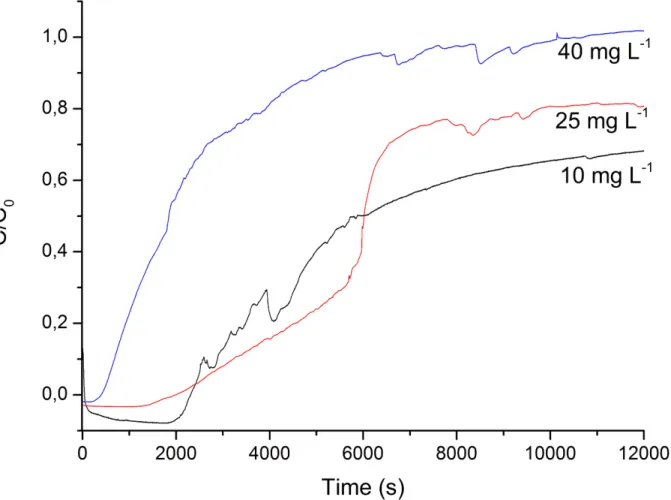
A metal-organic framework, Zn-[2-methylimidazolate] frameworks (ZIF-8), was used as ad-sorbent material to remove different concentrations of oxytetracycline (OTC) antibiotic in a fixed-bed column. The OTC was studied at concentrations of 10, 25 and 40 mg L-1. At 40
mg L-1, the breakthrough point was reached after approximately 10 minutes, while at 10 and
25 mg L-1this point was reached in about 30 minutes. The highest removal rate of 60% for
the 10 mg L-1concentration was reached after 200 minutes. The highest adsorption
capaci-ty (28.3 mg g-1) was attained for 25 mg L-1of OTC. After the adsorption process, a band
shift was observed in the UV-Vis spectrum of the eluate. Additional studies were carried out to determine the cause of this band shift, involving a mass spectrometry (MS) analysis of the supernatant liquid during the process. This investigation revealed that the main route of adsorption consisted of the coordination of OTC with the metallic zinc centers of ZIF-8. The materials were characterized by thermal analysis (TA), scanning electron microscopy (SEM), powder X-ray diffraction (XRD), and infrared spectroscopy (IR) before and after ad-sorption, confirming the presence of OTC in the ZIF-8 and the latter’s structural stability after the adsorption process.
Introduction
Studies of environmental impacts caused by chemical pollution usually focus on conventional pollutants such as dyes, heavy metals and carcinogenic substances [1–4]. However, several tons of pharmaceutical drugs are synthesized every year for human and veterinary use, and are con-sidered contaminants of emerging concern [5–7]. Although the toxic effects of drugs have not
a11111
OPEN ACCESS
Citation:dos Santos Ferreira da Silva J, López Malo D, Anceski Bataglion G, Nogueira Eberlin M, Machado Ronconi C, Alves Júnior S, et al. (2015) Adsorption in a Fixed-Bed Column and Stability of the Antibiotic Oxytetracycline Supported on Zn(II)-[2-Methylimidazolate] Frameworks in Aqueous Media. PLoS ONE 10(6): e0128436. doi:10.1371/journal. pone.0128436
Academic Editor:Andrew C Singer, NERC Centre for Ecology & Hydrology, UNITED KINGDOM
Received:December 8, 2014
Accepted:April 27, 2015
Published:June 9, 2015
Copyright:© 2015 Silva et al. This is an open access article distributed under the terms of the
Creative Commons Attribution License, which permits unrestricted use, distribution, and reproduction in any medium, provided the original author and source are credited.
Data Availability Statement:All relevant data are within the paper and its Supporting Information files.
Funding:The authors thank the Brazilian research funding agencies CNPq (National Council for Scientific and Technological Development) and INCT-INAMI (the National Institute of Science and Technology–Nanotechnology for Integrated
yet been fully investigated, various studies have shown that the accumulation of these sub-stances may interfere with the metabolism of aquatic organisms, resulting in an increase in bac-terial resistance and its potential risk to health [8–11].
Antibiotics deserve special attention because of their intensive use in human and veterinary medicine and in agriculture [12–14]. The antibiotic oxytetracycline (OTC) belongs to the class of tetracyclines and its mechanism of action is the inhibition of bacterial protein synthesis [15]. OTC is being prescribed for diseases such as sinusitis, bronchitis, cholera, acne, urinary tract infections, leptospirosis, relapsing fever, and others.
The human body absorbs from 60 to 80% of oxytetracycline [16]. This drug is considered the most important Antibiotic Growth Promoter, used in animal breeding programs and is often found at fish farms and swine feeding facilities [17–20]. One concern is that a consider-able fraction of 20 to 90% is not absorbed by the animal and is excreted unaltered [17].
Antibiotics enter aquatic environments through industrial wastewater that passes unaltered through treatment facilities and sewage treatment plants, since conventional techniques such as chemical coagulation, sedimentation, digesters, and other disinfection techniques have limit-ed ability to remove variety drugs [21,22].
A strategy to remove antibiotics from effluents at sewage treatment plants, after a traditional treatment is to include a solid phase adsorption step. Recently, the use of bamboo charcoal to adsorb tetracycline and chloramphenicol in aqueous solutions has been reported [23].
A new route using inorganic porous materials which is under development involves the so-called“three dimensional coordination networks,”also known as“Metal Organic Frameworks”
(MOFs), which are polymeric networks of metallic centers with organic ligands [24–26]. Their stability in water, large surface area and accessible pore structure are properties that indicate the suitability of MOFs as good adsorbent materials in aqueous media [27,28].
The use of some Metal Organic Frameworks has already proved effective in removing pol-lutants from wastewaters. MOF-235, iron terephthalate, has been used in the adsorptive re-moval of methyl orange and methylene blue from aqueous solutions [29]. The MOF MIL-53 (Al) is considered an efficient adsorbent for the removal of nitrobenzene from aqueous solu-tions [30]. The MOF MIL-101(Cr) was applied successfully in the adsorption of xylenol orange [31]. And the MOFs MIL-101(Fe), MIL-100 (Fe), HKUST-1([Cu3(TMA)2(H2O)3]n) and
MIL-100(Cr) have been studied for the adsorption of drugs in wastewater [32,33].
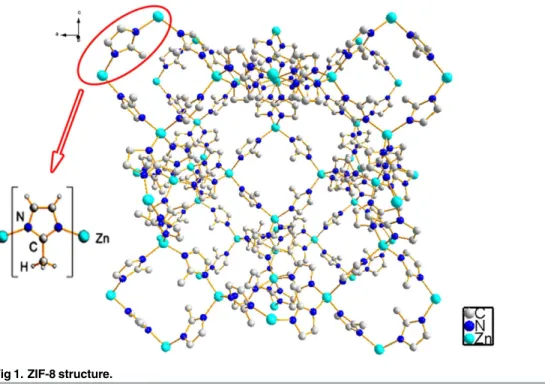
The MOF used in this work belongs to the family of Zeolitic Imidazolate Frameworks (ZIF) [34,35]. Specifically, this group possesses tetrahedral metal centers, commonly Zn (II) or Co (II), which are coordinated by nitrogen atoms in positions 1 and 3 of the ligand imidazolate, C3N2H3-. ZIF materials combine the thermal stability of zeolites with the broad structural
di-versity, harmony, and pore size congruence of Metal Organic Frameworks [36,37]. The ZIF-8 [34] used in this study consisted of Zn (II) metal centers coordinated by the ligand
2-methylimidazole (Fig 1).
Conspicuously, MOFs coordinated by the ligand imidazolate exhibit network topologies cor-responding to the sodalite type zeolites that are widely employed as successful adsorbent materi-als [38,39]. Zeolitic Imidazolate Frameworks number 8 offers high porosity, vast surface area and good stability in water [33,35,36,37,40]. All these properties make ZIF-8 an effective aque-ous adsorbent material. Furthermore, this material has recently shown good interaction with tetracycline antibiotics in chromatographic analysis as a solid phase adsorbent material [41].
The present work involved a study of the fixed-bed column adsorption process of the antibi-otic oxytetracycline in an aqueous medium, using the coordination network ZIF-8 as adsorbent material. The material was characterized after the adsorption process in order to identify the adsorption mechanism, and the possible degradation of both OTC and ZIF-8 was analyzed by mass spectrometry.
Education) for a fellowship granted to D.L.M. The funders had no role in study design, data collection and analysis, decision to publish, or preparation of the manuscript.
Materials and Methods
Reagents and experimental apparatus
All the reagents used here were analytically pure unless stated otherwise. Solutions were pre-pared in water purified by reverse osmosis and then deionized (18MOcm) with a Milli-Q gradi-ent Millipak 40.
ZIF-8 acquired from BASF (Aldrich) under the commercial name Basolite Z1200 was used with no previous treatment. Its BET surface is 1300–1800 m2g-1, particle size 4.9μm, pore size 0.6 nm, physical density without guest molecules is 0.95 g cm-1, porosity 58.8% and the pore
volume is 0.663 cm3g-1. [36,40].
The oxytetracycline hydrochloride C22H24N2O9.HCl, (95% purity), HPLC grade was
sup-plied by Aldrich.
Other chemicals employed were HCl (Vetec), NaOH (Dinâmica) to adjust the pH, metha-nol (Dinâmica), acetonitrile (Cromoline), MgSO4(Vetec), and Al(NO3)3(Vetec) for the
desorption process.
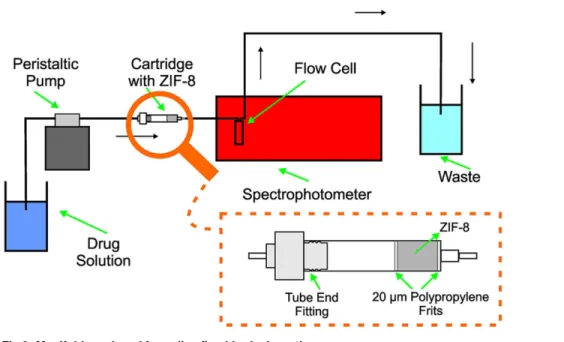
The pH of the solutions was measured with the aid of a Quimis Q400MT pH meter. The adsorption studies were performed in columns using the flow manifold depicted in
Fig 2. The apparatus consisted of a Gilson MINIPULS 3 peristaltic pump with Tygon pump tubing (Worthington, OH, USA), which delivered the drug solution to the adsorbent material placed in an empty 1 mL Agilent Bond Elut solid phase extraction cartridge attached to a low-pressure tube end fitting. Finally, the apparatus was connected to an Ionlab Q-76 quartz flow cell and placed in a Perkin Elmer Lambda 650 spectrophotometer. All the connections were made with 0.8 mm i.d. PTFE coil.
Fig 1. ZIF-8 structure.
Procedures
Preparation of standards
Standard solutions of oxytetracycline were prepared by weighing the exact amount of antibiotic for 10, 25 and 40 mg L-1solutions, which was dissolved in deionized water with the aid of an
ul-trasonic bath. The solutions had a pH of 4.3.
During the adsorption process, the oxytetracycline concentration was determined from the absorbance at 353.35 nm with the aid of an external calibration curve with standard solutions (0.1–40 mg L-1).
Fixed-bed column adsorption process
Fifty mg of ZIF-8 were placed in the solid phase extraction cartridge for all the adsorption as-says. The internal diameter of the cartridge was 5.75 mm and after being filled with the adsor-bent material had a height of 11 mm.
The oxytetracycline solution was passed through the manifold (Fig 3) for 200 minutes at a flow rate of 0.5 mL min-1. The assays were performed at room temperature (~25°C).
To evaluate the adsorption of the fixed-bed column, breakthrough curves were studied by plotting the relative amount of antibiotic eluted (C/C0) as a function of time [42].
The total amount of antibiotic (qtotal) removed during the continuous flow was calculated
from the integrated area under the breakthrough curve described by the oxytetracycline con-centration removed (CR) as a function of time, as described inEq 1[43], where CRis the
con-centration of removed antibiotic (mg L-1) calculated from the difference between the initial
concentration of oxytetracycline in the effluent and the concentration of oxytetracycline in the equilibrium after a time t and Q is the flow rate (mL min-1).
qtotal ¼ Q
1000
ðttotal
0
CRdt ð1Þ
The total amount of adsorbate (mtotal), in mg, that passed through the column is given by Fig 2. Manifold employed for online fixed-bed adsorption.
Eq 2,
mtotal¼
Ci:Q:ttotal
1000 ð2Þ
where Ciis the initial concentration of the antibiotic solution and ttotalis the analysis time.
The percentage of removed antibiotic (%R) was calculated from the ratio of qtotalto mtotal
given byEq 3,
%R¼ qtotal mtotal
x100: ð3Þ
The amount of adsorbed material in the equilibrium state or adsorbent adsorption capacity qe
(mg of adsorbed antibiotic/g of adsorbent), and the equilibrium concentration of adsorbate, Ce
(mg L-1), were calculated using Eqs4and5, respectively,
qe¼ qtotal
m ð4Þ
where m is the mass of adsorbent expressed in g,
Ce¼
mtotal qtotal Vefluent
x1000 ð5Þ
Fig 3. Breakthrough curves of the continuous flow adsorption processes at the three tested OTC concentrations: 10, 25 and 40 mg L-1.
Characterization of ZIF-8 before and after the adsorption process
Initially, both oxytetracycline and ZIF-8 were characterized prior to the adsorption process. After 24 hours of contact time by batch adsorption, consisting on adsorbent material in direct contact with a given volume of contaminant solution under agitation, until equilibrium was reached, with the purpose of a more homogeneous contact with the adsorbent. The resulting material was filtered, dried, and characterized by the techniques described below in order to study alterations in the structure of the adsorbing material and the oxytetracycline.
The process was performed at three oxytetracycline concentrations: 10, 25 and 40 mg L-1. A UV-Vis analysis indicated the absence of the drug in the supernatant solution.
Another batch adsorption assay was then performed using 20 mg of ZIF-8 and 50 ml of 25 mg L-1OTC solution for the mass spectrometry study. The OTC adsorption in MOF was
mon-itored using a first generation Synapt HDMS (High Definition Mass Spectrometry; Waters Corp., Manchester, UK). This mass spectrometer is equipped with an ESI source and has a hy-brid quadrupole/ion mobility/orthogonal acceleration time-of-flight geometry (oa-TOF).
Aliquots of the reaction mixture were collected after each given time, centrifuged, and the supernatant solution subjected to ESI (+). The conditions of this source were as follows: capil-lary voltage 3.0 kV, sample cone 30 V, extraction cone 3 V, source temperature 100°C, desolva-tion temperature 100°C, and desolvadesolva-tion flow rate 300 mL min-1of N2. For the MS
experiments, trap and transfer cells were operated at 6 and 4 V, respectively. For the MS/MS experiments, the ions of interest were selected in the quadrupole analyzer, fragmented in the transfer cell using argon as collision gas (the transfer energy was optimized for each ion of in-terest), and the product ions analyzed by TOF.
Physical Measurements
The samples were prepared on carbon tape on an aluminum support and coated with a 10–
20 nm gold film, using a Bal-Tec SCD 050 sputter coater. Images were recorded by a scanning electron microscope (Jeol JSM-5900 SEM) operating at a voltage of 15 KV, a 4.0 probe and a working distance of 18 to 24 nm. Diffractograms were recorded at room temperature in the range of 5° to 50° in a Rigaku 2400 DMAX X-ray diffractometer (XRD) with Cu Kα(0.15 nm).
The thermogravimetric analyses were performed in a Shimadzu DTG-60H analyzer in a N2
at-mosphere from room temperature to 800°C (10°C min-1). Vibrational spectra were obtained a
Bruker IFS 66v/S FTIR spectrometer in the range of 4000–400 cm-1.
Pore volume and surface area measurements were performed in a Micromeritics ASAP 2010 apparatus. About 100 mg of each sample was dried in an oven at 100°C for 12 h, before they were introduced in a quartz cell and attached to the physisorption apparatus. The sample was dried under vacuum at 100°C for 5 h. The BET surface area and pore volume were ob-tained by N2physisorption at 77.4 K.
Results and Discussion
Fixed-bed column adsorption process
A breakthrough curve was obtained for each tested oxytetracycline concentration, and the ab-sorbance was measured at one-second intervals for a total of 200 minutes after the fixed bed be-came saturated (Fig 3).
It was found that more than 5% of the initial concentration of oxytetracycline was adsorbed at the beginning of the adsorption process of the 40 mg L-1concentration, indicating that the breaking point was reached very quickly.
The total amount of OTC removed (qtotal) in 200 minutes in the different assays was
calcu-lated using the integration of the area under the curve described by the oxytetracycline concen-tration removed (CR) as a function of time, shown in theTable 1.
The breakthrough curve parameters were obtained using Eqs1to5given in the experimental section.
The removal of oxytetracycline using ZIF-8 varied from 20.7 and 60% for a period of 200 minutes of treatment depending on the initial OTC concentration. The lower OTC concentra-tions showed a better adsorption yield, using the same amount of adsorbent material and the same flow rate in all the assays.
Assays 1 and 2 resulted in a significant OTC removal rate in relation to the total mass of OTC that passed through the column (mt). Assay 3 showed a lower OTC removal rate, i.e.,
R(%) = 20.7, which can be explained by the high concentration of antibiotic used in this assay. However, OTC concentrations found in the environment and described in the literature [44,
45] are atμg L-1levels. Our purpose in using higher OTC concentrations was to achieve a
broader level of adsorbed antibiotic and to ensure proper adsorption at lower concentrations. After contact with ZIF-8, the pH of the eluate increased from 4.0 to 9.0. This increase may be attributed to an ion exchange with the medium. Oxytetracycline exists mainly as a zwitter-ion positively charged in the tertiary amine and negatively charge in the deprotonated hydroxyl group, which derives from intramolecular proton transfer [46] at pH levels of 4 to 8. This may be a determining factor in defining intermolecular and intramolecular interactions due to the influence of both pH and ionic strength.
Study of the possible degradation of oxytetracycline after contact with
ZIF-8
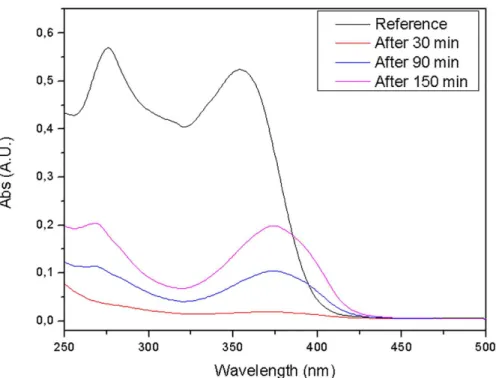
After the continuous flow adsorption process was completed, the UV-Vis absorption band of the eluate showed a wavelength shift of approximately 20 nm, with the wavelength of maxi-mum absorbance shifting from 353.35 to 374 nm, as shown inFig 4. Despite the band shift ob-served on the oxytetracycline absorption spectrum, the absorbance readings at fixed
wavelength were interpolated using the external calibration curve. Moreover, when the adsor-bent material is saturated, the stock solution concentration is found on the readings of the elu-ate, making sense operate this way.
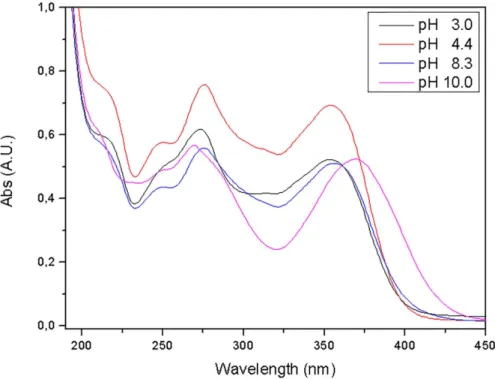
The Bathochromic band shift was studied by changing the pH of the oxytetracycline solu-tion. UV-VIS absorbance spectra were then recorded to establish a correlation between the in-crease in pH and the band shift of the antibiotic(Fig 5).
A direct correlation can be observed between the increase in the pH of the oxytetracycline solution and the band shift [47,48]. However, the magnitude of this shift was not the same as the one observed using ZIF-8.
Table 1. Breakthrough curve fixed-bed column adsorption parameters of the antibiotic OTC on ZIF-8.
Assay Ci(mg L-1) q
total(mg) mtotal(mg) R(%) qe(mg g-1) Ce(mg L-1)
1 10 0.60 1.0 60.0 12 4.0
2 25 1.42 2.5 56.6 28.3 10.8
3 40 0.83 4.0 20.7 16.6 31.7
Another batch adsorption process was performed to determine if the shift appears gradual-ly. Aliquots of the supernatant solution were collected and analyzed by UV-Vis at different times, i.e., 5, 20, 45, 60, 120 and 210 minutes. As can be seen inFig 6, the shift had already oc-curred at the 5 minute measurement, but no further shift was recorded after longer periods of contact with ZIF-8.
Another batch assay was performed to examine the interaction between zinc and the antibi-otic OTC. To this end, a solution of zinc acetate was mixed with 50 mL of a 25 mg L-1OTC
so-lution. The UV-Vis spectrum was then recorded and compared with the reference OTC solution. As can be seen inFig 7, a bathochromic band shift occurred from 353.35 to 374 nm, suggesting that the oxytetracycline molecules on coordination with the d orbitals of the Zn2+, form the ligand-to-metal charge-transfer (LMCT) coordination compound, during the adsorp-tion process [49].
In view of the results of the above described experiments, an MS analysis was performed to determine whether ZIF-8 was coordinating or degrading the antibiotic. Firstly, mass spectra were recorded of both ZIF-8 and oxytetracycline, whose characteristic ions are shown inFig 8.
The oxytetracycline mass spectra show ions corresponding to protonated molecules, sodium adducts and ions characteristic of NH3and H2O loss. Mass spectra of the ZIF-8 supernatant
suspension reveal the ion atm/z83, which is related to 2-methylimidazole (ligand of ZIF-8), and other unidentified ions.
After characterizing the OTC and ZIF-8, the adsorption process continued, with aliquots re-moved at 3, 5, 15, 30, 60, 90 and 120 minutes for ESI-MS analysis.
Fig 9shows representative mass spectra of two analyzed aliquots.
The mass spectra recorded during the adsorption process show the same ions as those ob-served in the oxytetracycline and ZIF-8, but no ions related to OTC degradation products were
Fig 4. UV-VIS absorption spectra of OTC reference solution (10 mg L-1) in deionized water and eluates collected at different contact times with ZIF-8 to study possible antibiotic degradation.
Fig 5. UV-Vis absorption spectra of OTC (25 mg L-1) in deionized water at different pH values.
doi:10.1371/journal.pone.0128436.g005
Fig 6. UV-Vis absorption spectra of OTC aliquots obtained in deionized water at different contact times with ZIF-8.
detected. Two new ions were observed at the onset of adsorption, the first one atm/z505 and the second atm/z569. The appearance of the ion atm/z505 is explained by the association of the deprotonated OTC [M–H] with sodium ions, [M–H + Na2]+. Eventually, OTC was also
co-ordinated by free zinc from ZIF-8, [M–H + Na2+ Zn]+, generating the corresponding ion at
m/z569, where the presence of zinc was confirmed by the isotopic pattern. The analysis of the next aliquots revealed a decrease in the intensity of the ions corresponding to the OTC, indicat-ing the occurrence of the adsorption process on ZIF-8. In addition, the ion atm/z569 disap-peared, probably due to the lower amount of OTC available for coordination in the solution. The MS analysis revealed the absence of degradation processes, suggesting that adsorption was the only phenomenon responsible for the decrease of oxytetracycline in solution. These as-sociations between OTC and Zn present in the coordination network are responsible for the band shift observed in the UV-Vis absorption spectra of the OTC eluates.
Antibiotics are electron rich compounds, while metallic ions are electron deficient. As for their chemical structure, the tetracycline group is composed of molecules with donor groups (N, O), which are good complexing agents [50]. The attraction between these species with op-posing signals makes them prone to interact, and the coordination compounds resulting from these interactions are usually quite stable [51–53]. The literature contains several reports about the coordination of antibiotics with a metal to overcome bacterial resistance; however, the use of coordination chemistry for the adsorption of pollutants in wastewater is an
innovative strategy.
The UV-Vis spectrum of the oxytetracycline solution reveals four absorption bands cen-tered at 360, 314, 265 and 218 nm. According to McCormick et al. [52], theπ-πtransition of the first ring of the tricarbonyl group containing the amine group contributes only to the 260 nm band. However, theπ-πtransition of the chromophore group that is present in the re-maining rings contributes to all the bands, particularly to the band centered at around 360 nm.
Fig 7. UV-Vis absorption spectra of OTC aliquots of reference and after contact with Zn(CH3COO)2for
24h.
Fig 8. ESI(+)-MS of (A) Oxytetracycline, and (B) suspension of ZIF-8 supernatant.
These transitions are sensitive to deprotonation and complexation, i.e., the addition of a coor-dinating metal noticeably changes the absorption spectrum.
In the work of McCormick et al. [54], the major modification involved in the absorption corresponded to the chromophore formed by benzene ring conjugated carbonyl and to enol
Fig 9. ESI(+)-MS of supernatant liquid aliquot: (A) after 3 minutes, and (B) after 120 minutes of contact between ZIF-8 and OTC.
present in oxytetracycline, which displayed a band shift from 354 to 374 nm. This suggests, therefore, the involvement of this chromophore in the OTC coordination with the Zn present in the ZIF-8 structure.
Characterization before and after the adsorption process
Infrared spectroscopy (IR). The intense stretching band in oxytetracycline is centered be-tween 3400 and 3300 cm-1due to the O–H from alcohol and phenolic groups. The C = O band partially overlaps the N–H band, which appears between 1640 cm-1and 1620 cm-1, appearing
as a small doublet. The characteristic aromatic ring vibrations appear at around 1450 cm-1, which is consistent with reports in the literature [55,56].
In the IR spectrum of ZIF-8 containing the 2–methyl–imidazole ligand, the N–H stretching band is visible at 3135 cm-1and the C
–H stretching bands of the methyl groups at 2929
(imid-azole aliphatic C–H) and 1307 cm-1. The band corresponding to C–N and C = N is located at 1457, 1423 and 1145 cm-1, and is displaced due to coordination with the metallic center. An
axial deformation is visible in the C = N band at 1576 cm-1. The absorption band at 421 cm-1is related to Zn–N stretching. The arrangement of the bands is in agreement with that expected
for the organic ligand, and similar results are reported in the literature [57].
After the adsorption process of oxytetracycline in ZIF-8, the resulting solids were analyzed by IR spectroscopy.Fig 10compares the above described starting materials, and the products obtained in the different adsorption processes. According to the IR spectra, the chemical bonds show no visible changes. A slight increase can be noted in the axial deformation if the C = N band at 1576 cm-1. With regard to the OTC, the OH band from 3100 cm-1to 3600 cm-1
Fig 10. Overlapped IR spectra of ZIF-8, OTC, and the product of adsorption at different tested concentrations.
disappeared, indicating deprotonation of the OH groups. The appearance of a new band at around 1300 cm-1may be due to the C–O-stretching band from OTC deprotonated oxygen atoms.
The IR spectra also showed no OTC carbonyl groups, and the amide band that appeared previously at 1630 cm-1(ν
C = O) was also missing in the product of the adsorption process,
in-dicating coordination with metallic ions [58].
Scanning Electron Microscopy (SEM). SeeS1 File.
Powder X-Ray Diffraction (XRD). Powder X-ray diffraction was performed to examine the sample’s crystallographic phases qualitatively, as well as to evaluate possible alterations in the ZIF-8 structure after its contact with oxytetracycline.
Fig 11shows the diffractograms of the ZIF-8 and the material resulting from the mixture of ZIF-8 and OTC at the concentrations of 10, 25 and 40 mg L-1compared with the diffractogram of ZIF-8. The XRD pattern of the ZIF-8, in which the presence of thin peaks indicates high crystallinity, is in good agreement with other studies reported in the literature [36,57,59]. All the diffractograms show the characteristic peaks of ZIF-8, although indications of the OTC structure at 2θ= 11.6° and 18.8° are visible.
Thermogravimetric analysis (TGA). The stability and thermal decomposition of the sam-ples were evaluated by TGA before and after the adsorption process.
The thermoanalytical profile of ZIF-8 displays a single step, which can be interpreted as the loss of the organic ligand, imidazolate, in a temperature range of 350 to 650°C. The ligand mass (minus a C atom) is 152 g mol-1, representing 66.4% of the total mass. The theoretical value is
in good agreement with the experimental data. The missing C is combined with zinc to form
Fig 11. Overlapping diffractograms of ZIF-8 and the different adsorption products after contact with OTC.
ZnC, generating a residual mass, after loss of the ligand, which corresponds to 33.6% of the molecular mass of ZIF-8.
The thermoanalytical profile of oxytetracycline hydrochloride shows a loss of HCl at about 100°C, which corresponds to 7.4% of the total mass and is in good agreement with the experi-mental loss of 7.424%. The remaining mass corresponds to the skeleton of OTC, 460 g mol-1,
Fig 12. TGA of (a) adsorption product after contact with 25 mg L-1 OTC, (b) OTC and (c) ZIF-8.
92.6% of the total mass. Decomposition was found to occur in two steps. This data is also con-sistent with the experimental result of 93.2%.
Fig 12shows the overlapping thermoanalytical profiles of OTC, ZIF-8 and the products of the adsorption process at 25 mg L-1concentration of OTC. The other thermoanalytical profiles are depicted in Figure D inS1 File. Note that the compound resulting from the adsorption pro-cess showed higher thermal stability that the starting materials. The thermal decomposition started at about 450°C. The acquired stability of these compounds is described in the literature on bioinorganic chemistry [51,52].
BET surface area analysis. Fig 13shows the N2sorption isotherms of ZIF-8, ZIF-8 + 10
mg L-1of oxytetracycline solution and ZIF-8 + 25 mg L-1of OTC solution performed at 77.4 K. Typical Type I isotherms were obtained for all samples, which reveal their microporous nature [60]. However, the behavior of the isotherms for values of P/P0>0.95 changes to Type IV, which suggests the existence of large pores due to intra agregate voids.
The surface area and pore volume from the N2adsorption isotherm of ZIF-8 are shown in Table 2. The BET and Langmuir surface area were 1745.4 and 1964.4 m2g-1, respectively, and
single point total pore volume = 0.720 cm3g-1. These results are in good agreement with the lit-erature [36].
ZIF-8 loaded with 10 and 25 mg L-1solutions of oxytetracycline showed a significant reduc-tion of the surface area and pore volume (Fig 13andTable 2, indicating an interaction between ZIF-8 and OTC molecules. The interesting structural features of ZIF-8, i.e. high surface area, large spherical cavities (11.8 Å), small apertures (3.4 Å) and structural flexibility make this ma-terial attractive for adsorption studies [36]. It has been revealed that ZIF-8 acts as a molecular sieve for xylene isomers [61]. Pirngruberet al. [61] showed thatpara-xylene, which the kinetic diameter (0.67 nm) is larger than the pore aperture (0.34 nm) of ZIF-8 can adsorb into it. Ap-parently, the pores open as a gate to allow the diffusion of the molecules into the cage of ZIF-8.
Fig 13. Nitrogen adsorption/desorption isotherms of (A) ZIF-8, (B) ZIF-8 + 10 mg L-1of OTC and (C)
ZIF-8 + 25 mg L-1of OTC.
Conversely, the adsorption ofortho-xylene (kinetic diameter = 0.74 nm) into the pores of ZIF-8 was insignificant and mainly occurred onto its external surface. Because OTC molecule is much larger thanortho-xylene, most likely OTC molecules are adsorbed onto the external sur-face of ZIF-8 instead of being inside of the pores.
Conclusions
In this study, a methodology was developed to minimize the amount of oxytetracycline in aquatic media using ZIF-8 as adsorbent material, and its performance was
considered satisfactory.
The adsorption process occurred by covalent bonding between the Zn metal present in the ZIF-8 and OTC, which resulted in a more stable compound than the raw materials. These find-ings were confirmed by the results of mass spectrometry and thermal analysis.
The removal of oxytetracycline was approximately 100% efficient for a period of 30 minutes, using antibiotic concentrations of 10 and 25 mg L-1. The results achieved in these conditions
were better than those obtained with the OTC concentration of 40 mg L-1.
In the conditions used in this work, 50 mg of adsorbent material and a flow rate of 0.5 mL min-1, the percentage removal of oxytetracycline after 200 minutes varied from 20.7 to 60%,
de-pending on the OTC initial concentration.
In view of the excellent adsorption behavior exhibited by the ZIF-8, the continuous system can be used as an integrated process for the treatment of wastewater contaminated with oxytetracycline.
Supporting Information
S1 File. Supporting information file which contains: SEM micrograph of commercial ZIF-8 (Figure A); SEM micrograph of OTC (Figure B), SEM micrograph of OTC 40 mg L-1 ad-sorbed on ZIF-8 (Figure C) and TGA of (a) adsorption product after contact with: 10 mg L-1 OTC and (b) 40 mg L-1OTC (Figure D).
(DOCX)
Acknowledgments
The authors thank the Brazilian research funding agencies CNPq (National Council for Scien-tific and Technological Development) and INCT-INAMI (the National Institute of Science and Technology–Nanotechnology for Integrated Markers) for fellowships granted to J.F.S., and CAPES (Brazil Nanobiotec Network/Federal Agency for the Support and Improvement of Higher Education) for a fellowship granted to D.L.M. The funders had no role in study design, data collection and analysis, decision to publish, or preparation of the manuscript.
Table 2. Surface area and pore volume for ZIF-8 and ZIF-8 loaded with different amounts of OTC.
Reference BET surface area SBET/m2g-1 Langmuir surface area SLang/m2g-1 Single-point total pore volume Vp/cm3g-1
ZIF-8 1745.4 1964.4 0.720
ZIF-8 + 10 mg L-1OTC 1294.7 1458.2 0.590
ZIF-8 + 25 mg L-1OTC 831.8 935.0 0.377
Author Contributions
Conceived and designed the experiments: SAJ GFS DLM. Performed the experiments: JSFS DLM. Analyzed the data: JSFS DLM. Contributed reagents/materials/analysis tools: SAJ MNE GAB CMR JMG. Wrote the paper: GFS SAJ JSFS DLM MNE GAB CMR.
References
1. Daughton CG, Ternes TA, Pharmaceuticals and personal care products in the environment: agents of subtle change?, Environ Health Perspect. 107 (1999) 907–938. PMID:10592150
2. Ehrampoush MH, Moussavi GHR, Ghaneian MT, Rahimi S, Ahmadian MI, Removal of Methylene Blue Dye From Textile Simulated Sample Using Tubular Reactor and TiO2/ UV-C Photocatalytic Process, J. Environ. Health. Sci. Eng. 8 (2011) 35–40.
3. Cao Y, Yun ZY, Yang J, Dong X, Zhou CF, Zhuang TT et al., Removal of carcinogens in environment: Adsorption and degradation of N’-nitrosonornicotine (NNN) in zeolites, Micropor. Mesopor. Mat. 103 (2007) 352–362.
4. Doskočil L, PekařM, Removal of metal ions from multi-component mixture using natural lignite, Fuel Process. Technol. 101 (2012) 29–34.
5. Sorensen B, Nielsen S, Lanzky P, Ingerslev F, Lutzhoft H, Jorgensens S, Occurrence, fate and effects of pharmaceutical substances in the environment—a review, Chemosphere 36 (1998) 357–393. PMID:9569937
6. Zuccato E, Castiglioni S, Fanelli R, Identification of the pharmaceuticals for human use contaminating the Italian aquatic environment, J. Hazard. Mater. 122 (2005) 205–209. PMID:15967275
7. Fent K, Wenston AA, Caminada D, Ecotoxicology of human pharmaceuticals, Aquat. Toxicol. (2006) 122–159. PMID:16257063
8. Kostich MS, Lazorchak JM, Risks to aquatic organisms posed by human pharmaceutical use, Sci. Total Environ. 389 (2008) 329–339. PMID:17936335
9. Le Bris H, Pouliquen H, Experimental study on the bioaccumulation of oxytetracycline and oxolinic acid by the blue mussel (Mytilus edulis). An evaluation of its ability to bio-monitor antibiotics in the marine en-vironment, Mar. Pollut. Bull. 48 (2004) 434–440. PMID:14980459
10. Ternes T, Stumpf M, Mueller J, Haberer K, Wilken R, Servos M, Behavior and occurrence of estrogens in municipal sewage treatment plants—I. Investigations in Germany, Canada and Brazil. Canada, Sci. Total Environ. 225 (1999) 81–90. PMID:10028705
11. Morley NJ, Environmental risk and toxicology of human and veterinary waste: Pharmaceutical expo-sure to aquatic host-parasite relationships, Environ. Toxicol. Phar. 27 (2009) 161–75. doi:10.1016/j. etap.2008.11.004PMID:21783935
12. Maia PP, Silva EC, Rath S, Reyes FGR, Residue content of oxytetracycline applied on tomatoes grown in open field and greenhouse, Food Control 20 (2009) 11–16.
13. Blanco G, Lemus JA, Grande J, Microbial pollution in wildlife: Linking agricultural manuring and bacteri-al antibiotic resistance in red-billed choughs, Environ. Res. 109 (2009) 405–412. doi:10.1016/j.envres. 2009.01.007PMID:19264302
14. Martínez-Caballo E, Gonzáles-Barreiro C, Scharf S, Gans O, Environmental monitoring study of select-ed veterinary antibiotics in animal manure and soils in Austria, Environ. Pollut. 148 (2007) 570–579. PMID:17291647
15. Chopra I, Roberts M, Tetracycline antibiotics: Mode of action, applications, molecular biology, and epi-demiology of bacterial resistance, Microbiol. Mol. Biol. Rev. 65(2) (2001) 232–260. PMID:11381101 16. Sande MA, Mandell GL, Antimicrobial agents: Tetracyclines, chloramphenicol, erythromycin and
mis-cellaneous antibacterial agents, In: Goodman and Gilman's The pharmacological basis of therapeutics, eighth edition. Gilman AG, Rall TW, Nies AS,Taylor P eds., Pergamon Press, New York, 1990, 1117–1145.
17. Chee-Sandford JC, Aminov RI, Krapac IJ, Garrigues-Jean N, Mackie RI, Occurrence and diversity of tetracycline resistance genes in lagoons and groundwater underlying two swine production facilities, Appl. Environ. Microbiol. 67 (2001) 1494–1502. PMID:11282596
18. Venglovsky J, Sasakova N, Placha I, Pathogens and antibiotic residues in animal manures and hygien-ic and ecologhygien-ical risks related to subsequent land applhygien-ication, Bioresour. Technol. 100 (2009) 5386–5391. doi:10.1016/j.biortech.2009.03.068PMID:19386485
20. Chen Y, Lin C, Migration behavior and separation of tetracycline antibiotics by micellar electrokinetic chromatography, J. Chromatogr. A 802 (1998) 95–105. PMID:9588012
21. Zhou JL, Zhang ZL, Banks E, Grover D, Jiang JQ, Pharmaceutical residues in wastewater treatment works effluents and their impact on receiving river water, J. Hazard. Mater. 166 (2009) 655–661. doi: 10.1016/j.jhazmat.2008.11.070PMID:19121894
22. Reif R, Suárez S, Omil F, Lema JM, Fate of pharmaceuticals and cosmetic ingredients during the oper-ation of a MBR treating sewage, Desalinoper-ation 221 (2008) 511–517.
23. Peng L, Zhengyi Z, Jing D, Xiaohui W, Wenbiao Z, Kun W et al. Adsorption of tetracycline and chloram-phenicol in aqueous solutions by bamboo charcoal: A batch and fixed-bed column study, Chem. Eng. J. 228 (2013) 496–505.
24. Rowsell JLC, Yaghi OM, Review Metal–Organic Frameworks: A new class of porous materials, Micro-porous and MesoMicro-porous Materials 73(2004) 3–14.
25. James SL, Metal-Organic Frameworks, Chem. Soc. Rev. 32 (2003) 276–288. PMID:14518181 26. Li H, Eddaoudi M, O'Keeffe M, Yaghi OM, Design and synthesis of an exceptionally stable and highly
porous Metal-Organic Framework, Nature 402 (1999) 276–279.
27. Henschel A, Senkovska I, Kaskel S, Liquid-phase adsorption on metal-organic frameworks, Adsorption 17 (2011) 219–226.
28. Küsgens P, Rose M, Senkovska I, Fröde H, Henschel A, Siegle S et al., Characterization of metal-or-ganic frameworks by water adsorption, Microporous Mesoporous Mater. 120 (2009) 325–330. 29. Haque E, Jun JW, Jhung SH, Adsorptive removal of methyl orange and methylene blue from aqueous
solution with a metal-organic framework material, iron terephthalate (MOF-235), J. Hazard. Mater. 185 (2011) 507–511. doi:10.1016/j.jhazmat.2010.09.035PMID:20933323
30. Patil DV, Rallapalli PBS, Dangi GP, Tayade RJ, Somani RS, Bajaj HC, MIL-53(Al): An efficient adsor-bent for the removal of nitrobenzene from aqueous solutions, Ind. Eng. Chem. Res. 50 (2011) 10516–10524.
31. Chen C, Zhang M, Guan Q, Li W, Kinetic and thermodynamic studies on the adsorption of xylenol or-ange onto MIL-101(Cr), Chem. Eng. J. 183 (2012) 60–67.
32. Hasan Z, Jeon J, Jhung SH, Adsorptive removal of naproxen and clofibric acid from water using Metal-Organic Frameworks, J. Hazard. Mater. 209 (2012) 151–157. doi:10.1016/j.jhazmat.2012.01.005 PMID:22277335
33. Cychosz KA, Matzger AJ, Water stability of microporous coordination polymers and the adsorption of pharmaceuticals from water, Langmuir 26 (2010) 17198–17202. doi:10.1021/la103234uPMID: 20923216
34. Tian YQ, Cai CX, Ren XM, Duan CY, Xu, Gao S et al. The silica-like extended polymorphism of cobalt (II) imidazolate three-dimensional frameworks: X-ray single-crystal structures and magnetic properties, Chem. Eur. J. 9 (2003) 5673–5685. PMID:14639651
35. Huang XC, Lin YY, Zhang JP, Chen XM, Ligand-directed strategy for zeolite-type metal-organic frame-works: Zinc(II) imidazolates with unusual zeolitic topologies, Angew. Chem. Int. Ed. Engl. 45 (2006) 1557–1559. PMID:16440383
36. Park KS, Ni Z, Côté AP, Choi JY, Huang R, Uribe-Romo FJ, et al., Exceptional chemical and thermal stability of zeolitic imidazolate frameworks, Proc. Natl. Acad. Sci. U.S.A. 103 (2006) 10186–10191. PMID:16798880
37. Hayashi H, Côté AP, Furukawa H, O’Keeffe M, Yaghi OM, Zeolite A imidazolate frameworks, Nature Materials 6 (2007) 501–506. PMID:17529969
38. Kallo D, Applications of natural zeolites in water and wastewater treatment, Rev. Mineral. Geochem. 45 (2001) 519–550.
39. Ma FJ, Liu SX, Sun CY, Liang DD, Ren GJ, F. Wei et al., A sodalite-type porous metal-organic frame-work with polyoxometalate templates: Adsorption and decomposition of dimethyl methylphosphonate, J. Am. Chem. Soc. 133 (2011) 4178–4181. doi:10.1021/ja109659kPMID:21370859
40. Tan JC, Bennett TD, Cheetham AK, Chemical structure, network topology, and porosity effects on the mechanical properties of Zeolitic Imidazolate Frameworks, Proc. Natl. Acad. Sci. U. S. A. 107 (2010) 9938–9943. doi:10.1073/pnas.1003205107PMID:20479264
41. Yang XQ, Yang CX, Yan XP, Zeolite imidazolate framework-8 as sorbent for on-line solid-phase extrac-tion coupled with high-performance liquid chromatography for the determinaextrac-tion of tetracyclines in water and milk samples, J. of Chromatography A 1304 (2013) 28–33. doi:10.1016/j.chroma.2013.06. 064PMID:23870544
43. Calero M, Hernáinz F, Blázquez G, Tenorio G, Martín-Lara MA, Study of Cr (III) biosorption in a fixed-bed column, J. Hazard. Mater. 171 (2009) 886–893. doi:10.1016/j.jhazmat.2009.06.082PMID: 19616378
44. Sorensen B, Nielsen S, Lanzky P, Ingerslev F, Lutzhoft H, Jorgensens S, Occurrence, fate and effects of pharmaceutical substances in the environment—a review, Chemosphere 36 (1998) 357–393. PMID:9569937
45. Bila D, Dezotti M; Fármacos no meio ambiente, Brasil: Química Nova 26 (2003) 523–530. doi:10. 1056/NEJMoa1107039PMID:21870978
46. Tapia O, Bertrán J (eds.), Understanding chemical reactivity: solvent effects and chemical reactivity, Kluwer Academic, vol. 17, New York, 2000.
47. von Mitscher LA, The chemistry of the tetracycline antibiotics, (Medicinal Research Series, Vol. 9) M. Dekker, New York, 1978.
48. Kong W, Li C, Dolhi JM, Li S, He J, Qiao M, Characteristics of oxytetracycline sorption and potential bio-availability in soils with various physical–chemical properties, Chemosphere 87 (2012) 542–548. doi: 10.1016/j.chemosphere.2011.12.062PMID:22245075
49. Atkins PJ, Shriver DF, Inorganic chemistry, 3rd ed., W.H. Freeman and CO., New York, 1999. 50. Chartone-Souza E, Loyola TL, Bucciarelli-Rodriguez M, Menezes MA, Rey NA, Pereira-Maia EC,
Syn-thesis and characterization of a tetracycline–platinum (II) complex active against resistant bacteria, J. Inorg. Biochem. (2005) 1001.
51. van Eldik R, Mechanistic studies in coordination chemistry, Coord. Chem. Rev. 182 (1999) 373. 52. van Eldik R, Introduction: Inorganic and Bioinorganic Mechanisms, Chem. Rev. 105 (6) (2005)
1917–1922. PMID:15941205
53. Williams RJP, Bio-inorganic chemistry: its conceptual evolution, Coord. Chem. Rev. 100 (1990) 573. 54. McCormick JRD, Fox SM, Smith LL, Bitler B, Reichenthal AJ, Origoni VE et al., Studies of the reversible
epimerization occurring in the tetracycline family. The preparation, properties and proof of structure of some 4-epi-tetracyclines, J. Am. Chem. Soc. 79 (1957) 2849.
55. Aristilde L, Marichal C, Miéhé-Brendlé J, Lanson B, Charlet L, Interactions of oxytetracycline with a smectite clay: a spectroscopic study with molecular simulations, Environ. Sci. Technol. 44 (2010) 7839–7845. doi:10.1021/es102136yPMID:20866047
56. Pavia DL et al., Introduction to Spectroscopy, Fourth Edition, Cengage Learning, 2009.
57. Ordoñez MJC, Balkus KJ Jr., Ferraris JP, Musselman IH, Molecular sieving realized with ZIF-8/Matri-mid mixed-matrix membranes, J. Membr. Sci. 361 (2010) 28–37.
58. Guerra W, Azevedo EA, Monteiro ARS, Nascimento AMA, Chartone-Souza E, Bucciarelli-Rodriguez M et al., J. Inorg. Biochem. 99 (12) (2005) 2348. PMID:16226807
59. Pan Y, Liu Y, Zeng G, Zhao L, Lai Z, Rapid synthesis of zeolitic imidazolate framework-8 (ZIF-8) nano-crystals in an aqueous system, Chem. Commun. 47 (2011) 2071–2073. doi:10.1039/c0cc05002d PMID:21206942
60. Sing KSW, Everett DH, Haul RAW, Moscou L, Pierotti RA, Rouquerol J et al., Reporting physisorption data for Gas/solid systems with special reference to the determination of surface area and porosity, Pure & Appl. Chem. 57 (1985) 603–619.