REMOVAL OF HELMINTH PARASITIC EGGS FROM WASTE
STABILIZATION PONDS AT SHIMOGA
INTRODUCTION
Occurrence of helminthic parasites of human origin in sewage is a major public health concern. Dependent upon the size of the community as well as the prevalence of infection within the community, municipal wastewater can contain varying numbers ofAscaris sp. and other helminthic ova. Infectious diseases caused by fecal pathogens are principal cause of human morbidity worldwide, particularly in developing countries where children under the age of five are at the risk of infection (WHO, 1990). Helminthic diseases are usually transmitted via contaminated water as a result of inadequate sanitation and water supply facilities or disposal of insufficiently treated wastewaters (Curtiset al., 1994).
In Nigeria, eggs of Ascaris lumbricoides and cysts of Entamoeba histolyticaremain viable in stabilization pond effluents used to irrigate vegetables that were eaten raw.
Such Inadequately treated sewage used for irrigation has been identified as increasing the risk towards the incidence of infections in farm workers and consumers.
Over the last three decades, an increasing number of studies conducted in different countries, showed that waste stabilization pond systems are the suitable biological wastewater treatment plants, especially with regard to the
removal of helminth parasites (Mara and Silva, 1986; Al-salem and Lumbers, 1987; Bartone and Arlosoroff, 1987; Saqqar and Pescod, 1991; Ayerset al.,1993). Lloyd and Frederick (2000) studied the removal of helminth parasites by waste stabilization pond systems.
Hence in the present investigation an attempt is made to understand the retention time for the helminth removal rates from WSP systems located in Shimoga.
Study Area
Shimoga City is located on the bank of River Tunga and is known for its scenic beauty. This commercial city is situated at an altitude of 13° 45' north and longitude 15° 35’ east and about 568.50 Mts. above MSL (mean sea level). The waste produced in the city includes the human excreta and washings mixed with water. The city possesses both underground drainage and open drainage sewage network. The City Corporation has established a sewage treatment plant with a capacity to treat the BOD 200 kg/hac/day in Sheshadripuram area in the eastern direction using Waste Stabilization Pond systems. The treatment plant covers a total area of about 12 hectare 10 guntas. The total capacity of the treatment plant is 1.13 million gallons/day. Approximately 1/3rdof the city sewage is presently treated in the waste stabilization pond system. The rest of the ABSTRACT
Helminth ova removal rates from waste stabilization pond effluents under tropical conditions of Shimoga using both laboratory and field modal ponds was undertaken. The helminthes were removed to the tune of 100% from laboratory model batch system ponds within 15 days of detention time and it was only 65% in case of laboratory model continuos flow system ponds. The observation in field model ponds revealed an average 90% removal with 10 days retention time. A 100% removal can not be expected both in continuous flow system laboratory model and field pond systems as these receive daily fresh load of helminth eggs through influent sewage. The helminth ova are usally removed from waste stabilization ponds systems through sedimentation process. It is because the helminth eggs attached to the suspended solids and when these solids settle to the bottom, the eggs
are also removed from pelagic water. In the present study eggs of 4 helminth species viz.Ascaris
lumbricoides, Hymenolepis diminuta, Hymenolepis nana and Enterobius vermicularis were
encountered. Their rate of ova removal in batch system ponds was 99%, 97.4%, 94.9% and 98.8% for respective species. Presence of these ova in the sewage water indicates the prevalence of infection in city population.
KEY WORDS S e w a g e , Stabilization ponds, Helminth ova Detention time.
Received on : 09.11.2006 Accepted on : 27.01.2007
* Corresponding author
M. SHANTHALA, B. B. HOSETTI AND REBECCA STOTT* P. G. Department of Applied Zoology, Biosciences Block,
Kuvempu University, Shankaraghatta - 577451 Shimoga , Karnataka, India
sewage is disposed directly into the River Tunga without any treatment. The waste stabilization ponds are individually operated on the continuous flow system and treated effluents are allowed to flow into River Tunga through a natural stream. The pond is having a flow rate of 150 l. / sec from wet wells and a detention period of 9 days. Field model Waste Stabilization Ponds
The sewage treatment plant of Shimoga city comprises a settling tank fitted with pumping motors followed by waste stabilization ponds operated individually in continuous flow system. The length, breadth and depth of WSP pond are 124.5 m, 80 m and 1.20 m respectively.
For studies on field model pond system the samples of raw, settled and final effluents from the waste stabilization pond system were collected every month for a period of one year. The surface samples collected in plastic cans placed in ice kits were carried to the laboratory and analyzed for enumeration of helminthes as per the procedures. Laboratory-model Waste Stabilization Ponds
Three sets each with 6 plastic tubs in duplicate were filled with 30 litres of raw sewage. To each of the experimental ponds, seed material collected from the field stabilization pond was added at the rate of 30 ml/l. These laboratory model ponds were placed in the open sunlight adjacent to field WSP and were operated on both batch system and continuous flow system under day and night conditions. The experiment was run for 20 days.
The laboratory model experiment for helminthes were set for both batch system and continuous flow system. Under both batch and continuous flow system one set was seeded and another was operated without seed. These ponds were operated for 20 days. The samples were collected once on every 5thday and analyzed for the enumeration of eggs of helminthes. The green water sample collected from field model pond was used as seed.
MATERIALS AND METHODS
Enumeration of eggs of intestinal helminthes was carried out according to Bailenger technique (Bailenger, 1979) as recommended by WHO (1990) with little modifications (Rebecca Stottet al., 1996). A known aliquot of sample was collected and allowed to settle for 1-2 hours. 90% of the supernatant was removed by using a suction pump or siphon or by decanting slowly. Sediments were transferred carefully to 3-4 centrifuge tubes, depending on volume of sample. The samples were centrifuged at 1000 rpm for 15-20 minutes. Care was taken to rinse all tubes to ensure no sediment is lost. The sediment material was mixed with equal volumes of ether on a magnetic stirrer. Again the samples were centrifuged at 1000 rpm for 15-20 minutes. Supernatant was removed and the volume of the sample was recorded. Sedgwick rafter cell method was adopted to enumerate the eggs.
RESULTS
Removal of helminthes from field model waste stabilization ponds
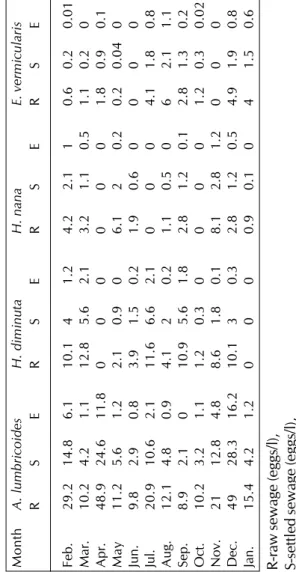
In the present study 2 species of nematodes and 2 species of cestodes were enumerated in Table 1. The results revealed thatAscaris lumbricoideswas a dominant species of helminthes in sewage followed by eggs ofHymenolepis diminuta, H. nanaandEnterobius vermicularis. Out of the total count of eggs of intestinal helminthes, 60% were nematodes and 40% cestodes. It was observed that more number ofAscaris lumbricoides(8.9 to 49 eggs/l) were observed in raw sewage and this is corresponding to a relatively high prevalence ofAscarisinfection in the city. Whereas in settled sewage their number was low when compared to raw sewage and observed in the range of 2.1 to 28.3 eggs/l. Ascaris lumbricoides was recorded maximum in the month of December (16.2 eggs/l) and they were completely absent in the month of September in the treated effluents.
Hymenolepis diminutawas in the range of 1.2 to 12.8 eggs/l and 0.3 to 6.6 eggs/l in raw and settled sewage respectively. Their number was high in the month of March and July, low (0.1 eggs/l) in the month of November and absent during April, May, October and January months. Another species of the same genera i eHymenolepis nana recorded in the range of 0.9 to 8.1 eggs/l and 0.1 to 2.8 eggs/l in raw and settled sewage respectively. In final effluent the range was 0.1 to 1.2 eggs/l and were absent in the months of June, July, August and October. Another nematodeEnterobius vermiculariswas also encountered in the range of 0.2 to 4.9 eggs/l in raw sewage, whereas in settled sewage the range was 0.04 to 2.1eggs/l and in final effluent it was 0.01 to 1.1 eggs/l respectively. In final effluents they recorded maximum of 1.1 eggs/l during August and minimum of 0.01 eggs/l during February. Eggs ofEnterobius vermiculariswere completely absent in the months of March, May, June, and November. In the raw sewage highest frequency ofAscaris lumbricoidesfollowed by H. diminuta and low number of H. nana and E. vermiculriswere observed. In treated effluent all these species were recorded in relatively small number might be due to sedimentation and settling of them to the bottom during primary treatment. There was no seasonal variation observed with respect to helminthes number.
to 100% in the months of May and October. Eggs ofH. diminutawas absent in the months of April and January. Cent per cent reduction forH. nanawas observed in the months of June, August and January and forE. vermicularis in the months of March and May respectively. Both of these were completely absent in the months of April, October, June and November. Data on field study revealed that the removal of eggs of all the 4 species is significant (Table 2). Their number decreased during the treatment process in waste stabilization ponds.
Removal of helminth eggs from laboratory model waste stabilization ponds
In order to understand further details about the retention time for the removal of helminth eggs from sewage during the treatment process laboratory model WSP were designed and studied for 20 days and enumerated the helminthic eggs. The model had two systems one was batch system and another continuos flow system. These two systems have non seeded (NS) and seeded (S) ponds in replicates. Continuos flow system (CFS) was compared with the field model WSP where as batch system (BS) inferred the retention
time required to removal of maximum helminth eggs.
Helminthes viz.A. lumbricoides, H. diminuta,H. nana andE. vermiculariswere recorded 46.8, 11.6, 9.8 and 5.4 eggs/l on zero day. Their number was reduced on consecutive days and disappeared completely on day 20 in batch system in both seeded and nonseeded ponds. Whereas in continuos flow system their number was more or less comparable due to addition of fresh raw sewage to both seeded and nonseeded ponds everyday. Removal efficiency of eggs in this system was low. In these two systems densitywiseA. lumbricoideswas high in number. The order of density
wasAscaris lumbricoides>Hymenolepis diminuta> Hymenolepis nana>Enterobius vermicularis(Table 4). Percent reduction was maximum in batch system with seeded and nonseeded ponds. In batch system 100%
Month A. lumbricoides H. diminuta H. nana E. vermicularis RS E RS E RS E R S E Feb. 29.2 14.8 6 .1 10.1 4 1 .2 4 .2 2 .1 1 0 .6 0 .2 0.01 Mar. 10.2 4 .2 1 .1 12.8 5 .6 2 .1 3 .2 1 .1 0 .5 1 .1 0 .2 0 Apr. 48.9 24.6 11.8 0 0 0 0 0 0 1 .8 0 .9 0 .1 M a y 11.2 5 .6 1 .2 2 .1 0 .9 0 6 .1 2 0 .2 0 .2 0.04 0 Jun. 9 .8 2 .9 0 .8 3 .9 1 .5 0 .2 1 .9 0 .6 0 0 0 0 Jul. 20.9 10.6 2 .1 11.6 6 .6 2 .1 0 0 0 4 .1 1 .8 0 .8 Aug. 12.1 4 .8 0 .9 4 .1 2 0 .2 1 .1 0 .5 0 6 2 .1 1 .1 Sep. 8 .9 2 .1 0 10.9 5 .6 1 .8 2 .8 1 .2 0 .1 2 .8 1 .3 0 .2 Oct. 10.2 3 .2 1 .1 1 .2 0 .3 0 0 0 0 1 .2 0 .3 0.02 Nov. 2 1 12.8 4 .8 8 .6 1 .8 0 .1 8 .1 2 .8 1 .2 0 0 0 Dec. 4 9 28.3 16.2 10.1 3 0 .3 2 .8 1 .2 0 .5 4 .9 1 .9 0 .8 Jan. 15.4 4 .2 1 .2 0 0 0 0 .9 0 .1 0 4 1 .5 0 .6 R-raw sewage (eggs/l), S-settled sewage (eggs/l), E-final effluent (eggs/l) Table 1: Total number of helminthic eggs in the wastewater during February 2002 -January 2003
Table 2: Variations in the helminth eggs in raw, settled and treated wastewaters of field stabilization ponds. (February 2002-January 2003)
I : One way ANOVA
* : Significant P < 0.05, ** : Not Significant P > 0.05
Parameters Raw Settled Effluent F-valueI P-Value
Av. ± Av. ± Av. ±
SD SD SD
Ascaris 20.5 ± 9.8 ± 8.9 ± 8.08 0.001*
lumbricoides 14.58 8.79 5.104
Enterobius 2.2 ± 0.8 ± 0.3 ± 9.83 0.00*
vermicularis 2.07 0.82 0.404
Hymenolepis 6.2 ± 2.6 ± 0.6 ± 6.65 0.004*
diminuta 4.85 2.33 0.85
Hymenolepis 2.5 ± 0.9 ± 0.2 ± 6.83 0.003*
nana 2.54 0.94 0.42
Table 3: Per cent reduction in the number of eggs of helminthes (February 2002-January2003)
AB - absent
Feb. 80.0 88.1 76.9 98.4
Mar. 89.2 83.6 84.4 100.0
Apr. 75.9 AB AB 94.5
May 89.3 100.0 96.7 100.0
Jun. 91.8 94.9 100.0 AB
Jul. 90.0 81.9 AB 80.5
Aug. 92.6 95.2 100.0 81.7
Sep. 88.8 83.5 96.4 92.9
Oct. 89.2 100.0 AB 98.4
Nov. 77.2 98.9 85.2 AB
Dec. 66.9 97.0 82.2 83.7
Jan. 92.2 AB 100.0 8.0
AV±SD 85.26 ± 92.3 ± 91.3 ± 191.5 ±
8.226 36.53 42.0 36.34
Months Ascaris lumbricoides (in
percentage)
Hymenolepis diminuta (in
percentage)
Hymenolepis nana (in
percentage)
Enterobius vermicularis (in
pathogens to solids followed by inactivation or predation have been suggested as important removal processes in a reduction was observed on day 15 for all the four species
but in continuous flow system the reduction was only in the range of 12.2 to 65.4% in nonseeded ponds and 25.2 to 61.3% in seeded ponds respectively (Table 5).
In nonseeded batch system pondsA. lumbricoidesreduced to 99.9% on day 15 whereas in seeded ponds eggs were completely absent on said day. Percent reduction ofH. diminutawas 97.4% and 99.1% in nonseeded and seeded ponds respectively on day 10 and they were completely absent on 15thday.H. nanadeclined to 94.9% in nonseeded and 96.9%in seeded ponds andE. vermicularisdeclined to 98.3% in nonseeded and 98.8% in seeded ponds on day 10 respectively. These three species were completely absent on day 15 in all the pond samples. In continuous flow system the percent reduction forA. lumbricoideswas 45.9, 12.2, 65.4 and 27.4% in nonseeded ponds whereas in seeded ponds it was 44.4, 25.2, 61.3 and 23.0% on days 5, 10, 15 and 20 respectively.H. diminutawas 6.9, 74.1, 14.7 and 29.3% in nonseeded ponds and in seeded ponds it was 23.3, 30.2, 5.2 and 48.3% on 5, 10, 15 and 20thday of the experiment.H. nanarecorded 62.2, 17.3, 16.3 and 8.2% in nonseeded ponds and in seeded ponds it was 23.5, 9.2, 9.2 and 12.2% on 5, 10, 15 and 20thday of the experiment respectively.E. vermicularisrecorded 44.4, 27.8, 68.5 and 63.0% in nonseeded ponds and in seeded ponds it was 64.8, 50.0, 7.4 and 42.6% on respective days of the analysis. Such type of gradual decline in the helminth number in pond samples indicate that the ova were settled to the bottom and removed from pelagic water. DISCUSSION
The data on the removal of helminthes from sewage after passing through the field waste stabilization pond revealed thatAscaris lumbricoideswas the predominant species of helminthes in the sewage. It may be due to femaleAscaris that lays upto 2,00,000 eggs per day. The density and diversity of eggs of intestinal parasites found in sewage can vary depending upon the intensity and prevalence of parasite infection in the sewered community (Rebeccaet al., 1996). In the effluents the helminthes eggs were reduced to low numbers. It may be due to their size and density removed by sedimentation and are accumulated in sludge (Shantaet al., 2001).
Adsorption of ova to settable solids is probably the main mechanism for removal of ova in ponds. Although evidences to substantiate this theory is lacking, still believed that it is the sole cause for removal of helminth eggs. Recent studies conducted in Morocco (Schwartzbrodet al., 1987) and in Brazil (Ayerset al., 1993) indicate that the removal of helminth ova and settleable solids may be re-lated. Helminthic eggs are heavier than water, so sedimentation is considered to be one of the principal ways of removal process (Feachemet al., 1983; Ayers, 1991). Sedimentation
of free or solids associated pathogens or adsorption of Table
variety of wastewater treatment systems including conventional systems like, WSP and gravel bed wetlands (Saqqar and Pescod, 1992).
Helminthes did not show any seasonal variations. In the hitherto study Ascaris lumbricoideswas the dominant species found more in number compared to the other 3 species.Ascariseggs may be among the most persistent of the helminthic pathogens with egg viability exceeding more than a year (Feachemet al.,1983). Nematode species are considered as indicators of fecal contamination. In the hitherto study Ascaris lumbricoideswas the dominant species found more in number compared to the other 3 species.
The helminthic eggs are most resistant to environmental conditions. The cysts of helminthic eggs may survive for weeks, possibly months in water and sewage. All the eggs found at single cell stage of development are considered to be potentially viable.H diminutais primarily a rodent intestinal parasite although human infection can occur by the accidental ingestion of the floor beetle, which is a intermediate host for this parasite and also through contaminated food made in many bakeries in unhygienic environment in the city.
Complete treatment of sewage is necessary to free it from helminth eggs. Feachemet al.(1983) explained the removal of helminthes, which need a minimum of 2 ponds connected in series with a total retention time of 20 days to ensure that the effluents are free from helminthes eggs. From the laboratory model waste stabilization ponds, it is revealed that in batch system; both nonseeded and seeded ponds the complete removal of helminthes of 4 species took place on 20thday of the experiment. It may be merely due to sedimentation to sludge because of their size and density (Shantaet al., 2001). In continuous flow system both non-seeded and seeded ponds, number of eggs were recorded more or less same throughout the period of observation, it is because of addition of raw waste daily which contained fresh helminthic eggs.
The diversity and density of eggs of human intestinal helminthes in the sewage is dependent on local prevalence of intestinal helminthes infection in the sewage contributing community. The distribution of helminth eggs per litre in the influent wastewater was found to be randomly distributed i.e. presence of eggs are rare, random and occur independently from one another. Eggs ofAscaris were present in influent wastewater with the greatest relative abundance compared to other species of helminth eggs.
Helminth parasites are of concern due to their ability to resist the conditions existing during the wastewater treatment. Eggs and cysts are the dormant resting stages and are highly resistant to treatment conditions. Infective eggs can survive for long periods. The eggs reaching the
larval stage were considered as viable and infective.
Retention period of 20 days was shown to eliminate helminthes eggs completely. This particular observation falls in line with the report of Feachemet al.(1983). The eggs at single cell stage of development are potentially viable. No development occurred in the sludge. From the laboratory model experimental ponds, it is concluded that a minimum of 20 days retention time is sufficient for the complete removal of helminth eggs from the treated effluents. But further treatment of sludge may be needed for its reuse as fertilizer.
The helminth egg value was always below the maximm WHO limit. Hence this effluent can be safely used for restricted irrigation provided that field workers are protected from direct contact with wastewater in the facultative pond effluent.
REFERENCES
Al-Saleem S, S., and Lumbers, J.P.1987.An initial evaluation of
Alsumara waste stabilization ponds. Water Sci. Technol.19:
33-37.
Ayers, R.M., Lee, D.L., Mara, D.D. and Silva, S.A. 1993.The
accumulation, distribution and viability of human parasitic nematode eggs in the sludge of a primary facultative waste stabilization pond. Transactions of the Royal Society of Tropical
Medicine and Hygiene.87: 256-258.
Ayers, R.M. 1991.On the removal of nematode eggs in waste
stabilization ponds and consequent potential health risks from
effluent reuse.Dissertation, University of Leeds, UK .
Bailenger, J. 1979.Mechanisms of parasitological concentration
in coprology and their practical consequences. Journal of
American Medical Technology.41:65-71.
Bartone, C.R. and Arlosoroff, S. 1987.Irrigation reuse of pond
effluents in developing countries. Water Science and
Technology.19:289-297.
Curtis, T.P., Mara, D.D., Dixo, N.G.H. and Sliva, S.A. 1994.
Light penetration in waste stabilization ponds.Water Research.
28:1031-1038.
Feachem, R.G., Bradly, D.J., Garelick, H. and Mara, D.D. 1983. Sanitation and Disease: Health aspects of excreta and wastewater Management. World Bank Studies in water Supply
and sanitation No.3:John Wiley and Sons, Chichester.
Lloyd, B.J. and Frederick G.L. 2000.Parasite removal by waste
stabilization pond systems and the relationship between concentrations in sewage and prevalence in the community.
Water Science & Technology.42:375-386.
Mara, D.D and Silva, S.A. 1986.Removal of intestinal nematode
eggs in tropical waste stabilization ponds.Journal of Tropical
Medicine and Hygiene.89:71-74.
Rebecca Stott, Teifryn, J., John, W., Magdy, B., Eric, M., Martyn,
F. and John, B. 1996.Pathogen removal and microbial ecology
in Gravel Bed Hydroponic (GBH) treatment of wastewater.
Monograph number.4:University of Portsmouth.
Saqqar, M.M. and Pescod, M.B. 1991. Microbiological
in agriculture. Water Science and Technology.23:1517-1524.
Saqqar, M.M. and Pescod, M.B. 1992.Modelling nematode
egg elimination in waste water stabilization ponds. Water
Science and Technology.26:1659- 1665.
Schwartzbrod, J., Bouhoum, K. and Baleux, B. 1987.Effect of
lagoon treatment on heliminth eggs. Water Science and
Technology.19:369-371.
Shanta Satyanarayana, P.R., Chaudhari and Kaul, S. N. 2001. Environmental Significance of Helminth Parasites and Their
Removal in Wastewater Treatment Processes.Environment
Conservation Journal.2:1-23.
World Health Organization. 1990.World Health Statistics