ISSN 0104-6632 Printed in Brazil
www.abeq.org.br/bjche
Vol. 27, No. 01, pp. 63 - 69, January - March, 2010
*To whom correspondence should be addressed
Brazilian Journal
of Chemical
Engineering
REVISITING THE INFLUENCE OF LOADING ON
ORGANIC MATERIAL REMOVAL IN PRIMARY
FACULTATIVE PONDS
F. J. A. da Silva
1*, R. O. de Souza
1and A. L. C. Araújo
21Department of Hydraulic and Environmental Engineering, Federal University of Ceará, Campus do Pici, Bloco 713,
CEP: 60455-760, Phone: + (55) (85) 33669623, Fax: + (55) (85) 33669627, Fortaleza - CE, Brazil.
*E-mail: [email protected]; E-mail: [email protected] 2
Department of Natural Resources, Federal Centre for Technological Education Rio Grande do Norte, Av. Senador Salgado Filho 1559, Tirol, CEP: 59000-015, Natal - RN, Brazil.
E-mail: [email protected]
(Submitted: June 15, 2009 ; Revised: October 22, 2009 ; Accepted: October 23, 2009)
Abstract - This paper investigated the influence of organic loading on BOD and COD removal in primary facultative ponds. The study was based on six full-scale pond plants in which average removals of unfiltered biochemical oxygen demand (BOD) and chemical oxygen demand (COD) were 72 and 50%, respectively. For filtered samples, the removals were 89 and 83%, respectively. First-order removal rates assuming ideal hydraulic patterns (completely mixed and plug-flow) decreased with increments in the mean hydraulic retention time (HRT). Reduction in organic loading also caused a decrease in removal rates. The results emphasized that HRT and surface organic loading are more reliable to estimate first-order removal rates than traditional Arrhenius-style equations. Thus, HRT and surface organic loading can be used to compute more realistic first-order removal rates and surface removal rates. An alternative design procedure based on HRT and surface organic loading was proposed and demonstrated.
Keywords:Primary facultative ponds; Removal of organic material; Design model.
INTRODUCTION
In waste stabilization pond technology, primary facultative units are the most used and investigated. They can be designed as single cells or as part of a pond series. Analytical models for the design of primary facultative ponds are based on first-order kinetics. An ideal hydraulic pattern is assumed that may be either completely mixed (Equation 1) or plug-flow (Equation 2) (USEPA, 1983; Preul and Wagner, 1987; Yánez, 1993; von Sperling, 2002).
k.HRT) Lo/(1
L= + (1)
-k.HRT
e
Lo.
L
=
(2)where: L and Lo are the effluent and influent biochemical oxygen demand, BOD (mg/L),
respectively, k is the first-order removal rate (day-1), and HRT is the mean hydraulic retention time (days).
The k value is temperature (T) dependent and the appropriate correction is obtained through Arrhenius-style equations. For completely mixed conditions, Mara (1976) suggested Equation 3, while for plug-flow Equation 4 is recommended by USEPA (1983).
20 T (1.05) 0.3
k= − (3)
20 T (1.09) 0.71
k= − (4)
0.54 day-1, at 20° C. In their own findings, the mean k value was 0.168 day-1 for unfiltered samples at 20°C. In filtered samples after algae removal they found a first-order removal rate of 0.327 day-1. These authors recommended that a k value of 0.3 day-1 at 20°C, from Equation 3, would be more appropriate for filtered BOD. For unfiltered samples, a more realistic k value would be 0.201 day-1. They also suggested an estimate of k (day-1) as a function of organic loading applied to the pond (λs in kg BOD/ha.day) according to the equation below.
k = 2.622x10⁻³ λs - 0.194 (5)
Actually, pond flow is neither completely mixed nor plug-flow. The dispersed flow is more adequate to represent the hydraulic pattern, as initially observed by Thirumurthi (1969). This approach is based on the Wehner-Wilhelm kinetic equation. However, there is a drawback due to the lack of data from field studies. The use of the dispersion-based model is debatable because extensive investigation would be required to obtain reliable figures. A broad application is limited by a number of factors such as unsteady flow, wind, and inlet and outlet structures that may significantly influence dispersion in ponds.
According to Juanico (1991), the plug-flow model is more representative of bacterial removal in contrast with BOD removal, which is more likely to approach completely mixed conditions. This explains why investigations on the influence of hydraulic pattern have focused on coliform removal and with good results (e.g. Lloyd and Vorkas, 1999; Shilton and Harrison, 2003; von Sperling, 2003; Shilton and Mara, 2005; Bracho et al., 2006).
Mara and Pearson (1986) and Mara et al. (1992) stated that limitations of “rational” methods based on first-order kinetics led to empirical procedures based on ambient temperature. Mara (1987) proposed a commonly applied model for the computation of the
maximum allowable organic loading in facultative ponds (Equation 6).
λs = 350(1.107-0.002T)T-25
(6)
where: λs is the maximum allowable surface loading applied to the pond (kg BOD/ha.day) and T is the average temperature of the coldest month (°C).
A properly designed primary facultative pond has a performance for BOD removal ranging from 70 to 80% for unfiltered samples and about 90% for filtered samples (Mara, 1997). Nevertheless, there is still a debate on design models that would better represent reality and couple with the performance of full-scale systems. Thus, our paper addresses this discussion and takes into account findings from full-scale pond systems. The purpose is to provide a more feasible and dependable approach for the design of primary facultative ponds.
MATERIALS AND METHODS
Six full-scale primary facultative ponds (PFPs) located in Fortaleza (38o 32' W; 3o 43' S, 15.5 m above the sea level), in Northeast Brazil, were investigated during 28 weeks in 2007. These pond plants have been operating for 22 years on average. Their original design characteristics are given in Table 1.
Raw wastewater and treated effluent samples were collected weekly at 10:00 AM. Flow measurements were performed with a clockwork device at the pumping station of each plant. The following parameters were analyzed in the raw wastewater: temperature, pH, biochemical oxygen demand (BOD) and chemical oxygen demand (COD). In the treated effluent these parameters were complemented with dissolved oxygen (DO), filtered BOD (BODf) and filtered COD (CODf). The analytical procedures followed the methods described in APHA (1992).
Table 1: Design characteristics of the primary facultative ponds.
Pond system HRT
(days)
λs (kg BOD/ha.day)
Volume (m3)
Width to length Ratio
Mean depth (m)
PFP1 26.9 178 22194.0 1:1.52 1.7
PFP2 62.0 128 168400.0 1:1.52 2.0
PFP3 25.7 261 25710.4 1:2.10 1.6
PFP4 25.0 230 51000.0 1:2.04 1.7
PFP5 22.3 283 45736.8 1:1.78 1.7
Brazilian Journal of Chemical Engineering Vol. 27, No. 01, pp. 63 - 69, January - March, 2010
RESULTS AND DISCUSSION
Temperature of the influents to the pond systems ranged from 22.0 to 26.2°C (mean of 24.9°C), while in the treated effluents it varied from 24.9 to 29.1°C (mean of 27.2°C). The pH of the raw wastewater was around neutral (7.11 ± 0.19). Unfiltered BOD and COD showed typical values of domestic wastewaters: 430 ± 150 mg/L and 707 ± 278 mg/L, respectively.
PFP2 and PFP4 ponds had HRTs similar to those in the design assumptions shown in Table 1. However organic loadings in these ponds were above design (14 and 32%, respectively). The other plants had higher HRTs (78.5 ± 44.2 days) and BOD loadings were 41 ± 19% below the values assigned in the original designs. Uncompleted connections of the buildings to the sewerage network and low per caput wastewater contributions may have caused lower influent flow rates to the plants, as suggested by Campos and von Sperling (1996). Table 2 shows the actual operational performance of the pond systems investigated.
Unfiltered BOD removal was at the lower limit (around 70%) mentioned in the literature (Mara et al., 1992; Mara, 1997). Consequently, unfiltered COD removal was also at the lower limit (around
50%). Concentrations of unfiltered BOD and COD in the treated effluents of the pond systems were 121 ± 36 mg/L and 343 ± 115 mg/L, respectively. Filtered samples (BODf and CODf) represented 39 ± 15% and 36 ± 18% of the respective unfiltered BOD and COD. The performance regarding filtered samples was in accordance with a number of studies (Bucksteeg, 1987; Mara et al., 2001; Abis and Mara, 2005).
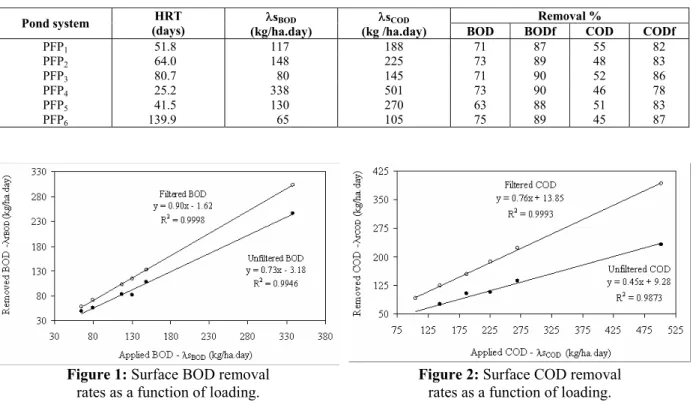
Surface removal rates of unfiltered and filtered BOD and COD correlated positively with the organic loading applied to the ponds (Figures 1 and 2). On the other hand, neither width to length ratio nor depth of the ponds showed a significant correlation with organic material removal.
Mean dissolved oxygen concentration in the treated effluents was 4.3 ± 3.6 mg/L. The highest values were observed in PFP6 (7.4 ± 3.5 mg/L), while the lowest were in PFP2 (2.1 ± 1.3 mg/L). Average pH in pond effluents was 7.80 ± 0.21. It was higher in PFP3 (8.04 ± 0.29) and lower in PFP2 (7.53 ± 0.29).
There was a positive correlation between pH and DO (r = 0.7191 at the 0.05 level of significance). Positive correlations of pH (r = 0.7638) and DO (r = 0.6150) were also observed in relation to surface CODf removal rate.
Table 2: Operational performance of the primary facultative ponds.
Removal %
Pond system HRT
(days)
λsBOD
(kg/ha.day)
λsCOD
(kg /ha.day) BOD BODf COD CODf
PFP1 51.8 117 188 71 87 55 82
PFP2 64.0 148 225 73 89 48 83
PFP3 80.7 80 145 71 90 52 86
PFP4 25.2 338 501 73 90 46 78
PFP5 41.5 130 270 63 88 51 83
PFP6 139.9 65 105 75 89 45 87
Figure 1: Surface BOD removal rates as a function of loading.
The hydraulic retention times in the pond systems influenced pH and DO values, with correlation coefficients of 0.6846 and 0.6882 respectively (at the 0.05 level of significance). This was similar to findings of Ceballos et al. (1996). These authors stated that HRT and loading impact algal dynamics and nictemeral variations that influence DO and pH.
The computed first-order removal rates based on ideal hydraulic flow are shown in Table 3. The values of the k for unfiltered BOD were lower than those calculated with the Arrhenius-style equations. For the completely mixed condition (Equation 3), the corrected value of k would vary from 0.381 to 0.468 day-1 (mean of 0.426 day-1 at 27.2°C), for a temperature ranging from 24.9 to 29.1°C. For the case of the plug-flow condition (Equation 4), the adjusted k value would vary from 1.083 to 1.555 day-1 (mean of 1.320 day-1), in the same temperature range. These numbers are too high even if compared to k rates computed for filtered samples.
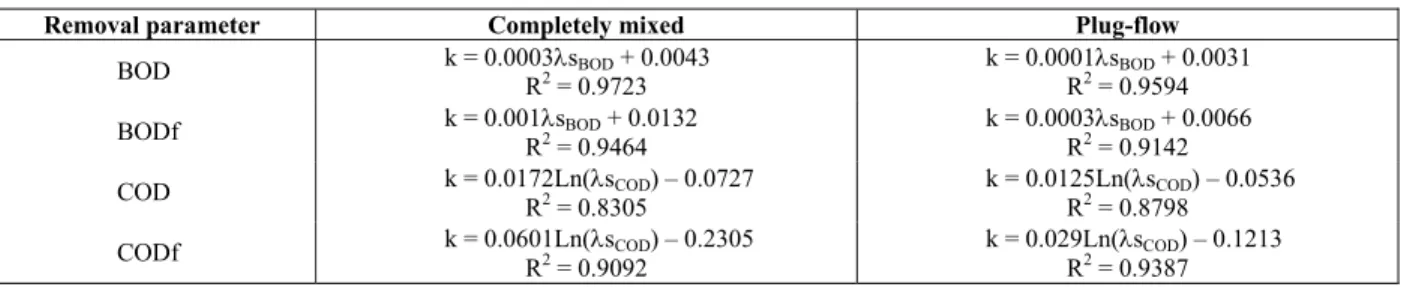
Hydraulic retention time and surface organic loading correlated with first-order reaction rates (at the 0.05 level of significance). Tables 4 and 5 provide empirical models that could be used for design ends.
Correlation discrepancies are not significant
unless they are seen under a more detailed statistical perspective. The discussion does not address which ideal hydraulic regimen is more representative, but the fact that higher HRTs and consequent lower surface organic loadings cause a decrease in first-order removal rates. Also, pond performance will not increase with a longer HRT or lower organic loading. This will not result in an effluent with less organic content.
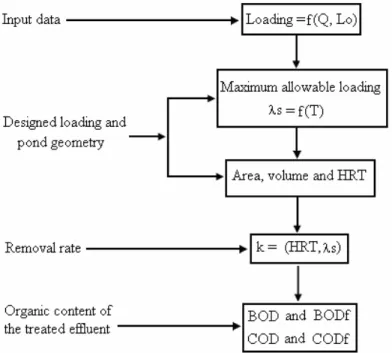
The fact is that the correction of first-order removal rates with Arrhenius-style equations produces unrealistic numbers. For design purposes, a reasonable approach is initially to compute the maximum allowable BOD loading (λs). After that, it is necessary to define geometric elements (length, width and depth) and compute the HRT. Then, either λs or HRT from Tables 4 and 5 may be used to calculate a more realistic k. The final effluent BOD is then computed from Equations 1 or 2, according to the initial assumption for a chosen hydraulic regimen.
If the designer wishes to estimate COD in the effluent, it is necessary to know the BOD/COD ratio in the influent and make the appropriate replacements. In domestic wastewaters, this ratio is around 0.5 (Metcalf and Eddy, 1991). The process also allows one to estimate organic content in filtered samples. Figure 3 represents this proposed stepwise approach.
Table 3: First-order removal rates (day-1) in the primary facultative ponds.
Completely mixed Plug-flow
Statistic parameter
BOD BODf COD CODf BOD BODf COD CODf
Mean 0.048 0.159 0.019 0.091 0.024 0.043 0.013 0.034
Min. 0.022 0.059 0.006 0.046 0.010 0.016 0.004 0.014
Max. 0.106 0.351 0.034 0.144 0.052 0.091 0.025 0.061
CV (%) 62 64 52 37 60 60 53 48
Table 4: First-order removal rates in primary facultative ponds as a function of HRT.
Removal parameter Completely mixed Plug-flow
BOD k = 1.3401HRT
-0.851
R2 = 0.8824 k = 0.8719HRT
-0.9141
R2 = 0.9610
BODf k = 7.6572HRT
-0.9889
R2 = 0.9750 k = 2.1546HRT
-0.9952
R2 = 0.9958
COD k = 1.1918HRT
-1.0476
R2 = 0.9360
k = 0.7883HRT-1.0353 R2 = 0.9649
CODf k = 1.2396HRT
-0.6573
R2 = 0.9667
k = 0.9307HRT-0.8397
R2 = 0.9954
Table 5: First-order removal rates in primary facultative ponds as a function of surface loading.
Removal parameter Completely mixed Plug-flow
BOD k = 0.0003λsBOD + 0.0043
R2 = 0.9723
k = 0.0001λsBOD + 0.0031
R2 = 0.9594
BODf k = 0.001λsBOD + 0.0132
R2 = 0.9464 k = 0.0003R2 = 0.9142 λsBOD + 0.0066
COD k = 0.0172Ln(λsCOD) – 0.0727
R2 = 0.8305
k = 0.0125Ln(λsCOD) – 0.0536
R2 = 0.8798
CODf k = 0.0601Ln(λsCOD) – 0.2305
R2 = 0.9092
k = 0.029Ln(λsCOD) – 0.1213
Brazilian Journal of Chemical Engineering Vol. 27, No. 01, pp. 63 - 69, January - March, 2010
Figure 3: A stepwise approach for the design of primary facultative ponds.
As an example, let us assume a domestic influent with a flow rate of 1000 m3/day and a BOD of 400 mg/L (therefore COD is 800 mg/L). The average ambient temperature during the coldest month is 20°C, the hydraulic regimen is assumed to be completely mixed and the pond depth is 2.0 m. Following the proposed method, the calculation procedure is:
i) Organic loading to be treated (BOD x Flow rate)
= 0.4 kg/m3 x 1,000 m3/day = 400 kg BOD/day (800 kg COD/day)
ii) Maximum allowable loading (according to Mara, 1987)
λs = 350(1.107-0.002x20)20-25
= 253 kg BOD/ha.day (506 kg COD/ha.day)
iii) Pond area, volume and HRT
Pond area = Organic loading to be treated/λs = (400 kg BOD/day)/(253 kg BOD/ha.day) = 1.58103 ha x 10,000 m2/ha = 15,810.3 m2
Pond volume = Pond area x Depth = 15,810.3 m2 x 2.0 m = 31,620.6 m3
HRT = Volume/Flow rate = 31,620.6 m3/(1,000 m3/day) = 31.62 days
iv) First-order removal rates (for completely mixed, Table 5)
BOD → k = 0.0003x(253 kg BOD/ha.day) + 0.0043 = 0.080 day-1
BODf → k = 0.001x(253 kg BOD/ha.day) + 0.0132 = 0.266 day-1
COD → k = 0.0172xLn(506 kg COD/ha.day) – 0.0727 = 0.034 day-1
CODf → k = 0.0601xLn(506 kg COD/ha.day) – 0.2305 = 0.144 day-1
v) Organic content in the treated effluent
BOD → L = 400 mg/L/(1+0.080 day-1x 31.62 days) = 113 mg/L
BODf → L = 400 mg/L/(1+0.266 day-1x 31.62 days) = 42 mg/L
COD → L = 800 mg/L/(1+0.034 day-1x 31.62 days) = 386 mg/L
CODf → L = 800 mg/L/(1+0.144 day-1x 31.62 days) =144 mg/L
The computation above resulted in removal efficiencies of 72, 90, 52 and 82% for BOD, BODf, COD and CODf, respectively. This performance is conservative, but similar to numbers from full-scale plants (von Sperling et al., 2004; Oliveira et al., 2006).
mg/L (90% removal). This result is too “good” and inconsistent with reality. Also, there is not an estimate of filtered BOD and COD concentrations in the treated effluent.
CONCLUSIONS
The six full-scale primary facultative ponds showed operational conditions different from the original designs. Performance of the pond systems were at the lower limit of the range indicated by the literature. Nevertheless, it was satisfactory and representative of reality, since these plants have been operating for over two decades.
High HRT and consequent low surface loading resulted in smaller first-order removal rates compared to the adjusted values from usual Arrhenius-style equations. Also, surface removal rates decreased as loading decreased and HRT increased.
The traditional design procedure based on the first-order removal rate provides unrealistic figures. At the same time, a rough empirical estimate of the pond performance is not a good engineering practice. Thus, an alternative design procedure was proposed, leading to a more dependable figure for organic material removal in primary facultative ponds.
REFERENCES
Abis, K. L. and Mara, D. D., Primary facultative ponds in the UK: the effect of hydraulic retention time and BOD loading on performance and algal populations. Water Science and Technology, v. 51, 61 (2005).
APHA, Standard Methods for the Examination of Water and Wastewater. American Public Health Association, 18th edition, Washington DC (1992). Bracho, N., Lloyd, B. and Aldana, G., Optimisation
of hydraulic performance to maximize faecal coliform removal in maturation ponds. Water Research, v. 40, 1677 (2006).
Bucksteeg, K., German experiences with sewage treatment ponds. Water Science and Technology, 19, 17 (1987).
Campos, H. M and von Sperling, M., Estimation of domestic wastewater characteristics in a developing country based on socio-economic variables. Water Science and Technology, v. 34, 71 (1996).
Ceballos, B. S. O., Konig, A., Lomans, B., Athayde, A. B. and Pearson, H. W., Evaluation of tropical
single-cell waste stabilization pond system for irrigation. Water Science and Technology, v. 31, 267 (1996).
Ellis, K. V. and Rodrigues, P. C., Developments of the first-order, complete-mix design approach for stabilisation ponds. Water Research, v. 29, 1343 (1995).
Juanico, M., Should waste stabilization ponds be designed for perfect-mixing or plug-flow? Water Science and Technology, v. 23, 1495 (1991). Lloyd, B. J. and Vorkas, C. A., A diagnostic
methodology for the evaluation and hydraulic optimisation of WSP design for pathogen removal using field assessments and modeling. In: 4th Specialist International Conference on Waste Stabilisation Ponds: Technology and the Environment, Marrakech, Morocco (1999). Mara D. D. and Silva S. A., Sewage treatment in
waste stabilization ponds: recent research in Northeast Brazil. Progress in Water Technology, v. 11, 341 (1979).
Mara, D. D. and Pearson, H. W., Artificial freshwater environment: waste stabilization ponds. In: Biotechnology - comprehensive treatise, Vol. 8, Chapter 4, Edited by H. J. Renm and G. Reed, Verlagsgesellschaft, Weinheim (1986).
Mara, D. D., Design Manual for Waste Stabilization Ponds in India. Ministry of Environment and Forests, National River Conservation Directorate, Lagoon Technology International – LTI, Leeds (1997).
Mara, D. D., Mills, S. W., Pearson, H. W. and Alabaster, G. P., Waste stabilization ponds: a viable alternative for small community treatment systems. Journal of the Institution of Water and Environmental Management, v. 6, 72 (1992). Mara, D. D., Sewage Treatment in Hot Climates.
John Wiley & Sons, Chichester (1976).
Mara, D. D., Waste stabilization ponds - problems and controversies. Water Quality International, v. 1, 20 (1987).
Mara, D. D., Pearson, H. W. Oragui, J., Arridge, H. and Silva, S. A., Development of a New Approach to Waste Stabilization Pond Design. Research Monograph No 5. University of Leeds, Leeds, UK (2001).
Metcalf & Eddy., Wastewater Engineering, Treatment, Disposal and Reuse. Third edition, McGraw-Hill Inc. New York (1991).
Brazilian Journal of Chemical Engineering Vol. 27, No. 01, pp. 63 - 69, January - March, 2010 Preul, H. C. and Wagner, R. A., Waste stabilization
pond prediction model. Water Science and Technology, v. 19, 205 (1987).
Shilton, A. and Harrison, J., Guidelines for the Hydraulic Design of Waste Stabilisation Ponds. Institute of Technology and Engineering, Massey University, Palmerston North NZ (2003).
Shilton, A. N. and Mara, D. D., CFD (computational fluid dynamics) modelling of baffles for optimizing tropical waste stabilization pond systems. Water Science and Technology, v. 51, 103 (2005).
Thirumurthi, D., Design criteria for waste stabilization ponds. Journal of Water Pollution Control Federation, v. 46, 2094 (1974).
Thirumurthi, D., Design principles of waste stabilization ponds. Journal of the Sanitary Engineering Division, 95(SA2), 311 (1969). U. S. Environmental Protection Agency, Design
Manual: municipal wastewater stabilization ponds. USEPA 625/1-81-013, Center for Environmental
Research Information, Cincinnati (1983).
Uhlmann, D., Removal rates of waste stabilization ponds as a function of loading, retention time, temperature and hydraulic flow pattern, Water Research, v. 13, 193 (1979).
von Sperling, M., Influence of dispersion number on the estimation of coliform removal in ponds. Water Science and Technology, v. 48, 181 (2003).
von Sperling, M., Relationship between first order decay coefficients, according to plug flow, CSTR and dispersed flow regimens. Water Science and Technology, v. 45, 17 (2002).
von Sperling, M., Oliveira, S. M. A. C., Vieira, M. R., Chernicharo, C. A. L. and Além Sobrinho, P., Extensive evaluation of the performance of 130 pond systems in Brazil. In: 6th Specialist International Conference on Waste Stabilisation Ponds, Avingnon, France (2004).