Lakes, reservoirs and ponds, vol. 1-2: 27-31, December 2008
©Romanian Limnogeographical Association
GENE LIKENS: A LEADER FOR OUR SCIENCE
William M. Lewis, Jr.
Professor and Director, Center for Limnology
Cooperative Institute for Research in Environmental Sciences University of Colorado, Boulder, CO 80309-0216
Abstract
Gene E. Likens, who began his career as a limnologist under the guidance of Arthur Hasler at the University of Wisconsin, has been a leading figure on limnology and ecology for the last 40 years. He showed the great potential of watershed manipulation for studying biogeochemical cycles that affect both terrestrial environments as well as streams, lakes, and wetlands, and was first to realize the extent of negative ecological effects caused by acidified precipitation in the Eastern US. He also has been an early and consistent champion of the value of long term studies in ecological research. Through his influence, the viewpoints of funding agencies that support ecological research have been transformed and made more effective. Another feature of Dr. Likens’ career has been his ability to build large collaborative groups that conduct research on diverse topics at a rapid pace. His first group was built around the Hubbard Brook Experimental Forest project and he subsequently built even a more diverse program at the Institute of Ecosystem Studies of the New York Botanical Garden. Dr. Likens has received dozens of honors and awards and has one of the most extensive and influential publication records of any living ecologist. He has pioneered concepts, methods of research, and organizational features of ecological research institutions.
Keywords: Gene Likens
1. EARLY YEARS
relied primarily on the collection of large amounts of data from the numerous lakes in Wisconsin, and use of comparative methods to reach generalities about these lakes. In the 1940s, the empirical approach of Birge and Juday at Wisconsin was strongly supplemented by the more theoretical and hypothesis driven approach of G. E. Hutchinson at Yale.
Arthur Hasler
succeeded Birge and Juday at the University of
Wisconsin. Like Hutchinson, Hasler was
interested in hypothesis testing, but he also brought a strong and new emphasis on the use of experiments to resolve hypotheses or provide insights into mechanisms that are important in inland
waters. The young Gene Likens, working with Hasler, used radioactive tracers to study the movement of water under ice (Likens and Hasler 1960). Although limnologists had thought of water under ice as quite static, the experiments showed substantial amounts of water movement and some predictable patterns (Likens and Ragotzkie 1966). Experimentation was the key, and Gene Likens took this lesson with him forward to a position at Dartmouth (1963).
2. HUBBARD BROOK
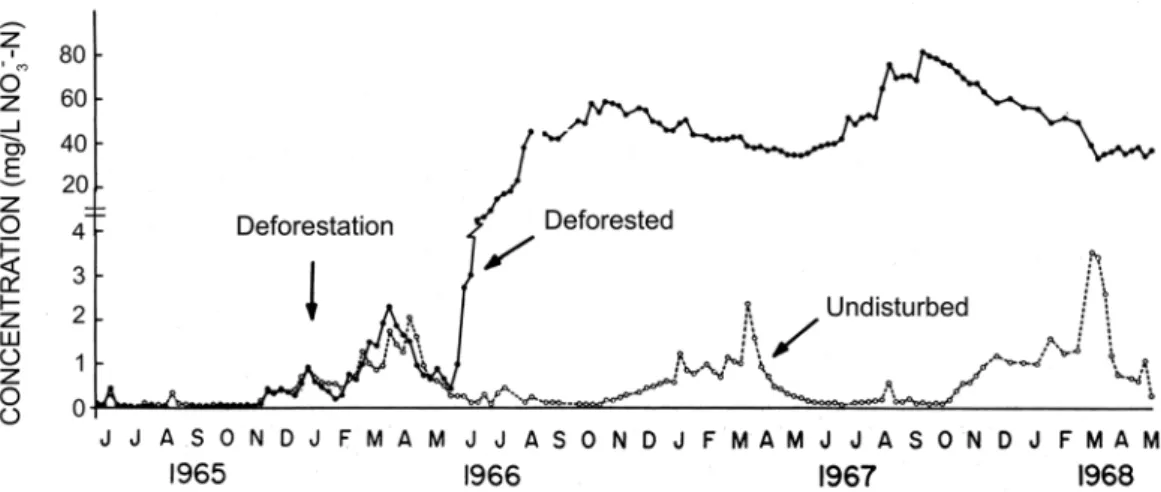
interesting elements. Their research team, working in collaboration with the U. S. Forest Service, burst into the headlines of ecological sciences through their measurements of nitrogen loss from watersheds that had been clearcut (Figure 1), as compared with similar watersheds that were not disturbed. The nitrogen output from the logged watersheds was 10 - 100 times higher than the nitrogen output from watersheds that were not disturbed (Likens et al. 1970). This work brought an awakening among limnologists and ecologists to the great potential of terrestrial disturbance to alter biogeochemical cycles.
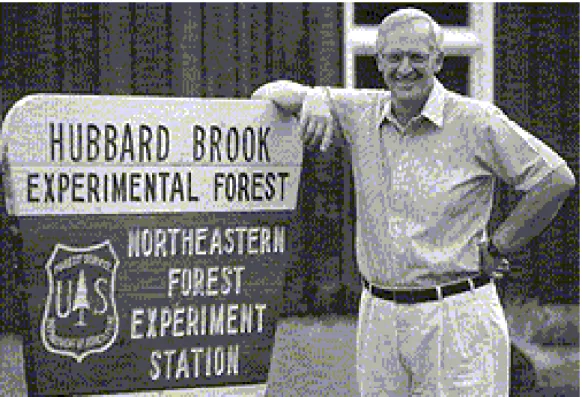
Fig. 1. Gene Likens at the Hubbard Brook Experimental Forest.
The Hubbard Brook Experimental Forest project revealed many other ecosystem processes affecting biogeochemical cycles. The findings to come from the research group encompassed hydrology, nutrient transport, major ion transport, effects of unusual weather events, effects of land management, and stream-lake interactions. Dozens of publications
emanated from the group, some of which are summarized in book form (Likens et al. 1977).
3. ACID RAIN
from Dartmouth in 1969, he documented acidification of precipitation in the northeastern United States and pointed out the severe consequences for biogeochemical cycles in watersheds and aquatic ecosystems (Likens et al. 1979). He was also one of the first scientists to appreciate the disadvantages of dispersing airborne pollutants through very high stacks, which lead to very broad distribution of damaging acidity. Dr. Likens and his students, as well as others who took an interest in this phenomenon, were influential in guiding the U. S. Federal Government in developing air quality controls intended to reduce the negative influence of acidity distributed through the atmosphere.
Fig. 2.. Concentrations of nitrate in streams draining undisturbed and deforested watersheds in the Hubbard Brook study area (modified from Likens et al. 1970).
Note the break in scale on the y axis.
4. THE INSTITUTE OF ECOSYSTEM STUDIES
5. SERVICE TO THE PROFESSION
A man very efficient in his use of time, Gene Likens was able to exercise a great amount of leadership through professional societies while continuing his research and administrative work at IES. He served as president of the Ecological Society of America, the American Institute for Biological Sciences, the American Society of Limnology and Oceanography, and the International Society for Limnology. He has proven himself to be an activist administrator, but with due consideration of diverse viewpoints.
His honors are too numerous to list. Most remarkable is his receipt of the U. S. National Medal of Science, the highest honor that the U. S. has for scientific achievement. In addition, he is a recipient (along with Herbert Bormann) of the Blue Planet Prize, and received the Naumann-Thienemann Medal of the International Society for Limnology.
6. PRESENT ACTIVITIES
Although now having stepped away from the directorship of IES, Gene Likens is actively conducting research, supervising students, and working with colleagues on new ideas and projects. We continually find more and more about his capabilities, although he is very modest in nature. He surprised his hosts at the entertainment phase of a professional meeting when he was invited to shoot at flying clay targets. His hosts were astonished when he broke two of the targets at once. They may not know that in his younger years he was a very successful baseball player. We are fortunate that he was more tempted to use his intellect and interpersonal skills than to make a career from his excellent eye-hand coordination.
References
Likens, G. E., and A. D. Hasler. 1960. Movement of radiosodium (Na-24) in a chemically stratified lake. Science 131: 1676-1677.
Likens, G. E., and R. A. Ragotzkie. 1966. Rotary circulation of water in an ice-covered lake. Verh. Internat. Verein. Limnol. 16: 126-133.
Likens, G. E., F. H. Bormann, N. M. Johnson, D. W. Fisher, and R. S. Pierce. 1970. Effects of forest cutting and herbicide treatment on nutrient budgets in the Hubbard Brook watershed-ecosystem. Ecological Monographs 40: 23-47.
Likens, G. E., F. H. Bormann, R. S. Pierce, J. S. Eaton, and N. M. Johnson. 1977. Biogeochemistry of a Forested Ecosystem. Springer, New York.