ISSN printed: 1806-2636 ISSN on-line: 1807-8672
Doi: 10.4025/actascianimsci.v36i4.23910
Influence of xylanase and vitamin A in wheat-based diet on
performance, nutrients digestibility, small intestinal morphology and
digesta viscosity in broiler chickens
Vahid Khoramabadi1*, Mohammad Reza Akbari1, Fariborz Khajali1, Hossein Noorani2 and Enayat Rahmatnejad3
1
Department of Animal Science, Shahrekord University, Rahbar Boulevard, 18, 115, Shahrekord, Chaharmahal Bakhtiari Province, Iran. 2
Department of Pathobiology, Shahrekord University, Shahrekord, Chaharmahal Bakhtiari Province, Iran. 3Young Researchers & Elites Club, Hamedan Branch, Islamic Azad University, Hamedan, Iran. *Author for correspondence. E-mail:[email protected]
ABSTRACT. The effect of wheat-based diet (WBD), supplemented with xylanase and surplus vitamin A, on performance, nutrient digestibility, intestinal morphology and digesta viscosity of broiler chickens was investigated. Based on a completely randomized design, 240-day-old chickens were randomly divided into six experimental diets and four replications with 10 chickens each. Experimental diets consisted of corn-based diet (CBD) (T1), WBD with routine amounts of vitamin A (9000 IU kg-1) (T2), T2 without vitamin A in premix
(T3), T2 + 6000 IU kg-1 vitamin A (T4), T2 + 420 IU kg-1 xylanase (T5), and T2 + 6000 IU kg-1 vitamin
A + 420 IU kg-1 xylanase (T6). For Feed Conversion Rate (FCR) between day 1 and 21 and between day 21 and
42 WBD supplemented with vitamin A and enzyme was less than CBD (p < 0.05). Also, supplementation of surplus vitamin A singly, and vitamin A and enzyme improved digestibility of crude protein (CPD) and crude fat (CFD) than WBD with routine amounts of vitamin A (p < 0.05). The villus (duodenum, jejunum and ileum) was longer (p < 0.05) in broilers fed on diet supplemented with vitamin A and enzyme than those with CBD. It may be concluded that enzyme and vitamin A supplementation to WBD may improve mentioned parameters. Keywords: digestibility, enzyme, morphology, viscosity, vitamin A, wheat.
Os efeitos de xilanase e vitamina A em dieta baseada no trigo (DBT) sobre o desempenho,
digestibilidade de nutrientes, morfologia do intestine delgado e viscosidade da digesta em
frangos de corte
RESUMO. Investigou-se o efeito de dieta baseada no trigo (DBT) e suplementada com xilanase e vitamina A sobre o desempenho, digestibilidade dos nutrientes, morfologia intestinal e viscosidade digesta de frangos de corte. Baseado num esquema aleatório, frangos de 240 dias foram divididos em grupos de seis dietas experimentais, com quatro repetições, com 10 frangos cada. As dietas foram: T1 = dieta baseada em trigo; T2 com DBT com vitamina A (9000 IU kg-1); T3 = T2 sem vitamina A; T4 = T2 + 6000 IU kg-1 vitamina A;
T5 = T2 + 420 IU kg-1 xylanase; T6 = T2 + 6000 IU kg-1 vitamina A + 420 IU kg-1 xylanase. Para a Taxa de
Conversão de Dieta entre dia 1 e 21 e entre dia 21 e 42 DBT suplementada com vitamina A e enzima foi menor do que DBM (p < 0,05). Suplementacão sozinha de vitamina A e vitamina A + enzima melhoru a digestibilidade de proteina bruta (DPB) e gordura bruta (DGB) do que DBT com a quantidade rotineira de vitamina A (p < 0,05). As vilosidades (duodeno, jejuno e íleo) eram mais compridas (p < 0,05) em frangos de corte alimentados com dieta suplementada com vitamina A e enzima do que os frangos alimentados com DBM. Conclui-se que a suplementação de DBT pela enzima e vitamina A poderá melhorar os parâmetros acima. Palavras-chave: digestibilidade, enzima, morfologia, viscosidade, vitamina A, trigo.
Introduction
Replacing corn with wheat in poultry diets, feed costs may be partly reduced. Various factors such as different varieties, grow requirements, harvest and storage factors affect the chemical composition and nutritional value of the cereal (GUTIERREZ-ALAMO et al., 2008). Some of the food used in poultry feed containing anti-nutritional ingredients
hydrolyzes polysaccharides and makes more nutrients
available (BUCHANAN et al., 2007). Among the
various nutrients, it appears that availability of fat, more than any other nutrient digestion, is affected by the digesta viscosity. It comes with the physiological limits for the digestion of fats in young chicks and may increase fat-soluble vitamin requirements of the chick when fed on diets rich in NSP, such as diets based on wheat (D'MELLO, 2000). Various studies have shown that retinol deficiency causes changes in the lining cells of animals fed on diets deficient in vitamin A; however, such changes were improved by adding vitamin A to the diet (BERDANIER, 1998). According to the effect of NSP on reduction fat digestibility, decreasing absorption of vitamin A, a fat-soluble vitamin, and NSP influence changes in the morphology of the inner lining of the small intestine, which is the main site of nutrient absorption, animal performance is reduced (BANCROFT; GAMBLE, 2002). Current study evaluates the effects of adding enzymes xylanase and high levels of vitamin A in wheat-based diets on performance, nutrient digestibility, small intestinal morphology and viscosity of the digesta contents.
Material and methods
Animals and treatments
A total of 240-day-old male broiler chicks (Ross-308) were randomly divided into six treatments and four replications with 10 chickens each. The basal diets (Table 1) were formulated to meet the nutrient requirements of chickens (NRC, 1994). Experimental diets consisted of T1: corn-based diet (CBD); T2: wheat-based diet (WBD) with routine amounts of vitamin A (9000
IU kg-1); T3: T2 without vitamin A in premix;
T4: T2 + 6000 (IU kg-1) vitamin A; T5: T2 + 420
(IU kg-1) xylanase; T6: T2 + 6000 (IU kg-1)
vitamin A + 420 ( IU kg-1) xylanase.
The enzyme used in this study contained at
least 440 U g-1 Beta-glucanase and 1200 U g-1
Arabinoxylanase activity. Enzymes (in powder form) were directly added to the complete diet
(350 g ton-1). Vitamin A as retinol acetate (equal
1000000 IU g-1 vitamin A) was used in this
experiment. Feeds were offered ad libitum at 1 – 21
or 22 – 42 days of age. Light was provided 24h a day and was gradually reduced until 23h a day. The temperature from heater was also gradually reduced by 2°C per week from the initial 32°C. Weight gain and feed intake were recorded weekly. Feed Conversion Rate (FCR) was
calculated by dividing feed intake to weight gain weekly.
Table1. Ingredient and calculated composition experimental diets (%).
Starter (1 - 21) Grower (22 – 42 day)
Ingredient CBD1 WBD2 CBD WBD
Wheat 0 58.87 0 65.02
Corn 58.62 0 64.73 0
Soybean meal 36.04 33.72 30.11 27.54
Soybean oil 1.56 3.66 1.88 4.2
Limestone 1.29 1.28 1.37 1.36
Dicalcium phosphate 1.4 1.37 1.05 1.01
Sodium carbonate 0.16 0.13 0.05 0.02
Salt 0.28 0.27 0.25 0.24
DL-Methionine 0.14 0.16 0.06 0.08
L-Threonine 0.01 0.04 0 0.02
Vitamin permix* 0.25 0.25 0.25 0.25
Mineral permix* 0.25 0.25 0.25 0.25
Total 100 100 100 100
Calculated composition
ME3 (Kcal kg-1) 2.900 2.900 3.000 3.000
CP4(%) 20.84 20.84 18.75 18.75
Lys5
(%) 1.12 1.09 0.94 0.94
Met6 + Cys7(%) 0.81 0.81 0.67 0.67
Ca8
(%) 0.9 0.9 0.84 0.84
AP9(%) 0.41 0.41 0.33 0.33
*Vitamin and Mineral premix, provided per kilogram: vitamin A, 360,000 IU; vitamin D3, 800,000 IU; vitamin E, 7,200 IU; vitamin K3, 800 mg; vitamin B1, 720 mg; vitamin B9, 400 mg; vitamin H, 40 mg; vitamin B2, 2,640 mg, vitamin B3, 4,000 mg; vitamin B5, 12,000 mg; vitamin B6, 11,82 mg; vitamin B12, 6 mg; cholinechloride, 100,000 mg, manganese, 40,000 mg, iron, 20,000 mg; zinc, 40,000 mg, copper, 4,000mg; iodine, 400 mg; selenium, 80 mg. 1Corn-based diet; 2Wheat-based diet; 3Metabolizable Energy; 4Crude Protein; 5Lysine; 6Methionine; 7Cysteine;8Calcium; 9Available phosphorus.
Nutrients’ digestibility
So that the digestibility of nutrients at 19 and 40 days of age could be determined, 0.3 percent chrome oxide were added as an external marker of feed intake treatments and after 48 hours (days 21 and 42) sampling of waste was disposed for 24 hours. Feed containing oxidized chrome samples were taken. Samples were pooled and then homogenized by grinding in a blender to a powder. The powder was then passed through a 1-mm sieve. The amount of chrome oxide in samples of feed and excreta was measured (FENTON ; FENTON, 1979). Crude fat and crude protein in the feed and excrete samples were measured by using standard procedures following AOAC method (AOAC, 1980).
Digesta viscosity
The viscosity of non-diluted supernatants prepared from the contents of jejunum and ileum was measured with a viscometer (Brookfield Engineering Laboratories). Viscosity was expressed as centipoises (cP).
Intestinal morphology
digestive tracts from the gizzard to the bile duct and from the bile duct to the Meckel’s diverticulum were dissected and designated duodenum and jejunum, respectively. The ileum was defined as the portion of the small intestine extending from Meckel’s diverticulum to the ileo-caecal junction. At 21 and 42 days of age, the middle sections of the jejunum (3-4 cm) were cut and histological parameters were measured according to method by By Iji et al. (2001). Histological parameters were determined with a computer coupled to light microscopic image analyzer (Motic Images, 2000 1.2, Scion Image).
The villous height (from the top of the villous to the crypt opening) and crypt depth (from the base of the crypt to the crypt opening) were measured, whilst villous height: crypt depth was calculated.
Statistical analysis
All data were analyzed as a completely randomized design using the GLM procedure of SAS (SAS, 2004). Duncan’s multiple range test was used to compare treatments (p < 0.05).
Results and discussion
Performance
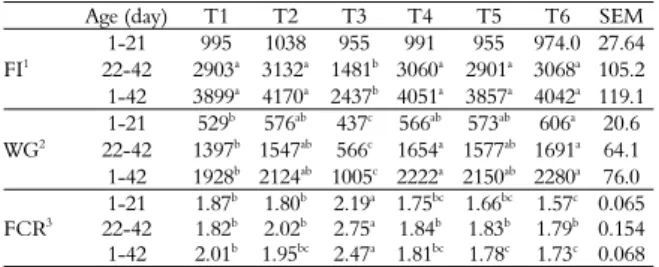
The growth performance parameters data at different growth period (1 to 21 and 22 to 42 days), and during the entire experimental period (1 to 42 days) are presented in Table 2.
The treatments had no significant (p > 0.05) effect on FI at days 1 to 21 days. Birds fed on WBD without vitamin A in premix had less FI than others (p < 0.05) at days 22 to 42 and days 1 to 42. In addition, at all periods, WBD without vitamin A in premix led to less WG and more FCR than other treatments (p < 0.05). At days 22 to 42 and days 1 to 42, WG was greater for WBD supplemented with vitamin A than CBD (p < 0.05). Further, at all periods, WG was greater for WBD supplemented with vitamin A and enzyme than CBD (p < 0.05). In the case of FCR at days 1 to 21, WBD supplemented with vitamin A and enzyme was less than CBD and WBD with routine amounts of vitamin A (p < 0.05). Furthermore, at day 1 to 42, WBD supplemented with vitamin A and enzyme resulted in less FCR than CBD (p < 0.05).
The non-reduction in feed intake, despite the increased viscosity of intestinal contents using diets based on wheat, has also been reported by Nian et al. (2011).
Reduction in weight gain in treatment 3 (WBD without vitamin A) could be due to reduced feed intakes and problems related to increased viscosity and vitamin A deficiency. In current study, enzyme supplementation in T5 did not significantly affect body weight gain and was matched with results by West et al. (2007). It seemed there was improvement in T4 (high level of vitamin A) to increase weight gain and nutrient digestibility related to reduction in viscosity in this treatment. However, enzyme supplementation with vitamin A (T6) improved weight gain and feed conservation ratio (FCR) and demonstrated the role of vitamin A in increasing nutrient digestibility and intestinal epithelial health (Tables 4 and 5). Improvement in Feed Conversion Rate (FCR) of dietary supplementation of enzymes related to enzymes breaks down the cell walls of plants and releases its nutrients, increasing nutrient digestibility which previously had been considered as encapsulated (BEDFORD, 2000).
Table 2. The effect of different treatments on the performance of broiler chickens in different periods of growth (1 to 21; 22 to 42; 1 to 42-days-old).
Age (day) T1 T2 T3 T4 T5 T6 SEM
FI1
1-21 995 1038 955 991 955 974.0 27.64 22-42 2903a 3132a 1481b 3060a 2901a 3068a 105.2
1-42 3899a 4170a 2437b 4051a 3857a 4042a 119.1
WG2
1-21 529b 576ab 437c 566ab 573ab 606a 20.6
22-42 1397b
1547ab
566c
1654a
1577ab
1691a
64.1 1-42 1928b 2124ab 1005c 2222a 2150ab 2280a 76.0
FCR3
1-21 1.87b 1.80b 2.19a 1.75bc 1.66bc 1.57c 0.065
22-42 1.82b 2.02b 2.75a 1.84b 1.83b 1.79b 0.154
1-42 2.01b 1.95bc 2.47a 1.81bc 1.78c 1.73c 0.068
Means with different superscripts in the same row are significantly different (p < 0.05). 1: Feed Intake; 2: Weight Gain; 3: Feed Conversion Rate. T1: corn-based diet (CBD); T2: wheat-based diet (WBD) with routine amounts of vitamin A (9000 IU kg-1); T3: T2 without vitamin A in premix; T4: T2 + 6000 IU kg-1 vitamin A; T5: T2 + 420 IU kg-1 xylanase; T6: T2 + 6000 IU kg-1 vitamin A + 420 IU kg-1 xylanase.
Digesta viscosity and nutrients’ digestibility
Results of measuring digesta viscosity in the jejunum and ileum treatments under study are shown in Table 3. At day 21, WBD significantly (p < 0.05) increased digesta viscosity but supplementation of vitamin A (T4) prevented this effect as birds fed on diet supplemented with enzyme and vitamin A had numerically less digesta viscosity than WBD (p < 0.05).
Table 3. Digesta viscosity (centipoise) of jejunum and ileum at 21 days of age.
T1 T2 T3 T4 T5 T6 SEM Jejunum 2.7b 4.93a 4.73a 2.5b 2.76b 2.52b 0.39
Ileum 2.75b
7.83a
6.99a
2.86b
2.6b
2.25b
0.63
The results of the digestibility of crude protein (CPD) and crude fat (CFD) in different treatments are reported in Table 4. At days 21 and 42, CPD and CFD were less for WBD without vitamin A in premix than others (p < 0.05). Wheat-based diet led to lower CDP and CFD compared with CBD at days 21 and 42 (p < 0.05). Also, supplementation of vitamin A and enzyme (individually or together) improved CPD and CFD for WBD (p < 0.05).
Table 4.The effect of different treatments on digestibility of crude protein (CPD) and crude fat (CFD) in broiler chickens (%).
Age (day) T1 T2 T3 T4 T5 T6 SEM
CPD 21 57.4
b 53c 44.6d 52.8c 57b 60.5a 0.97
42 63.1a 55.3b 35.4c 62.1a 62.2a 64.0a 0.97
CFD 21 79.5
bc 77.7cd 73.8e 76.4de 82.1ab 84.3a 0.87
42 82.8a
77.9b 74.8c 82.8a 83.2a 83.4a 1.02
Means with different superscripts in the same row are significantly different (p < 0.05). T1: corn-based diet (CBD); T2: wheat-based diet (WBD) with routine amounts of vitamin A (9000 IU kg-1); T3: T2 without vitamin A in premix; T4: T2 + 6000 IU kg-1 vitamin A; T5: T2 + 420 IU kg-1 xylanase; T6: T2 + 6000 IU kg-1 vitamin A + 420 IU kg-1 xylanase.
The presence of excess amounts of vitamin A in T4, protein and fat digestibility at 21 days was not affected when compared with T2 (current level of vitamin A) (p > 0.05). However, excess vitamin A (T4) at 42 days compared with current levels of vitamin A (Treatment 2) increased the digestibility of protein and fat (p > 0.05).
After feeding the grain, the water-soluble non-starch polysaccharides part, such as Arabinoxylan, beta-glucan and pectin solved in water increased digesta viscosity. This limited the nutritional value of wheat (BUCHANAN et al., 2007). By breaking the large molecules of non-starch polysaccharides into small polymers, the enzyme decreases the viscosity of the material and increases digestibility and nutritional value of food (CHOCT et al., 2004). In current study, the high levels of vitamin A added to diets based on wheat (T4), as treatments containing enzyme, reduces digesta viscosity when compared to T2, which may be attributed to improvements in gastrointestinal secretions. Currently, the role of vitamin A in the maintenance of the intestinal epithelium and their secretions has been demonstrated (BERDANIER, 1998).
The NSP fraction increases digesta viscosity and protects lipids, starch, and protein, thereby decreasing nutrient digestibility (BASMACIOGLU et al., 2010).
Choct and Annison (1992) reported that the low viscosity material may be available nutrient digestibility. Wang et al. (2003) reported that the addition of xylanase to wheat-based diets improves nutrition digestibility of broiler
chickens and yields better performance than chicks fed on corn-based diets.
Intestinal morphology
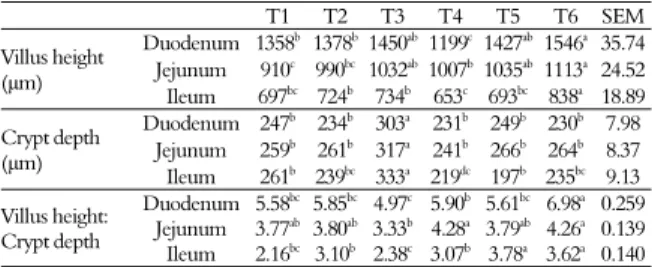
Data related to the morphology of the small intestine in 21 days of age are shown in Table 5. At day 21, the villus (duodenum, jejunum and ileum) was longer (p < 0.05) in broilers fed on diet supplemented with vitamin A and enzyme (T6) than CBD, but WBD had no significant (p > 0.05) effect on villus height when compared to CBD. T4 has lower villous height in the duodenum when compared to the other treatments. In comparison to CBD, crypt depth was not altered by WBD (p > 0.05). However, enzyme and vitamin A supplementation did not change the crypt depth in the duodenum, but ileal crypt in T4 was smaller than T5 (p > 0.05). For duodenum and ileum, villus height: crypt depth was increased by WBD, supplemented with vitamin A and enzyme (p < 0.05).
Table 5. The effect of different treatments on morphological characteristics of small intestine at 21 days of age.
T1 T2 T3 T4 T5 T6 SEM
Villus height (μm)
Duodenum 1358b
1378b 1450ab 1199c 1427ab 1546a 35.74 Jejunum 910c 990bc 1032ab 1007b 1035ab 1113a 24.52
Ileum 697bc 724b 734b 653c 693bc 838a 18.89
Crypt depth (μm)
Duodenum 247b
234b 303a 231b 249b 230b 7.98 Jejunum 259b 261b 317a 241b 266b 264b 8.37
Ileum 261b 239bc 333a 219dc 197b 235bc 9.13
Villus height: Crypt depth
Duodenum 5.58bc
5.85bc 4.97c 5.90b 5.61bc 6.98a 0.259 Jejunum 3.77ab 3.80ab 3.33b 4.28a 3.79ab 4.26a 0.139
Ileum 2.16bc 3.10b 2.38c 3.07b 3.78a 3.62a 0.140
Means with different superscripts in the same row are significantly different (p < 0.05). T1: corn-based diet (CBD); T2: wheat-based diet (WBD) with routine amounts of vitamin A (9000 IU kg-1
); T3: T2 without vitamin A in premix; T4: T2 + 6000 IU kg-1 vitamin A; T5: T2 + 420 IU kg-1 xylanase; T6: T2 + 6000 IU kg-1 vitamin A + 420 IU kg-1 xylanase.
The roles of vitamin A in maintaining the stability of the mucous membranes of cells secreting mucus (goblet cells) have been identified in intestinal tissue (BERDANIER, 1998). Different studies have shown that vitamin A has a complex effect on secretory function of the small intestine that could affect intestinal morphology (NZEGWU; LEVIN, 1991). Improvement in crude protein digestibility observed in T6 (high Vitamin A + enzyme) in comparison with T5 (enzyme alone) at day 21, could be due to better conditions in gastrointestinal mucosal tissues of the digestive tract.
absorption processes of the small intestine, as is the first to make contact with nutrients in the lumen and longer villi increase the absorptive surface of intestine (FAN et al., 1997).
Effect of enzyme added to wheat-based diets in increasing villous height compared to CBD in jejunum was matched to results by Amerah et al. (2008). Several studies have shown that retinol deficiency induced changes in epithelial cells in animals fed on diets deficient in vitamin A. These changes included replacing normal epithelial columns cells with creatine cells. These changes improved by adding vitamin A to the diet (BERDANIER, 1998). Increase in villous height to crypt depth ratio with enzyme supplementation in ileum and enzyme and vitamin A (T6) in three part of intestine resulted in a significant improvement in the digestion and absorption (KELLY et al., 1991).
Conclusion
In conclusion, the results of current study indicated that supplementation of enzyme and high level of vitamin A in the two growth periods or at the entire experimental period could significantly improve performance traits. Therefore, surplus vitamin A may decrease viscosity. Moreover, adding extra level of vitamin A in wheat-base diet may improve intestinal epithelium and decrease erosion effect of NSP resulting in a better nutrition digestibility.
Acknowledgements
The authors would like to thank Shahrekord University for financial support.
References
AMERAH, A. M.; RAVINDRAN, V.; LENTILE, R. G.; THOMAS, D. G. Influence of particle size and xylanase supplementation on the performance, energy utilization, digestive tract parameters and digesta viscosity of broiler starters. British Poultry Science, v. 49, n. 4, p. 455-459, 2008.
AOAC-Association of Official Analytical Chemists. Official methods of analysis. 13th ed. Washington, D.C.: AOAC, 1980.
BASMACIOGLU, H.; BAYSAL, S.; MISIRLIOGLU, Z.; POLAT, M.; YILMAZ, H.; TURAN, N. Effects of oregano essential oil with or without feed enzymes on growth performance, digestive enzyme, nutrient digestibility, lipid metabolism and immune response of broilers fed on wheat-soybean meal diets. British Poultry Science, v. 51, n. 1, p. 67-80, 2010.
BANCROFT, J. D.; GAMBLE, M. Theory and practice of histological Technique. 5th ed. Edinburgh: Churchill Livingstone, 2002.
BEDFORD, M. R. Exogenous enzymes in monogastric nutrition - their current value and future benefits.
Animal Feed Science and Technology, v. 86, n. 1, p. 1-13, 2000.
BERDANIER, C. D. Advanced nutrition: micronutrients. Boca Raton: CRC Press, 1998.
BUCHANAN, N. P.; KIMBLER, L. B.; PARSONS, A. S.; SEIDEL, G. E.; BRYAN, W. B.; FELTON, E. E.; MORITZ J. S. The effect of non-starch polysaccharide enzyme addition and dietary energy restriction on performance and carcass quality of organic broiler chickens. Journal of Application Poultry Research, v. 16, p. 1-12, 2007.
CHOCT, M.; ANNISON, G. The inhibition of nutrient digestion by wheat pentosans. British Journal of Nutrition, v.67, n. 1, p. 123-132, 1992.
CHOCT, M.; KOCHER, A.; WATERS, D. L.; PETTERSSON, D.; ROSS. G. A comparison of three xylanases on the nutritive value of two wheat’s for broiler chickens. British Journal of Nutrition, v. 92, n. 1, p. 53-61, 2004.
D’MELLO, J. P. F. Farm animal metabolism and nutrition. London: CABI Publishing, 2004.
FAN, Y.; CROOM, J.; CHRISTENSEN, V.; BLACK, B.; BIRD. A.; DANIEL. L.; MCBRIDE, B.; EISEN, E. Jejunal glucose uptake and oxygen consumption in turkey poultry selected for rapid growth. Poultry Science, v. 76, p. 1738-1745, 1997.
FENTON, T. W.; FENTON, M. Determination of chromic oxide in feed and feces. Canadian Journal of Animal Science, v. 58, n. 3, p. 631-642, 1979.
GUTIERREZ-ALAMO, A.; PEREZ, D. E.; AYALA, P.; VERSTEGEN, M.; DENHARTOG, L. A.; VILLAMID, M. J. Variability in wheat: factors affecting its nutritional value. World’s Poultry Science Journal, v. 64, n. 1, p. 10-39, 2008.
IJI, P. A.; SAKI, A. A.; TIVEY, D. R. Intestinal development and body growth of broiler chicks on diets supplemented with non-starch polysaccharides. Animal Feed Science and Technology, v. 89, n. 3, p. 175-188, 2001.
JACOBS, L. R. Effects of dietary fiber on mucosal growth and cell proliferation in small intestine of the rat: whit total fiber deprivation. American Journal of Clinical Nutrition, v. 37, n. 6, p. 954-960, 1983.
KELLY, D.; SMYTH, J. A.; MCCRACKEN, K. J. Digestive development of the early-weaned pig. 1. Effect of continuous nutrient supply on the development of the digestive tract and on changes in digestive enzyme activity during the 1st week post weaning. British Journal of Nutrition, v. 65, n. 2, p. 169-180, 1991.
NRC-National Research Council. 9th rev. Nutrient requirements for poultry. Washington, D.C.: National Acadademy Press, 1994.
NZEGWU, H.; LEVIN, R. J. Vitamin A deficiency and small intestinal secretory function in the rat. Gut, v. 32, n. 11, p. 1324-1328, 1991.
performance, net energy and gut microflora of broiler chickens fed wheat-based diets. Asian-Australasian Journal of Animal Science, v. 24, n. 1, p. 400-406, 2011.
SAS-Statistical Analysis System. User’s guide:release 9.1. Cary: SAS Institute, 2002.
WANG, H. Y.; GUO, Y. M.; YUAN, J. M. The effect of xylanase on performance in broilers fed on wheat diets. Feed Study, v. 12, n. 2, p. 1-5, 2003.
WEST, M. L.; CORZO, A.; DOZIER, W. A.; BLAIRAND, M. E.; KIDD, M. T. Assessment of dietar
rovabio excel in practical united states broiler diets. Poultry Science, v. 16, p. 313-321, 2007.
Received on May 17, 2014.
Accepted on July 10, 2014.