www.biogeosciences.net/11/1053/2014/ doi:10.5194/bg-11-1053-2014
© Author(s) 2014. CC Attribution 3.0 License.
Biogeosciences
Exploring local adaptation and the ocean acidification seascape –
studies in the California Current Large Marine Ecosystem
G. E. Hofmann1,3, T. G. Evans2, M. W. Kelly1,*, J. L. Padilla-Gamiño1, C. A. Blanchette3, L. Washburn3,4, F. Chan5, M. A. McManus6, B. A. Menge5, B. Gaylord7,8, T. M. Hill7,9, E. Sanford7,8, M. LaVigne7,9,10, J. M. Rose5,
L. Kapsenberg1, and J. M. Dutton1
1Department of Ecology, Evolution and Marine Biology, University of California Santa Barbara, Santa Barbara, CA
93106-9620, USA
2Department of Biological Sciences, California State University East Bay, Hayward, CA 94542, USA 3Marine Science Institute, University of California Santa Barbara, Santa Barbara, CA 93106-6150, USA 4Department of Geography, University of California Santa Barbara, Santa Barbara, CA 93106-4060, USA 5Department of Zoology, Oregon State University, Corvallis, OR 97331-2914, USA
6Department of Oceanography, University of Hawaii at Manoa, Honolulu, HI 96822, USA 7Bodega Marine Laboratory, University of California Davis, Bodega Bay, CA 94923, USA 8Department of Evolution and Ecology, University of California Davis, Davis, CA 95616, USA 9Department of Geology, University of California Davis, Davis, CA 95616, USA
10Department of Earth and Oceanographic Sciences, Bowdoin College, Brunswick, ME 04011, USA
*current address: Department of Biological Sciences, Louisiana State University, Baton Rouge, LA 70803, USA
Correspondence to: G. E. Hofmann ([email protected])
Received: 31 March 2013 – Published in Biogeosciences Discuss.: 16 July 2013
Revised: 18 December 2013 – Accepted: 30 December 2013 – Published: 24 February 2014
Abstract. The California Current Large Marine Ecosystem (CCLME), a temperate marine region dominated by episodic upwelling, is predicted to experience rapid environmental change in the future due to ocean acidification. The arago-nite saturation state within the California Current System is predicted to decrease in the future with near-permanent un-dersaturation conditions expected by the year 2050. Thus, the CCLME is a critical region to study due to the rapid rate of environmental change that resident organisms will experience and because of the economic and societal value of this coastal region. Recent efforts by a research consor-tium – the Ocean Margin Ecosystems Group for Acidifica-tion Studies (OMEGAS) – has begun to characterize a por-tion of the CCLME; both describing the spatial mosaic of pH in coastal waters and examining the responses of key calcification-dependent benthic marine organisms to natu-ral variation in pH and to changes in carbonate chemistry that are expected in the coming decades. In this review, we present the OMEGAS strategy of co-locating sensors and oceanographic observations with biological studies on
ben-thic marine invertebrates, specifically measurements of func-tional traits such as calcification-related processes and ge-netic variation in populations that are locally adapted to con-ditions in a particular region of the coast. Highlighted in this contribution are (1) the OMEGAS sensor network that spans the west coast of the US from central Oregon to south-ern California, (2) initial findings of the carbonate chem-istry amongst the OMEGAS study sites, and (3) an overview of the biological data that describes the acclimatization and the adaptation capacity of key benthic marine invertebrates within the CCLME.
1 Introduction
al., 2013; Pettorelli, 2012). As exemplified by the study of ocean acidification (OA) (Boyd, 2011; Hofmann et al., 2011; Kroeker et al., 2013), the issues in this scientific endeavor are complex. In addition to the natural complexity in ecosystems emanating from biotic interactions and variability in biologi-cal responses to the environment, physibiologi-cal environmental pa-rameters can also vary dramatically, as is evident when com-paring disparate ecosystems such as tropical reefs and polar seas. From a biological perspective, one way to better pre-dict the consequences of ocean change is to examine ways in which populations could potentially respond to environmen-tal change. One mechanism is inherent physiological plastic-ity that confers tolerance to a changing environment (Chown, 2012; Chown and Gaston, 2008; Helmuth, 2009; Huey et al., 2012); a second is outright evolutionary adaptation to rapidly changing conditions (Hoffmann and Sgrò, 2011; Kelly and Hofmann, 2012; Visser, 2008; Sunday et al., 2013). Of the two responses, evolutionary adaptation may be the most dif-ficult to study. The absence of extensive long-term data sets and the existence of complexity of biological processes com-bined with vast spatial expanses to cover have made studying evolution in the ocean a significant challenge.
In the oceans, major changes in temperature and carbonate chemistry are predicted in the coming decades (Feely et al., 2009; Gruber et al., 2012; Hauri et al., 2013; Orr et al., 2005) and in some ecosystems the rate of change will be rapid. For example, Australia is experiencing warming and extreme heat events (Wernberg et al., 2013) and the western Antarctic Peninsula has warmed significantly in the last two decades with significant decreases in sea ice that have already altered this polar marine ecosystem (Steinberg et al., 2012). In the California Current system, the focus of this article, arago-nite saturation state in the upwelling zone is expected to de-crease rapidly in the future (Gruber et al., 2012; Hauri et al., 2013). Here, within the next 30 yr, summer-long undersatu-ration conditions are expected in nearshore regions in the top 60 m. Thus, the California Current Large Marine Ecosystem (CCLME) is a critical region to study, both in terms of the pace at which associated biota might experience rapid envi-ronmental change and because of the economic and societal value of this coastal region (Costanza et al., 1997). From a biological perspective, we have limited information on how critical species might respond to this predicted shift in ocean chemistry. Major questions remain regarding whether marine species currently possess functional traits that would allow the tolerance of a changing environment, or whether they will be able to adapt to rapidly changing ocean conditions into the future.
Recently, a collaborative group of investigators, who have been studying biological, ecological and oceanographic con-ditions along the US west coast for decades, has begun to tackle these questions in the CCLME using a strategy that involves co-locating oceanographic sensors with biological observations. This group, called OMEGAS (Ocean Margin Ecosystems Group for Acidification Studies), has worked
as a collaborative body since 2010 studying an area span-ning from central Oregon (OR) to southern California (CA; Fig. 1). Research activities include gathering oceanographic observations (e.g., pH,pCO2, alkalinity, temperature,
salin-ity, currents) that are matched with biological data (physio-logical measurements, organismal-level responses to low pH conditions such as growth rates and calcification, and ge-netic data) for key species of calcifying benthic marine in-vertebrates. The central goal of the OMEGAS project is to consider physiological and ecological performance of organ-isms, and genetic variation within and between populations, within the broad spatial mosaic of pH and saturation states found across the CCLME. Ocean acidification is driven by absorption of anthropogenic CO2into surface waters and the
commensurate change in ocean chemistry, both the reduction in pH and the decline in the concentration of carbonate ions, are physiologically challenging to calcifying marine organ-isms (Doney et al., 2009). Further, because pH and saturation state regimes vary widely across the CCLME, our research allows a “substitution of space for time” (Pickett, 1989) ap-proach in an exploration of local adaptation of benthic ma-rine invertebrates to carbonate chemistry (Sanford and Kelly, 2011). The combination of simultaneous oceanographic and biological research across a large latitudinal range will help identify areas on the coast that express a range of acidifi-cation conditions. This information may indicate areas that might be refuges from acidification in the future, and could reveal regions that are adaptation “hot spots”; i.e., places where selection for undersaturation-tolerant genotypes has been underway for long periods of time (Jacobs et al., 2004). Finally, discovery of tolerant populations within the envi-ronmental mosaic of the CCLME can provide an opportu-nity to identify mechanisms that underlie tolerance (Evans et al., 2013a; Evans and Hofmann, 2012). We also hope to ad-dress whether some species possess sufficient physiological and genetic variation to adapt to future change. Species that lack physiological plasticity may quickly become excluded from an environment when change occurs. Alternatively, or-ganisms with the capacity to adapt should do so, and explor-ing the degree of standexplor-ing genetic variation for pH tolerance may help us to forecast responses to environmental change (De Wit and Palumbi, 2012; Kelly et al., 2013; Pespeni et al., 2013a).
Fig. 1. Map of the OMEGAS study sites in the California Current Large Marine Ecosystem. The OMEGAS primary study sites are from north to south: Fogarty Creek (FC), Strawberry Hill (SH); Van Damme (VD); Bodega Marine Reserve (BMR); Terrace Point (TP) and Lompoc Landing (LOL). Note: colors in the image represent sea surface temperature (◦C) from the NOAA CoastWatch database.
invertebrates across the CCLME. Here, we outline three lines of investigation that are integrated across the group and that frame our studies: (1) an overview of a spatially distributed sensor network for quantifying pH dynamics, (2) data on functional traits that may vary in populations and support physiological plasticity, and (3) data on genetic structure of the study populations that link to local adaptation in natural populations and the capacity to adapt to future environmental change in the CCLME.
2 The OMEGAS sensor network: identifying a pH mosaic in the CCLME
A central goal of researchers within the OMEGAS consor-tium is to link biological performance with environmental variability in ocean carbonate chemistry along what we hy-pothesized would be a mosaic or gradient of conditions that might foster local adaptation. Long-term observations have been invaluable in defining the rate of OA progression in low-latitude, open ocean biomes and records from sub-tropical gyre time-series stations (e.g., Bermuda Atlantic Time Series “BATS”, http://www.bios.edu/research/bats.html; Hawaiian Ocean Times Series “HOT”, http://hahana.soest.hawaii.edu/ hot/hot_jgofs.html; European Station for Time Series in the Ocean “ESTOC” http://www.eurosites.info/estoc.php) show a decline of ocean pH from−0.02 to−0.04 pH units over a 20 yr period against low-frequency seasonal oscillations of similar magnitude (Bates et al., 2012; Dore et al., 2009; Santana-Casiano et al. 2007). For coastal regions, the scien-tific community is just now assessing the longer-term vari-ability in pH. Recent analyses of long-term data sets indicate that pH is changing rapidly in coastal Washington (Woot-ton and Pfister, 2012), in coastal upwelling zones along the US Pacific coast (Harris et al., 2013; Chan et al., 2014), at a coastal region in the Netherlands (Provoost et al., 2010), and in the Monterey Bay area where low pH water is asso-ciated with low oxygen water masses that reach the shallow, nearshore regions (Booth et al., 2012). Cruise data have pro-vided snapshots of carbonate chemistry along the coast of the CCLME (Feely et al., 2008), and suggested that at some loca-tions in northern California, undersaturated waters shoaled in the inner shelf. Prior to OMEGAS, however, no coordinated inner-shelf time series were available that would allow eval-uation of the frequency, intensity and spatial expanse with which coastal ecosystems experience rapid acidification.
exploration of patterns of local adaptation to carbonate chem-istry across large marine ecosystems such as the CCLME, where previous studies have demonstrated possible genetic differences among populations (De Wit and Palumbi, 2012; Kelly et al., 2013; Pespeni et al., 2012, 2013a, b, c).
In summer 2011, OMEGAS scientists deployed a network of environmental sensors on the US west coast at locations that span∼1300 km of the CCLME. The sensor network in-cluded intertidally deployed instruments paired with instru-ments mounted on inner-shelf moorings (depth = 15–25 m), initially at eight sites ranging from central Oregon to Santa Barbara, CA (Fig. 1). Descriptions of intertidal sensors and sites and mooring configurations can be found elsewhere (Washburn et al., 2011; Evans et al., 2013; Pespeni et al., 2013c; Adams et al., 2013), but briefly, pH records shown in Fig. 2 are from custom-designed Durafet®-based sensors deployed in open coast, intertidal rocky habitats to record at 10 min intervals. Sensors were calibrated directly against certified reference materials (CRM) or indirectly against CRM-calibrated spectrophometric pH samples. Periodic (2– 4 weeks) discrete samples were collected for checks on sen-sor performance in situ and for characterization of carbonate system chemistry via paired total alkalinity and total CO2or
total alkalinity and spectrophotometric pH samples. Informa-tion on the range of alkalinity in conjuncInforma-tion with the tight covariation between pH andpCO2 served to constrain the
range of possiblepCO2values for the system and to inform
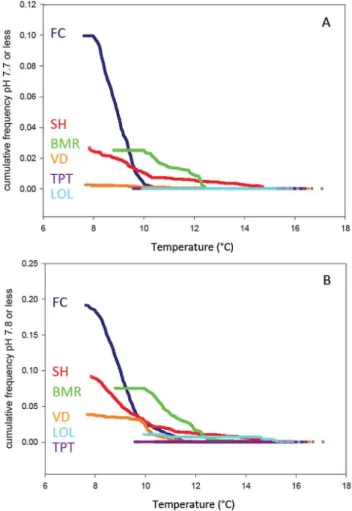
treatment selection for laboratory studies. This region is well known for patterns of episodic upwelling that vary from rel-atively intermittent to the north and relrel-atively persistent to the south (Checkley Jr and Barth, 2009; Menge and Menge, 2013). Recent efforts to characterize the nearshore carbonate chemistry of the California Current system (Fassbender et al., 2011; Feely et al., 2008; Hauri et al., 2009) suggest that biota of this region experience natural variation in pH due to latitudinally and temporally variable upwelling. Results from the OMEGAS sensor network indicate that acidification of coastal waters extends into the nearshore environments of the CCLME with low pH, undersaturated water reach-ing the rocky intertidal zone (Evans et al., 2013; Pespeni et al., 2013c; Chan et al., 2014). Importantly, these data indi-cate that biota in the plankton and benthic marine organisms on shore face an exposure regime to low pH and undersatu-rated waters that is tremendously dynamic in time and space (Evans et al., 2013; Chan et al., 2014). Across the OMEGAS network, the frequency of low pH events encountered in in-tertidal sensors ranged widely (Fig. 2). In central Oregon, as much as 20 % of pH values fell below 7.8. In contrast, sites in central and southern California experienced exposure to pH values below 7.8 less than 2 % of the time. This pattern of spatial separation is even more pronounced when we con-sider pH exposure at even lower-thresholds. For example, the frequency of exposure to low pH conditions of 7.7 or less at Bodega Marine Reserve (BMR) – a site in the geographic center of the network – is most similar to a station 700 km
Fig. 2. Cumulative frequencies of exposure to pH (total scale) less than 7.7 (A) and 7.8 (B) as recorded at 10 min intervals by in situ Durafet®-based pH sensors deployed in intertidal environment be-tween April and September (maximum record length). Exposure frequencies at a given pH threshold are normalized to expanding windows of maximum to minimum in situ water temperature to il-lustrate the response of pH to the progressive strengthening of sea-sonal upwelling at each site.
to the north in central Oregon at Strawberry Hill (SH), than adjacent stations within 150 km to the north at Van Damme (VD) and the southern site Terrace Point (TP). At 14◦C, this pH corresponds to apCO2value of 1200 µatm in our system.
Such values were used to inform experiments described be-low (Fig. 3). Our emerging understanding from this first year of operational deployment of the OMEGAS network thus suggests a mosaic-like coastal pH seascape where organism’s exposure to OA is both geographically defined and variable over spatial scales of dispersal of marine larvae (Gouhier et al., 2010; Navarrete et al., 2008).
Fig. 3. Fertilization success of Strongylocentrotus purpuratus ga-metes across populations andpCO2treatments. Adult urchins were collected from two locations that spanned the CCLME and the OMEGAS study sites: Fogarty Creek (FC), OR, and Bodega Marine Reserve (BMR), CA. Adult pairs from the same site were spawned in the laboratory (FCN=12 pairs; BMRN=8 pairs). Eggs were fertilized at 14◦C under control (400 µatm) and elevated (800 µatm, 1200 µatm)pCO2conditions at an ecologically relevant sperm con-centration of 7×10³sperm mL−1. Gametes were allowed a 30 min contact time and at least 200 eggs were scored per pair after the sec-ond cleavage. There was no significant effect ofpCO2by popula-tion (two-way ANOVA;pCO2×site effectp=0.8577;pCO2 ef-fectp=0.3168; site effectp=0.7147). A similar pattern was ob-served at higher and lower sperm concentrations (data not shown).
a function of measurements below pH 7.7, Fogarty Creek (FC) in Oregon has a much greater number of measurements below pH 7.7 whereas sites in California, Lompoc Landing (LOL), have the lowest frequency (Fig. 2a). If that filter is changed to pH 7.8, Fogarty Creek continues to maintain its position as the site with the greatest frequency of low pH exposure, other sites in central California begin to show ele-vated frequency of low pH but LOL in the south persists in being a low OA site (Fig. 2b).
3 The biology: assessing physiological plasticity and functional traits
Having demonstrated the mosaic of pH experienced by or-ganisms at study sites across the CCLME, OMEGAS inves-tigators began to explore whether there are functional traits and physiological performance profiles in key calcification-dependent organisms that are acclimatized to this pattern of carbonate chemistry conditions. Although it is difficult to pin any one phenotypic element on a single selection factor in the environment (e.g., temperature or pH alone), the impor-tance of the phenotype and tolerance traits has been increas-ingly recognized as a key mechanism by which a species might respond to environmental change in a number of sys-tems (Buckley and Kingsolver, 2012; Chown, 2012; Chown and Gaston, 2008; Helmuth, 2009). Recently within the
OMEGAS research community, functional traits and phys-iological tolerances have been measured in an environmen-tally relevant context (Evans et al., 2013; Kelly et al., 2013; Padilla-Gamiño et al., 2013; Pespeni et al., 2013a; Yu et al., 2011). The OMEGAS group hypothesized that such pheno-typic traits would show variation across space if benthic in-vertebrates are acclimatized to the local conditions (Chown, 2012) such that they might also contribute to how species respond to environmental change.
Studies initiated by the OMEGAS research teams first fo-cused on populations of ecologically important calcification-dependent benthic marine invertebrates, the purple sea urchin, Strongylocentrotus purpuratus, and the mussel, Mytilus californianus, across the OMEGAS study sites. Ex-periments conducted by the group included field exEx-periments at different OMEGAS sites and laboratory mesocosms that tested the response of organisms from various populations to variation in pH. The overall results of the laboratory com-ponent demonstrated that the two study organisms displayed different degrees of sensitivity to shifts in ocean chemistry with sea urchins appearing to be more resilient to variation in partial pressure of carbon dioxide (pCO2) than mussels.
Specifically, larval culturing of purple sea urchins in CO2
mesocosms showed sea urchin larvae were tolerant ofpCO2
levels that are representative of present-daypCO2levels
doc-umented by OMEGAS field sensors. That is, growth, mor-phology, early development to echinopluteus and develop-ment to metamorphosis were rarely affected (Kelly et al., 2013; Padilla-Gamiño et al., 2013; Pespeni et al., 2013a), although minor decreases in the size of the larval skeleton were seen at elevatedpCO2s of around 1000 µatm
(Padilla-Gamiño et al., 2013). The mechanistic underpinning of this tolerance and physiological plasticity is currently being ex-amined in greater detail. However, in the analyses of urchin larvae from the CO2 mesocosm experiments, the
transcrip-tome displayed variable gene expression during development that likely compensates for carbonate under-saturation and challenges to calcification and pHi homeostasis (Evans et
al., 2013a). In contrast, laboratory studies on mussel larvae (M. californianus) showed that low pH conditions reduced growth and shell strength (Gaylord et al., 2011). In light of the pH mosaic data from the sensors, these results suggest that mussel recruits will vary across the CCLME in terms of their susceptibility to drilling and crushing predators, and that susceptibility will increase through time.
When functional traits were compared from animals in populations across the OMEGAS study sites, we found a more complicated story. However, for the most part, results thus far highlight a resilience of function in the study’s ma-rine invertebrate organisms. First, in line with the robustness of the early-life embryonic stages of sea urchins in meso-cosm studies, analysis of fertilization kinetics using adult, purple sea urchins collected from OMEGAS sites showed that fertilization success was not affected by elevatedpCO2
at BMR showing the same insensitivity to elevated pCO2.
Similarly, larval culturing of sea urchins demonstrated that larvae from northern and southern populations have similar and more resilient metabolic responses to pCO2 (Kelly et
al., 2013). Specifically, oxygen consumption rates in early pluteus did not change between larvae reared under differ-entpCO2conditions (Fig. 4a), and this response was
con-sistent between populations exposed to different upwelling regimes (Kelly et al., 2013). Examining a feature of juvenile and adult sea urchins – the mineralogy of the calcium car-bonate skeleton– LaVigne et al. (2013) found that for the most part the composition of the skeleton was not differ-ent in urchins collected across the latitudinal gradidiffer-ent of the OMEGAS study sites. Adult spine composition (Mg / Ca and Sr / Ca ratios) was not different between populations from Fogarty Creek, Oregon, in the north to others near Lom-poc Landing in southern California (LaVigne et al., 2013) (Fig. 4b).
Finally, field experiments examined mussel growth at all the OMEGAS sites and, surprisingly, evidence to date sug-gests that adult mussel growth was not reduced at low pH sites across the OMEGAS regions (Fig. 4c). The results are more strongly correlated to other characteristics of the sites and growth may be driven by other factors such as food avail-ability (Thomsen et al., 2013) and temperature (Blanchette et al., 2007; Menge et al., 2008). These results that highlight different responses in life history stages of mussels (adult vs. larval forms) are intriguing, and our emphasis in future research will be to investigate the changes in physiology and ecology that underlie this apparent ontogenetic shift in sen-sitivity in M. californianus.
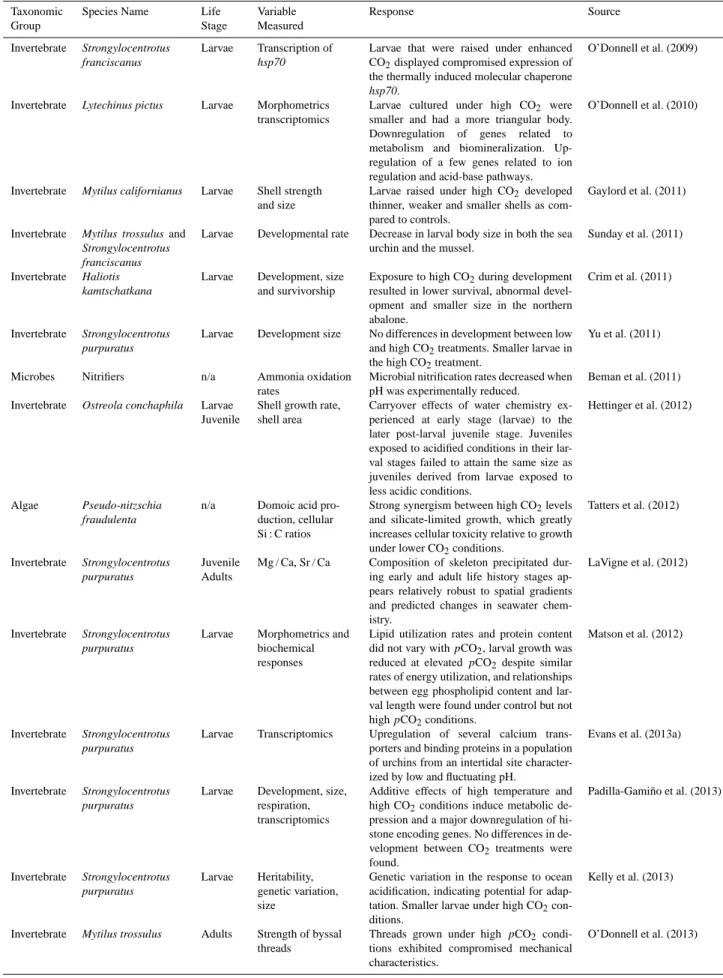
Taken together, studies initiated by the OMEGAS research teams have made two critical observations: species display a range of sensitivities to OA in the laboratory, and patterns of functional traits in natural populations show unexpected di-vergences from expectations (e.g., faster growth at sites with more extreme exposure to pH). Additional insights and res-olution of these patterns await further study in the coming field seasons for OMEGAS research. Finally, it should be noted that only a very few species from the rich biota of the CCLME have been studied in an OA context (Table 1) and determining the OA tolerance across a larger number of species occupying similar pH environments in the CCLME is a critical research need.
4 Local adaptation and benthic marine invertebrates of the CCLME
In addition to studying functional traits of study organisms, several lines of investigation within the OMEGAS group have been designed to address local adaptation. Local adap-tation occurs when there is genetic variation among popula-tions that matches some aspect of the environment, so that on average “local” genotypes outperform “foreign” genotypes
when they compete against one another in the home environ-ment (Kawecki and Ebert, 2004). An understanding of local adaptation is relevant to forecasting a species’ capacity to adapt to global change for two reasons. First, adaptation de-pends on genetic variation. Local adaptation to a particular gradient (temperature, pH) implies the existence of variation that will allow for adaptation to changes in that gradient in the future. In addition, the capacity to adapt to an environ-mental variable in space, suggests the capacity to adapt to changes in that variable through time. And conversely, limits to adaptation in space (for example failure to adapt to max-imum temperatures above 20◦C at a southern range limit) suggest possible limits to adaptation in the face of future changes.
There are several approaches to describing local adapta-tion. The gold standard for demonstrating local adaptation is a set of reciprocal transplants among sites, followed by a comparison of some aspect of performance for “local” vs. “foreign” genotypes in each environment. However, when lo-cal genotypes can be shown to have the highest performance in a particular environment it will not always be clear to which aspect of the environment they are responding to, as aspects of the environment (e.g., temperature, pH, biotic in-teractions) often co-vary. To test for adaptation to a specific environmental variable of interest, it will often be necessary to bring organisms from different populations into the labora-tory, and examine variation in performance along a particular axis of environmental variation.
This type of laboratory experiment was done by OMEGAS investigators with sea urchins. Kelly et al. (2013) per-formed quantitative genetic crosses among purple sea urchins (Strongylocentrotus purpuratus) from two different sites with different upwelling regimes, and then reared the offspring of these crosses under high and lowpCO2. They found
abun-dant genetic variation for the response to high pCO2, but
only minor differences between the offspring of males from the two sites. However these small differences were consis-tent with local adaptation to pH, with offspring from the site with more exposure to extreme pH levels showing a lesser sensitivity to low pH (Fig. 5). The lack of large differences among populations is also consistent with the biology of pur-ple urchins, which have long-lived planktonic larvae, and therefore relatively homogenized populations (Edmands et al., 1996).
Table 1. Ocean acidification studies on functional traits of organisms in the California Current Large Marine Ecosystem.
Taxonomic Species Name Life Variable Response Source
Group Stage Measured
Invertebrate Strongylocentrotus franciscanus
Larvae Transcription of hsp70
Larvae that were raised under enhanced CO2displayed compromised expression of
the thermally induced molecular chaperone hsp70.
O’Donnell et al. (2009)
Invertebrate Lytechinus pictus Larvae Morphometrics transcriptomics
Larvae cultured under high CO2 were
smaller and had a more triangular body. Downregulation of genes related to metabolism and biomineralization. Up-regulation of a few genes related to ion regulation and acid-base pathways.
O’Donnell et al. (2010)
Invertebrate Mytilus californianus Larvae Shell strength and size
Larvae raised under high CO2 developed
thinner, weaker and smaller shells as com-pared to controls.
Gaylord et al. (2011)
Invertebrate Mytilus trossulus and Strongylocentrotus franciscanus
Larvae Developmental rate Decrease in larval body size in both the sea urchin and the mussel.
Sunday et al. (2011)
Invertebrate Haliotis kamtschatkana
Larvae Development, size and survivorship
Exposure to high CO2during development
resulted in lower survival, abnormal devel-opment and smaller size in the northern abalone.
Crim et al. (2011)
Invertebrate Strongylocentrotus purpuratus
Larvae Development size No differences in development between low and high CO2treatments. Smaller larvae in
the high CO2treatment.
Yu et al. (2011)
Microbes Nitrifiers n/a Ammonia oxidation
rates
Microbial nitrification rates decreased when pH was experimentally reduced.
Beman et al. (2011)
Invertebrate Ostreola conchaphila Larvae Juvenile
Shell growth rate, shell area
Carryover effects of water chemistry ex-perienced at early stage (larvae) to the later post-larval juvenile stage. Juveniles exposed to acidified conditions in their lar-val stages failed to attain the same size as juveniles derived from larvae exposed to less acidic conditions.
Hettinger et al. (2012)
Algae Pseudo-nitzschia fraudulenta
n/a Domoic acid pro-duction, cellular Si : C ratios
Strong synergism between high CO2levels
and silicate-limited growth, which greatly increases cellular toxicity relative to growth under lower CO2conditions.
Tatters et al. (2012)
Invertebrate Strongylocentrotus purpuratus
Juvenile Adults
Mg / Ca, Sr / Ca Composition of skeleton precipitated dur-ing early and adult life history stages ap-pears relatively robust to spatial gradients and predicted changes in seawater chem-istry.
LaVigne et al. (2012)
Invertebrate Strongylocentrotus purpuratus
Larvae Morphometrics and biochemical responses
Lipid utilization rates and protein content did not vary withpCO2, larval growth was
reduced at elevatedpCO2despite similar
rates of energy utilization, and relationships between egg phospholipid content and lar-val length were found under control but not highpCO2conditions.
Matson et al. (2012)
Invertebrate Strongylocentrotus purpuratus
Larvae Transcriptomics Upregulation of several calcium trans-porters and binding proteins in a population of urchins from an intertidal site character-ized by low and fluctuating pH.
Evans et al. (2013a)
Invertebrate Strongylocentrotus purpuratus
Larvae Development, size, respiration, transcriptomics
Additive effects of high temperature and high CO2conditions induce metabolic
de-pression and a major downregulation of hi-stone encoding genes. No differences in de-velopment between CO2 treatments were
found.
Padilla-Gamiño et al. (2013)
Invertebrate Strongylocentrotus purpuratus
Larvae Heritability, genetic variation, size
Genetic variation in the response to ocean acidification, indicating potential for adap-tation. Smaller larvae under high CO2
con-ditions.
Kelly et al. (2013)
Invertebrate Mytilus trossulus Adults Strength of byssal threads
Threads grown under high pCO2
condi-tions exhibited compromised mechanical characteristics.
Fig. 4. Responses of marine calcifiers at the OMEGAS sites. (A) Respiration rates in larval sea urchins of Strongylocentrotus purpuratus; Sea urchin larvae from the Santa Barbara area and Van Damme were raised at 13◦C under high (1100 µatm) and low (400 µatm) pCO2 using a flow-through CO2mixing system. Rates of oxygen consumption were obtained 92 h after fertilization in early pluteus larvae. Larval respiratory rates did not differ among sites orpCO2treatments. (B) Biomineral composition of the spines of adult S. purpuratus; data shown are mean Mg / Ca (upper panel) and Sr / Ca (lower panel) ratios for spines collected from adult urchins at OMEGAS study sites: Purisma Point (PP), CA, near Lompoc Landing, Terrace Point (TPT), CA, Van Damme State Park (VD) and Fogarty Creek (FC), OR; (C) Growth of intertidal mussels, Mytilus californianus, during the 2011 summer upwelling season. Mussels∼40 mm in length were collected in April 2011 from the OMEGAS sites, notched at the posterior lip of the shell, and outplanted back to each site. Mussels were retrieved in October 2011, and growth was measured as the increase in shell length. Growth rate is expressed as millimeters per day, standardized by initial length; results shown here are scaled by the number of days for the study duration at each site and the individual mussel length at study initiation. Site abbreviations as in Fig. 1 and the text.
appeared to be under spatially varying selection. A limita-tion of the approach used in both of these studies is that variation in gene sequences often cannot be directly tied to variation in organismal performance. Furthermore, because of co-variation in environmental variables it is often diffi-cult to know which aspect of the environment is selecting for differences in allele frequencies among populations. How-ever studies like these provide a rich foundation for ongoing work attempting to identify the genetic basis of local adap-tation. Notably, in a mesocosm experiment where urchin lar-vae from OMEGAS study sites were cultured under ecolog-ically relevantpCO2conditions for the CCLME, Pespeni et
al. (2013a) found significant allelic change in 40 classes of functional proteins in gene classes for ion homeostasis and biomineralization, suggesting that standing genetic variation does exist within these study populations at the OMEGAS sites.
We are currently testing for local adaptation to carbonate chemistry in another species from the CCLME with a very different life history and dispersal mode from purple urchins. Coralline algae are an ecologically important group of ma-rine calcifiers that live in almost every habitat in the world’s
oceans, from the tropics to the polar regions (Johansen, 1981). Coralline algae are very abundant along the CCLME (Abbott and Hollenberg, 1976) providing substrata and set-tlement cues to invertebrate larvae and serving as habitat for many marine species (Johansen, 1981). Coralline algae are highly vulnerable to ocean acidification (Koch et al., 2013) and, to date, it is unclear how more acidified waters will af-fect algal physiological mechanisms dependent on HCO3
Fig. 5. Breeding experiment conducted using purple urchin adults collected from two OMEGAS study sites. (A) Cross design: we crossed adult urchins from two sites in California, US (inset), known to differ in their carbonate chemistry regimes (OMEGAS sites: northern CA, Van Damme; southern CA, Santa Barbara). In the lab, we crossed each male with two females from his own site, and two females from the opposite site, and split embryos from each cross into low and high pCO2 rearing conditions. (B) To-tal larval length (±SD) of S. purpuratus raised for five days un-der lowpCO2 and highpCO2 conditions. Offspring of northern CA sires are larger than the offspring of southern CA sires un-der highpCO2(pMCMC = 0.012) but not under lowpCO2 (pM-CMC = 0.27). Modified from Kelly et al 2013.
in the potential for adaptation could have important implica-tions for the distribution of C. vancouveriensis and the or-ganisms in the CCLME that depend on them.
5 Summary and future directions
The OMEGAS consortium has used a strategy of co-locating sensors and biological observations to begin to describe pat-terns of acclimatization and local adaptation in the CCLME. Ultimately, the goal of this research consortium is to use this information to forecast the impacts of future acidifica-tion in coastal regions around the globe. Co-locating sensors with measures of physiological performance makes sense, but should be more deeply appreciated in a biological con-text. Since it is the physical environment that makes a large contribution to genetic variation in populations, we would predict that regions characterized by large variation in pH
and changes in saturation state may have organisms with dif-ferent physiological tolerances and with difdif-ferent genetics in terms of OA tolerance (Kelly and Hofmann, 2012; Kelly et al., 2013; Pespeni et al., 2013a). Thus, from a global change biology perspective, this strategy also allows us to explore the extent to which physiological plasticity vs. the capacity for adaptation might play a role in species response to envi-ronmental change.
Our emerging understanding of a spatial mosaic of coastal pH has facilitated studies of biological responses to system-relevant, mean-state changes in carbonate chemistry. As we gain insights from this first-order coupling between field ob-servations and laboratory studies, we anticipate that a deep-ening understanding of the temporal variability of OA stress, its scope for future changes and covariation with other global change stressors will similarly enable a new generation of physiological, ecological and evolutionary studies. For ample, organisms in the CCLME will face changes in ex-posures to both the severity and frequency of low pH and saturation state conditions (Hauri et al., 2013), with impacts that can interact with exposures to declining oxygen concen-trations (Rykaczewski and Dunne 2010, Cocco et al., 2012). While capacity for resolving mean state vs. variability im-pacts and interactions between multiple stressors remains a limiting factor in the field, development of new experimen-tal systems (Bockmon et al., 2013) can enable experimenexperimen-tal treatments that mimic exposure regimes that organisms are observed and forecasted to face in situ. Such advances will be crucial to making more robust forecasts regarding the eco-logical consequences of future ocean change (Boyd, 2011; Harvey et al., 2013). Finally, as the complexity of this issue unfolds it will require that scientists engage more actively with policy makers, conservation biologists, and managers of critical marine ecosystems (Dawson et al., 2011; Ibáñez et al., 2013; Kelly et al., 2011).
Acknowledgements. We thank NOAA CoastWatch and Reiko
Michisaki for providing the satellite image used in Fig. 1. This research was funded by US National Science Foundation grant (NSF OCE-1040960) to the Ocean Margins Ecosystem Group for Acidification Studies (OMEGAS), a consortium of scien-tists from different institutions along the US west coast (see http://omegas.science.oregonstate.edu/), by funds from NSF grant IOS-1021536 to G. E. Hofmann and by funds from the University of California in support of a multi-campus research program, Ocean Acidification: A Training and Research Consortium (http://oceanacidification.msi.ucsb.edu/), to G. E. Hofmann, E. Sanford, B. Gaylord, and T. M Hill. Research presented here was also supported in part by grants from the David and Lucile Packard Foundation to the Partnership for Interdisciplinary Studies of Coastal Oceans (PISCO) consortium (http://piscoweb.org).
References
Abbott, I. A. and Hollenberg, G. J.: Marine algae of california, 1st ed., Stanford University Press, 827 pp., 1976.
Adams, K. A., Chan, F., and Barth, J. A.: Temporal variability of near-bottom dissolved oxygen during upwelling off central Ore-gon, J. Geophys. Res.-Oceans, 118, 4839–4854, 2013.
Bates, N. R., Best, M. H. P., Neely, K., Garley, R., Dickson, A. G., and Johnson, R. J.: Detecting anthropogenic carbon dioxide uptake and ocean acidification in the North Atlantic Ocean, Bio-geosciences, 9, 2509–2522, doi:10.5194/bg-9-2509-2012, 2012. Beman, J. M., Chow, C. E., King, A. L., Feng, Y. Y., Fuhrman, J. A., Andersson, A., Bates, N. R., Popp, B. N., and Hutchins, D. A.: Global declines in oceanic nitrification rates as a consequence of ocean acidification, P. Natl. Acad. Sci. USA, 108, 208–213, doi:10.1073/pnas.1011053108, 2011.
Blanchette, C. A., Helmuth, B., and Gaines, S. D.: Spatial patterns of growth in the mussel, Mytilus californianus, across a major oceanographic and biogeographic boundary at Point Concep-tion, California, USA, J. Exp. Mar. Biol. Ecol., 340, 126–148, doi:10.1016/j.jembe.2006.09.022, 2007.
Bockmon, E. E., Frieder, C. A., Navarro, M. O., White-Kershek, L. A., and Dickson, A. G.: Technical Note: Controlled experimen-tal aquarium system for multi-stressor investigation of carbonate chemistry, oxygen saturation, and temperature, Biogeosciences, 10, 5967–5975, doi:10.5194/bg-10-5967-2013, 2013.
Booth, J. A. T., McPhee-Shaw, E. E., Chua, P., Kingsley, E., Denny, M., Phillips, R., Bograd, S. J., Zeidberg, L. D., and Gilly, W. F.: Natural intrusions of hypoxic, low pH water into nearshore marine environments on the California coast, Cont. Shelf Res., 45, 108–115, doi:10.1016/j.csr.2012.06.009, 2012.
Boyd, P. W.: Beyond ocean acidification, Nat. Geosci., 4, 273–274, 2011.
Buckley, L. B. and Kingsolver, J. G.: Functional and phylogenetic approaches to forecasting species’ responses to climate change, Annu. Rev. Ecol. Evol. Syst., 43, 205–226, doi:10.1146/annurev-ecolsys-110411-160516, 2012.
Chan, F., Barth, J., Blanchette, C., Chavez, F., Cheriton, O., Friederich, G., gay, Gouhier, T., Hill, T. M., Hofmann, G. E., McManus, M., Menge, B. A., Russell, A. D., Sanford, E., and Washburn, L.: Widespread detection of coastal ocean acidifica-tion across the California Current System, in preparaacidifica-tion, 2014. Checkley Jr, D. M. and Barth, J. A.: Patterns and processes in
the California Current System, Progr. Oceanogr., 83, 49–64, doi:10.1016/j.pocean.2009.07.028, 2009.
Chown, S. L.: Trait-based approaches to conservation physiology: Forecasting environmental change risks from the bottom up, P. T. Roy. Soc. B, 367, 1615–1627, doi:10.1098/rstb.2011.0422, 2012. Chown, S. L. and Gaston, K. J.: Macrophysiology for a changing
world, Proc. Roy. Soc. B, 275, 1469–1478, 2008.
Costanza, R., d’Arge, R., de Groot, R., Farber, S., Grasso, M., Han-non, B., Limburg, K., Naeem, S., O’Neil, R. V., Paruelo, J., Raskin, R. G., Sutton, P., and van den Belt, M.: The value of the world’s ecosystem services and natural capital, Nature, 387, 253–260, 1997.
Crim, R. N., Sunday, J. M., and Harley, C. D. G.: Elevated sea-water CO2 concentrations impair larval development and re-duce larval survival in endangered northern abalone
(Halio-tis kamtschatkana), J. Exp. Mar. Biol. Ecol., 400, 272–277,
doi:10.1016/j.jembe.2011.02.002, 2011.
Dawson, T. P., Jackson, S. T., House, J. I., Prentice, I. C., and Mace, G. M.: Beyond predictions: Biodiversity conservation in a chang-ing climate, Science, 332, 53–58, doi:10.1126/science.1200303, 2011.
De Wit, P. and Palumbi, S. R.: Transcriptome-wide polymor-phisms of red abalone (Haliotis rufescens) reveal patterns of gene flow and local adaptation, Molecul. Ecol., 22, 2884–2897, doi:10.1111/mec.12081, 2012.
Doney, S. C., Fabry, V. J., Feely, R. A., and Kleypas, J. A.: Ocean Acidification: The Other CO2Problem, Annu. Rev. Mar. Sci., 1, 169–192, 2009.
Dore, J. E., Lukas, R., Sadler, D. W., Church, M. J., and Karl, D. M.: Physical and biogeochemical modulation of ocean acidification in the central North Pacific, P. Natl. Acad. Sci. USA, 106, 12235– 12240, 2009.
Edmands, S., Moberg, P. E., and Burton, R. S.: Allozyme and mito-chondrial DNA evidence of population subdivision in the purple sea urchin Strongylocentrotus purpuratus, Mar. Biol., 126, 443– 450, 1996.
Evans, T. G. and Hofmann, G. E.: Defining the limits of physio-logical plasticity: How gene expression can assess and predict the consequences of ocean change, Philosophical Transactions of the Royal Society B: Biological Sciences, 367, 1733-1745, 10.1098/rstb.2012.0019, 2012.
Evans, T. G., Chan, F., Menge, B. A., and Hofmann, G. E.: Tran-scriptomic responses to ocean acidification in larval sea urchins from a naturally variable pH environment, Molecul. Ecol., 22, 1609–1625, doi:10.1111/mec.12188, 2013.
Fassbender, A. J., Sabine, C. L., Feely, R. A., Langdon, C., and Mordy, C. W.: Inorganic carbon dynamics during northern Cal-ifornia coastal upwelling, Cont. Shelf Res., 31, 1180–1192, doi:10.1016/j.csr.2011.04.006, 2011.
Feely, R. A., Sabine, C. L., Hernandez-Ayon, J. M., Ianson, D., and Hales, B.: Evidence for upwelling of corrosive “acidi-fied” water onto the continental shelf, Science, 320, 1490–1492, doi:10.1126/science.1155676, 2008.
Feely, R. A., Doney, S. C., and Cooley, S. R.: Ocean acidification: Present conditions and future changes in a high- CO2 world, Oceanography, 22, 37–47, 2009.
Frieder, C. A., Nam, S. H., Martz, T. R., and Levin, L. A.: High temporal and spatial variability of dissolved oxygen and pH in a nearshore California kelp forest, Biogeosciences, 9, 3917–3930, doi:10.5194/bg-9-3917-2012, 2012.
Gaylord, B., Hill, T. M., Sanford, E., Lenz, E. A., Jacobs, L. A., Sato, K. N., Russell, A. D., and Hettinger, A.: Functional im-pacts of ocean acidification in an ecologically critical foundation species, J. Exp. Biol., 214, 2586–2594, 2011.
Gillson, L., Dawson, T. P., Jack, S., and McGeoch, M. A.: Accom-modating climate change contingencies in conservation strategy, Trends Ecol. Evol., 28, 135–142, doi:10.1016/j.tree.2012.10.008, 2013.
Gouhier, T. C., Guichard, F., and Menge, B. A.: Ecologi-cal processes can synchronize marine population dynamics over continental scales, P. Natl. Acad. Sci., 107, 8281–8286, doi:10.1073/pnas.0914588107, 2010.
Hall-Spencer, J. M., Rodolfo-Metalpa, R., Martin, S., Ran-some, E., Fine, M., Turner, S. M., Rowley, S., Tedesco, D., and Buia, M.-C.: Volcanic carbon dioxide vents show ecosystem effects of ocean acidification, Nature, 454, 96–99, doi:10.1038/nature07050, 2008.
Harris, K. E., DeGrandpre, M. D., and Hales, B.: Aragonite satura-tion state dynamics in a coastal upwelling zone, Geophys. Res. Lett., 40, 1–6, 2013.
Harvey, B. P., Gwynn-Jones, D., and Moore, P. J.: Meta-analysis reveals complex marine biological responses to the interactive effects of ocean acidification and warming, Ecol. Evol., 3, 1016– 1030, doi:10.1002/ece3.516, 2013.
Hauri, C., Gruber, N., Plattner, G.-K., Alin, S., Feely, R. A., Hales, B., and Wheeler, P. A.: Ocean acidification in the California Cur-rent System, Oceanography, 22, 60–71, 2009.
Hauri, C., Gruber, N., Vogt, M., Doney, S. C., Feely, R. A., Lachkar, Z., Leinweber, A., McDonnell, A. M. P., Munnich, M., and Plat-tner, G.-K.: Spatiotemporal variability and long-term trends of ocean acidification in the California Current System, Biogeo-sciences, 10, 193–216, doi:10.5194/bg-10-193-2013, 2013. Helmuth, B.: From cells to coastlines: How can we use physiology
to forecast the impacts of climate change?, J. Exp. Biol., 212, 753–760, 2009.
Hettinger, A., Sanford, E., Hill, T. M., Russell, A. D., Sato, K. N. S., Hoey, J., Forsch, M., Page, H. N., and Gaylord, B.: Persistent carry-over effects of planktonic exposure to ocean acidification in the Olympia oyster, Ecology, 93, 2758–2768, 2012.
Hoffmann, A. A. and Sgrò, C. M.: Climate change and evolutionary adaptation, Nature, 470, 479–485, 2011.
Hofmann, G. E., Smith, J. E., Johnson, K. S., Send, U., Levin, L. A., Micheli, F., Paytan, A., Price, N. N., Peterson, B., Takeshita, Y., Matson, P. G., Crook, E. D., Kroeker, K. J., Gambi, M. C., Rivest, E. B., Frieder, C. A., Yu, P. C., and Martz, T. R.: High-frequency dynamics of ocean pH: A multi-ecosystem comparison, PLoS ONE, 6, e28983, doi:10.1371/journal.pone.0028983, 2011. Hofmann, G. E., Blanchette, C. A., Rivest, E. B., and Kapsenberg,
L.: Taking the pulse of marine ecosystems: The importance of coupling long-term physical and biological observations in the context of global change biology, Oceanography, 26, 140–148, 2013.
Huey, R. B., Kearney, M. R., Krockenberger, A., Holtum, J. A. M., Jess, M., and Williams, S. E.: Predicting organismal vulnerability to climate warming: Roles of behaviour, physiology and adapta-tion, P. T. Roy. Soc. B, 367, 1665–1679, 2012.
Ibáñez, I., Gornish, E. S., Buckley, L., Debinski, D. M., Hellmann, J., Helmuth, B., HilleRisLambers, J., Latimer, A. M., Miller-Rushing, A. J., and Uriarte, M.: Moving forward in global-change ecology: Capitalizing on natural variability, Ecol. Evol., 3, 170–181, doi:10.1002/ece3.433, 2013.
Jacobs, D. K., Haney, T. A., and Louie, K. D.: Genes, diversity, and geologic process on the pacific coast, Annu. Rev. Earth Planet. S., 32, 601–652, 2004.
Johansen, H. W.: Coralline algae, a first synthesis, CRC Press, Inc., Boca Raton, Florida, 239 pp., 1981.
Kawecki, T. J. and Ebert, D.: Conceptual issues in local adaptation, Ecol. Lett., 7, 1225–1241, 2004.
Kelly, M. W. and Hofmann, G. E.: Adaptation and the phys-iology of ocean acidification, Funct. Ecol., 27, 980–990, doi:10.1111/j.1365-2435.2012.02061.x, 2012.
Kelly, M. W., Padilla-Gamiño, J. L., and Hofmann, G. E.: Natural variation, and the capacity to adapt to high pCO2 in a keystone species, Glob. Change Biol., 19, 2536–2546, doi:10.1111/gcb.12251, 2013 .
Kelly, R. P., Foley, M. M., Fisher, W. S., Feely, R. A., Halpern, B. S., Waldbusser, G. G., and Caldwell, M. R.: Mitigating local causes of ocean acidification with existing laws, Science, 332, 1036–1037, doi:10.1126/science.1203815, 2011.
Koch, M., Bowes, G., Ross, C., and Zhang, X. H.: Cli-mate change and ocean acidification effects on seagrasses and marine macroalgae, Glob. Change Biol., 19, 103–132, doi:10.1111/j.1365-2486.2012.02791.x, 2013.
Kroeker, K. J., Micheli, F., Gambi, M. C., and Martz, T. R.: Diver-gent ecosystem responses within a benthic marine community to ocean acidification, P. Natl. Acad. Sci. USA, 108, 14515–14520, doi:10.1073/pnas.1107789108, 2011.
Kroeker, K. J., Kordas, R. L., Crim, R., Hendriks, I. E., Ramajo, L., Singh, G. S., Duarte, C. M., and Gattuso, J.-P.: Impacts of ocean acidification on marine organisms: Quantifying sensitivities and interaction with warming, Glob. Change Biol., 19, 1884–1896, doi:10.1111/gcb.12179, 2013.
LaVigne, M., Hill, T. M., Sanford, E., Gaylord, B., Russell, A. D., Lenz, E. A., Hosfelt, J. D., and Young, M. K.: The elemental composition of purple sea urchin (Strongylocentrotus
purpura-tus) calcite and potential effects ofpCO2during early life stages, Biogeosciences, 10, 3465–3477, doi:10.5194/bg-10-3465-2013, 2013.
Martz, T. R., Connery, J. G., and Johnson, K. S.: Testing the Honey-well Durafet®for seawater pH applications, Limnol. Oceanogr.-Methods, 8, 172–184, 2010.
Matson, P. G., Yu, P. C., Sewell, M. A., and Hofmann, G. E.: De-velopment under elevatedpCO2conditions does not affect lipid utilization and protein content in early life-history stages of the purple sea urchin, Strongylocentrotus purpuratus, Biol. Bullet., 223, 312–327, 2012.
Menge, B. A. and Menge, D. N. L.: Dynamics of coastal meta-ecosystems: The intermittent upwelling hypothesis and a test in rocky intertidal regions, Ecol. Monogr., 83, 283–310, doi:10.1890/12-1706.1, 2013.
Menge, B. A., Chan, F., and Lubchenco, J.: Response of a rocky in-tertidal ecosystem engineer and community dominant to climate change, Ecol. Lett., 11, 151–162, 2008.
Miklasz, K. A.: Physical constraints on the size and shape of mi-croalgae, Stanford University, 268 pp., 2012.
Navarrete, S. A., Broitman, B. R., and Menge, B. A.: Interhemi-spheric comparison of recruitment to intertidal communities: Pat-tern persistence and scales of variation, Ecology, 89, 1308–1322, doi:10.1890/07-0728.1, 2008.
O’Donnell, M. J., Hammond, L. M., and Hofmann, G. E.: Predicted impact of ocean acidification on a marine invertebrate: Elevated CO2alters response to thermal stress in sea urchin larvae, Mar. Biol., 156, 439–446, 2009.
O’Donnell, M. J., George, M. N., and Carrington, E.: Mussel byssus attachment weakened by ocean acidification, Nat. Clim. Change, 3, 587–590, 2013.
Orr, J. C., Fabry, V. J., Aumont, O., Bopp, L., Doney, S. C., Feely, R. A., Gnanadesikan, A., Gruber, N., Ishida, A., Joos, F., Key, R. M., Lindsay, K., Maier-Reimer, E., Matear, R., Monfray, P., Mouchet, A., Najjar, R. G., Plattner, G.-K., Rodgers, K. B., Sabine, C. L., Sarmiento, J. L., Schlitzer, R., Slater, R. D., Totterdell, I. J., Weirig, M.-F., Yamanaka, Y., and Yool, A.: Anthropogenic ocean acidification over the twenty-first century and its impact on cal-cifying organisms, Nature, 437, 681–686, 2005.
Padilla-Gamiño, J. L., Kelly, M. W., Evans, T. G., and Hofmann, G. E.: Temperature and CO2additively regulate physiology, mor-phology and genomic responses of larval sea urchins,
Strongy-locentrotus purpuratus, Proc. R. Soc. B, 280, 1759, 20130155,
doi:10.1098/rspb.2013.0155, 2013.
Pespeni, M. H., Garfield, D. A., Manier, M. K., and Palumbi, S. R.: Genome-wide polymorphisms show unexpected tar-gets of natural selection, P. Roy. Soc. B, 279, 1412–1420, doi:10.1098/rspb.2011.1823, 2012.
Pespeni, M. H., Sanford, E., Gaylord, B., Hill, T. M., Hosfelt, J. D., Jaris, H. K., LaVigne, M., Lenz, E. A., Russell, A. D., Young, M. K., and Palumbi, S. R.: Evolutionary change during experimental ocean acidification, Proc. Natl. Acad. Sci. USA, 110, 6937–6942, doi:10.1073/pnas.1220673110, 2013a.
Pespeni, M. H., Barney, B. T., and Palumbi, S. R.: Differences in the regulation of growth and biomineralization genes revealed through long-term common-garden acclimation and experimen-tal genomics in the purple sea urchin, Evolution, 67, 1901–1914, doi:10.1111/evo.12036, 2013b.
Pespeni, M. H., Chan, F., Menge, B. A., and Palumbi, S. R.: Signs of adaptation to local pH conditions across an environmental mo-saic in the California Current Ecosystem, Integr. Comp. Biol., 53, 857–870, 2013c.
Pettorelli, N.: Climate change as a main driver of ecologi-cal research, J. Appl. Ecol., 49, 542–545, doi:10.1111/j.1365-2664.2012.02146.x, 2012.
Pickett, S. T. A.: Space-for-time subsitution as an alternative to long-term studies, in: Long-term studies in ecology: Approaches and alternatives, edited by: Likens, G. E., Springer-Verlag, New York, 110–135, 1989.
Price, N. N., Martz, T. R., Brainard, R. E., and Smith, J. E.: Diel variability in seawater pH relates to calcification and ben-thic community structure on coral reefs, PLoS ONE, 7, e43843, doi:10.1371/journal.pone.0043843, 2012.
Provoost, P., van Heuven, S., Soetaert, K., Laane, R. W. P. M., and Middelburg, J. J.: Seasonal and long-term changes in pH in the Dutch coastal zone, Biogeosciences, 7, 3869–3878, doi:10.5194/bg-7-3869-2010, 2010.
Sanford, E. and Kelly, M. W.: Local adaptation in marine inverte-brates, Annu. Rev. Mar. Sci., 3, 509–535, doi:10.1146/annurev-marine-120709-142756, 2011.
Santana-Casiano, J. M., Gonzalez-Davila, M., Rueda, M. J., Lli-nas, O. J., and Gonzalez-Davila, E. F.: The interannual variability of oceanic CO2parameters in the northeast Atlantic subtropical gyre at the ESTOC site, Global Biogeochem. Cy., 21, GB1015, doi:10.1029/2006GB002788, 2007.
Sunday, J. M., Calosi, P., Dupont, S., Munday, P. L., Stillman, J. H., and Reusch, T. B. H.: Evolution in an acidifying ocean, Trends Ecol. Evol., doi:10.1016/j.tree.2013.11.001, 2013.
Steinberg, D. K., Martinson, D. G., and Costa, D. P.: Two decades of pelagic ecology in the Western Antarctic Peninsula, Oceanog-raphy, 25, 56–67, 2012.
Sunday, J. M., Crim, R. N., Harley, C. D. G., and Hart, M. W.: Quantifying rates of evolutionary adaptation in response to ocean acidification, PLoS ONE, 6, e22881, doi:10.1371/journal.pone.0022881, 2011.
Tatters, A. O., Fu, F. X., and Hutchins, D. A.: High CO2 and silicate limitation synergistically increase the toxic-ity of Pseudonitzschia fraudulenta, PLoS ONE, 7, e32116, doi:10.1371/journal.pone.0032116, 2012.
Thomsen, J., Casties, I., Pansch, C., Körtzinger, A., and Melzner, F.: Food availability outweighs ocean acidification effects in ju-venile Mytilus edulis: Laboratory and field experiments, Glob. Change Biol., 19, 1017–1027, 10.1111/gcb.12109, 2013. Visser, M. E.: Keeping up with a warming world; assessing the rate
of adaptation to climate change, P. Roy. Soc. B, 275, 649–659, 2008.
Washburn, L., Fewings, M. R., Melton, C., and Gotschalk, C.: The propagating response of coastal circulation due to wind re-laxations along the central California coast, J. Geophys. Res.-Oceans, 116, C12028, doi:10.1029/2011JC007502, 2011. Wernberg, T., Smale, D. A., Tuya, F., Thomsen, M. S., Langlois,
T. J., de Bettignies, T., Bennett, S., and Rousseaux, C. S.: An ex-treme climatic event alters marine ecosystem structure in a global biodiversity hotspot, Nat. Clim. Change, 3, 78–82, 2013. Williams, S. E., Shoo, L. P., Isaac, J. L., Hoffmann, A. A., and
Langham, G.: Towards an integrated framework for assessing the vulnerability of species to climate change, PLoS Biol., 6, e325, doi:10.1371/journal.pbio.0060325, 2008.
Wootton, J. T. and Pfister, C. A.: Carbon system measurements and potential climatic drivers at a site of rapidly declining ocean pH, PLoS ONE, 7, e53396, doi:10.1371/journal.pone.0053396, 2012.
Wootton, J. T., Pfister, C. A., and Forester, J. D.: Dynamic pat-terns and ecological impacts of declining ocean pH in a high-resolution multi-year dataset, P. Natl. Acad. Sci., 105, 18848– 18853, 2008.