1545
UDC 69Ch a rac te riza tio n o f H igh Te m p e ra tu re Mo d u lu s o f Ela s tic ity o f Ligh tw e igh t Fo a m e d Co n c re te u n d e r Static Fle xu ral a n d Co m p re s s io n : An Exp e rim e n ta l In ve s tigatio n s
Md Azree Othum an Mydin
Universiti Sains Malaysia, Malaysia 118 0 0 , Penang
Dr. Education
E-m ail: azree@usm .m y
ABS TRACT. This paper focused on an experim ental works that have been perform ed to exam ine the young’s m odulus of foam ed concrete at elevated tem peratures up to 60 0 °C. Foam ed concrete of 650 and 10 0 0 kg/ m3 density were cast and tested under com pression and bending. The experim ental results of this study consistently dem onstrated that the loss in stiffness for cem ent based m aterial like foam ed concrete at elevated tem peratures occurs predom inantly after about 95°C, regardless of density. This indicates that the prim ary m echanism causing stiffness degradation is m icrocracking, which occurs as water expands and evaporates from the porous body. As expected, reducing the density of LFC reduces its strength and stiffness. However, for LFC of different densities, the norm alised strength-tem perature and stiffness-tem perature relationships are very sim ilar.
Ke yw o rd s: lightweight foam ed concrete; young m odulus; flexural strength; elevated tem perature; bending stress.
1. IN TROD U CTION
Foam ed concrete is a vast m ajority of concrete containing no large aggregates, only fine sand and with extrem ely light weight m aterials containing cem ent, water and foam . It is classified as lightweight concrete m aterial having a m inim um of 20 per cent by volum e of m echanically entrained foam in the m ortar slurry. Foam ed concrete is produced by entrapping num erous sm all bubbles of air in cem ent paste or m ortar. Mechanical foam ing can take place in two principal ways; by pre-foam ing a suitable foam ing agent with water and then com bining the foam with the paste or by adding a quantity of foam ing agent to the slurry and whisking the m ixture into a stable m ass with the required density. The m ost com m only used foam concentrates are based on hydrolyzed protein or synthetic foam ing agents. They are form ulated to produce air bubbles that are stable and able to resist the physical and chem ical forces im posed during m ixing, placing and hardening.
The dem and of LFC is becom ing higher now where this m aterial has increased m any folds in recent years due to its inherent econom ies and advantages over conventional concrete in a range of structural and sem i-structural applications. Foam ed concrete is m ore sensitive to water dem and com pared to norm al concrete. If too little water is added to the m ixture, the water will not be adequate for initial reaction of the cem ent and the cem ent will withdraw water from the foam , causing rapid degeneration of the foam . If too m uch water is added in the m ixture, segregation will take place causing variation in density. Fresh foam ed concrete has the appearance of a light-grey m ousse or m ilk-shake and it is the volum e of slurry to foam which dictates the casting density of the foam concrete. The density of foam ed concrete is determ ined by the ratio of foam to slurry. With an appropriate control in dosage of foam and m ethods of production, a wide range of densities (40 0 – 160 0 kg/ m3) of foam ed concrete can be produced hence providing flexibility for application such as structural elem ents, partition, insulating m aterials and filling grades. Foam ed concrete is physically has a self-levelling and self-com pacting nature where it fills the sm allest voids, cavities and seam s within the pouring area.
1546
The degradation m echanism s ofr cem ent-based m aterial like foam ed concrete upon exposure to elevated tem peratures com prise of m echanical dam age as well as chem ical degradation; where each m echanism is dom inant within a specific tem perature range. As a two phase m aterial with solid cem ent and air voids, the degradation m echanism s of LFC are principally caused by deprivation of the cem ent paste. Even though both m echanical and chem ical degradation result in degradation of m echanical properties, the m echanism s take place at considerably different tem perature ranges. The dehydration process in the cem ent paste becom es significant at tem peratures above about 110 °C [1] and dim inishes the calcium silicate hydrate (C-S-H ) links which provide the prim ary load-bearing form ation in the hydrated cem ent. Furtherm ore, due to low perm eability of the cem ent paste, internal water pressure is built up during dehydration of the hydrated C-S-H , which increases internal stresses and induce m icrocracks in the m aterial from about 30 0 °C, resulting in decreased strength and stiffness of the m aterial [2]. At higher tem peratures around 450 °C, calcium hydroxide (Ca(OH)2), which is one of the m ost vital com pounds in cem ent paste, dissociates, resulting in the shrinkage of LFC [3]. If the hot LFC is exposed to water, as in fire fighting, CaO in LFC turns into Ca(OH)2 to cause cracking and destruction of LFC. It is still extrem ely difficult to accurately predict these m echanism s and experim ental investigation rem ains essential. Thus, the aim of this study is to experim entally exam ine and characterize the elastic m odulus of foam ed concrete at elevated tem peratures. Tests were carried out at different tem peratures up to 60 0 °C. Extensive com pressive and bending strength tests will be perform ed for foam ed concrete of densities of 650 and 10 0 0 kg/ m3. Figure 1 and Figure 2 shows the utilization of foam ed concrete in som e projects.
Figure 1: Road in Holland is being widened and foam ed concrete was used for the road sub-base
Figure 2: Placem ent of foam ed concrete with the use of rem ovable shuttering
2 . MATERIALS 2 .1 Ce m e n t
1547
2 .2 Sa n d
Fine sand with additional sieving to rem ove particles greater than 2.36 m m was used in the m ix, to im prove the foam ed concrete flow characteristics and stability as in BS12620 .
2 .3 . W ate r
Through this experim ental study tap water was used for the m anufacture the foam ed concrete sam ples.
2 .4 S u rfa cta n ts
The surfactants (foam ing agent) used was Noraite PA-1 (protein based) which is suitable for foam ed concrete densities ranging from 60 0 to 160 0 kg/ m3. Noraite PA-1 com es from natural sources and has a weight of around 8 0 gram / litre and expands about 12.5 tim es when used with the foam generator. The stable foam was produced using foam generator Portafoam TM2 System .
3 . Exp e rim e n ta l s e tu p
Unstressed test technique was im plem ented for ease of this research. In the unstressed test, the sam ple was heated, without preload, at a steady rate to the predeterm ined tem perature. While m aintaining the target tem perature, load was applied at a prescribed rate until sam ple failure. Because the tem perature is unchanged, the test is also referred to as steady state test, as opposed to transient test in which the specim en tem perature changes with tim e. The electric furnace was used to heat the foam ed concrete specim ens to the various steady-state tem peratures. The furnace tem perature exposure profiles were produced by a program m able m icroprocessor tem perature controller attached to the furnace power supply and m onitored by a Type K therm ocouple located in the furnace cham ber.
Pre-testing checking of the furnaces showed that the furnace controller and furnace power system could m aintain furnace operating tem peratures within ±1°C over the test range. Com pressive strength tests were carried out on 10 0 x 20 0 m m cylinders. In order to m onitor the strain behaviour at am bient tem perature during loading, two strain gauges was fitted on each sam ple for the am bient test only.
Since no strain m easurem ent was m ade at elevated tem peratures, the am bient tem perature strain m easurem ents were used to confirm that the strain calculated based on the displacem ent of the loading platen was of sufficient accuracy. Four Type K therm ocouples were installed in the central plane of each cylinder specim en. Loading was applied using an am bient tem perature com pression m achine (Figure 3) after rem oving the test sam ples from the furnace. To m inim ise heat loss from the specim en to atm osphere, each specim en was wrapped with in sulation sheets im m ediately after being rem oved from the electric furnace. For each set of test, three replicate tests were carried out to check consistency of results.
1548
The three point bending test was carried out for convenience in this study. The preparation of sam ples followed a sim ilar procedure as delineated above for the com pression tests. The specim ens were rectangular parallelepipeds of height (h) 25 m m , width (w ) 125 m m and length L (l) 350 m m . As shown in Figure 4, the LFC specim en was sim ply supported and was subjected to point load at the centre point. The length between the supports was Ls = 20 0 m m , giving a Ls/h aspect ratio of 8 and sufficient to ensure predom inance of bending behaviour. The load-deflection was recorded for the evaluation of flexural tensile strength.
Figure 4: Setup for three point bending strength test
4 . Exp e rim e n tal Re s u lts
4 .1 S tre s s -s tra in u n d e r c o m p re s s io n
Figure 5 (a-b) displays the average stress-strain curves at all different testing tem peratures for the two densities. It can be seen from Figure 5 that for both densities at all tem perature levels, the ascending branch was linear for stress up to 75 % of the peak strength. The strain corresponding to the peak strength increased at increasing tem peratures. For foam ed concrete of 650 kg/ m3 density, the m axim um strains were 0 .0 0 34, 0 .0 0 39, 0 .0 0 55 and 0 .0 0 66 at am bient tem perature, 20 0 , 40 0 and 60 0 °C in that order; for the 10 0 0 kg/ m3 density, the corresponding values were 0 .0 0 24, 0 .0 0 29, 0 .0 0 39 and 0 .0 0 48 at am bient, 20 0 , 40 0 and 60 0 °C correspondingly. The increase in strain results from opening of cracks initiated by the heating at higher tem peratures. 0.00 0.40 0.80 1.20 1.60 2.00
0 0.001 0.002 0.003 0.004 0.005 0.006 0.007 0.008 Strain S tr e ss (N /m m 2 ) Ambient 200 °C 400 °C 600 °C 0.0 1.0 2.0 3.0 4.0 5.0 6.0
0 0.001 0.002 0.003 0.004 0.005 0.006 Strain S tr e ss (N /m m 2 ) Ambient 200 °C 400 °C 600 °C
a) 650 kg/ m3 b) 10 0 0 kg/ m3
Figure 5:Stress-strain relationships under com pression at different tem peratures
4 .2 Mo d u lu s o f e la s tic ity u n d e r c o m p re s s io n
1549
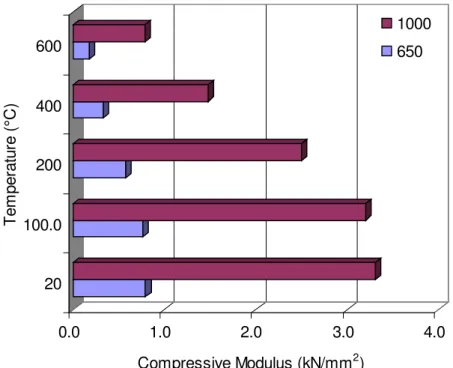
m odulus at the point where the m aterial changed from elastic to plastic behaviour from the experim ental com pressive stress– strain curve. Com pared to the reduction in foam ed concrete strength, the reduction in elastic m odulus is greater. Both figures show that the loss in m odulus of elasticity began im m ediately upon heating when the sam ples began to dry. The m odulus of elasticity at 20 0 °C, 40 0 °C and 60 0 °C was respectively about 75%, 40 % and 25% of the original value for both densities. As with changes in norm alised strengths of foam ed concrete of both densities at elevated tem peratures, the norm alised m odulus of elasticity of foam ed concrete of both densities at the sam e tem perature are alm ost the sam e.
0.0 1.0 2.0 3.0 4.0
Compressive Modulus (kN/mm2)
20 100.0 200 400 600
T
em
per
at
ur
e (
°C
)
1000
650
Figure 6: Com pressive m odulus of foam ed concrete as a function of tem perature
0.0 0.2 0.4 0.6 0.8 1.0
0 100 200 300 400 500 600
Temperature (°C)
N
or
m
al
iz
ed C
om
p
re
s
s
iv
e M
odul
us
(
%
)
650 kg/m3 1000 kg/m3
Figure 7: Norm alized com pressive m odulus of foam ed concrete as a function of tem perature
4 .3 Ela s tic m o d u lu s o f fo a m e d c o n c re te u n d e r be n d in g
1550
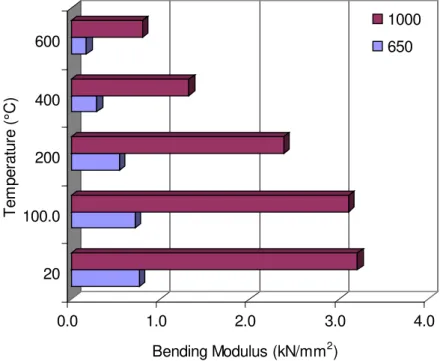
cylinder tests. Although there are som e differences, the com pressive m odulus and flexural m odulus values are very sim ilar for both densities and at different tem peratures.
0.0 1.0 2.0 3.0 4.0
Bending Modulus (kN/mm2) 20 100.0 200 400 600 T em per at ur e ( °C ) 1000 650
Figure 8: Bending m odulus of foam ed concrete as a function of tem perature
0.0 0.2 0.4 0.6 0.8 1.0
0 100 200 300 400 500 600
Temperature (°C) N or m al iz ed c om pr e s s iv
e and f
lex ur al m odul us ( % )
650 kg/m3 (compressive modulus) 1000 kg/m3 (compressive modulus) 650 kg/m3 (bending modulus) 1000 kg/m3 (bending modulus)
Figure 9: Com parison of norm alized com pressive m odulus and flexural tensile m odulus of foam ed concrete as a function of tem perature
4 .4 Mo d e o f fa ilu re u n d e r c o m p re s s io n
1551
Figure 10 : Failure m ode of 650 kg/ m3 density at am bient tem perature
Figure 11: Failure m ode of 650 kg/ m3 density at 40 0 °C
1552
Figure 13: Failure m ode of 10 0 0 kg/ m3 density at am bient tem perature
Figure 14: Failure m ode of 10 0 0 kg/ m3 density at 40 0 °C
Figure 15: Failure m ode of 10 0 0 kg/ m3 density at 60 0 °C
5 . CON CLU S ION
1553
concrete of different densities, the norm alised strength and stiffness-tem perature relationships are very sim ilar.
Ac kn o w le d ge m e n t
The author would like to thank Universiti Sains Malaysia for the financial support.
REFEREN CES :
1. Khoury G. A., Majorana, C. E., Pesavento, F., and Schrefler, B. A. Modelling of heated concrete. Mag. Concr. Res., 20 0 2. 54(2): p 77– 10 1.
2. H ertz K. D. Concrete strength for fire safety design. Mag. Concr. Res., 20 0 5. 57(8 ): p. 445-453.
3. Taylor H . F. W. Cem ent Chem istry. London: Academ ic Press, 1992.
4. Md Azree O. M. Effect of using additives to the com pressive strength of lightweight foam ed concrete. Master Dissertation, School of H ousing, Building and Planning, University of Science Malaysia, Penang, 20 0 4.
УДК 69
Характеристика модуля высоких температур эластичности легкого пено-бетона
при статическом изгибе и сжатии: экспериментальное исследование
Мд Азри Отхуман Мудин
Университет Малайзии, Малайзия
118 0 0 , Пенанг
Доктор образования
E-m ail: azree@usm .m y
Аннотация. В работе изучается экспериментальные работы, проводившиеся с целью
изучения модуля Юнга пенно-бетона при повышении температуры до 600°С. Пено-бетон
плотностью 650 и 1000 кг/м3 был протестирован при сжатии и изгибе. Результаты эксперимента показали, что потеря жесткости для материалов на основе цемента, таких как пенно-бетон при повышении температуры происходит преимущественно при 95°C,
независимо от плотности. Это означает, что первый процесс, приводящий к уменьшению жесткости – микрорастрескивание, который происходит в результате расширения воды и
испарений пористого тела. Как ожидалось, уменьшение плотности легкого пено-бетона
приводит к уменьшению его силы и жесткости. Тем не менее, для легкого пено-бетона
разной плотности нормализация силы-температуры и жесткости-температуры очень схожи.
Ключевые слова: легкий пено-бетон; модуль Юнга; прочность на изгиб;