Taxonomy and distribution pattern of the African
rain forest butterfly genus Euphaedra Hübner
sensu stricto with the description of three new
subspecies of Euphaedra cyparissa (Cramer)
and one of E. sarcoptera (Butler) (Lepidoptera,
Nymphalidae, Limenitidinae, Adoliadini)
Tomasz W. Pyrcz1, Haydon Warren-Gash2, Jadwiga Lorenc-Brudecka1, Dieuwko Knoop5, Philippe Oremans3, Szabolcs Sáián4
1 Zoological Museum of the Jagiellonian University, Ingardena 6, 30-060 Kraków, Poland 2 98 Overstrand Mansions, Prince of Wales Drive, London SW11 4EU 3 35, rue des Jacinthes, 6110 Montigny - le - Til-leul, Belgique 4 Institute of Silviculture and Forest Protection, University of West Hungary, Sopron, Hungary 5 Rijsberkamperweg 7, 8392TP Boyl, he Netherlands
Corresponding author:Tomasz W. Pyrcz ([email protected])
Academic editor:C. Peña | Received 21 February 2013 | Accepted 22 April 2013 | Published 10 May 2013
Citation: Pyrcz TW, Warren-Gash H, Lorenc-Brudecka J, Knoop D, Oremans P, Sáián S (2013) Taxonomy and distribution pattern of the African rain forest butterly genus Euphaedra Hübner sensu stricto with the description of three new subspecies of Euphaedra cyparissa (Cramer) and one of E. sarcoptera (Butler) (Lepidoptera, Nymphalidae, Limenitidinae, Adoliadini). ZooKeys 298: 1–37. doi: 10.3897/zookeys.298.4894
Abstract
Updated data on the distribution, ecology and taxonomy of Euphaedra cyparissa (Cramer) and Euphaedra sarcoptera (Butler) are presented. hree new subspecies of E. cyparissa and one of E. sarcoptera are described and their geographic distribution is presented. he monophyly of the genus Euphaedra sensu Hecq is as-sessed based on morphological, in particular male and female genitalia, and behavioural traits. Possible evolutionary reasons for the convergence of colour pattern between the sympatric subspecies of E. cypar-issa and E. sarcoptera are discussed.
Keywords
Afrotropical region, colour patterns convergence, Euphaedra cyparissa, Euphaedra sarcoptera, male and female genitalia, rain forests, subspecies, taxonomy
www.zookeys.org
Copyright Tomasz W. Pyrcz et al. This is an open access article distributed under the terms of the Creative Commons Attribution License 3.0 (CC-BY), which permits unrestricted use, distribution, and reproduction in any medium, provided the original author and source are credited.
Recent years have witnessed a rising interest in advanced studies focusing on species-rich African brush-footed butterlies (Nymphalidae). Examples include ongoing stud-ies, combining molecular, ecological and morphological data, on the genus Cymothoe
Hübner (Van Velzen et al. 2007, 2009, 2013) and Bicyclus Kirby used as one model group for modern research on genetics and evolutionary ecology (Monteiro and Pierce 2001; Conceição et al. 2011). From this perspective, one of the most speciose African butterly genera, Euphaedra Hübner with nearly 200 recognized species, remains unex-plored. his is due to the taxonomic complexity, but most of all to the unstable species-level systematics involved. he latter is a result of the tradition of basing Euphaedra tax-onomy on simple descriptions of wing colour patterns. It is striking that descriptions of new species of Euphaedra have not usually been accompanied by in-depth
morpho-logical analysis, nor by ecomorpho-logical (with the honourable exception of Amiet 2004) or biogeographic support, not to mention genetic data (Hecq 1984, 1997, 1999, 2012; Faravel 2002). he morphology of female genitalia of Euphaedra remained until re-cently nearly completely unexplored and was not used with any alpha-taxonomy or in assessing the phylogenetic relations within the genus (Pyrcz et al. 2011). One of the major problems when dealing with species-level Euphaedra taxonomy is the huge variation in individual colour pattern evident within some species, on occasion more important to the naked eye than intraspeciic diferences, compounded by apparently rather frequent intraspeciic hybridization producing viable individuals. his, coupled with wide geographic ranges, apparent pattern convergence between sympatric species and the lack of strong, quantitative characters, often impedes reliable recognition of species, which has led to the description of numerous species which are in fact merely individual variations of polymorphic species, or possibly natural hybrids (Hecq 2012). he above mentioned systematic problems efectively hampered any comprehensive studies within this group according to modern evolutionary biology approach, for ex-ample using molecular data (Wahlberg et al., in prep.). At this stage, the genus requires more detailed studies at the lower taxonomic level, such as species groups or subgenera, to help prepare the ground for a more broad based revision.
he subgenus Euphaedra was delimited by Hecq (1976) in an attempt to break down the extremely diverse genus Euphaedra sensu Hübner into several related,
pos-sibly monophyletic groups designated as subgenera. His work relied strongly on col-our patterns, such as forewing subapical bands and hindwing underside elements as valid characters, and some characters of male genitalia, especially the coniguration of cornuti on the vesica and shape of the apical part of valva. According to Hecq (1976) the subgenus Euphaedra is identiied by the elongated forewing apex and the absence
of red scaling on the hindwing underside. Subsequent authors, to a diferent degree, recognized the entities raised by Hecq, among others, D’Abrera (2004), Larsen (2005) and Vande Weghe (2010). he two species making up the subgenus Euphaedra sensu
congeners. Schultze (1920) pointed out their less developed, slender thorax. A striking colour pattern element - the pinkish ventral basal patch - present on the forewing in
E. sarcoptera and absent in E. cyparissa makes the immediate separation between the
two species unambiguous (Larsen 2005). hey are sympatric through most of their range in West and Central Africa. However, E. sarcoptera occurs as far east as western Tanzania, whereas E. cyparissa does not extend into the Congo basin. Both species are widely polytypic. Distribution of the three subspecies of E. cyparissa described so far is puzzling, being either widely disjunct and/or without any apparent geographical pat-tern. Larsen (2005) discusses three or possibly four subspecies of E. cyparissa but in the headings of the species he highlights only two, the nominate and ssp. tai Hecq. In the accompanying text, however, he also mentions aurata Carpenter and suggests that the Central African Republic population possibly represents a separate subspecies. Vande Weghe (2010) simply illustrates all green specimen, presumably from Gabon, and basically quotes Larsen (op. cit).
Material and methods
Adults of Euphaedra were collected using entomological nets and fruit-baited traps. Type specimens deposited in major collections were examined. Male and female geni-talia were dissected and compared. Standard dissection protocols were applied, consist-ing in soakconsist-ing the abdomens in a warm 10% KOH solution for 35 min., cleanconsist-ing out of scales and internal organs in distilled water, and staining genital organs with chlora-zole black. Genital preparations were placed in glycerol microvials, and pinned under their respective specimens. Photographs of adults were made with an Olympus E-500 digital camera and microscopic structures were photographed under an Olympus ster-eomicroscope SZX9 equipped with a Nikon Digital sight Ds-Fi1 camera. Plates were composed with Adobe Photoshop 9. Abbreviations used: FW: forewing; HW: hind-wing; D: dorsum; V: venter; TL: Type locality.
Collections consulted
ABRI African Butterly Research Institute, Nairobi, Kenya
BMNH he Natural History Museum (formerly British Museum of Natural His-tory), London, UK
DK Dieuwko Knoop, Tel Aviv, Israel and Boyl, he Netherlands
GF Gilles Faravel, Pradons, France HWG Haydon Warren-Gash, Pressac, France
MIIZ Muzeum i Instytut Zoologii Polskiej Akademii Nauk, Warszawa, Poland
MRAC Musée Royal de l’Afrique Centrale, Tervuren, Belgium
MZUJ Muzeum Zoologiczne Uniwersytetu Jagiellońskiego, Kraków, Poland
Senckenberg Naturhistorische Sammlungen Dresden Museum für Tierkunde
PhO Philippe Oremans, Montigny-le-Tilleul, Belgique TL Torben Larsen (data base)
TWP Tomasz Wilhelm Pyrcz (to be deposited in MZUJ)
Results
Taxonomic accounts
Euphaedra cyparissa cyparissa (Cramer)
http://species-id.net/wiki/Euphaedra_cyparissa_cyparissa
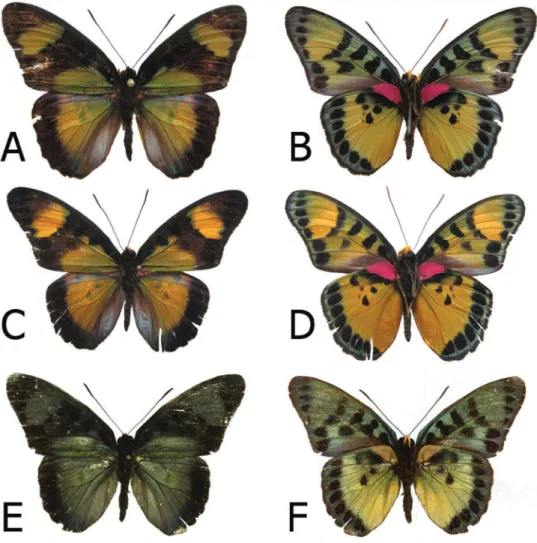
Figs 1A, 1B, 3A, 3B, 9A
Papilio cyparissa Cramer, [1775], in Cramer, [1775–1776]: 63, pl. 39. Figs D, E.
Papilio cato Fabricius, 1787: 12 (unnecessary replacement name)
Type-locality. Sierra Leone
Material examined. 1 ♂: Sierra Leone, Guma, 01.03.1982, prep. genit.
10/09.05.2012, J. Lorenc; 1 ♀: same data, prep. genit. 11/09.05.2012, J. Lorenc; 1 ♀: Sierra Leone, Guma Valley, 400 m, 11.1991; 1 ♀: Sierra Leone, no locality, no date; 1
♂: Ivory Coast, Abidjan (erroneous locality), 1966, S. Collins leg.; 1 ♀: same data (er-roneous locality), ABRI; 6 ♂ and 2 ♀: Sierra Leone, Guma, 01.III.1982, H. Warren-Gash leg.; 1 ♂: Guinea, Diecke, 07.2000, HWG; 1 ♂ and 5 ♀: Sierra Leone, SMTD; 4 ♂: Guinée, Guinée forestière, Province de Yomou, Forêt classée de Diecke, 1-26. III.2003, leg. Ph. Leonard and E. Vingerhoedt; 3 ♂ and 1 ♀: same data but VI.2003; 2 ♂: same data but III.2005, PhO; 3 ♂ and 1 ♀: Guinée, Forêt classée de Diecké, GF; 2 ♂ and 2 ♀: Liberia, Mount Swa, Sz. Sáián leg, MZUJ ; 1 ♂: same data, ABRI.
Diagnosis. Upperside colour black and apple green with a delicate yellow sheen,
somewhat more prominent on the HWD median area.
Redescription. Male (Figs 1A, 1B). Head: eyes lustrous, chocolate brown, naked;
large, roughly half-moon shaped patch in Cu1-Cu2; a difused subapical golden yellow patch; a row of seven, roughly oval submarginal patches, two tornal patches in Cu1-Cu2 and Cu1-Cu2-1/2A irregular and at least twice as big as the remainder. HWV golden green, with an elongated basal pinkish patch extending from costal margin to Rs to one-fourth costa, edged with black; four black median spots, two of which in discal cell, and a row of eight large, roughly oval black submarginal patches; marginal area darker bottle green and black. Male genitalia (Fig. 9A). Tegumen one and a half the length of
uncus, considerably elongated basally; uncus slender, slightly arched downwards with a sharp tip; gnathos long, one-fourth longer than uncus; pedunculus prominent; saccus lattened in lateral view; valvae with a smooth dorsal surface; aedeagus the length of valva+saccus, tubular and straight, with a sharp distal extremity and prominent cornuti.
Female (Figs 3A, 3B): Sexual dimorphism slight, recognized from the male by the
larger size (FW length: 40 mm, n=2). Female genitalia. Examined, but damaged and unsuitable for taxonomical use.
Range. he known range of this subspecies extends from Sierra Leone, Liberia to
SE Guinea. he pair in ABRI labeled as coming from Abidjan represent a conundrum. However, given the extensive research and collecting by one of the authors (HWG) in the Abidjan area without encountering any other specimens, we have concluded that they must be mislabeled. Larsen (2005) illustrated a male of the nominate subspecies identiied as “green form from Ghana”, but this particular specimen comes from Sierra Leone (ABRI collection, examined). He also identiied another specimen from Ghana as E. cyparissa cyparissa, which clearly does not belong to the nominate subspecies but
to the new subspecies described below.
Euphaedra cyparissa tai Hecq, 1986
http://species-id.net/wiki/Euphaedra_cyparissa_tai
Figs1E, 1F, 4A, 4B, 9B, 10D
Euphaedra cyparissa taï [sic] Hecq, 1986: 42, igs. 11, 16, 17.
Type-locality. Tai Forest (Forêt de Taï), Ivory Coast
Material examined. 12 ♂: Ivory Coast, Tai, 13–14.05.2000, S. Collins leg.; 1
♂: same data, prep. genit. 07/09.05.2012, J. Lorenc; 1 ♀: same data; 1 ♀: same data, prep. genit. 08/09.05.2012, J. Lorenc; 1 ♂: same data but XII.1998, K. Adams leg., ABRI; 2 ♂: Ivory Coast , Tai, 12.I.1999, H. Warren-Gash leg.; 1 ♂: Ivory Coast , Tai, 13.I.1999, H. Warren-Gash leg.; 1 ♂ and 1 ♀: Ivory Coast , Tai, XII.1998, K. Adams; 2 ♂ and 1 ♀: Ivory Coast, Tai, 02.I.2000, H. Warren-Gash leg.; 1 ♂ and 1 ♀: Ivory Coast, Tai, 13.V.2000, H. Warren-Gash leg., HWG.
Diagnosis. Upperside colour black and pine green.
Redescription. Male (Figs 1E, 1F): Head, thorax and abdomen: identical to other
part, and gently convex outer margin; most of wing surface black; costa from base to apex dusted with dark blue; a bottle green area from wing base to tornus, marginally entering discal cell; a large, roughly rectangular bottle green subapical patch with a bluish sheen, extending widely from subcostal to vein Cu1, with sharply deined zig-zagging basal limit, without any incision along vein M3, and somewhat difused outer limit; fringes grey. HWD oval with a gently scalloped outer margin; bottle green, gradually turning bluish green from vein M3 towards tornus and anal margin, with a black marginal area with a strong dark blue lush, gradually narrowing from roughly 4–5 mm at apex to 1 mm at tornus; fringes grey. FWV mostly bottle green, slightly lighter than on the upperside, a series of black spots, at wing base, mid cell, cell end, the latter two elongated, a half-moon one in mid cell Cu1-Cu2; two black elongated patches and four spots, two enclosing basally and distally a bottle green patch, and two large, roughly half-moon tornal patches in Cu1-Cu2 and Cu2-1/2A; HWV green with a strong yellow overcast gradually more prominent towards anal margin and tor-nus, with an elongated basal pinkish patch extending from costal margin to Rs to one-fourth costa, edged with black; two black discal spots, and a row of eight large, roughly oval black submarginal patches; marginal area darker bottle green and black.
Male genitalia (Fig. 9B): Not difering noticeably from the nominotypical, except for
a small, sharp apical tip on the valvae.
Female (Figs 4A, 4B): Sexual dimorphism slight, recognized from the male by the
larger size (FW length: 43 mm, n=3). Female genitalia (Fig. 10D): Bursa copulatrix very large, roughly oval; no signa; ductus bursae (0.10 mm) approximately the same width over the whole length, half the length of bursa; antrum, here referred as to colliculum (Razowski 1996), slat like with gently folded edges, strongly sclerotized, one-third the length of ductus bursae, shorter than in other subspecies; ductus seminalis joins the col-liculum at the entrance of ductus bursae; lamella postvaginalis slat-like; papillae anales three times as long (0.14 mm) as wide in lateral view, compressed in ventral view; apo-physe posteriores as long as the width of papillae anales; von Siebold organ prominent (but smaller than in some species of the E. ceres group (Pyrcz et al. 2011).
Range. he known distribution is limited to the Tai National Park in western
Ivory Coast. he same pine green colour can be found in E. sarcoptera styx (see below) and also in the local population of E. judith Weymer, the latter probably deserving a separate subspeciic status (Pyrcz et al. in prep.).
Euphaedra cyparissa nimbina Pyrcz & Warren-Gash, ssp. n. http://species-id.net/wiki/Euphaedra_cyparissa_nimbina
Figs 1C, 1D, 3C, 3D, 9C, 10C
Type-locality. Mount Nimba, Guinea
Material examined. Holotype ♂: Guinea, Mont Nimba, III.1996, ABRI;
: Guinée, Nimba, X.1998; 1 and 1 : Guinée, Labé, Fouta Djalon, X.1998; 1 : Guinea, Sérédou, VI.1999; 5 ♂ and 1 ♀: Guinea, Mont Nimba, VI.2000, HWG; 1
♂: Guinée, Mont Nimba, 02.V.1998, ex HWG; 1 ♂: same data but VI.2000; 1 ♀: same data; MZUJ; 7 ♂: Guinée, Mt. Nimba, VII.2004, E. Vingerhoedt leg.; 3 ♀: same data, PhO.
Diagnosis: Upperside black and golden green, similar to E. sarcoptera ferrea ssp.
n., little diference in shade between basal area and subapical patch, except for its slightly more prominent yellow shade.
Description. Male (Figs 1C, 1D): Head, thorax and abdomen: identical to other
subspecies. FWD: (length: 34–42 mm, mean: 38.5 mm, n=16) with an elongated api-cal part and gently convex outer margin; most of wing surface black; a golden green area from wing base to two-thirds of anal margin, covering lower one-third of discal cell, enclosing a mid discal cell black spot; a large, roughly rectangular golden yel-low subapical patch with a greenish overcast along inner and outer margin, extending widely from subcosta to vein Cu1, with sharply deined zigzagging basal limit and somewhat difused outer limit; fringes grey. HWD oval with a gently scalloped outer margin; uniform golden green, a black marginal area with a dark blue lush, roughly 4–5 mm wide with smooth and sharply deined basal edge (compared to more difuse and zigzagging in the nominate); fringes grey. FWV mostly golden green, a series of black spots, at wing base, mid cell, cell end, the latter two elongated, a half-moon one in mid cell Cu1-Cu2; two black elongated patches and four spots, two enclosing basally and distally a rich yellow patch, and two large, roughly oval tornal patches in Cu1-Cu2 and Cu2-1/2A. HWV golden green with, with an elongated basal pinkish patch extending from costal margin to Rs to one-fourth costa, edged with black; two black discal spots, and a row of eight large, roughly oval black submarginal patches; marginal area darker bottle green and black. Male genitalia (Fig. 9C): Does not difer noticeably from the nominotypical, except for a small, sharp apical tip on the valvae.
Female (Figs 3C, 3D): Sexual dimorphism slight, recognized from the male by
the larger size (43–50 mm, mean: 46 mm, n=5). Female genitalia (Fig. 10C): Bursa copulatrix large, oval; no signa; ductus bursae (0.19 mm) narrow, approximately the same width over the whole length, two-thirds the length of bursa; colliculum wide, slat like with folded edges, strongly sclerotized, one-third the length of ductus bursae; ductus seminalis joins the colliculum at the entrance of ductus bursae; lamella post-vaginalis small, slat-like; papillae anales three times as long (0.14 mm) as wide in lateral view, compressed in ventral view; apophyse posteriores as long as the width of papillae anales; von Siebold organ prominent (but smaller than in some species of the E. ceres
group (Pyrcz et al. 2011).
Etymology. he subspeciic epithet of this taxon derives from its type locality, the
massif of Mount Nimba (1750 m) on the Ivory Coast – Guinea border.
Range. he range is apparently disjunct with most specimens coming from the
Euphaedra cyparissa aurantina Pyrcz & Oremans, ssp. n. http://species-id.net/wiki/Euphaedra_cyparissa_aurantina
Figs 2A, 2B, 3E, 3F, 9D, 10A, 10B
Type-locality. N. Awasso, Bibiani, Western Region, Ghana
Material examined. Holotype♂: Ghana, Western, Bibiani, N. Awasso, 250–400
m, 02.IV.2007, MZUJ; Paratypes (127 ♂ and 29 ♀): 7 ♂: Ivory Coast, Abengourou, XI.1993, S. Collins leg., (1 ♂: prep. genit. 03/09.05.2012, J. Lorenc); 1 ♂: Ivory Coast, Abengourou, 13.V.1973 ; 1 ♀: Ivory Coast, Abengourou, 04.XII.1970, J. Kiel-land leg., prep. genit. 03/09.05.2012, J. Lorenc; 1 ♀: Ivory Coast, Abengourou; 1
10.III.2001, H. Warren-Gash leg.; 1 ♂: Ivory Coast, Foret d’Azagny, 06.I.2001, H. Warren-Gash leg., HWG; 14 ♂ and 7 ♀: Kibi, Ghana, XII.2012, local collector leg., Ph.O ; 2 ♂ and 1 ♀: same data, MZUJ.
Diagnosis. Upperside black and golden green with a yellow subapical patch
strongly sufused with green, compared to the slightly sufused patch in Euphaedra cyparissa aurata.
Description. Male (Figs 2A, 2B): Head, thorax and abdomen: identical to other
square tornal patches in Cu1-Cu2 and Cu2-1/2A; HWV mostly rich yellow with an elongated basal pinkish patch extending from costal margin to Rs to one-third costa, edged with black; two black discal spots, and a series of smaller patches forming a gradually shrinking row from mod costa to discal cell end, a row of eight large, mostly rectangular black submarginal patches; marginal area steely blue. Male genitalia (Fig.
9D): Not difering noticeably from the nominotypical subspecies.
Female (Figs 3E, 3F): Sexual dimorphism slight, recognized from the male by
subspecies, narrow, approximately the same width over the whole length, same length as bursa; colliculum slat like with gently folded edges, strongly sclerotized, one-third the length of ductus bursae; ductus seminalis joins the colliculum at the entrance of ductus bursae; lamella postvaginalis small, slat-like; papillae anales three times as long (0.9–0.13 mm) as wide in lateral view, compressed in ventral view; apophyse posteri-ores as long as the width of papillae anales; von Siebold organ prominent (but smaller than in some species of the E. ceres group (Pyrcz et al. 2011).
Etymology. he epithet of this taxon is an allusion to its resemblance to the next
subspecies, Euphaedra cyparissa aurata.
Range. A widely distributed subspecies found in coastal forests in the Ivory Coast
and Ghana, and also in inland forests in eastern Ivory Coast and Ghana.
Euphaedra cyparissa aurata Carpenter, 1895 http://species-id.net/wiki/Euphaedra_cyparissa_aurata
Figs 2C, 2D, 4C, 4D, 9E, 10E
Euphaedra cyparissa var. aurata Carpenter, 1895: 305.
Euphaedra cyparissa aurata Hecq, 1999: 4, 5
Type-locality. Lokoja, Nigeria
Material examined. 1 ♂: Nigeria, Butatong, Calabar, 14.XI.1995, S. Collins leg.;
1 ♀: same data but 14–18.XI.1995; 2 ♂: Nigeria, east, T. Davey leg.; 1 ♀: same data; 1 ♂: Nigeria, Lagos, IX.1957, J. Boorman leg.; 1 ♀: same data but X.1962; 3 ♂: Ni-geria, Mamu Forest, IV.1966, S. Collins leg.; 1 ♀: same data; 8 ♂: Nigeria, Obudu, 09–12.XI.1995, S. Collins leg.; 1 ♂: same data, prep. genit. 12/09.05.2012, J. Lorenc; 2 ♀: same data; 1 ♀: same data, prep. genit. 13/09.05.2012, J. Lorenc; 1 ♂: Nigeria, Okrasa, Calabar, S. Collins leg.; 1 ♀: Nigeria, Old Ekuri Calabar, 24–28.XI.1995, S. Collins leg.; 2 ♀: Nigeria, Olokomeji, IX.1957, J. Boorman leg.; 2 ♂: Cameroon, Eb-ogo, IV.1983, S. Collins leg., prep. genit. 16/09.05.2012, J. Lorenc, ABRI; 3 ♀: Nige-ria, Isheri F., XII.1989, II-III.1990, A. A. Knoop Lindeboom leg; 2 ♂: Nigeria, Oban XI.1995, T. B. Larsen leg.; 1 ♂: Nigeria, Anambra F. R., VII.1962, St. Leger leg.; 6 ♂: Nigeria, Isheri F., IV.1988, II.1989, IV.1989, XII.1989, II.1990, A. A. Knoop Linde-boom leg.; 1 ♂: Nigeria, Isheri F., II.1991, D. P. Knoop leg. DK; 2 ♂: Nigeria, Isheri Forest, 29.III.1989, A. Knoop leg.; 3 ♂: same data but 09.V.1990; 1 ♂: same data but 23.I.1990; 1 ♂: same data but 14.II.1990; 1 ♂: same data but 09.IV.1990; 2 ♀: same data but I.1990; 1 ♀: same data but 10.III.1990; 1 ♀: same data but 05.IV.1989; 1
♀: same data but 18.II.1990; 1 ♂: Nigeria, Olokomeji, 16.V.1988, A. Knoop leg.; 1
patch, usually with little or no green overcast.
Redescription. Male (Figs 2C, 2D): Head, thorax and abdomen: identical to
other subspecies. FW length 29–41 mm, mean: 36 mm, n=42 (one exceptionally small specimen, 25 mm, was examined). FWD: with an elongated apical part, and gently convex outer margin; most of wing surface black; costa from base to apex dust-ed with dark blue; a yellow green area from wing base to two-thirds of anal margin, slightly entering discal cell and base of cell Cu1-Cu2; a large, roughly rectangular rich yellow subapical patch dusted along the edges with yellow green scales, with sharply deined zigzagging basal limit and somewhat difused outer limit; fringes grey. HWD oval with a gently scalloped outer margin; predominantly steely bluish with some green yellow scaling in discal cell and in cells M1-M2 and M2-M3, with a blackish marginal area with a strong dark blue lush, gradually narrowing from roughly 4–5 mm at apex to 1 mm at tornus, leaving a dark blue submarginal dot in cell Cu1-Cu2; fringes grey. FWV mostly green yellow except for a large rich yellow subapical patch with some greenish overcast in apical part, a series of black spots, at wing base, mid cell, cell end, the latter two elongated, a half-moon one in mid cell Cu1-Cu2; two black elongated patches and four spots, two enclosing basally and distally a mostly rich yellow patch sufused with green yellow in its apical part, and two large, roughly square tornal patches in Cu1-Cu2 and Cu2-1/2A; HWV mostly rich yellow with an elongated basal pinkish patch extending from costal margin to Rs to one-third costa, edged with black; two black discal spots, and a series of smaller patches forming a gradually shrinking row from mod costa to discal cell end, a row of eight large, mostly rectangular black submarginal patches; marginal area steely blue. Male genitalia (Fig. 9E): Not difering noticeably from the nominotypical except for a small, sharp apical tip on the valvae.
Female (Figs 4C, 4D): FW length: 40–48 mm. Sexual dimorphism slight,
recog-nized from the male by the larger size (FW length: 39–47mm, mean: 44mm, n=16).
Female genitalia (Fig. 10E) Bursa copulatrix large, rounded; no signa; ductus bursae (0.16 mm) narrow, approximately the same width over the whole length, two-thirds the length of bursa; colliculum slat like with gently folded edges, strongly sclerotized, half the length of ductus bursae; ductus seminalis joins the colliculum at the entrance of ductus bursae; lamella postvaginalis small, slat-like; papillae anales three times as long (0.11 mm) as wide in lateral view, compressed in ventral view; apophyse posteri-ores as long as the width of papillae anales; von Siebold organ prominent (but smaller than in some species of the E. ceres group (Pyrcz et al. 2011).
Range. Found in the rain forests throughout southern Nigeria, western
Came-roon and Gabon. An individual (a female) collected by Faravel in Mondah, Gabon, is tentatively associated with this subspecies although it is lighter orange on the FW and HWD, and is therefore similar to E. cyparissa nimbina and also to E. sarcoptera
nipponicorum, with which it was confused by Vande Weghe (2010). More sampling
Euphaedra cyparissa nominalina Pyrcz & Knoop, ssp. n. http://species-id.net/wiki/Euphaedra_cyparissa_nominalina
Figs 2E, 2F, 4E, 4F, 9F, 10F
Euphaedra cyparissa [Cramer], Vande Weghe, 2010: 115, ig. 15 (male, dorsum), 304–305.
Type-locality. Mongoumba, Central African Republic
Material examined. Holotype ♂: Central African Republic, Mongoumba,
VII.1969, ABRI; Paratypes (5 ♂ and 4 ♀): 1 ♂: Central African Republic, Bangui, VIII.2000, S. Collins, prep. genit. 14/09.05.2012, J. Lorenc; 1 ♂: Central African Republic, near Bangui, 12.II.1969, J. Kielland leg.; 2 ♂: Central African Repub-lic, Bomoloto, R. Loanye, VII.1985, S. Collins leg.; 1 ♀: Central African Republic, Mongoumba, 19.VII.1969, S. Collins leg.; 1 ♀: same data prep. genit. 15/09.05.2012, J. Lorenc; 1 ♀: Central African Republic, no locality, ABRI; 1 ♀: Of Shore Nigeria, Platform Borgen Dolphin, 4o18’98”35 N, 8o22’00”32 E, VIII. 2005, ex coll. P.
Kowal-ski, MZUJ; 1 ♂: Cameroon, SE, Moloundou, 500 m, 25.VII.1989, E. Joly leg., PhO.
Diagnosis. Upperside colour black and olive drab, same as in the nominate E.
cyparissa, compared to golden green in E. cyparissa aurata and E. cyparissa aurantina, or
pine green in E. cyparissa tai; difering from the widely separated geographically nomi-nate E. cyparissa only in the slightly wider FWD subapical patch towards costal margin.
Description. Male (Figs 2E, 2F): Head, thorax and abdomen: identical to other
subspecies. FWD: (length 32–36 mm, mean: 34.9 mm, n=6) with an elongated apical part, and gently convex outer margin; most of wing surface black; costa from base to apex dusted with dark blue; a rich green area from wing base to three-fourths of anal margin, entering discal cell along lower part from base to root of vein Cu1, enclosing a black mid cell spot; a large, roughly rectangular bottle green subapical patch with a bluish sheen, extending widely along costa, with sharply deined zigzagging basal limit, without any notable incision along vein M3, and a difused outer limit; fringes grey. HWD oval with a gently scalloped outer margin; rich green, gradually turning bluish green from vein M3 towards tornus and anal margin gradually narrowing from roughly 4–5 mm at apex to 2 mm at tornus; fringes grey. FWV mostly bottle green, slightly lighter than on the FWD subapical patch, a series of black spots, at wing base, mid cell, cell end, the latter two elongated, extending across cells M3-Cu1 and Cu1-Cu2; a row of seven, roughly oval submarginal patches, two tornal patches in Cu1-Cu2 and Cu2-1/2A twice as big as the remainder. HWV golden green, with an elongated basal pinkish patch extending from costal margin to Rs to one-fourth costa, edged with black; two black discal spots, and a row of eight large, roughly oval black submarginal patches; marginal area darker bottle green and black. Male genitalia (Fig.
9F): Not difering noticeably from the nominotypical.
Female (Figs 4E, 4F): Sexual dimorphism slight, recognized from the male by
nalis joins the colliculum at the entrance of ductus bursae; lamella postvaginalis small, slat-like; papillae anales three times as long (0.12 mm) as wide in lateral view, com-pressed in ventral view; apophyse posteriores slightly longer than the width of papillae anales; von Siebold organ prominent (but smaller than in some species of the E. ceres
group (Pyrcz et al. 2011).
Etymology. he epithet of this taxon is an allusion to its resemblance to the
nomi-notypical subspecies.
Range. On present knowledge, the range of this subspecies is limited to the CAR
and eastern Cameroon, though its distribution pattern indicates it also occurs in adja-cent areas of the DRC. he individual collected on an ofshore platform in the Gulf of Guinea is an extraordinary inding. It is also a proof that E. cyparissa is prone to long distance dispersal. Other butterly species collected on the same platform were typi-cal dispersalists, including Danaus, Acraea and Melanitis. It is nonetheless surprising to ind in that area an individual which clearly matches the phenotype of E. cyparissa nominalina,whereas the distribution pattern would rather suggest the presence of the subspecies E. cyparissa aurata along the Atlantic coast of Cameroon.
Euphaedra sarcoptera sarcoptera (Butler, 1871)
http://species-id.net/wiki/Euphaedra_sarcoptera_sarcoptera
Figs 5A, 5B, 7A, 7B, 11A
Romaleosoma sarcoptera Butler, 1871: 81, pl. 31, ig. 2.
Euphaedra sarcoptera (Butler); Aurivillius, 1925: 186.
Type-locality. Ghana “Gold Coast”
Material examined. 1 ♂: Western Ghana, Bibiani, N. Awaso, 250–400 m,
1 ♂: no label; 2 ♂: Cameroon, Ebogo, Mbalmayo, X.2001; 1 ♂: Cameroon, Ebogo, II.1994, S. Collins leg., ABRI; 1 ♂: Ghana, Kibi Atewa Mts., II.2007., J. Boersma; 1 male ♂ : Nigeria, Ewohimi, I.1955, J. St. Leger leg., DK ; 2 ♂: Nigeria, Sapoba, III,1967, J. Riley leg., ex Cornes and Riley coll., DK; 2 ♂ and 2 ♀: Liberia, Mount Swa, Sz. Sáián leg, MZUJ; 1 ♂: same data, ABRI; 1 ♂: same data, SSS.
Diagnosis. Upperside ground colour predominantly golden green, with the
ex-ception of the light yellow subapical patch.
Redescription. Male (Figs 5A, 5B): Head: eyes lustrous, golden brown, naked;
its length except for terminal segments. horax: black, dorsally sparsely covered with black and brown hair, denser laterally, with some violet blue scales on patagium and mesoscutum; tegulae covered with black hair; some longer and denser black hair on metascutum; legs femora, tibiae and tarsi with black scales. Abdomen: totally covered with dense, black scales, ventrally with some grey scales. Wings (FW length: 35–39 mm, mean: 37 mm, n=8) with an elongated apical part, and gently convex outer mar-gin; most of wing surface black; costa from base to apex dusted with dark blue; a golden green area from wing base to two-thirds of anal margin, covering lower half of discal cell; a prominent mid discal cell black round spot; a large, elongated light yel-low subapical patch sufused with green, extending widely from subcosta costa to vein Cu1, with a nearly straight basal limit marked by an incision along vein M3, and a dif-fused outer limit; fringes grey and black. HWD oval with a gently scalloped outer mar-gin; rich golden green, with a difuse golden postdiscal patch and a strong shiny blue overcast in outer one-third from vein Cu2 to anal margin; submarginal and marginal area black with a strong blue sheen gradually narrowing from roughly 4 mm at apex towards tornus and transforming into rectangular patches, the last of which in Cu2-1-2A detached; fringes grey and black. FWV golden green, slightly lighter than on the FWD; basal to mi-cell area purple; a series of black patches, a rounded postbasal spot, a wide mid cell bar, a similar bar along discal cell distal margin, a series of half-moon shaped patches along basal limit of a difused subapical light yellow patch, a large half-moon shaped patch in mid cell Cu1-Cu2, and a series of submarginal patches, ive smaller from costa to cell M3-Cu1 and two larger, oval, in Cu1-Cu2 and Cu2-1-2A. HWV golden yellow, with an elongated basal purple patch extending from costal margin to Rs to one-fourth costa, edged with black; six black median spots, four of which in discal cell, and a row of eight large, roughly oval black submarginal patches; marginal area darker bottle green and black. Male genitalia (Fig. 11A): Tegumen same length as uncus, slightly arched; uncus stout, tip slightly curved downwards; gnathos long, same length as uncus; pedunculus prominent; saccus lattened in lateral view; valvae with a smooth dorsal surface and blunt apex; aedeagus as long as valvae, tubular and straight, with a sharp distal extremity and prominent cornuti.
Female (Figs7A, 7B): Sexual dimorphism slight except for the larger size of the
female (FW length: 41–45 mm, mean: 43 mm, n=5) and duller dorsal colours. Female genitalia: not examined.
Range. he nominate subspecies is widely distributed from central Liberia across
Euphaedra sarcoptera styx Larsen & Warren-Gash, 2003 http://species-id.net/wiki/Euphaedra_sarcoptera_styx
Figs 5E, 5F, 6E, 6F, 7E, 7F, 11C
Euphaedra sarcoptera styx Larsen & Warren-Gash, 2003: 97.
Type-locality. Tai Forest, Ivory Coast
Material examined. 1 ♂: Ivory Coast, Tai, 12.I.1999, H. Warren-Gash leg.; 3 ♂:
Ivory Coast, Tai, 02.I.2000, H. Warren-Gash leg.; 1 ♂: Ivory Coast, Tai, XII.1998, K. Adams leg.; 1 ♀: Ivory Coast, Tai, 01–10.IV.2001, H. Warren-Gash leg., HWG; 1 ♂: Ivory Coast, Moyen Cavally, Tai Forest, IV.2001, prep. genit. 03/09.11.2012, J. Lorenc, HWG; 1 ♂: same data but 02.I.2000, MZUJ; 1 ♂: Tai, Ivory Coast, 13–14.VIII.2001, S. Collins; 1 ♂: same data but 13.IX.2001; 1 ♂: same data but 13–14.V.2000 (paratype E. sarcoptera styx); 1 ♂: Tai Forest, H. Warren-Gash leg., 12.1.1999 (paratype E. sarcoptera styx); 1 ♂: Tai Ivory Coast, 13–14.V.2000, S. Col-lins leg.; 1 ♀: same data but 13–14.VIII.2001, S. Collins leg., ABRI.
Diagnosis. Upperside ground colour black and pine green.
Redescription. Male (Figs 5E, 5F, 6E, 6F): Head, thorax and abdomen same
longer than in the nominate subspecies, and prominent cornuti.
Female (Figs 7E, 7F): Sexual dimorphism slight except for the larger size of the
fe-male (FW length: 40–41 mm, mean: 40.5 mm, n=2). Female genitalia: not examined.
Range. Known distribution is limited to the Tai National Park in western Ivory Coast.
Euphaedra sarcoptera ferrea Pyrcz & Warren-Gash, ssp. n. http://species-id.net/wiki/Euphaedra_sarcoptera_ferrea
Figs 5C, 5D, 7C, 7D, 11E, 12B
Type-locality. Mount Nimba, Guinea
Material examined. Holotype♂: Guinée (Guinea), Mont Nimba, VI.1998, ex
HWG, MZUJ; Paratypes (7 ♂and 4 ♀): 5 ♂and 1 ♀: Guinée, Mont Nimba, VI.1998; 1 ♀: same data but VI.2000, HWG; 2 ♂: same data but 02.V.1998, ex HWG; 1 ♀: same data but 02.V.1998, ex HWG, prep. genit. 01/09.11.2012, J. Lorenc, 1 ♀: Ivory Coast, Azagny N. P., 13.VIII, 1999 (mislabeled), H. Warren-Gash leg., MZUJ.
Diagnosis. Upperside ground colour golden yellow, same as in E. sarcoptera
nip-ponicorum, difering from the golden green of the nominate subspecies, pine green of
E. sarcoptera styx or apple green of E. sarcoptera cyparissoides, difering from E.
sarcop-tera nipponicorum, widely separated geographically,only in the narrower FWD
sub-capical elongated golden yellow patch.
Description. Male (Figs 5C, 5D): Head, thorax and abdomen same as in the
pine green and black. Male genitalia (Fig. 11E): Tegumen same length as uncus, with
a lat dorsal surface; uncus stout, slightly arched, with a sharp tip pointing downwards, tegument and uncus approximately the same length as in the nominate subspecies; gnathos long, same length as uncus; pedunculus prominent; saccus lattened in lateral view; valvae with a smooth dorsal surface with an elongated distal extremity ending with a sharp tip, difering in this respect from the blunt valvae of the nominate subspe-cies and styx; aedeagus as long as valvae tubular and straight, with a sharp distal extrem-ity, sensibly longer than in the nominate subspecies or styx, and prominent cornuti.
Female (Figs 7C, 7D): Head, thorax and abdomen abdomen same as in the
fused subapical light yellow area, two outer triangular, two central rectangular, a large irregularly shaped patch in mid cell Cu1-Cu2, and a series of submarginal patches, ive smaller from costa to cell M3-Cu1 and two larger, one rounded and one oval, in Cu1-Cu2 and Cu2-1-2A. HWV golden yellow, with an elongated basal purple patch extending from costal margin to Rs to one-fourth costa, edged with black; six black median spots, three of which in discal cell, and a row of eight large, roughly oval black submarginal patches; marginal area darker bottle green and black. Female genitalia
(Fig. 12B): Bursa copulatrix very large, larger than the rest of genital body, oval, no signa; ductus bursae narrow, gradually widening towards the opening of bursa, one-third the length of bursa; colliculum narrow, slat like with folded edges, , one-one-third the length of ductus bursae; ductus seminalis joins the colliculum at the entrance of ductus bursae; lamella postvaginalis very small, slat-like; papillae anales three times as long as wide in lateral view, compressed in ventral view, apophyse posteriores one and half as long as the width of papillae anales; von Siebold organ prominent.
Etymology. he subspeciic epithet of this taxon derives from iron in Latin,
fer-rum. he type locality, the massif of Mount Nimba on the Ivory Coast – Guinea bor-der, is rich in iron ore. Iron ore mining is a serious threat for the unique ecosystem of this mountainous area of West Africa.
Range. Distribution limited to the Mount Nimba area. Considered that
south-ern Ivory Coast was extensively sampled for several years, also by one of the authors (HWG), we believe that one paratype was labeled as from “Azagny” by error.
Euphaedra sarcoptera cyparissoides Hecq, 1979
http://species-id.net/wiki/Euphaedra_sarcoptera_cyparissoides
Figs 6A, 6B
Euphaedra sarcoptera cyparissoïdes [sic] Hecq, 1979: 31.
Type-locality. Ketta Forest, Ouesso, Moyen Congo
Material examined.Holotype♂: Ketta Forest (Ouesso), A.E.F. Moyen Congo,
T. H. E. Jackon, VII.1959; 2 ♂: same data as the holotype, MRAC; 1 ♂: S Cameroon, Mintom, II.2009, P. A., ABRI.
Diagnosis. Upperside ground colour black and apple green.
Redescription. Male (Figs 6A, 6B): Head, thorax and abdomen same as in the
Figure 10. Female genitalia (in lateral view): A E. cyparissa aurantina Mpasso, Ghana e cyparissa aurantina Abengourou, Ivory Coast; 1 ♂: S. Nigeria, Ewohimi, 29.XI.55, J. Boorman; 1 ♂: no label; 2
roughly oval black submarginal patches; marginal area dark green and black. Male genitalia: not examined.
Female: Not examined
Range. his subspecies was described from Ouesso in Congo, and apart from the
holotype there are only a couple of other specimens known. Hecq (1979) mentions it from RCD and Cameroon. We could conirm its presence in SE Cameroon based on a specimen in ABRI. he reports from RDC might well refer to the next subspecies.
Euphaedra sarcoptera nipponicorum (Carcasson), 1965 http://species-id.net/wiki/Euphaedra_sarcoptera_nipponicorum
Figs 6C, 6D, 8A–F, 11B, 11D, 11F, 12A, 12C
Najas sarcoptera nipponicorum Carcasson, 1965: 132, ig. 4.
Euphaedra sarcoptera nipponicorum (Carcasson); Ackery et al. 1995: 414.
Type-locality. Ititye Camp, Mihuno, 25 miles east of Kigoma, Western Province, Tanzania.
Material examined. 3 ♀: Kasye Forest, Kigoma, Tanzania, III.1990, leg. local
dea-ler, ex coll. P. Boyer, MZUJ; 3 ♂: R.C.A., Bangui, C.A.R., VIII.2000, S. Collins leg.; 1 ♂: R.C.A., Bangui, IX.2000, S. Collins leg., 2 ♂ and 1 ♀: R.C.A., Bangui, IV.2004, S. Collins leg.; 1 ♂: R.C.A., Bomoloto, R. Longamp, VII.1985, S. Collins leg.; 2 ♀: R.C.A., Bangui, VIII.2000, S. Collins leg.; 1 ♀: R.C.A., I.2004, S. Collins leg.; 2 ♂: R.D.C. (NW), Lukolela, Congo River, V.2012; 11 ♂ and 10 ♀: Tanzania, ABRI; 1 ♂: Congo, Province de l’Equateur, Mbandaka, 12.II.1998, prep. genit. 01/04.12.2012, J. Lorenc; 1 ♂: same data, prep. genit. 05/04.1.2012, J. Lorenc; 1 ♀: same data but XII.1997, prep. genit. 08/04.12.2012, J. Lorenc; 1 ♂: Congo, Province de l’Equateur, Environ de Mbandaka – Kuluboku, 27.IV.1995, prep. genit. 06/04.1.2012, J. Lorenc; 1 ♀: same data but 15.XI.1995, prep. genit. 07/04.12.2012, J. Lorenc; 1 ♂: Congo, Province de l’Equateur, Lukolela, 26.X.1993, prep. genit. 03/04.12.2012, J. Lorenc; 1 ♂: same data but 27.X.1993, prep. genit. 04/04.12.2012, J. Lorenc; 1 ♂: same data but XI.1993, PhO; 1 ♂: Sandoa, Katanga, R.D.C., Sandoa, 16.I .1991; 1 ♂: same data but 30.X.1920; 1 ♂: Kafakumba, Katanga, R.D.C., VII.1939; F.G. Overlaet leg.; 2 ♂: same data but II.1939; 1 ♂: same data but IX.1933; 1 ♂: Kinda, Katanga, R.D.C., 31.III.1916; 1 ♂: same data but 31.VIII.1916; 1 ♂: Montamba, 24.V.1916; 1 ♂: Kondué, East Kasai, R.D.C., no date, E. Luja leg.; 1 ♂: Tshilolo, Sankuru, East Kasai, 10.III.1951, Dr. Vallard leg.; 1 ♀: Kafakumba, Katanga, R.D.C., II.1939, F. G. Overlaet leg.; 1 ♀: same data but III.1939; 1 ♀: same data but IV.1939; 1 ♀: same data but IX.1933; 1 ♀: Kinda, 27.II.1916, F. G. Overlaet leg., MRAC.
Diagnosis. Upperside ground colour golden yellow, same as in ferrea.
Redescription. Male (Figs 6C, 6D): Head, thorax and abdomen same as in of the
sufusion from wing base to two-thirds of anal margin, covering lower half of discal cell; black postbasal and mid discal cell black round spots connected to black costal area; a large, elongated golden yellow subapical patch, extending from subcosta costa, progressively widening to space M2-M3, then narrowing and reaching to vein Cu1, with an irregular basal limit marked by an incision along vein M3, and a difused outer limit, not reaching outer margin; fringes grey and black. HWD subtriangular with a gently scalloped outer margin; golden yellow, from Rs to costal margin dull brown; submarginal and marginal area black with a strong blue sheen, gradually narrowing from costa, where some 4 mm wide, to tornus, where greenish-blue takes over black and leaves one black spot in Cu1-Cu2 free; fringes grey and black. FWV green yellow, except for difuse are in mid cell Cu2-1A-2A where free of green and in subapical area where forming a large patch shaped as on the upperside; basal to median area purple; a series of black patches, a rounded postbasal spot, a wide mid cell bar, a similar bar along discal cell distal margin, a series of four, moon-shaped patches along basal limit of a difused subapical light yellow area, a large moon-shaped patch in mid cell Cu1-Cu2 coupled with a minute spot in Cu1-Cu2-1A-2A, and a series of submarginal patches, ive small from costa to cell M3-Cu1 and two large, roughly oval, in Cu1-Cu2 and Cu2-1A-2A. HWV golden yellow, with an elongated basal purple patch extending from costal margin to Rs to one-fourth costa, edged with black; six to seven black median spots, three or four of which in discal cell, and a row of eight large, roughly oval black submarginal patches; marginal area darker bottle green and black. Male genitalia: (Figs 11B, 11D, 11F) Tegumen same length as uncus, with a dome-like dor-sal surface; uncus stout, more so than in other subspecies, slightly arched, with a sharp tip pointing downwards; gnathos long, same length as uncus; pedunculus prominent; saccus lattened in lateral view; valvae with a smooth dorsal surface with a blunt distal extremity ending with a small tip; aedeagus as long as valvae tubular and straight, with a sharp distal extremity, longer than in the nominate subspecies or styx, approaching the length of nimbta, and prominent cornuti.
Female (Figs 8A–F): Sexual dimorphism slight except for the larger size of the
female (FW length: 40–51 mm, mean: 47,5 mm, n=10). Female genitalia (Figs 12A, 12C): Bursa copulatrix very large, larger than the rest of genital body, oval, no signa; ductus bursae wide, of same width throughout, one-third the length of bursa; collicu-lum short and weakly sclerotized; ductus seminalis joins the collicucollicu-lum at the entrance of ductus bursae; lamella postvaginalis very small, slat-like; papillae anales three times as long as wide in lateral view, compressed in ventral view, apophyse posteriores one and half as long as the width of papillae anales; von Siebold organ prominent.
Range. his subspecies was described from the now largely destroyed Kasye forest
. We refrain from further actions until more thorough sampling in the west-ern Congo Basin conirms the diferently pattwest-erned individuals are either syntopic or represent parapatric subspecies.
Discussion
Distribution and ecology
In terms of geographical range, the two species are largely sympatric, though, as noted above, E. sarcoptera stretches further south and east, into the Congo basin and the eastern shores of Lake Tanganyika. he six subspecies of E. cyparissa and the four of E. sarcoptera are discrete, in the sense of no overlap, and morphologically clearly distinct. Examination of the genitalia makes it clear that only two species are involved.
he apparent gaps in the range of E. cyparissa are puzzling. his is particularly striking in Nigeria where there are (or there were, since most of the western forests have now been logged down) strong populations in Yorubaland. here are however no records from the localities situated further south and east on the western bank of the river Niger. his is despite long-term and intensive collecting in the Okomu forest (Edo) by Wojtusiak, Knoop, Larsen and other researchers, or in Ajebandele (Ondo) by Pyrcz. East of the river Niger the pattern is equally unusual. Only one specimen was collected by Wojtusiak in Nsukka during ive years of sampling. Larsen, however, collected several in the Oban Hills. Specimens are known from the Obudu range, and the riverine forests near Calabar. In Ghana and Ivory Coast the species seems to be widespread but local, distributed from Danané in north-western Ivory Coast to the At-ewa Range in the Eastern Region of Ghana (Larsen 2006a; Larsen et al. 2007). Larsen (2005, 2006b) reports E. cyparissa from the Volta region but only as older records,
probably from the collection of Father heodor Maessen and we have not seen any specimens collected recently which would conirm its presence in the mountains on the border of Ghana and Togo. It is uncommon in eastern Sierra Leone and it has only recently been found in Liberia (Mount Swa), where it seems to be strongly localized. In its eastern range, E. cyparissa appears to be extremely scarce and local. In Cameroon,
records are limited to two specimens from Ebogo, an intensively sampled locality, in the superb ABRI collection, while Vande Weghe (2010) reports it as very rare from a unique locality in northern Gabon. here are more frequent reports from CAR, how-ever, compared to other Euphaedra sensu lato this species is far less frequently collected.
E. sarcoptera has a much wider geographic range but its distribution is also
author (TP) despite of many years of collecting in the SW never came across it. Lees (1989) mentions it from Korup and most specimens in the BMNH are from the Niger Delta. Also in Cameroon E. sarcoptera is exceedingly seldom encountered. However,
in some areas of the western Congo Basin and in Katanga it is locally rather frequently met. here are very few reports from the central Congo basin despite rather extensive collections of other species of Euphaedra.
In terms of habitat, the ecological preferences of E. cyparissa are inconsistent. Van-de Weghe (2010) states briely that E. cyparissa is a “deep forest” species, whereas
Lars-en (2005) considers it a rain forest edge, disturbed forest and evLars-en a gallery savannah species. He reports it “in small fragments of forests where few forest loor butterlies survive”. It seems that both authors may in fact be correct. In our experience, most
E. cyparissa have been collected on the fringes of secondary or primary mangrove and riverine forests in good condition, whether it be humid forest typical of the localities in Sierra Leone, or much of the Ivory Coast, or the drier inland forests of the eastern Ghana and Nigeria. he size of the forest is less important than the condition of what remains. Furthermore, and curiously, some populations of E. cyparissa appear to be lower montane, in particular E. cyparissa nimbina and the local population of E. cypar-issa aurata found in the Obudu massif on the Nigeria-Cameroon border. E. sarcoptera
occurs in similar habitats but Larsen (2005) points out that it is more strictly tied to forest than E. cyparissa which is possibly the case for West Africa. In the southern part of the Congo Basin however E. sarcoptera occurs apparently in riverine forests in a predominantly savanna land. Both species have recently been observed hill-topping on forested hilltops in Liberia (Mount Swa), a behaviour not reported for any other
Euphaedra. Males perch rather high on leaves of trees in the lower canopy level or on the edge of forest gaps (6–15 m high) in the afternoon hours (14–15.00), they chase all passing Euphaedra, often involved in intraspeciic and occasionally in interspeciic interactions. he larval food plants of E. cyparissa and E. sarcoptera are unknown there-fore their habitat preferences based on their hosts cannot be asserted.
Colour pattern convergence
It is interesting to observe that where the two species ly sympatrically, as they do through much of their range, the wing colour markings in one species are closely matched by the other. here are two plausible explanations for that. Either, it is a parallel evolution relecting an adaptation to a particular forest light structure, a common background. In fact, all green populations are found in rain forest (Euphaedra cyparissa tai, E. sarcoptera styx, E. cyparissa nominalina, E. sarcoptera cyparissoides), the yellow ones (Euphaedra sarcoptera nipponicorum, E. cyparissa ferrea, E. sarcoptera nimbina) typically occur in drier and often more patchy forests. he second explanation would involve a mimicry scenario, implying that one of the species is the model, whereas the other the mimic.
Euphaedra are not known to be obnoxious and unpalatable to predators, however the
of Müllerian mimicry among sympatric species and subspecies of many Ithomiines and
Heliconius in the neotropical region. Pyrcz (in prep.) suggests another explanation for
mimicry among palatable species, involving colour convergence to the most abundant pattern in a given area involving the process of anti-apostatic selection.
he validity of the subgenus Euphaedrasensu Hecq
Apart from the slender body and elongated wings, we did not ind any other outstand-ing morphological characters in E. cyparissa and E. sarcoptera that would set them apart from other Euphaedra sensu lato. Male and female genitalia are typical of Euphaedra sensu lato compared to species of the “ceres” group for example (Pyrcz et al. 2011) or
to the “eleus” group (Pyrcz et al., in prep.). he shape and the coniguration of the vesica cornuti of E. sarcoptera and E. cyparissa do not present unequivocal, qualitative characters distinguishing the two species from other Euphaedra sensu lato. As between the two species, the external similarity of E. cyparissa and E. sarcoptera in terms of wing shape and colour patterns is striking. here are however signiicant diferentiating characters, apart from the presence or absence of the pinkish basal patch on the FWV. In particular, the antennae of E. cyparissa are chestnut – orange on the underside while those of E. sarcoptera are black. In the male genitalia of E. cyparissa, the tegumen ex-tends considerably basally, which is an exclusive character among the examined species of Euphaedra sensu lato, while in E. sarcoptera it is moderately elongated in the same
way as in other species of Euphaedra sensu lato. he uncus of E. cyparissa is particularly slender and long while that of E. sarcoptera is average in length and thickness for spe-cies of Euphaedra sensu lato. In the female genitalia E. cyparissa and E. sarcoptera difer more from each other than the subgenus Euphaedra sensu stricto from Euphaedra sensu lato. he most noticeable character of E. sarcoptera is the particularly large corpus
bursae and massive, yet short, ductus bursae, compared to the rather average in size homologous structures of E. cyparissa.
he most interesting trait of E. cyparissa and E. sarcoptera is arguably their unique behaviour, particularly striking for any naturalist with African rain forest experience. Whereas other Euphaedra sensu lato ly rapidly very close to the ground, E. cyparissa
Conclusion
In the light of this study, previously published articles and the ongoing research on the taxonomy of Euphaedra sensu lato (Pyrcz et al., in prep.), the morphological diferences between the species in the subgenus Euphaedra sensu Hecqand other subgenera of Eu-phaedra sensu lato are insuicient alone to warrant it a separate taxonomic status. We found no characters in the external or genital morphology exclusive of E. sarcoptera and
E. cyparissa which could be considered as solid qualitative synapomorphies sustaining its
possible monophyly. However, there is a case for retaining the subgenus resting on behav-ioural grounds. he two species present unique features, involving territoriality and mat-ing strategies, and the occurrence in the forest subcanopy. his study emphasizes as well the need for taking into account also other comparative and phylogenetically valuable characters than those so far available in the research on the genus Euphaedra sensu lato.
Acknowledgements
he authors would like to thank Steve C. Collins (Nairobi) for hosting T. Pyrcz and Sz. Sáian in Nairobi and for the unrestricted access to the ABRI collections, Teresa di Micco de Santo (Nairobi) for her assistance in photography and data basing in ABRI; Torben B. Larsen (Copenhagen) for cross checking the identiications of Euphaedra at the MZUJ, Gilles Faravel (Pradons) for data and interesting comments on Euphaedra from Gabon, (late) Janusz Wojtusiak (Kraków) and Józef Razowski (Kraków) for valuable information on the female genial morphology, Izabela Stachowicz (Kraków) for the production of dis-tribution maps, and Hein Boersma (St. Nicolaasga) for data and photographs of his speci-mens. he work of Sz. Sáián was supported by the European Union and was co-inanced by the European Social Fund through the project “Talentum” - Infrastructural Develop-ment of Talent ManageDevelop-ment of Students in the University of West Hungary, grant num-ber TÁMOP – 4.2.2. B – 10/1 – 2010 – 0018. he work of T. Pyrcz was supported by the internal grants of the Institute of Zoology of the Jagiellonian University (DS/IZ/2012) and the Zoological Museum of the Jagiellonian University (BW/IZ/MZ-UJ).
References
Ackery PR, Smith LR, Vane-Wright RI (1995) Carcasson’s African Butterlies. CSIRO, Aus-tralia, 803 pp.
Aurivillius C (1925) Die Afrikanischen Tagfalter (Ed. A. Seitz). Alfred Kernen, Stuttgart. 613 pp., 80 pl.
Amiet J-L (2004) Types de chenilles et de nymphes chez les Euphaedra du Cameroun
Butler AG (1873) Description of new species of Lepidoptera. Cistula Entomologica, 1 : 150–177. Conceição IC, Long AD, Gruber JD, Beldade P (2011) Genomic Sequence around Butter-ly Wing Development Genes: Annotation and Comparative AnaButter-lysis. PLoS ONE 6(8): e23778. doi: 10.1371/journal.pone.0023778
D’Abrera B (2004) Butterlies of the Afrotropical Region. Part II - Nymphalidae, Libytheidae. Hills House Publishers, Melbourne-London, 356 pp.
Faravel G (2002) Description d’un Euphaedra nouveau du Gabon (Lepidoptera,
Nymphali-dae). Entomologia Africana, 7(2): 15–17.
Hecq J (1976) Eassai de classiication du genre Euphaedra Hübner. Lambillionea, 76: 38–48,
53–63.
Hecq J (1979) Etude des Euphaedra. Clés de détermination des sous-genres Euphaedra Hübner
et Radia Hecq. Lambillionea, 79: 31–32.
Hecq J (1984) Etude des Euphaedra (Nymphalidae africains). Monographie du groupe preussi
(s.g. Euphaedrana Hecq). (Note no. 25). Lambillionea, 84: 9–16, 23–28.
Hecq J (1997) Euphaedra. Union des Entomologistes Belges, Tervuren, 117 pp.
Hecq J (1999) Euphaedra (and supplement in French). In: Bauer, E. and Frankenbach, T.
Butterlies of the World, Part 4, Nymphalidae III. Goecke and Evers, Keltern, Germany.
Hecq J (2012) Catalogue des espèces d’Euphaedra sous-genre Euphaedrana Hecq 1976, groupe
eleus et description de nouvelles espèces. Lambillionea, 112: 11–22.
Larsen TB (2005) Butterlies of West Africa, vol.1–2. Apollo Books, Stenstrup. vol.1, 595 pp, vol. 2, 270 pp.
Larsen TB (2006a) he Ghana butterly fauna and its contribution to the objectives of the protected areas system. WDSP Report no. 63. Wildlife Division (Forestry Commission) and IUCN (World Conservation Union), Accra: 207 pp. http://abdb-africa.org/user/bibli o/200620Ghana20Report20complete201.5MB.pdf
Larsen TB (2006b) he butterlies of Kyabobo National Park, Ghana, and those of the Volta Re-gion. WDSP Report no. 64. Wildlife Division (Forestry Commission) and IUCN (World Conservation Union), Accra 60 pp. http://abdb africa.org/user/biblio/200620Kyabobo-Volta20complete20480K.pdf
Larsen TB, Aduse-Poku K, Boersma H, Sáián Sz, Baker J (2007) Bobiri Butterly Sanctuary in Ghana – Discovering its butterlies (with a checklist of the 930 butterlies of Ghana). Metamorphosis, 18(3): 87–126.
Lees DC (1989) A feasibility study into butterly farming for the Korup National Park, Cam-eroun.
Monteiro AF, Pierce NE (2001) Phylogeny of Bicyclus (Lepidopterea: Nymphalidae) inferred
from COI, COII, and EF-a gene sequences. Molecular Phylogenetics and Evolution,
18: 264: 281.
Pyrcz TW, Lorenc J, Knoop DP (2011) New species of Euphaedra Hübner of the ceres group
from southwestern Nigeria – with new evidence from female genital morphology (Lepi-doptera: Nymphalidae: Limenitidinae). Genus, 22(4): 621–638.
Schultze A (1920) Lepidoptera II, in SCHUBOTZ, Al. Ergebnisse der zweiten Deutschen Zentral-Afrika Expedition, 1910–1911. Leipzig. Vol. 1, (Zoologie): 1113–1194.
hornhill R, Alcock J (1983) he Evolution of Insect Mating Systems. Cambridge, MA: Har-vard University Press.
Vande Weghe GR (2010) Papillons du Gabon. Wildlife Conservation Society, 424 pp. Van Velzen R, Bakker FT, van Loon JJA (2007) DNA barcoding reveals hidden species
diver-sity in Cymothoe (Nymphalidae). Proceedings of the Netherlands Entomological Society Meeting, 18: 95–103.
Van Velzen R, Larsen TB, Bakker FT (2009) A new hidden species of the Cymothoe caenis-complex (Lepidoptera: Nymphalidae) from western Africa. Zootaxa, 2197: 53–63. Van Velzen R, Wahlberg N, Sosef MF, Bakker FT (2013) Efects of changing climate on